


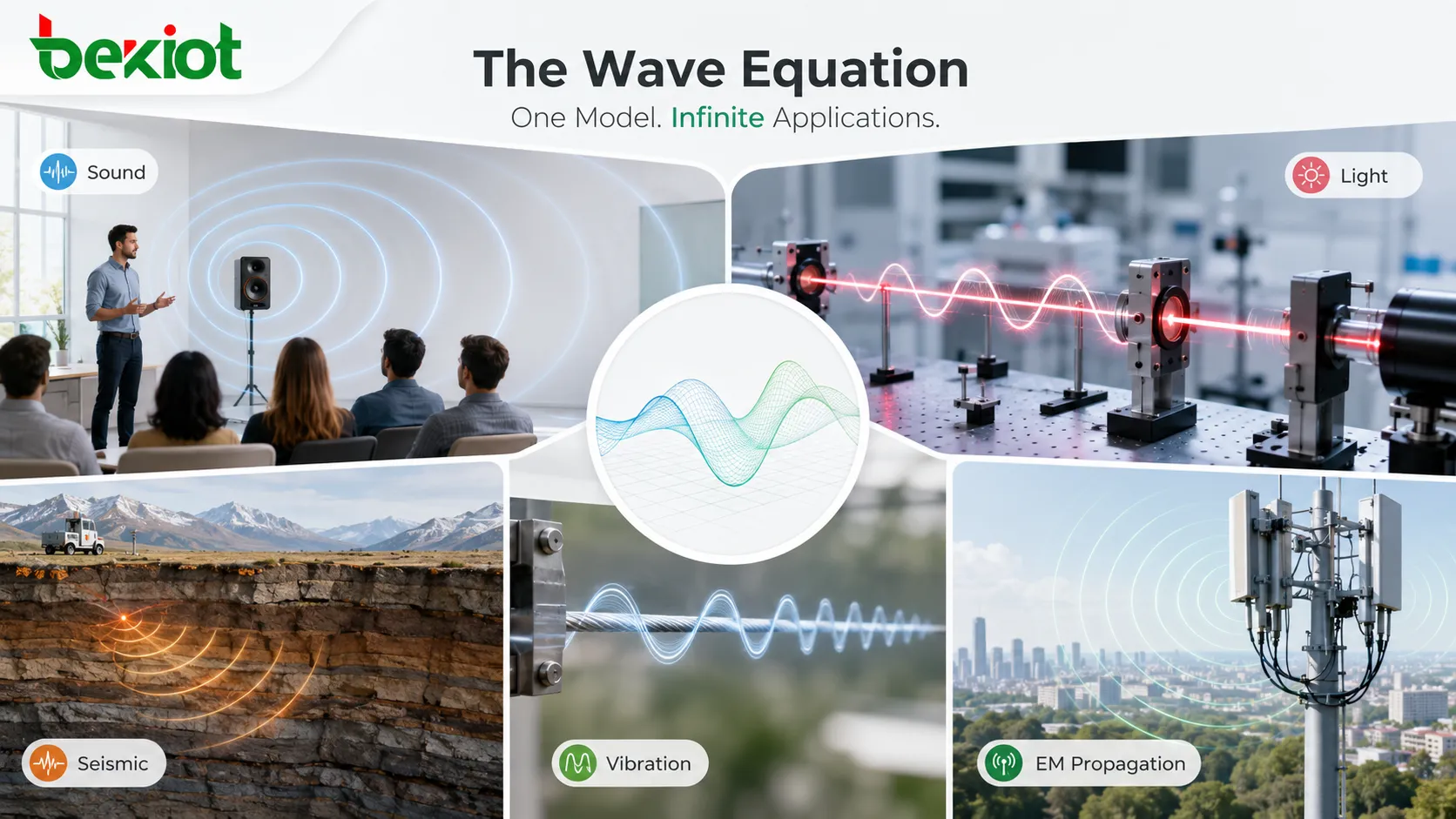
The wave equation is a mathematical model used to describe how a disturbance propagates through a medium or field over time. It appears in physics, engineering, acoustics, optics, electromagnetics, geophysics, mechanical vibration, fluid dynamics, communication systems, and numerical simulation. Although its mathematical form may look abstract, its practical value is very concrete: it helps explain how sound travels, how light behaves, how structures vibrate, how seismic waves move, and how signals propagate.
In simple terms, the equation connects time variation with spatial variation. If something changes at one point, the effect can spread outward as a wave. Depending on the medium and boundary conditions, the wave may reflect, refract, diffract, attenuate, resonate, interfere, or form standing patterns. These behaviors make the equation useful across many technical domains.
From Mathematical Model to Real-World Phenomena
A wave is not limited to ocean water or visible vibration. It can be pressure variation in air, displacement in a string, voltage and current along a cable, electromagnetic fields in space, stress inside the ground, or acoustic energy inside a room. The same general modeling idea can be adapted to many of these situations.
The common one-dimensional form is often written as ∂²u/∂t² = c² ∂²u/∂x², where u represents the wave quantity and c represents propagation speed. In real applications, the equation may become more complex because materials are not perfectly uniform, geometry may be three-dimensional, and energy may be lost through damping or absorption.
This flexibility is one reason the model is so widely used. Engineers and scientists can adjust the equation for different media, boundary conditions, source types, and measurement goals.
Acoustics and Sound Propagation
One of the most familiar applications is sound. Sound waves are pressure disturbances that travel through air, water, solids, or other media. The equation helps describe how sound spreads from a source, reflects from surfaces, bends around obstacles, and forms interference patterns.
In architectural acoustics, it supports the study of concert halls, classrooms, recording studios, offices, factories, tunnels, and public spaces. Designers use wave behavior to understand echo, reverberation, speech clarity, noise control, and sound insulation.
In industrial and environmental noise analysis, wave-based models help predict how machine noise, traffic noise, sirens, alarms, or loudspeakers may be heard at different locations. This supports better placement of barriers, absorbers, enclosures, and sound sources.
Optics and Light Behavior
Light can be modeled as an electromagnetic wave. In optics, wave equations help explain reflection, refraction, diffraction, interference, polarization, and focusing. These effects are important in lenses, cameras, microscopes, telescopes, lasers, optical fibers, sensors, and imaging systems.
Geometrical optics can describe light rays in many ordinary cases, but wave-based analysis becomes essential when the wavelength matters. Examples include diffraction through small openings, interference in thin films, laser beam propagation, holography, and optical communication.
Modern photonics also relies on wave modeling to design waveguides, resonators, filters, integrated optical circuits, and fiber systems. The ability to predict field distribution helps engineers improve transmission, coupling, and signal quality.
Electromagnetic Propagation
Radio waves, microwaves, millimeter waves, and other electromagnetic signals can be described using wave principles. This is important for antennas, radar, wireless communication, satellite links, transmission lines, waveguides, shielding, and electromagnetic compatibility analysis.
In antenna design, the model helps predict radiation patterns, beam direction, gain, near-field behavior, and interaction with surrounding structures. In wireless planning, it supports analysis of signal reflection, diffraction, fading, multipath, and coverage.
In high-speed electronics, wave behavior also appears on circuit boards and cables. At high frequencies, traces and interconnects can behave like transmission lines rather than simple wires. Designers must consider impedance, reflection, delay, and signal integrity.
Mechanical Vibration and Structural Dynamics
Mechanical systems often experience wave-like motion. A vibrating string, beam, plate, shell, bridge, pipeline, machine frame, or aircraft structure can carry elastic waves. The equation helps describe how mechanical disturbances travel through materials and how resonance patterns form.
This is important in product design, civil engineering, aerospace, railway systems, rotating machinery, and vibration control. Engineers use wave analysis to reduce unwanted vibration, prevent fatigue, improve comfort, and detect structural problems.
Standing waves are especially important. When reflections combine with incoming waves, certain frequencies may produce large vibration amplitudes. This can cause noise, mechanical stress, or failure if not controlled.
| Application Area | Wave Quantity | Typical Engineering Question |
|---|---|---|
| Acoustics | Sound pressure | How does sound spread, reflect, and decay in a room or outdoor space? |
| Optics | Electric and magnetic fields | How does light diffract, focus, interfere, or travel through a fiber? |
| Structural vibration | Displacement or stress | How does vibration travel through beams, plates, machines, or buildings? |
| Seismology | Ground motion | How do earthquake waves move through layered geological structures? |
Seismic and Geological Analysis
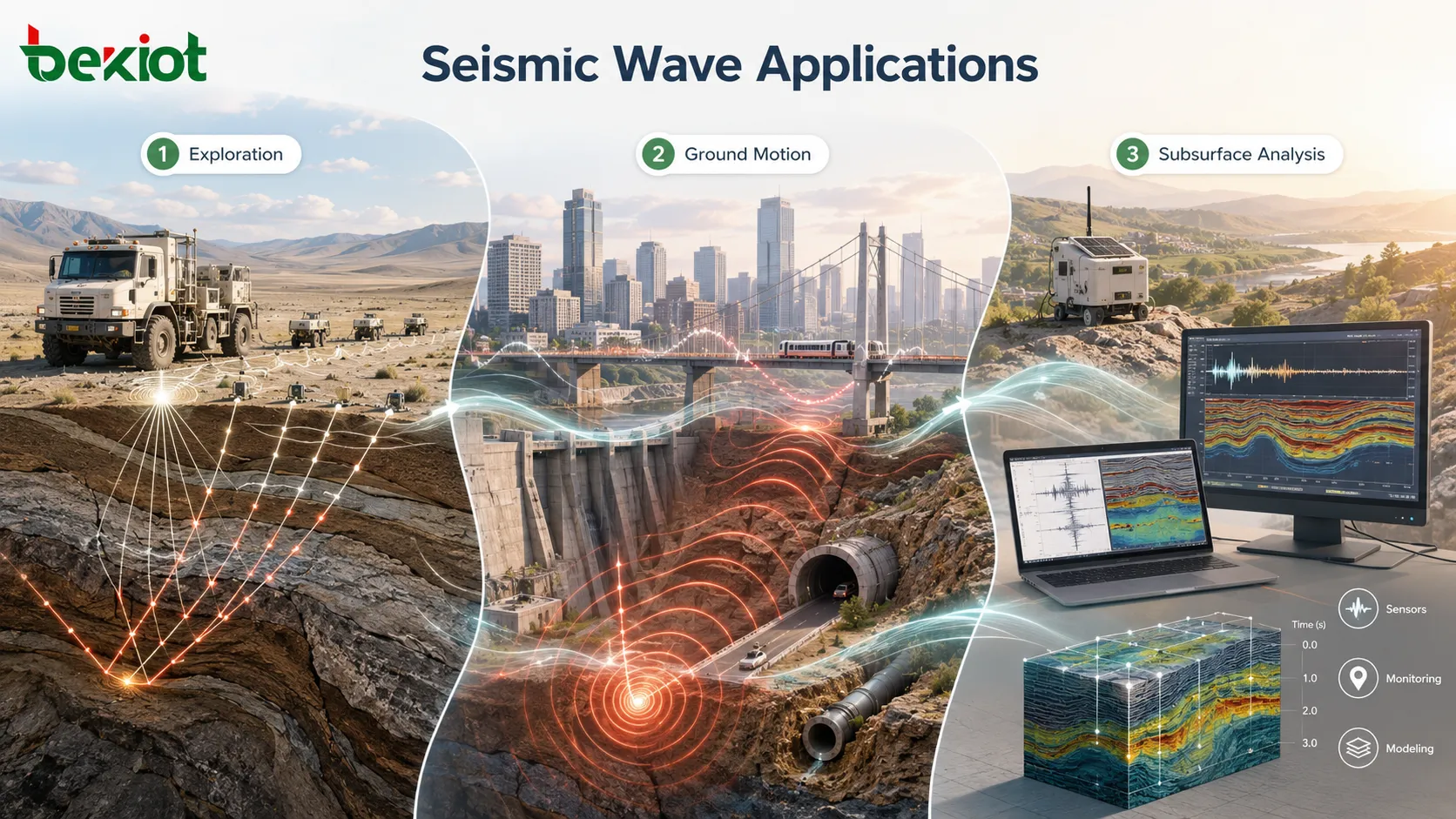
Earthquakes generate waves that travel through the Earth. Seismologists use wave-based models to study how these waves move through rock layers, faults, sediment basins, and geological boundaries. The travel time, amplitude, and reflection behavior provide information about subsurface structures.
In earthquake engineering, wave modeling helps estimate ground motion, site amplification, structural response, and potential damage zones. Buildings, bridges, tunnels, dams, pipelines, and infrastructure systems can be evaluated against expected seismic excitation.
In oil, gas, geothermal, and mineral exploration, controlled seismic sources are used to send waves into the ground. Reflected and refracted signals are measured and interpreted to create subsurface images. This is one of the most economically important uses of wave physics.
Water Waves and Fluid Motion
Surface waves in water are another important application area. Ocean waves, harbor waves, ship wakes, tsunami propagation, wave tanks, and coastal structures can be analyzed with wave-based models. The actual equations may be adapted because water waves involve gravity, depth, fluid motion, and boundary effects.
Coastal engineers use wave analysis to design breakwaters, ports, seawalls, offshore platforms, floating structures, and marine energy systems. Understanding wave height, period, direction, and reflection helps reduce risk and improve durability.
In environmental and disaster studies, tsunami modeling uses wave propagation principles to estimate arrival time, inundation risk, and coastal impact. These simulations support warning systems and emergency planning.
Communication and Signal Transmission
Signals in cables, fibers, antennas, and wireless channels often behave as waves. The model helps engineers understand how signals travel, reflect, distort, disperse, and attenuate along transmission paths.
In telecommunication systems, wave analysis appears in radio propagation, fiber-optic transmission, microwave links, antenna arrays, and high-frequency cable design. It supports decisions about bandwidth, impedance matching, modulation, channel loss, and link reliability.
In digital electronics, signal edges may travel as waves when the circuit is fast enough. Poor impedance control can cause reflections, overshoot, ringing, and timing errors. This is why high-speed PCB design often uses transmission-line theory derived from wave behavior.
Medical Imaging and Biomedical Systems
Ultrasound imaging uses high-frequency sound waves to create images of internal body structures. Wave models help describe how acoustic pulses travel through tissue, reflect from boundaries, scatter from structures, and return to the transducer.
The same principles also appear in therapeutic ultrasound, elastography, acoustic microscopy, and some biomedical sensing methods. Understanding wave speed, attenuation, impedance, and reflection is important for image quality and safety.
In medical imaging, the goal is not only to send waves into the body. The system must interpret the returning signals accurately and convert them into useful spatial information.
Numerical Simulation and Digital Twins
Many practical wave problems cannot be solved with a simple closed-form formula. Real systems may have irregular geometry, complex materials, nonuniform media, damping, obstacles, and multi-physics interactions. Numerical simulation is therefore widely used.
Methods such as finite difference, finite element, finite volume, boundary element, and spectral methods can approximate wave behavior. These tools are used in acoustics, electromagnetics, structural dynamics, seismic analysis, medical imaging, and product development.
Digital twin systems may also include wave-based models to monitor and predict real-world behavior. For example, vibration waves can help detect equipment faults, acoustic waves can support leak detection, and electromagnetic wave models can help optimize wireless coverage.
Education and Conceptual Modeling
The equation is also important in education because it connects mathematics with visible and audible phenomena. Students can use strings, springs, water ripples, sound waves, and computer simulations to understand propagation, superposition, reflection, and resonance.
It provides a bridge between calculus, differential equations, physics, engineering, and computational modeling. By studying one wave model, learners can better understand many different systems that share similar behavior.
This cross-domain nature makes the equation especially valuable. Once the main ideas are understood, they can be transferred from sound to light, from vibration to radio, or from water waves to seismic waves.
Practical Limits of the Model
The standard equation assumes ideal conditions that may not fully match real systems. Materials may absorb energy, waves may be nonlinear, the medium may change with direction, and boundaries may be irregular. In these cases, the basic model must be extended or replaced by a more specialized formulation.
For example, sound in a complex room may require absorption and scattering models. Electromagnetic waves in lossy materials require material parameters. Seismic waves in layered media require elastic wave equations. Water waves may require nonlinear or shallow-water models.
Good engineering practice means choosing a model that is accurate enough for the problem without making the analysis unnecessarily complex.
The value of the wave equation lies in its ability to reveal a shared pattern behind many physical systems: disturbance, propagation, boundary interaction, and energy transfer.
FAQ
Does the wave equation only describe visible waves?
No. It can describe many invisible phenomena, including sound pressure, electromagnetic fields, seismic motion, and mechanical stress waves.
Why are boundary conditions so important?
Boundary conditions define how waves behave at edges, surfaces, interfaces, or fixed points. They determine reflection, resonance, standing waves, and energy transfer.
Can the same equation be used for every material?
Not directly. Different materials may require different wave speeds, damping terms, elastic properties, or more advanced equations.
What makes a wave problem difficult to solve?
Complex geometry, nonuniform materials, nonlinear behavior, multiple reflections, high frequencies, and coupling with other physical effects can make analysis difficult.
Why do engineers use simulation instead of exact formulas?
Exact formulas are available only for simplified cases. Real-world structures, rooms, circuits, geological layers, and devices often require numerical simulation.







