Multi-party dispatching is a communication and command method that allows a dispatcher or control center to coordinate several users, teams, channels, devices, or departments within the same operational communication process. Instead of speaking with only one person at a time, the dispatcher can communicate with multiple parties through group calls, conference sessions, push-to-talk groups, radio channels, intercom endpoints, paging zones, mobile users, or unified communication platforms.
In practical use, multi-party dispatching is designed for situations where one-to-one communication is not enough. Emergency response, industrial operations, transportation control, public safety, utility maintenance, campus security, healthcare coordination, logistics, and field service teams often need several people to hear the same instruction, report status, and coordinate action at the same time. Multi-party dispatching creates a shared communication space where instructions, updates, alerts, and decisions can move faster.
Multi-party dispatching can be implemented through dispatch consoles, IP-based communication systems, radio dispatch platforms, SIP servers, RoIP gateways, intercom systems, conference bridges, paging systems, mobile dispatch apps, or command center platforms. Its value comes from combining real-time voice communication with group control, priority handling, user management, recording, monitoring, and operational visibility.
What Is Multi-Party Dispatching?
Definition and Core Meaning
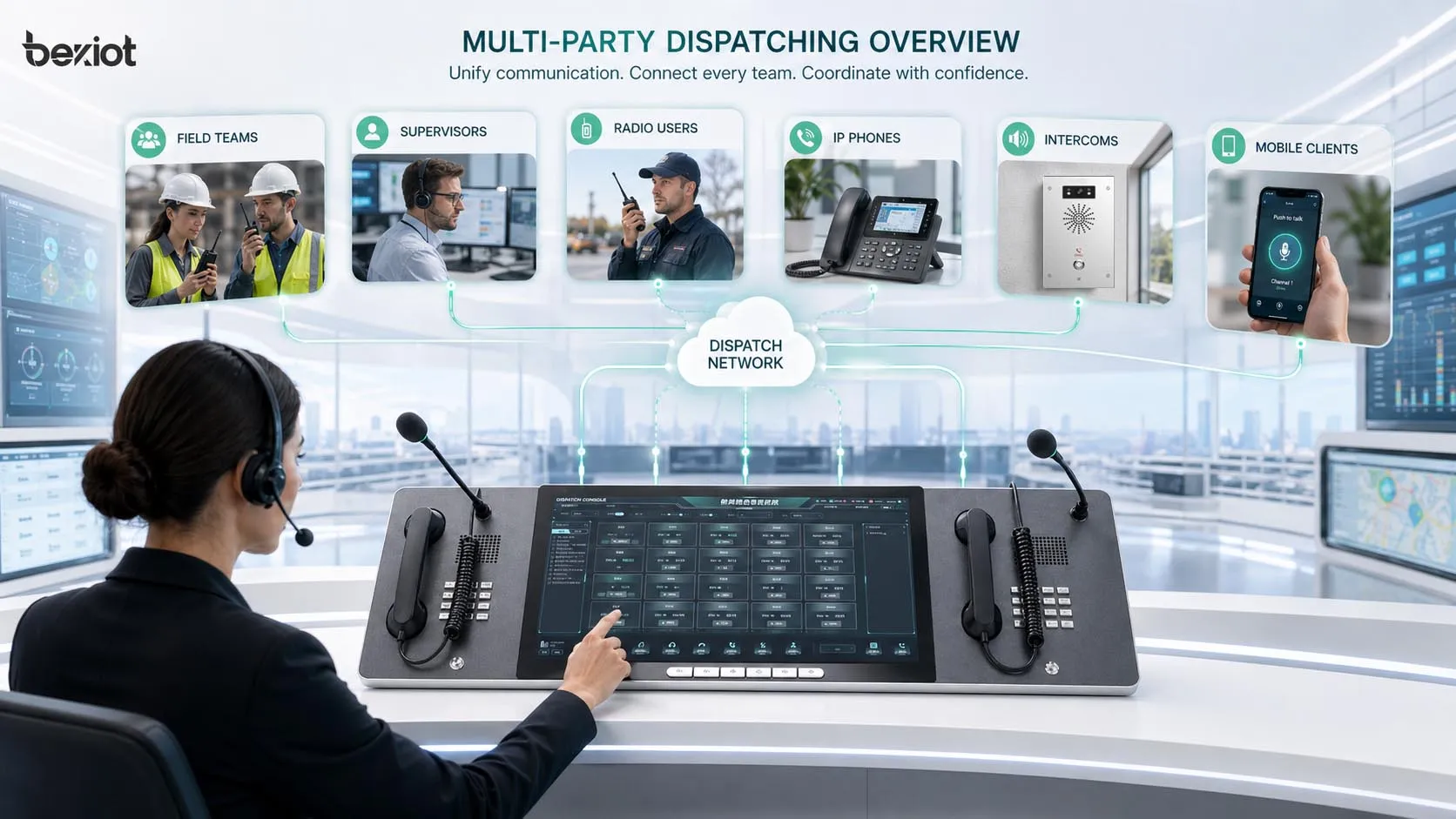
Multi-party dispatching is a dispatch communication mode in which a dispatcher connects, manages, or coordinates more than two communication participants within one operational workflow. These participants may include field workers, supervisors, emergency teams, control room operators, maintenance staff, security guards, drivers, public address zones, radio users, IP phones, intercom terminals, and mobile clients.
The core meaning is coordinated communication among multiple parties. A dispatcher can send instructions to a group, bring different users into a shared voice session, monitor several channels, transfer communication between teams, or merge calls when a situation requires joint response.
In traditional point-to-point calling, each conversation is isolated. In multi-party dispatching, communication becomes operationally connected. The dispatcher can manage who talks, who listens, which channel has priority, which group receives the message, and how information flows during normal operations or emergencies.
Multi-party dispatching turns communication from separate conversations into a coordinated command process.
Why Multi-Party Dispatching Is Important
Multi-party dispatching is important because many operational tasks involve more than one person or department. A single incident may require security, maintenance, medical staff, traffic control, field technicians, supervisors, and command center personnel to coordinate quickly. If each person is contacted separately, information may become delayed, inconsistent, or incomplete.
A multi-party dispatching system allows the dispatcher to deliver the same instruction to several relevant parties at once. It also allows participants to report back, confirm status, and receive updated instructions as the situation changes. This improves response speed and reduces the risk of misunderstanding.
In mission-critical or time-sensitive environments, the ability to coordinate multiple parties clearly can directly affect safety, service continuity, and operational efficiency.
How Multi-Party Dispatching Works
Dispatcher-Centered Communication Control
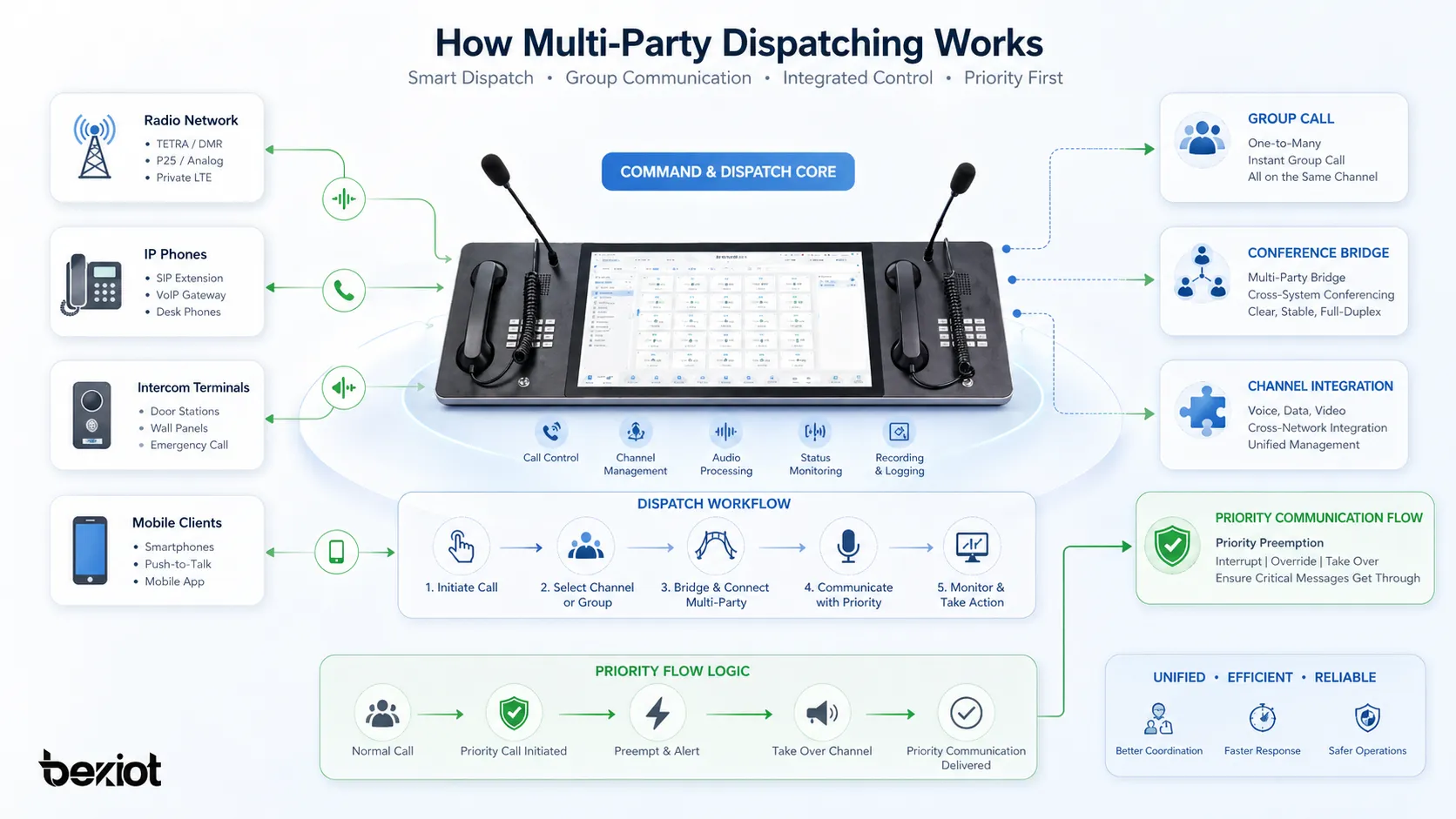
Multi-party dispatching usually begins from a dispatcher console or control center platform. The dispatcher can see users, groups, channels, devices, or communication zones and choose how to connect them. Depending on the system design, the dispatcher may start a group call, join an active channel, create an ad-hoc conference, broadcast a paging message, or bridge two communication systems together.
The dispatcher-centered model is important because it gives one control point for communication coordination. The dispatcher can decide who should receive instructions, who should be added to the conversation, which team should respond first, and which communication path should have priority.
In more advanced systems, dispatchers may also see user status, location, device online status, call history, alarm information, and related video or event data. This helps dispatch decisions become more informed and more precise.
Group Call and Conference Session
One common method of multi-party dispatching is the group call. In a group call, several users are connected so they can hear the dispatcher and, depending on permissions, speak back to the group. This is useful for maintenance teams, security patrols, emergency responders, logistics staff, and field service groups.
Another method is the conference session. A dispatcher can create a temporary conference by adding selected users, supervisors, experts, or external contacts into the same voice session. This is useful when a problem requires joint discussion instead of one-way instruction.
Group calls are often used for fast command and status updates. Conference sessions are often used for coordination, troubleshooting, decision-making, and cross-department response.
Channel Bridging and System Integration
Multi-party dispatching can also involve channel bridging. For example, a dispatcher may need to connect a radio group with an IP phone user, a SIP intercom, a mobile app, or a command center operator. In this case, the dispatching system bridges different communication technologies so that users can coordinate even if they are not using the same device type.
Integration may involve SIP, radio over IP, IP PBX, public address systems, paging controllers, intercom networks, mobile clients, alarm platforms, and recording servers. The goal is to reduce communication silos and make different teams reachable from one dispatch interface.
This integrated approach is especially useful in industrial sites, transportation systems, public safety organizations, campuses, and large facilities where different communication tools coexist.
Multi-party dispatching works best when users, groups, channels, and communication systems can be managed from one operational view.
Main Features of Multi-Party Dispatching
Group Communication
Group communication is the most basic feature of multi-party dispatching. It allows a dispatcher to contact a predefined team or temporary group without calling each person individually. Groups may be organized by department, location, task, emergency role, vehicle fleet, maintenance zone, security patrol, or response level.
Group communication improves efficiency because everyone receives the same message at the same time. It also reduces repeated explanation. When the dispatcher gives an instruction, all relevant participants understand the task context and can respond more consistently.
In fast-moving situations, group communication can reduce delays and help teams act as a coordinated unit.
Ad-Hoc Conference Creation
Ad-hoc conference creation allows the dispatcher to build a temporary multi-party session based on the situation. Instead of relying only on fixed groups, the dispatcher can select the exact people needed for a specific incident or task.
For example, a dispatcher may add a field technician, electrical supervisor, safety officer, and control room engineer into the same session when equipment failure occurs. In a security incident, the dispatcher may connect patrol staff, monitoring room operators, gate control, and emergency responders.
This feature supports flexible coordination when real events do not match predefined group structures.
Priority and Permission Control
Priority control is important in dispatch environments because not all calls and users have the same urgency. Emergency calls, supervisor instructions, alarm-related communication, and safety messages may need higher priority than routine conversations.
A multi-party dispatching system may allow dispatchers to interrupt lower-priority calls, force connect important users, mute selected participants, control speaking rights, or assign priority levels to groups and channels. Permission control also determines who can initiate group calls, who can join conferences, who can listen, and who can speak.
Priority and permission control help keep multi-party communication orderly, especially when many users are connected.
Monitoring, Recording, and Playback
Many dispatching systems include monitoring and recording features. Dispatchers may monitor active channels, listen to selected groups, review communication history, and replay recorded calls after an incident. Recording is useful for accountability, training, incident review, compliance, and service improvement.
In critical operations, recorded dispatch audio can help reconstruct what happened, when instructions were issued, who responded, and whether communication procedures were followed. This can be valuable after emergencies, equipment failures, security events, or operational disputes.
Monitoring and recording should be managed according to privacy rules, organizational policy, and applicable regulations.
System Architecture of Multi-Party Dispatching
Dispatch Console Layer
The dispatch console layer is the user interface for dispatchers. It may be a desktop console, touchscreen command station, software client, web platform, or integrated control room workstation. The console displays users, channels, groups, alarms, call status, and sometimes maps or device locations.
The console allows dispatchers to initiate calls, join channels, create conferences, make announcements, monitor users, record communication, and manage emergency response workflows. In some systems, it can also integrate video, alarm pop-ups, access control events, or GIS information.
A clear console interface is important because dispatchers often work under time pressure. The interface should support fast action without requiring complicated steps.
Communication Server and Switching Layer
Behind the console, the communication server or switching layer handles call routing, group management, session control, user registration, conference mixing, channel bridging, priority policy, and signaling. This layer may include an IP PBX, SIP server, dispatch server, media server, conference bridge, RoIP server, or unified communication platform.
The server layer determines how calls are connected and how audio is distributed among participants. It also controls permissions, records call logs, manages user status, and supports integration with other systems.
In larger deployments, redundancy, server clustering, network segmentation, and backup power may be required to keep dispatching available during failures.
Endpoint and Field Device Layer
The endpoint layer includes the devices used by field personnel and operational teams. These may include IP phones, SIP intercoms, push-to-talk handsets, mobile apps, radios, dispatch terminals, speakers, call boxes, vehicle units, tablets, control panels, and emergency phones.
Different endpoint types may support different functions. A radio may support fast push-to-talk communication. An IP phone may support full-duplex voice. An intercom may support door or help-point communication. A mobile client may support voice and location. A paging speaker may support one-way announcement.
Multi-party dispatching becomes more powerful when these endpoints can be coordinated through a common dispatch workflow.
Benefits of Multi-Party Dispatching
Faster Coordination
The most direct benefit of multi-party dispatching is faster coordination. A dispatcher can contact multiple users at once instead of repeating the same message through separate calls. This is valuable during emergencies, service interruptions, field maintenance, security incidents, production faults, and transportation events.
Faster coordination reduces response time and helps all participants work from the same information. When everyone hears the same instruction, there is less room for inconsistent interpretation.
In time-sensitive operations, saving even a few minutes can significantly improve outcomes.
Improved Situational Awareness
Multi-party dispatching improves situational awareness because users can share updates in a common communication flow. Field teams can report conditions, supervisors can give instructions, and dispatchers can adjust response plans based on real-time feedback.
When integrated with maps, alarms, video, or device status, the dispatcher can understand not only who is speaking but also where the event is happening and which resources are available. This helps the control center make better decisions.
Better situational awareness is especially important when incidents involve multiple locations, teams, or systems.
Reduced Communication Silos
Many organizations use different communication tools across departments. Security may use radios, maintenance may use phones, operators may use intercoms, and managers may use mobile clients. Without integration, these tools can create communication silos.
Multi-party dispatching reduces silos by allowing different users and systems to be connected through a common dispatch platform. The dispatcher can bridge communication paths when needed and ensure that relevant parties are included.
This improves cross-department response and reduces the risk that important information stays trapped in one team.
Better Accountability
Multi-party dispatching can improve accountability through call logs, recordings, user status, event timestamps, and response records. After an incident, managers can review who was contacted, what instructions were given, when the response started, and how the situation developed.
This supports training, compliance, incident investigation, and process improvement. It also helps organizations refine dispatch procedures and identify communication gaps.
Accountability does not only mean blame. It also means creating a reliable record that helps improve future response.
Applications of Multi-Party Dispatching
Public Safety and Emergency Response
Public safety and emergency response teams use multi-party dispatching to coordinate police, fire, medical, rescue, traffic, command staff, and field personnel. During an incident, the dispatcher may need to connect several teams quickly and keep communication organized.
Multi-party dispatching supports group calls, priority communication, emergency alerts, channel monitoring, recording, and command coordination. It helps ensure that responders receive consistent instructions and can report back from the field.
In emergency response, clear multi-party communication can improve speed, safety, and command discipline.
Industrial Operations and Maintenance
Industrial sites such as factories, power plants, refineries, mines, ports, and utility facilities often require coordinated communication between control rooms, field operators, maintenance technicians, safety teams, and supervisors. Equipment faults, process changes, inspections, and emergency shutdowns may involve several teams at once.
Multi-party dispatching helps connect these teams through group calls, conference sessions, radio channels, intercom endpoints, and paging zones. It supports faster fault response and better coordination between field and control room personnel.
In high-noise or hazardous environments, dispatching systems may also need priority control, rugged endpoints, clear audio, and reliable backup power.
Transportation and Traffic Control
Transportation systems use multi-party dispatching to coordinate drivers, station staff, maintenance crews, traffic controllers, security teams, and emergency responders. Applications include railways, metro systems, airports, bus fleets, highways, tunnels, ports, and logistics hubs.
Dispatchers may need to contact a group of vehicles, connect station personnel with control centers, coordinate incident response, or broadcast instructions to a service area. Multi-party dispatching supports these workflows by connecting the right users quickly.
In transportation environments, communication speed and accuracy directly affect service continuity and passenger safety.
Campus, Hospital, and Facility Security
Campuses, hospitals, public buildings, and commercial facilities use multi-party dispatching for security patrols, facility maintenance, emergency response, visitor assistance, and building operations. A single event may require security staff, medical staff, facility engineers, reception, and management to coordinate.
Multi-party dispatching allows the control room to form a response group, connect intercom calls to security staff, broadcast alerts, or bring supervisors into a call. This helps avoid fragmented communication during incidents.
In facility security, dispatching supports both daily coordination and emergency readiness.
Multi-Party Dispatching in Voice, Radio, and IP Systems
Radio Dispatching
Radio dispatching is one of the traditional forms of multi-party dispatching. A dispatcher communicates with radio users through talk groups or channels. Multiple users can listen to the same channel and respond according to radio procedures.
Radio dispatching is fast, familiar, and effective for mobile teams. It is widely used in public safety, transportation, security, construction, utilities, and industrial operations. Push-to-talk operation keeps communication simple and immediate.
Modern systems may connect radio channels with IP networks so that dispatchers can coordinate radio users and IP users from the same platform.
IP and SIP-Based Dispatching
IP and SIP-based dispatching uses packet networks to connect dispatch consoles, IP phones, SIP intercoms, mobile clients, conference servers, and paging devices. This approach supports flexible routing, remote access, integration, recording, and software-based management.
SIP-based systems can connect standard voice endpoints and support features such as group calling, call transfer, call recording, priority routing, and conference sessions. When combined with dispatch software, they can become part of a broader command communication system.
IP dispatching is useful for organizations that want to integrate voice communication with IT networks and digital operation platforms.
Hybrid Dispatching
Hybrid dispatching combines radio, IP telephony, intercom, paging, mobile, and sometimes public telephone networks. This is common in organizations that have existing radio systems but also need modern IP communication.
Hybrid systems may use gateways to connect analog radio, digital radio, SIP phones, mobile apps, and dispatch consoles. The dispatcher can then coordinate users across different technologies without forcing every team to use the same device.
Hybrid dispatching is valuable during migration projects and in large sites where different communication technologies serve different operational roles.
Deployment Considerations
Define User Groups and Workflows
A successful multi-party dispatching deployment begins with user groups and workflows. The system should reflect how the organization actually works. Groups may be based on location, department, shift, function, emergency role, vehicle type, or response priority.
Designers should identify who needs to communicate with whom, which calls require priority, which groups should be monitored, and which users should have permission to initiate multi-party sessions. This prevents the system from becoming confusing or overloaded.
Good group design makes dispatching faster and easier for operators.
Plan Network and Audio Quality
Multi-party dispatching depends on reliable audio. Poor network quality, weak radio coverage, high latency, packet loss, low microphone quality, echo, acoustic feedback, or excessive background noise can reduce effectiveness.
IP-based systems should consider bandwidth, Quality of Service, VLAN design, network redundancy, firewall traversal, endpoint registration, and server availability. Radio systems should consider coverage, channel capacity, interference, and antenna placement.
Audio quality should be tested under real operating conditions, not only in a quiet office environment.
Set Priority and Emergency Policies
Priority and emergency policies should be defined before the system is used. Organizations should decide which users can interrupt calls, which groups receive emergency alerts, how dispatchers handle simultaneous incidents, and how calls are recorded or escalated.
Without clear policy, a multi-party system may become chaotic during high-pressure events. With clear policy, the system can support disciplined command and response.
Priority rules should be documented and included in user training.
Multi-party dispatching is not only a technical feature; it is also an operational procedure that must match real command workflows.
Common Challenges
Too Many Participants
Adding too many participants to one session can reduce clarity. People may talk over each other, repeat information, or listen to messages that are not relevant to them. This can slow down decision-making instead of improving it.
The solution is to design groups carefully and use dispatch control. The dispatcher should include the people who need the information and avoid unnecessary participants when a smaller group is more effective.
Multi-party communication should be coordinated, not uncontrolled.
Audio Interference and Background Noise
Field environments often include machinery noise, traffic, crowds, wind, alarms, and echo. When several users join a group call, background noise from multiple endpoints can reduce clarity.
Noise control may require push-to-talk discipline, microphone gain settings, noise reduction, endpoint selection, headset use, echo control, and dispatcher muting functions. In some systems, automatic gain control and voice activity detection may also help.
Clear audio is essential because multi-party dispatching depends on fast understanding.
Integration Complexity
Integrating radio, SIP, intercom, paging, mobile apps, and external systems can be complex. Different systems may use different signaling methods, audio codecs, permissions, network paths, and operating procedures.
Integration should be planned carefully. Engineers should test call routing, audio levels, delay, recording, priority, emergency calls, and failure behavior before full deployment.
The goal of integration is to simplify the dispatcher’s workflow, not to create a more complicated system behind the console.
Maintenance and Operation Tips
Test Group Calls Regularly
Group calls, conference sessions, emergency groups, and priority routes should be tested regularly. A dispatching system may appear normal during idle periods, but a misconfigured group or offline endpoint may only be discovered when the function is needed.
Regular testing should include user connection, audio quality, priority behavior, recording, and dispatcher controls. Critical groups should be tested more frequently than routine groups.
Testing helps keep the system ready for real incidents.
Keep User and Group Records Updated
Dispatching systems depend on accurate user and group records. When staff change roles, departments move, devices are replaced, or new teams are created, the dispatch configuration should be updated. Old users, unused groups, and incorrect labels can create confusion.
Accurate naming is especially important under pressure. Dispatchers should be able to identify the correct group or endpoint quickly without guessing.
Good records support faster and safer communication.
Review Recordings and Incident Logs
Recordings and logs should be reviewed after important incidents or drills. They can show whether dispatch instructions were clear, whether the right people were contacted, whether response time was acceptable, and whether communication procedures need improvement.
Review should focus on learning and improvement. If users spoke over one another, if a group was missing, or if audio quality was poor, the system or procedure should be adjusted.
Continuous improvement makes multi-party dispatching more effective over time.
Conclusion
Multi-party dispatching is a communication method that allows dispatchers to coordinate several users, teams, channels, devices, or systems within the same operational workflow. It is used when one-to-one calling is not enough and when groups need shared instructions, fast updates, and coordinated response.
Its main features include group communication, ad-hoc conferencing, priority control, permission management, monitoring, recording, playback, channel bridging, and integration with radio, SIP, intercom, paging, and mobile systems. These features help organizations improve response speed, situational awareness, cross-team coordination, and accountability.
Multi-party dispatching is widely used in public safety, industrial operations, transportation control, emergency response, utility maintenance, campus security, healthcare facilities, logistics, and large public infrastructure. When deployed with clear workflows, reliable audio, correct priority policies, and regular maintenance, it becomes a practical foundation for coordinated command communication.
FAQ
What is multi-party dispatching in simple terms?
Multi-party dispatching is a communication method that lets a dispatcher coordinate several people or teams at the same time through group calls, conference sessions, radio channels, intercoms, or IP communication systems.
It helps teams receive the same instruction and respond together more efficiently.
What are the main features of multi-party dispatching?
The main features include group communication, ad-hoc conference creation, priority control, user permissions, monitoring, recording, playback, channel bridging, and integration with radio, SIP, paging, intercom, and mobile systems.
These features help dispatchers manage complex communication during normal operations and emergencies.
Where is multi-party dispatching used?
Multi-party dispatching is used in public safety, transportation, industrial plants, utility operations, mining, ports, campuses, hospitals, security control rooms, logistics centers, and emergency command centers.
It is useful wherever multiple teams need fast and coordinated communication.