


In emergency rescue, public safety, industrial response, and high-intensity field operations, situational awareness and fast command coordination are always critical. Traditional communication methods often depend on fixed network infrastructure. Once the public network is interrupted, terrain blocks the signal, or the deployment area lacks stable coverage, frontline information may not reach the command platform in time.
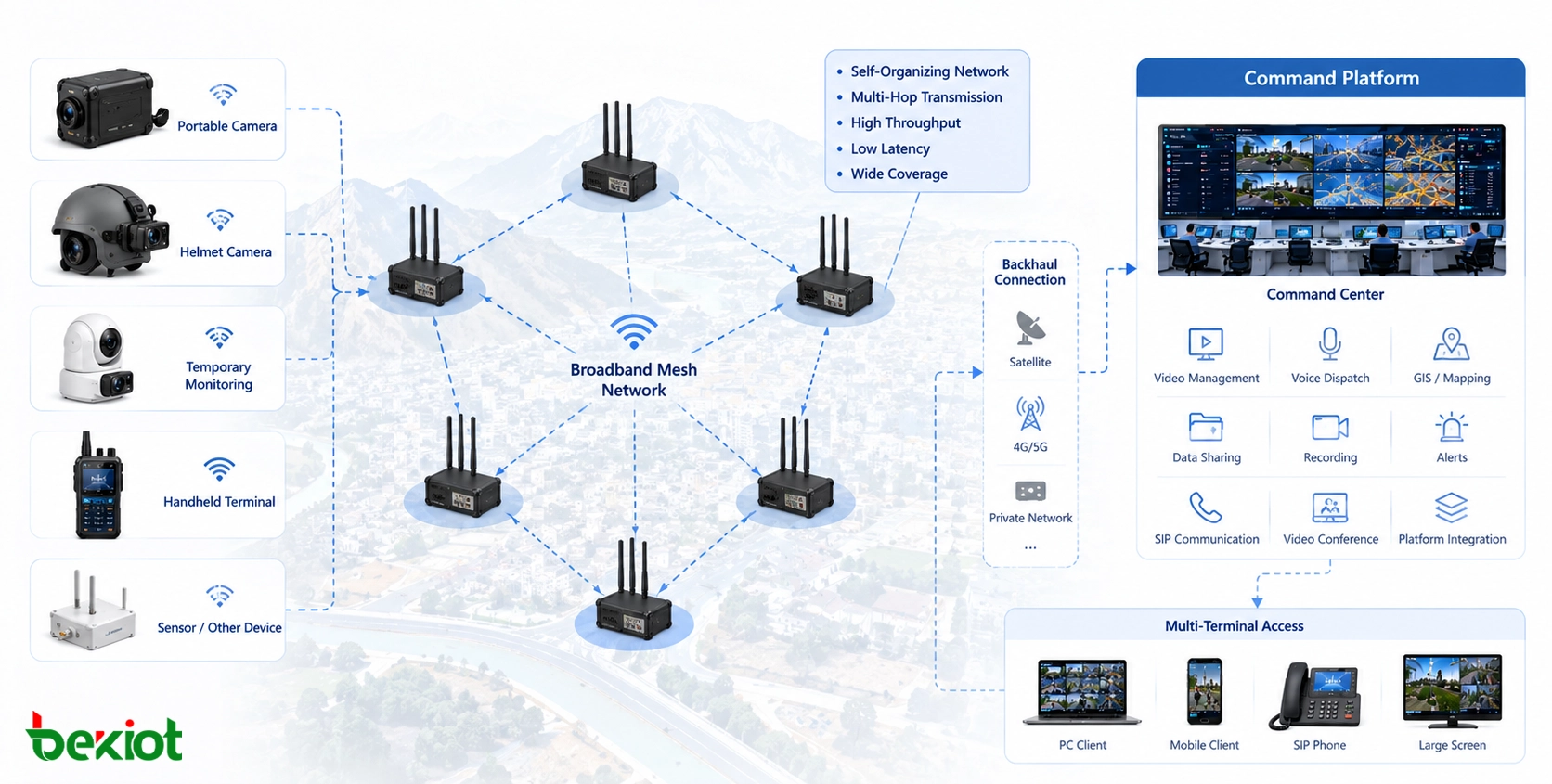
Broadband mesh field terminals provide a practical way to solve this challenge. They can quickly build a local broadband mesh network without relying on carrier infrastructure. Portable cameras, helmet cameras, temporary monitoring devices, and other field video sources can access the network through Ethernet, Wi-Fi, or HDMI encoding, allowing live video to be transmitted back to the command system for unified viewing, processing, and distribution.
The key value of this architecture is not only wireless access. It creates a complete workflow from field perception to command decision-making. Frontline video can be collected, encoded, transmitted, transcoded, displayed, shared, and distributed to multiple terminals, helping command teams see the scene clearly, coordinate teams efficiently, and deliver information to higher-level platforms when needed.
Field Operations Need More Than Basic Connectivity
In many emergency and security projects, the first problem is not the lack of devices, but the lack of a stable communication path. A site may have portable cameras, helmet-mounted video devices, handheld terminals, sensors, and communication endpoints, but these resources cannot support decision-making if they remain isolated.
A broadband mesh field terminal acts as the access layer for the frontline area. It helps create a low-latency local network so that different field devices can join the system quickly. Compared with fixed network construction, this approach is more flexible for temporary deployment, complex terrain, disaster response, outdoor operations, and areas where infrastructure is damaged or unavailable.
For command teams, the goal is not simply to receive a video stream. The real requirement is to obtain usable field information that can be displayed, distributed, recorded, and integrated with voice dispatch, SIP communication, emergency alerts, and operational workflows.
Two Practical Access Paths for Field Video
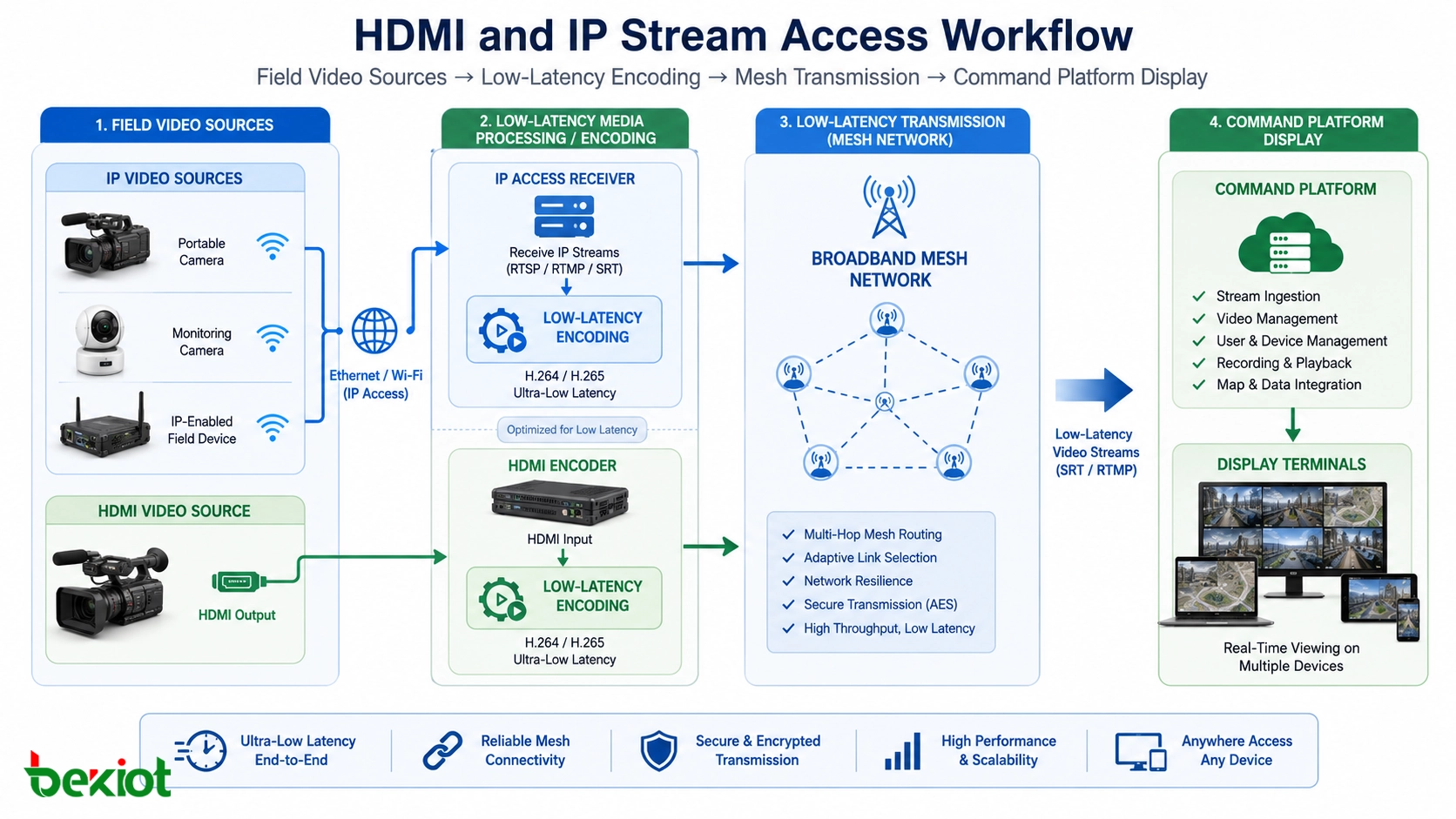
A broadband mesh architecture can support different access methods according to field conditions. The first path is network-based access. Portable cameras, helmet cameras, temporary monitoring points, and other IP-enabled devices can connect through Ethernet or Wi-Fi. The mesh terminal then forwards the video stream through the local broadband network to the command platform.
This method is useful when video devices already support IP output or standard streaming protocols. For example, a portable monitoring camera can access the system through GB/T 28181, while other IP video sources may use RTSP, RTMP, or similar streaming methods. Once connected, the command platform can receive and manage the video without complex site-level configuration.
The second path is HDMI encoding access. Some field devices provide HDMI output rather than a direct network stream. In this case, the broadband mesh terminal can capture and encode the HDMI signal, convert it into an IP stream, and send it through the mesh network. This keeps the field workflow simple while still allowing the video to enter the command system.
Low Deployment Complexity Matters on Site
Emergency scenes and temporary field operations do not allow long configuration cycles. A practical solution should reduce the need for specialist support during deployment. Network access, Wi-Fi access, and HDMI encoding should be simple enough for field teams to use without rebuilding the whole communication environment.
When the access path is well designed, frontline devices can join the local network quickly. Video sources can be collected and forwarded with minimal manual adjustment. This is especially important for teams that need to arrive, deploy, collect information, and start coordination in a short time.
For project delivery, this also reduces training pressure and maintenance complexity. A system that is easy to deploy is more likely to be used correctly under real operational stress.
Media Processing Turns Video Into Usable Intelligence
After field video enters the system, the next question is how the command platform uses it. Video access alone is not enough. The platform must support decoding, transcoding, multi-stream processing, screen display, protocol conversion, and distribution to different terminals.
A practical media processing layer should support multiple concurrent IP streams. In demanding projects, it may need to process 4K and 1080P streams at the same time, combine multiple video windows into one unified display, and output the fused view to large screens or command workstations.
The original engineering logic highlights the value of 16-channel video fusion. Multiple views from portable cameras, helmet cameras, and field monitoring points can be combined into one visual interface, giving the command team a clearer understanding of the whole site.
The purpose of field video is not only to see more images. It is to transform scattered visual resources into a usable command view.
Real-Time Transcoding Keeps the Workflow Smooth
Different field devices may output different encoding formats, resolutions, bitrates, and streaming protocols. Without a transcoding layer, some streams may not open on certain terminals, some may freeze under weak network conditions, and some may be incompatible with the command platform.
A high-speed media processing layer solves this problem by converting incoming video into formats that downstream terminals can use. The original project logic emphasizes a transcoding delay of only about 35 milliseconds. For command and dispatch scenarios, this low-latency performance is important because video must keep pace with voice instructions and operational decisions.
The system should support mainstream streaming outputs such as RTMP, RTSP, HLS, FLV, WebRTC, SIP, and GB/T 28181. With multi-protocol output, one field video source can be collected once and distributed to different systems and terminals without repeated deployment.
Weak-Network Transmission Requires Special Design
Field communication is often affected by weak links, unstable bandwidth, or changing network conditions. Satellite links, 4G, 5G, private wireless networks, and temporary broadband links may all be used depending on the project environment. The media platform must therefore support adaptive transmission and protocol-level interconnection.
GB/T 28181 upper-level and lower-level cascading, SIP interconnection, and WebRTC two-way communication are especially useful in multi-platform projects. These capabilities allow field video and communication resources to connect with upper-level command systems, remote dispatch users, browser clients, and SIP-based communication platforms.
The purpose of weak-network optimization is to keep the field image available even when the connection is not ideal. A useful system should reduce freezing, control bitrate, adapt stream quality, and ensure that key images can still be delivered to the command side.
Multi-Terminal Distribution Expands Command Reach
A complete field command solution should not send video to only one screen. Video streams may need to be distributed to command workstations, browser clients, visual phones, video meeting terminals, upper-level platforms, and software clients. Different terminals may require different protocols and video profiles.
For browser access, WebRTC and HTTP-FLV can provide convenient viewing methods. For SIP-based environments, video can be integrated with communication terminals and dispatch systems. For upper-level platform connection, GB/T 28181 can help standardize video resource access and management.
The original article also emphasizes multi-party video meeting capability, including support for 16-party 1080P participation. In this type of workflow, monitoring video sources and field terminals can join the same communication session, reducing the need for extra conversion equipment and improving collaboration efficiency.
A Complete Architecture for Emergency Response
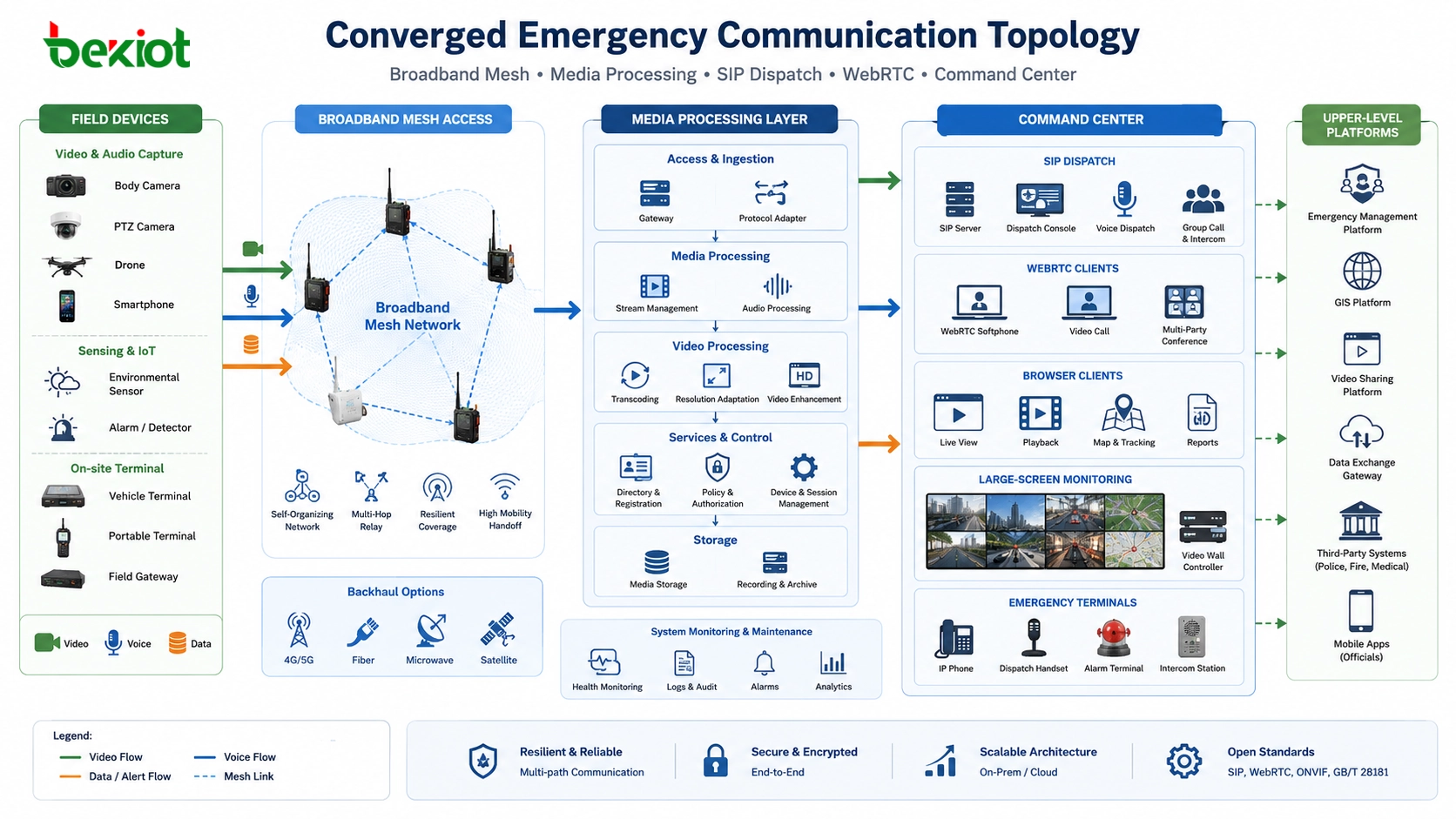
A practical architecture usually includes four layers. The first is the field perception layer, including portable cameras, helmet cameras, monitoring points, and communication terminals. The second is the broadband mesh access layer, which builds the local network and forwards IP streams or encoded HDMI video.
The third is the media processing and command platform layer. This layer handles stream decoding, transcoding, video fusion, protocol conversion, recording, distribution, and dispatch integration. The fourth is the application layer, where operators use command screens, SIP terminals, browser clients, visual phones, or upper-level platforms to view and coordinate field resources.
For projects that require video integration, voice dispatch, SIP communication, emergency calls, and industrial command workflows, Becke Telcom can be considered as a converged communication solution partner. Its solution approach can help connect SIP dispatch, industrial intercom, emergency communication terminals, and platform integration into a more complete response architecture.
Reducing Equipment and Maintenance Pressure
In traditional field command deployments, many separate devices may be needed for video conferencing, video monitoring access, streaming media distribution, video matrix output, recording, dispatch control, and display management. This increases equipment quantity, wiring complexity, configuration workload, and maintenance pressure.
A software-defined media processing platform can reduce this complexity by integrating multiple roles into one system layer. Instead of deploying separate devices for each media function, the project can centralize video access, protocol adaptation, screen display, and terminal distribution.
This approach is especially valuable in emergency response and industrial command projects where space, time, and maintenance resources are limited. A simpler architecture is easier to deploy, easier to operate, and easier to troubleshoot.
What Project Teams Should Evaluate
Before deployment, project teams should evaluate field coverage requirements, expected video source types, access methods, uplink bandwidth, command platform compatibility, and terminal display requirements. The system should be tested with real devices, real network conditions, and real command workflows.
The access layer should be checked for Ethernet, Wi-Fi, and HDMI encoding requirements. The media layer should be checked for multi-stream processing, 4K and 1080P handling, 16-channel video fusion, transcoding performance, and low-latency delivery. The platform layer should be checked for RTMP, RTSP, HLS, FLV, WebRTC, SIP, and GB/T 28181 output.
The operational layer should also be verified. Command teams should confirm whether video can be opened quickly, whether multiple feeds can be displayed clearly, whether the system can distribute streams to different terminals, and whether weak-network conditions are handled properly.
| Design Area | Key Requirement | Project Value |
|---|---|---|
| Mesh access | Build a local broadband network without relying on carrier infrastructure | Improves field deployment flexibility in complex environments |
| Video input | Support Ethernet, Wi-Fi, IP streams, and HDMI encoding | Allows different field video sources to enter the command workflow |
| Media processing | Handle multiple 4K and 1080P streams with video fusion | Improves situational awareness and screen display efficiency |
| Transcoding | Keep media conversion delay around 35 ms where system design allows | Supports real-time command and dispatch decisions |
| Protocol output | Support RTMP, RTSP, HLS, FLV, WebRTC, SIP, and GB/T 28181 | Enables multi-terminal and multi-platform distribution |
| Weak-network adaptation | Optimize transmission over satellite, 4G, 5G, and temporary networks | Helps keep field video available under unstable conditions |
Where This Solution Fits Best
Broadband mesh field terminal integration is suitable for emergency rescue, public safety, fire response, industrial safety, transportation operations, energy sites, utility maintenance, mining, large events, and temporary field operations. These scenarios often need fast deployment, flexible networking, and live video return from multiple field positions.
In emergency rescue, it helps command teams understand site conditions before making decisions. In industrial operations, it supports remote inspection, safety confirmation, and maintenance coordination. In public safety and transportation environments, it helps connect field teams, monitoring resources, and command platforms into one operational workflow.
The common requirement is clear: field information must be visible, usable, shareable, and connected to the command process. Broadband mesh access and media processing work together to make that possible.
Conclusion
Broadband mesh field terminals solve the last-mile wireless access problem in complex field environments. They allow portable cameras, helmet cameras, temporary monitoring devices, and other field video sources to join a local broadband network without relying completely on fixed infrastructure or carrier coverage.
The media processing platform solves the next problem: how to use the video after it enters the system. Multi-stream processing, 16-channel video fusion, low-latency transcoding, multi-protocol output, weak-network optimization, SIP interconnection, WebRTC communication, and GB/T 28181 cascading turn field video into an operational command resource.
A real emergency command system is not only about receiving images. It must see clearly, coordinate effectively, and transmit information reliably. Broadband mesh field terminals combined with a converged media and communication platform provide a practical architecture for building that capability.
FAQ
What is a broadband mesh field terminal?
A broadband mesh field terminal is a communication device that can build a local wireless mesh network for field operations. It helps cameras, helmet video devices, portable terminals, and other resources transmit data and video without relying only on public network infrastructure.
Why is mesh networking useful in emergency operations?
Mesh networking is useful because it can quickly create local coverage in areas where fixed infrastructure is unavailable, damaged, or blocked by terrain. It supports flexible deployment and helps frontline information reach the command platform more reliably.
Why is video transcoding needed in this architecture?
Different field devices may output different video formats, resolutions, bitrates, and protocols. Video transcoding converts these streams into formats that command platforms, browsers, SIP terminals, and other endpoints can use smoothly.
Which protocols are important for command platform integration?
Common protocols include RTMP, RTSP, HLS, FLV, WebRTC, SIP, and GB/T 28181. These protocols help connect field video with browsers, communication terminals, command platforms, and upper-level systems.
What should engineers test before deployment?
Engineers should test field coverage, video source access, HDMI encoding, multi-stream processing, 16-channel video fusion, transcoding delay, weak-network behavior, SIP interconnection, WebRTC access, GB/T 28181 cascading, and terminal playback quality.







