


In industrial communication and dispatch environments, system reliability depends on both stable communication channels and the effective organization, monitoring, and control of underlying terminal equipment, access gateways, and core network devices across their service lifecycle. As critical infrastructures expand across rail command centers, mines, tunnels, petrochemical factories, ports, and cross-regional emergency networks, multi-vendor devices with independent management interfaces form a fragmented ecosystem. This forces maintenance teams to switch between dozens of standalone systems for daily inspection and troubleshooting, raising human error risks and fault response latency. For mission-critical scenarios where communication interruptions can cause safety accidents or economic losses, decentralized management has become a key bottleneck restricting overall reliability.
Professional equipment management systems break down data silos across devices and vendors, unifying the fragmented ecosystem into a structured, fully observable, and precisely controllable digital operational layer. Through unified protocol adaptation and data modeling, all terminals, gateways, and network nodes are abstracted into standardized manageable objects and integrated into a coordinated end-to-end communication architecture. No longer just a hardware maintenance tool, equipment management serves as a core foundational component supporting real-time decision-making and stable mission-critical operations, running through the entire process of network planning, deployment, daily operation, emergency response, and asset retirement.
Unified control in dispatch-oriented environments
Industrial dispatch systems cover a wide range of devices including SIP intercom terminals, explosion-proof telephones, dispatch consoles, VoIP gateways, trunked radio nodes, and emergency alarm columns, distributed across multiple sites and often supplied by different vendors. Without a unified management platform, operators must log in to separate backends one by one for configuration and fault handling, which reduces work efficiency and increases configuration error risks.
Equipment management systems introduce a unified control abstraction layer, enabling monitoring, configuration, debugging, and maintenance of all devices via a single visual platform through protocol adaptation and interface integration. Operators can complete full-lifecycle management through standardized workflows without mastering separate operation logic for each vendor’s equipment. Centralized full-network visibility presents real-time device status across sites via lists, topology maps, and GIS maps with color-coded indicators, allowing dispatchers to instantly identify abnormal devices without switching systems. For cross-regional enterprises, this capability reduces operation and maintenance costs and shortens average fault recovery time through remote diagnosis and adjustment.
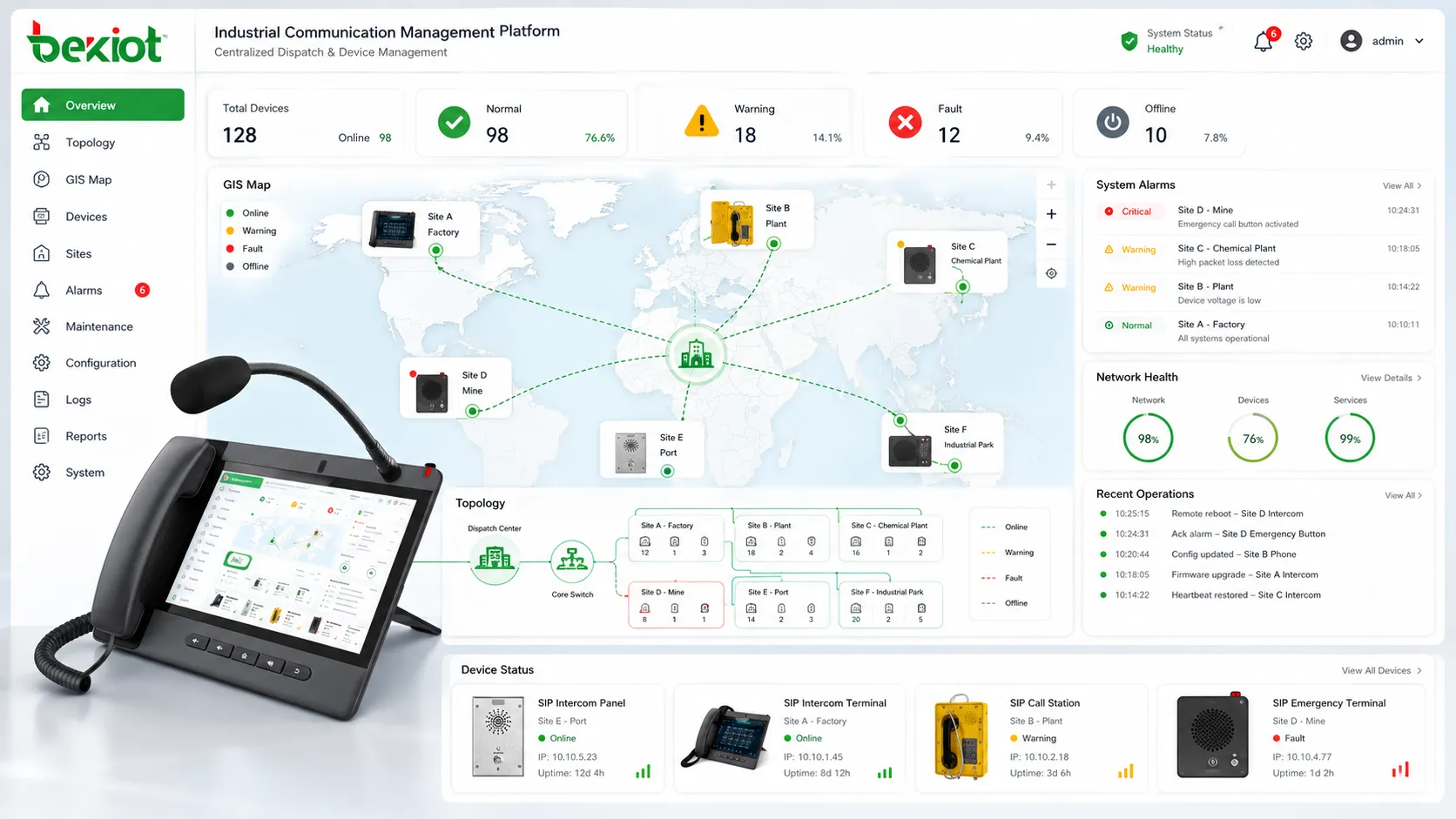
Deployment coordination across multi-site communication networks
In emergency and large-scale industrial communication systems, devices are widely distributed across urban areas, industrial parks, tunnels, ports, and remote field stations, with major differences in deployment environment, network access conditions, and on-site maintenance capabilities. Devices in remote mountainous areas or underground tunnels often rely on private networks or satellite links, creating major challenges for unified deployment and configuration.
Equipment management systems enable efficient cross-environment deployment coordination through standardized provisioning templates and remote configuration mechanisms. Maintenance teams can pre-create configuration templates covering SIP accounts, codec strategies, network parameters, security rules, and alarm thresholds on the central platform. With zero-touch provisioning (ZTP), devices automatically pull matching configurations after power-on without manual on-site parameter setup. For private network environments, hierarchical regional node deployment supports local device access and configuration distribution, ensuring normal deployment even with limited bandwidth. This standardized model ensures consistent communication rules and security policies for all endpoints regardless of physical location, and enables rapid networking for mobile emergency communication teams at disaster sites.
Real-time operational awareness for command centers
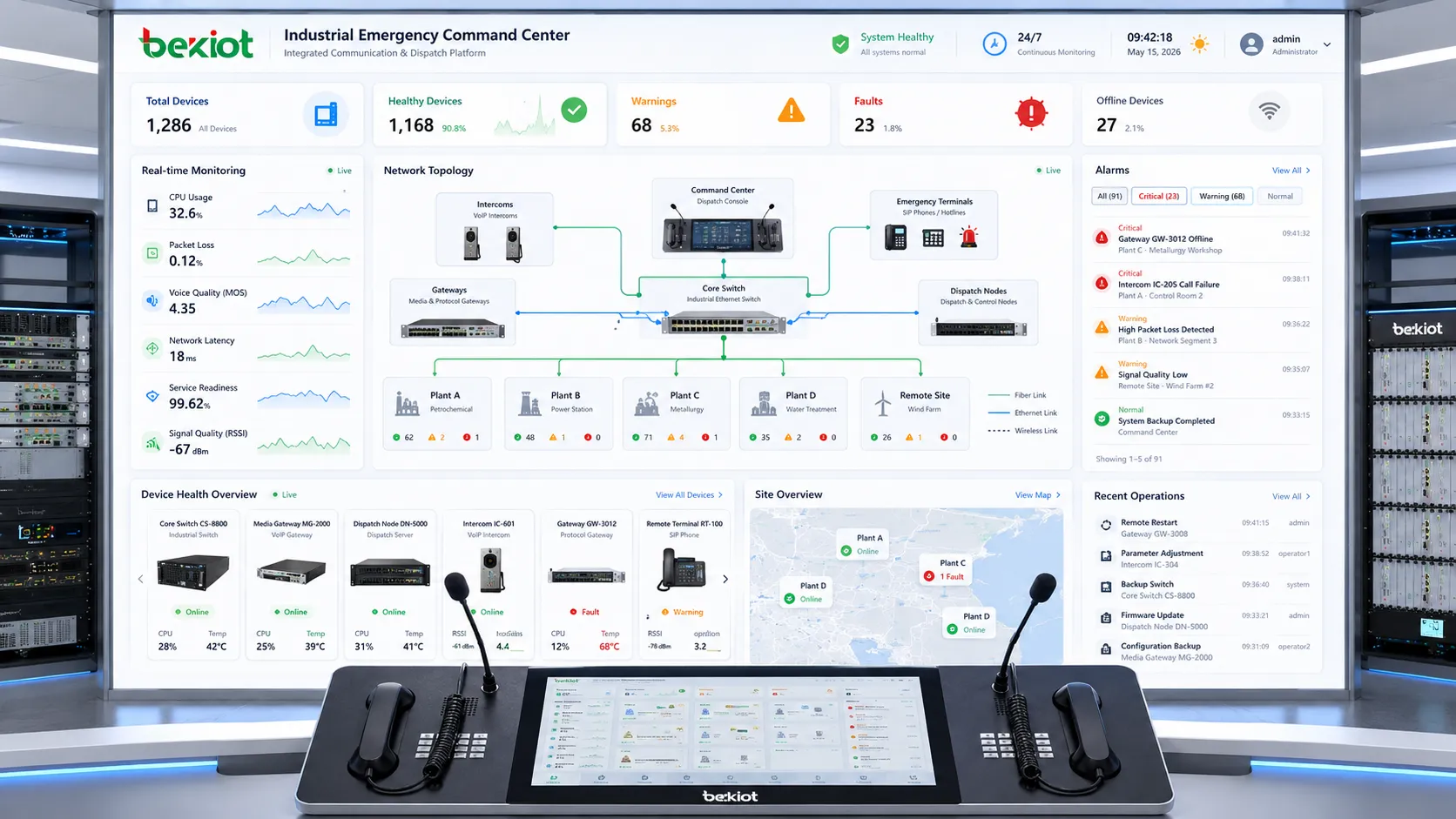
As the core of industrial scheduling and emergency command, command centers rely on real-time, accurate perception of full-network communication status to make correct decisions. Equipment management systems provide 7×24 uninterrupted monitoring of all connected devices, covering device health, network connection status, signal quality, service operation status, and operational readiness, with second-level data updates to the command platform.
The system supports multi-level alarm thresholds for all monitoring indicators. When parameters such as CPU usage, packet loss rate, or voice quality exceed normal ranges, the system automatically sends early warnings before a full service outage occurs. Maintenance teams can locate abnormal devices immediately and take corrective measures such as remote restart, parameter adjustment, or on-site maintenance to eliminate hidden faults in advance. This proactive operation and maintenance model prevents most potential communication interruptions. In emergency scenarios, this capability ensures command centers can grasp on-site device status in real time and quickly switch to backup equipment when individual devices fail, minimizing disruption to on-site command.
Automation layer for emergency response systems
In high-pressure emergency scenarios such as natural disasters and industrial safety accidents, on-site conditions change rapidly, and manual one-by-one configuration is slow and prone to errors under tense conditions. Equipment management systems build an automated operation layer above basic management functions, automating key emergency workflows including standby device activation, channel and call group allocation, emergency configuration updates, and priority adjustment.
The system supports pre-edited linkage strategies for different emergency types. Once an emergency plan is activated, the system automatically matches the corresponding strategy and completes full-network configuration adjustment within seconds without manual intervention. This not only reduces communication system response delay in emergencies, but also improves coordination efficiency across multiple response agencies. When the joint command mechanism is activated, the system can automatically open cross-departmental communication permissions, allocate dedicated channels, and establish unified command groups, eliminating communication barriers between independent systems.
Equipment lifecycle governance in communication infrastructure
Industrial communication devices typically have a service lifecycle of 5 to 10 years from procurement to decommissioning. In traditional decentralized management, equipment information is scattered across different departments, leading to unclear asset ledgers, missing maintenance records, and expired equipment still in service, which increases operation costs and brings potential hidden dangers to system stability.
Equipment management systems realize full-process tracking and standardized management across the entire equipment lifecycle, establishing a unique electronic file for each device covering procurement, deployment, daily maintenance, and decommissioning. The system automatically records every configuration change, fault maintenance, and firmware upgrade, and reminds teams to evaluate equipment aging status and arrange renewal plans in advance. This structured governance ensures all devices in the network are under standardized management, improving long-term system stability and providing data support for subsequent system expansion and investment optimization.
Scalability for distributed dispatch architectures
Modern industrial dispatch systems need to scale smoothly from small single-factory control rooms to large cross-regional command infrastructures. Without sufficient scalability, equipment management systems will become a bottleneck restricting business expansion and may even require full replacement.
Equipment management systems achieve efficient scalability through a three-layer hierarchical distributed architecture: edge device layer, regional control node layer, and central management platform layer. Edge devices are responsible for field communication and data collection; regional nodes handle local device access and fault processing to reduce pressure on the central platform; the central platform undertakes global monitoring, cross-regional scheduling, and data analysis. This architecture supports horizontal expansion by adding new regional nodes without modifying the central platform, ensuring stable performance even when tens of thousands of devices are online simultaneously. It also provides good fault isolation: a single regional node failure only affects its own jurisdiction, further improving overall system reliability.
| Layer | Function in Dispatch System | Typical Equipment |
|---|---|---|
| Edge Devices | Field communication and data capture | Industrial intercom terminals, alarm columns, radio handsets |
| Regional Nodes | Aggregation and local control | Regional gateways, edge management servers |
| Central Platform | Global monitoring and decision coordination | Core management servers, central dispatch consoles |
Security control in mission-critical communication systems
Network and information security is the core bottom line for industrial communication networks. In mission-critical systems for production scheduling and emergency command, unauthorized device access or malicious configuration tampering can lead to disordered commands, information leakage, or even full system paralysis, posing serious threats to production and public safety.
Equipment management systems implement strict standardized security policies across multiple dimensions: strict identity authentication including password, digital certificate, and MAC address binding to prevent illegal device access; role-based fine-grained access control (RBAC) to avoid security risks from excessive permissions; regular configuration integrity checks with automatic alarm and recovery functions for unauthorized changes. All operation behaviors and abnormal events are recorded in tamper-proof audit logs for full traceability. When abnormal behaviors are detected, the system automatically triggers multi-level early warnings and corrective measures to stop security risks in time, meeting industrial control security standards such as IEC 62443.
Fault detection and resilience in dispatch networks
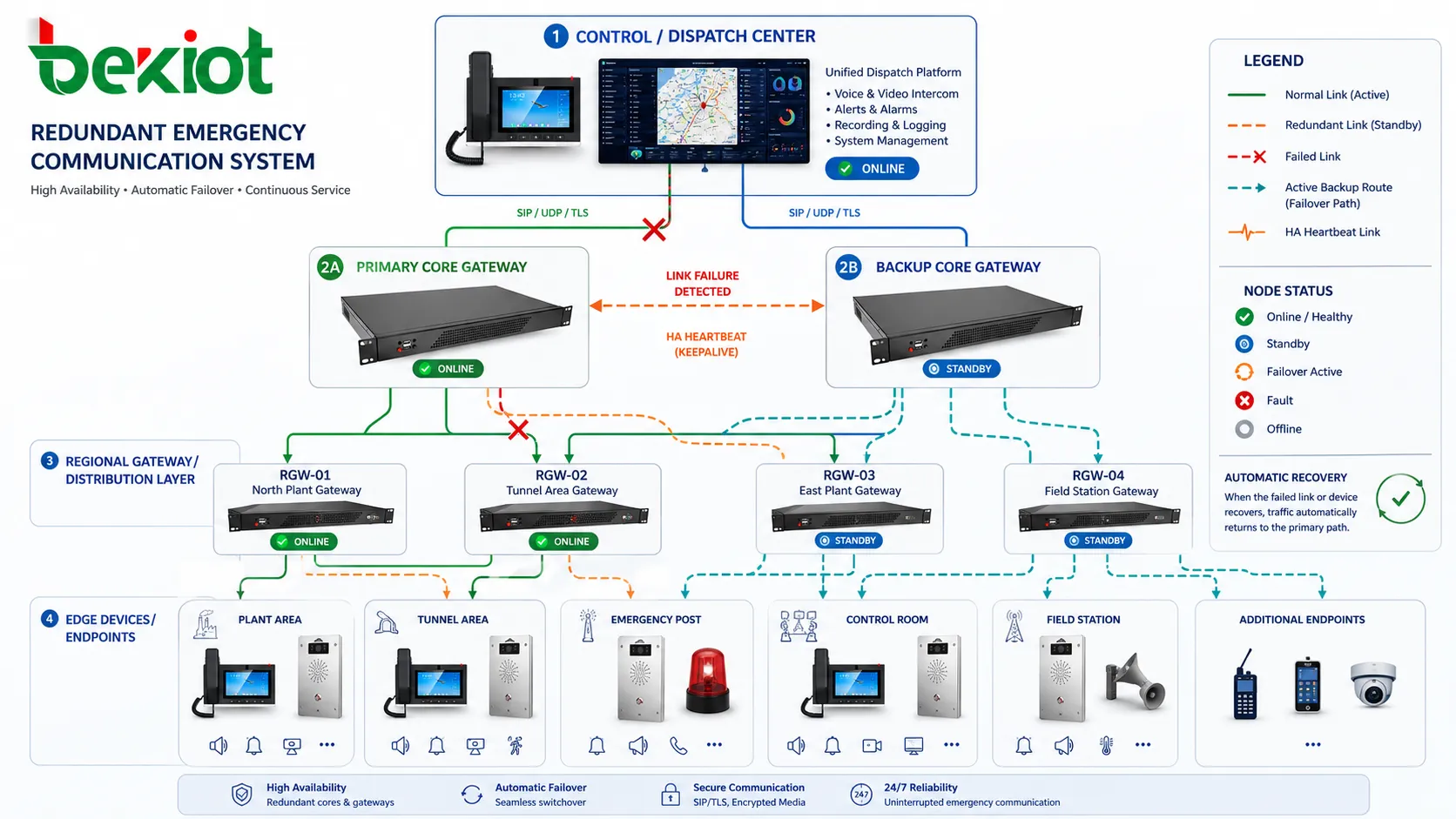
In networked communication systems, a single core device failure can cause cascading effects, leading to abnormal operation of a large number of downstream terminals and regional service outages. For example, a regional gateway failure will cut off all terminals under it from the central dispatch system.
Equipment management systems introduce redundancy-aware monitoring mechanisms that detect device status and identify upstream-downstream associations and redundancy relationships, enabling accurate fault location at the device, port, and link levels. When instability or failure is detected, the system automatically activates backup devices or redundant routing paths according to pre-configured strategies, achieving millisecond-level failover without manual intervention. This automatic recovery capability greatly improves overall network resilience, ensuring uninterrupted communication guarantee for emergency rescue. The system also counts fault frequency and locations to help teams identify weak network links and optimize redundancy design.
Integration with dispatch and emergency platforms
Modern equipment management systems are no longer standalone operation and maintenance tools, but an important part of the overall industrial communication and emergency command system. They provide rich northbound API interfaces and standard protocol docking capabilities, enabling deep integration with dispatch consoles, intercom systems, radio gateways, video surveillance, GIS systems, and emergency command platforms.
This deep integration embeds equipment status into dispatch decision-making processes. Dispatchers can view terminal status directly on the dispatch console without switching systems; when a terminal is faulty, the system automatically recommends alternative contacts and triggers channel rerouting. In emergency command platforms, equipment distribution and status are displayed on GIS maps to help commanders adjust resource deployment according to accident development. This business linkage makes the scheduling process smoother and gives full play to the overall efficiency of the communication system.
Operational efficiency in high-density communication environments
In high device-density scenarios such as large factories, long tunnels, and port hubs, communication terminals number in the hundreds or thousands. Traditional manual one-by-one configuration and inspection is extremely inefficient, and configuration errors increase significantly with device quantity.
Equipment management systems reduce operation complexity through logical grouping and batch policy delivery. Maintenance personnel can divide devices into groups by location, department, or service type, and apply unified configuration, firmware upgrades, and permission adjustments to entire groups at once, completing batch processing of hundreds of devices in minutes. According to practical statistics, batch configuration time can be reduced by more than 80% compared with manual operation, with near-zero error rates. The system also supports regular automatic inspection and report generation, replacing manual daily inspection work and allowing maintenance personnel to focus on fault disposal and system optimization.
Support for industrial-grade environmental conditions
Unlike office equipment in controlled environments, industrial field communication devices must withstand harsh conditions such as extreme temperatures, high humidity, mechanical vibration, dust, and electromagnetic interference for long periods. These conditions accelerate component aging and increase failure probability, putting forward higher requirements for equipment operation and maintenance.
Equipment management systems continuously collect equipment operation parameters and environmental sensing data, evaluating equipment performance and health status under harsh conditions in real time. When performance degradation caused by environmental factors is detected, such as overheating or frequent offline issues, the system automatically triggers maintenance work orders and notifies teams to take improvement measures. This capability extends equipment service life, reduces environmental-related failure rates, and provides reference for subsequent equipment model selection and deployment protection design.
Data-driven optimization for dispatch operations
Equipment management systems collect massive operation data covering device status, call services, fault alarms, and maintenance records across the whole network. Through systematic statistical analysis and mining, operation managers can identify system bottlenecks and carry out targeted optimization, replacing traditional experience-based management.
Dispatch centers can optimize communication routing strategies to balance network load, adjust resource allocation to improve utilization, and optimize emergency response processes based on historical operation data. The system provides complete data visualization and regular operation reports, offering sufficient data basis for management decision-making. It can also integrate with enterprise MES, ERP and other industrial systems to realize collaborative optimization of production business and communication support. With accumulated data, artificial intelligence algorithms can be introduced to realize intelligent fault prediction and resource recommendation, further improving the intelligent level of system operation.
FAQ
Is equipment management necessary for small dispatch systems?
Yes. Even small systems with dozens of terminals benefit from centralized status monitoring and standardized configuration management, which helps detect faults in time and avoid configuration errors. More importantly, deploying an equipment management system in the early stage avoids system replacement and data migration problems during subsequent business expansion, supporting smooth scale growth.
Can equipment management work in offline or isolated networks?
Yes. Most systems support localized private network deployment, with all core services and data storage running on local servers without external network connection. This ensures all operation data is stored inside the private network, meeting the security and confidentiality requirements of scenarios such as underground mines and confidential communication systems. The system also supports offline configuration export and import for ultra-isolated scenarios.
Does it replace manual dispatch operations?
No. It automates routine and repetitive work such as inspection, configuration delivery, and fault early warning to improve operator efficiency, but complex emergency decisions still rely on human judgment and deployment. The system provides auxiliary information and tools for decision-makers, and final command decisions are completed manually. This human-machine collaboration mode combines system efficiency with human flexibility in handling complex problems.
Is integration with existing communication systems possible?
Yes. Most mainstream systems support integration with intercom, radio, and IP-based communication platforms through standard protocols and open APIs. Devices using general protocols can be directly connected for unified management, and targeted adaptation is available for non-standard proprietary protocol devices. The integration cycle and difficulty vary by system type and interface openness, so detailed scheme evaluation is recommended at the initial project stage.







