


An emergency call system is designed for the moment when normal communication is no longer enough. In a stressful incident, people may forget phone numbers, lose mobile signal, panic, or be unable to explain where they are. A fixed emergency call point, panic button, or call box gives them a simple way to request help and gives the control room a clear starting point for response.
Converting a distress action into a managed response
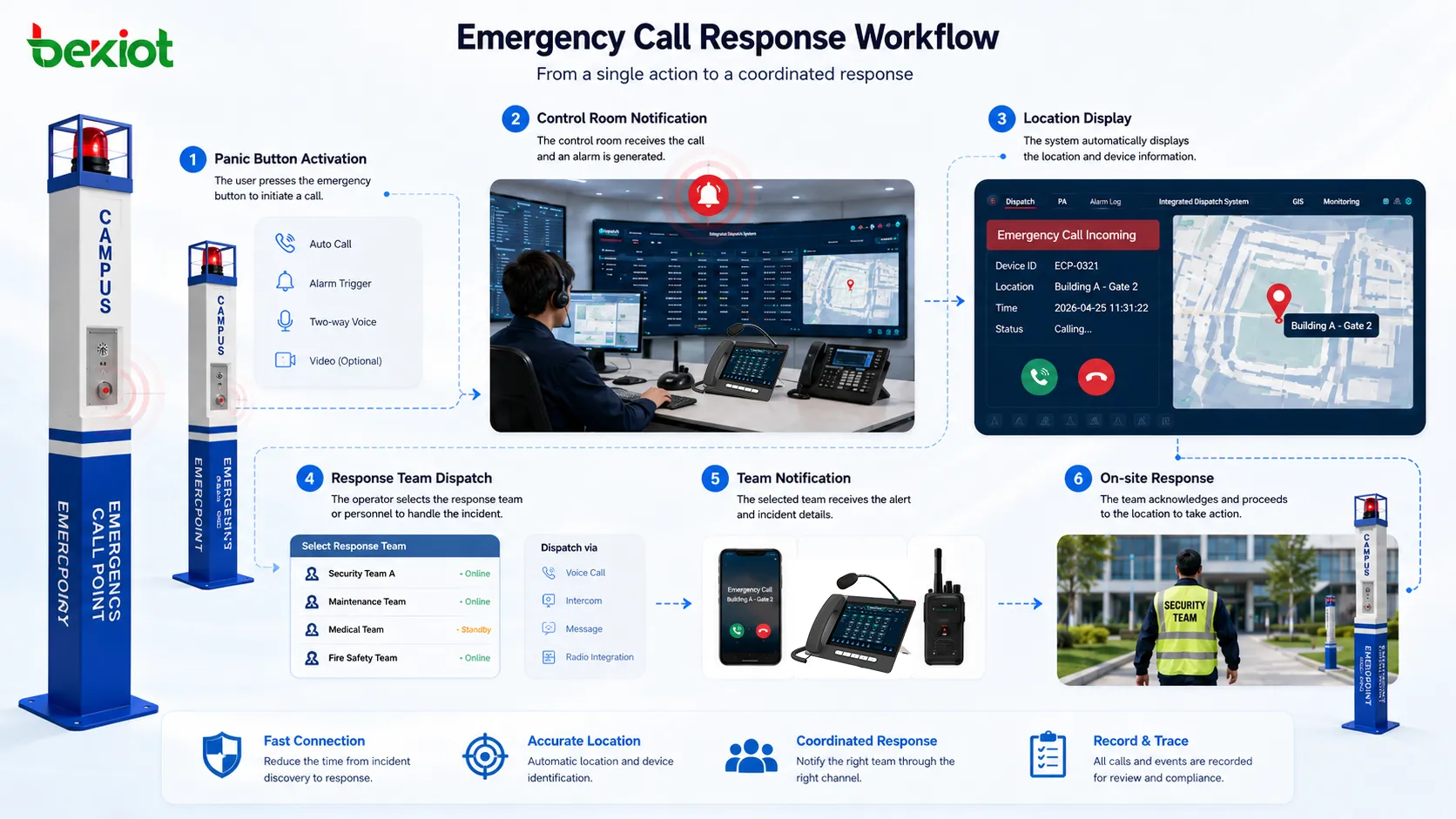
The most direct advantage of an emergency call system is that it turns a single action into an organized response process. Instead of relying on a person to find the right number, describe the location, and explain the event under pressure, the system can automatically connect the call to a control room, security desk, emergency center, or designated response team.
This is especially important in locations where people may not be familiar with the site, such as campuses, industrial parks, railway stations, parking areas, tunnels, hospitals, logistics facilities, and public buildings. A visitor, worker, driver, passenger, or contractor may not know the internal communication procedure. The emergency call point removes that uncertainty by providing a visible and dedicated help interface.
From an operational perspective, the call action usually does more than open a voice channel. It may generate an event in the management platform, display the device name, show the location, trigger an alarm tone, start call recording, and notify a predefined response group. This helps operators move quickly from “someone needs help” to “where is the event and who should respond.”
The practical value lies in reducing the gap between discovery and action. When every second matters, a structured workflow is more reliable than manual contact searching. It also helps ensure that different operators follow a consistent response path, even during shift changes or high-pressure incidents.
Clearer location information for faster decision-making
In many incidents, the biggest delay is not making the call but identifying exactly where help is needed. A caller may be unable to speak clearly, may use an informal location name, or may not know the site layout. Fixed emergency call devices solve this problem by binding each activation point to a known physical location.
Every call box, emergency phone, panic button, or help point can be assigned to a zone, building, floor, tunnel section, gate, parking area, platform, equipment room, or production line. When the device is activated, the operator receives location information immediately. This reduces dependence on the caller’s description and gives responders a more accurate starting point.
Location data becomes more useful when connected with maps, device lists, floor plans, CCTV points, and response resources. For example, a control room can identify the nearest camera, the closest patrol team, the safest access route, or the correct department to notify. This is particularly valuable in large or complex sites where a wrong dispatch direction can waste critical time.
A practical emergency communication solution should therefore treat location as part of the alarm event, not as a separate question asked after the call begins. Systems such as the Becke Telcom BK-RCS emergency alarm system can support this type of centralized alarm handling by helping operators view communication events and response resources in a unified platform, depending on the project configuration.
Reliable communication when personal devices are unavailable
Mobile phones are useful, but they are not always reliable during emergencies. The person may not have a phone, the battery may be dead, the screen may be damaged, or the network may be weak. In underground areas, remote corners, shielded buildings, tunnels, elevators, industrial facilities, and large parking structures, mobile coverage may also be unstable.
An emergency call system provides a site-owned communication path. The device is installed at a known location, connected to a managed communication platform, and intended for urgent use. Unlike personal devices, it can be inspected, tested, monitored, and maintained as part of the safety infrastructure.
Direct voice communication remains important because operators often need to understand the type and severity of the event. A panic signal can show that help is needed, but a voice call can reveal whether the issue is a medical emergency, security threat, trapped person, equipment accident, fire risk, visitor assistance request, or false activation. Even a short conversation can help determine the correct response priority.
In noisy or difficult environments, device design also matters. Hands-free operation, high-volume speaker output, visible call status, vandal-resistant construction, weather protection, and clear button design all affect usability. The system should be designed around real people under stress, not only around network connectivity.
Linkage with alarms, video, and public notification
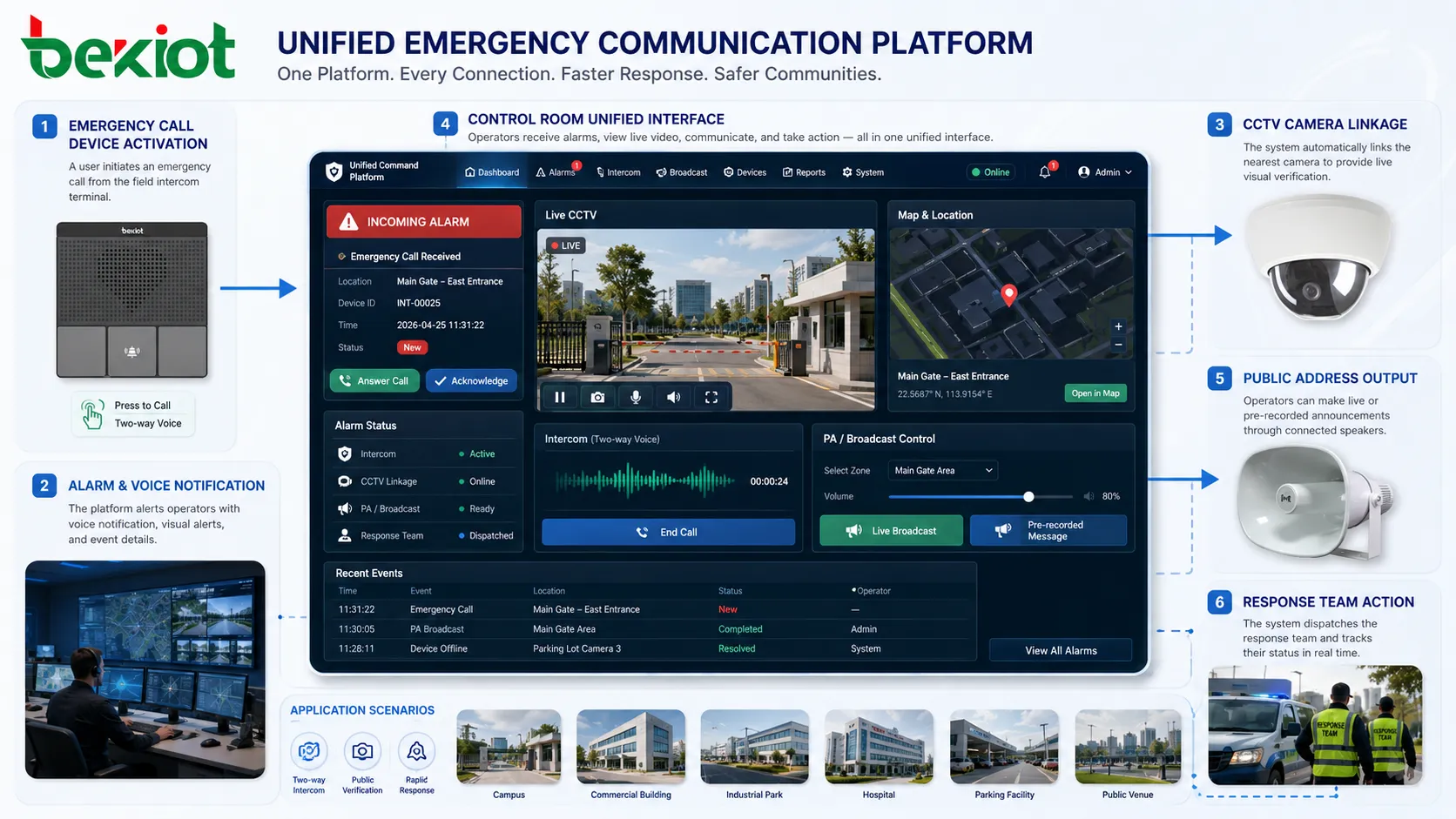
An emergency call system becomes more valuable when it is connected with other safety systems. A call point can trigger more than voice communication. It can activate an alarm display, open a related camera, notify a response group, trigger public address instructions, send messages to supervisors, or generate a record in the event platform.
This linkage reduces manual coordination. In a traditional process, an operator may need to answer the call, ask for the location, search for the camera, call the patrol team, notify the supervisor, and create a record manually. With system linkage, key information and communication channels can appear together, allowing the operator to focus on judgment rather than searching.
For example, when an emergency call box at a perimeter gate is activated, the system can show the gate name, display nearby video, start recording, and route the call to the security center. In a tunnel or industrial site, the call can be linked with zone alarms, broadcast instructions, or maintenance dispatch. In a campus, it can notify the security team while preserving call records for later review.
The advantage is not automation for its own sake. The goal is to make response more consistent and less dependent on memory. A configured workflow helps prevent missed steps and gives operators the right context at the right time.
Related solution: Emergency Call Box System Solution for Critical Sites
Better coverage for isolated and high-risk areas
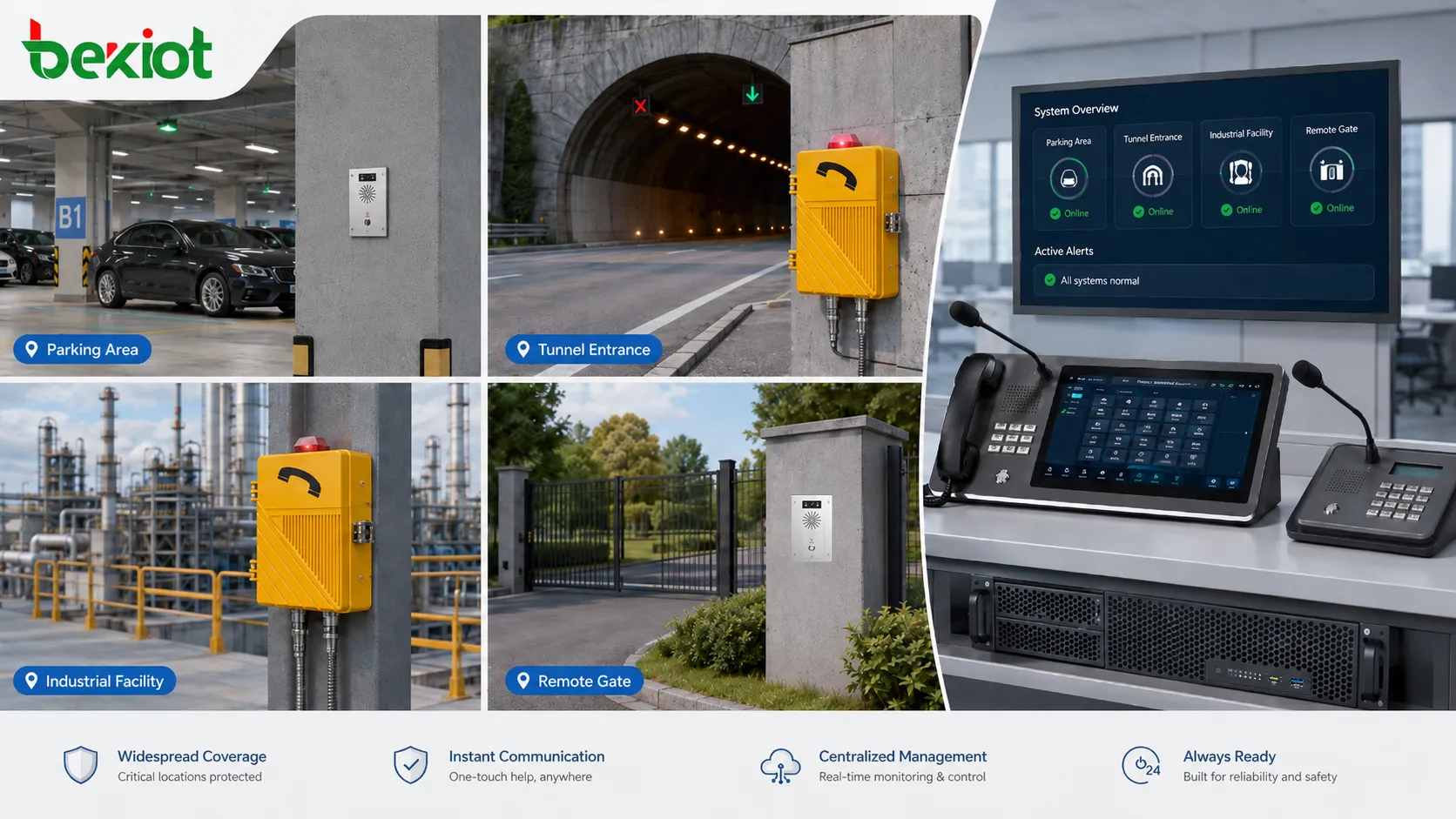
Emergency call systems are especially useful in places where people may be isolated or where normal assistance may take longer to reach. Typical locations include parking lots, tunnels, stairwells, elevators, campus paths, remote gates, loading docks, equipment rooms, production zones, utility corridors, waterfront areas, and outdoor public spaces.
Good coverage planning starts with risk rather than convenience. Devices should not be placed only where cable routing is simple. They should be placed where incidents are more likely, where people may be alone, where mobile coverage is weak, where visibility is low, or where response teams need a clear fixed point for coordination.
Visibility and usability are just as important as quantity. A call point should be easy to find, easy to identify, and easy to activate. Signage, lighting, mounting height, button protection, weather resistance, and accessibility all influence whether the system can be used effectively in a real event.
In critical sites, emergency call devices should also be planned with response routes. A device may be technically connected, but if responders cannot reach the location quickly or do not know which route to use, the practical benefit is reduced. Communication planning and physical response planning should therefore be considered together.
Traceability for review, training, and accountability
Emergency communication does not end when the call is answered. Organizations often need to review what happened, how quickly the event was handled, which operator responded, who was notified, and whether the response process followed internal procedures. This is where recording and event history become practical advantages.
Call recording can preserve the original request, operator instructions, background sounds, escalation decisions, and communication timeline. Event logs can record activation time, answer time, device identity, location, response group, operator actions, and event closure. Together, these records create a factual timeline that is much more reliable than memory after a stressful incident.
Traceability also helps improve daily management. If one location has repeated activations, the site may need better lighting, clearer signage, more patrol coverage, or improved access control. If response time is slow in a specific zone, the organization may need to adjust team placement or escalation rules. If false alarms occur often, the device type or installation position may need to be reviewed.
For regulated, public-facing, or high-risk environments, records can also support compliance and internal audit. The organization can prove that devices are installed, tested, monitored, and handled according to procedure. Becke Telcom BK-RCS emergency alarm system can be lightly considered in this context when a project needs centralized event handling, voice communication, alarm display, and response traceability as part of a broader emergency communication architecture.
Lower dependence on individual experience
A reliable emergency response process should not depend only on the most experienced operator being on duty. Incidents can happen during night shifts, holidays, staff turnover, or periods of high workload. A structured emergency call system reduces dependence on individual memory by embedding key response information into the platform and device layout.
When a call arrives with location, device name, alarm type, linked resources, and response group information, even a newer operator can begin handling the event more confidently. The system does not replace human judgment, but it gives operators a better starting point. This is especially important in large sites where no single person can memorize every device and every location.
Standardized workflows also make training easier. Operators can learn how different events appear, which groups should be contacted, how calls are recorded, and how escalation works. Instead of relying on informal instructions, the organization can build repeatable procedures around the system.
For management, this improves consistency. Similar incidents can be handled in similar ways, regardless of who is on duty. This is one of the strongest practical advantages of emergency call infrastructure: it helps turn emergency response from personal experience into an organized operating capability.
Readiness in harsh or unattended environments
Many emergency call points are installed in places that are exposed to weather, dust, vibration, temperature changes, vandalism, corrosion, or electrical interference. Outdoor parking areas, tunnel entrances, industrial plants, transport platforms, perimeter gates, and remote service areas are not gentle environments for communication equipment.
The practical value of the system depends on whether devices remain ready after months or years of exposure. Weather-resistant enclosures, impact-resistant buttons, protected cable entry, corrosion-resistant materials, stable power design, and clear status indicators can all influence long-term availability. A device that fails silently is worse than no device at all because the site may assume protection exists when it does not.
Remote monitoring is therefore important. The system should support device status checks, call test records, line supervision, network fault alarms, power condition monitoring, or periodic inspection procedures depending on the deployment. Maintenance teams need to know when a device is offline, damaged, or not performing correctly.
Routine maintenance should include both technical and physical checks. Operators may test call connection and audio quality, while field staff inspect enclosure condition, signage visibility, mounting stability, cable protection, and environmental damage. Emergency systems deliver value only when readiness is maintained continuously.
Operational value beyond major incidents
An emergency call system is often discussed in the context of serious events, but many sites also use it for daily assistance. A call box near a gate may help visitors contact security. A parking help point may support vehicle problems. A device in a production zone may report equipment-related risk. A campus pathway station may provide after-hours support. These daily uses keep the system visible and familiar.
This broader use improves practical value, but it should be managed carefully. Routine assistance should not block urgent calls, and operators should be able to distinguish between service requests and emergency activations. The platform should support clear priority display and routing rules so that high-risk events remain obvious.
When the same infrastructure supports both safety and controlled assistance, the organization gets more value from the deployment. Devices are noticed more often, tested more naturally, and maintained with greater attention. Users also become more familiar with where help points are located and how they work.
The key is balance. An emergency call system should remain primarily a safety tool, but it can also strengthen daily facility operations when call types, priorities, and response workflows are clearly defined.
FAQ
How should emergency call devices be distributed across a site?
Distribution should be based on risk areas, walking distance, visibility, mobile signal weakness, response routes, and whether people may become isolated. Parking areas, tunnels, entrances, stairwells, perimeter zones, and remote service areas usually require closer planning than fully staffed spaces.
Can an emergency call system work with CCTV and public address systems?
Yes. In many projects, emergency calls can be linked with camera views, alarm notifications, and public address output. This helps operators verify the situation, communicate with the caller, notify responders, and provide wider instructions when needed.
What causes false alarms in emergency call systems?
False alarms may result from accidental pressing, vandalism, unclear signage, environmental damage, poor button protection, or users treating the device as a general service phone. Reviewing event records can help identify whether the problem is user behavior, placement, or device design.
Why is voice communication still important if an alarm signal is already sent?
Voice allows the operator to understand the nature of the incident, assess urgency, comfort the caller, and give instructions. Alarm data shows that help is needed, but live communication often determines what kind of response is appropriate.
What should be included in routine maintenance?
Routine maintenance should check call connection, audio clarity, button function, power supply, network status, enclosure condition, signage visibility, alarm linkage, recording function, and whether the device location information in the platform is still accurate.







