


Ex Ia is not a stronger enclosure, a thicker shell, or a label that simply means “explosion-proof.” It is a protection concept based on limiting energy inside an electrical circuit so that sparks, arcs, or hot surfaces cannot ignite a surrounding explosive atmosphere under defined fault conditions.
That distinction is important. In hazardous areas, the question is not only whether equipment can survive an explosion. The more important question is whether the equipment can avoid becoming an ignition source in the first place.
The protection idea behind intrinsic safety
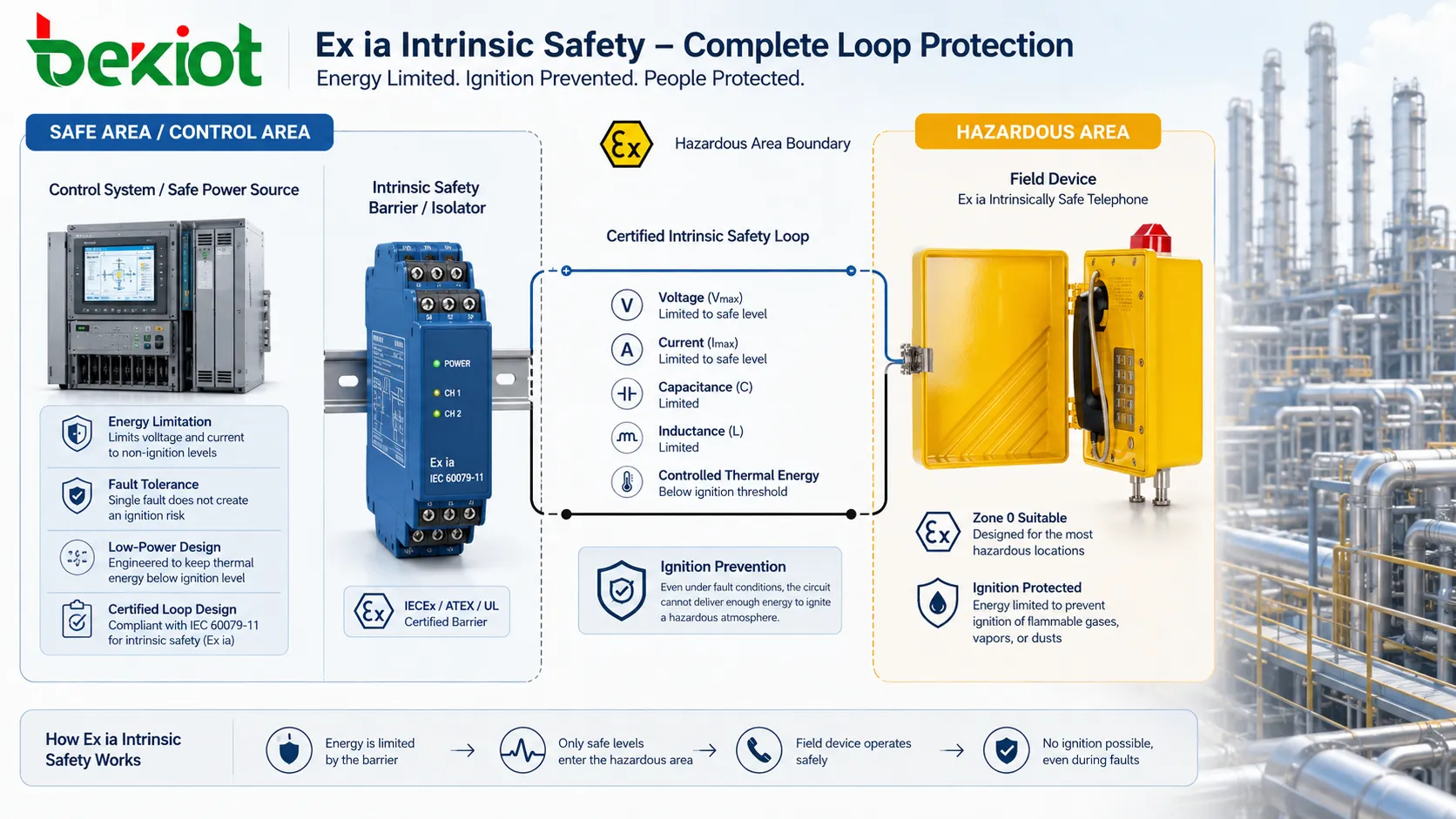
Intrinsic safety is based on a preventive engineering principle: electrical and thermal energy must be restricted below the level capable of igniting a hazardous atmosphere. Instead of containing an explosion after ignition occurs, intrinsic safety reduces the available ignition energy within the circuit. This makes it especially suitable for low-power devices, signal circuits, sensors, communication terminals, control loops, measurement instruments, and field devices used in explosive gas or dust environments.
The term “Ex i” refers to intrinsic safety as a type of explosion protection. The letter after “i” defines the protection level. Among the common levels, “ia” is the highest level for gas atmospheres and is designed to remain safe even under more severe fault assumptions. This is why Ex ia equipment is commonly associated with Zone 0 applications, where an explosive gas atmosphere may be present continuously, for long periods, or frequently.
Unlike flameproof protection, which uses a strong enclosure to contain an internal explosion, intrinsic safety works by controlling voltage, current, capacitance, inductance, temperature rise, and stored energy. Components, wiring, barriers, and field devices must be considered as a system. A device may be marked as intrinsically safe, but the complete loop must still be installed and maintained according to the certified conditions.
This system-level nature is one of the most important details. A certified field device connected through the wrong cable length, incorrect barrier, unsuitable power supply, or non-approved associated apparatus may no longer meet its intended protection concept. Intrinsic safety is therefore both a product design discipline and an installation discipline.
How the marking should be understood
An Ex ia marking contains several layers of information. Each part tells the user something about protection method, hazardous area suitability, gas or dust classification, temperature limitation, and equipment protection level. The marking should not be read as one word. It should be decoded step by step before the product is selected or installed.
In a simplified example such as “Ex ia IIC T4 Ga,” the “Ex” indicates equipment intended for explosive atmospheres, “ia” indicates intrinsic safety with protection level “a,” “IIC” identifies the gas group, “T4” identifies the temperature class, and “Ga” indicates the equipment protection level. In ATEX-style marking, this may be combined with equipment group and category information such as “II 1G,” depending on the certification system and regional requirements.
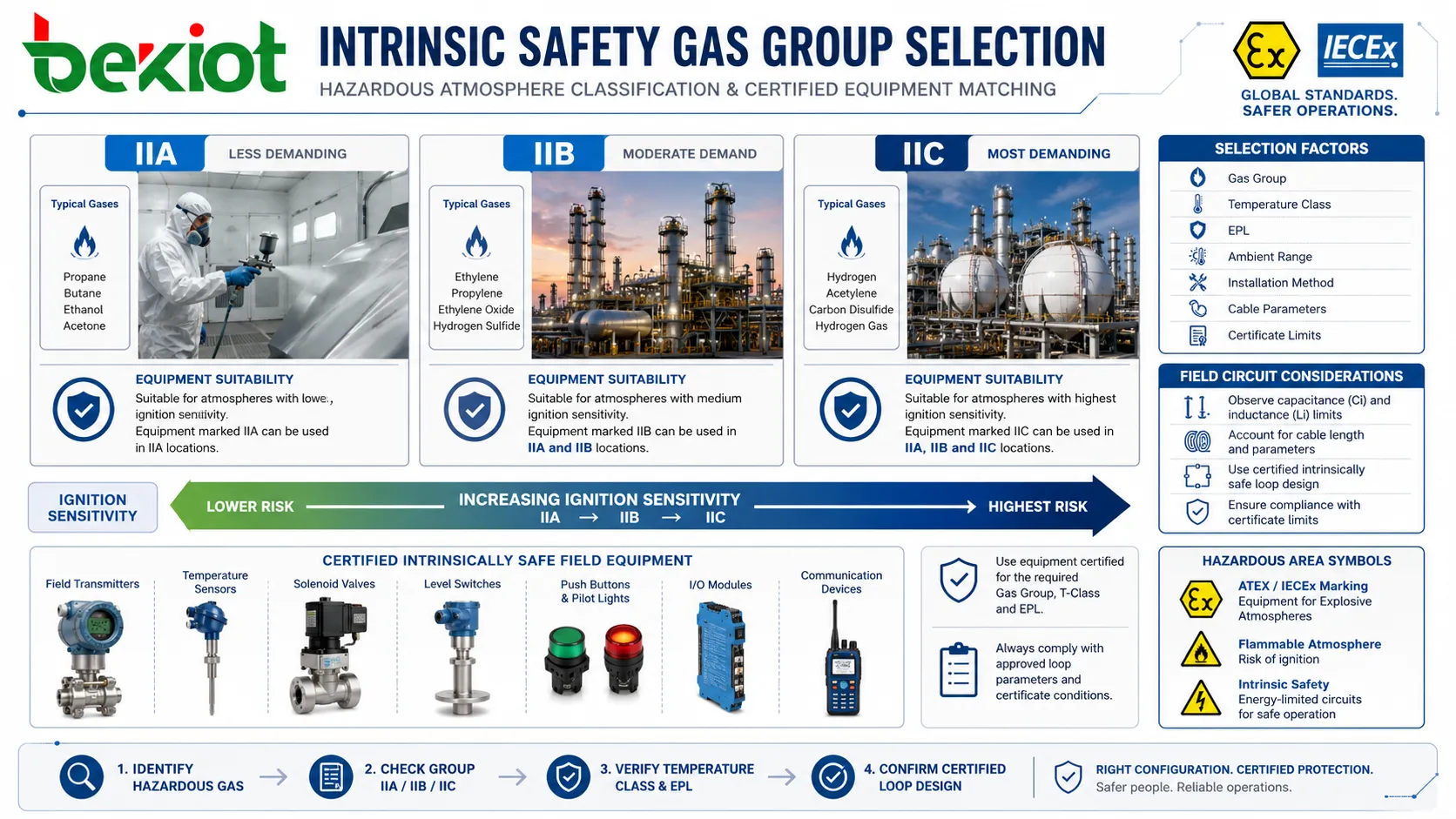
The gas group is important because gases do not all have the same ignition sensitivity. IIA, IIB, and IIC represent increasing severity for gas atmospheres, with IIC generally covering the most easily ignitable gases such as hydrogen and acetylene. Equipment certified for IIC is usually suitable for IIB and IIA gas groups when all other conditions are also compatible, but selection must still follow the exact certificate and installation requirements.
The temperature class tells users the maximum surface temperature category of the equipment under defined conditions. This must be lower than the ignition temperature of the hazardous atmosphere present at the site. For example, a T4 rating means the equipment belongs to a surface temperature class that must be evaluated against the gas or vapor risk in the area. The temperature rating is not optional; it is part of the ignition prevention logic.
The equipment protection level, such as Ga, Gb, or Gc for gas atmospheres, helps match equipment to zone classification and risk level. Ex ia is normally associated with the highest gas protection level, Ga, when the certificate supports that use. However, the complete marking, certificate schedule, entity parameters, and installation drawings must always be checked rather than relying on “ia” alone.
Why “ia” is considered a higher protection level
The “a” in Ex ia identifies the highest intrinsic safety protection level. Its significance comes from fault tolerance. Ex ia equipment is designed so that the circuit remains incapable of causing ignition in normal operation and under specified fault conditions, including multiple countable faults according to the standard framework. This makes it more demanding than lower intrinsic safety levels used in less severe hazardous zones.
In practice, the difference between ia, ib, and ic is not a matter of appearance. Two devices may look similar from the outside, but their internal circuit design, component spacing, protective components, energy limitation, thermal behavior, and fault assessment may be very different. Ex ia requires stricter design evaluation because it must remain safe under more difficult fault assumptions.
This is why Ex ia is commonly used where hazardous atmosphere presence is most severe. In gas hazardous areas, Zone 0 is the area with the highest continuous or frequent explosive atmosphere risk. A protection level suitable for Zone 0 must provide a very high margin against ignition because the equipment may be exposed to explosive gas during normal operation, not only during abnormal leakage events.
Lower protection levels may still be appropriate in other zones. Ex ib is typically associated with Zone 1 / EPL Gb applications, where explosive gas is likely to occur occasionally during normal operation. Ex ic is typically associated with Zone 2 / EPL Gc applications, where explosive gas is not likely to occur in normal operation or is present only briefly. The correct level depends on hazardous area classification, not on preference alone.
Ex ia should be selected because the hazardous area requires that level of protection, not simply because it sounds safer on a datasheet.
The role of IEC, IECEx, and ATEX frameworks
Intrinsic safety is commonly discussed through international and regional certification systems. IEC 60079-11 is the key technical standard for equipment protection by intrinsic safety “i” within the IEC 60079 series. It defines construction and testing requirements for intrinsically safe apparatus and associated apparatus intended for explosive atmospheres. For global projects, IECEx certification is widely used as an international conformity system based on IEC standards.
ATEX is the European regulatory framework for equipment and protective systems intended for use in explosive atmospheres. It uses equipment groups and categories such as II 1G, II 2G, and II 3G for gas atmospheres, which correspond to different zone suitability levels. Although IECEx and ATEX markings are not identical, they often appear together on products used in international markets.
For users, the practical question is how to read the certificate and marking together. A device may carry both ATEX and IECEx information. The ATEX marking may indicate group, category, and atmosphere type, while the IECEx-style marking may show Ex protection concept, gas group, temperature class, and equipment protection level. Both should be consistent with the installation environment.
It is also important to understand that standards evolve. Project teams should verify the current applicable standard edition, local legal requirements, notified body or certification body documentation, and certificate conditions. A general marking explanation can help users understand the structure, but the certificate remains the authoritative source for exact application limits.
In procurement and engineering review, standards should not be treated as decorative references. They define how the product was evaluated, what hazardous area it may enter, what wiring conditions apply, and what limitations the installer must observe. For Ex ia systems, this is especially important because field wiring and associated apparatus affect the total safety loop.
Gas group classification and ignition sensitivity
Gas group classification is one of the most practical selection factors for Ex ia equipment. Explosive gases and vapors differ in ignition energy, flame propagation behavior, and explosion characteristics. The group classification helps match equipment protection capability to the gas environment where it will be installed.
For surface industries, gas groups are commonly identified as IIA, IIB, and IIC. IIA generally represents less easily ignitable gases, IIB represents a more demanding group, and IIC represents the most severe group among these gas categories. Hydrogen and acetylene are typical examples associated with IIC-level risk. Equipment marked IIC has been evaluated for the most demanding gas group within that classification structure.
This does not mean that gas group alone is enough for selection. Temperature class, equipment protection level, ambient temperature range, installation method, cable parameters, and certificate limitations must also be reviewed. A device may have the correct gas group but still be unsuitable if its temperature class is not adequate or if the installation violates entity parameter limits.
In real projects, gas group information usually comes from hazardous area classification documents, process safety analysis, material safety data, or engineering design specifications. The equipment selection team should not guess based on industry type alone. A petrochemical site, battery area, gas storage facility, paint shop, laboratory, or offshore platform may contain different gases and require different protection assumptions.
For intrinsically safe communication and control circuits, the gas group affects permitted capacitance and inductance values in the circuit. Cable length and cable type can therefore influence whether a loop remains within certified limits. This is another reason why Ex ia selection must include both product marking and loop design.
Temperature class and thermal ignition control
Intrinsic safety is often associated with spark prevention, but thermal ignition control is equally important. Equipment installed in a hazardous atmosphere must not develop surface temperatures that can ignite the surrounding gas or vapor. The temperature class defines the maximum surface temperature category under specified conditions and helps ensure that the equipment remains below the ignition temperature of the hazardous substance.
Temperature classes are commonly expressed as T1 through T6, with T6 representing the lowest maximum surface temperature category and T1 representing the highest. A lower maximum surface temperature is generally more restrictive and may be required for gases with low ignition temperatures. The correct temperature class depends on the hazardous material present in the area, not only on the equipment type.
For Ex ia circuits, thermal behavior is evaluated together with electrical energy limitation. Components such as resistors, semiconductors, fuses, batteries, connectors, and protective devices must not reach dangerous temperatures under normal and defined fault conditions. This is why certification assessment considers both spark ignition and thermal ignition risks.
Ambient temperature range also matters. A device certified for a standard ambient range may not be suitable for very hot outdoor installations, cold storage areas, desert sites, offshore platforms, or industrial cabinets with poor ventilation. If the installation environment exceeds the certified ambient range, the temperature class may no longer be valid.
In maintenance work, thermal safety should not be compromised by unauthorized repair, component substitution, blocked ventilation, damaged enclosure parts, or unapproved accessories. Even though intrinsic safety primarily limits circuit energy, changes to the thermal behavior of the equipment can affect compliance with the certified protection concept.
Equipment protection levels and zone suitability
Equipment Protection Level, or EPL, provides a structured way to match equipment protection capability with hazardous area risk. For gas atmospheres, the common EPL levels are Ga, Gb, and Gc. Ga represents a very high level of protection, Gb represents a high level, and Gc represents an enhanced level for lower-risk gas areas. Ex ia is normally associated with Ga when certified for that purpose.
Zone classification describes how often an explosive atmosphere is expected to occur. Zone 0 indicates continuous, long-duration, or frequent presence of explosive gas. Zone 1 indicates likely occasional presence during normal operation. Zone 2 indicates that explosive gas is unlikely in normal operation and, if present, exists only for a short time. Equipment protection must be selected according to this classified risk.
In many practical interpretations, Ex ia / Ga is suitable for Zone 0, Zone 1, and Zone 2 gas areas when all other marking conditions match. Ex ib / Gb is generally applied to Zone 1 and Zone 2. Ex ic / Gc is generally applied to Zone 2. However, the final decision must follow the certificate, local code, and site classification documents.
ATEX categories express similar suitability through categories such as 1G, 2G, and 3G for gas atmospheres. Category 1G is associated with Zone 0, Category 2G with Zone 1, and Category 3G with Zone 2. For dust atmospheres, categories and zones differ and should not be mixed casually with gas markings.
Understanding EPL and zone suitability prevents two common mistakes. The first is installing equipment with insufficient protection level in a more hazardous area. The second is overspecifying without checking whether the complete loop and accessories are also compliant. A high protection marking on one device does not automatically make the entire installation suitable.
Associated apparatus, barriers, and complete loop safety
Intrinsic safety often depends on more than the field device itself. Many Ex ia installations use associated apparatus such as safety barriers, galvanic isolators, intrinsically safe interface modules, or certified power-limiting devices. These components may be installed in a safe area or in another protected enclosure and are responsible for limiting energy delivered into the hazardous area circuit.
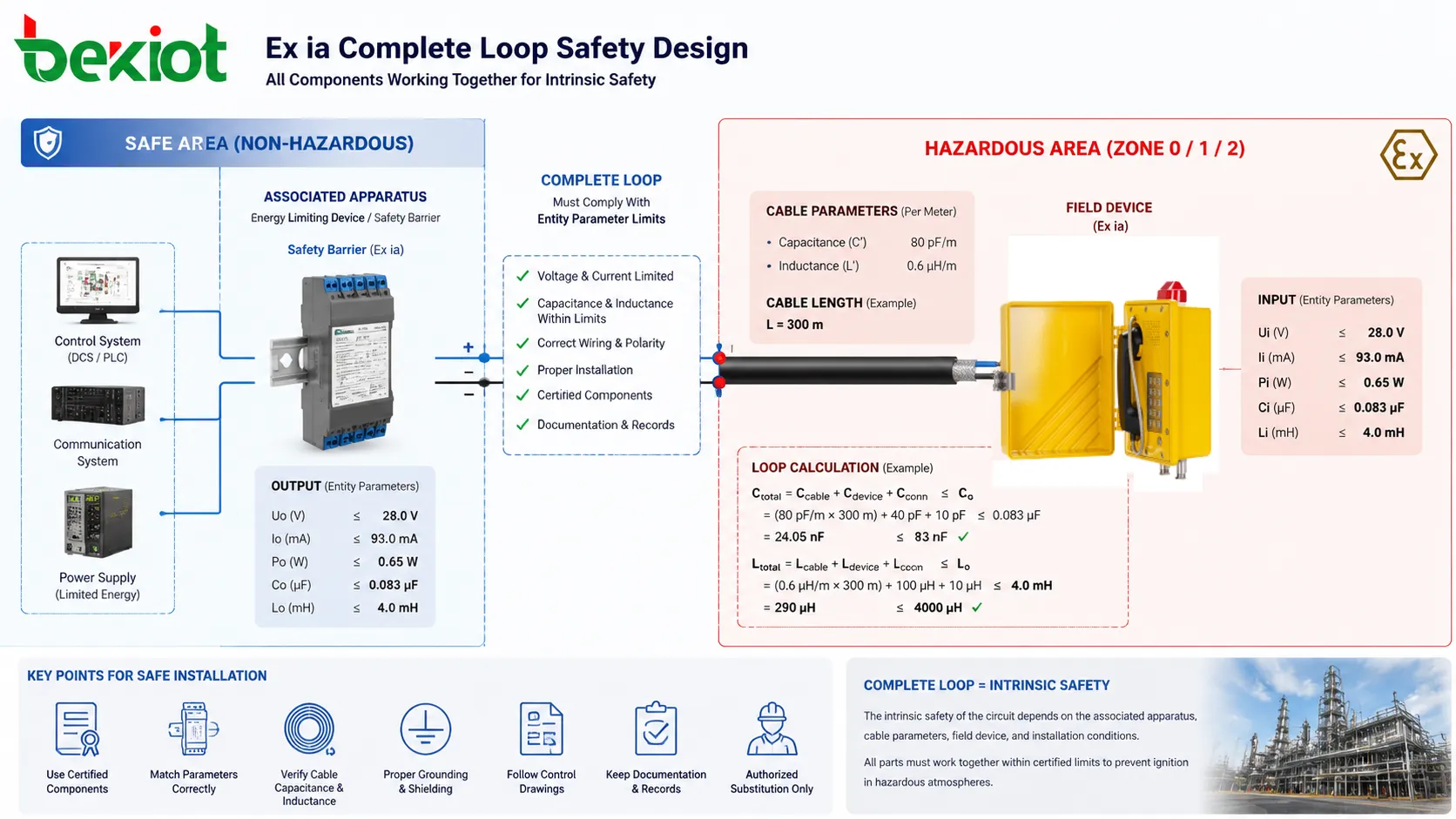
The associated apparatus defines maximum output parameters such as voltage, current, power, capacitance, and inductance limits. The field device defines its input parameters and acceptable connection conditions. The cable adds capacitance and inductance. The complete loop must remain within the certified limits. If the cable is too long or has unsuitable electrical characteristics, the system may exceed permitted values even if the individual devices are certified.
This is why intrinsic safety documentation often includes entity parameters, control drawings, loop diagrams, and installation notes. Engineers should compare the output parameters of the associated apparatus with the input parameters of the field device, then include cable parameters in the calculation. This process is part of proving that the installed loop remains intrinsically safe.
In practical terms, a safe installation requires correct product selection, correct barrier selection, correct wiring, correct grounding, and correct documentation. Maintenance staff must also avoid replacing barriers, cables, or devices with similar-looking but uncertified alternatives. A small substitution can change the electrical characteristics of the loop.
Complete loop safety is one of the most distinctive features of Ex ia systems. The protection grade is not only a label attached to a device; it is the result of a controlled relationship between all components in the circuit.
Installation and maintenance implications
Installing Ex ia equipment requires careful attention to the certified installation conditions. Cable type, cable length, separation from non-intrinsically safe circuits, grounding, barriers, terminals, and enclosure entry methods must follow the approved design. Intrinsically safe wiring should not be treated as ordinary low-voltage wiring just because it carries limited energy.
Separation between intrinsically safe and non-intrinsically safe circuits is important. If wiring is mixed incorrectly, energy from a non-safe circuit could be introduced into the intrinsically safe loop. Junction boxes, terminal blocks, cable trays, and control cabinets should be arranged so that wiring identification and separation remain clear throughout the life of the installation.
Maintenance work must preserve certification integrity. Unauthorized component replacement, cable extension, enclosure modification, connector substitution, or repair using non-approved parts can invalidate the protection concept. If a device is damaged, maintenance teams should follow the manufacturer’s instructions and certification conditions rather than performing ordinary field repair.
Inspection should include label readability, enclosure condition, cable glands, grounding, corrosion, mechanical damage, wiring separation, barrier condition, and documentation consistency. In harsh sites, these checks should be performed more frequently because vibration, moisture, chemical exposure, and temperature cycling can gradually affect installation quality.
For operational teams, the key habit is to treat Ex ia equipment as part of a certified safety system. The installation is safe only when the device, wiring, associated apparatus, documentation, and maintenance practice remain consistent with the approved design.
Common misunderstandings during selection
One common misunderstanding is assuming that Ex ia means the equipment is suitable for every hazardous area. Ex ia is a high-level intrinsic safety concept, but suitability still depends on gas group, temperature class, equipment group, EPL, ambient temperature range, and certificate limitations. A device with Ex ia marking may still be unsuitable for a specific gas or environmental condition.
Another misunderstanding is treating intrinsic safety as the same as flameproof protection. Flameproof protection allows ignition inside an enclosure but prevents flame propagation to the surrounding atmosphere. Intrinsic safety prevents ignition by limiting energy. These are different protection concepts, and they have different installation and maintenance requirements.
A third mistake is ignoring the complete loop. Users may select a certified field device but connect it through an unsuitable barrier or cable. In intrinsic safety, the interface and wiring are part of the safety calculation. A compliant product used in a non-compliant loop can create a non-compliant installation.
Some users also assume that lower power always means intrinsically safe. This is not correct. Intrinsic safety requires certified design, testing, and documentation. A low-voltage device is not automatically Ex ia. It must be assessed under the relevant standard and marked accordingly.
Finally, users sometimes overspecify Ex ia when the area classification only requires a lower protection level. While using a higher level may be acceptable in some cases, it can increase cost or limit equipment choices. Selection should follow the hazardous area classification and engineering requirement rather than a general preference for the highest grade.
FAQ
Is Ex ia always required in hazardous areas?
No. Ex ia is typically used where the highest intrinsic safety level is required, such as Zone 0 gas environments. Zone 1 or Zone 2 areas may allow other protection levels depending on the hazardous area classification, gas group, temperature class, certificate, and local regulations.
Can Ex ia equipment be repaired on site?
Only if the repair method is allowed by the manufacturer and certification conditions. Unauthorized repair, component substitution, or enclosure modification can invalidate the protection concept. Many certified devices require controlled repair procedures or replacement rather than ordinary field repair.
Does Ex ia mean the equipment is waterproof or corrosion-resistant?
No. Ex ia refers to intrinsic safety protection against ignition risk. Waterproofing, dust protection, corrosion resistance, and impact resistance are separate mechanical or environmental ratings. A device may be Ex ia but still require additional IP, material, or enclosure suitability for the installation environment.
Why are cable parameters important in intrinsic safety?
Cables add capacitance and inductance to the circuit. If these values exceed the certified limits of the loop, stored energy may become too high for the approved intrinsic safety design. Cable type and length should therefore be included in loop verification.
What should be checked before selecting Ex ia equipment?
Check the hazardous zone, gas or dust group, temperature class, EPL or category requirement, ambient temperature, certificate scope, entity parameters, associated apparatus, installation method, and maintenance requirements. The complete system must match the classified risk, not just the product name.







