


Communication technology has advanced rapidly. 5G networks are widely deployed, 6G is already being discussed, mobile apps are everywhere, and public-network push-to-talk services are becoming more common. Yet traditional walkie-talkies have not disappeared. In many industries, they are still purchased, deployed, replaced, and upgraded on a regular basis.
The reason is simple: walkie-talkies solve communication problems that smartphones and public networks do not always solve well. They provide direct, fast, group-oriented, and often network-independent communication. For public safety, emergency response, construction, industrial operations, property management, and field coordination, this combination remains highly valuable.
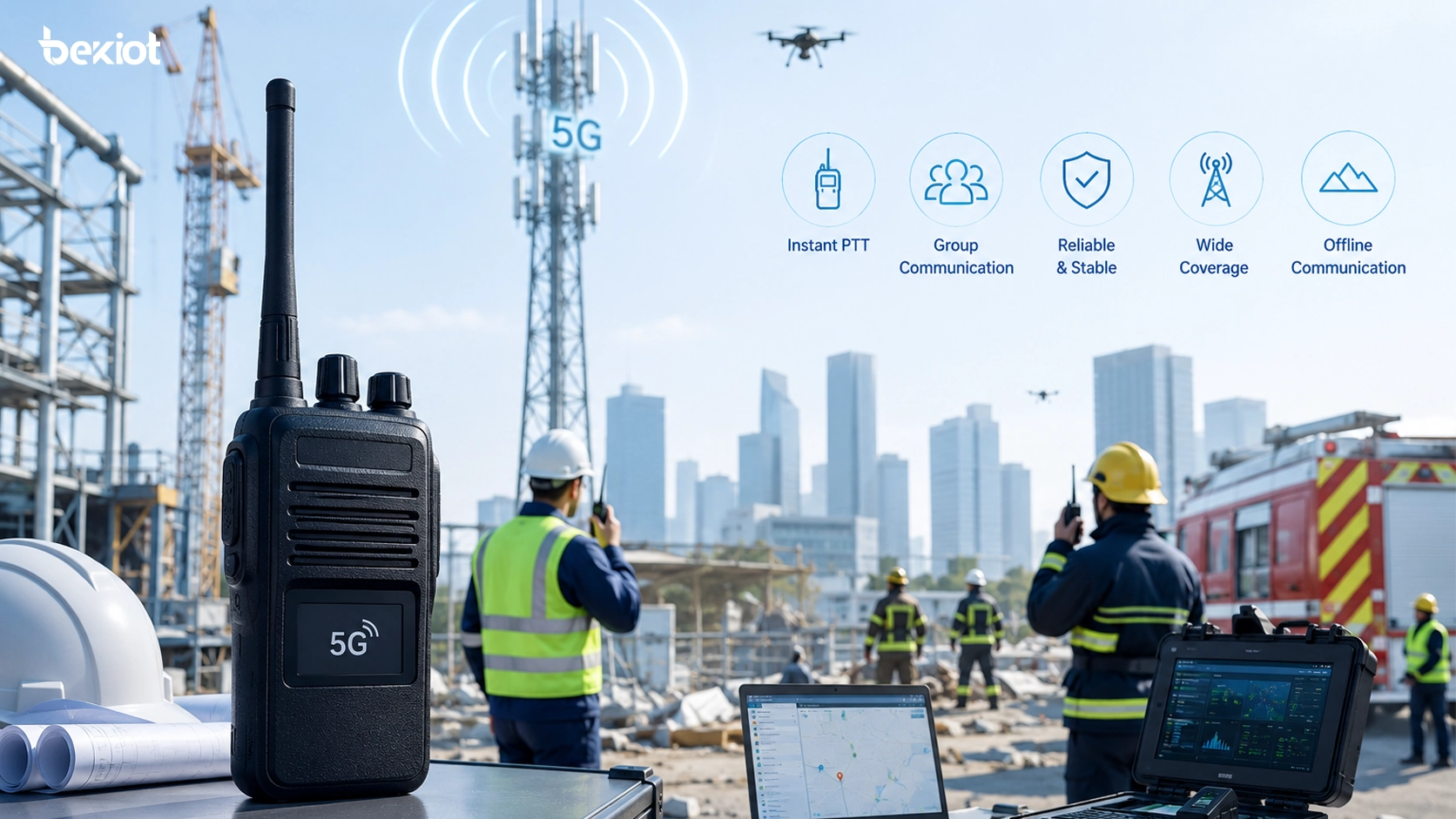
Independent Communication Still Has Real Value
One of the most important advantages of walkie-talkies is off-network communication. In direct mode, users can communicate without relying on public mobile networks, cellular base stations, internet access, or cloud services. This is extremely important in emergency response, rescue operations, remote areas, outdoor work, and temporary field deployments.
When a public network is unavailable, overloaded, damaged, or restricted, a mobile phone may no longer be reliable. A walkie-talkie can continue to provide short-range or system-based communication depending on its operating mode and radio system design. This makes it useful not only as a daily dispatch tool, but also as a backup communication layer.
The value of a walkie-talkie is not that it replaces modern networks. Its value is that it can keep communication available when modern networks are not ideal.
PTT Is Faster Than App-Based Calling
Walkie-talkies use PTT, or Push-to-Talk, as their core communication method. The user presses the button to speak and releases it to listen. This operating model is extremely simple. It requires almost no training, no menu navigation, no contact searching, and no call setup process.
For industries that depend on fast instructions, this simplicity is a major advantage. A security guard, construction worker, firefighter, warehouse operator, hotel staff member, or field technician can send a short message immediately. In many real operations, communication is not a long conversation. It is a short command, a quick confirmation, or an urgent alert.
One Speaker Can Reach the Whole Group
Mobile phones are mainly designed for point-to-point communication. Multi-party calling usually requires additional systems, conferencing features, or software platforms. Walkie-talkies are naturally designed for group communication. One person speaks, and everyone on the same channel or talk group can hear the message.
This one-to-many communication model fits many dispatch scenarios. In security patrols, emergency rescue, logistics, construction, plant operations, and event management, teams often need shared awareness rather than private conversations. Walkie-talkies provide this by default through half-duplex communication.
Half-duplex communication may sound simple, but it is very efficient for operational coordination. It reduces repeated calls, avoids long dialing steps, and allows the whole team to receive the same instruction at the same time.
A Mature Product Range Supports Many Use Cases
Walkie-talkies have remained strong because the product category is mature and highly segmented. There are low-cost models for daily communication and hobby use, professional devices for commercial operations, rugged units for harsh environments, and specialized systems for public safety and industrial users. Price ranges can vary from tens of yuan to several thousand yuan or even more than ten thousand yuan, depending on the required system, features, durability, and certification level.
The technology formats are also diverse. Traditional analog walkie-talkies are still widely used, while digital systems such as DMR, PDT, and TETRA serve different professional and industry-specific requirements. These formats allow users to choose products based on coverage, audio quality, encryption, dispatch needs, system capacity, and project budget.
| Category | Typical Role | Application Value |
|---|---|---|
| Analog walkie-talkies | Basic voice communication | Simple, cost-effective, and easy to deploy |
| DMR systems | Digital commercial and industrial radio | Improved voice quality, capacity, and system features |
| PDT systems | Professional dispatch communication | Suitable for public safety and industry-focused deployments |
| TETRA systems | Mission-critical trunked radio | Designed for high-reliability group communication |
Frequent Use Creates Ongoing Demand
Another reason walkie-talkies have not disappeared is that they are often consumable operational equipment. In many high-frequency-use environments, devices are exposed to drops, dust, water, vibration, battery aging, and long daily operation. Unlike some office devices that may be purchased once and used for many years with little replacement, walkie-talkies in active field use often need periodic replacement or expansion.
For security teams, construction sites, property management departments, factories, emergency teams, and event service providers, procurement is not always a one-time purchase. New projects, staff changes, battery wear, device damage, and system upgrades can all create recurring demand.
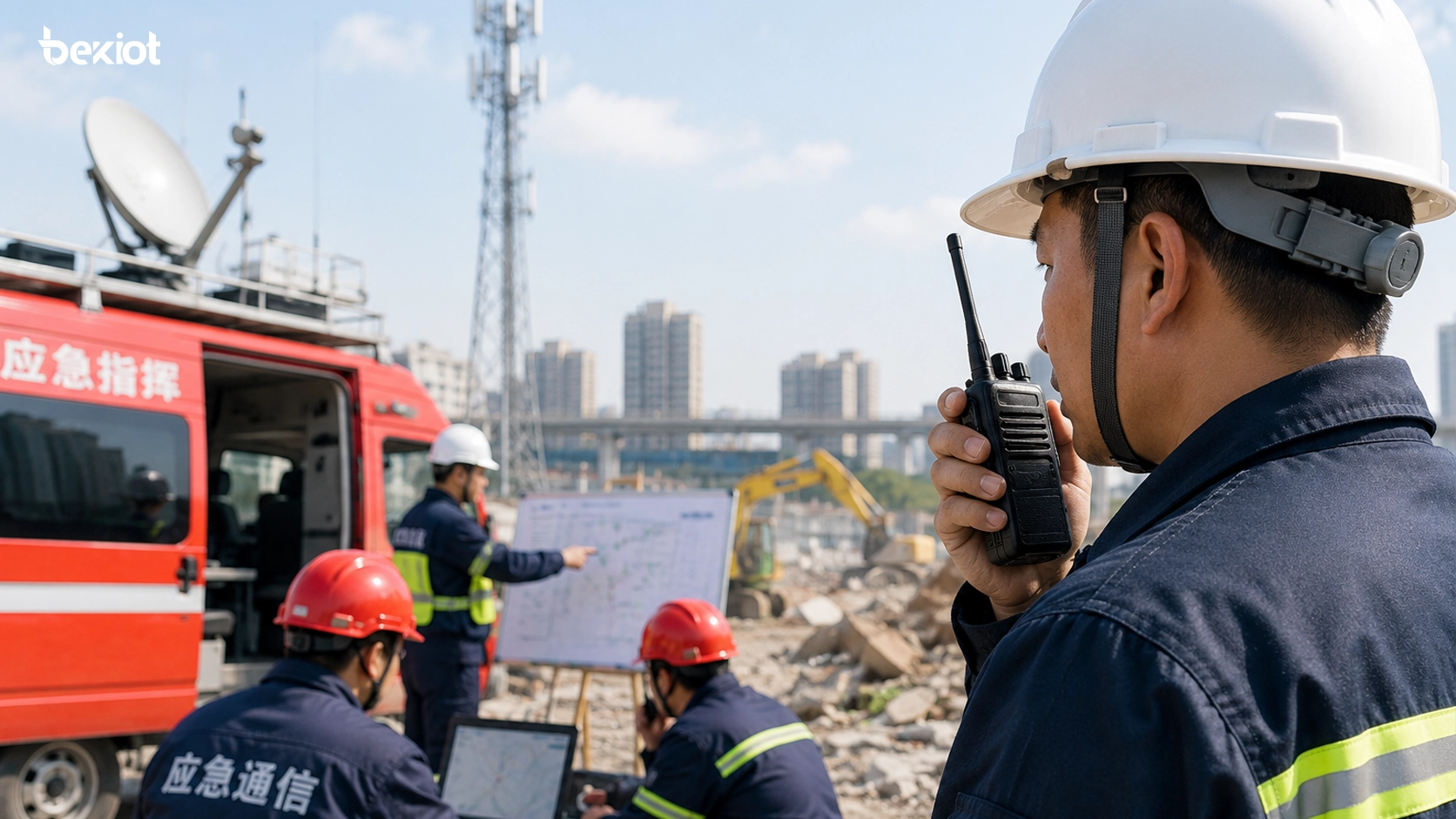
Public Safety Still Depends on Reliable Dispatch
Public safety and emergency rescue remain core application areas for walkie-talkies. Police, fire, rescue, medical emergency teams, and event security teams need communication tools that are simple, fast, and dependable. In large events, public mobile networks may become congested because many people are using the same base stations at the same time.
A dedicated radio communication system can help keep dispatch instructions flowing when mobile networks are overloaded. This is why walkie-talkies are still treated as practical communication tools rather than outdated devices. Their role is not only convenience, but operational reliability.
Industrial Sites Need Hands-Free-Like Simplicity
In heavy industry and construction, workers often operate in conditions where smartphones are not ideal. Crane operators, tunnel workers, drilling teams, factory technicians, and maintenance staff may wear gloves, hold tools, or work in noisy environments. A large physical PTT button is easier to operate than a touchscreen.
This physical usability is a major technical advantage. Walkie-talkies allow users to communicate without looking at the device, unlocking a screen, opening an app, or selecting a contact. In time-sensitive operations, this can improve both efficiency and safety.
Hotels, Properties, and Commercial Teams Need Short Calls
Not every communication requirement is mission-critical, but many are still time-sensitive. In hotels, office buildings, shopping centers, parking facilities, and property management projects, staff communication is usually frequent and short. Security, cleaning, maintenance, front desk, and management teams often need rapid coordination throughout the day.
Using mobile calls or messaging apps for every small instruction can be inefficient. Walkie-talkies support quick team communication with lower operational friction. A short message can be sent to the entire relevant group immediately, which makes daily coordination faster and easier.
RoIP Extends Radio into IP Networks
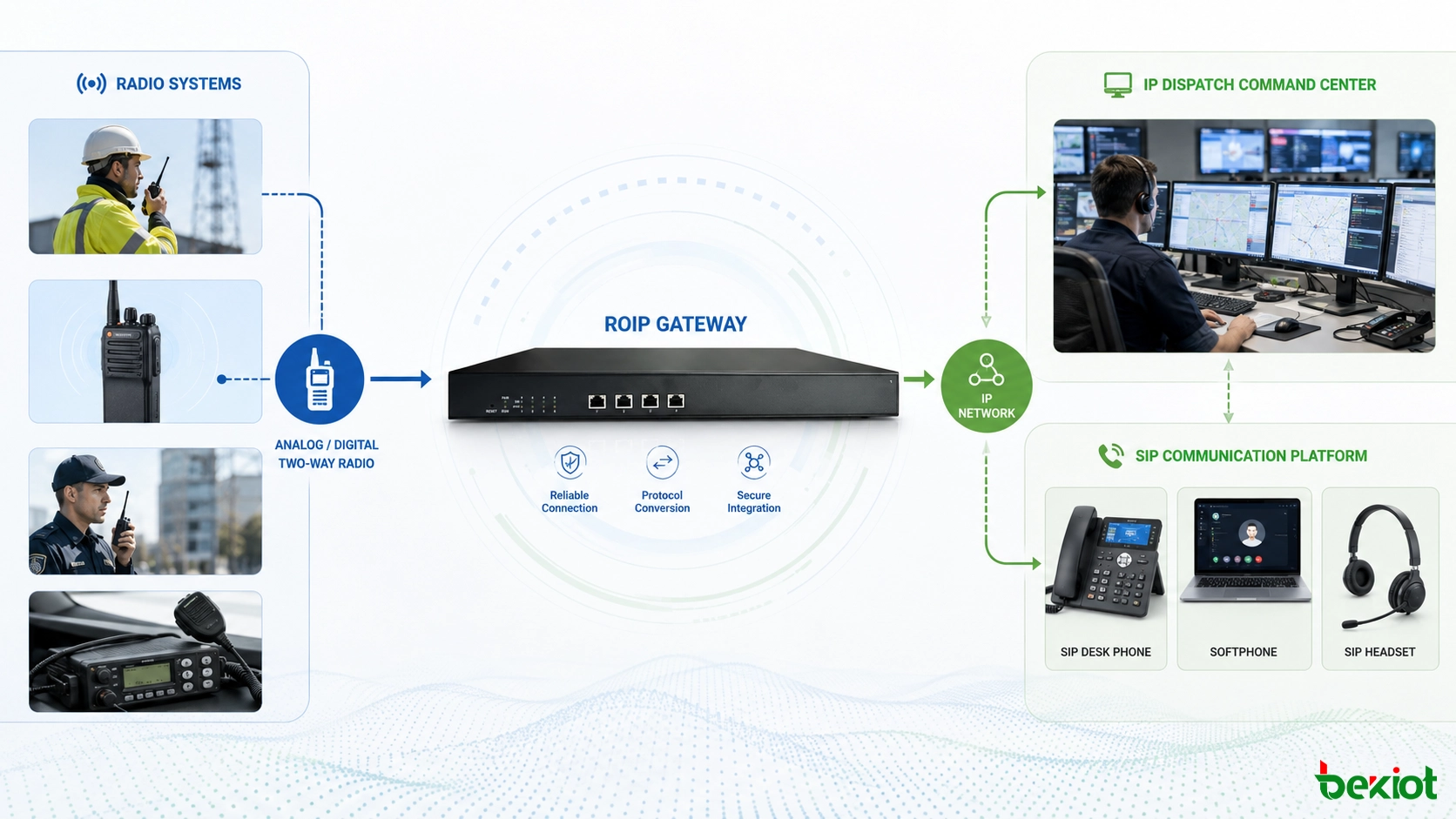
Modern walkie-talkies are no longer isolated from IP-based communication systems. RoIP, or Radio over IP, allows radio communication to be connected with office networks, command centers, dispatch platforms, and mobile applications. Through a RoIP gateway, traditional radio signals can be converted and transmitted over IP networks, enabling wider-area interconnection and cross-system communication.
This “public network plus private radio” model helps preserve the reliability and simplicity of walkie-talkies while extending them into modern command systems. For example, a local radio group can be connected to a remote dispatch center, or radio users can communicate with IP-based dispatch terminals through a gateway layer.
For projects that need radio-to-IP interconnection, Becke Telcom can provide RoIP gateway options for connecting walkie-talkie systems with IP dispatch, SIP communication, and command platforms. This type of integration is especially useful when legacy radio networks need to become part of a broader emergency or industrial communication workflow.
Modern Radio Devices Continue to Evolve
The walkie-talkie market has not remained static. Many modern devices now integrate public-network push-to-talk, GPS positioning, digital encryption, recording, emergency alarms, data functions, and even satellite communication capabilities in some specialized models. These upgrades allow radio communication products to adapt to new operational requirements.
This evolution is one of the reasons the category remains active. Instead of being replaced completely by mobile phones or 5G networks, walkie-talkies are being combined with new communication methods. The result is a more flexible communication ecosystem where radio, IP networks, public-network PTT, and dispatch platforms can work together.
Choosing the Right System Requires Scenario Thinking
The correct walkie-talkie system depends on the user’s environment, communication distance, team size, reliability requirements, budget, and integration needs. A small property team may only need simple analog devices. A large industrial site may require rugged digital radios, repeaters, dispatch software, and recording. A public safety or emergency command project may need private-network radio, cross-region interconnection, and RoIP integration.
Engineering teams should not select products only by price or advertised communication distance. They should evaluate operating mode, coverage design, battery life, audio clarity, device durability, group management, encryption requirements, interoperability, and whether the system needs to connect with IP networks or command platforms.
| Selection Factor | Why It Matters | Typical Consideration |
|---|---|---|
| Network dependency | Determines whether communication can continue without public networks | Direct mode, repeater mode, private network, or public-network PTT |
| Communication style | Defines how users exchange information | PTT, group calls, one-to-many dispatch, emergency alert |
| Industry environment | Affects device durability and usability | Dust, water, noise, gloves, vibration, outdoor use |
| System format | Influences compatibility and long-term expansion | Analog, DMR, PDT, TETRA, public-network PTT |
| IP integration | Enables connection with dispatch and command systems | RoIP gateway, SIP integration, remote dispatch access |
Conclusion
Walkie-talkies have not been eliminated in the 5G era because they are not competing only on network speed or multimedia capability. Their core advantages are direct communication, off-network operation, instant PTT, group broadcasting, simple handling, industry-specific design, and strong suitability for high-frequency operational communication.
5G, public-network PTT, mobile apps, and future communication technologies will continue to grow. But in many real-world scenarios, teams still need a tool that can send a clear voice instruction immediately, reach the whole group, operate with one button, and remain useful when public networks are not dependable. That is why walkie-talkies continue to be relevant, and why modern RoIP integration is making them part of broader IP-based command and communication systems.
FAQ
Why are walkie-talkies still used when 5G is available?
Walkie-talkies provide instant PTT communication, one-to-many group calling, and off-network operation. These features are important in emergency response, industrial operations, construction, public safety, and field coordination where speed and reliability matter more than multimedia functions.
Can walkie-talkies work without a public mobile network?
Yes. Many walkie-talkies can communicate in direct mode without relying on public mobile networks, cellular base stations, or internet access. This makes them useful in remote areas, disaster response, outdoor operations, and temporary work sites.
What is the difference between a walkie-talkie and public-network PTT?
A traditional walkie-talkie uses radio communication and may work independently of public networks. Public-network PTT usually depends on cellular or internet connectivity. Both can be useful, and many modern systems combine private radio with IP or public-network communication.
How does RoIP improve walkie-talkie systems?
RoIP connects radio communication with IP networks. It allows walkie-talkie users to interconnect with dispatch centers, remote sites, SIP systems, and command platforms through a RoIP gateway. This helps traditional radio become part of a wider communication system.







