


A video gateway is not simply a device that forwards video streams from one place to another. In real security, emergency command, industrial monitoring, and smart city projects, it often acts as a media adaptation layer between different cameras, platforms, recorders, body-worn devices, and command systems. Its value comes from stream aggregation, protocol conversion, encoding adaptation, frame rate adjustment, bitrate control, resolution conversion, and platform-level interoperability.
GB/T 28181 is one of the most important standards in many video surveillance and public safety projects. However, saying that a video gateway “supports GB/T 28181” is not enough. Some gateways only allow GB/T 28181 terminals to register. Some can cascade only as a lower-level platform. Others can work only as an upper-level platform. For engineering projects, the gateway becomes much more useful when it supports both directions.
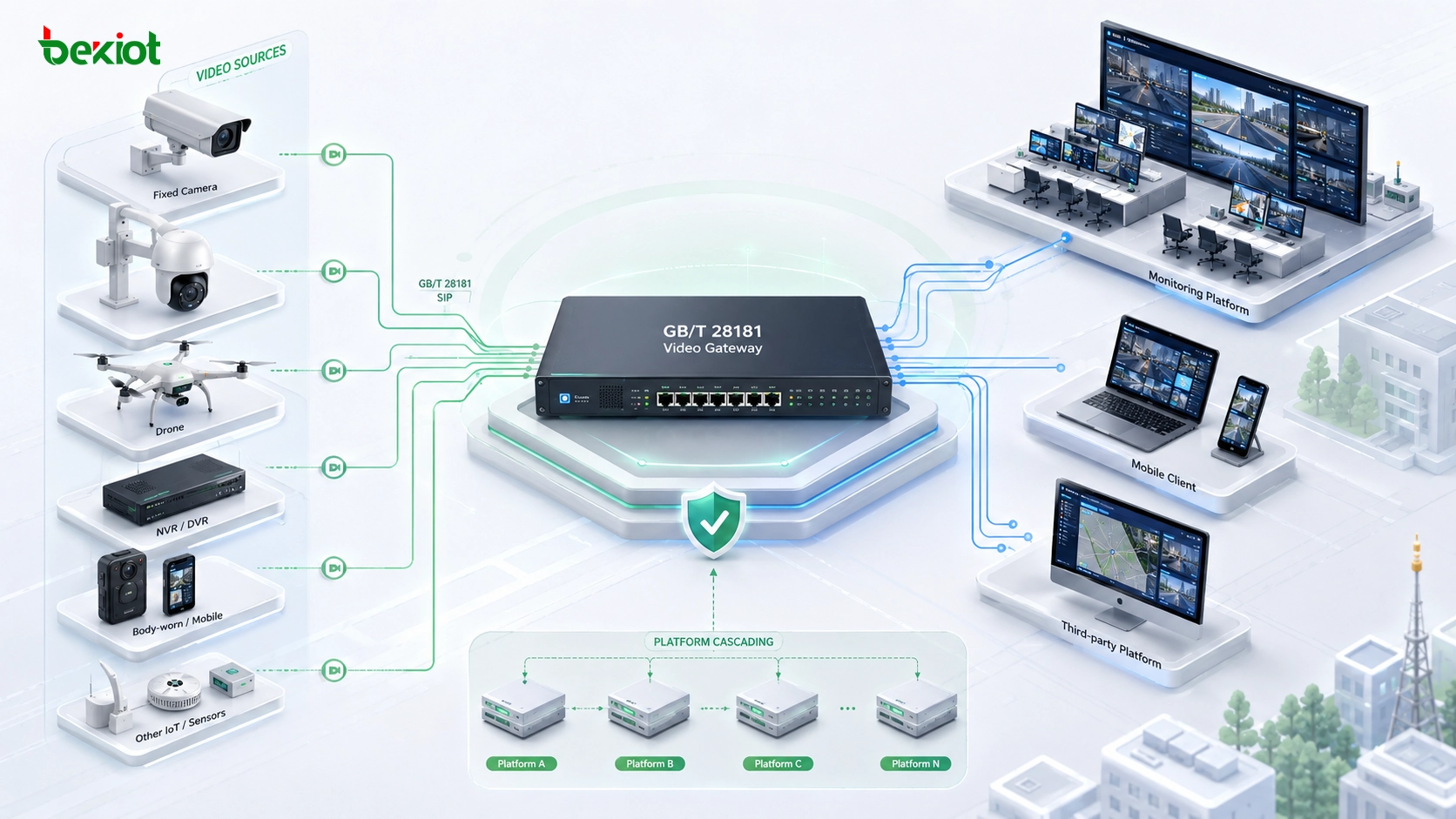
Protocol Compatibility Is Only the Starting Point
Many product datasheets list RTSP, RTMP, GB/T 28181, ONVIF, HLS, WebRTC, or other media protocols. These protocol names show that the gateway can recognize certain stream formats, but they do not always prove that the device supports complete platform logic. In a real project, engineers need to confirm whether the gateway can handle registration, directory synchronization, stream request, stream forwarding, device status, channel mapping, and cascading relationships.
This difference is critical. A gateway may technically support GB/T 28181 but still fail to meet the needs of a multi-platform project if it cannot work as both an upper-level and a lower-level platform. The result may be that cameras, body-worn recorders, existing video platforms, or other surveillance resources cannot be integrated in a manageable way.
A practical video gateway should not only understand media protocols. It should also understand how video platforms organize devices, channels, directories, and cascading relationships.
Receiving Resources from Existing Platforms
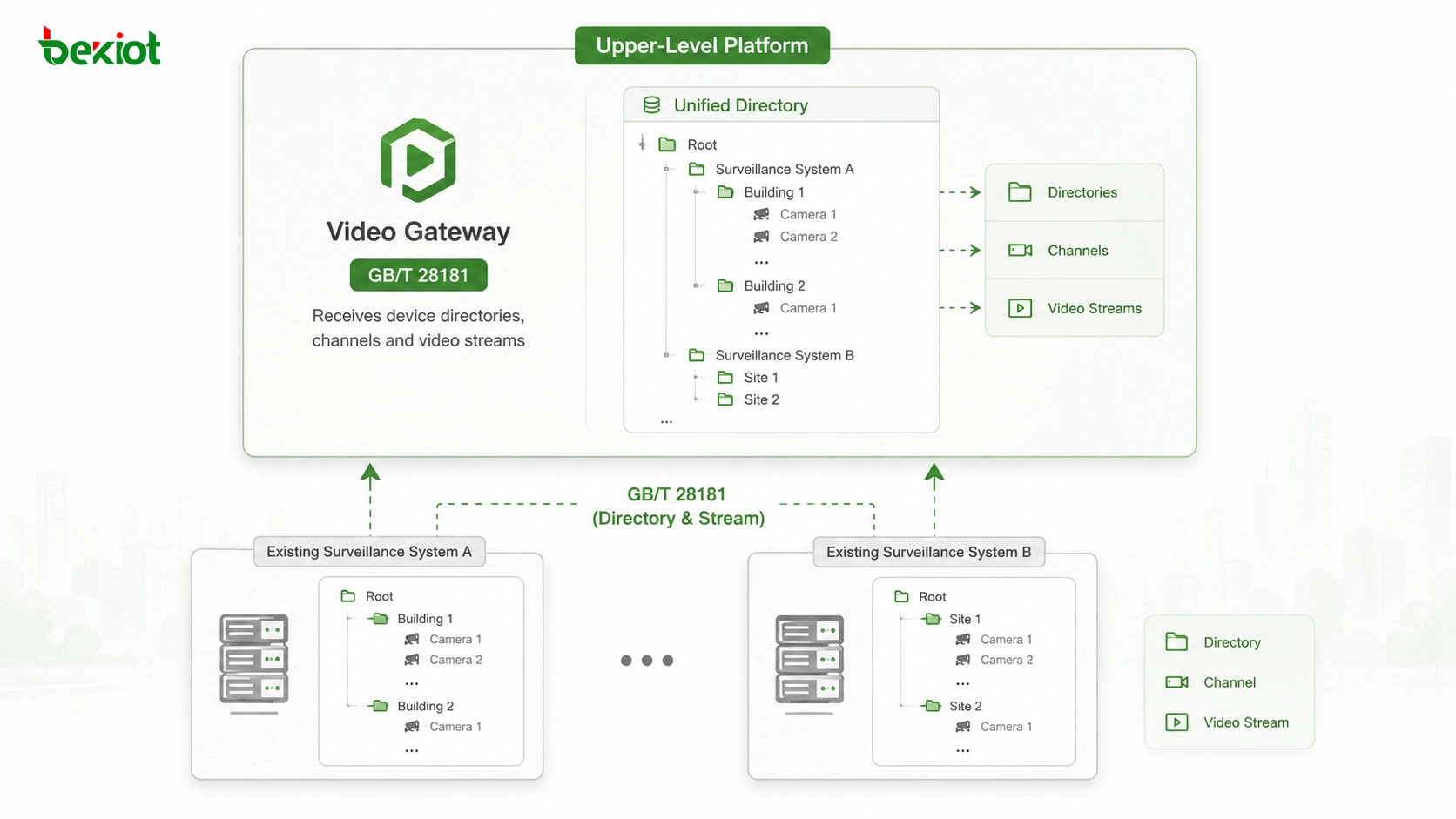
When a video gateway works as an upper-level GB/T 28181 platform, it can receive video resources from lower-level platforms or devices. This function is especially important in large projects where video sources are already distributed across several systems. For example, a project may include GB/T 28181 cameras, mobile recorders, body-worn cameras, surveillance balls, local monitoring platforms, and emergency command platforms.
In a simple deployment, each device can be configured with a GB/T 28181 account and registered directly to the video gateway. The gateway then processes the incoming video stream and outputs it in the required format for another system. But many projects are not this simple. Users may already have a dedicated video surveillance platform, and all field devices may already be connected to that platform.
In this situation, it is not always practical to reconfigure every terminal device. Many terminals support registration to only one GB/T 28181 platform, which means they cannot register to both the existing video platform and the new gateway at the same time. If the gateway can act as an upper-level platform, the existing platform can cascade its device directory and video resources to the gateway without changing every field device.
Why Single-Platform Registration Creates Integration Pressure
One of the most common engineering problems is that terminal devices are already occupied by an existing platform. Cameras, recorders, mobile video units, and other devices may have fixed GB/T 28181 registration settings. Changing these settings can interrupt the original monitoring system, increase deployment risk, and create extra maintenance work.
With upper-level capability, the video gateway can receive the whole directory structure from another platform. It can then access many downstream video channels through platform cascading rather than through direct device-by-device registration. This approach reduces reconfiguration work and makes the gateway more suitable for projects where the video system has already been built.
Publishing Non-Standard Streams Upward
A video gateway also needs lower-level GB/T 28181 capability. In this mode, the gateway registers to an upper-level GB/T 28181 platform as a subordinate platform or device resource. This is one of the most common uses of a video access gateway because many projects need to convert non-GB/T video streams into standard GB/T 28181 resources.
For example, an RTSP camera stream may need to be delivered to an upper-level command platform through GB/T 28181. Video streams from existing security systems, temporary monitoring points, or emergency command platforms may also need to be converted and presented to a public safety or emergency response platform. In these cases, the gateway collects non-standard or non-GB/T streams, organizes them into a device directory tree, and pushes them upward to the GB/T 28181 platform.
From the perspective of the upper-level platform, the video channels under the gateway can be managed like standard GB/T 28181 devices. This greatly simplifies integration because the main platform does not need to understand every original stream protocol. The gateway handles protocol adaptation and presents unified video resources to the platform.
Directory Trees Make Video Resources Easier to Manage
In large-scale projects, video integration is not only about whether the stream can be played. Engineers also need to consider how resources are named, grouped, searched, selected, and maintained. Directory tree delivery is therefore an important capability of a GB/T 28181 video gateway.
When the gateway works as a lower-level platform, it can push all connected video sources to the upper platform in a structured directory. When it works as an upper-level platform, it can receive directory structures from other systems. This two-way directory logic makes the gateway more flexible in command centers, industrial parks, transportation projects, emergency communication systems, and multi-site monitoring networks.
The ability to organize video channels into a clear directory is often just as important as the ability to convert the stream itself.
Media Conversion Should Not Be Limited to Fixed Paths
A qualified video gateway should provide broad stream conversion capability. It should not only support one or two fixed conversion paths, such as RTSP to GB/T 28181 or RTMP to RTSP. In complex projects, different systems may require different stream formats, encoding parameters, frame rates, bitrates, and resolutions.
The gateway should be able to process multiple types of media input and output according to project needs. This includes protocol conversion, video encoding conversion, bitrate adaptation, frame rate adjustment, and resolution conversion. If a product only supports limited conversion between specific protocols, it may work in a demonstration environment but fail when the project encounters special devices or platform requirements.
Where This Capability Matters Most
Both upper-level and lower-level GB/T 28181 support are valuable in projects where video resources come from many different sources. Typical scenarios include urban surveillance, emergency command centers, industrial safety monitoring, transportation hubs, energy facilities, ports, mines, campuses, and temporary command deployments.
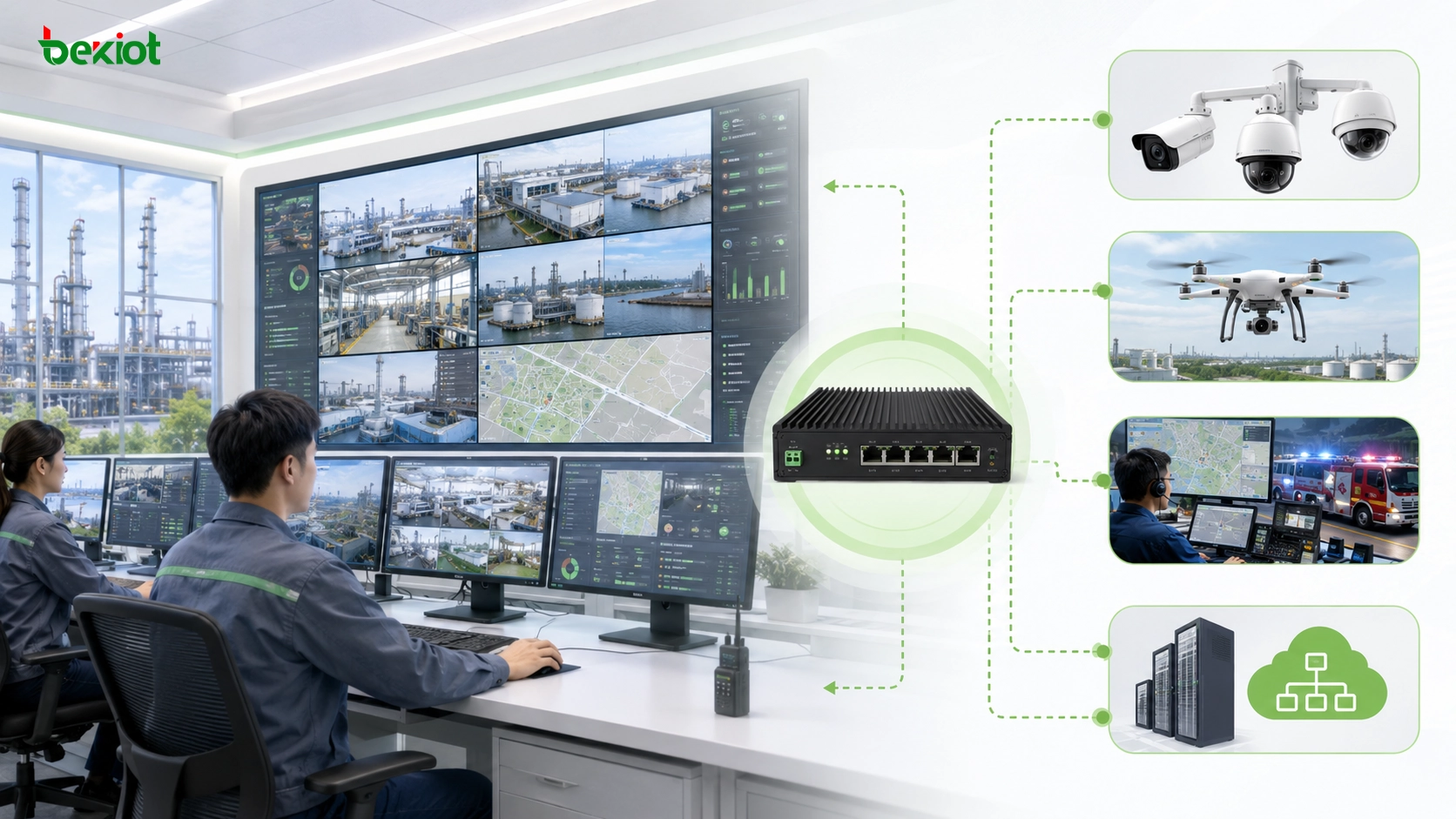
In an emergency command project, for example, fixed cameras, emergency command platforms, body-worn recorders, and existing surveillance systems may all need to be connected to a central dispatch platform. Some resources may already belong to a local GB/T 28181 system, while others may only provide RTSP or RTMP streams. A dual-role video gateway can receive existing GB/T resources from one side and publish newly converted resources to another side.
Engineering Checks Before Selecting a Gateway
Before selecting a video gateway, project teams should verify the real application logic behind the specification sheet. The first check is whether the gateway can work as an upper-level GB/T 28181 platform. This determines whether it can receive device directories and video streams from existing lower-level platforms.
The second check is whether it can work as a lower-level GB/T 28181 platform. This determines whether it can register to an upper platform and publish converted video resources in a standard way. The third check is whether it supports directory tree management, because this affects how video channels are organized and displayed.
The fourth check is whether the gateway supports flexible media conversion rather than limited protocol pairs. Project teams should confirm whether it can process RTSP, RTMP, GB/T 28181, and other required formats, and whether it can adapt video encoding, frame rate, bitrate, and resolution when needed.
| Selection Item | Why It Matters | Recommended Verification |
|---|---|---|
| Upper-level GB/T 28181 capability | Receives device directories and streams from existing platforms | Confirm cascading access, directory import, and channel playback |
| Lower-level GB/T 28181 capability | Publishes converted video resources to an upper platform | Test registration, directory push, and stream request from the upper platform |
| Non-standard stream conversion | Adapts RTSP, RTMP, existing surveillance feeds, and other video sources | Verify real input and output formats required by the project |
| Media processing | Supports encoding, bitrate, frame rate, and resolution adaptation | Check whether conversion is flexible or limited to fixed paths |
| Directory management | Makes large numbers of video resources easier to manage | Review directory tree display, channel naming, and grouping logic |
Building a More Reliable Video Integration Layer
In a well-designed video integration solution, the video gateway sits between field video sources, existing platforms, command systems, and upper-level monitoring platforms. It reduces the need to change terminal devices, avoids repeated configuration work, and provides a unified access point for video stream processing.
This is also where video integration can work together with voice dispatch, emergency communication, public address, and command systems. For projects that need video linkage with industrial telephones, SIP dispatch, emergency calls, or command center workflows, Becke Telcom can be considered as a solution partner for converged communication and system-level integration. The video gateway layer can then become part of a broader response workflow instead of an isolated video tool.
Conclusion
A video gateway needs both upper-level and lower-level GB/T 28181 capabilities because real projects are rarely built from a single platform or a single protocol. Some video resources already exist under GB/T 28181 platforms. Some devices can register to only one platform. Some video streams come from RTSP, RTMP, recorders, emergency command platforms, or other non-standard sources. A gateway that supports both directions can receive existing resources, convert new streams, publish unified directories, and make platform integration much easier.
When selecting a video gateway, engineers should look beyond protocol names in the product description. The key question is whether the gateway supports complete project logic: cascading, directory management, stream conversion, media adaptation, and stable platform interconnection. Only then can the gateway provide real value in large-scale monitoring, emergency response, industrial safety, and command center applications.
FAQ
What does upper-level GB/T 28181 capability mean for a video gateway?
It means the video gateway can act as an upper platform and receive video resources, device directories, and channels from lower-level GB/T 28181 platforms or devices. This is useful when video resources are already connected to another platform and cannot be registered directly to the gateway one by one.
What does lower-level GB/T 28181 capability mean?
It means the gateway can register to an upper GB/T 28181 platform and publish its connected or converted video sources upward. For example, it can convert RTSP or RTMP streams into GB/T 28181 resources and present them to the upper platform through a directory tree.
Why is simple GB/T 28181 support not enough?
Because protocol support does not always include full platform behavior. A gateway may support GB/T 28181 stream access but fail to support cascading, directory synchronization, upper-level access, or lower-level registration. These functions are often required in real engineering projects.
Which projects need this type of video gateway?
It is useful in public safety, emergency command, industrial monitoring, transportation, energy, ports, campuses, mines, and multi-site surveillance projects. These environments often include mixed video sources, existing monitoring platforms, emergency command platforms, and upper-level command systems.







