


Deep space exploration depends on communication as much as propulsion, navigation, and life support. When a spacecraft travels around the Moon, it is not enough to send back simple telemetry or low-resolution images. Modern missions need high-definition video, scientific data, operational files, flight plans, crew communication, and real-time mission support across hundreds of thousands of kilometers.
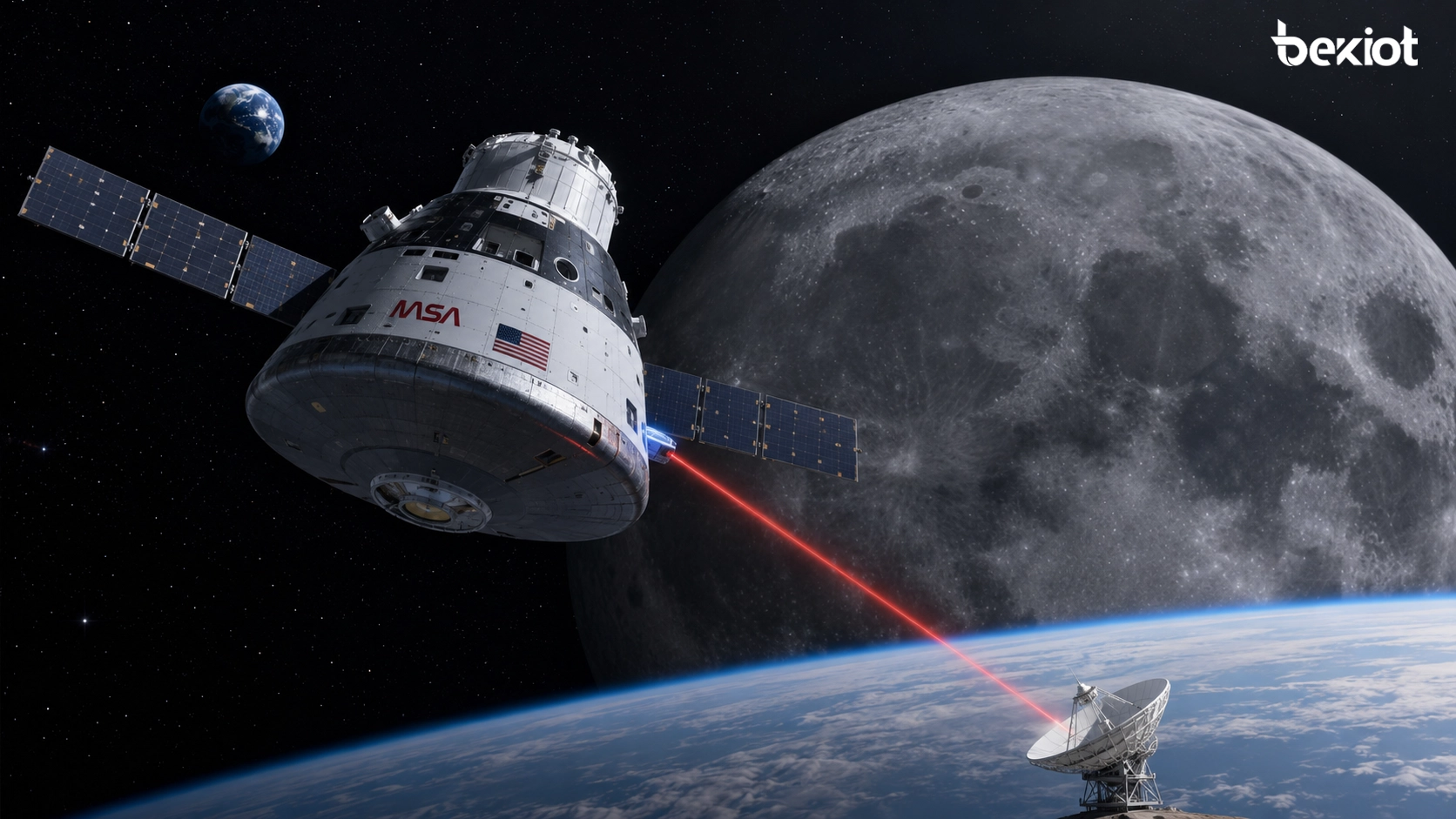
The Artemis II mission brought this requirement into a new stage. During the crewed lunar flyby, NASA’s Orion spacecraft carried the Orion Artemis II Optical Communications System, known as O2O. This laser-based communication payload was designed to demonstrate how optical links can deliver far higher data capacity than traditional radio-frequency communication in deep space operations.
A New Requirement for Lunar Missions
Human lunar exploration has changed dramatically since the Apollo era. Early missions mainly relied on voice, telemetry, still images, and limited television signals. Today, mission teams expect spacecraft to send large volumes of data, including high-resolution imagery, 4K video, system diagnostics, science records, operational documents, and crew support media.
The distance between Earth and the Moon is roughly 380,000 kilometers. At this scale, communication systems must overcome signal loss, pointing accuracy, limited spacecraft power, atmospheric effects near Earth, and the need for stable ground reception. Traditional radio-frequency systems remain essential, but they are increasingly challenged by the rising data demand of modern exploration.
This is why optical communication is becoming important. Instead of using conventional radio waves, optical systems transmit data through infrared laser beams. The narrower beam and higher carrier frequency allow far more information to be packed into the link, making the technology suitable for data-heavy exploration missions.
What O2O Adds to Orion
O2O stands for Orion Artemis II Optical Communications System. It was developed as a laser communication terminal for the Orion spacecraft and was created through work involving NASA’s Goddard Space Flight Center and MIT Lincoln Laboratory. Before integration with Orion, the terminal went through demanding environmental testing to verify that it could operate under the vibration, temperature variation, radiation, and reliability requirements of spaceflight.
In the Artemis II architecture, O2O was not intended to replace every communication method. Instead, it added a high-capacity optical layer to support data products that are difficult to transmit efficiently through conventional channels. These include high-definition video, detailed images, flight plans, operational procedures, and mission communication files.
The system represents a practical step from experimental optical demonstrations toward operational use. For future lunar and Mars missions, this type of payload can help transform deep space communication from a low-bandwidth support function into a mission-critical data infrastructure.
Why Laser Links Carry More Information
Radio waves and infrared laser light both travel at the speed of light in vacuum, but their communication characteristics are different. Infrared light has a much shorter wavelength and higher frequency than most traditional radio-frequency communication bands. This allows optical communication systems to support much higher data capacity within a focused beam.
The result is a major increase in transmission efficiency. Compared with radio-frequency links, optical communication can move larger data packages within the same communication window. For lunar missions, this means more imagery, more science data, more engineering information, and better support for real-time or near-real-time mission operations.
Laser beams are also highly directional. This improves link efficiency and can reduce unwanted signal spread. However, it also creates strict pointing requirements. The spacecraft terminal and ground station must align accurately so that the narrow beam can be captured and decoded.
Optical communication does not simply make a space link faster. It changes the type and volume of information that can realistically be returned from deep space.
The 260 Mbps Performance Target
One of the most important technical figures associated with O2O is its lunar-distance downlink capability. NASA’s public material describes data transmission rates up to 260 megabits per second. For deep space communication, this is a major step forward because it supports data flows that are closer to terrestrial broadband behavior than traditional low-bandwidth mission links.
At this level of capacity, a mission can send high-definition imagery, video, science data, procedures, and operational files with far greater efficiency. In practical terms, this gives engineers, scientists, mission controllers, and the public a richer view of the spacecraft’s environment and crew activities.
For Artemis II, this capability supported the broader goal of demonstrating technologies that will be needed for sustained lunar exploration. A future lunar base, orbiting platform, surface rover network, or Mars transfer mission will require much more than basic voice and telemetry. It will need a layered communication network capable of moving large data volumes reliably.
How the System Works in a Mission Architecture
A deep space optical link is built around three major segments: the spacecraft terminal, the optical signal path, and the ground receiving network. On the spacecraft side, the terminal converts mission data into laser signals and points the optical beam toward Earth. On the ground side, specialized optical stations receive the beam, recover the data, and connect it to mission control systems.
The spacecraft terminal must handle modulation, pointing control, acquisition, tracking, and data interface functions. Because the laser beam is narrow, the system must maintain precise alignment while Orion is moving through space and Earth is rotating below. This is a more demanding process than a wide-beam radio link, but the reward is much higher data throughput.
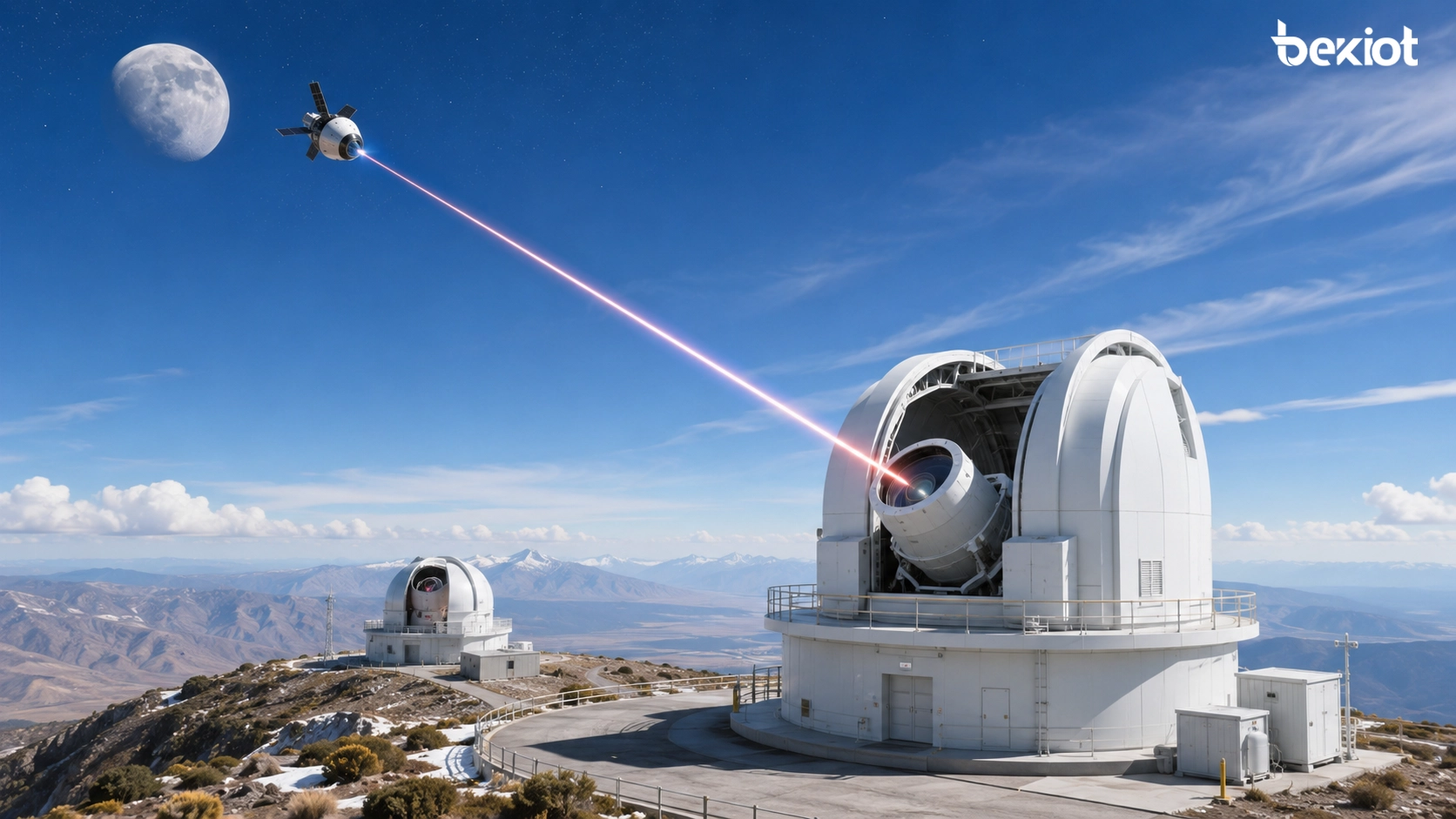
The ground segment is equally important. Optical receiving stations must be located where atmospheric conditions are favorable. High altitude, dry air, low cloud cover, and stable visibility can improve the chance of receiving the laser beam successfully. This is why optical ground stations are often built in carefully selected locations rather than in ordinary urban environments.
Atmospheric Conditions Become a Design Factor
Laser communication offers high bandwidth, but it also faces a challenge that radio-frequency systems handle differently: Earth’s atmosphere. Clouds, rain, fog, dust, turbulence, and moisture can weaken, scatter, or block optical signals. A clear line of sight is therefore much more important for an optical link.
This does not make laser communication impractical. Instead, it means the system must be designed as part of a resilient network. Multiple receiving sites, weather-aware scheduling, backup communication paths, and hybrid radio-optical strategies can improve service continuity. In a real mission, optical communication works best when it is integrated with other mission communication layers.
NASA’s optical ground station strategy reflects this requirement. Stations in dry, high-altitude, low-cloud locations can increase the probability of successful reception. With a distributed ground network, the mission can select the best available site based on geometry and weather conditions.
System Efficiency Matters in Spacecraft Design
Every spacecraft has strict limits on mass, volume, power, and thermal performance. A communication terminal that can deliver high data throughput while using space and power efficiently has direct mission value. Lighter and more efficient communication systems can free spacecraft resources for other payloads, scientific instruments, redundancy, or crew-support equipment.
Optical terminals can offer advantages in size, weight, and power compared with some traditional high-capacity radio-frequency alternatives. This is especially important for exploration missions where launch mass and spacecraft integration space are limited. A smaller terminal that can return more data helps mission planners make better use of the spacecraft.
Efficiency also affects the long-term communication architecture. If future lunar and Mars missions require continuous high-volume data exchange, communication payloads must scale without adding excessive mass or complexity to every spacecraft.
More Data Means More Scientific Value
The technical benefit of optical communication is not only faster transmission. The deeper value is that more data can reach Earth in a usable time frame. Higher bandwidth allows scientists to receive larger raw datasets, compare observations more quickly, and make decisions based on richer information.
For crewed missions, high-capacity links also improve operational awareness. Mission control can receive clearer imagery, better system data, and more detailed crew communication. For public engagement, high-definition video from lunar distance can make space exploration more visible, understandable, and emotionally powerful.
In future missions, this capability could support surface mapping, rover operations, habitat monitoring, scientific payload control, medical support, and remote engineering diagnostics. The communication system becomes part of the mission’s intelligence layer rather than a simple transmission pipe.
From Demonstration to Operational Network
O2O should be understood as part of a larger technology roadmap. NASA’s space communication strategy has been moving optical communication from laboratory validation to flight demonstration and then toward operational deployment. The Artemis II mission provided an important opportunity to test this technology in a crewed lunar mission environment.
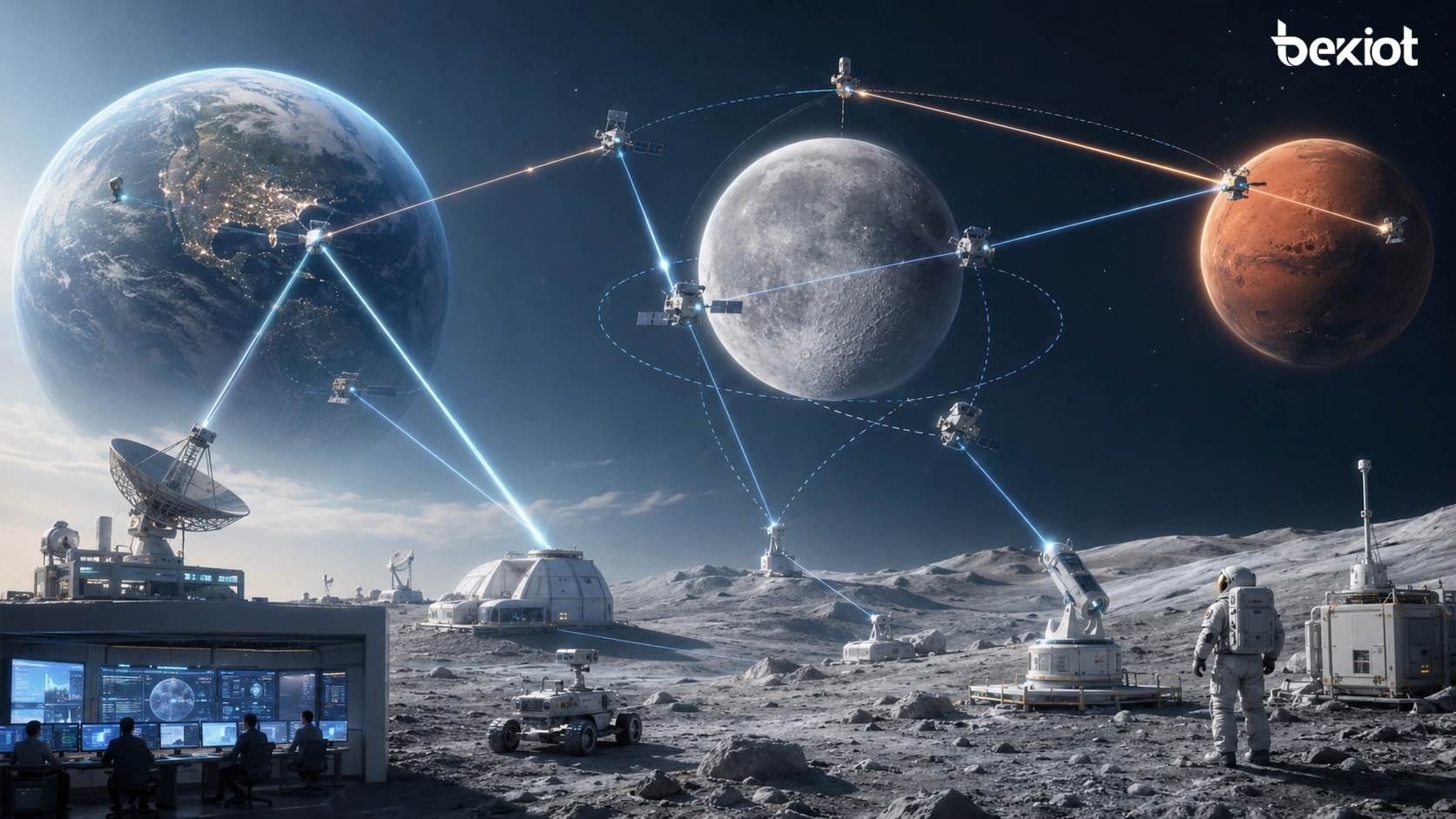
This transition matters because future exploration will not be limited to single spacecraft missions. Long-term lunar activity may include orbital platforms, surface habitats, robotic assets, crewed vehicles, science stations, and eventually Mars-bound spacecraft. These assets will need a communication network that can scale across distance, data volume, and mission complexity.
Optical communication is therefore a building block for the Moon-to-Mars architecture. It can support a future environment where deep space missions exchange high-resolution imagery, scientific measurements, operational files, and human communication through a more capable network.
Engineering Considerations for Similar Systems
Any organization planning an optical communication system for aerospace, remote sensing, high-altitude platforms, or advanced mission networks must consider more than peak data rate. The full system design should include link budget, pointing accuracy, acquisition strategy, tracking stability, ground station diversity, atmospheric loss, fallback communication, data security, and operational workflow.
The optical terminal must be designed as part of the complete mission architecture. It needs compatible onboard data systems, stable power, thermal control, precise mechanical pointing, and software integration with mission operations. The ground network must support scheduling, signal acquisition, weather monitoring, data routing, and handover to mission control or data processing platforms.
This is why optical communication is best treated as a system-level solution. A high-speed laser terminal alone is not enough. The real value appears when spacecraft hardware, ground stations, network management, mission planning, and data processing operate together.
| Design Area | Technical Role | Project Impact |
|---|---|---|
| Optical terminal | Converts spacecraft data into laser signals and maintains beam pointing | Determines link capacity, reliability, and payload integration requirements |
| Ground stations | Receive, track, and decode laser signals from space | Affect availability, weather resilience, and global coverage |
| Atmospheric planning | Accounts for clouds, rain, fog, turbulence, and visibility | Improves link scheduling and operational continuity |
| Hybrid communication | Combines optical links with radio-frequency backup channels | Balances high throughput with mission reliability |
| Data workflow | Routes video, images, telemetry, procedures, and science data | Turns bandwidth into usable mission information |
Why This Technology Matters Beyond Artemis II
The significance of O2O goes beyond one mission. It shows how future exploration programs can move from limited data return to broadband-like deep space communication. As missions become more complex, communication links must support not only spacecraft health data but also human interaction, science operations, real-time decision-making, and public outreach.
For lunar missions, optical communication can help support high-volume surface operations. For Mars missions, it can become part of a long-distance data architecture where every bit of bandwidth matters. For Earth-orbit and near-space platforms, the same principles can improve downlink capacity for imaging, sensing, and scientific payloads.
In this sense, O2O is not only a communication payload. It is a prototype for a future space data infrastructure, where optical links, radio-frequency systems, relay networks, and ground stations work together to support human expansion beyond low Earth orbit.
Conclusion
O2O demonstrated why deep space optical communication is becoming essential for the next stage of lunar and planetary exploration. By using infrared laser transmission, the system can deliver much higher bandwidth than traditional radio-frequency links, supporting 4K video, high-resolution imagery, mission data, flight plans, and operational communication across lunar distances.
The technology also introduces new engineering challenges, including precise beam pointing, atmospheric interference, ground station site selection, and system-level integration. These challenges do not reduce its value. Instead, they define the architecture needed for reliable, high-capacity space communication.
As lunar exploration moves toward sustained operations and future Mars missions, communication will become a core infrastructure layer. O2O shows that the path forward is not simply sending signals farther, but sending richer, faster, and more useful information across deep space.
FAQ
What does O2O stand for?
O2O stands for Orion Artemis II Optical Communications System. It is a laser communication payload designed for NASA’s Orion spacecraft during the Artemis II mission.
Why use laser communication instead of only radio-frequency links?
Laser communication can transmit much more data because infrared light has a shorter wavelength and higher frequency than traditional radio-frequency systems. This allows higher data capacity, narrower beam transmission, and improved efficiency for data-heavy missions.
What data rate can O2O support?
NASA’s public information describes O2O as capable of transmitting data at rates up to 260 megabits per second, supporting high-definition video, images, science data, procedures, flight plans, and communication between Orion and Earth.
What is the biggest challenge for deep space laser communication?
One of the biggest challenges is atmospheric interference near Earth. Clouds, fog, rain, and turbulence can weaken or block optical signals, so missions need carefully selected ground stations, weather-aware planning, and backup communication methods.
How does this technology support future Moon and Mars missions?
Future missions will need to transmit much larger volumes of data from spacecraft, lunar infrastructure, surface systems, and eventually Mars-bound missions. Optical communication provides a scalable way to increase bandwidth and support richer mission operations.







