


In emergency command, public safety, energy, utilities, transportation, industrial operations, and field service environments, walkie-talkies and radio systems remain essential communication tools for frontline teams. They are simple, fast, and reliable for push-to-talk coordination. However, many projects face the same practical problem: different radio systems often operate in separate and closed communication environments.
A command center may already use a converged communication platform with voice dispatch, video meetings, monitoring screens, IP telephony, and alarm linkage. Frontline personnel may still rely on radios. Public-network push-to-talk systems may also be used alongside private radio networks. Without a suitable gateway layer, these systems may all work independently, making real-time coordination difficult when it matters most.
A RoIP gateway helps solve this problem by converting radio voice and control behavior into IP-based communication resources. It can connect radio channels with SIP dispatch systems, bridge public-network PTT platforms with private radio networks, and create direct back-to-back interconnection between different radio terminals.
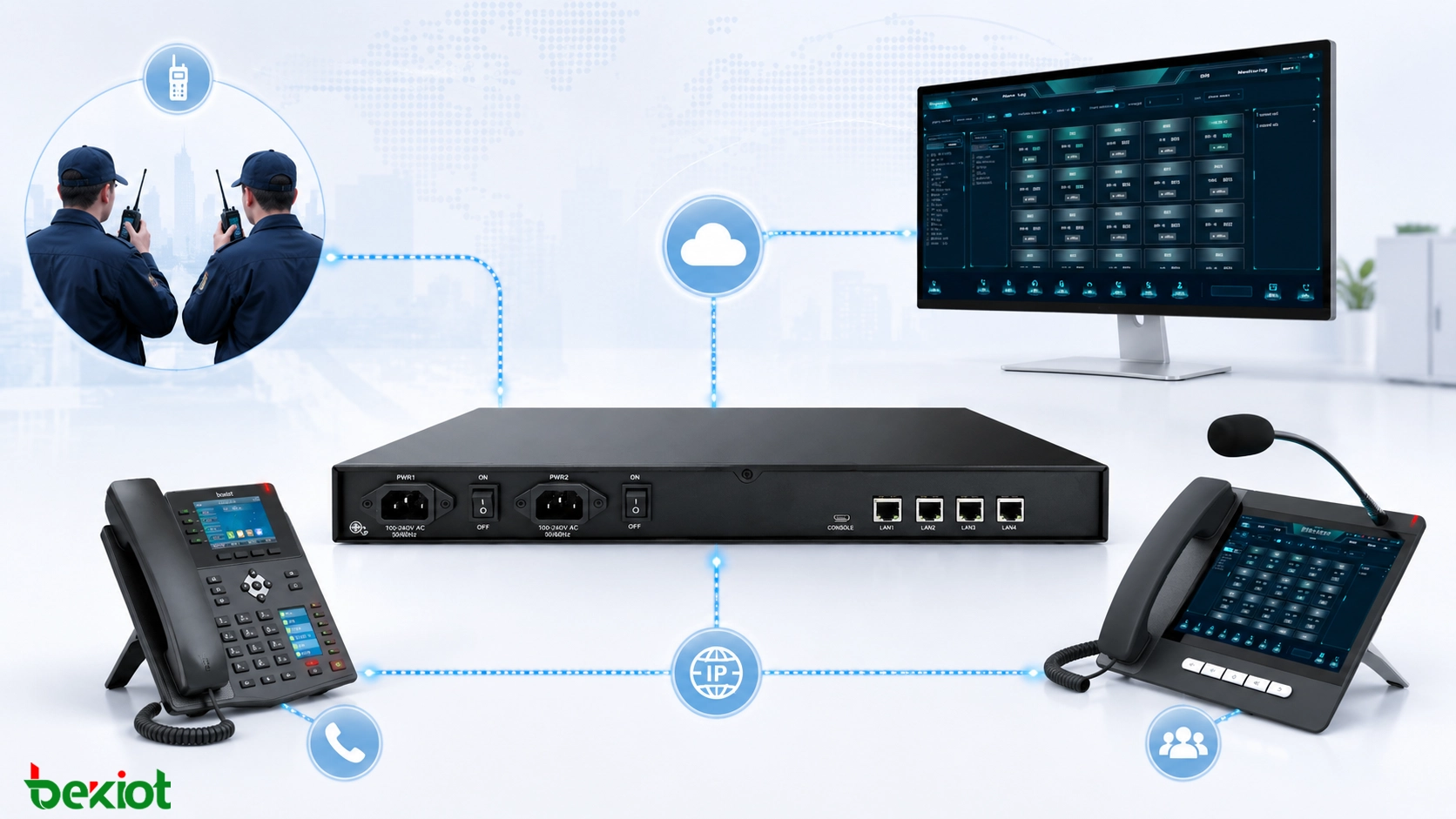
The Integration Challenge in Field Communication
Many organizations have upgraded their command centers with modern communication platforms. These systems may support IP phones, dispatch consoles, video conferencing, monitoring integration, alarm workflows, and unified communication management. On paper, the platform looks complete. In real operations, however, one important gap often appears: the radio network is still outside the platform.
This creates a communication break between dispatchers and field users. The dispatcher operates from an IP-based command system, while field personnel use handheld radios, mobile radios, or private radio systems. Without radio integration, messages may need to be relayed manually. This slows down response, increases misunderstanding, and weakens the value of the command platform.
The role of a RoIP gateway is to bring the radio side into the IP communication workflow. By converting radio audio and PTT behavior into a format that dispatch systems can use, it extends command center communication directly to frontline radio users.
Connecting Radios to a Dispatch Platform
The first typical use of a RoIP gateway is to connect traditional radio terminals with a converged communication platform or command dispatch system. In this model, the gateway converts radio-side voice into standard SIP communication. After integration, dispatch operators can call radio users from the platform, and radio users can speak back by pressing PTT.
This makes radios, IP phones, dispatch consoles, and communication platforms work as part of one coordinated system. The command center no longer needs to rely on manual message transfer between different communication tools. Dispatch instructions can reach frontline radio users more directly, and field feedback can return to the command platform in a more structured way.
This model is suitable for command center construction, emergency dispatch projects, industrial control rooms, public safety communication systems, and video meeting platforms that need to include radio voice as part of the wider workflow.
The real value of RoIP is not only audio conversion. It is the ability to make field radios become usable communication resources inside a modern IP dispatch environment.
How SIP Makes Radio Access Easier
SIP is widely used in IP telephony, dispatch systems, call control platforms, and unified communication networks. When a RoIP gateway supports SIP, radio channels can be connected to systems that already understand SIP signaling. This reduces integration complexity and makes the gateway easier to deploy in existing IP communication projects.
For example, a dispatcher may use a SIP-based console to initiate communication with a radio channel. The gateway handles the link between the SIP side and the radio side, including audio transmission and PTT control behavior. This allows the radio channel to become part of the same communication environment as IP phones, dispatch terminals, and other SIP endpoints.
In practical engineering, this capability is especially valuable when users want to preserve existing radio assets while upgrading the command center to an IP-based communication platform.
Linking Public-Network PTT and Private Radio
The second typical use is to connect public-network push-to-talk systems with private radio systems. Public-network PTT, often based on 4G or broadband mobile networks, has become common because it offers wide coverage and flexible deployment. However, many organizations still rely on private radio networks for local reliability, dedicated communication, or existing operational habits.
The challenge is that public-network PTT and private radio systems are usually two different communication worlds. Users on one side may not be able to speak directly with users on the other side. A RoIP gateway can act as the bridge between them.
In a more advanced deployment, the gateway does more than pass audio. It can participate in talk-right control. When a public-network PTT user presses the talk button, the gateway can trigger PTT behavior on the private radio side. When the radio side finishes speaking, the gateway can release the talk right. This creates a more natural conversation experience and reduces delay compared with simple audio bridging.
This type of integration usually requires interface cooperation from the public-network PTT platform. If the platform supports common control methods such as SIP INFO, DTMF, or other signaling interfaces, the connection can be smoother and easier to adapt.
Creating Direct Back-to-Back Radio Bridges
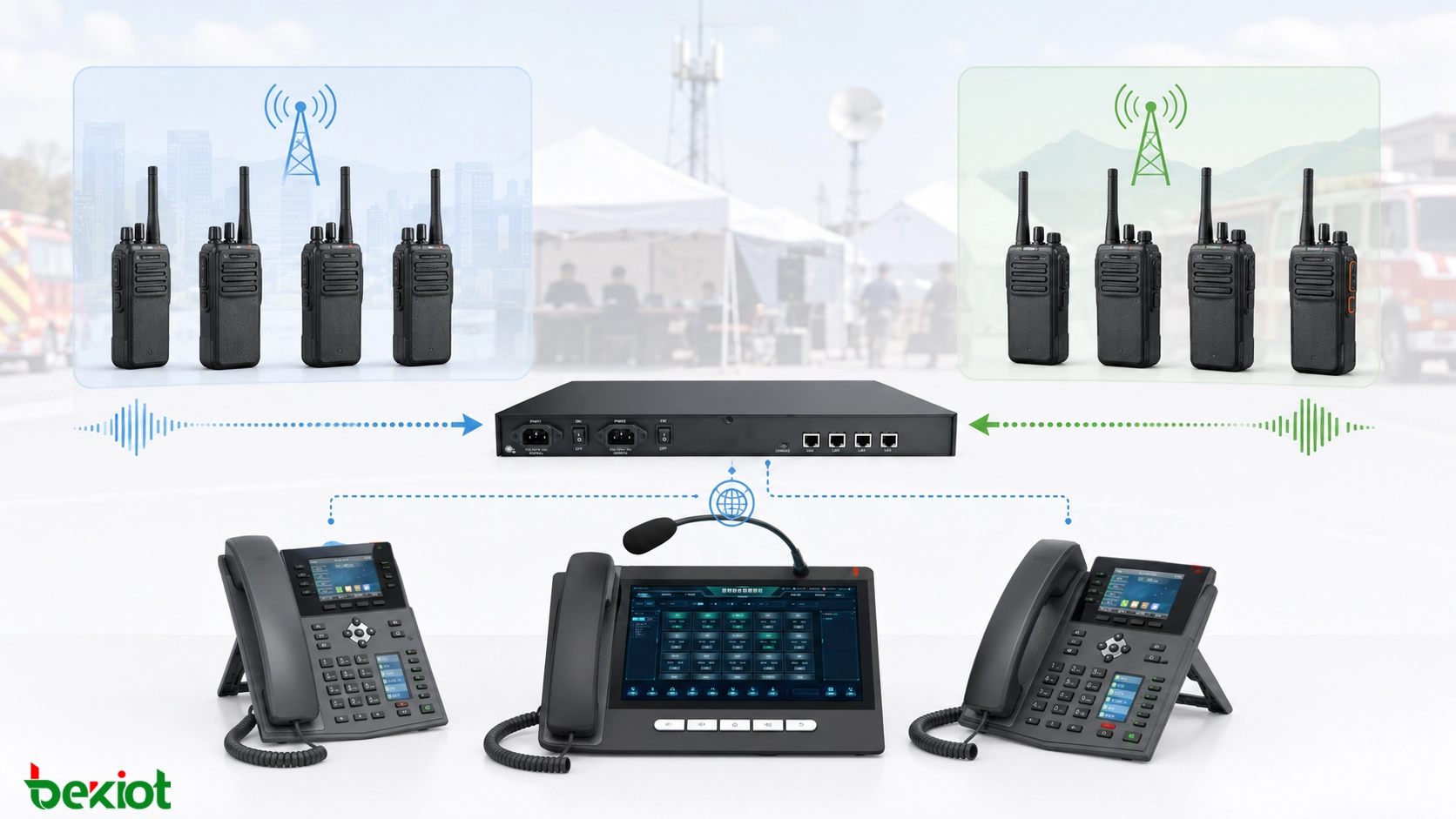
The third use is more direct. In some temporary operations, there may be no converged communication platform and no public-network PTT system. The site may simply have two different radio systems that need to communicate with each other. In this case, the RoIP gateway can be used in a back-to-back bridging mode.
One radio interface is connected to one radio system, and another interface is connected to a different radio system. The gateway sits in the middle and bridges the voice path. When users on one side speak, users on the other side can hear the message. This is useful when two teams use different radio frequencies, different systems, or different devices but need quick temporary coordination.
This mode is especially useful for emergency response, temporary joint operations, cross-department coordination, rescue sites, event security, and other scenarios where a fast interconnection is needed without building a full platform.
Why VOX and COR Matter
In back-to-back radio bridging, one key technical question is how the gateway knows when someone is speaking. Without platform signaling, the gateway needs a way to detect radio activity and trigger the correct audio path. This is where VOX and COR become important.
VOX, or voice activation, detects whether someone is speaking based on audio input. When voice is detected, the gateway can activate transmission behavior. COR, or carrier-operated relay detection, identifies radio signal status and helps the gateway understand whether a radio channel is active.
Audio buffering is also important. In fast PTT switching, the first words of a message may be lost if the system reacts too slowly. A gateway with voice buffering helps preserve the beginning of the speech and improves conversation clarity during radio-to-radio switching.
Choosing the Right Architecture
The correct deployment model depends on the user’s communication environment. If the organization already has a SIP dispatch system or converged communication platform, the gateway should be used to bring radio channels into the platform. If the user already has public-network PTT and private radio systems, signaling-level integration should be considered. If the requirement is temporary and simple, back-to-back radio bridging may be enough.
This is why a RoIP gateway should not be selected only by the number of interfaces. Engineers should evaluate protocol support, SIP compatibility, PTT control, VOX and COR detection, audio buffering, web-based configuration, power reliability, network design, and long-term maintenance requirements.
| Use Case | System Problem | Gateway Role | Typical Scenario |
|---|---|---|---|
| Radio to SIP dispatch | Radios cannot communicate with the IP command platform | Converts radio voice and PTT behavior into SIP communication | Command centers, industrial dispatch, public safety platforms |
| Public-network PTT to private radio | PoC users and private radio users cannot talk directly | Bridges audio and supports talk-right control through signaling | Organizations using both broadband PTT and private radio |
| Back-to-back radio bridge | Two radio systems need temporary direct interconnection | Connects two radio channels through voice bridging | Emergency sites, joint operations, temporary field coordination |
Practical Selection Guide for RoIP Gateways
For projects that need stable radio-to-IP interconnection, the Becke Telcom BK-ROIP4 Four-Channel RoIP Gateway can be used as a practical gateway option. It is suitable for connecting radio channels with SIP dispatch platforms, IP communication systems, and multi-site command networks, especially when existing radio resources need to be integrated into a wider communication workflow.
The BK-ROIP4 supports standard SIP protocol, provides four Gigabit Ethernet ports, and adopts a 1U rack-mounted chassis. It supports web-based configuration and remote upgrade, helping simplify project deployment and daily maintenance. The device uses dual AC power inputs and is suitable for 7×24 continuous communication scenarios with high operational reliability.
Core Features
The BK-ROIP4 is equipped with four RJ45 radio interfaces, one Mini USB debugging interface, and four Gigabit Ethernet ports. It supports factory reset and provides status indicators for SIP registration, channel status, PTT button activity, operating status, and alarm status.
Application Areas for Radio-to-IP Integration
RoIP gateway integration is valuable wherever radio users need to communicate with command centers, dispatch operators, IP communication platforms, or other radio groups. Typical applications include public safety, emergency management, fire response, railway operations, power utilities, petroleum and chemical sites, mining, forestry, transportation, large properties, and industrial parks.
In railway and transportation environments, radio-to-IP integration can help connect operation teams, station staff, maintenance personnel, and control centers. In energy and industrial sites, it can improve coordination between field workers and control rooms. In emergency response, it can help different rescue teams communicate even when they arrive with different radio systems.
The gateway layer also helps protect existing investment. Instead of replacing every radio terminal or rebuilding the entire communication system, users can add an IP interconnection layer that gradually brings radio communication into a more unified dispatch architecture.
Key Technical Checks Before Deployment
Before deploying a RoIP gateway, project teams should first confirm the radio system type, connection method, and interface requirements. Different radio terminals may use different audio, PTT, COR, and accessory connections. Proper adaptation is necessary for stable communication.
The second check is platform compatibility. If the target system is SIP-based, SIP registration, call routing, codec support, and dispatch control behavior should be tested. If the system needs to connect with a public-network PTT platform, talk-right control and signaling compatibility should be verified in advance.
The third check is operational behavior. Engineers should test voice delay, audio clarity, PTT response, VOX sensitivity, COR detection, first-word protection, network stability, and recovery after power or network interruption. In critical communication projects, these details directly affect user experience and response efficiency.
| Technical Item | What to Verify | Why It Matters |
|---|---|---|
| SIP compatibility | Registration, calling, routing, and codec behavior | Ensures radio channels can work inside IP dispatch systems |
| PTT control | Press, release, signaling trigger, and talk-right timing | Determines whether conversations feel natural and responsive |
| VOX and COR detection | Audio activation and carrier signal detection | Supports back-to-back bridging and non-platform use cases |
| Audio buffering | First-word protection and switching behavior | Reduces lost speech at the beginning of a transmission |
| Network reliability | IP stability, recovery, power design, and status monitoring | Supports daily dispatch and emergency communication continuity |
Conclusion
A RoIP gateway can solve several common communication problems in one device. It can connect radio terminals to SIP-based dispatch platforms, bridge public-network PTT with private radio systems, and create direct back-to-back interconnection between different radio groups. These three usage models make it valuable for command centers, emergency sites, industrial operations, transportation systems, and organizations that need practical cross-system voice coordination.
The key is to treat the gateway as part of a complete communication architecture rather than a simple audio adapter. SIP support, PTT control, VOX, COR, audio buffering, platform compatibility, and deployment reliability all affect the final result. When selected and configured properly, a RoIP gateway helps extend radio communication into modern IP-based command and dispatch systems while preserving the speed and simplicity of traditional PTT communication.
FAQ
What does a RoIP gateway do?
A RoIP gateway connects radio communication systems with IP networks. It can convert radio voice into SIP-based communication, bridge different radio systems, and connect radio users with dispatch platforms or command centers.
Can a RoIP gateway connect walkie-talkies with a dispatch platform?
Yes. If the gateway supports SIP and proper radio-side control, it can allow dispatch operators to communicate with radio users from an IP-based dispatch platform.
What is back-to-back radio bridging?
Back-to-back bridging means connecting two different radio systems through a gateway without relying on a full dispatch platform. One radio side speaks, and the other side receives the voice through the gateway.
Why are VOX and COR important?
VOX detects speech activity, while COR detects radio carrier status. These functions help the gateway decide when to transmit or receive, especially in radio-to-radio bridging scenarios.
Where can BK-ROIP4 ROIP Gateway be used?
BK-ROIP4 can be used in command and dispatch projects, industrial communication networks, transportation operations, emergency response systems, mining, utilities, and other scenarios where radio resources need to connect with IP-based communication systems.







