


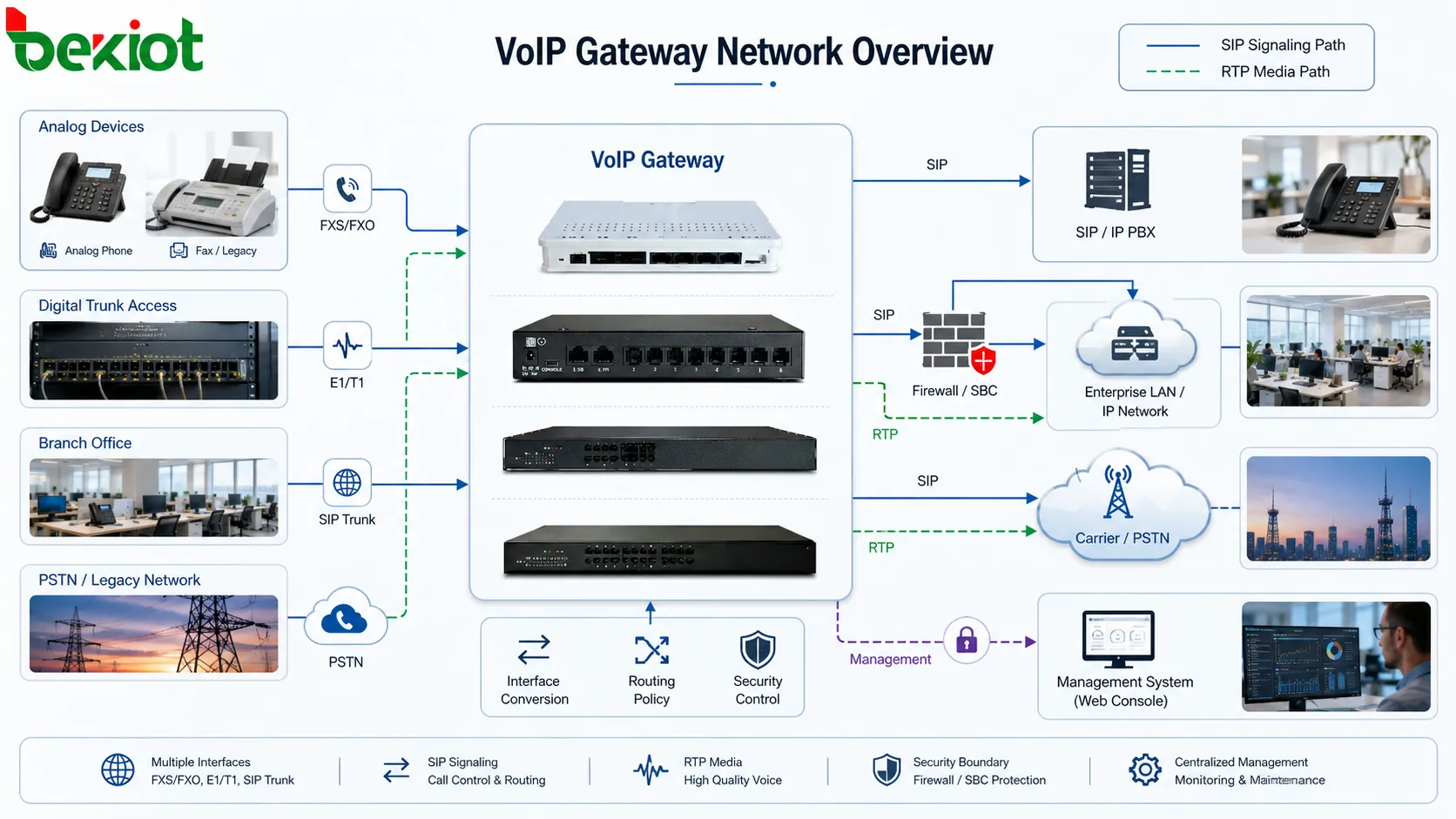
A VoIP Gateway is not only a device that converts one type of voice interface into another. In a real communication project, it sits between legacy telephony, SIP platforms, PBX systems, carrier trunks, analog phones, E1/T1 circuits, radio gateways, fax devices, emergency phones, and IP networks. If the network architecture is poorly designed, even a powerful gateway may suffer from registration failure, one-way audio, unstable calls, poor voice quality, wrong routing, NAT problems, security exposure, and difficult maintenance.
Designing the network architecture of a VoIP Gateway means planning where the gateway is placed, how signaling flows, how RTP media travels, how numbers are routed, how the gateway connects to PBX and carrier networks, how legacy lines are protected, how QoS is applied, how security boundaries are built, and how the system is monitored. A good design turns the gateway into a stable voice bridge rather than a hidden fault point inside the communication network.
Understanding the gateway role before designing the architecture
Interface conversion is only the first function
The basic function of a VoIP Gateway is interface conversion. It may convert analog FXS or FXO lines into SIP, connect E1/T1 or PRI circuits to an IP PBX, bridge legacy PBX trunks with VoIP platforms, or provide analog access for phones, elevator phones, fax machines, intercoms, or emergency endpoints. This conversion makes different voice systems able to communicate.
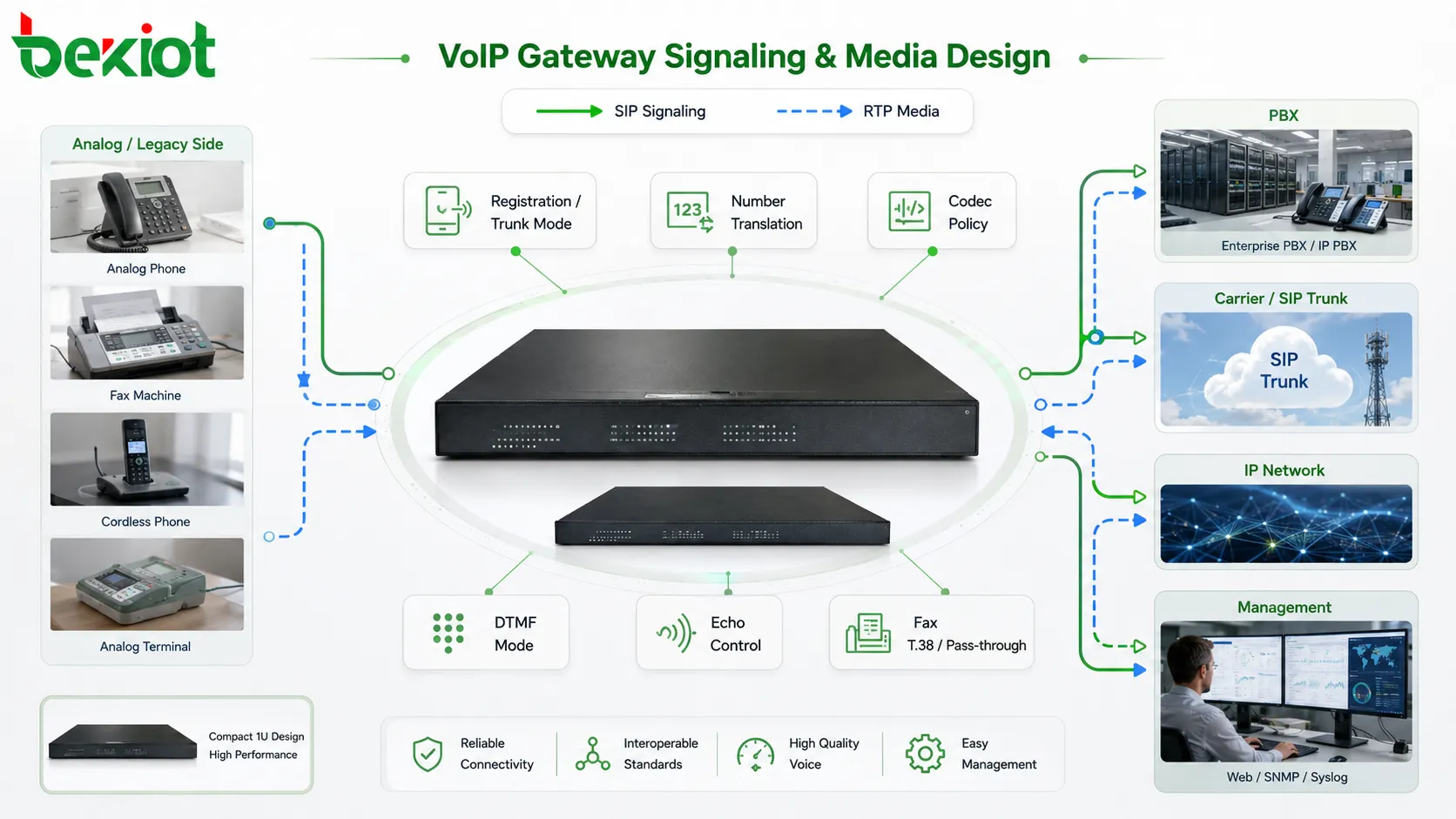
However, architecture design cannot stop at interface conversion. The gateway also participates in signaling control, media negotiation, codec selection, number transformation, echo control, DTMF handling, failover routing, call progress tone mapping, line supervision, and system security. These functions affect the whole voice network.
The gateway as a boundary point
A VoIP Gateway often sits at a boundary between two networks: analog and IP, PSTN and enterprise, legacy PBX and SIP platform, local site and carrier trunk, or private voice network and public access. Because it is a boundary point, it must be designed with clear routing, protection, and management rules.
If the gateway is placed without boundary planning, voice traffic may cross the wrong network path, NAT may block media, unauthorized SIP attempts may reach the gateway, or calls may bypass intended policies. The network architecture should define what the gateway is allowed to connect, which systems can access it, and how traffic is controlled.
Media and signaling may not follow the same path
One of the most important ideas in VoIP Gateway design is that signaling and media are different. SIP signaling controls call setup, registration, routing, ringing, transfer, and hang-up. RTP media carries the actual voice packets. In some networks, SIP signaling may pass through a PBX or SBC, while RTP media may flow directly between the gateway and another endpoint.
This separation is a common cause of architecture problems. A call may be established successfully, but audio may fail because RTP is blocked by firewall rules, NAT translation, wrong IP advertisement, or routing mismatch. Therefore, gateway architecture must always design both signaling path and media path, not only SIP registration.
Core architecture layers
Access layer
The access layer is where endpoints, legacy devices, or outside voice lines connect to the gateway. This may include analog phones, fax machines, elevator phones, emergency phones, door intercoms, FXO PSTN lines, E1/T1 circuits, radio interfaces, or legacy PBX trunks. The access layer determines what type of voice resources the gateway must support.
Design at this layer should consider port type, cable distance, line protection, impedance, ringing load, grounding, surge protection, fax requirements, emergency call behavior, and endpoint compatibility. For analog ports, electrical conditions matter. For digital trunks, clocking, framing, signaling mode, and number format matter.
Voice service layer
The voice service layer includes PBX, IP PBX, SIP server, unified communication platform, call center platform, dispatch system, or carrier SIP trunk. The gateway must communicate with this layer using the correct protocol, registration method, authentication, dial plan, codec, and signaling behavior.
Some gateways register as SIP endpoints. Some work as SIP trunks. Some use peer-to-peer SIP routing without registration. Some connect to multiple PBX or carrier platforms. The architecture should choose the mode that fits the project instead of using default settings without planning.
Transport network layer
The transport network layer carries SIP and RTP traffic. It includes LAN switches, routers, VLANs, WAN links, firewalls, VPNs, SD-WAN, private lines, carrier networks, and internet paths. This layer strongly affects voice quality and call stability.
For reliable voice, the network should support low packet loss, controlled delay, stable jitter, correct routing, QoS, and predictable firewall behavior. A gateway cannot produce good voice quality if the transport network is unstable, overloaded, or incorrectly segmented.
Management and monitoring layer
The management layer includes gateway configuration, logs, alarms, SNMP, syslog, call detail records, packet capture, firmware management, backup configuration, performance metrics, and remote maintenance access. This layer is often ignored during initial deployment, but it becomes essential when troubleshooting begins.
A good architecture separates management access from public or untrusted voice access where possible. Administrators should be able to monitor gateway health, trunk status, call failures, port alarms, CPU load, network state, and registration status without exposing the device to unnecessary security risk.
Signaling architecture design
SIP registration or peer trunk mode
The first signaling decision is whether the gateway should register to a SIP server or work in peer trunk mode. Registration mode is common when the gateway acts like a SIP endpoint or group of extensions. The PBX authenticates the gateway, and calls are routed through registered accounts. This is often used for FXS gateways serving analog extensions.
Peer trunk mode is common when the gateway connects PBX-to-PBX, PBX-to-carrier, or digital trunk-to-SIP environments. Instead of registering many accounts, the systems trust defined IP addresses and route calls by trunk rules. This mode needs stronger IP access control and clear security boundaries.
Number transformation and dial plan
The gateway must understand number formats. Analog devices may dial short extensions. A carrier trunk may require national or international number format. A PBX may use prefixes for outbound calls. A legacy PBX may send numbers with leading zeros or special trunk access codes. The gateway may need to add, remove, replace, or translate digits.
Dial plan design should be documented clearly. Engineers should define inbound rules, outbound rules, emergency numbers, extension ranges, trunk prefixes, caller ID format, DID handling, DOD handling, and fallback routing. Poor number planning can cause calls to fail even when signaling and media are healthy.
Call progress and tone mapping
VoIP Gateways often need to map call progress between different systems. Analog lines use voltage state, loop current, busy tone, ringback tone, disconnect tone, and polarity reversal. SIP uses messages such as trying, ringing, session progress, OK, busy, declined, and request termination. Digital trunks use their own signaling states.
If call progress is not mapped correctly, users may hear wrong tones, calls may not release, billing may start at the wrong time, or gateways may keep channels occupied after the far end hangs up. Architecture design should include tone plans, answer supervision, disconnect detection, and regional signaling settings.
DTMF transmission
DTMF is used for IVR menus, door opening, conference PINs, voicemail access, call control, and remote commands. A gateway may transmit DTMF in-band, through RTP events, or through SIP signaling methods. The correct method depends on the PBX, carrier, codec, and application.
DTMF problems are common in gateway projects. Users may say that IVR menus do not recognize keys or door opening commands fail. The architecture should standardize DTMF mode across gateways, PBX, trunks, and endpoints, then test real services.
Media architecture design
RTP path planning
RTP carries the voice payload. The architecture must define whether RTP flows directly between gateway and endpoint, gateway and PBX, gateway and SBC, or gateway and media server. Direct media may reduce delay, but it requires correct routing and firewall opening. Anchored media through a PBX or SBC may improve control and NAT handling, but it may add processing load.
RTP planning should consider IP addressing, NAT, firewall pinholes, RTP port ranges, QoS marking, media anchoring, transcoding, packetization interval, and recording requirements. A call that connects but has no audio usually indicates that the media path was not designed correctly.
Codec selection
Codec selection affects bandwidth, quality, delay, compatibility, and transcoding load. Common project decisions include whether to use wideband codecs for internal calls, narrowband codecs for PSTN interconnection, or compressed codecs for low-bandwidth WAN links. The gateway must support codec negotiation with both sides.
Architectures should avoid unnecessary transcoding. Every transcoding step may add delay, consume CPU, and reduce audio quality. If possible, the PBX, gateway, and carrier should share a common codec for the expected call paths. Codec policy should be matched with bandwidth planning and user expectations.
Echo control
Gateways that connect analog or digital telephony to VoIP may need echo cancellation. Echo can appear because of impedance mismatch, hybrid circuits, long analog lines, poor wiring, or delay in the IP network. The longer the delay, the more noticeable echo becomes.
Echo cancellation should be enabled and tuned according to the gateway type and line environment. However, echo problems should not be solved only by software settings. Cable condition, grounding, impedance, analog device quality, and excessive delay should also be checked.
Fax and modem considerations
Fax and modem traffic can be more sensitive than ordinary voice. A VoIP Gateway may support T.38 fax relay or fax passthrough. The correct choice depends on the carrier, PBX, endpoint, codec, and network stability. If fax is important, it should be treated as a special design requirement, not as a normal voice call.
Architectures that support fax should avoid packet loss, excessive jitter, unstable codec switching, and unsupported T.38 negotiation. Test with actual fax devices and real call routes. A gateway that handles voice well may still fail fax if fax design is ignored.
Security and network protection
Firewall and access control
A VoIP Gateway should not be exposed to every network segment by default. SIP ports, RTP ports, web management, SSH, SNMP, and provisioning interfaces should be protected by firewall rules and access control lists. Only trusted PBX, SBC, management systems, and carrier addresses should reach the gateway where possible.
Uncontrolled exposure may lead to unauthorized calls, SIP scanning, toll fraud, configuration attacks, or service disruption. Gateway security should be designed at the network layer and the device layer. Changing default passwords is necessary, but it is not enough.
NAT traversal and public network access
If the gateway communicates across NAT, the architecture must handle SIP headers, SDP media addresses, RTP port mapping, keepalive behavior, and firewall timeout. Many one-way audio problems come from private IP addresses being advertised in SIP messages or RTP ports being blocked by NAT.
For public network access, using an SBC or controlled VPN is often safer than exposing the gateway directly. The gateway should not become an open SIP device on the internet unless the project has strong security design, access filtering, and monitoring.
Encryption and trusted transport
Some environments may require SIP over TLS, SRTP, VPN tunnels, or private network transport. Encryption protects signaling and media from interception or manipulation. However, encryption must be supported by all relevant systems and configured correctly.
Security design should consider certificates, key management, cipher compatibility, device performance, troubleshooting visibility, and emergency fallback. Encrypted voice architecture is valuable, but it should be implemented in a manageable way.
Toll fraud prevention
VoIP Gateways may connect to paid trunks or external telephone networks. If attackers gain access, they may place unauthorized international or premium calls. Toll fraud prevention should include strong passwords, IP restrictions, call barring, route permissions, destination limits, time-based rules, trunk monitoring, and CDR review.
Outbound routing should not be too permissive. Emergency calls, local calls, national calls, and international calls may need different authorization. A gateway should only route what the organization intends to allow.
QoS and voice quality design
Bandwidth planning
Voice bandwidth depends on codec, packetization interval, RTP overhead, signaling traffic, number of simultaneous calls, and network encapsulation. E1/T1 gateways, multi-port FXS gateways, and high-capacity SIP trunks may generate many simultaneous media streams. The network must have enough bandwidth for peak call volume.
Bandwidth planning should include growth and failover scenarios. If one gateway fails and calls move to another path, the backup path must also support the traffic. Voice quality problems often appear during busy periods, not during basic testing.
QoS marking and priority
Voice packets are sensitive to delay, jitter, and loss. QoS marking helps switches and routers prioritize SIP and RTP traffic over less time-sensitive data. RTP media usually needs higher priority than signaling because media quality is directly heard by users.
QoS must be end-to-end. Marking packets at the gateway is not useful if switches, firewalls, WAN links, or carriers ignore or rewrite the markings. Engineers should verify QoS behavior across the full path.
Jitter and packet loss control
Gateways may include jitter buffers to smooth packet arrival variation. However, jitter buffers are not a substitute for stable networks. Excessive jitter or packet loss will still create broken audio, delay, or call quality complaints.
Network design should reduce congestion, avoid overloaded uplinks, protect voice VLANs, and monitor packet loss. If voice crosses WAN or wireless links, quality should be tested under normal traffic load. Gateway logs and RTP statistics can help locate issues.
Voice VLAN and segmentation
Separating voice traffic into a voice VLAN can improve manageability, QoS, security, and troubleshooting. A VoIP Gateway may have one interface for voice service and another for management, or it may use VLAN tags to separate traffic logically.
Segmentation should be practical. Too much segmentation without clear routing can create complexity. The goal is to separate voice from unnecessary broadcast traffic, protect management access, and maintain predictable paths for SIP and RTP.
High availability and continuity planning
Gateway redundancy
For important voice services, one gateway may not be enough. Gateway failure can affect analog extensions, PSTN access, emergency phones, fax service, or trunk interconnection. Redundancy may involve backup gateways, dual trunks, standby devices, or distributed gateways across sites.
The redundancy design should define what happens when the primary gateway fails. Will the PBX route calls to a secondary gateway? Will analog endpoints have backup paths? Will emergency calls still work? Failover should be tested, not assumed.
Trunk and carrier backup
If the gateway connects to external telephone networks, trunk backup is important. A site may use multiple SIP trunks, PSTN lines, E1/T1 circuits, or carrier routes. The gateway or PBX should have routing rules for carrier failure, busy circuits, or network outage.
Backup trunks should support critical number routes, especially emergency and service numbers. Some organizations keep a small number of analog or local backup lines even after moving most calls to SIP trunks. This can improve continuity during IP network problems.
Power and grounding
Voice gateways need stable power. If the gateway serves emergency phones, elevator phones, security lines, or critical trunks, backup power should be considered. UPS, redundant power supplies, protected circuits, and monitored power status can improve reliability.
Grounding is important for analog, FXO, E1/T1, and outdoor line connections. Poor grounding can contribute to noise, surge damage, unstable signaling, or equipment failure. Gateway architecture should include physical infrastructure, not only IP routing.
Configuration backup and recovery
Configuration backup is part of availability. If a gateway fails or must be replaced, administrators should be able to restore trunk settings, dial plans, IP addresses, codec policies, routing rules, and security settings quickly. Manual reconstruction during an outage is risky.
Backups should be updated after changes and stored securely. Change records should show what was modified and why. This helps prevent configuration drift and speeds recovery.
Deployment patterns
Centralized gateway architecture
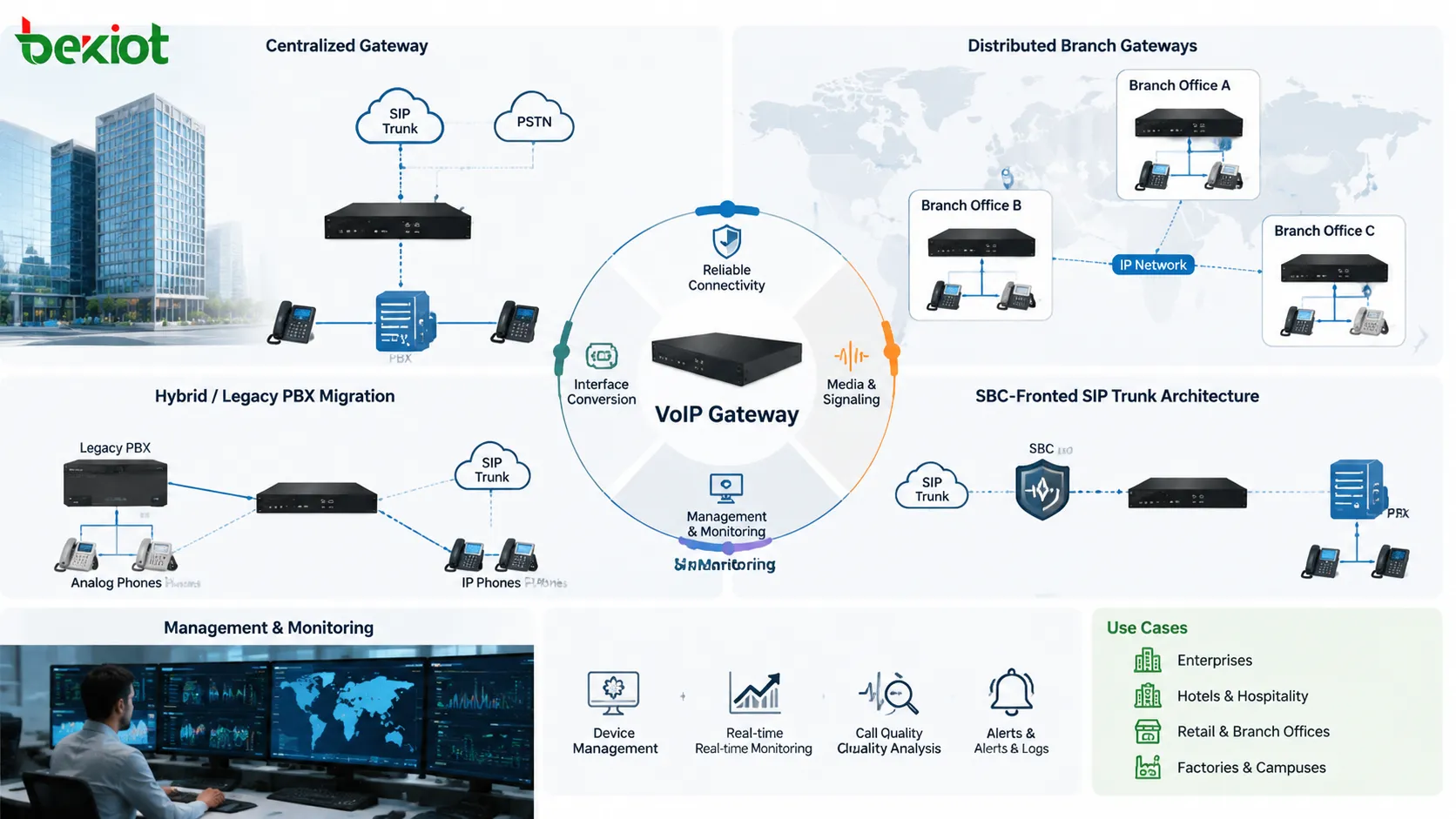
In a centralized architecture, one main gateway cluster connects enterprise voice systems to carrier trunks, PSTN lines, or legacy PBX resources. Branch sites send voice traffic through the central system. This design simplifies management and centralizes trunk control.
The risk is dependence on WAN connectivity. If a branch loses connection to the central site, external calling or analog access may fail unless local backup is provided. Centralized design is suitable when WAN reliability is high and centralized policy is important.
Distributed gateway architecture
In a distributed architecture, gateways are deployed at different branches, buildings, or operating sites. Each gateway connects local analog endpoints, PSTN lines, emergency phones, or local trunks. This improves local survivability and reduces dependency on a single central gateway.
Distributed design requires more management effort. Numbering, routing, firmware, security, monitoring, and configuration backup must be consistent across sites. It is useful for multi-branch organizations, campuses, industrial parks, utilities, and locations requiring local emergency access.
Hybrid migration architecture
Many projects use a hybrid architecture during migration. Legacy PBX systems, analog phones, SIP platforms, carrier trunks, and new IP endpoints coexist. Gateways bridge old and new systems while the organization migrates gradually.
Hybrid design should include a clear migration path. Temporary routing rules can become permanent confusion if not documented. Engineers should define which systems are legacy, which are target systems, and how numbering and trunking will evolve.
SBC-fronted architecture
In some designs, an SBC sits between the VoIP Gateway and external SIP networks. The SBC handles security, NAT traversal, topology hiding, SIP normalization, media anchoring, and carrier interconnection. The gateway focuses on interface conversion and internal voice routing.
This architecture is useful when connecting to public SIP trunks or untrusted networks. It reduces direct exposure of the gateway and gives administrators better policy control. However, it adds another system that must be managed and monitored.
Management and maintenance architecture
Monitoring and alarm visibility
Gateways should report important status information. This may include trunk status, port status, registration state, call failures, CPU load, memory, packet loss, jitter, channel usage, power status, line faults, and network reachability. Without monitoring, problems may remain hidden until users complain.
Monitoring should be tied to operational procedures. If a gateway trunk goes down, who receives the alarm? If an analog port fails, how is it handled? If call failure rate increases, who reviews the data? Architecture design should include response ownership.
Logs and packet capture
Gateway troubleshooting often requires logs and packet capture. SIP messages, RTP statistics, port events, call records, DTMF events, and error logs help engineers identify whether the problem is routing, signaling, codec, media, line state, or network transport.
Architectures should allow safe access to diagnostic data. If the gateway is in a remote site, remote logging and controlled packet capture can reduce maintenance time. Sensitive information should be protected according to policy.
Firmware and configuration management
Firmware updates may fix bugs, improve compatibility, or add security patches. However, updates can also change behavior. Gateway firmware should be managed carefully, especially in critical voice networks. Test updates before applying them to production where possible.
Configuration management should include templates, version records, backup files, and change approval. Gateways often contain complex dial plans and trunk settings. Uncontrolled changes can cause widespread call failures.
Routine testing
Routine tests should include inbound calls, outbound calls, emergency numbers, analog ringing, DTMF, fax, failover routes, trunk release, caller ID, recording, and audio quality. Test cases should reflect real usage, not only a single successful call.
For sites with emergency phones, elevators, industrial endpoints, or public assistance lines, routine testing is especially important. A gateway path that is rarely used may fail silently unless it is checked regularly.
Common design mistakes
Designing SIP only and ignoring RTP
One of the most common mistakes is focusing only on SIP signaling. Engineers may successfully register the gateway and complete call setup, but audio fails because RTP is blocked or routed incorrectly. Voice architecture must design media paths with the same attention as signaling paths.
Using default dial plans
Default dial plans rarely match real organizations. They may allow unwanted routes, block necessary calls, fail emergency numbers, or mishandle caller ID. Dial plan design should be specific to the site’s numbering structure and carrier requirements.
Exposing gateways directly to untrusted networks
Direct exposure can create serious security risk. Gateways connected to public networks should be protected by firewalls, SBCs, VPNs, ACLs, strong authentication, and monitored routing policies. SIP scanning and toll fraud are real risks in poorly protected systems.
Ignoring analog line conditions
When gateways connect analog devices, engineers may focus on IP settings and forget line conditions. Ringing load, cable length, impedance, echo, grounding, surge protection, and device compatibility can all affect performance. Analog design remains important.
No documentation after commissioning
A gateway may contain many routing rules, port mappings, number translations, codec settings, and security rules. If these are not documented, future troubleshooting becomes slow and risky. Documentation should be part of project delivery.
Evaluation standards
Call routing correctness
The first standard is whether calls route correctly. Internal calls, outbound calls, inbound calls, emergency calls, DID calls, analog endpoint calls, trunk calls, and failover calls should follow the intended paths. Each important route should be tested.
Voice quality and stability
Voice should remain clear under expected traffic conditions. Evaluation should include delay, jitter, packet loss, echo, codec behavior, DTMF recognition, fax performance, and call release behavior. Testing should include busy-hour conditions where possible.
Security control
The gateway should not allow unauthorized access or calls. Management interfaces, SIP peers, trunk routes, outbound permissions, and password policies should be reviewed. Security should be verified, not assumed.
Survivability
The design should define what happens during gateway failure, trunk outage, WAN loss, power interruption, or PBX failure. Critical services should have backup paths or documented procedures.
Maintainability
A good architecture is easy to operate after deployment. Administrators should have monitoring, logs, backups, documentation, test procedures, and clear ownership. Maintainability determines whether the gateway remains reliable over time.
Closing Notes
A VoIP Gateway network architecture should be designed around the complete voice path, not only the gateway device. It must consider access interfaces, SIP signaling, RTP media, number routing, codecs, DTMF, fax, echo control, security, QoS, redundancy, management, and maintenance. Each layer affects call success and voice quality.
The gateway may connect analog endpoints, legacy PBX systems, digital trunks, SIP servers, carrier trunks, emergency phones, fax devices, radio interfaces, and multi-site networks. Its architecture should define how these resources communicate, how they are protected, how calls are routed, and how failures are handled.
The strongest design uses clear boundary planning, predictable media paths, secure access control, documented dial plans, QoS-enabled transport, tested failover, and visible monitoring. When these elements are handled properly, the VoIP Gateway becomes a stable bridge between legacy telephony and modern IP communication systems.
FAQ
What is the main role of a VoIP Gateway in network architecture?
Its main role is to connect different voice systems, such as analog phones, digital trunks, PBX systems, SIP platforms, PSTN lines, and IP voice networks, while handling signaling, media, routing, and compatibility.
Why do VoIP Gateway calls sometimes connect but have no audio?
This usually happens when SIP signaling works but RTP media is blocked or routed incorrectly. Firewall rules, NAT, wrong SDP addresses, RTP port ranges, or routing paths should be checked.
Should a VoIP Gateway be placed behind an SBC?
It is often recommended when connecting to public SIP trunks or untrusted networks. An SBC can provide security, NAT traversal, SIP normalization, topology hiding, and media control.
What should be considered when connecting analog devices?
Engineers should consider FXS or FXO type, ringing voltage, REN load, cable distance, impedance, echo, grounding, surge protection, DTMF, fax requirements, and endpoint compatibility.
How can VoIP Gateway reliability be improved?
Reliability can be improved through redundant gateways, backup trunks, UPS power, clear failover routing, QoS, monitoring, configuration backups, surge protection, and regular call-path testing.







