


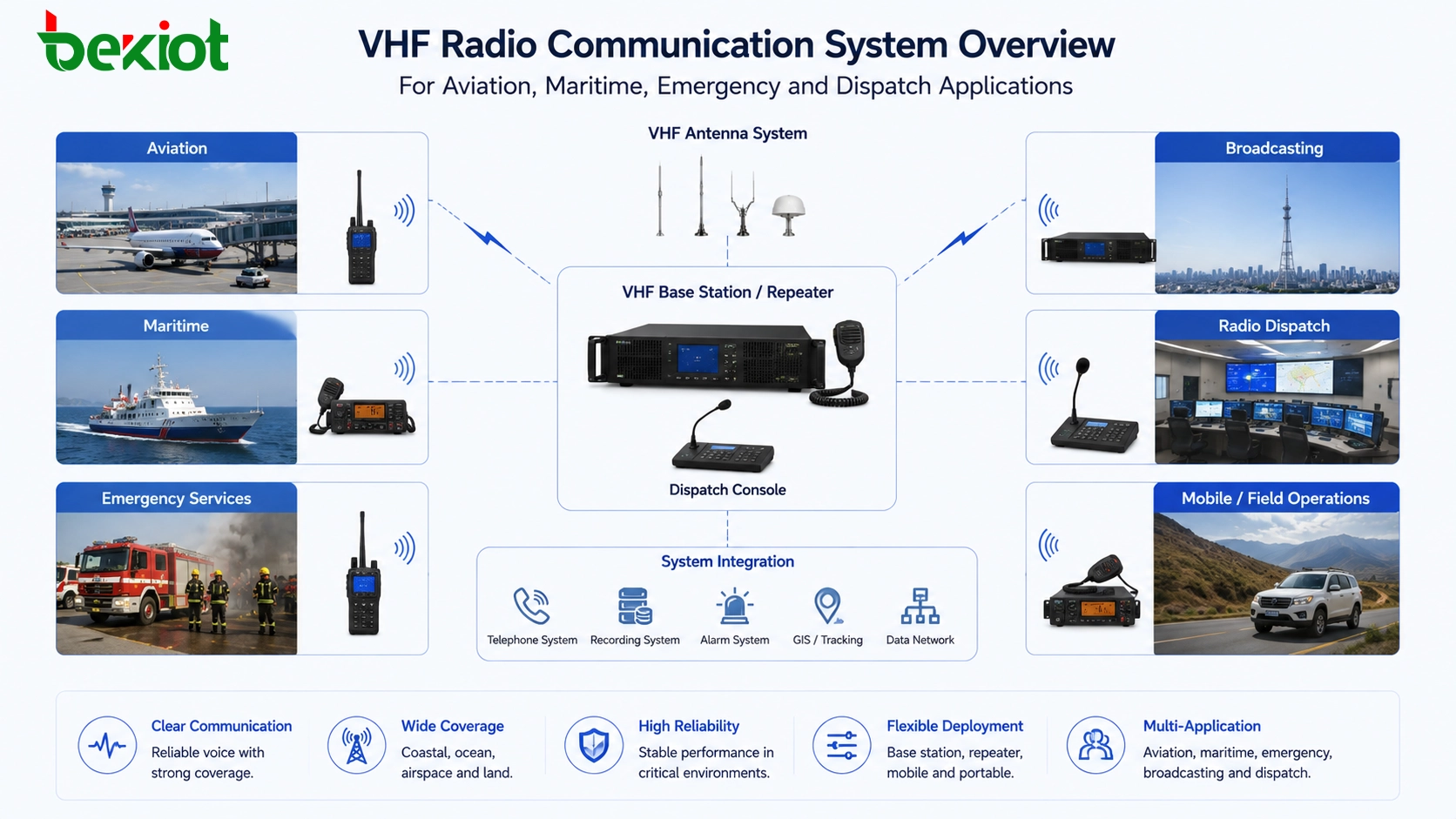
Very High Frequency, commonly known as VHF, is a radio frequency band ranging from 30 MHz to 300 MHz. Communication systems that use this frequency range are generally referred to as VHF radio communication systems. In practical engineering projects, VHF is often discussed when radio communication needs to be connected with dispatch platforms, command centers, emergency systems, or unified communication networks.
VHF communication is different from common VoIP-based voice communication. VoIP usually depends on IP networks, SIP signaling, servers, and digital terminals, while VHF radio communication works through radio frequency transmission over the air. Because of its propagation characteristics, VHF is widely used in broadcasting, aviation, maritime communication, emergency response, and amateur radio. Among these, aviation and maritime communication are two of the most common project scenarios where VHF radios need to be integrated with modern command and dispatch systems.
Why This Frequency Range Is Widely Used
The 30 MHz to 300 MHz range gives VHF communication a useful balance between coverage, voice clarity, antenna size, and system reliability. Compared with some lower-frequency bands, VHF can support clearer voice communication in many practical environments. Compared with higher-frequency systems, VHF can often provide more stable area coverage for line-of-sight or near-line-of-sight communication.
In real projects, VHF is usually selected where fast voice communication, wide-area field coverage, and direct radio operation are more important than complex data services. It is especially useful in places where operators need immediate push-to-talk communication, such as airports, ports, vessels, coastal stations, emergency command centers, and field operation teams.
The strength of VHF is not only the frequency band itself. Its value also comes from mature industry standards, long-established operating habits, and dedicated radio equipment ecosystems. Aviation and maritime sectors have already built many operational procedures around VHF radio, so integration projects usually need to respect existing radio rules instead of replacing them with ordinary network voice systems.
How It Differs from VoIP-Based Communication
VoIP communication is built on packet networks. Calls are usually controlled by SIP servers, IPPBX platforms, softswitches, or unified communication systems. Users communicate through IP phones, softphones, dispatch consoles, gateways, or mobile applications. This architecture is flexible, scalable, and easy to integrate with enterprise systems.
VHF communication follows a different logic. A radio user transmits voice over a specific radio frequency channel. Other radios or ground stations tuned to that channel can receive the transmission. In many cases, communication is half-duplex, meaning one party speaks while others listen. Push-to-talk operation is common, and channel discipline is important.
Because of this difference, VHF radios cannot normally be treated as ordinary SIP phones or IP terminals. If a project needs VHF radios to communicate with telephones, dispatch consoles, recording systems, emergency platforms, or VoIP users, an integration layer is usually required. This layer may handle audio access, push-to-talk control, SIP transmission, routing, and system linkage.
Where VHF Is Commonly Applied
VHF is used across several industries. In broadcasting, it has historically been associated with radio and television transmission. In emergency communication, it can provide field voice links when teams need fast coordination. In amateur radio, VHF is used for personal, technical, and community communication activities. However, in engineering integration projects, the most frequent requirements often come from aviation and maritime scenarios.
Aviation and maritime communication have clear operational requirements, established channel usage, and dedicated radio equipment. These systems are not only communication tools; they are also part of safety, navigation, coordination, and emergency response procedures. That is why VHF integration should be handled carefully, especially when connecting radios to command platforms or IP-based systems.
Aviation Communication in Airport Projects
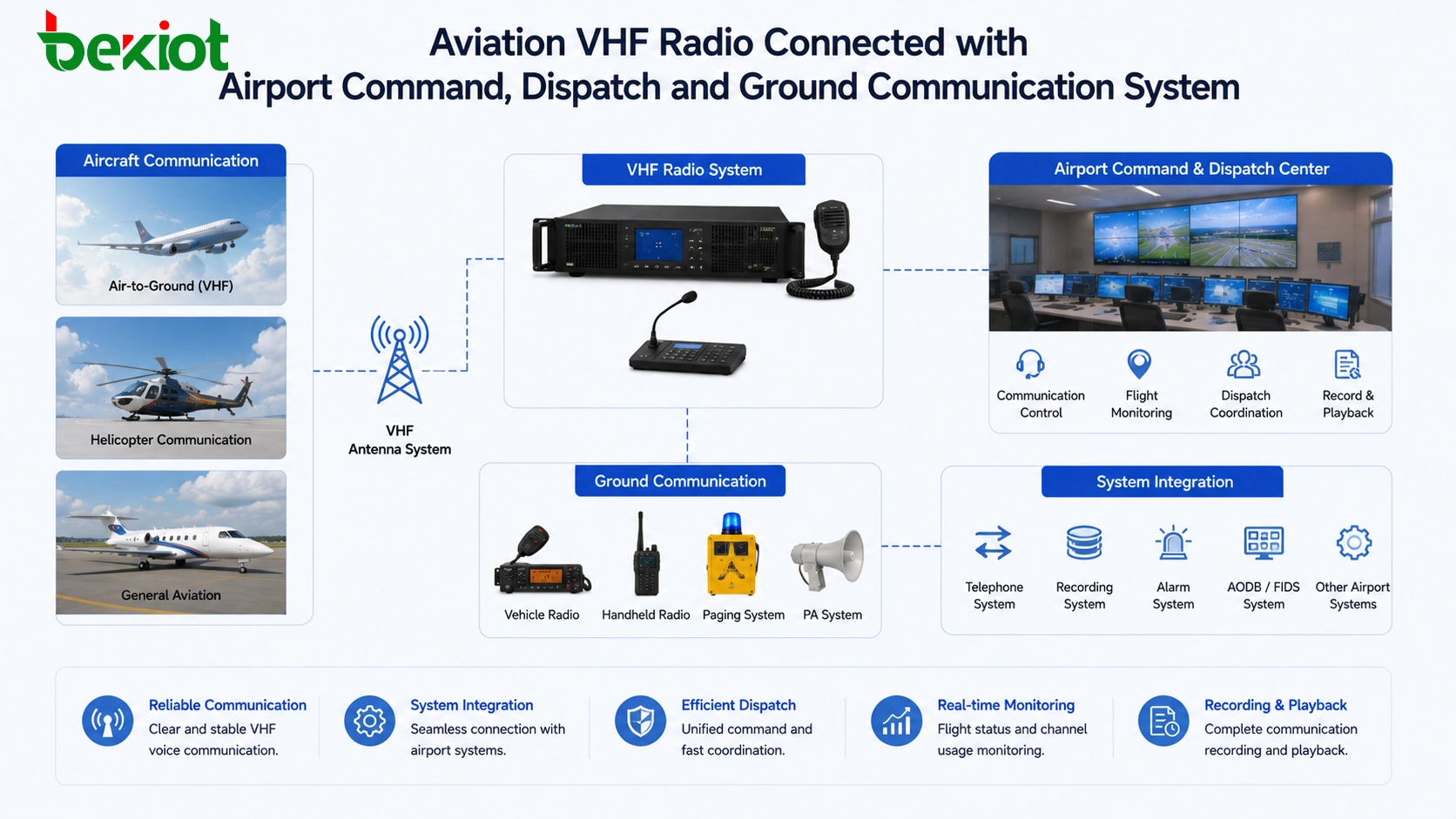
Aviation communication uses both high frequency and very high frequency resources. In many aviation communication references, HF is commonly associated with 2 MHz to 30 MHz, while aviation VHF communication often works within 118 MHz to 136.975 MHz. VHF aviation radios are mainly used for communication between aircraft and ground stations, such as towers, control rooms, airport operation teams, and related command positions.
In airport projects, integrators may encounter requirements to connect aviation VHF radios into a command and dispatch system. The purpose is usually not to replace the aviation radio system, but to allow authorized operators in a command center to monitor, coordinate, or communicate through the existing radio channel under the project’s operational rules.
Typical aviation radio equipment may include a speaker, hand microphone, display, control buttons, antenna connection, and dedicated power supply. Because aviation radios often need reliable transmission power and stable operation, power planning and installation quality are important. The integration design should also consider audio level matching, PTT control, grounding, electromagnetic interference, and operational safety.
Marine Radio for Ships and Port Operations
Maritime VHF communication is widely used between vessels and coast stations, vessels and ports, and vessels operating near each other. It supports daily navigation communication, port coordination, traffic information exchange, weather warnings, distress alerts, and emergency assistance. For many regulated vessel operations, marine radio is an essential communication tool before departure.
Marine VHF radios have their own frequency plan. A commonly referenced marine VHF range includes ship station transmit frequencies from 156.025 MHz to 157.425 MHz and receive frequencies from 156.050 MHz to 162.025 MHz. These values are important in system planning because the equipment, antenna, and integration method must match the correct radio environment.
One well-known maritime communication point is Channel 16, which is widely used as an international distress, safety, and calling channel. In emergency situations at sea, switching to Channel 16 allows nearby ships and relevant stations to receive distress communication and provide assistance according to maritime procedures.
In port, coastal, offshore, and unmanned terminal projects, marine radio integration may be needed for centralized dispatch. A command center may need to communicate with vessels, patrol boats, port operation teams, or marine safety positions through the existing radio channel. In such cases, the VHF radio system can be connected with dispatch consoles, recording systems, IP communication platforms, or emergency management systems.
Integration Challenges in Real Projects
Although VHF radios are mature and reliable, integrating them into modern communication platforms is not always simple. Many radios are designed for direct radio operation rather than open system integration. Some devices may not provide standard external interfaces, and some may require customized cabling to access audio, speaker output, microphone input, PTT control, or control signals.
The project team must also consider how voice will be transmitted after it leaves the radio device. If the target system is based on SIP or VoIP, the radio audio may need to be converted into an IP voice stream. If dispatch users need to talk back through the radio, the system must also support push-to-talk control from the dispatch side.
In addition, radio communication has operational characteristics that differ from ordinary telephone calls. A telephone call is usually point-to-point and full-duplex. A radio channel may be shared by multiple users and may require strict speaking order. The integration platform should avoid creating confusion on the radio channel, especially in aviation, maritime, and emergency environments.
A Practical Architecture for VHF-to-IP Connection
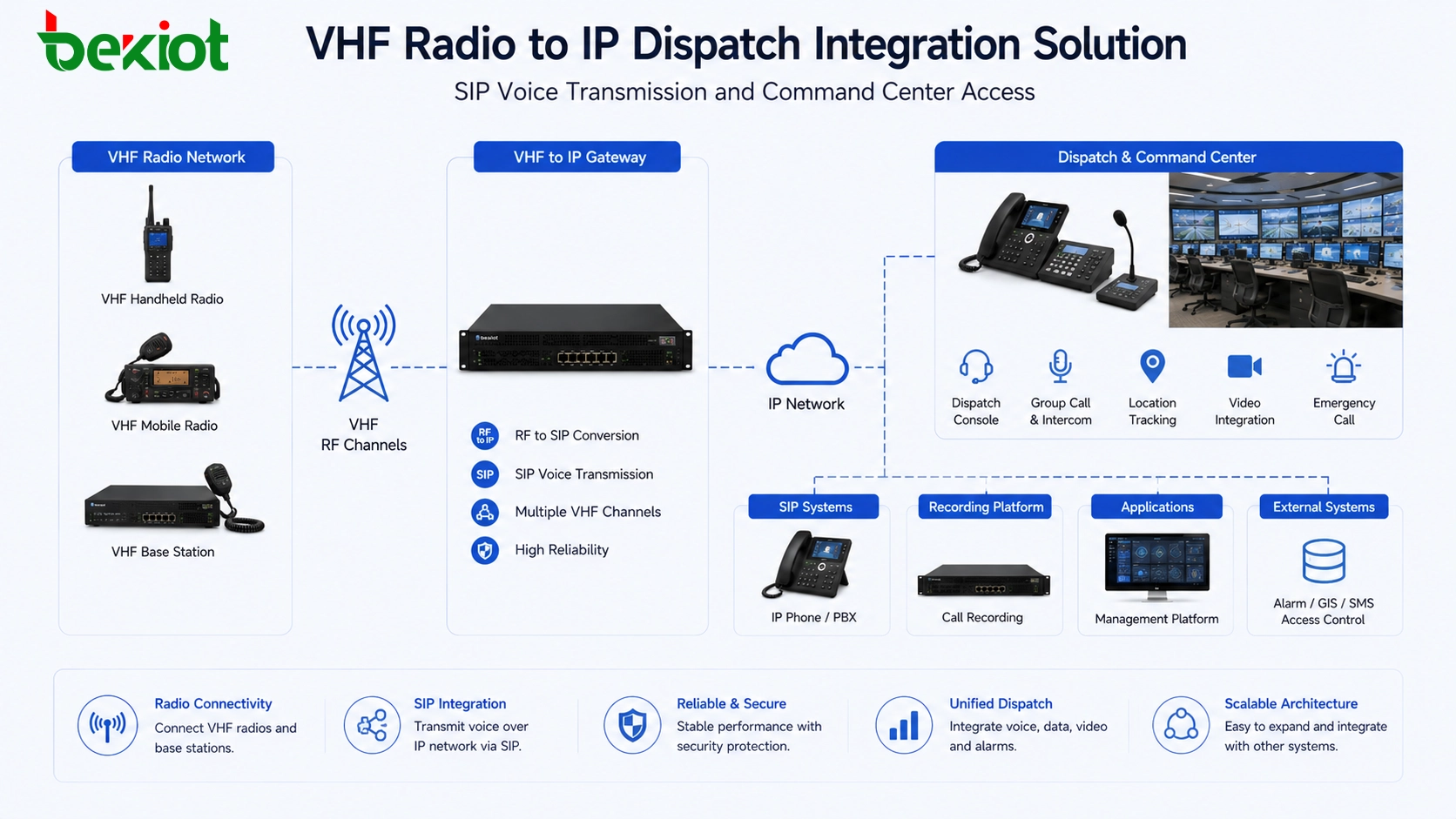
A common integration architecture includes four layers. The first layer is the VHF radio equipment, including aviation radios, marine radios, antennas, power supply, and local audio accessories. The second layer is the radio access layer, which connects audio input, audio output, PTT control, and other necessary signals.
The third layer is the communication conversion layer. This layer can convert radio-side audio and control signals into IP-based voice communication. In many projects, SIP is used so that VHF radio channels can interoperate with dispatch consoles, IP phones, softphones, recording systems, and unified communication platforms.
The fourth layer is the application layer. This may include airport operation centers, port dispatch rooms, emergency command platforms, call recording systems, GIS screens, alarm linkage systems, and unified communication dashboards. Through this architecture, the VHF radio remains the field communication resource, while the command platform gains centralized access and management capability.
Typical Project Scenarios
| Scenario | Communication Need | Integration Value |
|---|---|---|
| Airport Operations | Connect aviation VHF radio with ground command and dispatch positions | Improves coordination between tower-related communication, operation teams, and command users |
| Port and Coastal Management | Connect marine VHF radio with port dispatch or coastal monitoring centers | Supports vessel communication, traffic coordination, weather alerts, and emergency response |
| Emergency Command | Allow command centers to access field radio channels | Provides fast voice coordination during incidents, rescue tasks, and field operations |
| Industrial or Remote Sites | Bridge radio communication with IP-based dispatch platforms | Allows remote operators to communicate with field teams through existing radio resources |
| Recording and Review | Record radio communication for traceability and event review | Helps preserve communication evidence and improve operational accountability |
Design Points Before Deployment
Confirm the Radio Frequency and Use Case
The project should clearly identify whether the radio system is used for aviation, maritime, emergency, industrial, or other communication purposes. Frequency range, channel rules, operating permissions, and communication procedures may be different in each field. Integration must follow the actual communication environment.
Check the Available Interfaces
Not all VHF radios provide convenient expansion ports. Some may require access through microphone, speaker, accessory, or custom interface cables. Before system design, engineers should confirm whether audio input, audio output, PTT control, and power requirements can be safely and reliably connected.
Match Audio and Control Signals
Audio level matching is important. If the input level is too low, the remote side may hear weak audio. If it is too high, distortion may occur. PTT control should also be tested carefully to ensure the radio transmits only when authorized and does not stay keyed unexpectedly.
Plan Dispatch and Permission Rules
When VHF radio is connected to a dispatch platform, not every user should have the same control permission. The system should define who can listen, who can transmit, who can record, who can manage channels, and who can access historical communication records.
Consider Recording and Event Linkage
In aviation, maritime, and emergency applications, communication traceability can be important. Recording, time stamps, channel information, operator identity, and event linkage should be considered if the project needs later review, evidence preservation, or operation analysis.
Why Experience Matters in VHF Integration
VHF communication has strong industry characteristics. Aviation and maritime radio systems have specific frequency plans, operation habits, emergency procedures, and equipment forms. A general VoIP integration approach is not always enough. The project team must understand both the radio side and the IP communication side.
The technical difficulty often lies in the details: cable adaptation, PTT timing, audio level control, echo and noise handling, radio channel discipline, SIP interoperability, recording path, and system permission design. A small mistake may cause poor audio quality, unstable transmission, incorrect channel control, or operational confusion.
For this reason, VHF integration should be planned as a communication engineering project rather than a simple device connection task. Proper testing with real radios, real dispatch users, real network conditions, and real operation workflows is necessary before the system is delivered.
Final Takeaway
VHF refers to the 30 MHz to 300 MHz radio frequency band and is widely used in broadcasting, aviation, maritime communication, emergency response, and amateur radio. In practical integration projects, aviation and maritime applications are especially common because both fields depend heavily on dedicated VHF radio communication.
Aviation VHF communication often works within 118 MHz to 136.975 MHz and is used for aircraft-to-ground and airport operation communication. Marine VHF systems commonly use frequencies around 156 MHz to 162 MHz, with Channel 16 serving as an important international distress and safety channel.
When VHF radios need to work with command centers, dispatch consoles, VoIP systems, call recording platforms, or emergency management systems, a radio-to-IP integration layer is usually required. A well-designed solution should preserve the reliability of radio communication while adding centralized access, SIP interoperability, recording, dispatch control, and platform linkage.
FAQ
Is VHF the same as walkie-talkie communication?
Not exactly. Some walkie-talkies may use VHF, but VHF is a frequency band, not a specific device type. Aviation radios, marine radios, emergency radios, and other systems can also operate within VHF ranges.
Can VHF radios communicate directly with IP phones?
Usually not directly. VHF radios and IP phones use different communication mechanisms. A conversion or integration layer is normally needed to bridge radio audio and SIP-based voice systems.
Why is Channel 16 important in maritime communication?
Channel 16 is widely used for distress, safety, and calling purposes in maritime communication. It allows vessels and stations to monitor emergency calls and respond when assistance is needed.
Can existing VHF radios be reused in a dispatch upgrade?
In many projects, yes. Existing radios can often be connected through suitable audio and control interfaces. However, compatibility should be confirmed through testing before final deployment.
What should be tested before connecting VHF radio to a command system?
Engineers should test audio clarity, PTT control, channel behavior, transmission delay, recording quality, SIP interoperability, permission rules, and operation procedures under real working conditions.







