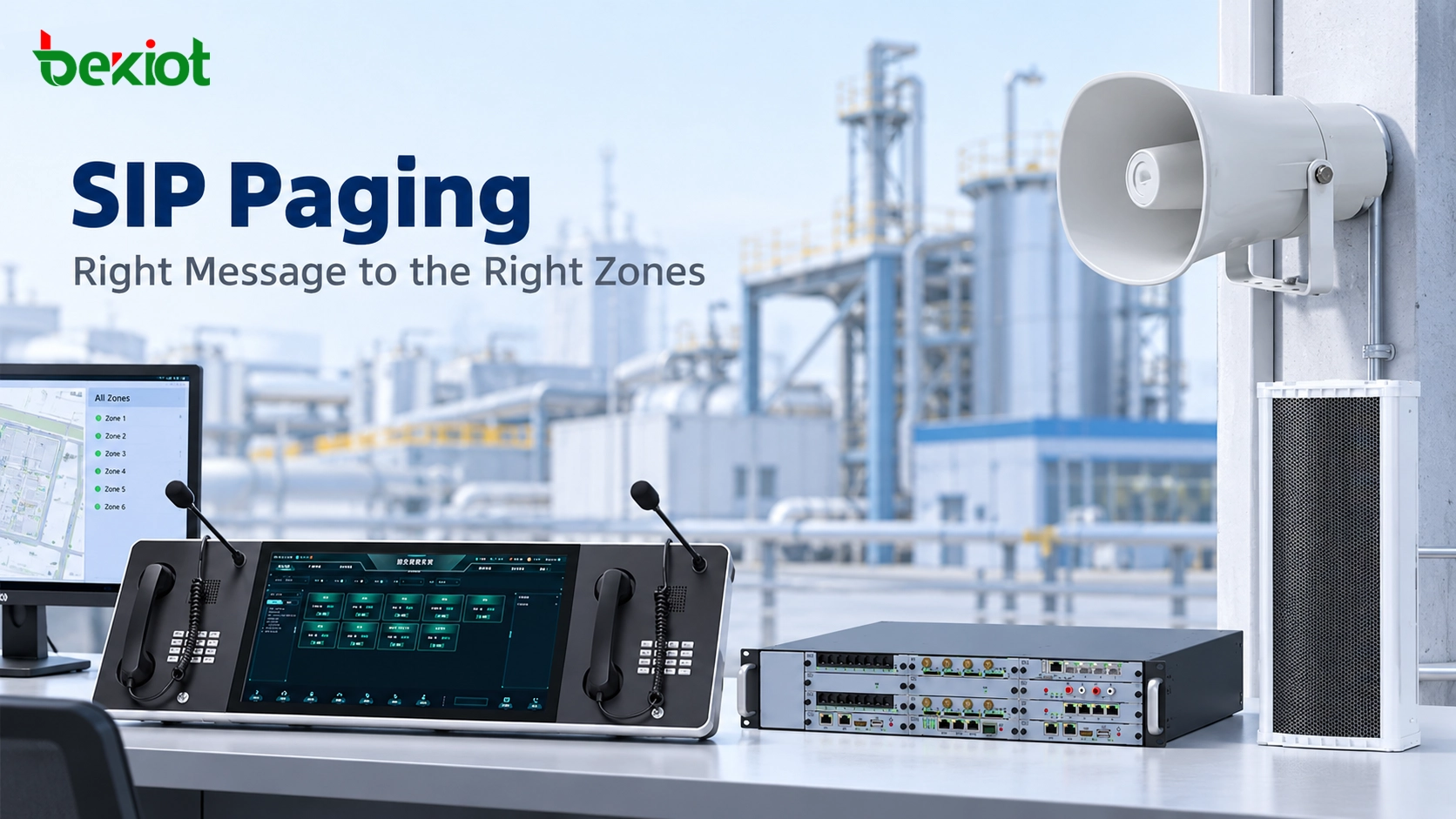
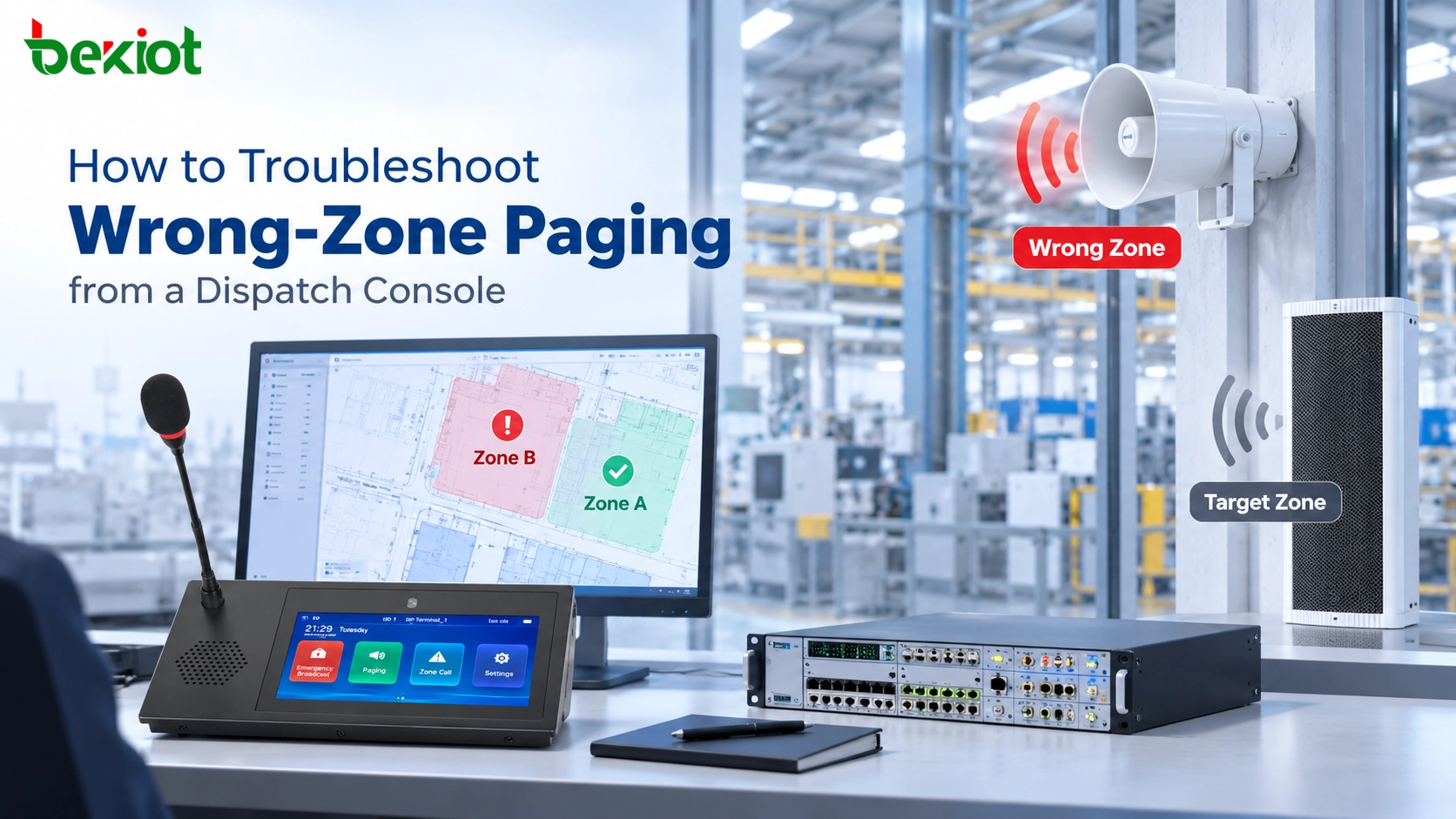
In many communication projects, the problem is not whether voice communication is still needed, but how different voice systems can continue to work together when the network architecture changes. Enterprises may already have analog phones, PBX systems, PSTN lines, SIP platforms, radio systems, public address interfaces, emergency phones, and dispatch consoles. These resources often belong to different generations of technology, but they may still be operationally important. A voice gateway is the device or system layer that makes these separated voice environments communicate through a controlled conversion process.
A voice gateway can be defined as a communication bridge that converts voice signaling, media streams, interfaces, and routing logic between different telephony or IP communication systems. It may connect analog phones to an IP PBX, convert E1 or T1 trunks into SIP trunks, integrate radio channels into a dispatch platform, or allow legacy PSTN access to coexist with modern VoIP systems. Its role is not limited to “making calls pass through.” It also manages compatibility, routing, codec negotiation, numbering plans, call control, and service continuity.
In industrial communication, emergency communication, enterprise telephony, transportation, energy, public safety, and multi-site operations, voice gateways are often used as transition points between old and new systems. They help organizations protect existing investment while enabling gradual migration toward IP-based, software-defined, and centrally managed communication platforms.
The practical definition behind the interface layer
A voice gateway is easiest to understand as a protocol and media conversion point. Traditional voice systems and IP communication systems do not always speak the same technical language. A conventional analog telephone works through electrical loop current, ringing voltage, and analog voice transmission. A digital trunk uses structured timeslots and signaling protocols. A SIP-based system uses IP packets, session signaling, codecs, and RTP media streams. The gateway sits between these systems and translates their behavior into a form the other side can understand.
This definition is important because the gateway is not simply a passive adapter. A cable adapter only changes physical connection format, but a voice gateway actively processes call signaling and voice media. It may detect off-hook status, generate dial tone, receive DTMF digits, establish SIP sessions, convert codec formats, route calls according to dial rules, and maintain call state throughout the conversation. In many cases, it also provides echo cancellation, gain control, jitter buffering, call progress tone adaptation, and fault monitoring.
From a system perspective, the gateway becomes a boundary controller between different communication domains. One side may be circuit-based, analog, or legacy. The other side may be packet-based, IP-driven, and centrally managed. The gateway makes these domains interoperable without requiring every endpoint to be replaced immediately. This is why gateways remain important even as more communication systems move toward all-IP architecture.
The practical definition can therefore be summarized as follows: a voice gateway is a communication device that enables heterogeneous voice systems to interconnect by converting interfaces, signaling, numbering, and media transport. It supports continuity during migration, integration across systems, and unified access between different voice networks.
How signaling conversion makes calls possible
Voice communication is not only about carrying audio. Before two users can speak, the system must know who is calling, which number is being dialed, whether the destination is available, how the call should be routed, when ringing should start, and when the session should end. These control actions are handled through signaling. Different systems use different signaling methods, and one of the core functions of a gateway is to translate between them.
In an analog environment, signaling may involve loop start, ring voltage, polarity reversal, DTMF digits, or line status detection. In a digital trunk environment, signaling may involve PRI, SS7, R2, or other trunk protocols depending on the region and system design. In a SIP environment, signaling is handled through messages such as INVITE, TRYING, RINGING, OK, ACK, BYE, and REGISTER. A voice gateway must understand both sides and map call states correctly between them.
For example, when an analog phone goes off-hook, the gateway detects the line state and provides dial tone. When the user dials digits, the gateway collects the number and converts the call request into a SIP INVITE toward an IP PBX or SIP server. When the remote side rings, the gateway may generate ringback tone to the analog side. When the call is answered, it connects the media path. When either side hangs up, it releases the session and restores the port to idle state.
This signaling translation must be accurate because small mismatches can create major operational problems. Incorrect digit collection may cause routing failure. Wrong tone generation may confuse users. Delayed hang-up detection may leave channels occupied. Poor mapping of call states may create one-way audio, stuck calls, or repeated registration issues. A well-designed gateway therefore handles signaling not as a simple conversion table, but as a controlled state machine.
In larger communication systems, signaling conversion also supports numbering plan integration. Internal extensions, public numbers, emergency numbers, short codes, group numbers, and trunk prefixes may all need to pass through the gateway. This makes dial rule design one of the key engineering tasks in gateway deployment.
Media conversion and voice quality control
Once a call is established, the gateway must carry the actual voice content. In traditional telephony, voice may be transmitted as analog electrical signals or structured digital channels. In IP systems, voice is encoded into digital packets and transported through RTP streams. The gateway converts between these media formats while preserving intelligibility, timing, and audio stability.
Media conversion usually involves codec handling. Common codecs such as G.711, G.729, G.722, or Opus may be used depending on bandwidth, quality requirements, and platform compatibility. If the two sides of a call do not support the same codec, the gateway may perform transcoding. Transcoding improves compatibility but consumes processing resources and may introduce slight latency. For this reason, codec planning is important in gateway projects.
Voice quality is also affected by echo, delay, packet loss, jitter, gain imbalance, and background noise. A gateway that connects analog or trunk circuits to IP networks must often include echo cancellation because hybrid circuits and impedance mismatch can reflect part of the speaker’s voice back into the channel. Jitter buffers are used on the IP side to smooth packet arrival variations. Gain adjustment may be required when one side sounds too loud or too weak.
In industrial and emergency communication, voice quality should be judged by intelligibility and reliability rather than only by high-fidelity audio standards. A command instruction, alarm notice, tunnel call, station announcement, or dispatch order must be clear enough to understand under field conditions. The gateway must therefore provide stable media handling even when the network environment is not perfect.
Media conversion also affects recording, monitoring, conferencing, and dispatch integration. If voice streams pass through a central platform, the system can record calls, mix group communication, monitor channel status, or forward audio to other systems. In this sense, the gateway does more than connect two endpoints; it makes legacy and IP voice resources available to the wider communication architecture.
Major categories used in real projects
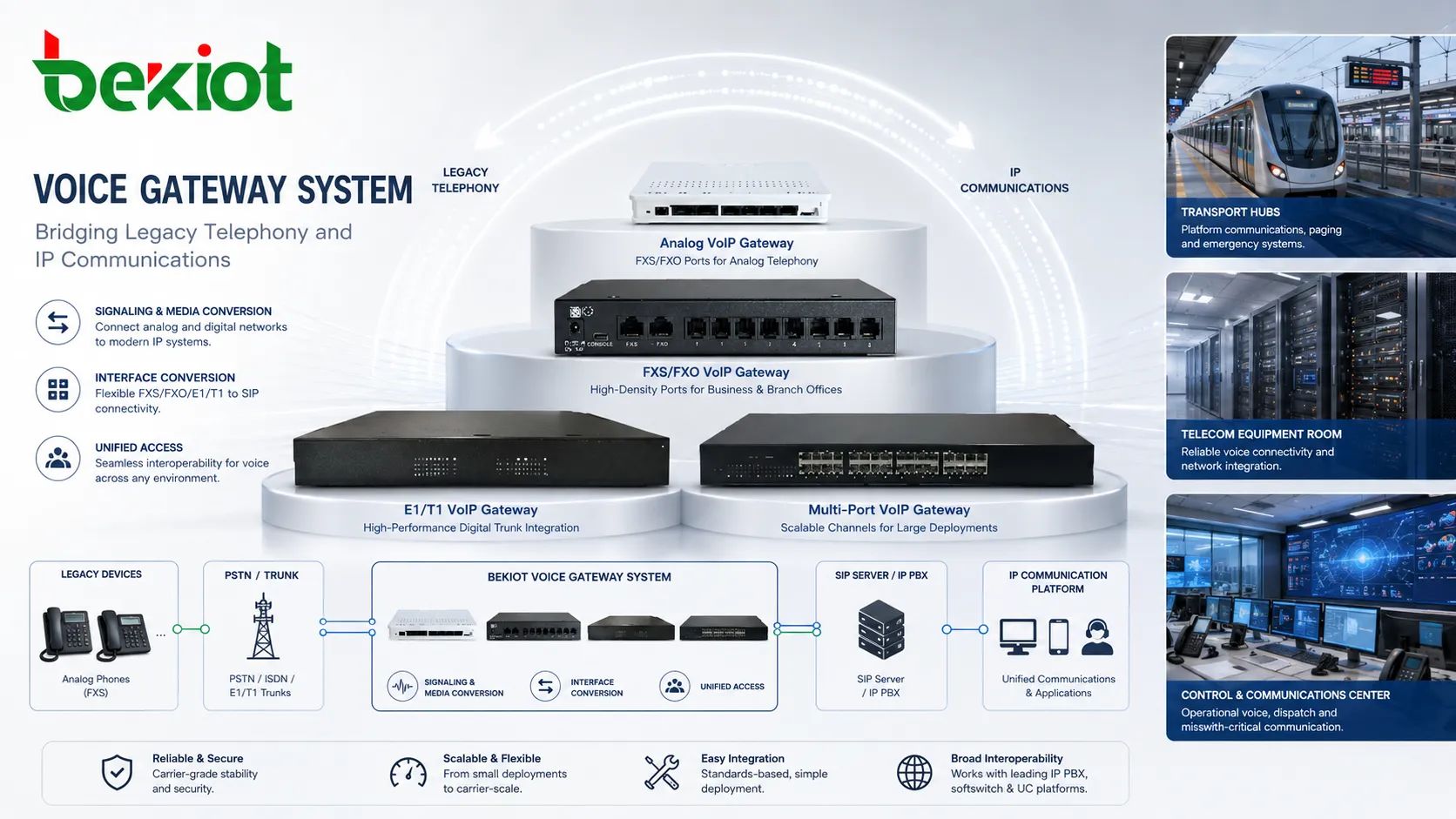
Voice gateways are usually classified by the type of interface or network they connect. Analog gateways are used to connect traditional phones, fax machines, hotline devices, elevator phones, analog PBX ports, or PSTN lines to an IP system. FXS ports connect to analog telephone endpoints, while FXO ports connect to analog lines from a PBX or telephone operator. These gateways are common in small and medium migration projects where existing analog equipment still needs to operate.
Digital trunk gateways connect E1, T1, PRI, or similar trunk interfaces to SIP or IP PBX platforms. They are often used in enterprise telephony rooms, carrier access environments, call centers, hotels, transportation networks, and large organizations that still use digital trunk circuits. These gateways are useful when organizations want to migrate the internal system to IP while keeping existing trunk resources for external connectivity.
SIP trunk gateways or session border gateway functions are used to connect enterprise voice platforms with SIP carriers or external IP voice networks. In these scenarios, the gateway may handle SIP normalization, security policy, codec negotiation, NAT traversal, topology hiding, and routing control. The emphasis is less on analog conversion and more on IP-to-IP interoperability and boundary protection.
Radio over IP gateways and specialized industrial voice gateways connect radio systems, intercom networks, emergency telephones, PA systems, or dispatch platforms into IP communication architecture. In command and control environments, this category is especially important because field users may rely on different voice tools. A dispatch center may need to call SIP phones, connect radio channels, trigger announcements, and communicate with emergency terminals from the same platform.
Becke Telcom’s IPGA series voice gateways are typically positioned for this type of integration need, especially where industrial communication systems must connect analog voice resources, IP platforms, dispatch systems, and multi-site communication networks. The value of this kind of gateway lies in helping projects bridge existing field equipment with newer IP-based communication platforms without forcing a complete replacement at once.
| Gateway Type | Main Interface | Typical Use |
|---|---|---|
| Analog voice gateway | FXS / FXO | Connect analog phones, PBX lines, hotline devices, or PSTN access to VoIP systems |
| Digital trunk gateway | E1 / T1 / PRI | Convert legacy digital trunks into SIP or IP PBX connectivity |
| SIP trunk gateway | IP / SIP | Connect enterprise voice platforms to SIP carriers or external VoIP networks |
| Industrial integration gateway | Analog / IP / dispatch interface | Integrate field terminals, paging systems, emergency phones, or radio-related communication resources |
Functions that matter beyond basic call connection
The basic function of a voice gateway is to connect calls between different systems, but in real deployments, several additional functions determine whether the gateway can support stable operations. One important function is call routing. The gateway should be able to route calls based on dialed digits, port groups, trunk selection rules, fallback policies, and destination availability. Without proper routing design, calls may connect unpredictably or fail during abnormal conditions.
Another key function is digit manipulation. Different systems may use different numbering formats. One side may use short internal extensions, while another expects full public numbers or trunk prefixes. The gateway may need to add, remove, or replace digits before forwarding the call. This function is especially important when connecting legacy PBX systems with SIP platforms or when migrating users gradually from one numbering plan to another.
Survivability and fallback behavior are also important. If the SIP server becomes unavailable, some gateways can route calls through alternative trunks or preserve local calling between certain ports. In emergency communication projects, this capability may be essential because communication should not stop immediately when one network segment fails.
Management and monitoring functions affect long-term maintainability. A gateway should support status visibility for ports, trunks, registrations, alarms, call statistics, network conditions, and system logs. Maintenance teams need to know whether a call failed because of a line fault, SIP registration error, codec mismatch, routing problem, or network packet loss. A gateway without useful diagnostics can become a black box during troubleshooting.
Security features are increasingly important as voice systems become IP-based. SIP authentication, access control, TLS, SRTP, firewall policy, and management account protection help reduce unauthorized access and toll fraud risks. Even when a gateway is deployed inside a private network, security should not be ignored because voice infrastructure often connects to external trunks or critical operational systems.
How gateways support migration from legacy telephony to IP
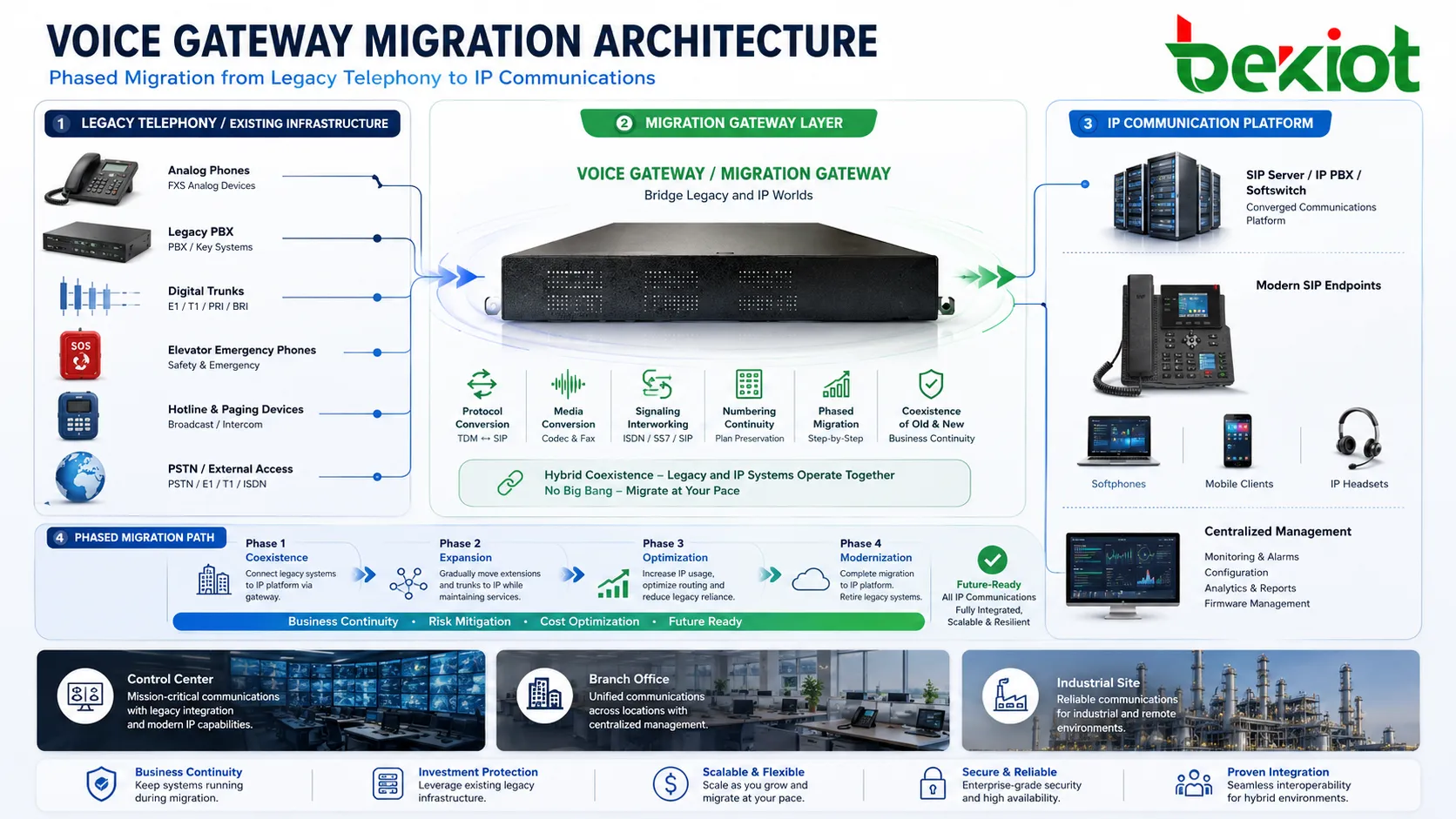
Many organizations cannot replace all voice infrastructure at the same time. Existing analog phones, PBX systems, public network trunks, elevator emergency phones, hotline devices, and field communication endpoints may still be working and may be expensive or risky to remove quickly. A voice gateway supports phased migration by allowing old and new systems to operate together.
In a typical migration, the organization may deploy an IP PBX, softswitch, or converged communication platform first. Instead of discarding all analog devices, analog gateways connect existing phones or lines into the new system. Digital trunk gateways may preserve access to existing carrier trunks while internal users move gradually to SIP extensions. This reduces disruption and allows the project to be implemented in stages.
Migration also involves operational habits. Users may still rely on familiar extension numbers, hotline behavior, call groups, or trunk dialing methods. The gateway can help preserve these behaviors while the underlying system changes. This is often important because communication migration is not only a technical change; it also affects daily work, emergency procedures, and maintenance practice.
For multi-site organizations, gateways can be deployed at branches, substations, plants, tunnels, stations, or remote facilities. Each site may keep local analog or trunk access while connecting to a centralized IP platform. This creates a hybrid architecture that supports both centralized management and local continuity.
The migration value of a gateway is therefore not limited to saving hardware cost. It reduces project risk, shortens cutover time, protects operational continuity, and gives the organization more control over the pace of modernization.
Applications in enterprise communication environments
In enterprise environments, voice gateways are often used to connect traditional office telephony systems with IP PBX platforms, SIP trunks, branch networks, and contact center infrastructure. This is common in organizations that have grown over time and now operate a mix of analog extensions, digital PBX trunks, IP phones, and cloud or hosted voice services.
A gateway can help unify these resources under one dialing plan. Employees can dial internal extensions across old and new systems. External calls can be routed through available trunks based on cost, reliability, or location. Branch offices can connect to headquarters through IP while retaining local PSTN backup. This flexibility helps organizations avoid disruptive replacement of the entire communication system.
Contact centers may use gateways to connect legacy trunk lines to modern call center platforms. Hotels may use analog gateways to preserve room phones while upgrading the core PBX. Schools and campuses may connect existing emergency phones or paging lines into newer communication platforms. Healthcare facilities may need to preserve analog nurse call or emergency voice interfaces while improving centralized management.
In these cases, the gateway becomes a practical integration component. It does not necessarily define the entire voice system, but it allows the system to evolve without breaking existing service. For organizations with many legacy endpoints, this is often the difference between a feasible migration and an expensive full replacement.
Applications in industrial, transport, and emergency systems
Industrial and infrastructure environments often have more complex requirements than standard office telephony. A factory, tunnel, railway station, port, power plant, mine, or emergency command center may use analog emergency phones, rugged telephones, paging amplifiers, radio systems, SIP terminals, dispatch consoles, and public network trunks at the same time. These systems are not always replaced frequently, but they must remain operational.
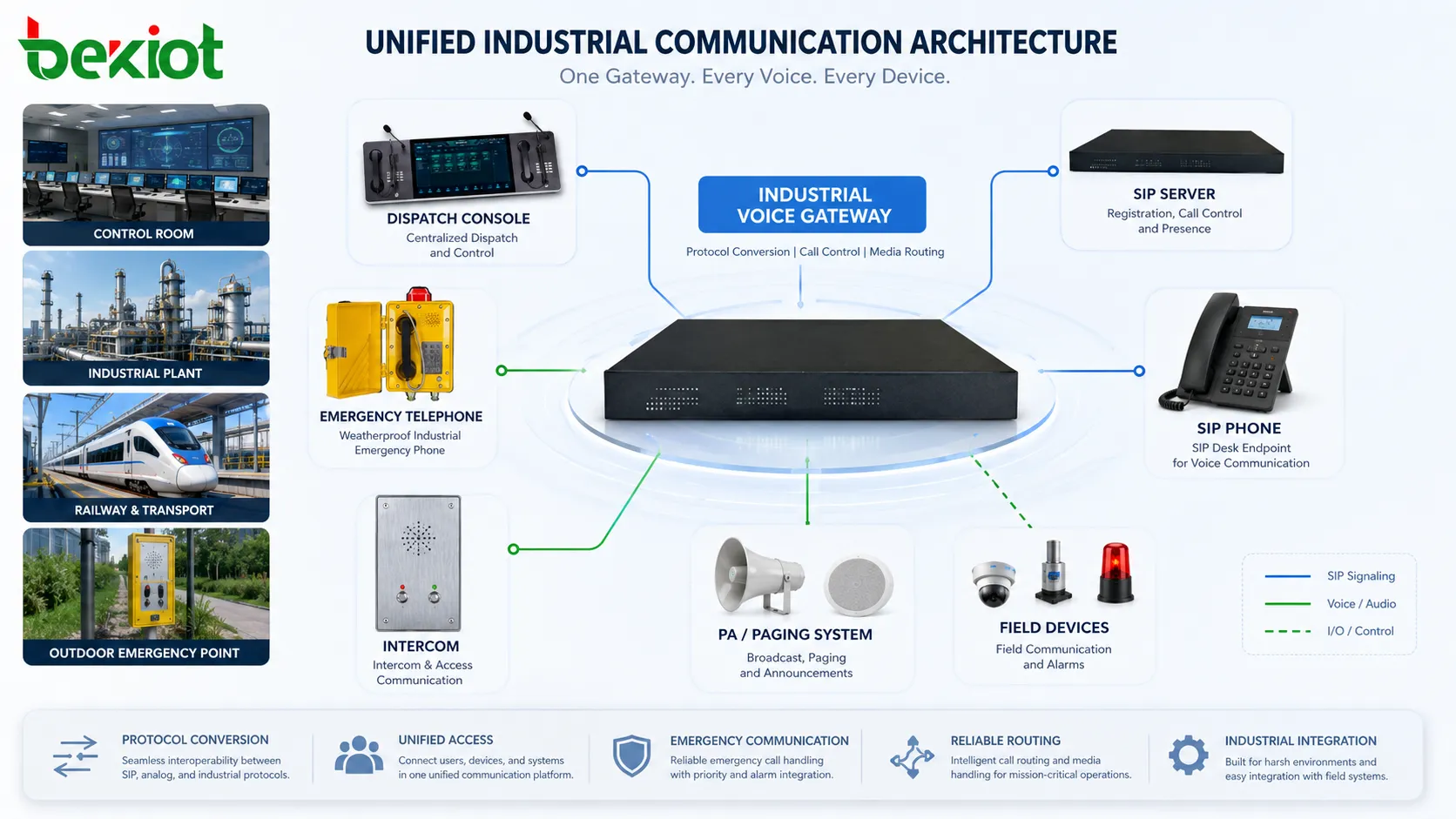
Voice gateways are used here to bring different field communication resources into a unified platform. An emergency phone may need to call a dispatch center through SIP. A control room may need PSTN backup if the IP route fails. A public address system may need to receive voice from an IP platform. A radio interface may need to be bridged into a dispatcher’s console. The gateway provides the conversion and routing layer that makes these interactions possible.
Transportation environments often use gateways to connect station voice systems, control center platforms, tunnel emergency phones, and public telephone access. Industrial plants may use gateways to integrate explosion-proof phones, analog lines, SIP dispatch systems, and alarm communication. Emergency systems may rely on gateways to preserve communication with legacy devices while adding IP-based command and recording functions.
In these scenarios, reliability, environmental adaptability, and manageability are often more important than simple port count. Becke Telcom IPGA series voice gateways can be considered in projects where field voice resources need to be integrated with IP dispatch, industrial communication servers, or emergency communication platforms. The key is to match the gateway type and capacity with the site’s actual interfaces, routing logic, and continuity requirements.
Routing logic and numbering plan design
A voice gateway becomes much more useful when its routing logic is designed carefully. Routing determines where a call should go based on the dialed number, source port, trunk availability, time policy, user group, or fallback condition. Poor routing design can cause call loops, failed outbound access, incorrect emergency routing, or confusion between internal and external numbers.
Numbering plan design should begin with the organization’s operational structure. Internal extensions, site prefixes, emergency numbers, public access codes, hotline numbers, and department groups should be planned before gateway rules are configured. If several sites are connected, each site may need a clear numbering range to avoid conflict. If legacy PBX systems are retained, their existing patterns should be mapped into the new system carefully.
Digit manipulation is often needed during this process. A user may dial a short extension, but the SIP server may need a longer number format. A gateway may receive a public number from a trunk and convert it into an internal extension. Emergency numbers may need to bypass normal routing and reach a specific dispatch group. These rules must be tested with real calling scenarios, not only with configuration screenshots.
Fallback logic should also be part of routing design. If the primary SIP server is unreachable, should calls go to a backup server, local trunk, or emergency destination? If one trunk group is busy, should the gateway select another route? If a field phone fails to register, should the console show an alarm? These questions determine whether the gateway supports real operational continuity.
Security and access control in IP voice integration
As voice gateways connect legacy systems to IP networks, they also become security boundary points. A gateway may have access to public trunks, internal extensions, emergency devices, and management interfaces. If poorly secured, it can expose the organization to toll fraud, unauthorized calls, service disruption, or configuration tampering.
Basic security starts with management protection. Default passwords should be changed, management access should be limited to trusted networks, unnecessary services should be disabled, and firmware should be maintained according to vendor guidance. Logs should be reviewed periodically, especially when the gateway has public or carrier-facing connectivity.
SIP security requires attention to authentication, registration policy, IP trust lists, encryption options, and call permission rules. If SIP trunks are used, the gateway should be configured to accept traffic only from known peers. If remote management is needed, secure access methods should be used rather than exposing administrative interfaces directly to the public internet.
Access control also applies to call routing. Not every port or user should have permission to make long-distance or international calls. Emergency routes should be protected from accidental misuse but always available to authorized endpoints. In industrial systems, some devices should only call the control room or dispatch center, while others may require broader access. The gateway must enforce these policies consistently.
Voice quality risks and troubleshooting methods
Voice gateway problems often appear as familiar symptoms: one-way audio, no ringback tone, failed outbound calls, echo, delay, noisy audio, dropped calls, or incorrect caller ID. These symptoms may come from different layers, so troubleshooting should follow a structured method rather than changing settings randomly.
For signaling problems, engineers should check registration status, dial rules, SIP messages, trunk status, and call logs. If calls do not establish, the issue may be digit routing, authentication, trunk availability, codec negotiation, or signaling mismatch. Packet capture tools can help identify whether SIP messages are being sent and answered correctly.
For media problems, engineers should examine RTP flow, codec selection, NAT behavior, firewall rules, jitter, packet loss, and gain settings. One-way audio often indicates media path blockage or incorrect address negotiation. Echo may point to analog impedance mismatch or insufficient echo cancellation. Low volume may require gain adjustment, but gain should not be increased blindly because it may also raise noise or cause clipping.
For analog line issues, physical wiring, loop current, polarity, ring detection, and port status should be checked. For digital trunks, synchronization, framing, signaling mode, and carrier status become important. For multi-site deployments, WAN quality and QoS settings may strongly affect call quality. The gateway provides the connection point, but the final voice result depends on the entire path.
Selection factors for a suitable deployment
Selecting a voice gateway should begin with interface requirements. The project needs to identify how many FXS ports, FXO ports, E1 or T1 trunks, SIP trunks, or specialized interfaces are required. It should also consider whether the gateway is used for endpoint access, trunk access, site interconnection, dispatch integration, emergency communication, or migration support.
Capacity planning is equally important. Port count alone is not enough. Engineers should consider concurrent calls, codec requirements, transcoding load, routing complexity, recording integration, redundancy expectations, and management visibility. A gateway that appears sufficient by port number may still be inadequate if it cannot handle the required call volume or media processing load.
Compatibility should be verified with the target PBX, SIP server, carrier, dispatch platform, or industrial communication system. SIP is a standard protocol, but real deployments often involve differences in header behavior, registration mode, DTMF transmission, codec preference, NAT traversal, and caller ID handling. Interoperability testing reduces project risk.
For industrial or emergency environments, reliability and management are major selection factors. The gateway should support stable operation, alarm reporting, remote configuration, logs, and clear diagnostics. Where Becke Telcom IPGA series voice gateways are used, they should be selected according to actual interface type, system scale, and integration target rather than simply choosing the largest model. Proper matching is more valuable than excessive configuration.
FAQ
Is a voice gateway the same as an IP PBX?
No. An IP PBX manages users, extensions, call features, and internal telephony logic, while a voice gateway mainly connects different interfaces or networks. In many systems, the gateway works with an IP PBX or dispatch platform rather than replacing it.
Can a gateway solve all compatibility issues between old and new systems?
It can solve many interface, signaling, and routing issues, but not every problem automatically. Numbering plans, codec support, trunk behavior, DTMF mode, caller ID format, and system permissions still need proper configuration and testing.
When should FXS and FXO ports be used?
FXS ports are used to connect analog telephones or endpoint devices because they provide line power and ringing. FXO ports are used to connect to analog lines from a PBX or telephone operator because they behave like a telephone endpoint receiving service from the line.
Why does one-way audio often happen after gateway deployment?
One-way audio is usually related to media path problems such as NAT, firewall blocking, incorrect RTP address negotiation, codec mismatch, or routing issues. The SIP call may be established successfully while the voice stream fails in one direction.
What should be tested before putting a gateway into service?
Testing should include inbound calls, outbound calls, emergency numbers, internal extension routing, caller ID display, DTMF transmission, codec negotiation, failover routes, recording integration, and call quality under normal network load.