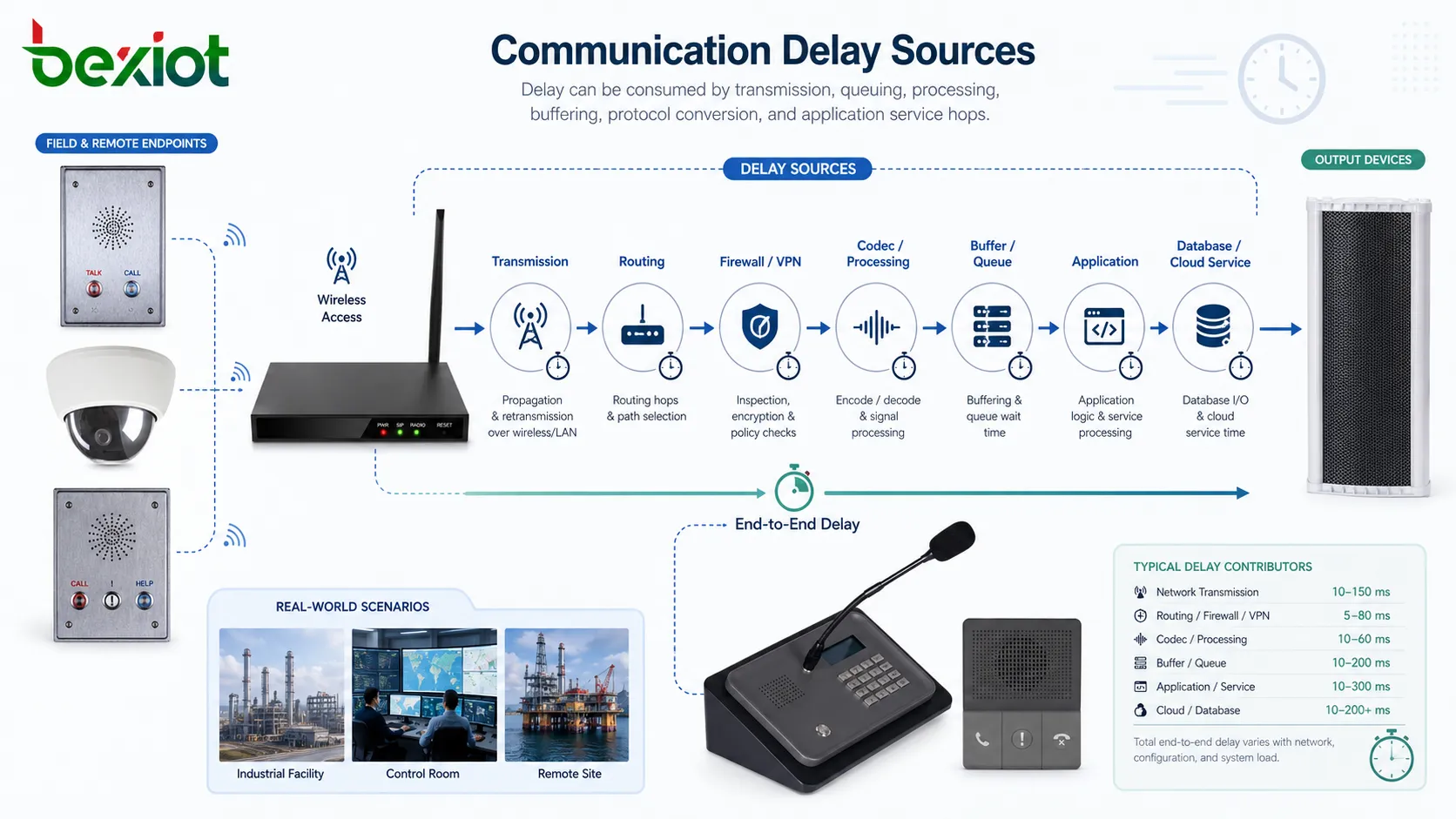
In communication engineering, delay is rarely caused by one single device. It is spent little by little: in access networks, switching, routing, wireless scheduling, encryption, buffering, protocol conversion, server processing, application queues, and even endpoint decoding.
A communication delay budget gives those milliseconds a place to belong. It defines how much delay each part of the system is allowed to consume before the total experience becomes unacceptable.
The meaning of a communication delay budget
A communication delay budget is a planned allocation of acceptable latency across a complete communication path. Instead of only saying “the system should be low-latency,” engineers divide the total allowable delay into smaller parts. Each network segment, processing module, transmission link, terminal, platform, or application layer receives its own delay target.
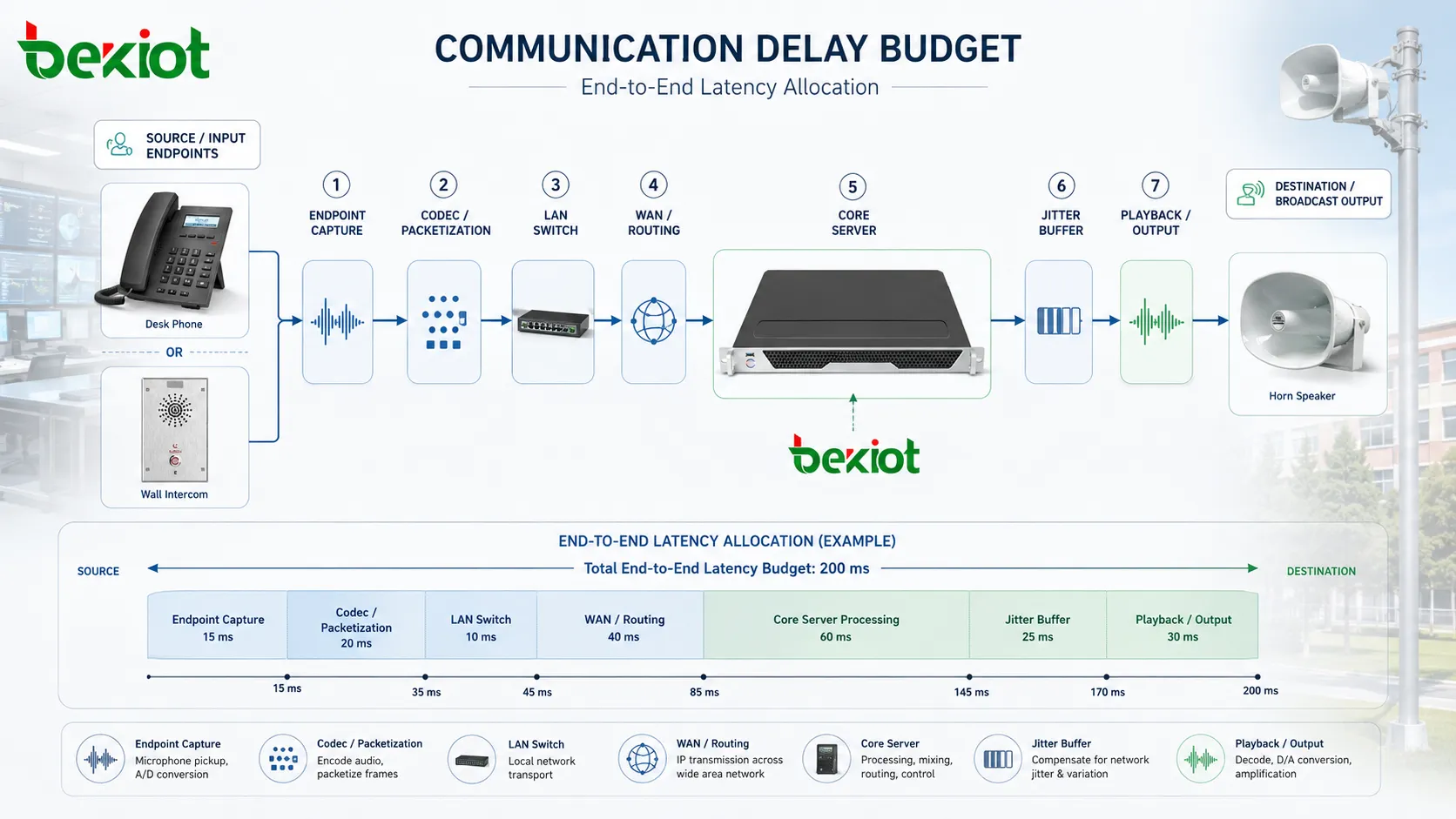
For example, an end-to-end voice communication system may need to keep one-way delay within a level that still feels natural to users. That total delay may include microphone capture, codec processing, packetization, LAN switching, WAN transmission, jitter buffering, server processing, and speaker playback. If each part is not controlled, the total delay can easily become too high even when no single component looks seriously overloaded.
The same principle applies to video conferencing, industrial control, remote monitoring, dispatch communication, cloud access, autonomous systems, and real-time collaboration. The delay budget becomes a design reference that tells the project team where latency is acceptable, where it must be minimized, and where trade-offs are allowed.
This makes delay budgeting different from ordinary performance testing. Testing measures what has already happened. Delay budgeting shapes the system before it is deployed. It helps engineers avoid discovering too late that the architecture cannot meet the required response time.
Why total delay needs to be divided
Looking only at total delay is useful for final acceptance, but it is not enough for design. If a system exceeds the target, the team must know which part consumed too much time. Was the problem caused by wireless access, WAN routing, codec processing, application queuing, server overload, or excessive buffering? Without a delay budget, troubleshooting becomes guesswork.
Dividing delay creates visibility. Each team can understand its responsibility. The network team manages transport delay and queue behavior. The application team controls processing and database response. The terminal team reduces encoding and decoding time. The operations team monitors congestion and routing changes. The project owner can then judge whether the whole system is still within the planned limit.
This division also prevents unrealistic expectations. A customer may ask for extremely low delay while also requiring long-distance cloud processing, high-definition video, heavy encryption, wireless access, and multiple platform integrations. A delay budget makes the trade-off visible. It shows where time is being consumed and whether the requirement can be achieved with the chosen architecture.
In practical projects, a clear delay budget helps avoid vague arguments. Instead of saying “the network is slow” or “the application is heavy,” teams can compare measured delay against planned delay for each section. This turns performance discussion into engineering analysis.
The main advantages in project design
The first advantage is predictability. Real-time communication systems cannot depend only on average performance. They need stable response under busy conditions. A delay budget gives the design team a target before equipment is selected, links are sized, servers are placed, or protocols are chosen. This reduces the risk of building a system that works in a test room but fails in real operation.
The second advantage is better architecture selection. If the delay budget is strict, some design choices may not be suitable. A remote cloud server may add too much round-trip time. A wireless link may need local edge processing. A video stream may require a different codec or lower buffering. A control system may need local survivability instead of sending every command through a distant platform.
The third advantage is clearer capacity planning. Delay increases when queues build up. If bandwidth, CPU, memory, storage, or radio resources are insufficient, packets and tasks wait longer. A delay budget forces engineers to consider not only whether data can pass, but whether it can pass within the required time.
The fourth advantage is easier acceptance testing. When the project has defined delay targets for each section, acceptance is not limited to a single end-to-end test. Engineers can verify terminal delay, network delay, server delay, and application delay separately. This makes the final result more credible and easier to maintain.
Where latency is usually consumed
Communication delay is often hidden in small places. Physical transmission adds propagation delay, especially over long distances. Switching and routing add forwarding delay. Congestion creates queuing delay. Firewalls, VPNs, encryption devices, and protocol gateways add inspection or conversion delay. Wireless systems add scheduling, retransmission, and signal recovery time.
Terminals also contribute to the budget. A microphone, camera, sensor, phone, intercom, controller, or mobile device may need time to capture, encode, compress, encrypt, packetize, decode, and play out data. In voice systems, jitter buffers are often necessary to smooth packet arrival variation, but larger buffers increase delay. In video systems, encoding complexity can create visible latency even if the network is healthy.
Application platforms add another layer. A request may wait in an application queue, pass through an API gateway, query a database, trigger a message broker, call another service, or wait for authentication. These steps may be normal, but they still consume time. In cloud-based systems, each additional service hop can affect the total delay budget.
This is why delay budgeting should include the complete service path, not only the network. A fast LAN cannot compensate for slow application logic. A powerful server cannot remove delay caused by long-distance transport. A good design looks at the whole chain.
Applicable field: voice and dispatch communication
Voice communication is one of the most direct fields for delay budgeting. Human conversation is sensitive to delay because people expect immediate turn-taking. When one-way delay becomes too high, speakers interrupt each other, conversation rhythm becomes unnatural, and command instructions feel slow. This is especially important in dispatch, control room, emergency, and public safety communication.
In a voice system, the delay budget may include endpoint audio processing, codec delay, packet interval, network forwarding, jitter buffer, server routing, recording insertion, and gateway conversion. If a voice call passes through multiple platforms or public networks, the delay budget becomes even more important.
Dispatch communication has stricter operational expectations than ordinary office calling. Operators may need to issue instructions quickly, interrupt routine communication, connect groups, or coordinate emergency response. If the system delay is too high, the command process feels disconnected from the field situation.
A delay budget helps planners decide whether voice processing should be local, whether WAN paths are acceptable, whether gateway conversion should be minimized, and whether priority handling is needed for voice packets. It also helps explain why low bandwidth usage does not automatically mean low delay. Voice traffic may be light, but it still needs predictable timing.
Applicable field: video conferencing and live monitoring
Video systems often have more complex delay behavior than voice systems. A video path includes camera capture, image processing, encoding, network transmission, buffering, decoding, display rendering, and sometimes cloud mixing or recording. High-definition video, noise reduction, compression, and adaptive bitrate control can all add latency.
For video conferencing, low delay is important because users interact in real time. If the delay is too high, discussion becomes awkward and interruptions increase. For live monitoring, the acceptable delay depends on the use case. A security overview may tolerate more delay than remote operation, emergency command, or live industrial inspection.
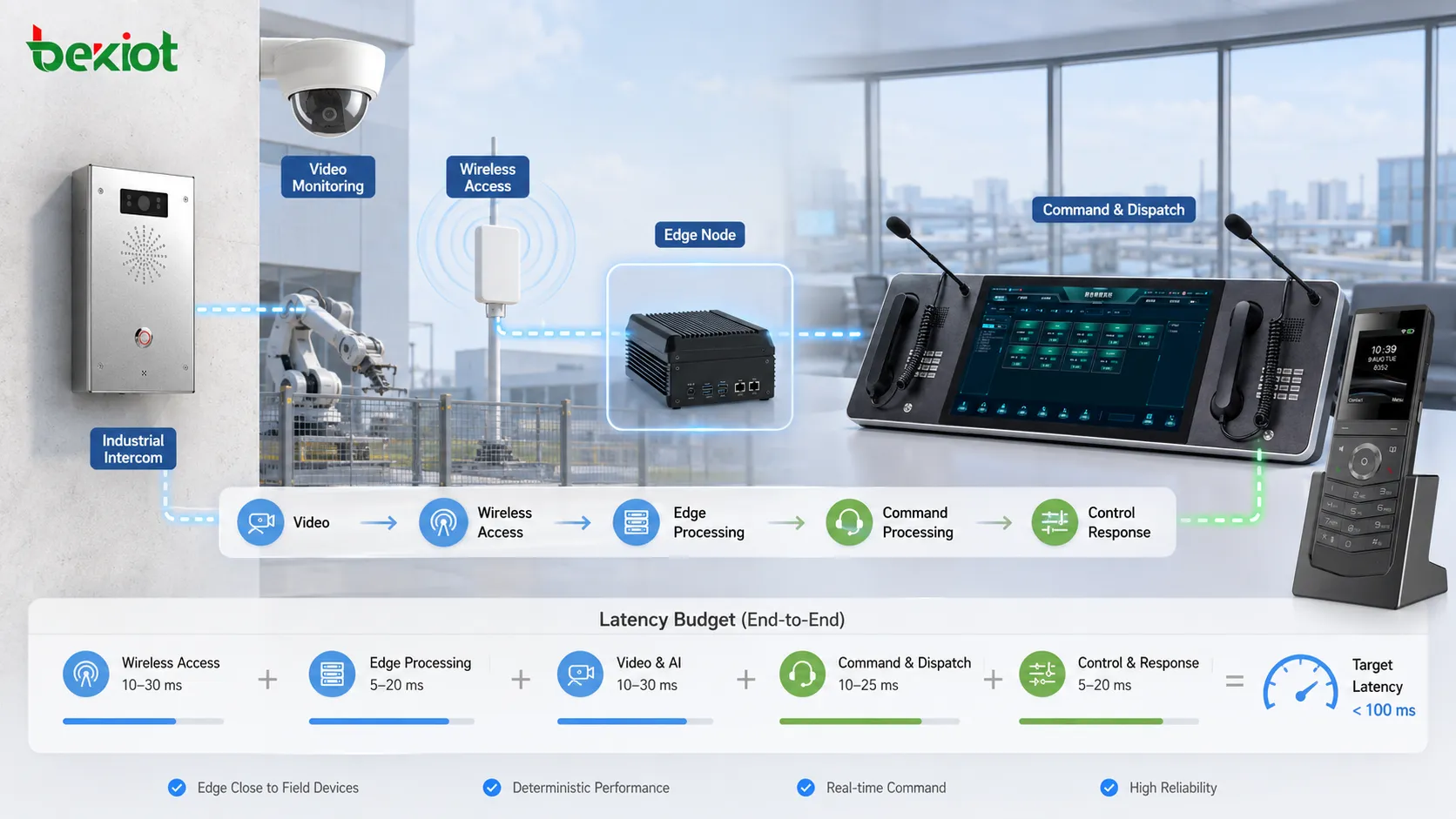
A communication delay budget helps engineers decide where video processing should happen. Some systems can process video centrally. Others need edge processing to avoid sending every stream to a distant platform. If video is used for safety confirmation or remote control, the budget should be stricter than for general recording.
Video also competes for bandwidth. When a network is congested, video buffers may grow and delay may increase. QoS, local caching, stream selection, and bitrate control should therefore be considered as part of the delay budget rather than added after problems appear.
Applicable field: industrial control and automation
Industrial communication often uses delay budgets because control actions may depend on predictable timing. A sensor reading, controller instruction, alarm signal, or machine status update may not use much bandwidth, but it may need to arrive within a defined time. In these cases, delay is not only a user experience issue; it can affect process stability and safety.
Different industrial applications have different timing requirements. A monitoring dashboard may tolerate seconds of delay. A production coordination system may need sub-second response. A motion control or protection system may require much stricter timing and may not be suitable for ordinary shared networks. The delay budget helps separate these requirements instead of treating all industrial data the same.
For automation projects, delay budgeting supports decisions about local controllers, edge gateways, private networks, protocol conversion, and cloud connectivity. If a control loop cannot tolerate WAN delay, it should remain local. If cloud analytics are useful but not time-critical, they can operate outside the strict control path.
This separation is practical. It allows organizations to modernize industrial systems without forcing every signal into a remote architecture. Real-time actions remain close to the equipment, while non-real-time data can be sent to higher-level platforms.
Applicable field: wireless, 5G, and edge networks
Wireless communication makes delay budgeting more important because radio conditions change. Signal strength, interference, handover, scheduling, retransmission, and user density can all affect latency. A wired link may behave more predictably, while wireless systems require more careful planning for real-time services.
In private wireless, 5G, Wi-Fi, and mobile communication networks, delay budgets help decide whether the application can run through the radio layer and still meet its target. For example, push-to-talk, video inspection, mobile dispatch, AGV control, and remote maintenance may all have different tolerance levels. One wireless design cannot automatically satisfy every case.
Edge computing is often introduced to reduce delay. Instead of sending all data to a remote cloud, processing can be placed closer to users, machines, cameras, or field devices. This reduces transport delay and can also reduce congestion on the backhaul network.
A delay budget helps justify where edge nodes should be placed. If the budget shows that long-distance transport consumes too much time, local processing becomes necessary. If the delay requirement is loose, central processing may still be acceptable. This keeps edge deployment tied to real performance needs rather than trend-driven architecture.
Applicable field: cloud services and distributed applications
Cloud services and distributed applications often contain many hidden delay points. A user request may pass through DNS, access networks, firewalls, load balancers, API gateways, authentication services, application servers, databases, caches, message queues, and third-party interfaces. Each step may be acceptable alone, but the total response time may become too high.
A delay budget helps cloud architects decide how much time each layer may consume. If database response is slow, the application layer must not hide the problem with excessive retries. If the API gateway adds inspection overhead, it should be included in the budget. If a third-party service is unpredictable, the application may need timeout control or asynchronous handling.
For distributed applications, the budget also helps decide where data should be placed. A service that frequently reads data from a distant region may suffer unnecessary latency. Regional replicas, local caches, content delivery networks, and edge services can reduce delay when used properly.
This is why delay budgeting is not limited to telecom engineering. It is equally useful in software architecture, cloud migration, SaaS platforms, financial systems, online services, and enterprise digital platforms where response time affects user experience and business efficiency.
Applicable field: emergency and safety-related systems
Emergency systems must be designed with delay in mind because late communication can reduce response effectiveness. Alarm activation, emergency calling, public address, dispatch instructions, video confirmation, and responder notification should not depend on unpredictable processing chains. A delay budget helps define how quickly each action should occur.
For example, an emergency call may need to reach the control room quickly. A panic alarm may need to display location information without waiting for multiple remote services. A public announcement may need to start within a short time after operator confirmation. A video feed may need to open fast enough to support scene verification.
The acceptable delay depends on the scenario. A maintenance notification may tolerate more delay than evacuation instruction. A general event record may be less urgent than a live voice channel. The delay budget helps classify these actions so that the system protects the most time-sensitive paths.
In safety-related systems, delay budgeting also supports testing. The project team can test whether the alarm-to-display time, call setup time, announcement startup time, or video opening time meets the operational requirement. This makes acceptance more realistic than simply checking whether each subsystem is connected.
How to create a practical delay budget
A practical delay budget begins with the service requirement, not with the equipment list. Engineers should first define what kind of communication is being supported and how much total delay is acceptable. Voice, video, control, monitoring, reporting, and file transfer should not share one generic target.
The next step is mapping the full path. This includes endpoints, access network, switching, routing, WAN, wireless links, security devices, gateways, servers, databases, applications, and display or playback devices. Every hop that can add delay should be visible in the design.
After the path is mapped, the total allowable delay can be divided into segments. The access network may receive one target, the core network another, the application platform another, and endpoint processing another. The allocation should be realistic. Some parts can be optimized heavily, while others have physical or technical limits.
The final step is verification. Measurements should be taken under normal and busy conditions. Average delay is useful, but peak delay, jitter, queue behavior, and timeout events are often more revealing. A system that meets the target only when idle may not be ready for real operation.
Common mistakes in delay budget design
One common mistake is using only average latency. Average values can hide short bursts of delay that damage real-time services. Voice, video, and control applications often suffer more from unstable delay than from a slightly higher but stable delay. A useful budget should consider jitter, peak delay, and delay variation.
Another mistake is ignoring endpoint processing. Engineers may focus heavily on network delay while forgetting codec delay, camera processing, display rendering, encryption, application queuing, or database response. In many systems, the network is only one part of the delay chain.
Some projects also set targets without considering geography. A long-distance path has unavoidable propagation delay. If users, servers, and data are placed far apart, the budget must reflect that reality. Demanding ultra-low latency from a remote cloud architecture may be unrealistic.
A final mistake is treating delay budget as a one-time design document. Network traffic changes, applications are updated, more users are added, wireless conditions shift, and platform functions expand. The delay budget should be reviewed when the system changes, especially when new services are added to the same communication path.
How to judge whether the delay budget is successful
A successful delay budget is not judged by paperwork. It is judged by whether the system delivers stable communication under real conditions. The first criterion is whether end-to-end delay stays within the service requirement. The second is whether each segment remains close to its allocated target. The third is whether delay remains stable when the system is busy.
User experience should also be considered. A voice system may technically pass a delay test but still feel unnatural if jitter is high. A video system may show acceptable average latency but freeze during congestion. A control system may meet normal timing but fail during peak traffic. Measurements and actual service behavior should be reviewed together.
Operational teams should also be able to locate delay quickly. If performance becomes worse, the budget should help identify whether the issue is in the access link, WAN, server, application, wireless segment, or endpoint. This diagnostic value is one of the strongest reasons to create a delay budget in the first place.
When a delay budget is well designed, it becomes a shared reference for design, deployment, acceptance, maintenance, and future expansion. It turns “low latency” from a vague requirement into a controllable engineering target.
FAQ
Is a communication delay budget the same as network latency?
No. Network latency is one part of the total delay. A communication delay budget includes network latency, endpoint processing, buffering, server handling, protocol conversion, application response, and other delay sources across the full service path.
Why is delay budgeting important for voice communication?
Voice conversations depend on natural timing. If delay is too high or unstable, users may interrupt each other, hear gaps, or feel that the call is difficult to manage. A delay budget helps protect voice quality before the system is deployed.
Can a delay budget be used in cloud applications?
Yes. Cloud applications often pass through many service layers, regions, gateways, databases, and APIs. A delay budget helps identify how much time each layer can consume and whether edge processing, caching, or regional deployment is needed.
What is the biggest mistake when creating a delay budget?
The biggest mistake is focusing only on the transport network while ignoring endpoint processing, application queues, database response, jitter buffers, encryption, and protocol gateways. Real delay usually comes from the whole chain.
How often should a delay budget be reviewed?
It should be reviewed when new services are added, user scale changes, network paths change, cloud regions move, wireless conditions shift, or real-time performance complaints increase. Delay budgets should evolve with the system.