


The value of an integrated communication system is not reflected in how many devices it connects, but in how quickly people can coordinate when separate systems would normally slow them down.
In many organizations, communication resources exist in separate layers: telephones for calls, radios for field teams, paging systems for announcements, cameras for verification, alarms for emergency signals, and management platforms for records. Each system may work independently, but independent operation does not automatically create coordinated response. The real value appears when these resources are connected into one operational workflow.
Breaking Communication Silos: From Fragmented Tools to a Unified Framework
An integrated communication system is valuable because it reduces the fragmentation that often exists between different communication tools. In a traditional environment, a control room may use one platform for phone calls, another for radio channels, another for alarms, another for public address, and another for video confirmation. When an incident occurs, the operator must switch screens, search contacts, verify locations, and manually coordinate teams. This process consumes time and increases the chance of missing important information.
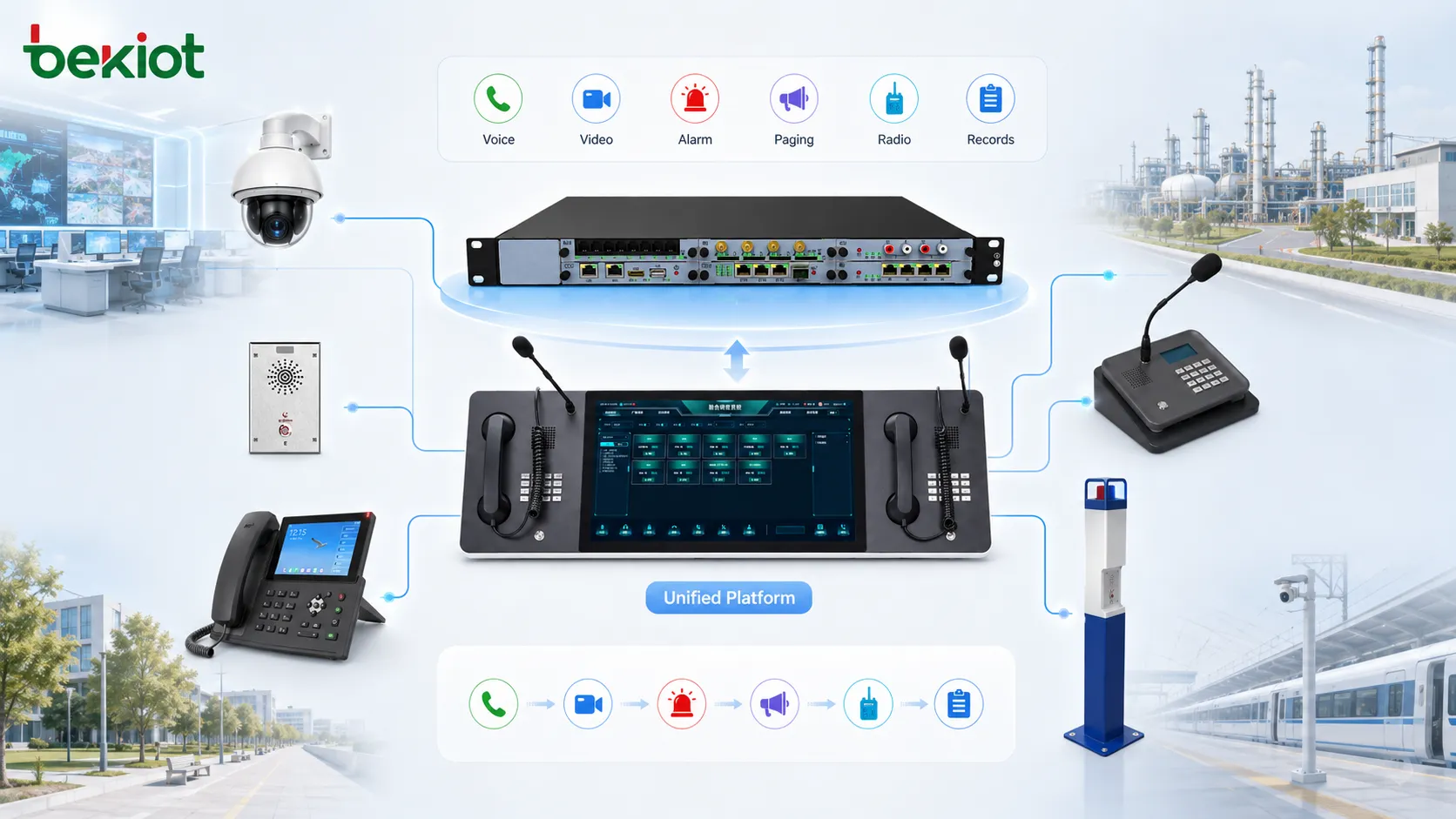
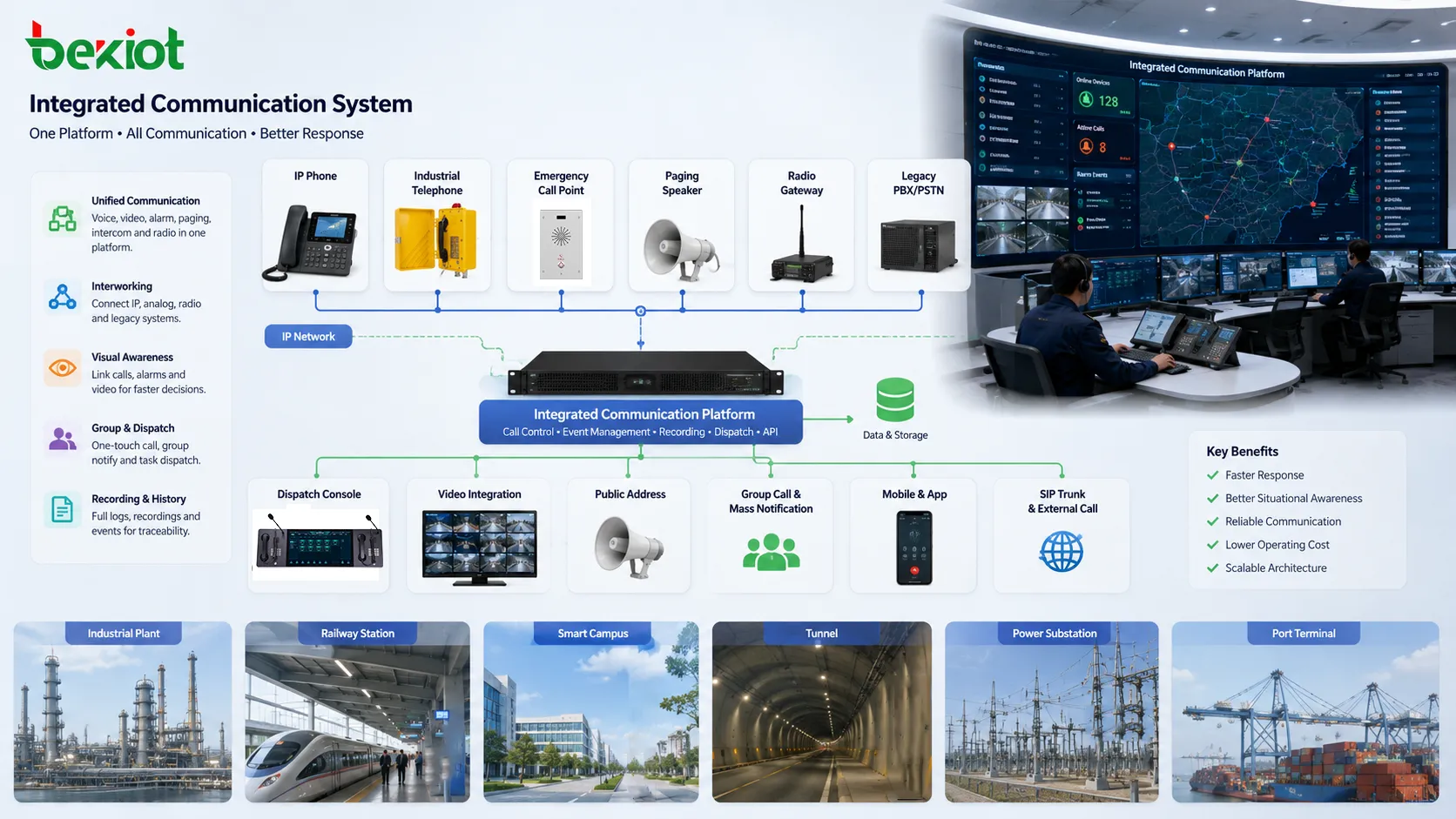
Integration changes the structure. Instead of treating voice, video, alarm, paging, intercom, and dispatch as isolated systems, it organizes them into one communication framework. Operators can handle calls, view events, activate groups, trigger announcements, contact field teams, and review records through a more unified operating process. The system does not remove the uniqueness of each communication method; it makes them work together around the same operational objective.
This is especially important in environments where communication is tied to safety, production, service continuity, or emergency response. A railway station, industrial park, energy facility, campus, port, hospital, tunnel, or command center may contain many communication endpoints, but the practical question is whether those endpoints can support coordinated action. An integrated communication system helps convert scattered tools into a controllable response capability.
At the management level, this also simplifies daily operation. Instead of maintaining separate user lists, separate event records, and separate response rules, the organization can build a more consistent communication structure. This improves visibility, reduces duplicated work, and makes system expansion easier over time.
Incident Response: Linking Manual Steps into a Coordinated Workflow
The value of integration becomes very clear during an incident. A normal communication chain often depends on manual steps: someone reports a problem, the operator asks for the location, searches for the right camera, contacts a response team, makes a public announcement if needed, and records the event afterward. Each step may be simple, but together they create delay. In a time-sensitive situation, the delay can affect safety and operational control.
An integrated platform can connect these steps into a linked workflow. When an alarm is triggered, the system may display the location, open related communication channels, show nearby cameras, notify a response group, and start recording. The operator still makes decisions, but the system prepares the communication context. This shortens the path between receiving information and taking action.
For example, when a security incident occurs at a gate, the system can connect the emergency call, camera view, security patrol group, and control room in one workflow. In an industrial plant, a production alarm can be linked with the maintenance team, dispatch console, public address zone, and event log. In a transport site, platform staff, control center operators, and field responders can be reached more quickly through predefined groups.
This practical advantage is not about automation replacing human judgment. It is about reducing unnecessary manual coordination so that operators can focus on assessment, instruction, and follow-up. A well-designed integrated communication system gives the right people the right channel at the right moment.
Unified Dispatch: A Command Surface for Operational Control
Integrated communication systems usually need a clear command surface, and this is where dispatch functions become important. A dispatch console or command interface allows operators to control calls, groups, priorities, alarms, announcements, and field communication resources from one position. Without such an interface, integration may exist in the background but remain difficult for operators to use during real work.
Unified dispatch makes communication more operational. It allows users and devices to be organized by department, zone, site, role, duty group, or incident type. Instead of dialing individual numbers one by one, the operator can contact a predefined response group, call a field terminal, join a radio channel, or launch a broadcast to a target area. This matches the way real command decisions are made.
Priority handling is also part of this value. Routine communication and emergency communication should not have the same operational weight. An integrated communication system can assign higher priority to emergency calls, alarm-triggered sessions, or command announcements. This helps ensure that urgent messages do not become buried behind ordinary traffic.
In solutions such as the Becke Telcom BK-RCS converged communication system, the value is reflected in the ability to organize multiple communication resources around dispatch and emergency response workflows. The point is not simply that more devices can be connected, but that operators can manage them through one structured command logic.
Situational Awareness: Connecting Information for Informed Decisions
Communication is more effective when operators understand the situation behind the call. In many systems, a voice report provides only part of the picture. The operator may still need to know where the event is located, which device triggered the alarm, whether nearby cameras are available, which team is closest, and whether other related systems are affected. Integrated communication improves situational awareness by connecting these information sources.
For distributed sites, this capability is especially valuable. A headquarters control room may need to understand conditions across branches, stations, substations, production zones, parking areas, or remote service points. If each site uses isolated communication tools, visibility becomes fragmented. Integrated platforms can present device status, call events, alarm information, and response records in a more centralized view.
Situational awareness also helps reduce wrong responses. If an alarm is linked with a known device location and video reference, the operator can confirm the event more quickly. If the system shows that one contact is offline, the operator can choose another route. If a group is already busy handling another incident, the dispatcher can adjust assignment. These small decisions improve the quality of response.
In daily operations, this visibility helps managers understand communication load, repeated fault areas, frequently used channels, and response bottlenecks. Over time, the system becomes not only a communication tool but also a source of operational insight.
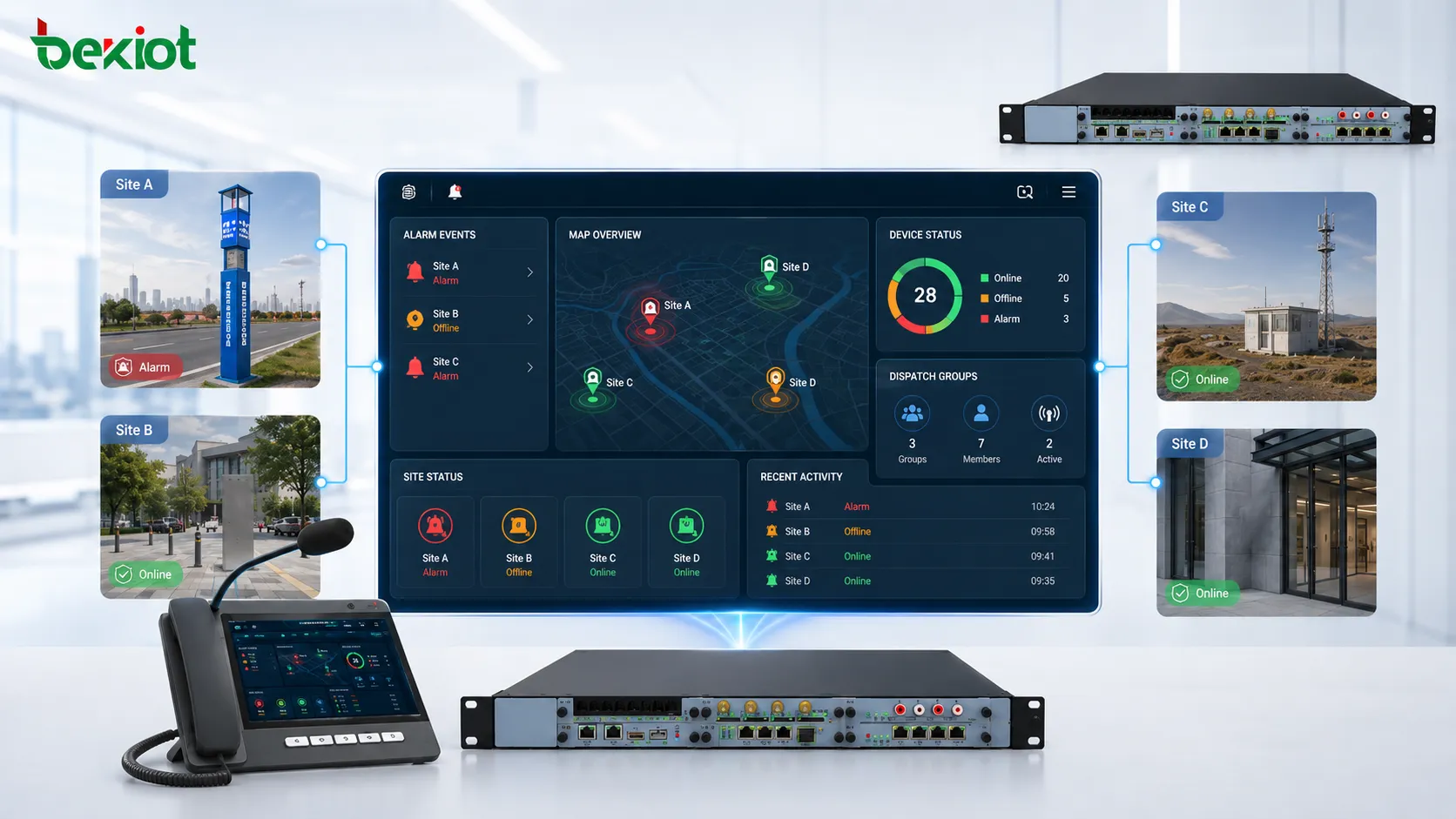
Related solution: Becke Telcom BK-RCS Converged Communication System
Emergency Coordination: Structured Processes for Consistent Response
Emergency coordination requires more than the ability to make a phone call. It requires clear routing, known roles, reliable contact paths, response priority, event traceability, and the ability to notify several teams quickly. Integrated communication systems provide value by turning emergency communication into a predefined process rather than an improvised series of calls.
When an emergency call, panic alarm, fire signal, equipment fault, or security event enters the platform, the system can route it according to the event type and location. A control room may receive the voice call, a patrol team may be notified, a public address zone may be activated, and a supervisor may receive an alert. These actions can be configured according to the organization’s emergency plan.
This improves response consistency. If every operator handles incidents based only on personal experience, response quality may vary by shift, training level, or workload. An integrated system helps preserve the organization’s intended procedure. Operators still make decisions, but the platform supports them with structured communication paths.
Emergency coordination also benefits from redundancy planning. In critical environments, the system should consider fallback communication paths, local survivability, backup trunks, recording continuity, and endpoint monitoring. Integration should not create a single fragile dependency; it should provide a more resilient way to connect people and systems during abnormal conditions.
Daily Operational Efficiency: Reducing Friction in Routine Communication
The value of an integrated communication system is not limited to major incidents. In daily operation, it can reduce repetitive coordination work. Maintenance teams can be contacted through groups. Security posts can be reached from the same interface. Public announcements can be sent to selected zones. Call records and event history can be reviewed without switching between multiple systems. These small efficiencies accumulate over time.
For organizations with many departments or sites, unified contact structure is especially useful. Staff no longer need to remember separate numbers, radio channels, paging codes, or platform procedures for every situation. The system can organize resources by function and role, which makes communication easier for operators and field personnel.
Daily efficiency also appears in maintenance. A unified platform can help technical teams check device status, identify offline terminals, review call logs, and locate recurring communication problems. Instead of waiting for users to report issues, maintenance staff can identify abnormal patterns earlier.
In business terms, this means reduced coordination friction. The organization can handle routine communication, abnormal events, and emergency response with fewer manual steps and less dependence on informal personal networks. Communication becomes a managed operational resource instead of a scattered set of tools.
Industrial and Infrastructure Integration: Meeting the Demands of Complex Sites
Industrial and public infrastructure sites often contain diverse communication systems because different teams and equipment types have different requirements. A factory may use IP phones, explosion-proof telephones, paging speakers, intercom points, radio systems, and control room consoles. A transport site may combine station phones, emergency terminals, CCTV, public address, and command center dispatch. A campus may need security calls, visitor help points, mass notification, and maintenance communication.
The integrated communication system provides value by allowing these resources to support one another. A field emergency phone can reach the control room. A control room can notify a response group. A public address system can broadcast instructions. A video feed can assist confirmation. A dispatch console can coordinate multiple communication paths from one position. The system becomes stronger because each communication method contributes to a larger workflow.
This is particularly useful where old and new systems must coexist. Many sites cannot replace all analog, radio, or legacy systems at once. Integration allows existing resources to be connected into IP-based or platform-based communication architecture. This protects earlier investment while enabling modernization.
The most important value is practical continuity. Industrial and infrastructure environments cannot depend only on ordinary office communication habits. They need communication methods that match field conditions, safety risks, equipment distribution, and command responsibilities. Integrated communication provides a way to align technology with these real operating needs.
Traceability and Accountability: Evidence-Based Improvement Through Recorded Events
Another important value of integrated communication is traceability. When calls, alarms, broadcasts, recordings, and operator actions are handled through separate systems, it is difficult to reconstruct what happened during an incident. An integrated platform can associate communication records with event time, device identity, operator action, response group, and handling result.
This supports post-event review. Managers can check when an event occurred, how quickly it was answered, who was contacted, whether the correct group responded, and how long the communication lasted. This helps improve training, staffing, response procedures, and system configuration. It also supports accountability because key actions are recorded rather than relying entirely on verbal reports.
Traceability is useful in daily operations as well. Repeated calls from one area may indicate a facility issue. Frequent offline devices may indicate network or power problems. Long response times may reveal process bottlenecks. High call traffic during certain periods may suggest staffing or workflow imbalance. Integrated communication data helps organizations move from experience-based judgment to evidence-based improvement.
For critical sites, this management value is often overlooked during procurement but becomes important after deployment. A system that only connects calls solves immediate communication needs. A system that records and organizes communication behavior helps the organization improve over time.
Modernization Without Disruption: A Gradual Path to Future-Ready Communication
Many organizations adopt integrated communication during modernization projects. They may have older PBX systems, analog voice lines, radio networks, paging equipment, emergency terminals, and newer SIP-based systems operating at the same time. Replacing everything at once is often expensive, risky, and disruptive. Integration provides a more gradual path.
A converged communication platform can connect existing systems through gateways, interfaces, APIs, SIP trunks, radio integration, and alarm linkage. This allows the organization to keep essential legacy equipment while adding centralized management, dispatch functions, recording, emergency workflows, and IP-based expansion. The result is a controlled transition rather than a sudden cutover.
Modernization value also appears in scalability. Once the architecture is integrated, new sites, terminals, groups, and functions can be added more systematically. The organization can expand emergency communication, paging, dispatch, or monitoring functions without rebuilding every subsystem from scratch.
Lightweight deployment of a system such as Becke Telcom BK-RCS can be considered where projects need to combine dispatch communication, emergency response, voice integration, and multi-system coordination into one platform. The selection should still be based on site scale, interface requirements, workflow design, and long-term maintenance needs.
Practical Considerations: Realizing Value Through Design, Training, and Maintenance
An integrated communication system does not create value automatically just because it connects many functions. The design must match real workflows. If groups are poorly organized, operators cannot find contacts quickly. If alarm linkage is unclear, automation may create confusion. If permissions are too broad, control becomes risky. If records are not managed, traceability is weakened. Value depends on configuration, training, testing, and maintenance.
Successful projects usually begin with communication workflow analysis. Who needs to contact whom? Which events require priority? Which systems should be linked? Which devices are critical? Which records must be kept? Which functions must continue during network failure? These questions should guide architecture design before equipment is deployed.
Operator training is equally important. A platform may provide many features, but operators need to know how to use the functions under pressure. Training should include normal calls, emergency calls, group dispatch, alarm handling, paging, recording retrieval, and abnormal situation response. The system should support users rather than overwhelm them.
Maintenance must also be continuous. Device status, server health, gateway availability, network quality, recording storage, permissions, and configuration backups should be reviewed regularly. Integration increases value, but it also means that failures in one connected area may affect workflows elsewhere. Good maintenance keeps the system trustworthy.
Conclusion
The essential value of an integrated communication system lies in turning disconnected voice, video, alarm, paging, and radio resources into one coordinated operating framework. It shortens response time by linking communication actions, strengthens situational awareness, supports reliable emergency coordination, and reduces the daily friction of managing scattered tools. Rather than simply adding more devices, the system organizes people and channels around the same operational logic—giving operators a command surface and management a traceable record of events.
Realizing that value depends on more than technical connectivity. The system must be built around actual workflows, tested under pressure, supported by clear training, and maintained as a living operational resource. When those conditions are met, integrated communication becomes a practical capability that improves safety, efficiency, and accountability across the organization—not just another collection of connected hardware.
FAQ
Is an integrated communication system only for large command centers?
No. It is useful wherever multiple communication tools must work together. A medium-sized factory, campus, transport station, hospital, port, or industrial park may benefit if voice, alarms, paging, video, and field communication are currently handled separately.
Can legacy equipment be integrated without full replacement?
Yes, in many cases. Analog phones, PBX trunks, radio channels, paging systems, emergency terminals, and SIP devices can often be connected through gateways or interfaces. The exact method depends on protocol compatibility, wiring conditions, and project requirements.
What is the difference between simple interconnection and true integration?
Simple interconnection allows systems to pass signals or calls. Integration goes further by combining communication actions with workflow, status display, priority rules, event records, and operator control. Integration is about operational coordination, not just technical connection.
What should be planned before deploying an integrated communication system?
Planning should include user groups, device types, alarm sources, dispatch roles, emergency procedures, paging zones, video linkage needs, recording requirements, network conditions, redundancy expectations, and future expansion. Workflow planning should come before interface configuration.
How does an integrated system help with post-incident analysis?
It provides records of calls, alarms, broadcasts, response times, operator actions, device status, and recurring events. These records help managers improve procedures, training, staffing, maintenance, and system layout over time.







