


A network can have more than enough bandwidth and still deliver a miserable experience—your video meeting freezes mid-sentence, the VoIP call dissolves into stuttering fragments, a dispatch order lands seconds too late, and a surveillance stream breaks into pixelated noise. The connection isn’t down; it’s just letting every type of traffic shove into the same pipe and fight without any sense of priority. Real-time voice gets trampled by a file download, critical commands queue up behind a system update, and suddenly all that capacity counts for nothing. Quality of Service, or QoS, is what turns this chaos into something manageable—by making sure the traffic that can’t wait doesn’t have to.
Why traffic needs service differentiation
Quality of Service exists because not all network traffic has the same tolerance for delay, loss, or interruption. A file download can slow down and still finish successfully. An email can wait a few seconds without changing its meaning. A voice call, emergency command session, industrial control message, or live video stream behaves differently. If packets arrive too late or too unevenly, the service may fail even when the link is technically available.
QoS provides a way to classify traffic and apply different handling rules according to service importance. Instead of treating every packet as equal, the network can recognize which packets are delay-sensitive, which traffic can be queued, which flows need guaranteed bandwidth, and which applications should be limited during congestion. This makes the network more aligned with business and operational priorities.
The practical point is not to make every application faster. QoS cannot create unlimited bandwidth, and it cannot repair a poorly designed network by itself. Its value appears when congestion or competition occurs. At that moment, QoS helps the network decide which traffic should be protected first and which traffic can tolerate delay.
In enterprise, industrial, campus, transportation, healthcare, and command center networks, this distinction matters. A backup task, software update, or large data transfer should not be allowed to damage emergency communication, real-time voice, video monitoring, or production control traffic. QoS gives engineers a policy framework for making this behavior predictable.
The practical uses in real network environments
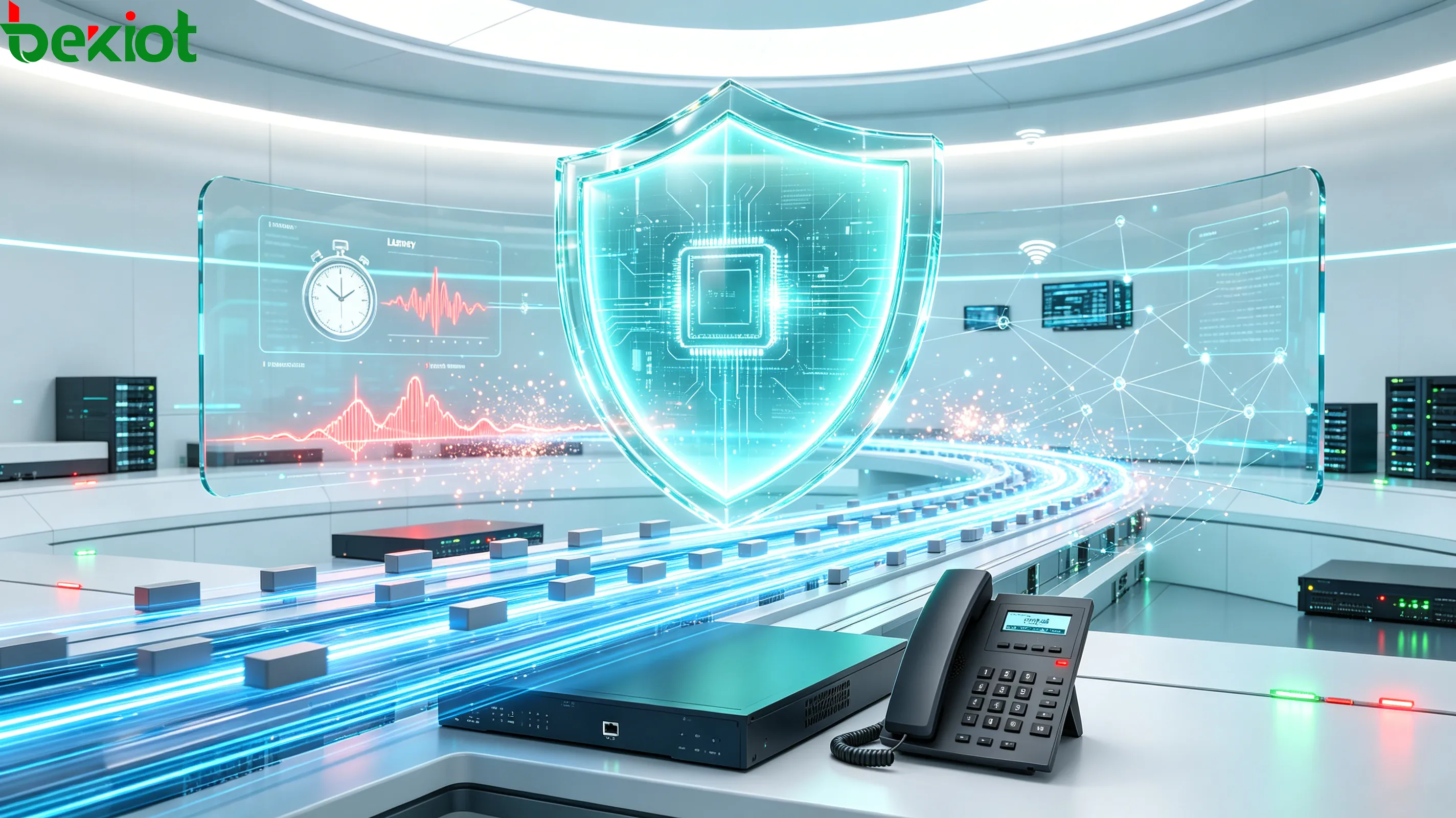
The first common use of QoS is protecting voice communication. Voice packets are small, frequent, and delay-sensitive. If they are delayed too long, users hear gaps. If they arrive unevenly, the conversation sounds unstable. If too many packets are lost, speech becomes unclear. QoS can mark voice traffic, place it into a priority queue, and reduce the chance that it will be delayed behind bulk data traffic.
Video services are another major use case. Video conferencing, surveillance streams, remote inspection, and live command feeds require stable throughput and controlled packet loss. Unlike file transfer, video does not always have time to retransmit missing packets. QoS can allocate bandwidth, manage queue behavior, and prevent video flows from being overwhelmed by less urgent traffic during busy periods.
Industrial and operational networks also use QoS to protect control and monitoring traffic. In these environments, small amounts of data may carry high operational importance. A status message from a field controller, a signaling packet from a communication terminal, or an alarm event from a safety system may not consume much bandwidth, but it should not be delayed behind ordinary office traffic. QoS helps preserve responsiveness for these critical flows.
QoS is also useful for WAN links and multi-site networks. Branch sites, remote stations, cloud access paths, VPN tunnels, and leased lines often have limited bandwidth compared with local switching networks. When multiple services share the same WAN link, QoS can prevent a single large transfer from affecting calls, application sessions, or management traffic. This makes the available bandwidth more predictable and more usable.
How classification and marking make priority possible
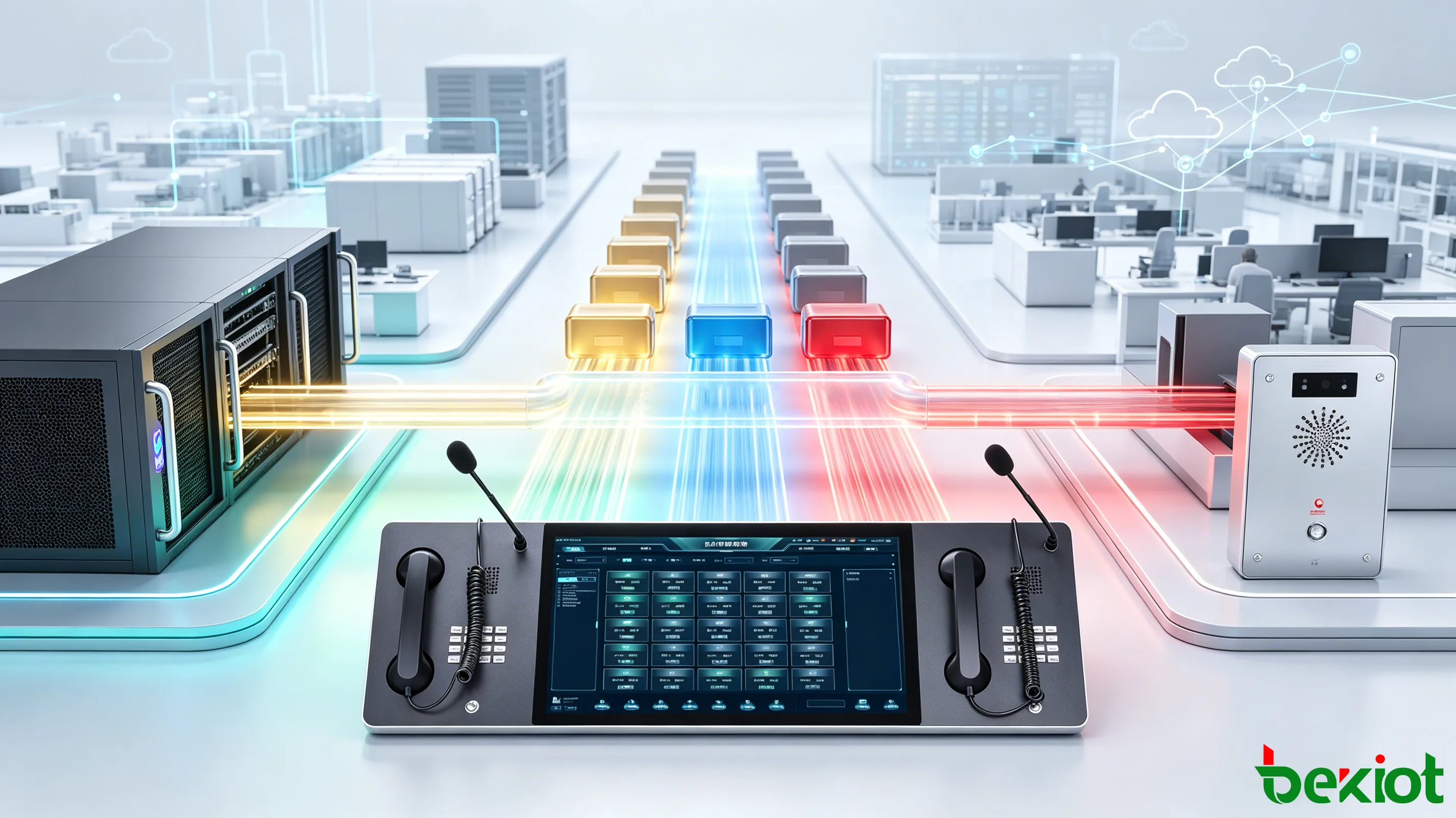
QoS begins with classification. Before the network can prioritize traffic, it must first identify what kind of traffic is passing through. Classification may be based on source address, destination address, VLAN, port number, protocol, application type, device role, or existing packet markings. The goal is to place traffic into meaningful categories rather than handling everything blindly.
After classification, traffic is often marked. In IP networks, Differentiated Services Code Point, or DSCP, is commonly used to indicate the forwarding treatment a packet should receive. At Layer 2, 802.1p priority values may be used in VLAN-tagged Ethernet frames. These markings allow switches, routers, firewalls, and WAN devices to apply consistent service policies as packets move through the network.
Marking must be planned carefully. If every device is allowed to mark its own traffic as highest priority, the priority system loses meaning. A good QoS design defines a trust boundary. For example, the network may trust markings from IP phones or managed communication equipment but rewrite markings from ordinary user devices. This prevents misuse and keeps priority queues reserved for traffic that truly needs protection.
Classification and marking also help troubleshooting. When engineers know which class a packet belongs to, they can check whether it is being placed in the right queue, whether it is being dropped, whether markings are preserved across the WAN, and whether downstream devices respect the same policy. Without consistent marking, QoS becomes difficult to verify and maintain.
Queue management during congestion
QoS becomes most visible when congestion occurs. A network interface can only transmit a limited amount of traffic at one time. When packets arrive faster than they can be sent, they must wait in queues or be dropped. Queue management decides how that waiting and dropping happens. Without QoS, important packets may sit behind large amounts of less urgent traffic.
Priority queuing allows time-sensitive traffic to be served first. This is useful for voice, emergency signaling, and certain control messages. However, priority queuing must be controlled. If too much traffic is placed into the highest-priority queue, lower-priority services may suffer. A priority queue should be reserved for traffic that truly requires low delay, not used as a general performance shortcut.
Bandwidth allocation is another queue management method. Different classes can be assigned minimum bandwidth guarantees or maximum limits. This helps ensure that important services receive enough capacity while preventing non-critical traffic from consuming the entire link. On WAN links, this is especially important because bandwidth is more limited and congestion is more likely.
Drop behavior also matters. Some QoS mechanisms drop lower-priority traffic first when queues fill. Others use active queue management to avoid severe congestion before buffers become full. For real-time applications, excessive buffering can be harmful because it increases delay. A network that never drops packets but creates large delay may still provide poor voice or video experience.
QoS is not only about giving priority; it is about deciding how the network behaves when resources are limited.
Protecting real-time voice and video quality
Voice and video are often the clearest examples of why QoS matters. These services are sensitive to three main conditions: delay, jitter, and packet loss. Delay affects how naturally people can speak to each other. Jitter affects whether packets arrive at a steady rhythm. Packet loss affects clarity, continuity, and intelligibility. QoS helps control these conditions by giving real-time packets more predictable handling.
For VoIP, low latency is essential. If one-way delay becomes too high, users begin talking over each other or feel that the call is unnatural. Jitter buffers can absorb some timing variation, but they cannot solve all network problems. If jitter is too large, the buffer may either increase delay or allow audio gaps. QoS reduces the chance that voice packets will be delayed unpredictably in queues.
For video, the requirements depend on the application. Video surveillance may tolerate slightly more delay than interactive video conferencing, but it still needs stable throughput and controlled loss. Emergency command video, remote operation, and real-time monitoring require more predictable delivery. QoS can help protect these flows from being disrupted by large data bursts, backups, or uncontrolled user traffic.
QoS is also important when voice and video share the same link with ordinary services. In many networks, communication traffic, office applications, internet browsing, file transfer, cloud access, and system updates all use the same infrastructure. Without traffic differentiation, real-time services compete directly with everything else. QoS creates a controlled hierarchy so that user experience remains stable during busy periods.
Supporting critical applications and service continuity
Beyond voice and video, QoS is used to support critical business and operational applications. These may include ERP systems, remote desktop sessions, database replication, industrial monitoring platforms, security systems, medical applications, dispatch platforms, or cloud-based collaboration tools. Not all of these applications need the highest priority, but many need predictable performance.
The key is to define service importance. A production monitoring system may not consume much bandwidth, but it may need reliable access. A cloud file synchronization task may consume large bandwidth but tolerate delay. A security alarm platform may generate small bursts of traffic that must be delivered quickly. QoS helps express these differences in network policy.
Service continuity also depends on preventing low-value traffic from overwhelming essential paths. Guest internet access, large downloads, personal cloud backups, or uncontrolled software updates can create congestion. QoS can limit or deprioritize these flows so that critical services remain usable. In this sense, QoS works as part of operational discipline, not just packet engineering.
In multi-site networks, QoS can support business continuity by protecting important traffic across WAN, VPN, MPLS, SD-WAN, or private network links. Since WAN links are often narrower than internal LAN links, they are common points of contention. A good QoS policy ensures that essential services do not become unstable every time the link is busy.
Judgment criteria: latency, jitter, and packet loss
The quality of a QoS design must be judged by measurable service behavior, not by whether a configuration exists. The first major criterion is latency. Latency is the time required for packets to travel from source to destination. For interactive services such as voice, video conferencing, remote control, or dispatch communication, excessive latency directly affects usability.
Jitter is the variation in packet arrival time. Even if average latency appears acceptable, high jitter can damage real-time services because packets do not arrive at a steady rhythm. Voice and video systems use buffers to smooth jitter, but larger buffers add delay. A good QoS policy should reduce jitter for real-time traffic during congestion.
Packet loss is another critical measure. Some applications can retransmit lost data, while real-time applications may not have enough time to recover. Packet loss in voice can cause broken syllables or silence. Packet loss in video can cause freezing, artifacts, or frame drops. Packet loss in control systems can cause delayed or missed status updates.
These three indicators should be measured under normal load and during busy periods. A network may appear healthy at midnight but fail during working hours. QoS should be evaluated when competition exists, because its purpose is to control behavior under pressure. Testing only in an idle network gives a false sense of success.
Bandwidth, throughput, and queue behavior as evaluation factors
Bandwidth is often confused with QoS, but they are not the same. Bandwidth defines the capacity of a link. QoS defines how that capacity is shared. A network can have high bandwidth and poor QoS if critical traffic is not protected. It can also have limited bandwidth but acceptable service if traffic is classified and managed properly.
Throughput is the amount of data successfully delivered over time. For bulk applications, throughput is often the main performance concern. For real-time services, throughput matters, but stability and timing may matter more. A voice call does not need much bandwidth, but it needs consistent delivery. A video stream needs more bandwidth, but it also needs predictable packet handling.
Queue behavior reveals whether QoS policies are working. Engineers should check which queues are used, whether priority queues are overloaded, whether lower-priority queues are dropping packets, and whether bandwidth guarantees are being applied as expected. If all traffic ends up in the same queue, the QoS policy may exist on paper but not function in practice.
Interface drops, queue drops, tail drops, policy drops, and shaping statistics should be reviewed during troubleshooting. These counters show whether congestion is occurring and which traffic classes are affected. A good QoS judgment process uses these indicators to confirm whether policy decisions match service requirements.
User experience as the final validation
Technical metrics are necessary, but user experience remains the final validation of QoS. A voice system may show low packet loss but still sound poor if jitter bursts occur at the wrong time. A video stream may meet average throughput requirements but still freeze during congestion. A remote application may appear reachable but feel slow to the operator. QoS must be judged by both measurements and service experience.
For voice, user experience may be assessed through call clarity, delay perception, echo complaints, dropped calls, and Mean Opinion Score where available. For video, it may be judged by smoothness, frame stability, resolution consistency, and freeze frequency. For business applications, response time and session stability may be more important than raw bandwidth consumption.
Feedback should be connected with network evidence. If users report poor call quality at certain times, engineers should compare the report with interface utilization, queue drops, WAN latency, jitter, and packet loss data from the same period. This prevents guesswork and helps identify whether the problem is QoS policy, access network quality, endpoint behavior, codec selection, or upstream service conditions.
The best QoS designs are not only technically correct; they are understandable to operations teams. Engineers should be able to explain which traffic is protected, why it is protected, what the expected result is, and how success is measured. If no one can judge whether the policy is working, the design is difficult to maintain.
Deployment mistakes that weaken QoS results
One common mistake is applying QoS only at one point in the network. A packet may be marked correctly at the access switch but lose its marking at a firewall, VPN tunnel, WAN edge, or service provider boundary. QoS should be treated as an end-to-end behavior. Each device along the path should either preserve, translate, or intentionally remark traffic according to the policy.
Another mistake is overusing the highest-priority class. If too many applications are placed into the priority queue, the queue becomes congested and loses its special value. Critical traffic should be identified carefully. Voice signaling, voice media, emergency communication, control traffic, and video may all need protection, but they should not always share the same treatment.
Some deployments classify traffic too broadly. For example, assigning all traffic from one subnet as high priority may include software updates, browsing, backups, and real-time sessions together. This weakens control. Classification should be as specific as practical, using application, protocol, device role, or traffic marking where reliable.
A final mistake is ignoring testing. A QoS configuration may look correct in templates but fail under real traffic. Engineers should test congestion scenarios, voice calls, video streams, failover paths, VPN behavior, and WAN conditions. QoS should be validated under the conditions it is designed to handle, not only during quiet periods.

How to build a practical judgment framework
A practical QoS judgment framework should begin with service classification. The organization should identify which services are real-time, which are mission-critical, which are business-important, which are best-effort, and which should be limited. This step turns vague priority ideas into usable traffic classes.
The second step is defining measurable targets. For voice, this may include latency, jitter, packet loss, and call quality indicators. For video, it may include throughput stability, frame loss, and packet loss. For critical applications, it may include response time, availability, and transaction success. Targets should be realistic and based on application needs.
The third step is verifying policy enforcement. Engineers should confirm that traffic is marked correctly, queues are used as intended, shaping and policing are configured properly, and markings are preserved across network boundaries. If a service crosses a WAN provider or cloud link, the team should understand whether markings are honored, changed, or ignored.
The fourth step is continuous review. Network usage changes over time. New applications, more users, cloud migration, video growth, security tools, and backup strategies can all change traffic patterns. QoS policies should be reviewed periodically so that they still match current service priorities.
Conclusion
Quality of Service is not a tool for creating more bandwidth—it is a discipline for managing contention when multiple traffic types compete for the same resources. Its real-world value shows up in the measurable protection of voice clarity, video stability, and critical application responsiveness under load. That protection depends on careful classification, consistent end-to-end marking, disciplined queue management, and continuous validation against latency, jitter, packet loss, and actual user experience. When designed correctly and judged by clear criteria, QoS turns an otherwise chaotic network into a predictable, business-aligned platform where the traffic that cannot wait does not have to.
FAQ
Does QoS increase total network bandwidth?
No. QoS does not create additional bandwidth. It controls how existing bandwidth is shared when traffic competes. If the link is constantly overloaded, QoS can protect important services, but capacity upgrade may still be necessary.
Should all business applications be marked as high priority?
No. If too many applications receive high priority, the priority system becomes ineffective. Business importance should be separated from timing sensitivity. Some important applications can tolerate delay, while real-time services may need stricter handling.
Where should QoS be applied in a network?
QoS should be considered end to end, including access switches, core switches, routers, firewalls, WAN edges, VPN tunnels, and service provider links. A policy applied at only one point may not protect traffic across the full path.
How can engineers tell whether QoS is working?
They should check traffic markings, queue statistics, latency, jitter, packet loss, interface drops, application behavior, and user experience during busy periods. Successful QoS should show measurable protection for priority traffic under congestion.
Can incorrect QoS configuration make performance worse?
Yes. Wrong classification, excessive priority traffic, poor policing, inconsistent markings, or unmanaged queue behavior can increase delay, cause drops, or starve lower-priority services. QoS should be tested carefully before full deployment.







