Public network two-way radios, also known as PoC radios or push-to-talk over cellular terminals, are widely used in security, transportation, industrial parks, logistics, utilities, emergency response, and large-scale site operations. As more organizations deploy radios from different manufacturers, one practical challenge often appears: different brands, platforms, fleets, and user groups cannot always talk to each other directly.
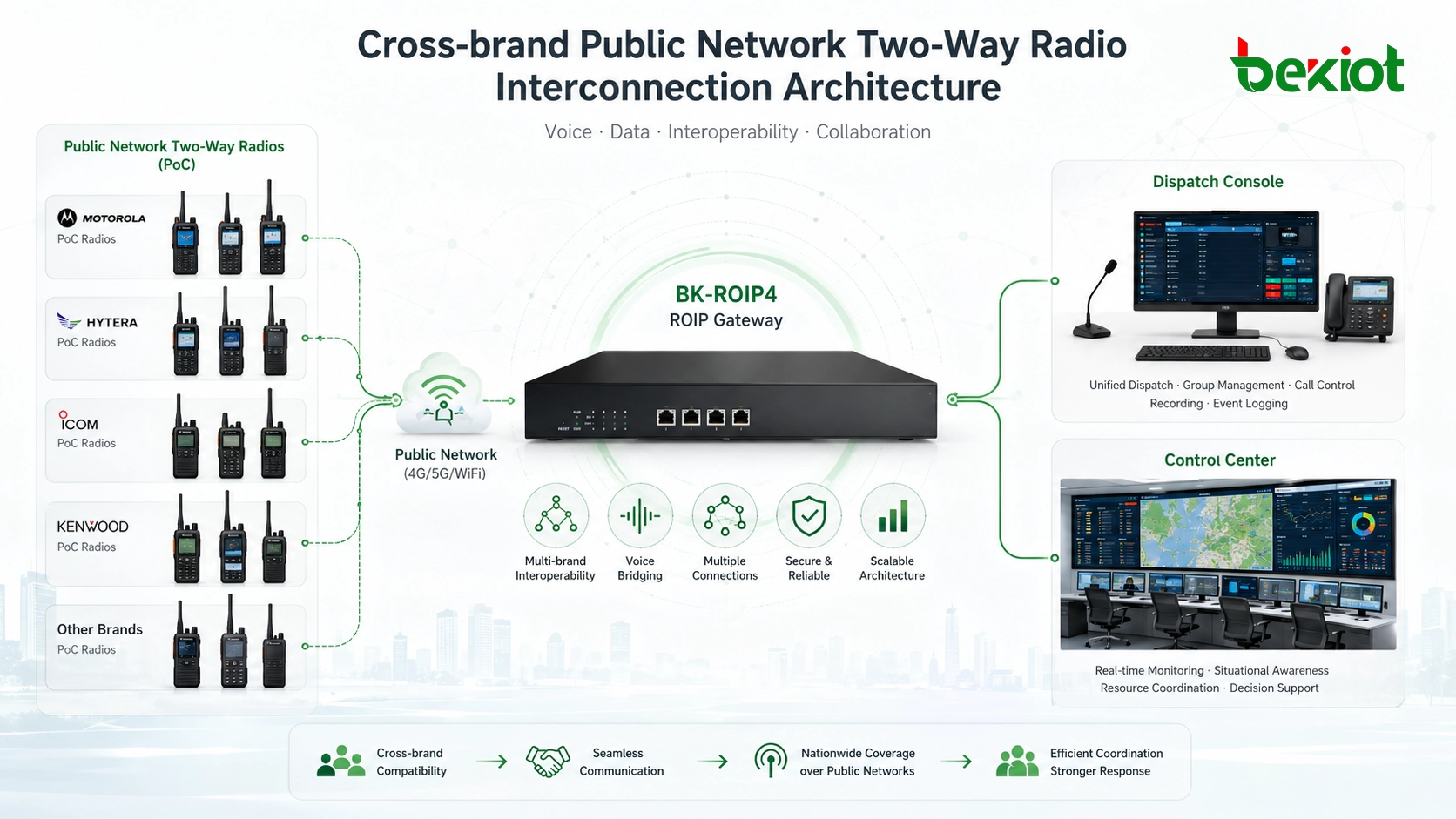
A radio interconnection gateway provides a practical way to solve this problem. Instead of replacing existing radios or rebuilding the communication platform, the gateway connects different public network radio systems through terminal docking, audio bridging, PTT control, and dispatch-side integration. This allows users from different brands or networks to communicate in the same operational workflow while keeping their familiar devices and calling habits.
Why Cross-Brand Radio Communication Becomes a Problem
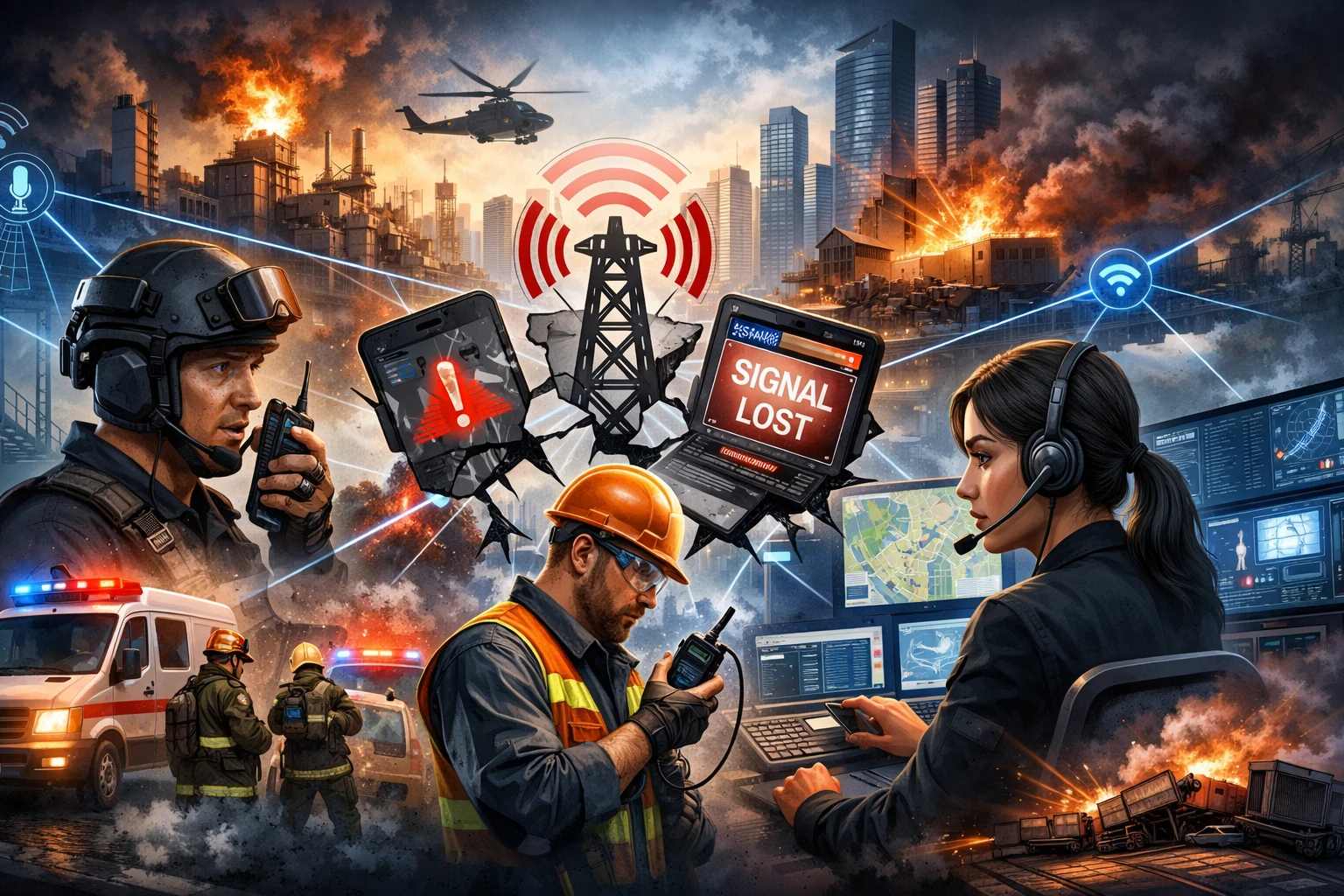
Public network radios usually depend on cloud platforms, SIM-based data networks, private dispatch servers, or manufacturer-specific management systems. When all users belong to the same platform, group calls, private calls, dispatch monitoring, and recording are relatively easy to manage. However, in real projects, organizations often use mixed devices because of phased procurement, regional deployment, supplier changes, rental equipment, subcontractor access, or legacy system upgrades.
For example, a logistics company may already have one brand of PoC radios in its main fleet, while temporary drivers or outsourced teams use another brand. A public safety project may need to connect patrol teams, traffic support teams, event security personnel, and command staff across several independent radio platforms. Without interconnection, each team can only communicate inside its own system, which creates communication islands.
The result is slower coordination, duplicated equipment investment, more dispatch workload, and higher risk during emergency response. The key requirement is not simply “buying more radios,” but making existing radios and platforms communicate in a controlled, stable, and manageable way.
A Gateway-Based Method for Unified Push-to-Talk
A radio interconnection gateway works as a bridge between different radio networks or terminal groups. It can connect public network radios, handheld terminals, vehicle-mounted radios, dispatch consoles, and sometimes private radio systems through audio input/output, PTT signaling, network interfaces, or platform-side integration methods.
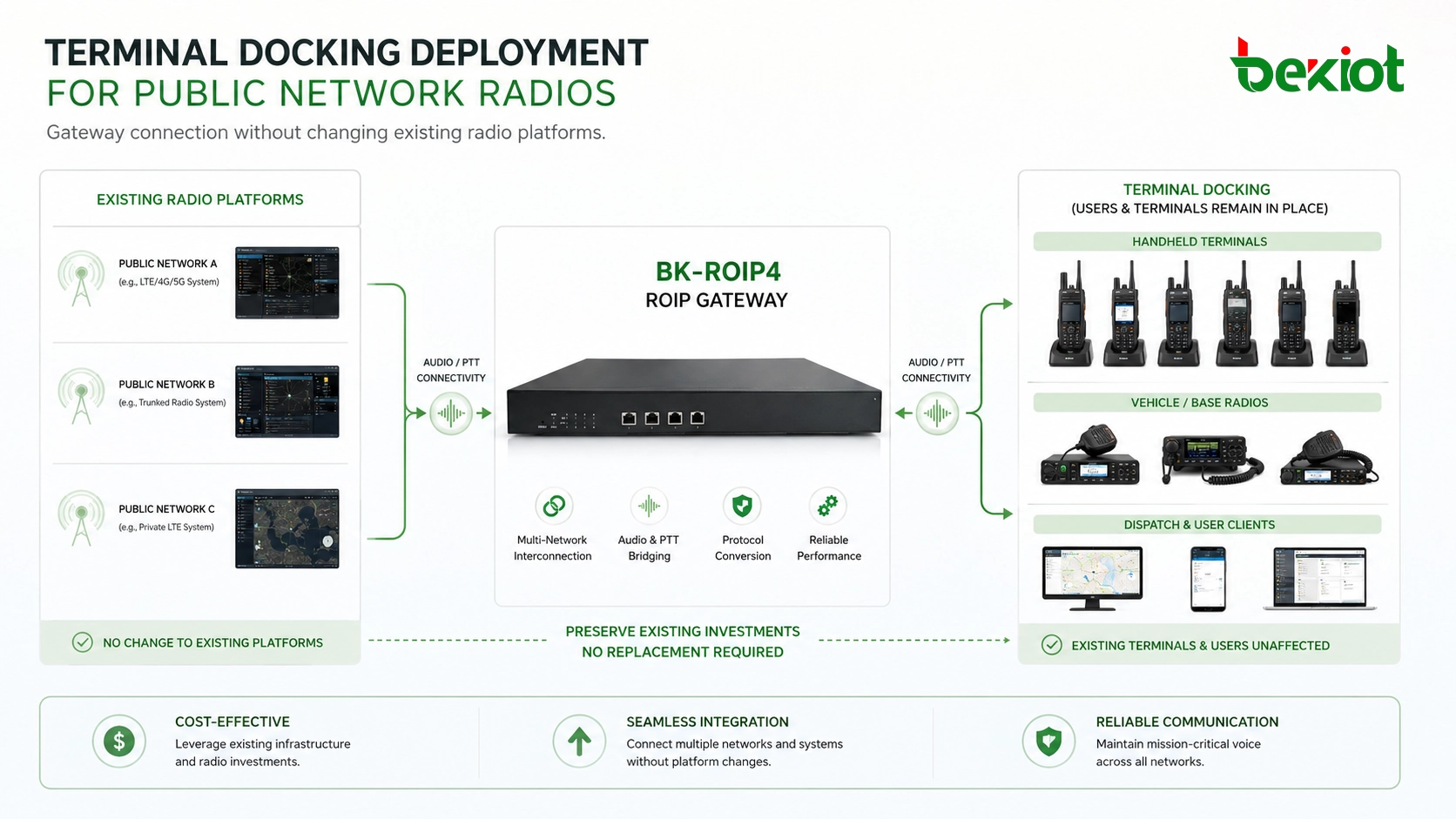
One common approach is terminal docking. In this mode, the gateway connects to representative radio terminals or system access points and converts voice and control signals between different communication groups. The advantage is that the existing system architecture does not need to be changed. Users can continue using their current radios, accounts, channels, and operation habits, while the gateway handles the interconnection in the background.
This method is especially valuable when different systems cannot be deeply integrated through APIs, SDKs, or server-level access. It offers a fast deployment path, reduces development work, and avoids disrupting active communication services.
How Terminal Docking Keeps Existing Systems Stable
In many industrial and public safety environments, communication systems are already part of daily operations. Replacing all equipment at once is expensive and risky. Terminal docking reduces this risk because it does not require major changes to the original radio network, dispatch platform, user grouping structure, or staff training process.
The gateway can be deployed as an additional interconnection layer. When one radio group speaks, the voice is collected, processed, and transmitted to another connected group. PTT control helps maintain half-duplex communication logic, so users still experience the workflow as normal push-to-talk communication. This makes the solution easier for field teams to accept because they do not need to change their daily operating behavior.
Key Functions Needed in a Radio Interconnection Solution
Cross-Platform Voice Bridging
The basic function is to transmit voice between two or more radio systems. The gateway should support stable audio input and output, clear voice transmission, and reliable conversion between different system interfaces. In real projects, the gateway may need to connect public network radios, dispatch terminals, analog interfaces, IP networks, or other communication endpoints.
PTT Control and Call Direction Management
Push-to-talk communication depends on clear speaking priority. A proper interconnection solution should handle PTT triggering, call direction, busy status, and audio path control. This prevents overlapping speech, repeated audio loops, and uncontrolled group transmission.
Compatibility with Handheld and Vehicle-Mounted Radios
Many organizations use both portable radios and vehicle-mounted terminals. A flexible gateway solution should be able to work with different terminal types and different field roles. This allows mobile teams, patrol vehicles, command vehicles, warehouse operators, and site supervisors to communicate through a unified workflow.
Fast Deployment with Limited Development Work
In projects where time is critical, a plug-and-play style deployment is more practical than a long software customization process. A gateway-based solution can often be installed faster because it focuses on system interconnection rather than platform replacement. This is suitable for temporary events, emergency projects, construction sites, industrial upgrades, and multi-team coordination scenarios.
Typical Application Scenarios
Industrial Parks and Manufacturing Sites
Large industrial parks often include production teams, maintenance teams, security teams, logistics teams, contractors, and emergency response personnel. These groups may use different communication tools. A radio gateway can help dispatch centers connect separated radio groups and improve response efficiency during equipment failure, safety alarms, fire events, or production coordination.
Transportation and Logistics Operations
Transportation companies may operate across regions with different branches, driver teams, dispatch platforms, and subcontractors. Cross-brand radio interconnection helps dispatchers communicate with mixed fleets without forcing all drivers to replace their existing devices. This is useful for ports, warehouses, freight yards, bus fleets, and highway support teams.
Public Safety and Emergency Coordination
During temporary events, rescue operations, large venues, or emergency response, different teams may arrive with different radio systems. A gateway-based bridge can support unified voice coordination between on-site teams and the command center, reducing communication delays and improving situational response.
Energy, Utilities, and Remote Sites
Power plants, substations, water treatment facilities, oil and gas sites, mines, and renewable energy stations often require long-term communication reliability. When old and new systems coexist, gateway interconnection allows gradual upgrades while keeping existing radios available during the transition period.
Where BK-ROIP4 Fits into the Solution
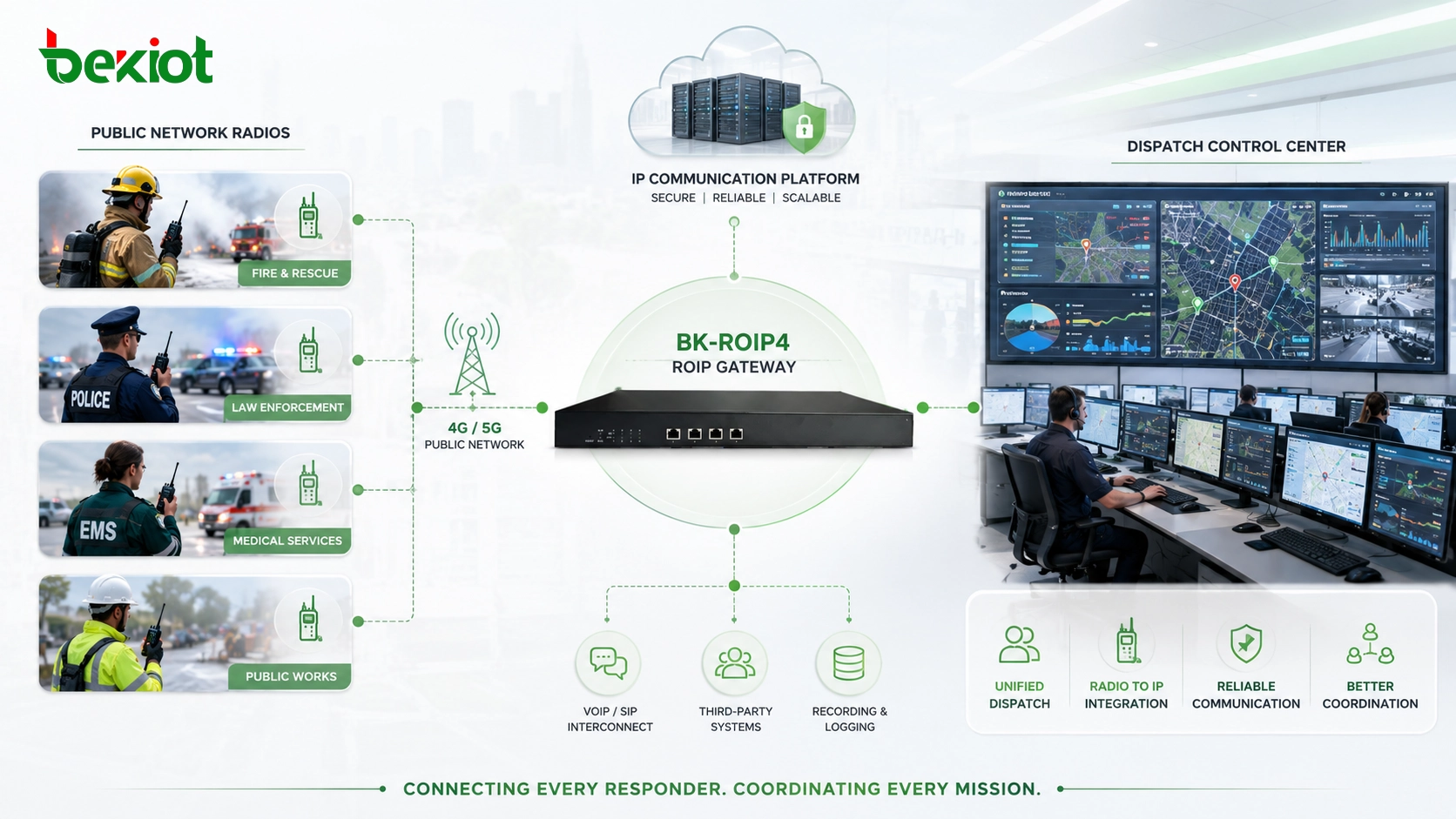
For projects that need radio-to-IP or radio-to-dispatch integration, the Becke Telcom BK-ROIP4 ROIP Gateway can be considered as part of the interconnection layer. It is suitable for scenarios where radio communication needs to be extended into an IP-based dispatch system, command platform, SIP environment, or unified communication workflow.
Rather than replacing the customer’s entire communication system, BK-ROIP4 can help connect radio resources with centralized dispatch and network-based communication applications. This makes it useful for industrial sites, emergency command centers, transportation operations, and multi-system communication projects where radio voice must be shared with IP communication infrastructure.
A practical interconnection project should focus on protecting existing investment first, then improving interoperability, dispatch visibility, and emergency response efficiency step by step.
Deployment Workflow for a Cross-Brand Radio Project
Assess Existing Radio Systems
The first step is to identify the radio brands, platforms, terminal types, group structures, dispatch methods, and user roles already in use. Engineers should confirm whether the systems are public network PoC radios, private radio terminals, vehicle-mounted radios, or mixed communication endpoints.
Define Interconnection Requirements
Not every group needs to talk to every other group. A clear communication matrix should define which teams need mutual communication, which groups need dispatch monitoring, whether emergency calls require higher priority, and whether voice recording or command-center access is required.
Select the Gateway Connection Method
Depending on the project environment, the gateway may use terminal docking, audio interface bridging, IP-based integration, or dispatch platform interconnection. Terminal docking is often preferred when the existing systems cannot be modified or when fast deployment is required.
Test Voice Quality and PTT Behavior
Before full deployment, the project team should test speech clarity, delay, PTT response, busy handling, group call behavior, and emergency communication flow. This ensures that the solution is not only connected technically, but also usable for field operators under real working conditions.
Benefits for System Integrators and End Users
For end users, the biggest benefit is continuity. Existing radios, user habits, and operational processes can remain largely unchanged. Teams do not need to carry multiple devices or switch between isolated communication groups. Dispatchers can coordinate more users from a central point, and emergency response becomes more direct.
For system integrators, gateway-based interconnection reduces project complexity. It provides a practical way to connect different brands, different terminal types, and different communication networks without requiring full platform redevelopment. This helps shorten delivery time and makes the solution easier to apply across industrial, transportation, public safety, and enterprise communication projects.
From a cost perspective, the solution protects previous investment. Instead of replacing all existing equipment, organizations can keep useful devices in service while gradually expanding toward IP dispatch, unified communication, recording, monitoring, and emergency command integration.
Technical Considerations Before Deployment
A successful project should consider audio level matching, PTT triggering method, network stability, power redundancy, grounding, installation environment, maintenance access, and future expansion. In mission-critical sites, the gateway should be deployed with stable power supply, reliable cabling, and clear operating rules for dispatchers and field users.
Security should also be evaluated. If radio communication is connected to an IP network or command platform, access control, network segmentation, account management, and system logs should be planned properly. This helps prevent unauthorized access and keeps the communication system manageable over time.
Conclusion
Different brands of public network two-way radios can work together when a suitable gateway-based interconnection solution is used. By using terminal docking, voice bridging, PTT control, and dispatch-side integration, organizations can connect separated radio groups without changing their original system architecture or user habits.
For industrial communication, transportation dispatch, emergency coordination, public safety, and multi-team operations, this approach offers a practical balance between fast deployment, system compatibility, investment protection, and long-term upgrade potential. When radio communication needs to be connected with an IP dispatch or unified communication platform, solutions such as the Becke Telcom BK-ROIP4 ROIP Gateway can provide a flexible path for radio-to-IP integration.
FAQ
Can different brands of public network radios communicate with each other directly?
In many cases, they cannot communicate directly because they may use different platforms, accounts, servers, or management systems. A radio interconnection gateway can bridge these systems and allow cross-brand communication.
Does this solution require replacing existing radios?
Not necessarily. A terminal docking or gateway-based solution is designed to keep existing radios and user habits as much as possible. This helps reduce upgrade cost and deployment risk.
Is software development always required?
No. For many practical projects, gateway-based interconnection can reduce or avoid deep software development. The exact method depends on the existing radio systems, interfaces, and project requirements.
Can the system connect radios with a dispatch control center?
Yes. With a suitable ROIP gateway or radio interconnection device, field radio communication can be connected to an IP dispatch system, command center, or unified communication platform.