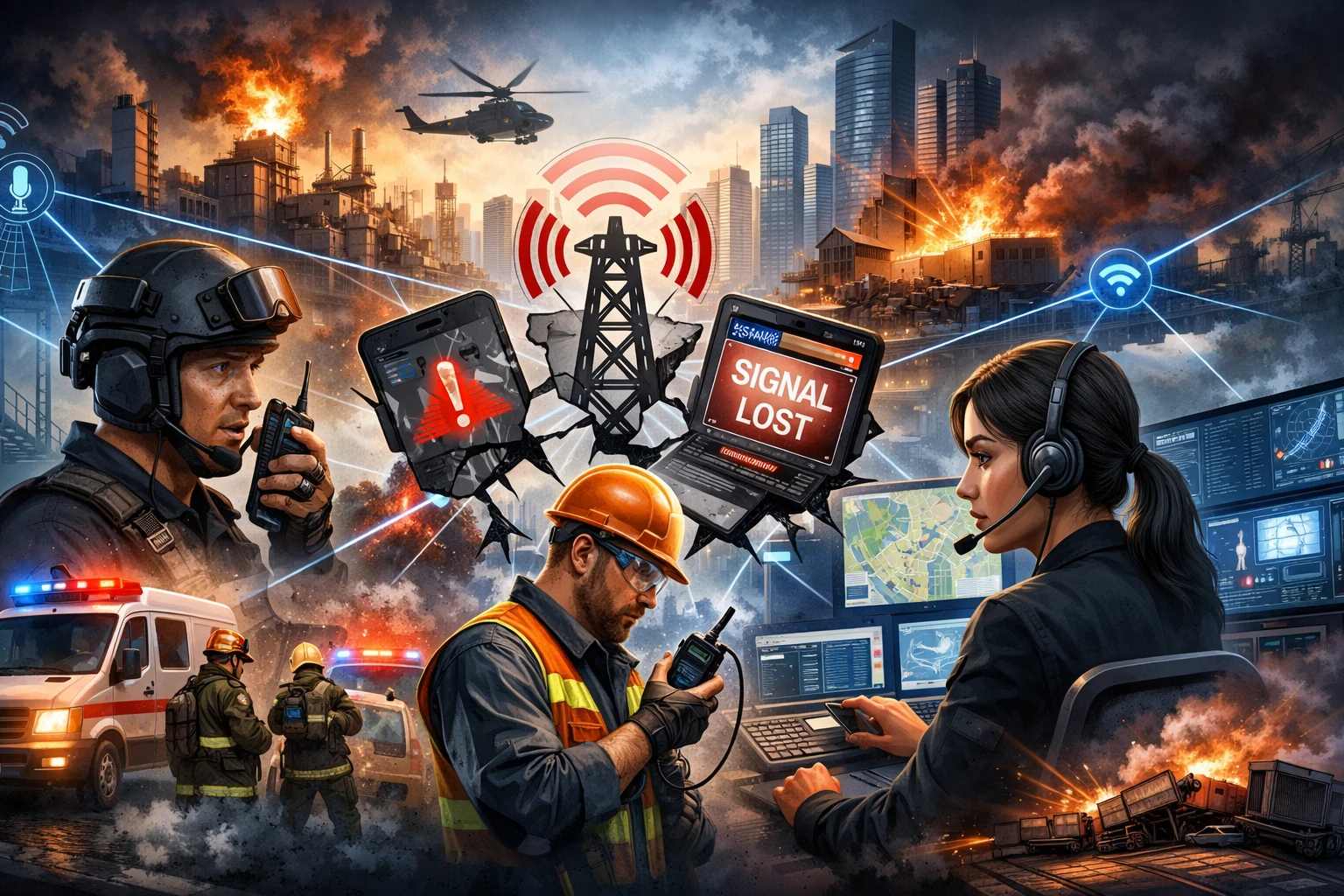
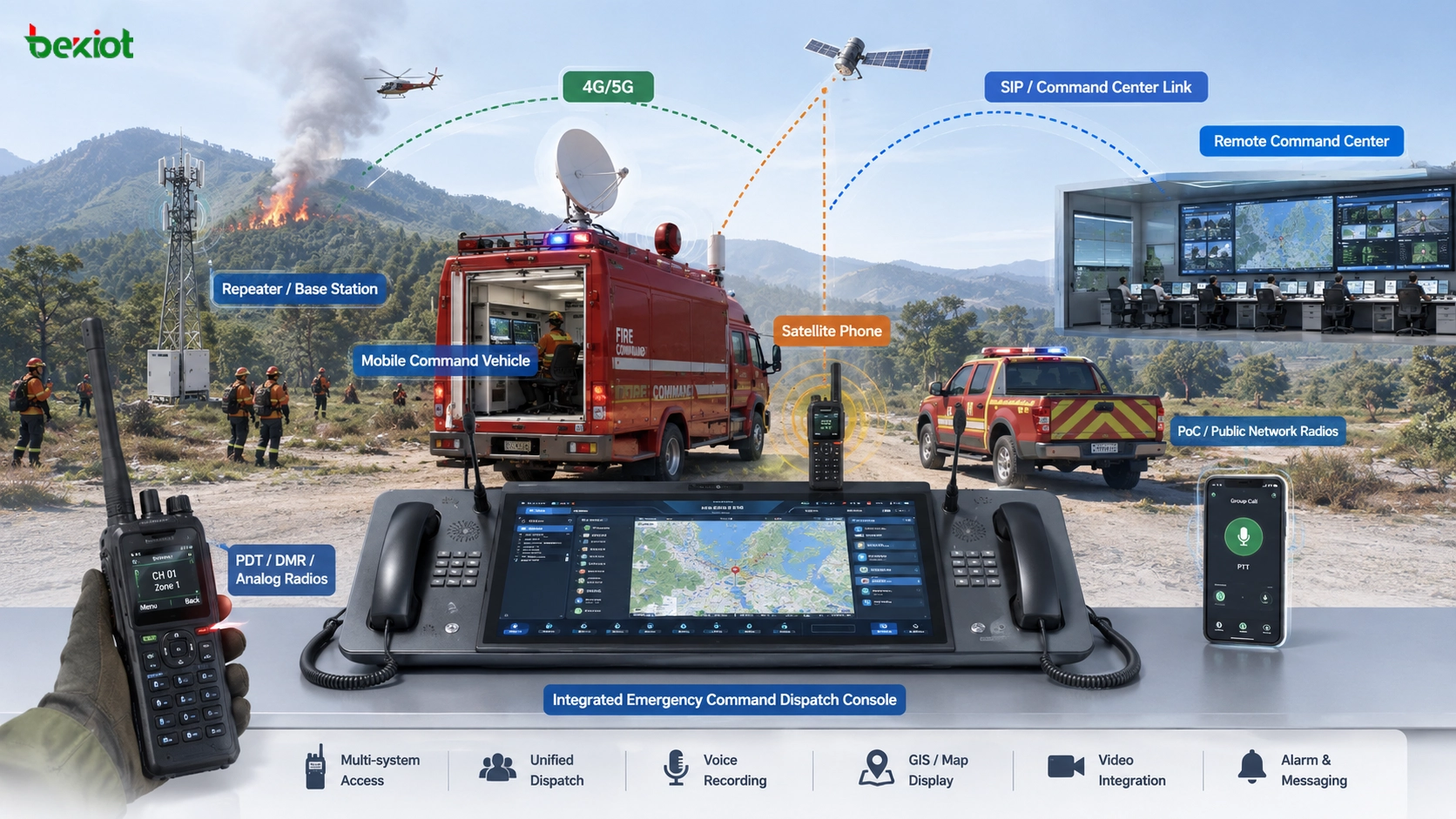
Forest firefighting requires fast, stable, and coordinated communication across complex terrain. In a real emergency, frontline teams, patrol units, vehicle crews, aerial support, local command posts, and remote command centers may all use different communication tools. Some teams rely on PDT or DMR radios, some use analog radios, some use PoC public network push-to-talk, and others may depend on satellite phones when public networks fail.
The main problem is not the lack of communication devices. The real challenge is that these devices often work in separate systems and cannot be managed together. An integrated emergency command dispatch console solves this problem by bringing multiple voice resources into one operational platform, allowing field commanders to connect, dispatch, monitor, and coordinate different teams from a unified interface.
Why Forest Fire Scenes Need Unified Voice Coordination
Forest fire response is highly time-sensitive. Fire conditions change quickly because of wind direction, terrain, vegetation density, road access, and weather. Commanders must understand the situation, assign teams, coordinate evacuation routes, dispatch equipment, and report updates to the command center without delay.
In many emergency scenes, different departments arrive with different communication systems. Firefighting teams may use professional narrowband radios. Local rescue teams may use analog radios. Temporary support personnel may use public network PoC radios. Remote command staff may communicate through SIP voice, satellite phone, or a command platform. Without a unified dispatch layer, these resources remain isolated.
Traditional single-purpose equipment can only solve part of the problem. A repeater may extend radio coverage, but it does not integrate satellite calls or command-center voice. A radio gateway may connect certain radios, but it may not provide visual dispatch control. A large fixed dispatch platform may be powerful, but it is often too heavy for rapid field deployment. Forest firefighting requires a more compact and integrated method.
Connecting Different Radios at the Fireground
A practical field dispatch console should support access to multiple radio formats. In forest firefighting, teams may use PDT, DMR, analog walkie-talkies, vehicle radios, trunked radio systems, or PoC public network radios. These systems may operate on different channels, protocols, or network platforms.
Through radio interface docking, customized connection cables, audio access, and dispatch-side control, the integrated emergency command dispatch console can bring different radio terminals into one command workflow. Field commanders can select channels, bridge groups, isolate unrelated users, and establish temporary communication paths according to the incident plan.
This is especially useful when multiple teams need to cooperate but cannot replace their existing radios in the middle of an emergency. The console helps protect existing equipment investment while enabling cross-system coordination at the command post.
Extending Coverage with Repeaters and Mesh Resources
Forest areas often include mountains, valleys, dense trees, firebreak roads, and remote patrol zones. Radio signals may be blocked or weakened by terrain. A dispatch console can work with fixed repeaters, vehicle-mounted repeaters, backpack repeaters, narrowband trunking repeaters, and self-organizing radio systems to extend field coverage.
Instead of using the repeater only as a coverage device, the dispatch console turns it into part of the command network. Field radios can communicate over a longer distance, while the command post can still monitor and coordinate the teams through the same dispatch interface.
This design is valuable for firefighting operations that move continuously. As teams advance, retreat, or establish new working zones, portable repeaters and field radio nodes can help maintain communication continuity.
Using Satellite Phones When Public Networks Fail
Forest fires may damage power, base stations, roads, and public network infrastructure. In extreme emergency conditions, satellite phones become an important backup channel. However, relying on only one satellite phone system may create new risks, such as channel congestion, weather impact, or device availability limitations.
An integrated emergency command dispatch console should support access to different satellite phone resources. Depending on project configuration, field users may connect domestic satellite phones, maritime satellite phones, Thuraya terminals, Iridium terminals, or other satellite voice devices. The goal is to keep a reliable voice path available when normal communication links become unstable.
By integrating satellite calls into the dispatch workflow, the field command post can avoid treating satellite phones as isolated devices. Satellite voice can become part of the same command chain used for radio dispatch, field reporting, and remote command-center communication.
Linking the Scene with the Remote Command Center
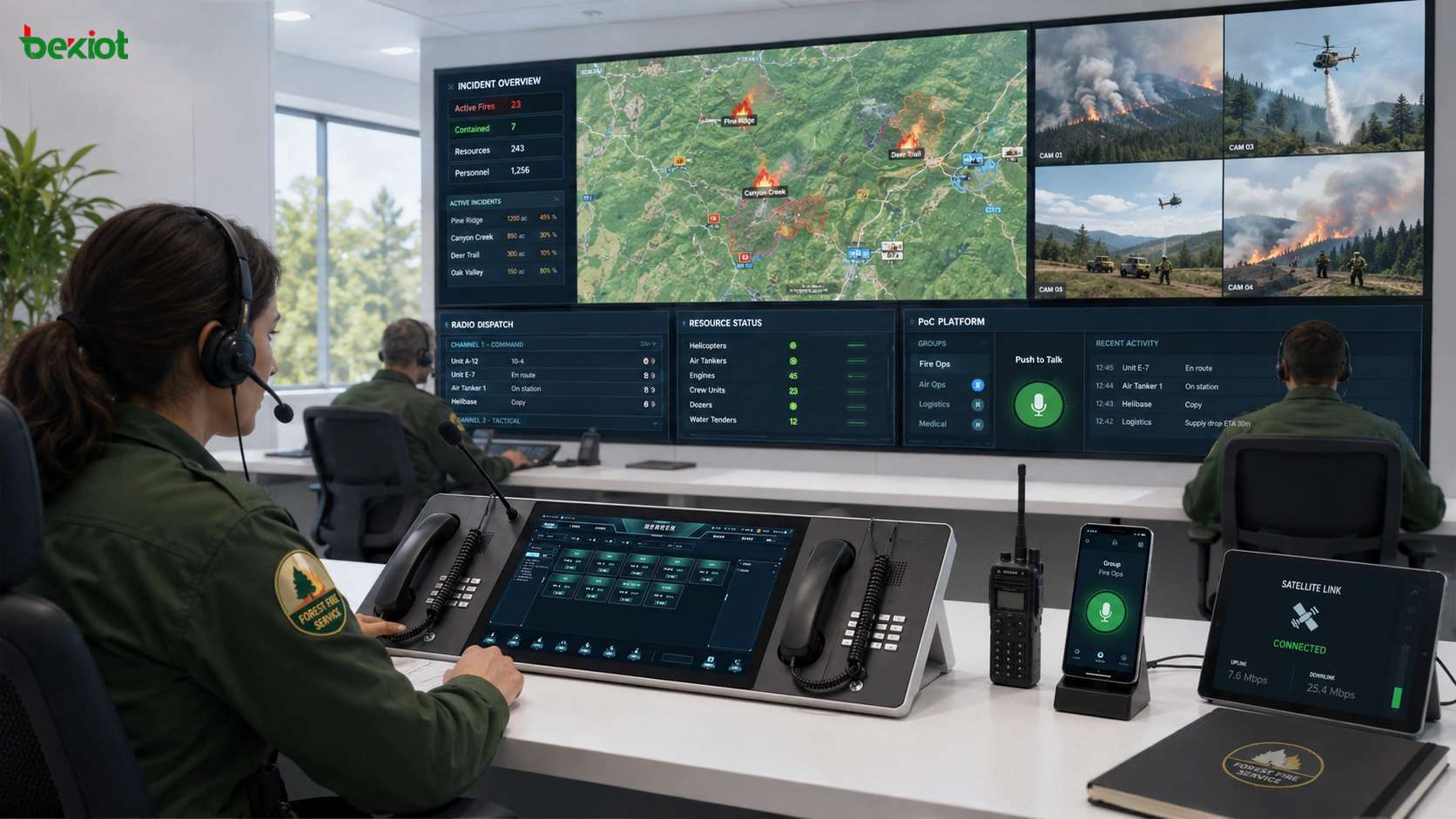
Local field communication is only one part of the solution. The command post must also connect with the rear command center so that higher-level commanders can receive reports, make decisions, coordinate resources, and support the frontline team.
When public mobile coverage is available, the dispatch console can use 4G or 5G network access to connect with the existing command platform. Through standard SIP protocol and VoIP communication, the command center can establish voice communication with field radios, satellite channels, PoC users, or other connected terminals.
This means the command center does not need to wait for manual message relay. It can communicate directly with the field command post and, when authorized, connect with specific frontline communication groups.
Low-Bandwidth Satellite Data for Harsh Conditions
In some areas, 4G or 5G coverage may be unavailable. Satellite data links can be used to connect the field dispatch console with the command center. High-throughput satellite links usually provide enough bandwidth for voice communication, but they are not always available or convenient in every field scenario.
A more resilient design may also consider narrowband satellite IoT links. With voice optimization, emergency communication can be supported under very limited bandwidth, even below 10 Kbps in certain optimized applications. When there is no voice activity, the system can reduce unnecessary traffic, making it more suitable for narrowband satellite platforms.
For emergency use, this detail is important. C-band satellite resources can offer better resistance to rain attenuation compared with Ka-band or Ku-band links in some weather conditions, which makes them valuable for disaster response and forest firefighting environments.
Direct PoC Platform Access for Public Network Push-to-Talk
Many command centers already use PoC platforms for public network push-to-talk. In this case, the integrated emergency command dispatch console can be configured as a powerful dispatch endpoint under the PoC system. This allows field command staff to join PoC communication without relying only on a mobile app.
Compared with ordinary app-based operation, console-based dispatch offers faster operation, clearer channel management, more direct call control, and better suitability for duty desks or temporary command posts. It can also help connect PoC users with radio users, satellite users, and command-center SIP users in the same operational workflow.
Dispatch Control That Field Teams Can Actually Use
Interconnection alone is not enough. If all channels are simply mixed together, the emergency scene may become confusing. A field command system must provide real dispatch management, including channel selection, group bridging, call monitoring, status display, access control, and quick operation.
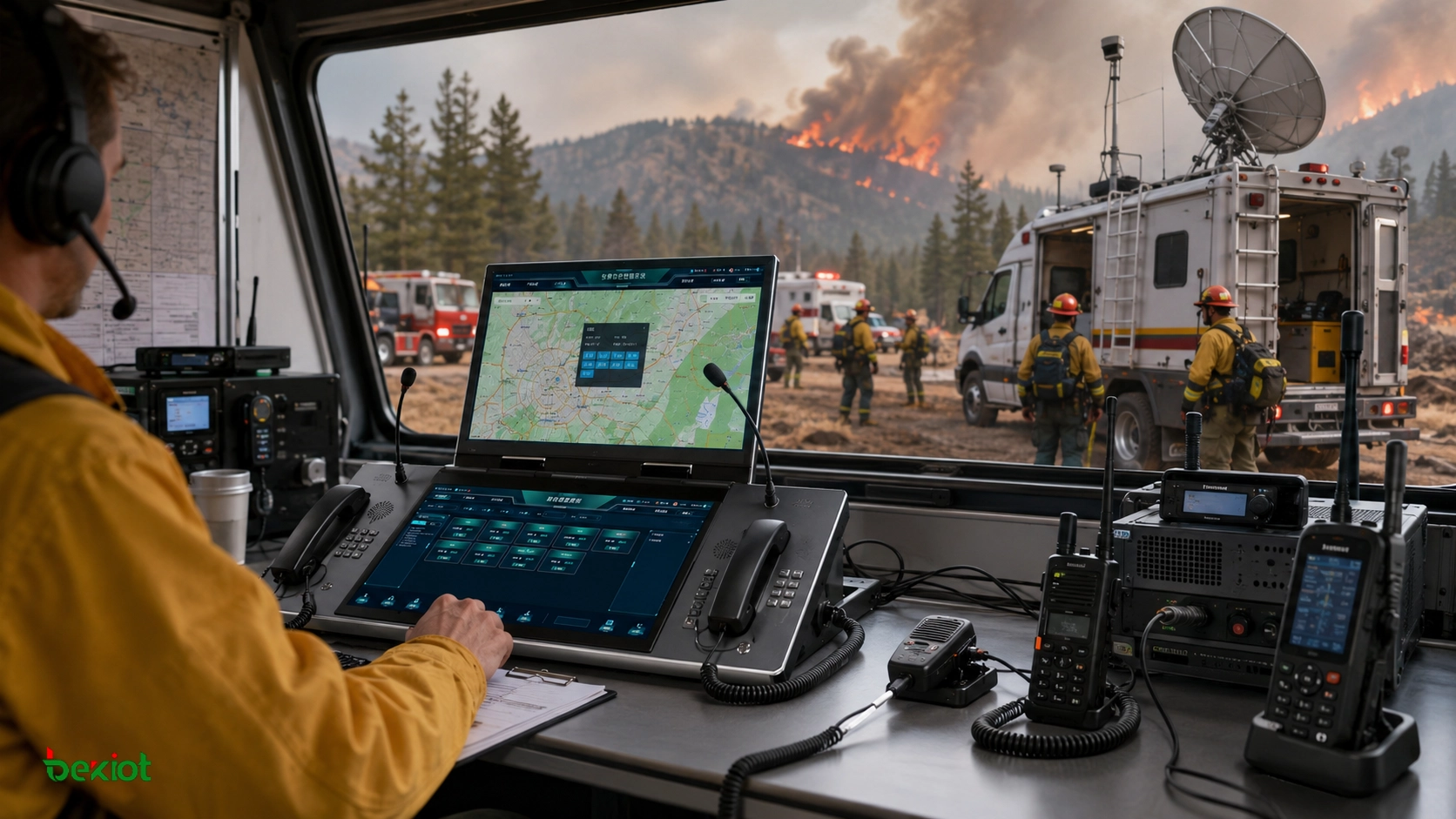
The integrated touchscreen interface allows operators to see channel status, connect or disconnect communication paths, manage different teams, and build temporary groups according to the mission. This helps commanders avoid uncontrolled audio mixing and improves the efficiency of on-site command.
A good field console should also be compact, easy to transport, quick to power on, and simple enough for emergency teams to operate under pressure. The purpose is to replace a pile of scattered devices with one integrated command hub.
Where Becke Telcom Can Fit into the Solution
For projects that require professional emergency communication, Becke Telcom can provide suitable command dispatch, SIP communication, and unified communication solutions for industrial safety, public safety, transportation, tunnel rescue, and forest firefighting scenarios.
In forest firefighting projects, Becke Telcom solutions can be considered when customers need to connect radios, IP voice, dispatch consoles, public network communication, recording, emergency broadcasting, and command-center workflows. The system configuration should be selected according to the number of teams, radio formats, satellite access needs, field deployment method, and command-center integration requirements.
The value of an emergency command dispatch console is not only device integration. It is the ability to turn separated voice resources into a clear, controllable, and field-ready command process.
Typical Forest Firefighting Use Cases
Temporary Field Command Post
When a forest fire occurs, the command team may establish a temporary field post near the incident area. The integrated dispatch console can connect radio teams, satellite phones, PoC users, and the remote command center, giving commanders a fast and flexible communication hub.
Mobile Command Vehicle
A mobile command vehicle can carry the console, satellite equipment, radio access devices, repeaters, antennas, power systems, and network equipment. This allows the command team to move closer to the emergency scene and establish communication quickly.
Mountain Patrol and Fire Prevention
During fire prevention patrols, teams may work across wide forest regions with unstable network coverage. A dispatch console can help connect patrol radios, remote stations, duty rooms, and public network communication resources for daily supervision and emergency escalation.
Multi-Agency Rescue Coordination
Forest firefighting often involves fire departments, forestry authorities, emergency management teams, police, medical support, road management, and volunteer rescue teams. Because these groups may use different communication tools, a unified dispatch layer helps reduce coordination barriers.
Engineering Points Before Deployment
Before deployment, engineers should evaluate the forest terrain, expected command radius, radio formats, repeater placement, satellite access conditions, available mobile networks, power supply, vehicle installation space, antenna layout, and command-center platform interface.
The communication plan should also define which teams can talk to each other, which channels should be monitored by the field command post, which calls need to reach the rear command center, and which emergency channels require priority handling.
Field testing is essential. The project team should verify voice clarity, channel switching, delay, satellite connection stability, SIP registration, PoC platform access, repeater coverage, power endurance, and operator procedures before formal deployment.
Long-Term Expansion Direction
After voice integration is established, the same architecture can be expanded toward GIS positioning, video monitoring, UAV live video, alarm linkage, event recording, operation logs, emergency broadcasting, and multi-level command platform integration.
For regions with multiple forest areas or distributed fire prevention stations, the system can be standardized across different command posts. This helps build a repeatable communication model for daily patrol, emergency drills, early fire response, and large-scale disaster coordination.
Conclusion
Forest firefighting communication must connect many different tools into one coordinated command process. Radios, repeaters, satellite phones, 4G or 5G networks, SIP platforms, PoC systems, and remote command centers all play important roles, but they need an integrated dispatch layer to work together effectively.
An integrated emergency command dispatch console provides this layer. It supports multi-system access, field dispatch control, satellite backup, SIP connection, PoC platform integration, and rapid deployment. For forest firefighting and other emergency response scenarios, it helps field commanders build a reliable voice command hub and keep communication flowing between the frontline and the command center.
FAQ
Why do forest firefighting teams need an integrated command dispatch console?
Forest firefighting teams often use different radios, satellite phones, PoC systems, and command platforms. An integrated console helps connect these resources so field commanders can coordinate teams through one dispatch workflow.
Can the system connect PDT, DMR, analog radios, and PoC radios?
Yes. With suitable radio access methods, customized cables, gateway interfaces, or platform docking, different radio formats can be connected into a unified field dispatch system.
How does satellite communication help in forest fire response?
Satellite communication provides backup voice or data links when public networks are unavailable, overloaded, or damaged. It is especially useful in remote mountain areas and extreme emergency conditions.
Can the field console connect with an existing command center?
Yes. The console can connect with a remote command platform through 4G, 5G, satellite data links, private network, or SIP-based VoIP communication, depending on the project environment.
What should be tested before formal deployment?
Engineers should test radio access, voice quality, repeater coverage, SIP registration, satellite link stability, PoC platform docking, power supply, antenna layout, and operator workflow under real field conditions.