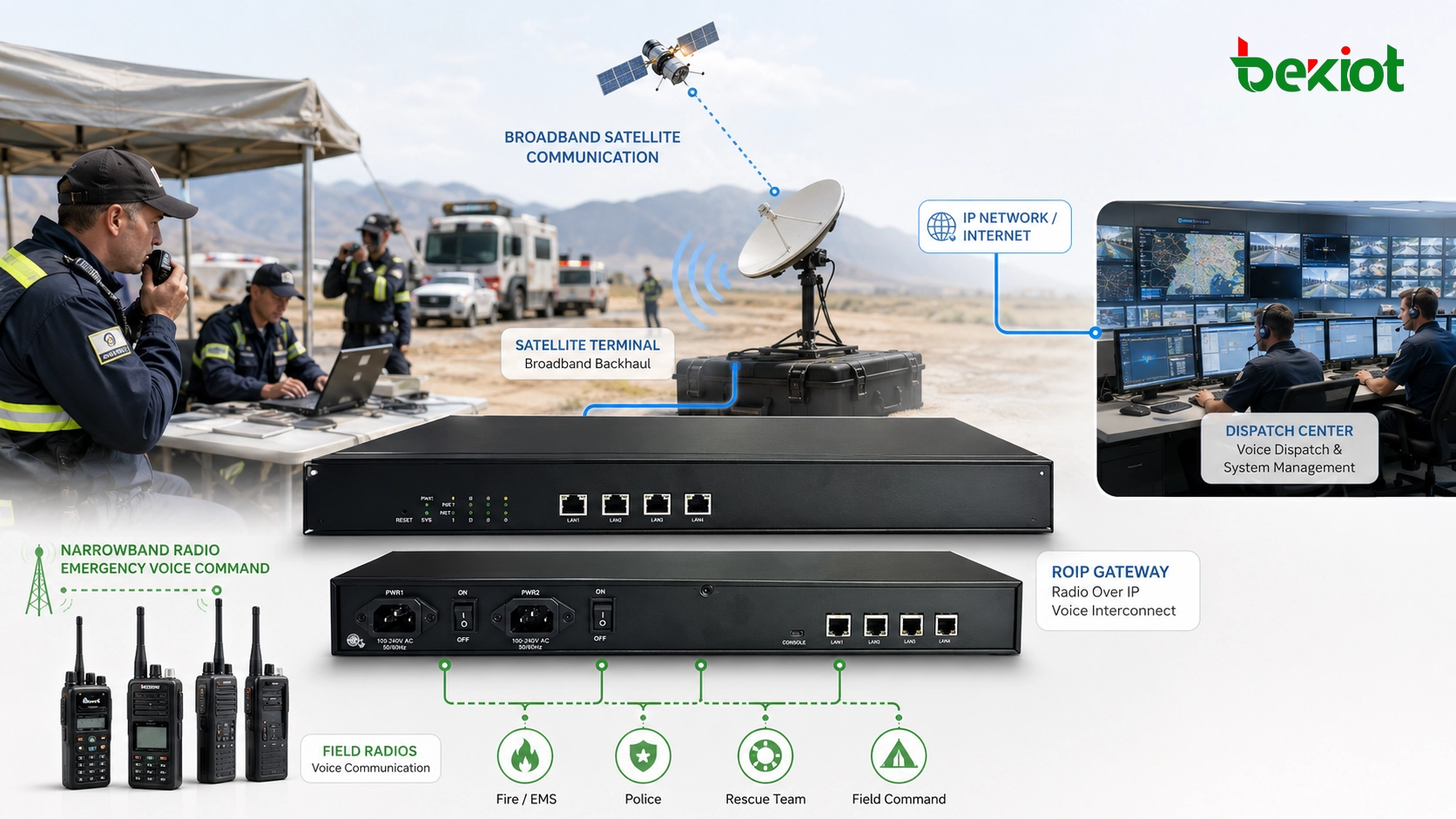
In emergency response, field teams often operate in areas where public mobile networks are weak, damaged, overloaded, or completely unavailable. Mountain rescue, forest firefighting, flood control, mining accidents, transportation incidents, maritime operations, energy sites, and temporary field command posts all require reliable voice communication between on-site teams and remote command centers.
Broadband satellite communication can provide long-distance IP backhaul for remote sites, while narrowband radios remain one of the most practical tools for fast push-to-talk communication on the ground. The key challenge is not whether these two technologies can work separately, but how they can be integrated into one cross-regional emergency voice command system.
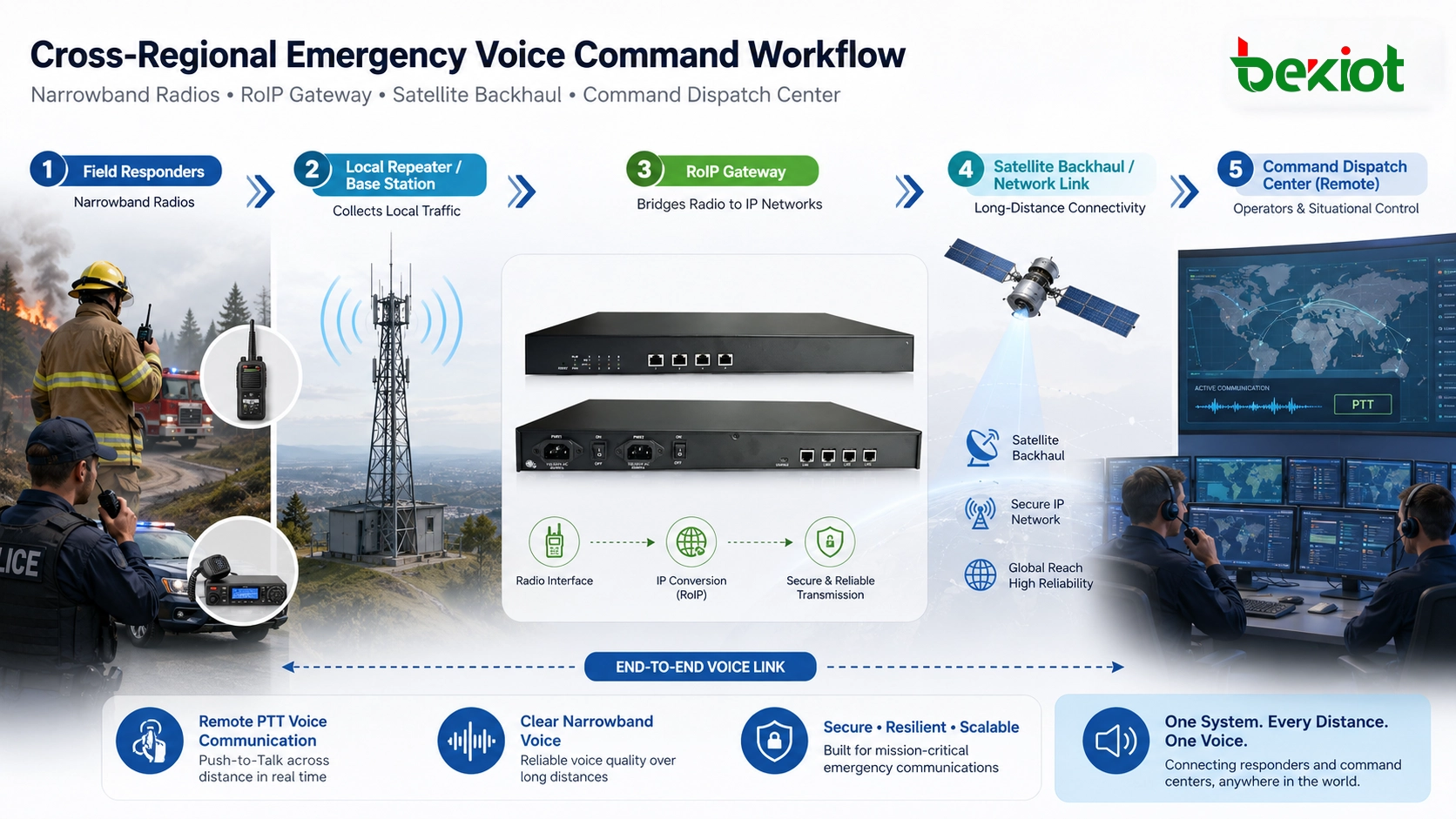
A practical solution is to use a Radio over IP gateway to connect traditional radios, repeaters, base stations, or vehicle-mounted radios to an IP network, then transmit voice and PTT control through satellite links, private networks, VPN, fiber, 4G/5G, or hybrid routes. This allows field radio users to keep using familiar handheld radios while the command center gains remote access, centralized dispatch, monitoring, recording, and cross-area coordination.
Why Radios Still Matter in Field Response
Even when broadband satellite communication is available, narrowband radios still play an important role in emergency field operations. Radios provide instant push-to-talk communication, fast group calling, simple operation, wide field familiarity, and good usability for mobile teams wearing gloves, helmets, protective clothing, or rescue equipment.
Compared with video or data-heavy applications, narrowband voice communication consumes very little bandwidth. A radio voice channel can often remain usable in environments where high-speed data services are limited, unstable, or reserved for video backhaul, GIS, command applications, and data reporting.
Radios are also suitable for team coordination at the front line. Firefighters, rescue teams, patrol staff, utility workers, security personnel, transportation crews, and industrial maintenance teams often rely on PTT communication because it is direct, fast, and easy to operate during time-sensitive events.
What Satellite Backhaul Actually Solves
Broadband satellite communication solves the long-distance transmission problem. It can connect a remote disaster site, field command vehicle, portable emergency station, offshore platform, mountain base, forest command point, or mining rescue site back to a regional command center when terrestrial networks are unavailable.
However, a satellite link alone does not automatically make local radio channels available to the command center. Radios normally operate within their own RF coverage area. A handheld radio can talk to nearby users or a local repeater, but the rear command center may be hundreds or thousands of kilometers away. This is where RoIP becomes necessary.
In a complete architecture, satellite communication provides the IP transport path, while the RoIP gateway converts radio voice and PTT control into IP-based communication resources. The command center can then access the field radio channel through a dispatch console, SIP platform, unified communication system, or emergency command platform.
The Role of RoIP in Cross-Regional Command
RoIP stands for Radio over IP. It converts radio audio, push-to-talk control, and channel status into IP packets so that radio systems can be connected across LAN, WAN, VPN, private network, 4G/5G, or satellite networks. This allows a radio channel in one location to be accessed from another location through an IP-based command system.
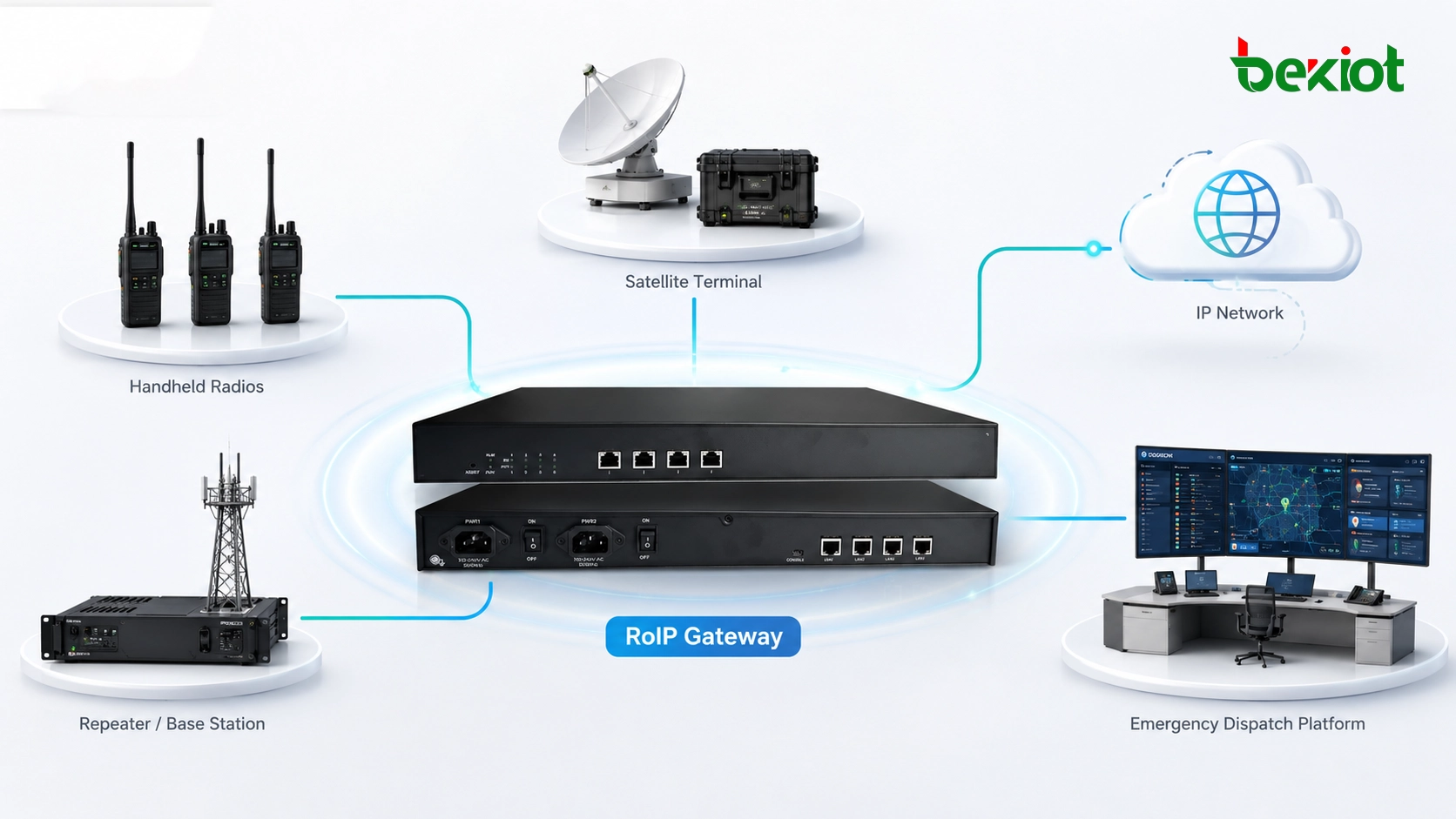
From a system perspective, the RoIP gateway works as a bridge between the radio side and the network side. The radio side handles local field coverage and mobile team communication. The IP side handles long-distance transport, remote access, platform integration, recording, and dispatch control.
For organizations that already use narrowband radios, RoIP protects existing radio investment while adding remote dispatch, cross-site interconnection, centralized management, and command platform integration. Field users do not need to change their operating habits, while dispatchers gain a wider and more manageable voice command capability.
How the System Works
Radio Voice Access
The RoIP gateway is usually connected to a radio, repeater, base station, or vehicle-mounted radio through audio input/output, PTT control, COR/SQL detection, or dedicated radio adapter cables. When a field user presses the PTT button, the radio receives voice from the RF channel, and the gateway captures the audio and detects the channel activity.
Different radio brands and models may have different audio levels, connector definitions, PTT trigger methods, and squelch status signals. Proper interface matching is essential for stable audio quality, reliable PTT control, and correct channel status detection.
Encoding and IP Transmission
After receiving radio audio, the gateway converts the voice signal into IP packets. These packets can then be transmitted over a satellite router, field network, VPN, private network, or mixed communication path. Because voice traffic uses much less bandwidth than video, it can often maintain service even when satellite bandwidth is limited or shared with other applications.
For emergency voice command, the design must pay close attention to latency, jitter, packet loss, codec selection, and network priority. The goal is not only to transmit audio, but to preserve the fast response feel of push-to-talk communication.
PTT Control and Two-Way Operation
A RoIP system must support two-way operation. The command center should be able to listen to the field radio channel, but dispatchers also need to speak back to field teams. When the dispatcher presses a PTT button on the dispatch console or software platform, the gateway triggers the connected radio to transmit over the RF channel.
This turns the remote command center into an active participant in the field radio network. It can call local teams, coordinate multiple groups, issue instructions, and join emergency communication without being physically located inside the radio coverage area.
Dispatch Platform Integration
Once radio channels are connected to IP, they can be integrated with a dispatch platform. Dispatchers can monitor channels, initiate calls, create groups, record communication, manage permissions, review logs, and coordinate with other systems such as SIP telephony, public address, video monitoring, GIS maps, alarm systems, and incident management platforms.
This is the real value of RoIP integration. The radio channel is no longer an isolated field tool. It becomes a managed communication resource inside the wider emergency command workflow.
A Practical Architecture for Field Deployment
Field Communication Layer
The field layer includes handheld radios, vehicle radios, repeaters, base stations, portable radio stations, local command posts, and sometimes broadband devices such as cameras, drones, tablets, and smart terminals. Narrowband radios provide fast local voice coverage, while broadband devices support video, data, positioning, and applications.
Access and Gateway Layer
The RoIP gateway connects the local radio system to the IP network. It handles radio audio access, PTT control, channel state detection, encoding, network transmission, and platform connection. In some projects, multiple gateways may be deployed in different areas to connect several radio channels or departments.
Satellite and Network Layer
The IP transport layer may use broadband satellite communication as the main backhaul or as a backup path. It can also work with private fiber, microwave links, 4G/5G, broadband ad hoc networks, or local emergency networks. A hybrid design is often more reliable than relying on only one transmission method.
Command Application Layer
At the command center, dispatchers use a dispatch console, voice command platform, SIP system, or unified communication platform to access field radio channels. The system may also support recording, role-based access, event logs, group dispatch, audio conference, emergency broadcast, GIS positioning, and cross-department coordination.
Key Advantages of This Design
Cross-Regional Radio Access
Traditional radios are limited by RF coverage, terrain, repeater placement, and distance. By using RoIP over satellite or other IP links, a command center can access field radio channels across regions. This is useful when the rear command center is far away from the incident site.
Familiar Operation for Field Teams
Field users can continue using handheld radios and standard PTT workflows. This reduces training pressure and avoids changing front-line habits during emergencies. The upgrade happens at the gateway and platform level, not at the user behavior level.
Centralized Listening and Dispatch
Dispatchers can listen to multiple radio channels, speak to selected groups, record key communication, and coordinate field teams from one platform. This improves situational awareness and reduces the need to manage several independent radio consoles.
Better Resilience in Weak-Network Areas
In remote areas, public mobile networks may fail or lack coverage. Satellite backhaul can provide a more independent communication path. When combined with local radio coverage, the system supports both front-line local voice and long-distance command access.
Integration with Wider Emergency Systems
A RoIP-based architecture can be connected with SIP phones, dispatch consoles, emergency phones, public address systems, alarm systems, video platforms, and GIS applications. This allows voice command to become part of a complete emergency response workflow rather than a separate radio island.
Important Design Considerations
Interface Compatibility
Radio systems differ by connector type, audio level, PTT method, squelch signal, channel mode, and operating procedure. Before deployment, engineers should confirm whether the gateway can properly match the radio, repeater, base station, or vehicle radio interface.
Latency and PTT Experience
Satellite links may introduce higher latency than fiber or terrestrial IP networks. For PTT communication, latency affects the natural rhythm of speaking, replying, and group coordination. The solution should be tested under real network conditions, especially for urgent command scenarios.
Bandwidth and QoS Planning
Voice traffic is lightweight, but emergency sites may also carry video, data, GIS, sensor reports, and conferencing traffic. Voice command should be prioritized through QoS, traffic shaping, or network policy so that PTT communication remains available when the link is busy.
Power and Field Reliability
Field deployment often depends on vehicle power, portable power stations, generators, solar backup, or temporary batteries. The radio gateway, satellite terminal, router, and local radio equipment should be designed for stable operation under outdoor, mobile, and temporary deployment conditions.
Security and Access Control
Because radio voice may involve emergency operations, law enforcement, industrial safety, or command decisions, the IP backhaul should be protected with VPN, authentication, network segmentation, user permissions, and logging. Dispatch actions should be traceable for review and accountability.
Where This Solution Is Useful
Disaster Response and Rescue
After earthquakes, floods, landslides, typhoons, or large accidents, public communication infrastructure may be damaged. A satellite plus radio solution can quickly restore command voice between the front-line team and the rear command center.
Forest Firefighting
Forest areas often lack reliable mobile network coverage. Field teams can use radios for local communication, while RoIP and satellite backhaul allow remote command centers to join the radio channel, coordinate teams, and issue instructions.
Mines, Tunnels, and Underground Spaces
Underground environments suffer from signal loss, complex structures, and limited coverage. Radio repeaters and local wireless systems can provide field coverage, while gateways and backhaul links connect the site to the surface command center.
Energy, Ports, and Industrial Sites
Oil and gas sites, power stations, ports, chemical parks, and remote industrial zones often need reliable voice coordination across wide areas. RoIP integration allows different radio zones and command centers to work together more efficiently.
Transportation and Large Events
Highways, railways, airports, logistics hubs, and large public events require fast communication between mobile teams, control rooms, and command centers. A RoIP gateway can help connect local radio users with broader dispatch and security systems.
Application Note for BK-ROIP4
For projects that need to connect existing radio channels to IP dispatch or satellite backhaul, the Becke Telcom BK-ROIP4 ROIP Gateway can be considered as a practical access device. It is suitable for scenarios where field radios, repeaters, dispatch platforms, SIP communication, and emergency command systems need to work together without replacing all front-line radio equipment.
In a satellite emergency voice command solution, BK-ROIP4 can be positioned at the field site, command vehicle, repeater room, or temporary command post. It helps convert radio voice and PTT control into network-accessible communication resources, making it easier to integrate radios with Becke Telcom dispatch, industrial phones, emergency broadcasting, alarm linkage, and unified communication systems.
Broadband satellite communication extends the network. RoIP integration extends the command voice. Together, they turn isolated radio channels into cross-regional emergency communication resources.
Conclusion
Broadband satellite communication and narrowband radios are not competing technologies. They solve different parts of the emergency communication problem. Satellite links provide long-distance IP backhaul, while radios provide fast, simple, and reliable field voice communication.
The bridge between them is RoIP. By connecting radios, repeaters, base stations, and vehicle radios to an IP network, a RoIP gateway enables cross-regional dispatch, remote PTT access, centralized monitoring, recording, and multi-system linkage.
For emergency management, public safety, mining, transportation, energy, forest firefighting, industrial parks, and remote operations, this architecture offers a practical way to combine the reliability of narrowband radio with the reach of broadband satellite communication.
FAQ
Why use narrowband radios if satellite communication is already available?
Satellite communication provides long-distance network transmission, but narrowband radios remain practical for local PTT communication. Radios are fast, simple, bandwidth-efficient, and familiar to field teams.
What does a RoIP gateway do in this system?
A RoIP gateway connects radio audio, PTT control, and channel status to an IP network. It allows remote command centers to listen to and speak through local radio channels over satellite or other IP links.
Can the command center talk directly to field radio users?
Yes. With proper PTT control and radio interface matching, dispatchers can speak from the command platform to field radios through the RoIP gateway and connected radio equipment.
Does satellite latency affect PTT communication?
It can. Satellite links may introduce higher latency than terrestrial networks. The system should be tested with real PTT workflows, appropriate codecs, jitter handling, and QoS settings.
Is this suitable for existing radio systems?
Yes. One of the main benefits of RoIP is that it can connect existing radios, repeaters, base stations, or vehicle radios to modern IP dispatch systems without forcing field users to change their normal radio operation.