


In tunnels, underground utility corridors, mining galleries, and other enclosed spaces, emergency communication often faces limited signal coverage, unstable transmission links, isolated systems, and delayed command response. A reliable solution must do more than provide voice coverage inside the tunnel. It should connect field personnel, forward command vehicles, and the remote command center into one coordinated communication workflow.
This solution uses narrowband self-organizing radio networking, command vehicle access, multi-link backhaul, and a command dispatch console to build a three-level coordination architecture. It helps overcome communication islands inside enclosed environments and enables real-time voice dispatch from the worksite to the control center.
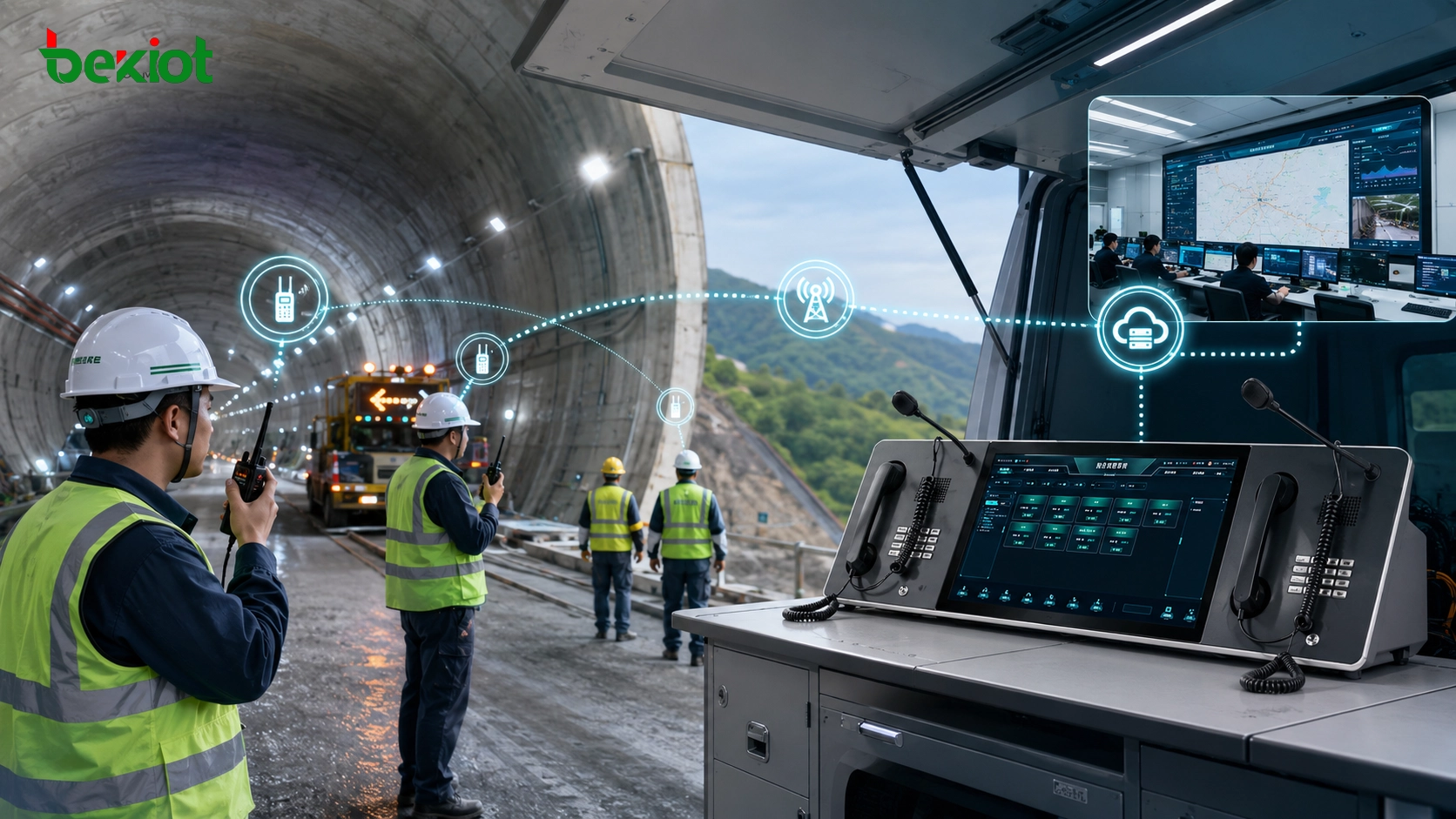
Communication Challenges in Enclosed Tunnel Environments
Tunnel communication is difficult because the operating environment is physically enclosed, long and narrow, and often affected by concrete structures, rock layers, metal equipment, curves, slopes, and electromagnetic interference. Public cellular signals may be weak or unavailable, and traditional radio coverage may not reach every work section without proper relay design.
In many projects, a narrowband self-organizing network is deployed inside the tunnel. This type of system does not rely on public networks or fixed base stations. Instead, communication nodes automatically relay signals between each other, helping workers maintain basic voice communication inside the tunnel.
However, internal coverage alone is not enough. If the tunnel communication system remains isolated from the outside command system, the site team can talk inside the tunnel, but field information may not reach the command center in time. This creates a dispatch gap between frontline execution and rear decision-making.
Building a Three-Level Coordination Model
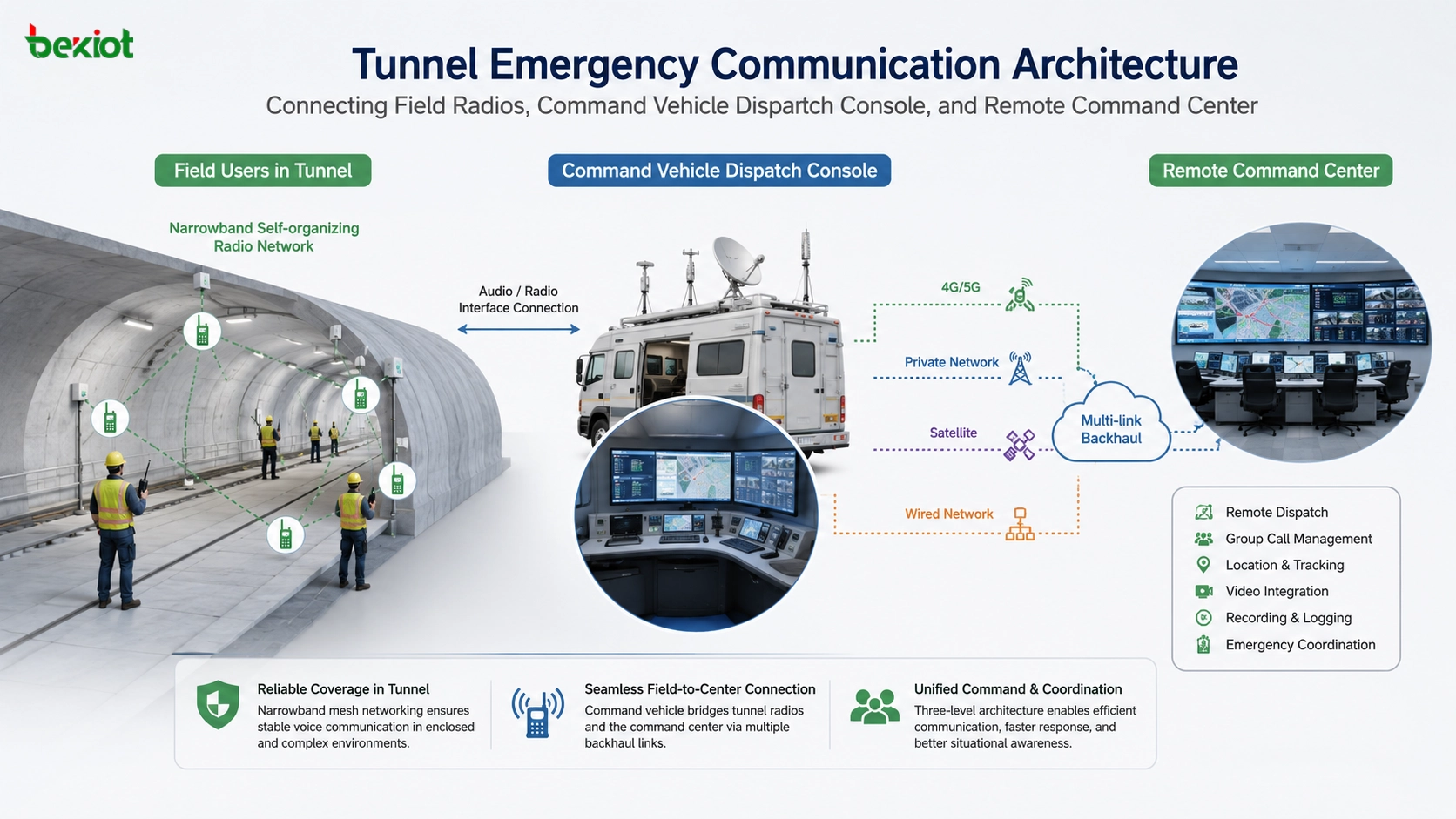
A practical tunnel emergency communication solution should connect three operational layers: the field layer inside the tunnel, the forward command layer near the tunnel entrance, and the rear command center. Each layer has a different role, but all layers must share voice communication and operational information in real time.
Field Layer Inside the Tunnel
The field layer uses narrowband self-organizing network equipment and two-way radio terminals. Workers, maintenance teams, rescue personnel, inspection staff, and safety supervisors can communicate through voice calls inside the tunnel. Automatic relay between nodes improves coverage continuity and supports communication in areas where ordinary network signals are difficult to maintain.
Forward Command Layer in the Command Vehicle
A command vehicle is deployed outside the tunnel as the on-site coordination point. Inside the vehicle, a command dispatch console connects with the tunnel radio system through audio access, radio interface docking, or other integration methods. This allows the forward command team to monitor, call, group-call, and coordinate field users from a centralized operating position.
Rear Command Center Layer
The rear command center connects with the command vehicle through public network, private network, 4G/5G, satellite, or other available backhaul links. Once connected, the control center can participate in remote dispatch, receive field updates, support decision-making, and coordinate additional resources when necessary.
How the Dispatch Console Extends Tunnel Radio Communication
The command dispatch console is the key bridge between tunnel radio users and the command center. It receives voice from the narrowband self-organizing radio system, manages calls and groups, and forwards communication to the external command network. In this way, tunnel workers are no longer limited to an isolated local radio group.
The console can support multiple communication resources, including narrowband radio, public network push-to-talk, private radio, IP voice, command center communication, and dispatch-side audio access. This helps different teams communicate through one coordinated workflow rather than operating separate communication systems.
For emergency response, the value is clear: field teams can report incidents quickly, the forward command team can organize immediate action, and the rear command center can provide remote coordination. This creates a closed-loop process from incident discovery to command decision and field execution.
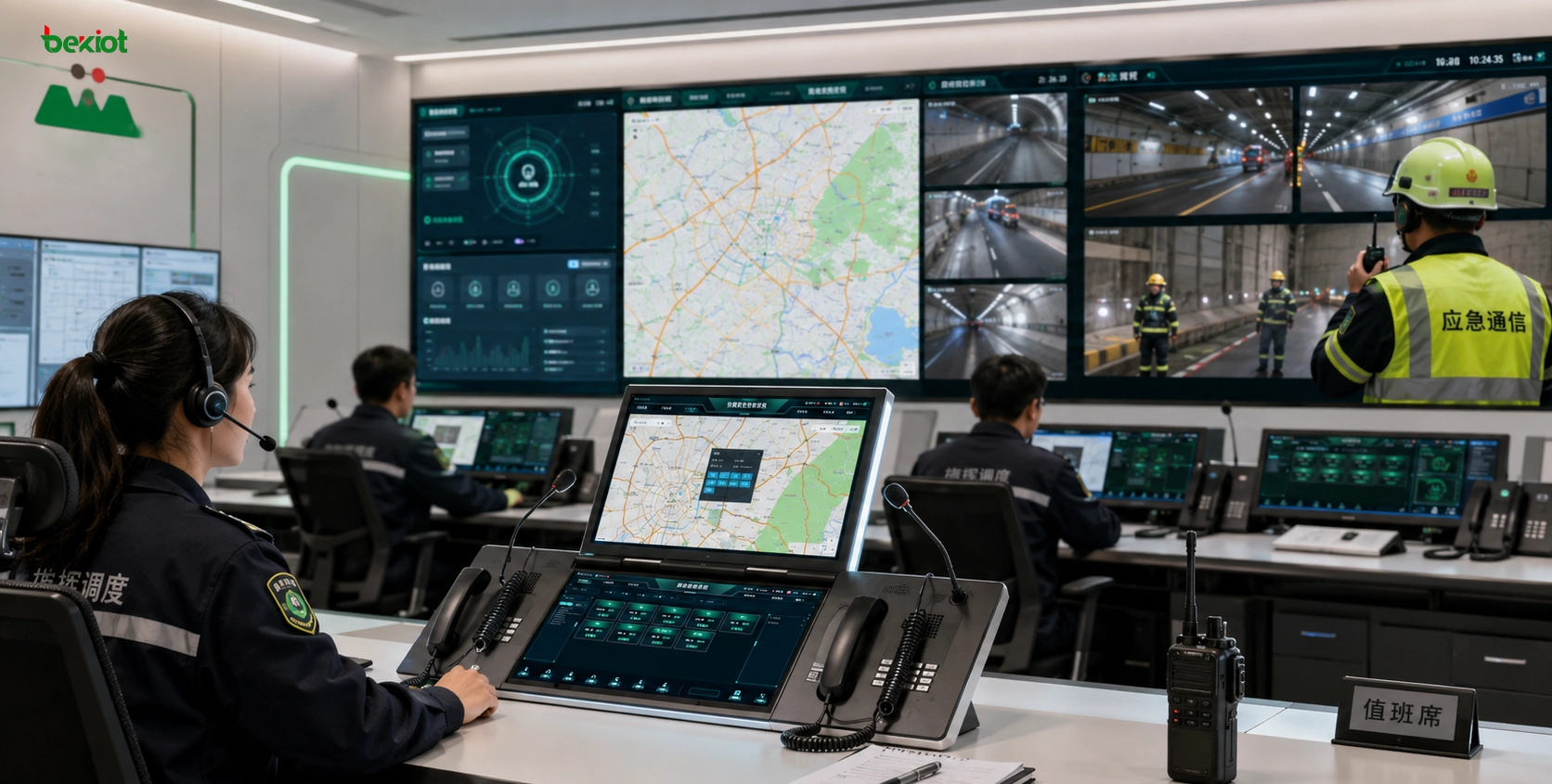
Core Capabilities Required for Field-to-Center Communication
Multi-System Access
Emergency sites may use different communication terminals, including narrowband mesh radios, handheld radios, vehicle-mounted radios, public network intercoms, IP phones, or command center endpoints. A flexible dispatch console should support multi-system access so that different communication resources can be coordinated from one operating position.
Fast Terminal Docking
In emergency scenarios, deployment speed is critical. Terminal docking allows radios or communication access devices to connect directly without rebuilding the original system. This is suitable for temporary rescue operations, construction accidents, tunnel maintenance, disaster response, and rapid command vehicle deployment.
Multiple Backhaul Options
Tunnel emergency communication should not rely on a single link. A practical solution may use 4G/5G, private network, wired broadband, microwave, satellite, or other available links depending on the site environment. Multiple backhaul options improve communication resilience when one link becomes unstable.
Visual Dispatch Operation
A command dispatch console should provide a clear operating interface for calling, group calling, channel switching, monitoring, and emergency coordination. This reduces operator workload and helps the forward command team respond quickly inside the command vehicle.
Mobile Deployment
The solution should support fast movement with a command vehicle. This is important for tunnel rescue, highway tunnel accidents, underground construction, temporary maintenance, emergency drills, and other scenarios where communication infrastructure must be established quickly near the incident site.
Where Becke Telcom DSC Consoles Can Be Applied
In projects that require a more professional forward command position, Becke Telcom DSC Series dispatch consoles can be used as part of the command vehicle or fixed control room configuration. For example, the DSC-BD215S dual-handset command dispatch console is suitable for operators who need separated calling positions or dual-channel handling, while the DSC-238 dual-screen dispatch console is suitable for visual dispatch, multi-system monitoring, and control-room style operation.
These consoles can be considered when tunnel radio communication needs to be extended into a broader command platform, IP dispatch system, emergency response workflow, or multi-team coordination environment. The product selection should depend on the number of operators, communication resources, display requirements, and project-level dispatch workflow.
A good tunnel communication design should not only solve coverage inside the tunnel, but also ensure that field voice, forward command, and rear decision-making are connected in one reliable chain.
Operational Value for Emergency and Industrial Sites
Breaking Communication Isolation
By connecting the narrowband radio system inside the tunnel with the external command system, the solution solves the common problem of communication isolation. Field users can keep using radios suited to the tunnel environment, while the command vehicle and control center gain access to the same communication flow.
Improving Command Efficiency
The three-level structure forms a clear workflow: field execution, forward command, and rear decision support. This reduces the delay caused by manual message relay and allows command staff to coordinate people, equipment, rescue teams, and maintenance resources more efficiently.
Supporting Rapid Emergency Deployment
Because the command vehicle and dispatch console can be deployed near the tunnel entrance, the system can be set up quickly for temporary incidents. It is suitable for rescue response, emergency drills, construction protection, accident handling, and short-term operational support.
Protecting Existing Communication Investment
The solution does not require a complete replacement of existing narrowband radios or field terminals. Instead, it builds an interconnection layer between the tunnel system and the command system. This helps reduce upgrade cost and keeps familiar operating habits for field personnel.
Typical Application Scenarios
Tunnel emergency communication is widely applicable to highway tunnels, railway tunnels, metro construction sections, underground utility corridors, mines, hydropower tunnels, municipal pipe galleries, underground parking facilities, and large industrial underground spaces. These sites often require stable voice communication, quick command response, and coordination between internal teams and external control rooms.
In emergency rescue, the system helps rescue teams communicate across enclosed areas and report conditions to the forward command vehicle. In tunnel construction and maintenance, it supports daily scheduling, safety supervision, equipment coordination, and accident response. In underground corridor management, it helps operators coordinate inspection, maintenance, security, and emergency handling.
Deployment Planning and Engineering Notes
Before deployment, engineers should evaluate tunnel length, structure, turning points, slope sections, construction materials, radio blind spots, power availability, command vehicle parking location, and backhaul network conditions. These factors directly affect node placement, relay performance, voice quality, and communication stability.
The project team should also define the communication matrix. Not every user needs access to every group. The design should clarify which tunnel teams can talk to each other, which groups are monitored by the forward command vehicle, which calls should be escalated to the rear command center, and how emergency priority should be handled.
Testing is essential before formal use. Voice clarity, relay delay, group call behavior, dispatch console operation, 4G/5G or private network stability, satellite backup, power redundancy, and operator procedures should all be verified under realistic field conditions.
Long-Term Expansion Possibilities
Once the voice communication chain is established, the same architecture can be expanded to support video monitoring, GIS positioning, emergency alarm linkage, recording, event logging, public address broadcasting, and command platform integration. This allows the system to evolve from simple voice bridging into a broader emergency command and situational awareness platform.
For organizations managing multiple tunnels or underground sites, the architecture can also be standardized. A unified dispatch center can connect multiple field systems, command vehicles, and local response teams, helping build a repeatable emergency communication model across different projects.
Conclusion
A tunnel emergency communication solution must connect more than people inside the tunnel. It must link the field team, forward command vehicle, and rear command center into a stable communication chain. By combining narrowband self-organizing radio coverage, command vehicle access, multi-link transmission, and a command dispatch console, the solution can solve communication isolation and improve emergency coordination.
For tunnel rescue, underground construction, utility corridor management, and industrial emergency response, this architecture provides strong practical value. It supports fast deployment, multi-system access, reliable dispatch, and future expansion toward video, alarms, recording, and unified command platforms.
FAQ
Why is tunnel communication difficult?
Tunnel communication is difficult because enclosed structures, long distances, curves, concrete, rock layers, and underground conditions can block or weaken wireless signals. A relay-based narrowband self-organizing network can improve internal voice coverage.
What is the role of the command vehicle?
The command vehicle acts as the forward command point near the tunnel entrance. It connects the tunnel radio system with the external command center and allows on-site command staff to coordinate field teams more efficiently.
Can the system work without changing existing radios?
In many projects, yes. Terminal docking and audio access methods can connect existing radios or narrowband communication systems to a dispatch console without replacing the entire field communication system.
What links can be used between the command vehicle and the control center?
Depending on the project environment, the system can use 4G/5G, private network, wired broadband, microwave, satellite, or other available transmission links to connect the command vehicle with the remote command center.







