


Smartphones have changed modern communication. They support voice calls, video calls, group chats, photos, location sharing, mobile apps, and cloud services. However, in emergency response, industrial sites, security patrols, construction command, outdoor activities, and field dispatch, the two-way radio still has a practical role that smartphones cannot fully replace.
The reason is not that a radio has more functions than a smartphone. It is because the two devices are designed for different communication tasks. A smartphone is a multi-function internet terminal, while a two-way radio is a dedicated push-to-talk communication tool. In fast-moving field operations, the most valuable function is often simple: press, talk, release, and listen.
For industrial and emergency communication projects, the better direction is not to replace all radios with smartphones. A more reliable approach is to combine two-way radios, PoC radios, RoIP gateways, SIP dispatch platforms, emergency phones, public address systems, and control-room software into a practical hybrid communication architecture.
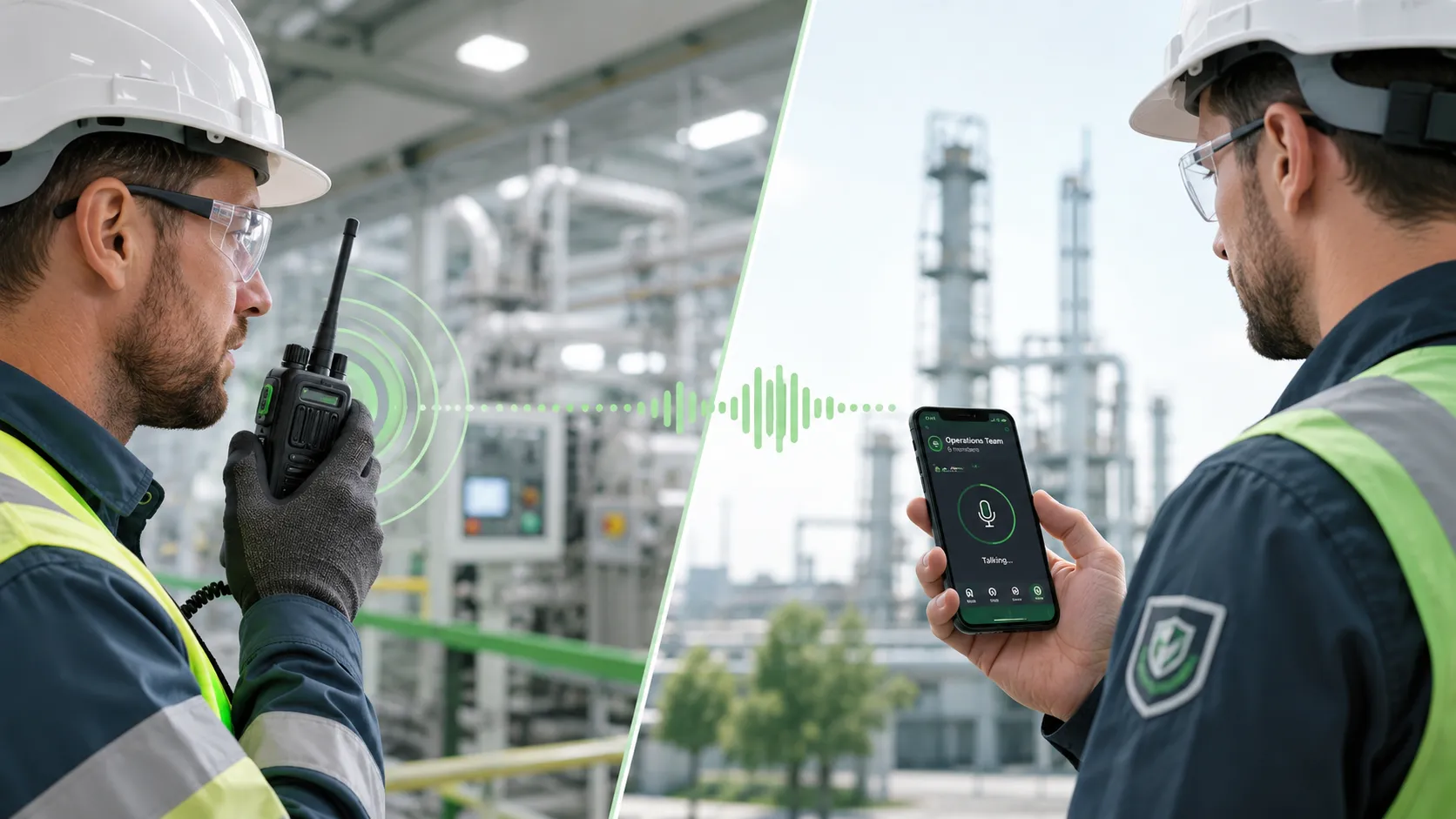
Tool Device vs. Multi-Function Device
A smartphone is a general-purpose device. It depends on apps, cellular networks, user accounts, touch interfaces, notification systems, and internet services. This makes it flexible and powerful, but it also means basic communication often requires several steps before a message is sent.
A two-way radio is different. It is a dedicated communication device. When users are on the same frequency, channel, or talk group, they can press the PTT button and speak immediately. The workflow is direct and easy to train, which is why radios are still common in rescue, patrol, construction, factory, warehouse, and site command scenarios.
| Item | Smartphone | Two-Way Radio |
|---|---|---|
| Primary design goal | Mobile internet, multimedia, apps, and personal communication | Instant voice dispatch and group communication |
| Operation method | Open an app, find a contact or group, send voice or text, wait for playback | Press PTT and speak immediately |
| Network dependence | Usually depends on cellular or Wi-Fi network coverage | Can work directly on radio frequency without mobile network support |
| Best application | Rich information exchange, images, video, documents, and data services | Command, patrol, rescue, construction, security, and field coordination |
How Two-Way Radios Work
A two-way radio converts the user’s voice into an analog or digital signal, transmits it through radio frequency, and restores the voice at the receiving end through demodulation or digital decoding. Radios can support real-time point-to-point communication on the same frequency, and they can also support group or trunked communication across defined radio groups.
In traditional use, operators only need to set radios to the same frequency or channel. After pressing the transmit key, voice can be sent immediately to other radios in the same communication group. This is why two-way radios are widely used in rescue operations, event command, self-driving convoys, construction sites, factories, warehouses, security patrols, and outdoor activities.
Their advantages are clear: they do not always require public network support, they provide instant voice, and they usually have long standby time. Their limitations are also clear: communication distance is limited, signal penetration can be weak inside buildings, and coverage depends heavily on terrain, antenna, power, frequency, and interference.
Range and Coverage: Why 3–5 km Matters
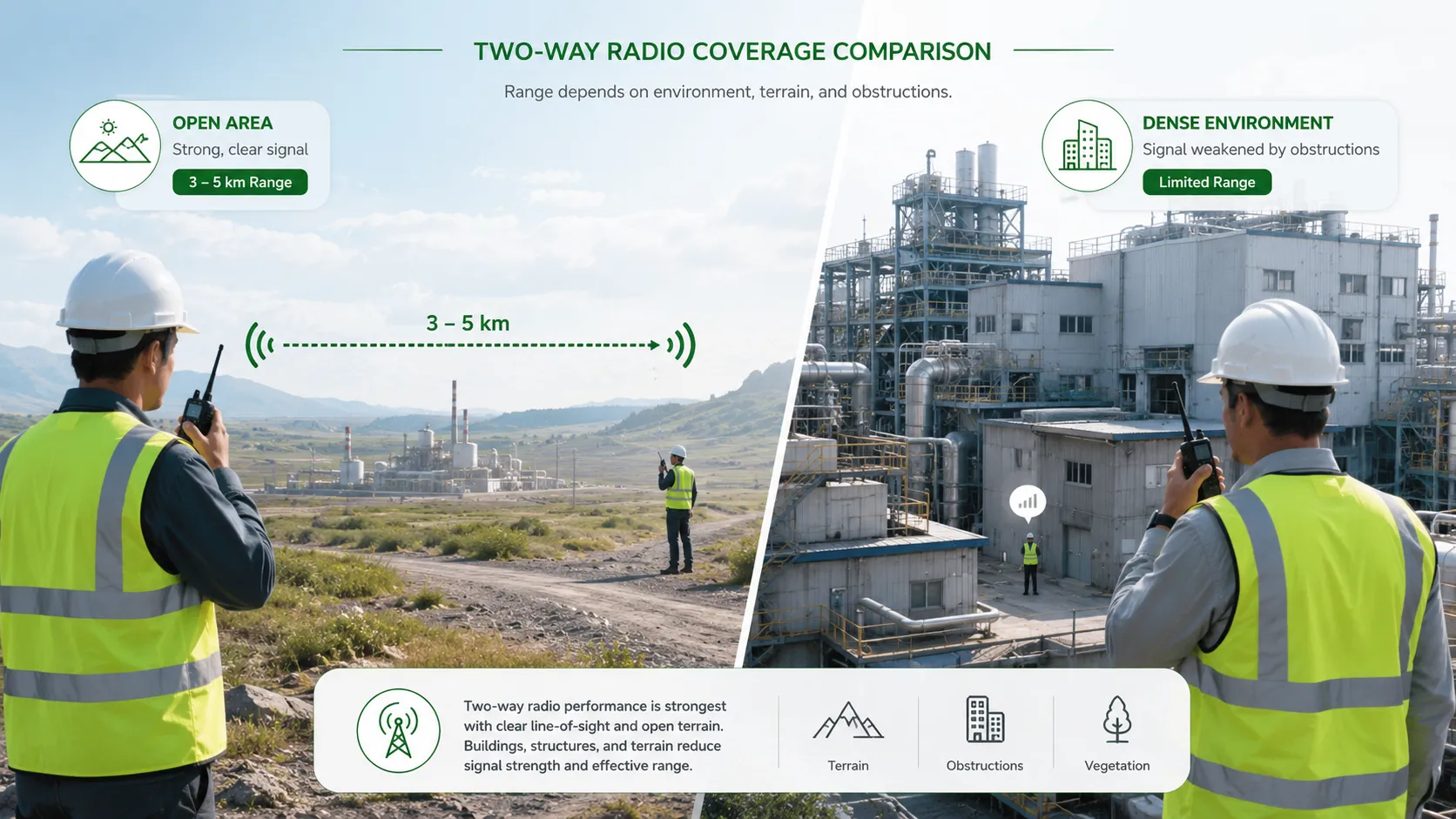
In open environments, many handheld two-way radios can communicate over a useful field distance. Under suitable open-area conditions, communication distance may reach about 3–5 km. In buildings, underground spaces, dense urban areas, and metal-structured industrial sites, radio signals can attenuate quickly.
This means radio range should not be treated as a fixed number. A radio that works well in an open field may perform very differently inside a factory, tunnel, high-rise building, or underground parking area. For professional projects, a coverage survey, repeater planning, antenna optimization, and dispatch system design are often more important than simply increasing device power.
Why Smartphone Apps Feel Slower in Field Dispatch
Smartphone apps such as WeChat, QQ, mobile chat software, or enterprise communication tools can provide voice messages, text, images, videos, files, and location information. These functions are useful when teams need rich multimedia information.
However, app-based communication is not the same as radio dispatch. A user often needs to unlock the phone, open the app, find the correct contact or group, record a voice message, send it, and wait for the other side to tap and play it. In fast-moving field operations, this process can feel slow compared with one-button PTT.
For daily office communication, this extra process may not matter. For rescue, patrol, maintenance, traffic control, site command, and emergency broadcasting, a few seconds can be important. This is why radios remain valuable even when every worker already owns a smartphone.
The value of a two-way radio is not that it has more functions than a smartphone. Its value is that the most important function—instant voice—is always ready.
Emergency Communication: When Network Independence Matters
Wireless radio communication can be especially important when mobile phone networks are damaged, congested, unavailable, or unstable. 2008 Wenchuan earthquake: communication worker Liu Daobin risked his life to repair and restore the county’s only maritime satellite phone, sending the first distress signal to the outside world.
This example shows a deeper principle: in emergency communication, redundancy matters. Public mobile networks, satellite phones, two-way radios, PoC radios, wired dispatch systems, emergency telephones, and public address systems should not be viewed as competing tools. They should be designed as complementary communication paths.
A reliable emergency communication system should include more than one voice path. When one network is unavailable, another method should still support command, notification, coordination, and rescue response.
PoC Radios: A Bridge Between Smartphones and Traditional Radios
Besides traditional analog and digital radios, public network radios have become common in many industries. These are often called PoC radios, meaning Push-to-Talk over Cellular. They use a SIM card and mobile communication network to provide PTT-style voice services.
Examples include China Telecom’s Tianyi PTT service and China Mobile’s He-DuiJiang service. These systems use the operator network to extend communication distance. Their advantages include relatively low communication cost, long-distance communication, voice transmission through data traffic, many stored voice groups, point-to-point calling, and group calling.
In some service packages, the annual cost may be only several hundred RMB. This makes PoC attractive for logistics, property management, mobile patrols, city services, chain stores, and teams that need wide-area communication but still prefer a PTT-style operation.
Why PoC Still Does Not Replace All Radios
PoC radios are useful, but they still depend on mobile networks. If cellular coverage is weak, the base station is overloaded, or the network is interrupted during a disaster, PoC communication may be affected. Traditional radios can still provide local radio communication without depending on the public mobile network.
Therefore, PoC should be viewed as an extension rather than a full replacement. It can expand communication distance and simplify wide-area team management, while traditional radios remain valuable for local independence, fast PTT, and emergency backup.
HAM Radio and Legal Frequency Use
Another important point is the HAM radio community. HAM operators are people who love radio communication and use radio equipment legally after obtaining an amateur radio license. Within the frequency range allowed by their license, they can communicate with other HAM operators, exchange technical knowledge, and participate in emergency communication support during disasters.
Two-way radios can be divided by transmit power and application category, including license-free civil radios and amateur UV-band radios. If the transmit power exceeds a specified limit or the radio uses regulated frequency bands, users must obtain the correct radio license before legal operation.
For enterprises and industrial users, legal frequency planning is not optional. A professional project should consider local regulations, frequency authorization, device certification, interference control, and operational discipline before deployment.
Hybrid Communication Architecture for Industrial Users
A modern industrial communication system should not rely on one device type. A practical architecture may include traditional two-way radios for local PTT, PoC radios for wide-area mobile teams, RoIP gateways for radio-to-IP connection, SIP servers for call control, industrial telephones for fixed points, emergency intercoms for help points, and PA systems for mass notification.
With an integrated communication approach, field radio users can talk with control-room operators, SIP phone users, industrial telephone stations, dispatch consoles, and emergency broadcast zones. Radio voice can be bridged into the IP network through RoIP gateways, while SIP platforms manage routing, recording, group calling, priority communication, and alarm linkage.
Becke Telcom can support this type of hybrid architecture with industrial communication terminals, SIP dispatch integration, RoIP gateway connection, and emergency communication system design for demanding field environments.
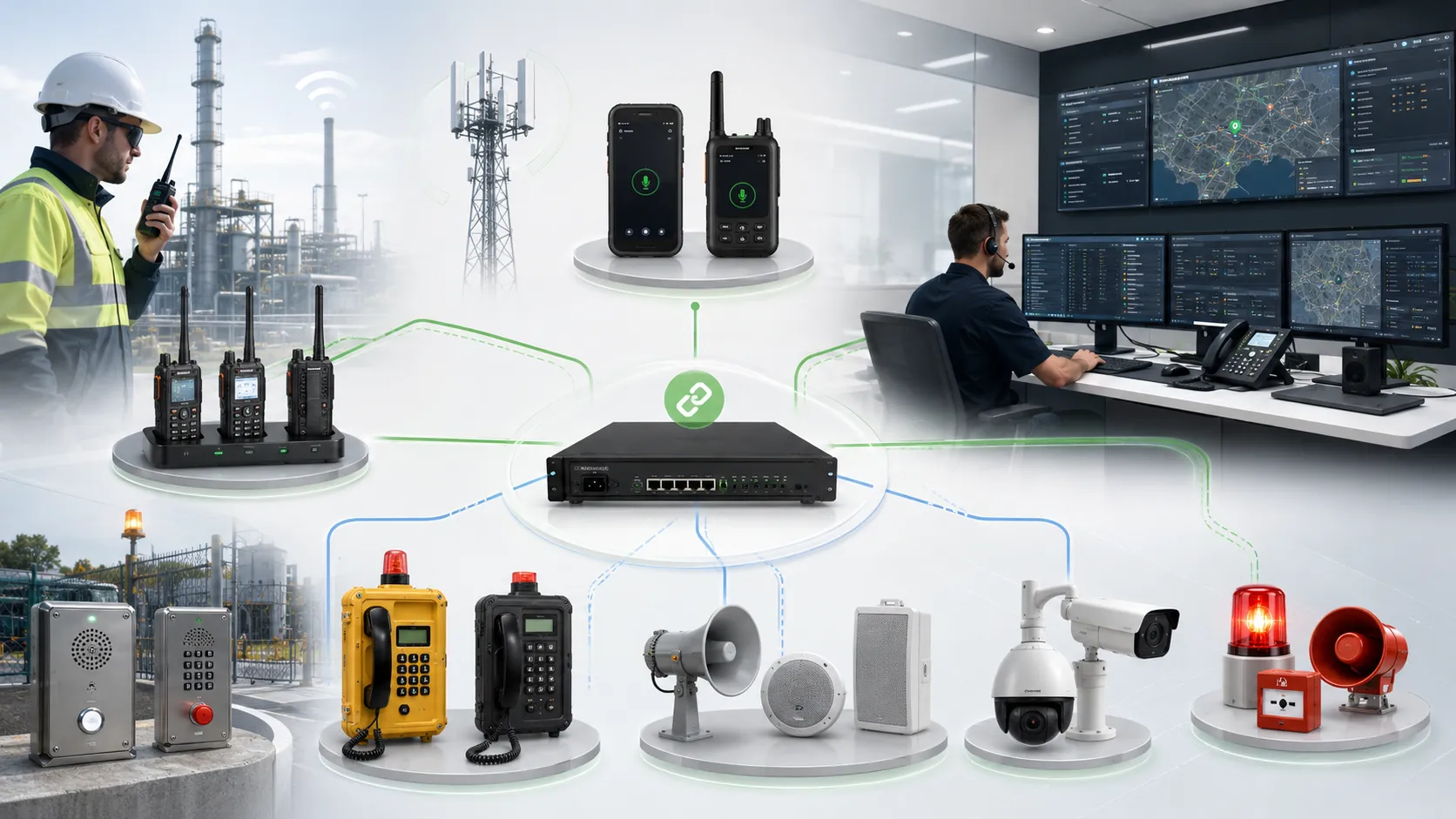
Recommended Architecture Layers
Field Communication Layer
The field layer includes handheld radios, PoC terminals, vehicle radios, and portable communication devices. These devices support patrols, inspection teams, maintenance staff, mobile workers, rescue teams, and security personnel.
Gateway and Network Layer
RoIP gateways, SIP gateways, network switches, wireless access, and operator network links connect different communication systems. This layer is responsible for bridging radio, cellular, IP, and SIP communication paths.
Control and Dispatch Layer
The dispatch layer includes SIP servers, dispatch consoles, recording systems, group management, priority call handling, and alarm linkage. Operators can manage field communication from a centralized control room.
Emergency Notification Layer
Emergency telephones, SIP intercoms, PA speakers, strobe lights, CCTV systems, access control, and fire alarm linkage can be integrated into the same workflow. When an incident occurs, the system can support voice dispatch, site broadcast, visual confirmation, and response tracking.
Application Scenarios
Emergency Rescue and Disaster Response
During natural disasters or major accidents, communication networks may become unstable. A hybrid system using radios, PoC, satellite communication, emergency telephones, and SIP dispatch can improve redundancy and response speed.
Construction and Industrial Command
Construction sites and industrial plants need fast coordination between supervisors, equipment operators, safety officers, and control rooms. Two-way radios provide instant local voice, while dispatch and SIP systems connect fixed and mobile users.
Security Patrol and Property Management
Security teams need simple and fast communication. Radios are useful for patrol groups, while PoC and SIP integration help supervisors communicate across larger areas and record important communication events.
Outdoor Convoys and Field Operations
Self-driving convoys, outdoor teams, rescue groups, and maintenance crews can use radios for fast group communication. Where distance is long, PoC terminals and RoIP integration can extend coordination to remote command centers.
Conclusion
Smartphones are powerful, but they cannot fully replace two-way radios. Radio communication is direct, fast, simple, and often independent of mobile networks. In open areas, handheld radios may cover several kilometers, with about 3–5 km possible under suitable conditions. In buildings and complex environments, coverage becomes more limited and requires proper planning.
Smartphone apps can provide text, images, video, and voice messages, but they cannot always match the immediacy of pressing a PTT key and speaking. PoC radios extend PTT communication through mobile networks, but they still depend on network coverage and service platforms. HAM radio also reminds us that legal frequency use and emergency radio capability remain important parts of the communication ecosystem.
The best answer is not replacement. The best answer is integration. By connecting two-way radios, PoC radios, RoIP gateways, SIP dispatch platforms, industrial telephones, emergency intercoms, PA broadcasting, CCTV, and alarm systems, organizations can build a communication solution that is fast, redundant, compliant, and suitable for real field operations.
FAQ
Can smartphones replace two-way radios?
Smartphones can replace some non-critical communication tasks, but they cannot fully replace two-way radios in emergency, industrial, patrol, construction, and field dispatch scenarios where instant PTT and simple operation are required.
Why are two-way radios faster than smartphone apps?
A two-way radio only requires the user to press the PTT button and speak. A smartphone app usually requires unlocking the phone, opening an app, selecting a contact or group, recording or sending a message, and waiting for the other user to play it.
How far can a handheld two-way radio communicate?
The distance depends on terrain, antenna, power, frequency, and obstacles. In open areas, about 3–5 km may be possible under suitable conditions. Inside buildings or dense industrial environments, signal attenuation can greatly reduce coverage.
What is a PoC radio?
A PoC radio is a Push-to-Talk over Cellular device. It uses a SIM card and mobile network to provide PTT-style voice communication, including point-to-point calls and group calls over a wide area.
Do all two-way radios require a license?
Not all radios require the same licensing conditions. Some low-power civil radios may be license-free, while amateur UV-band radios or higher-power devices may require a valid radio license and legal frequency authorization.
How can radio systems connect with industrial communication platforms?
Radio systems can be connected with RoIP gateways, SIP dispatch platforms, industrial phones, emergency intercoms, PA systems, CCTV linkage, and alarm systems. Becke Telcom can provide related industrial communication products and integration support when a project requires a unified system.







