


A common question in wireless communication is why a handheld two-way radio can sometimes communicate over several kilometers, or even more than ten kilometers in open areas, while a mobile phone normally depends on cellular base stations to complete a call. The answer is not simply “radio power.” It involves frequency bands, wavelength, propagation environment, network architecture, transmission mode, and the role of infrastructure.
Two-way radios and mobile phones are designed for different communication models. A walkie-talkie is usually built for direct, short-to-medium-range group communication. A mobile phone is built for wide-area public network access, voice services, data transmission, video, internet applications, and mobility management through base stations.
From a Becke Telcom solution perspective, both technologies are valuable. Two-way radios are still widely used in industrial sites, ports, mines, tunnels, security patrols, emergency response, construction projects, and large outdoor operations. When connected with RoIP gateways, SIP dispatch platforms, industrial telephones, public address systems, and emergency communication systems, traditional radio networks can become part of a modern unified communication architecture.
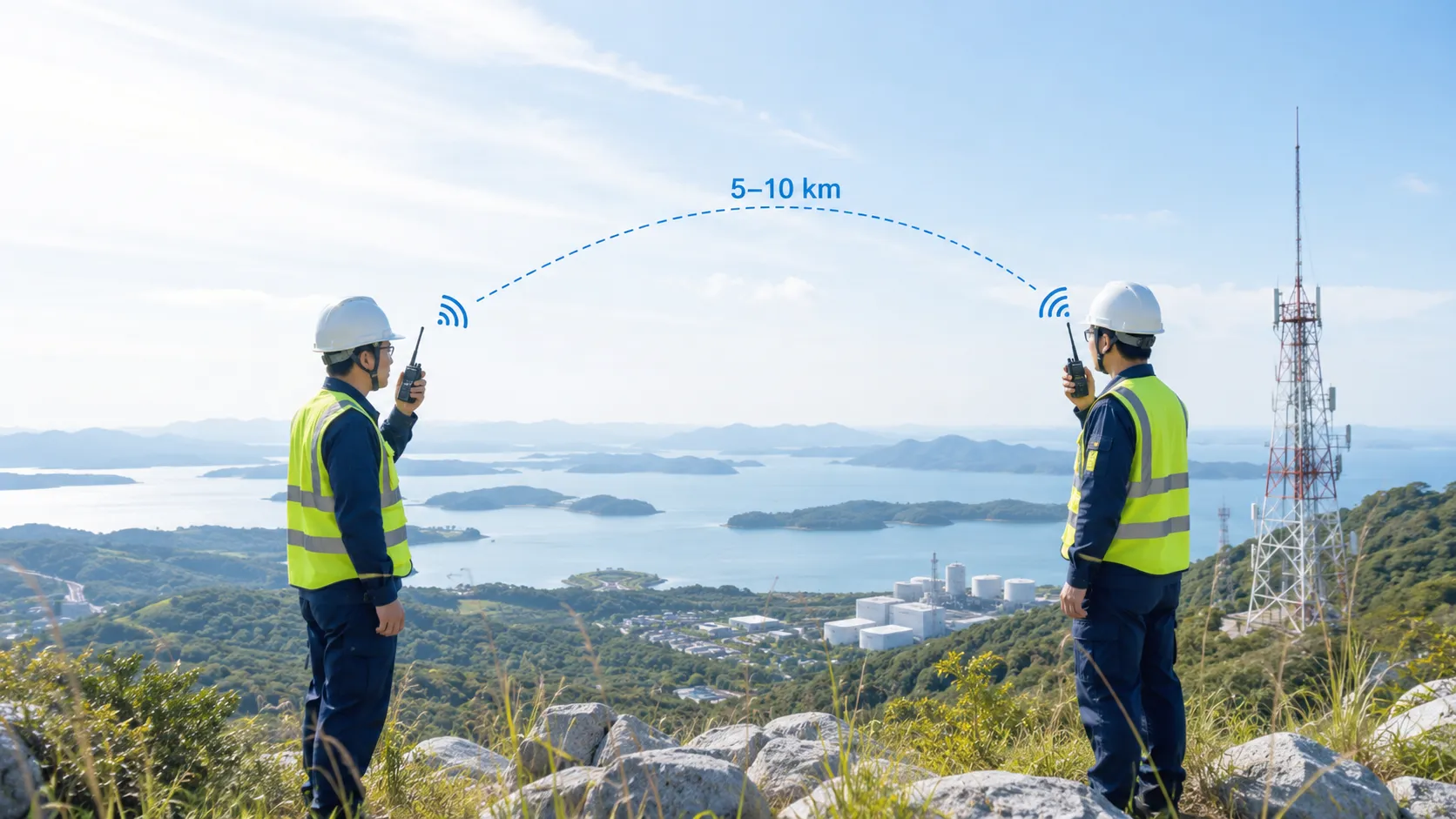
Two Different Communication Architectures
The most important difference is the communication path. A conventional two-way radio can work in a direct radio-to-radio mode. When two radios are on the same frequency and within coverage range, one user presses the PTT button, transmits voice, and the other radio receives it directly.
A mobile phone usually does not call another phone directly over the air. When a user dials a number, the mobile phone sends a signal to a nearby base station. The base station forwards the call through the mobile network, core network, switching system, and then to the receiving user’s phone through another base station. This architecture enables national and global communication, but it also means the phone depends heavily on network infrastructure.
| Item | Two-Way Radio | Mobile Phone |
|---|---|---|
| Typical communication mode | Direct radio-to-radio or repeater-based group communication | Base station and cellular network forwarding |
| Typical use | PTT voice, team dispatch, patrol, emergency response | Voice, internet, video, messaging, applications |
| Infrastructure dependence | Can work without a base station in direct mode | Normally requires cellular base station coverage |
| Communication style | Half-duplex, press to talk and release to receive | Full-duplex voice and packet data services |
Why Two-Way Radios Can Reach Several Kilometers
In open environments such as coastal areas, open fields, industrial yards, mining areas, and rural outdoor sites, handheld radios may reach several kilometers. Under favorable conditions with fewer obstacles and good antenna placement, communication distance can extend to more than ten kilometers. In dense urban areas with high buildings, metal structures, walls, vehicles, and electrical interference, the actual range will be much shorter, but it can still cover useful field distances.
Radio range depends on many factors: output power, antenna efficiency, terrain, building density, frequency band, electromagnetic interference, receiver sensitivity, battery condition, and whether repeaters are used. Therefore, “ten kilometers” should be understood as a possible open-area performance rather than a guaranteed distance for every device and every site.
VHF and UHF Frequency Bands
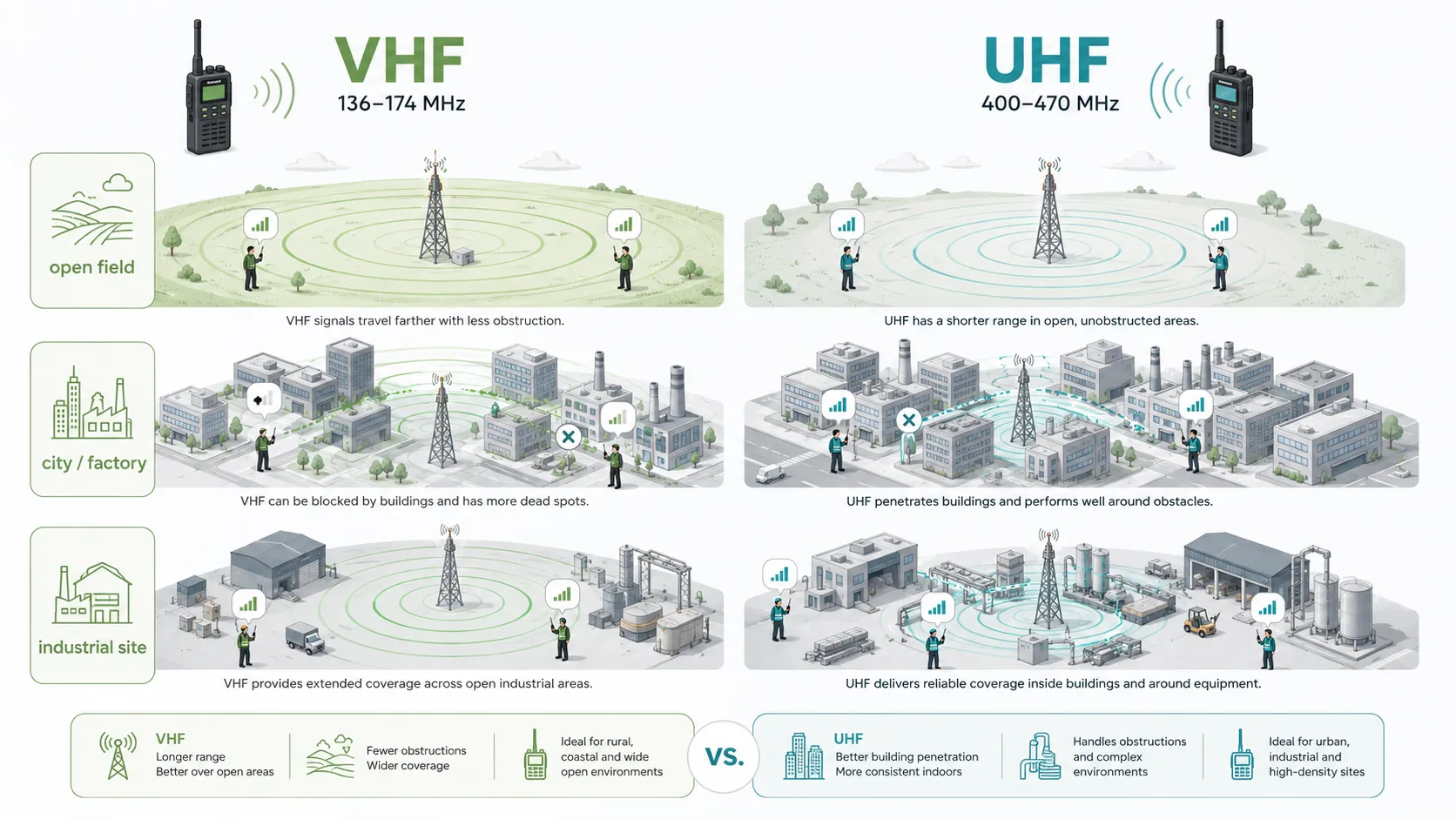
Many civil and professional two-way radios operate around two common frequency ranges: 136–174 MHz for VHF and 400–470 MHz for UHF. These bands have different propagation characteristics.
VHF has a longer wavelength and often performs well in open spaces such as sea areas, rural roads, mountains, farms, and wide outdoor environments. UHF has a shorter wavelength and is often more practical in cities, buildings, factories, warehouses, and complex industrial areas because it may perform better around obstacles and indoor structures.
| Band | Typical Frequency Range | Typical Advantage | Common Application |
|---|---|---|---|
| VHF | 136–174 MHz | Longer wavelength, good open-area propagation | Marine, rural, outdoor patrol, field operations |
| UHF | 400–470 MHz | Better suitability for urban and building environments | Factories, buildings, campuses, security, warehouses |
Why Radio Power Cannot Be Increased Without Limit
Some users think that increasing transmission power is the easiest way to extend radio range. In reality, radio power is controlled by regulations and engineering limits. Excessive power may increase electromagnetic exposure, create unnecessary interference, affect nearby radio systems, and reduce the efficiency of frequency resource management.
Professional radio system design should not rely only on higher power. A more reliable approach is to combine proper frequency planning, antenna placement, repeater deployment, site surveys, RoIP gateway integration, and dispatch platform management. This is especially important in industrial communication projects where reliability, safety, and legal compliance are more important than simply chasing maximum distance.
Why Mobile Phones Depend on Base Stations
Mobile phones are designed for cellular network communication. A phone does not only transmit voice. It must support voice calls, SMS, internet access, video, application data, location mobility, network authentication, handover between cells, billing, encryption, and quality-of-service management.
Because the mobile phone system provides large-area public communication, the network uses base stations to divide the coverage area into cells. Each base station manages radio access in its area and connects mobile users to the operator’s core network. This is why a phone may lose service when there is no base station coverage, even if another phone is physically nearby.
Mobile Network Frequency Examples
Mobile networks commonly use higher and more complex frequency arrangements than traditional two-way radios. In the reference article, China Mobile frequency examples are listed as follows: GSM900 uses 890–909 MHz uplink and 935–954 MHz downlink; GSM1800 uses 1710–1725 MHz uplink and 1805–1820 MHz downlink.
For later generations, the examples include TD-SCDMA 3G at 1880–1900 MHz and 2010–2025 MHz; 4G bands such as 1880–1900 MHz, 2320–2370 MHz, and 2575–2635 MHz; and 5G planning around 3300–3600 MHz and 4800–5000 MHz, with 3300–3400 MHz mainly limited to indoor use in that context.
Higher frequency usually means shorter wavelength. Shorter wavelengths can support high-capacity data services, but they are also more affected by building blockage, terrain loss, indoor penetration loss, and coverage planning. This is one of the reasons cellular networks need dense base station deployment, especially for high-speed 4G and 5G services.
Understanding Mobile Signal Icons: G, E, 3G, H, H+, 4G, 4G+, HD, and 5G
Mobile phone signal icons also reflect the evolution of cellular network technology. Each icon indicates a different network generation or service capability.
| Signal Icon | Meaning | Technical Note |
|---|---|---|
| G | GPRS | A 2.5G mobile data service based on GSM. |
| E | EDGE | A GSM evolution technology, often described as 2.75G. |
| 3G | Third-generation mobile network | Provides higher data rate and better mobile internet support than 2G. |
| H | HSDPA | A 3.5G upgrade with theoretical downlink speed up to 14.4 Mbps. |
| H+ | HSPA+ | A 3.75G enhancement with theoretical downlink speed up to 42 Mbps. |
| 4G | Fourth-generation mobile network | Supports faster audio, video, image, and data transmission, with theoretical rates up to 100 Mbps in the reference article. |
| 4G+ | LTE-A | Uses carrier aggregation and related enhancement technologies. |
| HD | VoLTE high-definition voice | Voice is carried over 4G data network instead of traditional 2G or 3G voice channels. |
| 5G | Fifth-generation mobile network | The reference article mentions a theoretical speed of 10 Gbps, about 20 times faster than 4G. |
Radio Communication Is Not a Replacement for Mobile Networks
Two-way radios can communicate directly without cellular base stations, but they are not the same as mobile phones. Radios are excellent for instant group voice, command dispatch, field coordination, and emergency response. Mobile phones are better for wide-area communication, internet applications, multimedia data, and public network services.
In professional projects, the best design is often not “radio or mobile phone,” but a hybrid communication architecture. Field workers can use handheld radios for fast PTT communication. Control-room operators can use SIP phones, dispatch consoles, or computer-based communication clients. Managers can use mobile apps, softphones, or IP terminals. Gateways and platforms connect these systems together.
Becke Telcom Solution: Connecting Radio, SIP, Dispatch, and Industrial Endpoints
Becke Telcom focuses on industrial communication, SIP systems, emergency telephony, public address, dispatch, gateway integration, and unified communication solutions. In projects where two-way radios are already deployed, Becke Telcom can help extend radio communication into an IP-based command system.
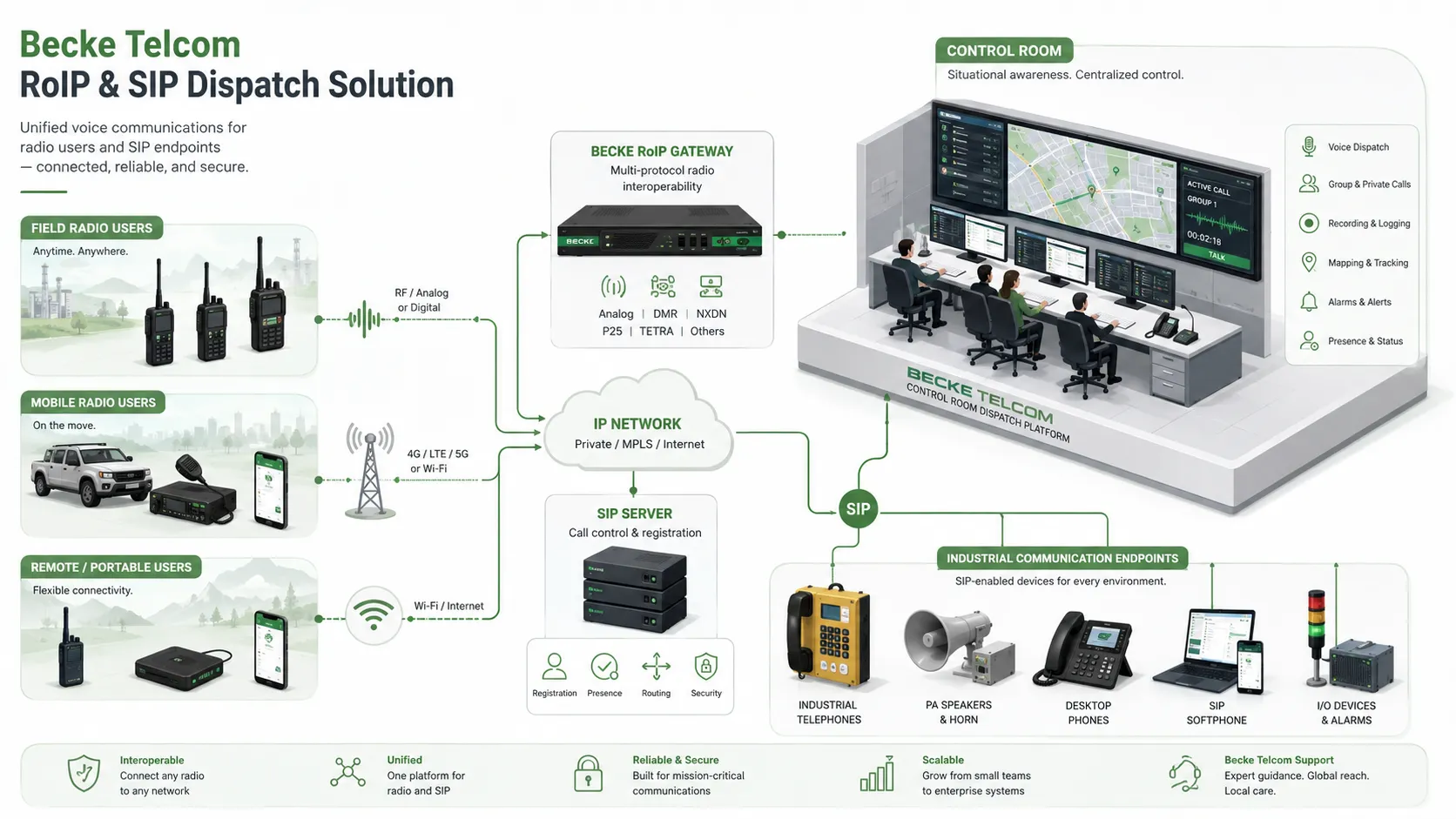
Through a RoIP gateway, radio voice can be connected to an IP network. Through a SIP dispatch platform, radio users can communicate with control-room operators, SIP phones, industrial telephones, emergency call stations, and public address systems. Through alarm and CCTV linkage, voice communication can become part of a complete incident response workflow.
Typical Integrated Architecture
A practical architecture may include handheld radios, radio repeaters, RoIP gateways, SIP servers, dispatch consoles, industrial SIP phones, emergency intercom stations, PA speakers, CCTV systems, and alarm inputs. The radio network remains useful for field teams, while the IP communication platform provides recording, routing, monitoring, multi-site dispatch, and system integration.
Where This Solution Is Useful
Industrial Plants and Manufacturing Sites
In factories and industrial parks, radios are often used by maintenance teams, production supervisors, warehouse staff, security guards, and emergency response teams. When radio communication is connected with a SIP dispatch platform, the control room can coordinate field users, fixed phones, broadcast zones, and alarm events from one interface.
Ports, Mines, Energy, and Petrochemical Facilities
These environments may cover large areas and include outdoor zones, metal structures, high-noise locations, hazardous operations, and limited mobile coverage. A combined radio and IP communication solution helps improve field coordination while keeping command centers connected to site operations.
Tunnels, Transportation, and Utility Corridors
In tunnels and long corridor environments, direct radio range may be affected by structure, curvature, and shielding. A planned system using repeaters, leaky feeder cables, RoIP gateways, SIP emergency phones, public address, and video linkage can create a more reliable emergency communication chain.
Technical Design Recommendations
For industrial users, communication distance should not be judged only by advertised radio range. A reliable project should begin with a site survey. Engineers should evaluate building density, terrain, antenna height, frequency environment, repeater location, control-room requirements, emergency workflows, and integration needs.
UHF may be preferred for factories, buildings, warehouses, and urban sites. VHF may be more suitable for open fields, sea areas, and outdoor long-distance operations. Where radio coverage alone is not enough, repeaters and RoIP gateways can extend communication and connect radio users to IP-based dispatch systems.
In industrial communication design, the real goal is not the longest possible radio range. The real goal is reliable coverage, clear voice, fast dispatch, legal frequency use, and connection with emergency response workflows.
Conclusion
Two-way radios can communicate over long distances because they can use direct radio links, often operate in VHF or UHF bands such as 136–174 MHz and 400–470 MHz, and are optimized for PTT voice communication. In open environments, communication may reach several kilometers or even more than ten kilometers under favorable conditions. In cities or complex industrial environments, the distance becomes shorter because of building blockage, interference, and terrain loss.
Mobile phones follow a different design. They use cellular networks, higher-frequency bands, complex data services, and base station infrastructure. This gives users wide-area mobile communication and high-speed internet access, but it also means the phone normally depends on network coverage.
For Becke Telcom industrial communication solutions, the best approach is to combine the strengths of both models. Two-way radios provide fast field PTT communication. RoIP gateways connect radio users to IP networks. SIP dispatch platforms connect control rooms, industrial phones, emergency intercoms, PA systems, CCTV, and alarm systems. Together, they form a more complete, reliable, and scalable communication solution for modern industrial operations.
FAQ
Why can two-way radios communicate without a base station?
Many two-way radios can work in direct radio-to-radio mode. As long as the radios are on the same frequency and within coverage range, they can communicate without cellular base station forwarding.
How far can a two-way radio communicate?
The distance depends on terrain, antenna, power, frequency, interference, and obstacles. In open areas, some radios may communicate over several kilometers or even more than ten kilometers. In cities or buildings, the distance is usually much shorter.
Which is better for industrial use, VHF or UHF?
VHF, such as 136–174 MHz, is often better for open outdoor areas. UHF, such as 400–470 MHz, is often more practical in cities, factories, warehouses, and building environments.
Why do mobile phones need base stations?
Mobile phones are designed for cellular networks. They send signals to base stations, and the base stations connect users through the operator’s network. This enables wide-area communication, internet access, mobility, authentication, and service management.
Can two-way radios connect with SIP phones or dispatch systems?
Yes. With a RoIP gateway and SIP dispatch platform, radio users can communicate with SIP phones, industrial telephones, control-room dispatch consoles, emergency intercoms, and PA systems.
How does Becke Telcom support radio communication projects?
Becke Telcom can provide RoIP gateway integration, SIP dispatch systems, industrial telephones, emergency communication terminals, public address systems, and unified communication solutions for factories, tunnels, ports, mines, energy facilities, and transportation sites.







