When developers first read the PJSIP source code, one question appears very quickly: why does a seemingly simple SIP INVITE request pass through so many files, modules, callbacks, and state machines? Why does PJSIP provide pjsip, pjsip-simple, pjsip-ua, PJSUA, and PJSUA2 instead of exposing only one simple API?
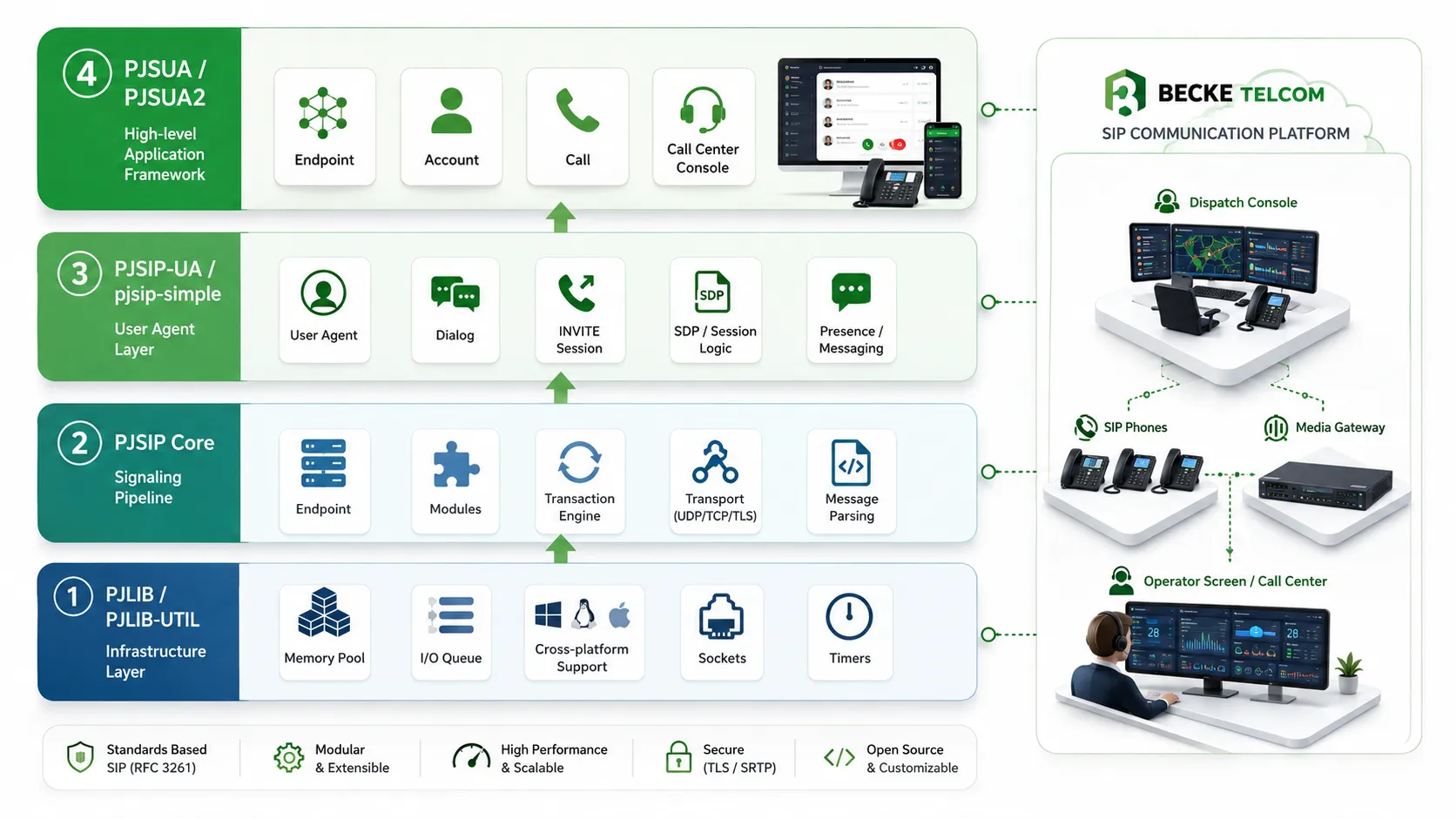
The answer lies in PJSIP’s layered abstraction and encapsulation philosophy. PJSIP is not a loose collection of C functions. It is a carefully structured communication stack that gradually abstracts SIP from low-level transport and memory handling into high-level business objects such as accounts, calls, dialogs, media sessions, and application endpoints. For call centers, dispatch systems, SIP platforms, and industrial communication solutions, this layered design is the reason PJSIP can be both lightweight and powerful.
Becke Telcom uses SIP, VoIP, dispatch communication, gateway integration, industrial telephones, emergency intercoms, and unified communication platforms in many professional scenarios. Understanding PJSIP’s layered architecture helps engineers design more reliable call center systems, SIP softphones, RoIP gateways, emergency communication platforms, and control-room dispatch solutions.
PJSIP as a Layered Logistics System
A useful way to understand PJSIP is to compare it to a logistics system. A call center user only wants to click a button and start a call, just like an online shopper only wants to place an order. However, behind that simple action are roads, trucks, traffic rules, tracking numbers, sorting centers, delivery workers, and customer service workflows.
PJSIP follows the same idea. Each layer hides part of the complexity and exposes a more practical interface to the layer above it. This is why a SIP INVITE crosses multiple components: every layer has a specific responsibility, and each responsibility is isolated to make the system stable, extensible, and maintainable.
| PJSIP Layer | Logistics Analogy | Engineering Role |
|---|---|---|
| PJLIB | Roads and trucks | Provides memory, threading, socket, timer, and cross-platform infrastructure. |
| PJSIP Core | Traffic rules and shipping documents | Parses, routes, sends, and receives SIP messages according to RFC 3261. |
| PJSIP-UA | Sorting center and delivery workers | Turns raw SIP messages into dialogs, sessions, and user-agent behavior. |
| PJSUA / PJSUA2 | E-commerce front desk | Provides high-level APIs for accounts, calls, media, registration, and application logic. |
PJLIB and PJLIB-UTIL: The Infrastructure Layer
At the bottom of PJSIP are PJLIB and PJLIB-UTIL. This layer does not focus on business calls or call center logic. Its purpose is to solve the difficult and repetitive problems of C network programming, including memory management, cross-platform compatibility, sockets, timers, event polling, threading, logging, and utility functions.
RFC 3261 defines how SIP should behave as a protocol, but it does not define how a C program should manage memory, handle concurrency, or support different operating systems. PJSIP solves these engineering problems through PJLIB so that the upper layers can focus on SIP signaling and media workflows.
Memory Pool Abstraction: pj_pool_t
SIP message parsing creates many short-lifecycle strings, headers, URI objects, parameters, and temporary structures. If every object is allocated and released through frequent malloc/free operations, memory fragmentation can become serious, especially in embedded devices, gateways, and long-running communication systems.
PJSIP introduces pj_pool_t as a memory pool abstraction. It is not only a simple allocator; it is a lifecycle manager. When PJSIP creates a transaction, dialog, or message-processing context, related memory can be allocated from a pool. When the lifecycle ends, the whole pool can be released at once.
This design hides memory fragmentation risk behind a controlled allocation model. For call center systems and industrial SIP gateways, this is important because the software may run continuously for months or years and must remain stable under high call volume.
I/O Queue Abstraction: pj_ioqueue
SIP systems need to handle multiple transports, including UDP, TCP, and TLS. These transports should be non-blocking, scalable, and efficient. However, different operating systems use different event models, such as epoll on Linux, IOCP on Windows, and kqueue on macOS or BSD-style systems.
PJSIP encapsulates this complexity through pj_ioqueue. Developers can call pj_ioqueue_poll() without caring about the underlying operating system event mechanism. This allows PJSIP-based applications to be portable across servers, embedded devices, desktop softphones, industrial terminals, and gateway platforms.
PJLIB solves the “run reliably” problem. It gives PJSIP a stable foundation for memory, concurrency, timers, sockets, and cross-platform event handling.
PJSIP Core: The Signaling Pipeline Layer
The PJSIP Core layer is the heart of SIP signaling. However, it does not directly define business meaning such as “agent login,” “customer call,” or “dispatch group.” Instead, it builds a standardized and extensible message pipeline based on SIP rules.
This layer handles message parsing, message generation, transport selection, endpoint management, module dispatching, transaction processing, and routing logic. It is where SIP begins to become an engineering framework rather than plain text over a network socket.
Endpoint and Module Architecture
The pjsip_endpoint can be understood as the central authority of the signaling world. All SIP messages pass through the endpoint. Instead of putting all logic into one large function, PJSIP divides the protocol stack into a set of pjsip_module components, such as transaction modules, event modules, utility modules, user-agent modules, and application modules.
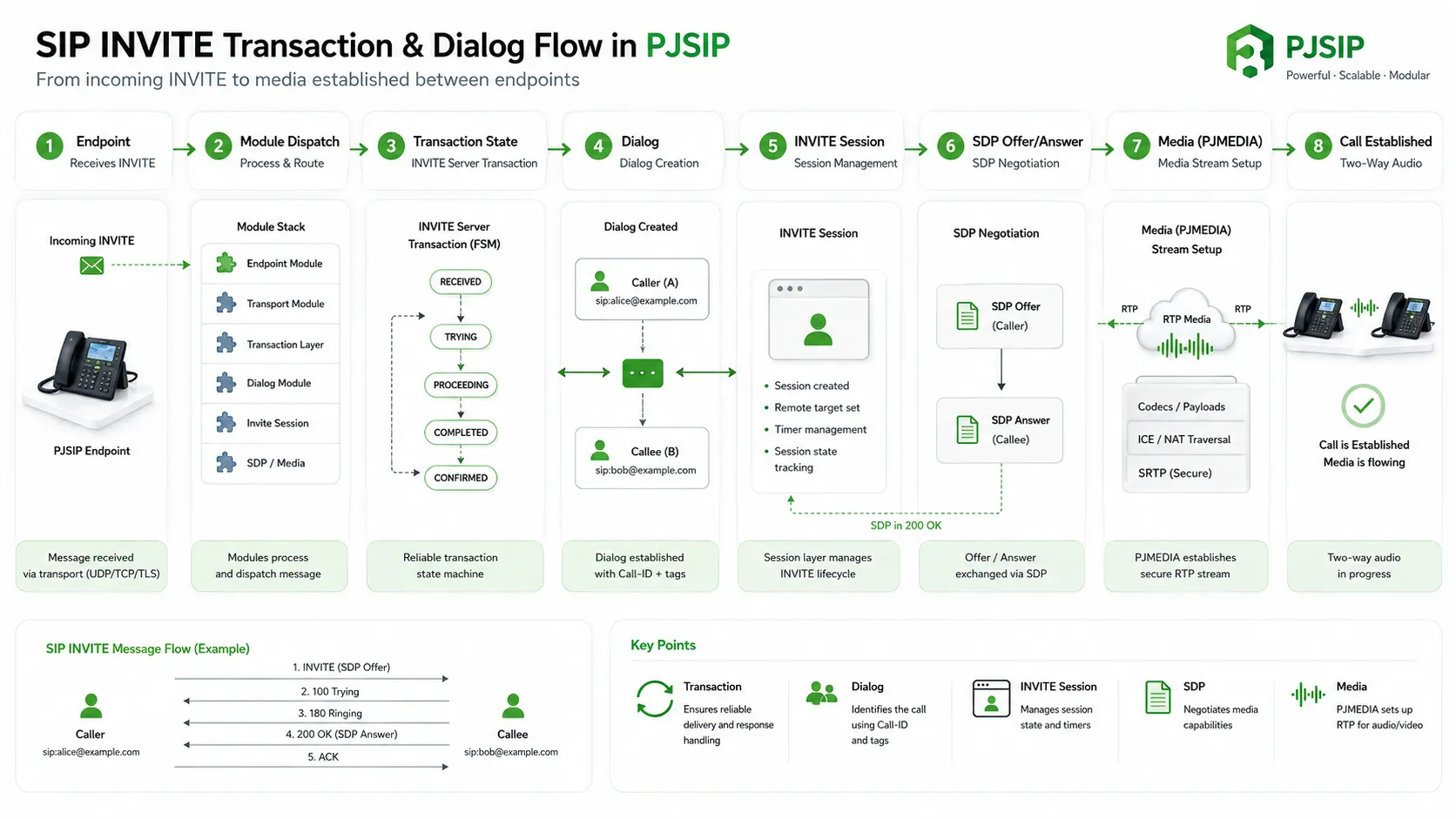
When a network packet arrives, it is parsed into a pjsip_rx_data structure. The endpoint then distributes the message to registered modules based on priority. A typical inbound flow may pass through message parsing, transport handling, transaction matching, user-agent processing, and application callbacks.
When the application sends a SIP message, the flow moves in the opposite direction. The application creates a message, modules process it, route logic is applied, transaction handling is attached when needed, and the transport layer sends it through UDP, TCP, TLS, or another configured transport.
The Onion Model of SIP Processing
PJSIP’s module system works like an onion model. Each layer can inspect, modify, or handle SIP messages without changing the entire core. This is valuable for call center platforms and Becke Telcom-style communication systems because custom modules can be added for authentication, logging, routing policy, security inspection, header rewriting, call recording triggers, or gateway interworking.
For example, a SIP dispatch platform may need to intercept INVITE messages, check caller identity, apply routing rules, record signaling logs, and then send the call to an agent group, SIP phone, industrial telephone, or emergency call station. PJSIP’s modular core makes this possible without rewriting the complete SIP stack.
Transaction Abstraction: pjsip_tsx
In SIP, a request and its responses form a transaction. RFC 3261 defines complex timer and retransmission behavior, including timers such as Timer A, Timer B, and Timer D. Manually implementing these timers is difficult and error-prone.
PJSIP encapsulates transaction behavior through pjsip_tsx. The transaction layer turns request-response interaction into a black-box state machine. Instead of writing retransmission and timeout logic manually, developers listen to callbacks such as on_tsx_state.
This abstraction is extremely important for SIP reliability. In a call center, thousands of INVITE, REGISTER, OPTIONS, BYE, and MESSAGE transactions may happen continuously. The transaction layer ensures that message timing, retransmission, and state changes remain consistent with the SIP protocol.
PJSIP-UA: From Messages to Sessions
RFC 3261 describes SIP messages, requests, responses, headers, tags, transactions, and routing behavior. However, real users do not think in terms of raw messages. A call center agent thinks in terms of “answering a call,” “putting a caller on hold,” “transferring a call,” or “ending a conversation.”
The PJSIP-UA layer bridges this gap. It converts raw SIP messages into user-agent concepts such as dialogs and invite sessions. This is where PJSIP moves from protocol text to communication objects.
Dialog Abstraction: pjsip_dlg
Native SIP identifies a dialog using a combination of Call-ID, From tag, and To tag. For developers, managing this manually is primitive and risky. A real call can involve many requests and responses, and each message must be matched to the correct dialog context.
PJSIP encapsulates this into the pjsip_dlg object. A dialog automatically maintains CSeq values, route sets, dialog matching, response handling, and related state. This turns a mostly stateless text protocol into a stateful object model.
For call center engineering, this is a major step. Once a dialog is established, the application can manage call-related behavior with much less concern about raw header matching and manual sequencing.
Invite Session Abstraction: pjsip_inv_session
A complete SIP call is not just one INVITE transaction. It may include INVITE, 100 Trying, 180 Ringing, 183 Session Progress, 200 OK, ACK, PRACK, UPDATE, re-INVITE, and BYE. These messages form a complete call lifecycle.
PJSIP encapsulates this lifecycle through pjsip_inv_session. The invite session links multiple transactions into one meaningful call session. It also introduces SDP negotiation, which means SIP signaling starts to coordinate with media handling.
At this layer, SIP is no longer only about sending and receiving text messages. It begins to work with PJMEDIA to establish media streams, negotiate codecs, handle RTP, and connect audio devices or media ports.
pjsip-simple: Presence, Messaging, and Event-Based Services
In many call center and unified communication systems, voice calls are only one part of the solution. Users may also need presence, instant messaging, subscription, notification, and event-based communication features. This is where pjsip-simple becomes important.
The pjsip-simple layer provides building blocks for SIP SIMPLE-related services. These services can support functions such as user status, message notifications, and event subscriptions. In a Becke Telcom communication platform, similar concepts may be used to show endpoint availability, dispatch status, device online state, alarm notifications, or operator presence.
PJSUA and PJSUA2: High-Level Application Frameworks
For most application developers, it is unnecessary to directly manipulate low-level PJSIP Core or PJLIB APIs. PJSIP provides PJSUA and PJSUA2 as high-level frameworks that package the lower layers into practical application interfaces.
This is the layer where developers stop thinking like protocol engineers and start thinking like communication application builders.
PJSUA: High-Level C API
PJSUA is the C-language high-level API. It encapsulates accounts, calls, registrations, media ports, audio devices, and conference bridges into convenient handles and global framework functions.
For example, when a developer calls pjsua_call_make_call(), the framework automatically performs a series of lower-level tasks: creating an INVITE transaction, creating a dialog, negotiating SDP, connecting media, handling signaling callbacks, and managing the call state.
The tradeoff is that PJSUA is less flexible than direct PJSIP Core programming, but development speed is much faster. For many softphones, test tools, embedded SIP clients, and standard call center endpoints, this level of abstraction is highly practical.
PJSUA2: Object-Oriented C++ API
PJSUA2 is the modern object-oriented C++ API for PJSIP application development. It wraps the underlying C structures into classes and makes the programming model easier to understand for developers building larger applications.
In PJSUA2, Endpoint represents the whole protocol stack instance. Account represents a SIP account, including registration and authentication logic. Call represents a communication session, including signaling callbacks and media operations.
This design almost hides the protocol stack from the application developer. Instead of writing raw SIP network code, the developer operates a set of telephone-like objects. This is ideal for call center clients, operator consoles, SIP softphones, dispatch applications, and enterprise communication terminals.
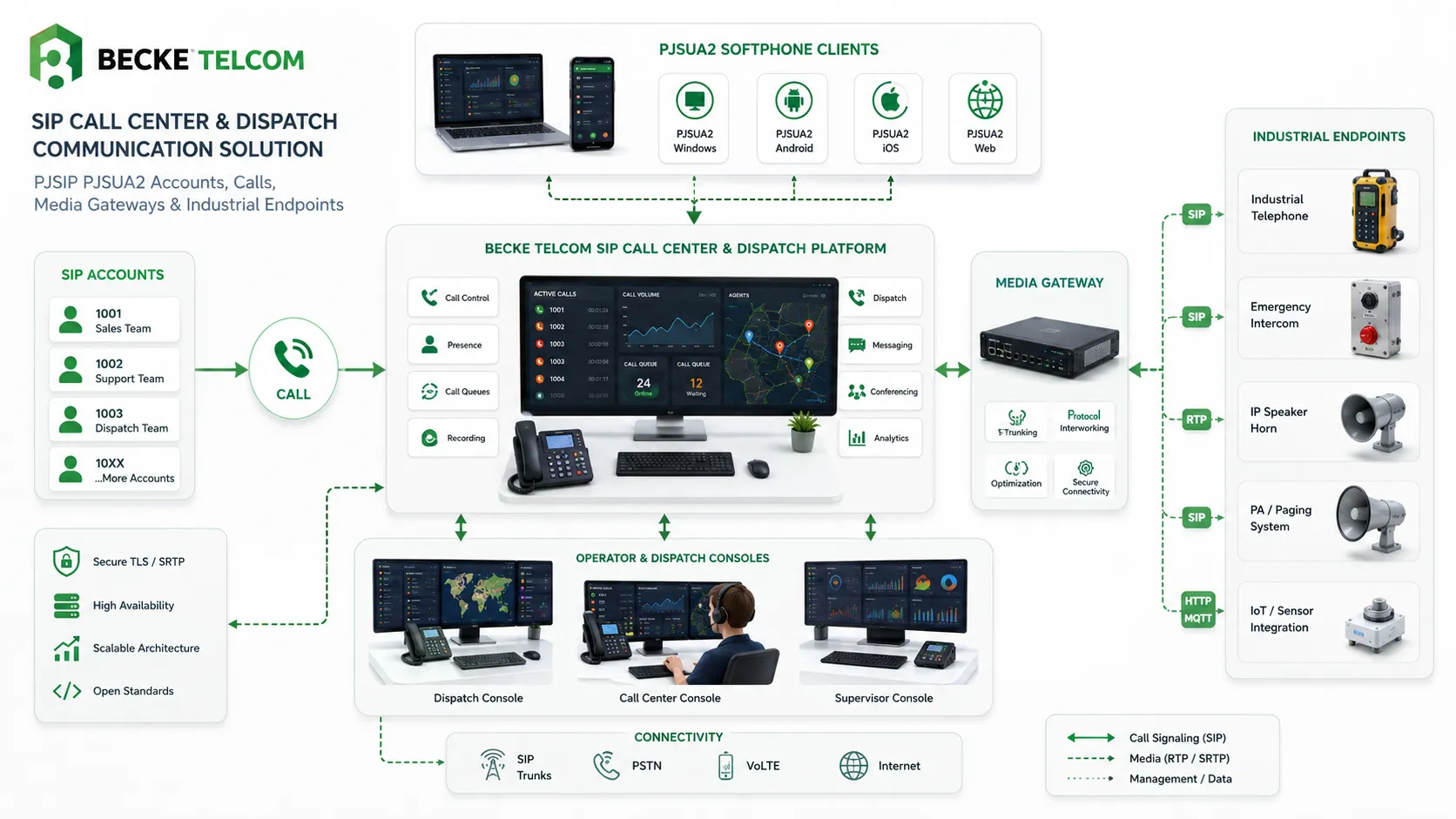
How PJSIP Supports Call Center and Dispatch System Development
A call center platform must handle registration, inbound calls, outbound calls, ringing, answer, hold, transfer, conference, recording, routing, media negotiation, and status monitoring. If every function were built from raw SIP messages, development would be slow and unreliable.
PJSIP’s layered architecture gives engineers the right level of control. A simple SIP endpoint can be developed quickly with PJSUA2. A more advanced dispatch server can use lower-level modules to intercept SIP messages, apply routing policies, connect gateways, and integrate with external systems.
Account Registration and Authentication
In a call center system, each agent terminal or SIP device usually needs a SIP account. PJSUA2 can encapsulate account registration, authentication, and status updates. This allows developers to manage SIP accounts as application objects instead of manually constructing REGISTER messages.
Call Control and Agent Workflow
Calls can be represented as objects with states such as calling, ringing, confirmed, disconnected, or held. This model matches call center workflows naturally. Agent software can display call status, trigger call recording, start transfer operations, or update CRM data based on call callbacks.
Media Handling and SDP Negotiation
SIP signaling alone does not carry voice. Voice media is negotiated through SDP and then transmitted through RTP or related media paths. PJSIP works with PJMEDIA to handle codec negotiation, audio devices, media ports, conference bridges, and stream management.
Gateway and Industrial Endpoint Integration
Becke Telcom communication solutions may include SIP phones, industrial telephones, emergency call stations, paging terminals, RoIP gateways, broadcast systems, and dispatch consoles. PJSIP-style architecture supports this kind of integration because signaling, session control, media handling, and application logic can be separated clearly.
Becke Telcom Technical Solution Perspective
From a Becke Telcom solution perspective, PJSIP’s layered philosophy is highly relevant to real-world communication platforms. A control center may need SIP trunk access, IP PBX connectivity, industrial telephone endpoints, emergency intercoms, radio gateway access, PA broadcasting, CCTV linkage, and dispatch console integration.
A reliable architecture should not mix all logic into one application layer. Instead, it should follow clear separation: transport and system resources at the bottom, SIP signaling in the core, dialog and session logic in the middle, and business workflows at the top.
This approach makes the system easier to debug, easier to scale, and easier to integrate with third-party platforms. It also allows different products to reuse the same core capabilities. For example, a SIP call center client, industrial SIP phone, RoIP gateway, and emergency dispatch platform may all share similar SIP signaling concepts while exposing very different user interfaces.
PJSIP is powerful because it separates protocol complexity from business development. This is exactly the design principle needed in modern call center, dispatch, and industrial communication systems.
Why PJSIP Uses So Many Layers
PJSIP’s layered abstraction exists to solve the conflict between the complexity of RFC 3261 and the efficiency required for real engineering projects. SIP is flexible, but that flexibility creates many edge cases. PJSIP organizes those cases into manageable layers.
PJLIB solves the problem of running reliably by managing memory, sockets, timers, and concurrency. PJSIP Core solves the problem of sending and receiving SIP messages correctly according to RFC rules. PJSIP-UA solves the problem of managing dialogs, sessions, and SDP negotiation. PJSUA and PJSUA2 solve the problem of building business applications quickly.
This is why PJSIP can be used in very different environments. It can be trimmed down for embedded devices and IoT communication terminals, while also being expanded for softphones, video calls, conference systems, dispatch platforms, and call center applications.
Practical Engineering Value for Developers
Better Maintainability
When each layer has a clear responsibility, developers can locate problems faster. A memory problem belongs to the infrastructure layer. A retransmission issue belongs to the transaction layer. A call-state issue belongs to the dialog or invite session layer. A business workflow issue belongs to the application layer.
Better Scalability
Modular SIP processing allows developers to add authentication, routing, logging, monitoring, recording triggers, and security rules without rewriting the entire stack. This is especially useful for enterprise call centers and multi-site dispatch platforms.
Better Product Reuse
A unified communication company can reuse the same SIP foundation across different products. The same core design can support SIP phones, call center agents, dispatch consoles, paging gateways, and industrial emergency endpoints.
Conclusion
PJSIP may look complicated at first because one INVITE request travels through many files and layers. However, this complexity is intentional. PJSIP transforms SIP from raw protocol messages into a structured engineering system.
PJLIB provides the infrastructure. PJSIP Core builds the signaling pipeline. PJSIP-UA turns messages into dialogs and sessions. PJSUA and PJSUA2 expose practical APIs for application developers. Together, these layers allow PJSIP to serve both lightweight embedded devices and complex call center or dispatch communication systems.
For Becke Telcom-style solutions, this layered design offers an important reference model. Whether building a SIP call center, industrial communication platform, RoIP gateway, emergency intercom system, or dispatch console, the best architecture is not a pile of functions. It is a disciplined structure that separates transport, signaling, session control, media, and business logic.
FAQ
Why does a simple SIP INVITE pass through so many PJSIP files?
Because PJSIP separates responsibilities into layers. An INVITE may involve transport handling, message parsing, endpoint dispatching, transaction processing, dialog matching, invite session handling, SDP negotiation, and application callbacks.
What is the role of PJLIB in PJSIP?
PJLIB provides low-level infrastructure such as memory pools, sockets, timers, event polling, threading, logging, and cross-platform abstraction. It helps PJSIP run reliably across different operating systems and devices.
What is the difference between PJSIP Core and PJSIP-UA?
PJSIP Core focuses on SIP message processing, transport, modules, endpoint logic, and transactions. PJSIP-UA focuses on user-agent concepts such as dialogs, invite sessions, call lifecycle, and SDP-related session control.
What is PJSUA2 used for?
PJSUA2 is the C++ object-oriented API for PJSIP. It wraps the lower layers into classes such as Endpoint, Account, and Call, making it easier to develop softphones, call center clients, dispatch applications, and SIP communication tools.
Why is memory pool design important in SIP systems?
SIP parsing creates many temporary objects and strings. Memory pools reduce fragmentation and simplify lifecycle management, which is important for embedded devices, gateways, servers, and long-running call center systems.
How does this architecture help Becke Telcom communication solutions?
It provides a clear technical model for building SIP call centers, dispatch platforms, RoIP gateways, industrial phones, emergency intercoms, and unified communication systems. Each product can reuse the same layered principles while exposing different business functions.