Introduction to Rural Broadcasting Systems
What Is Rural Broadcasting?
Rural broadcasting leverages public address (PA) or IP-powered audio infrastructure to disseminate announcements, safety alerts, and critical information across villages, agricultural zones, and underserved remote communities. As a core communication solution for non-urban and isolated regions, it fills the gap left by insufficient digital communication tools, mobile network coverage, and traditional media penetration, becoming the most direct and effective way to reach every resident in sparsely populated areas.
These purpose-built systems serve as a vital communication backbone for public notifications, emergency warnings, community coordination, and agricultural/educational outreach initiatives. Unlike urban audio systems that focus on commercial and indoor applications, rural broadcasting is tailored to outdoor, long-distance, and large-scale scenarios, ensuring that essential information is transmitted clearly and stably to meet the daily management and emergency response needs of rural communities.
Challenges in Rural Deployment
Rural deployments face unique operational hurdles, including inconsistent power infrastructure, large-scale coverage demands, and exposure to extreme, unregulated weather conditions. Many remote rural areas lack stable mains electricity, suffering from frequent power outages; the vast geographical span requires equipment to cover several square kilometers with minimal devices; and harsh outdoor environments such as heavy rain, sandstorms, high temperatures, and freezing cold pose severe tests to equipment durability.
As a result, broadcasting hardware must deliver rugged reliability, long-term durability, and simplified maintenance workflows to withstand these demanding environments. The equipment must adapt to off-grid working conditions, resist physical damage and environmental erosion, and be designed for easy installation and repair, as professional technical teams are often unavailable in remote rural areas.
A robust rural broadcasting system ensures time-sensitive, life-saving information reaches communities rapidly—even in remote, infrastructure-constrained locations. It acts as a lifeline for rural residents, especially in disaster-prone areas, enabling timely early warnings and emergency guidance to protect personal and property safety.
System Configuration for Rural Broadcasting
Core Equipment Selection
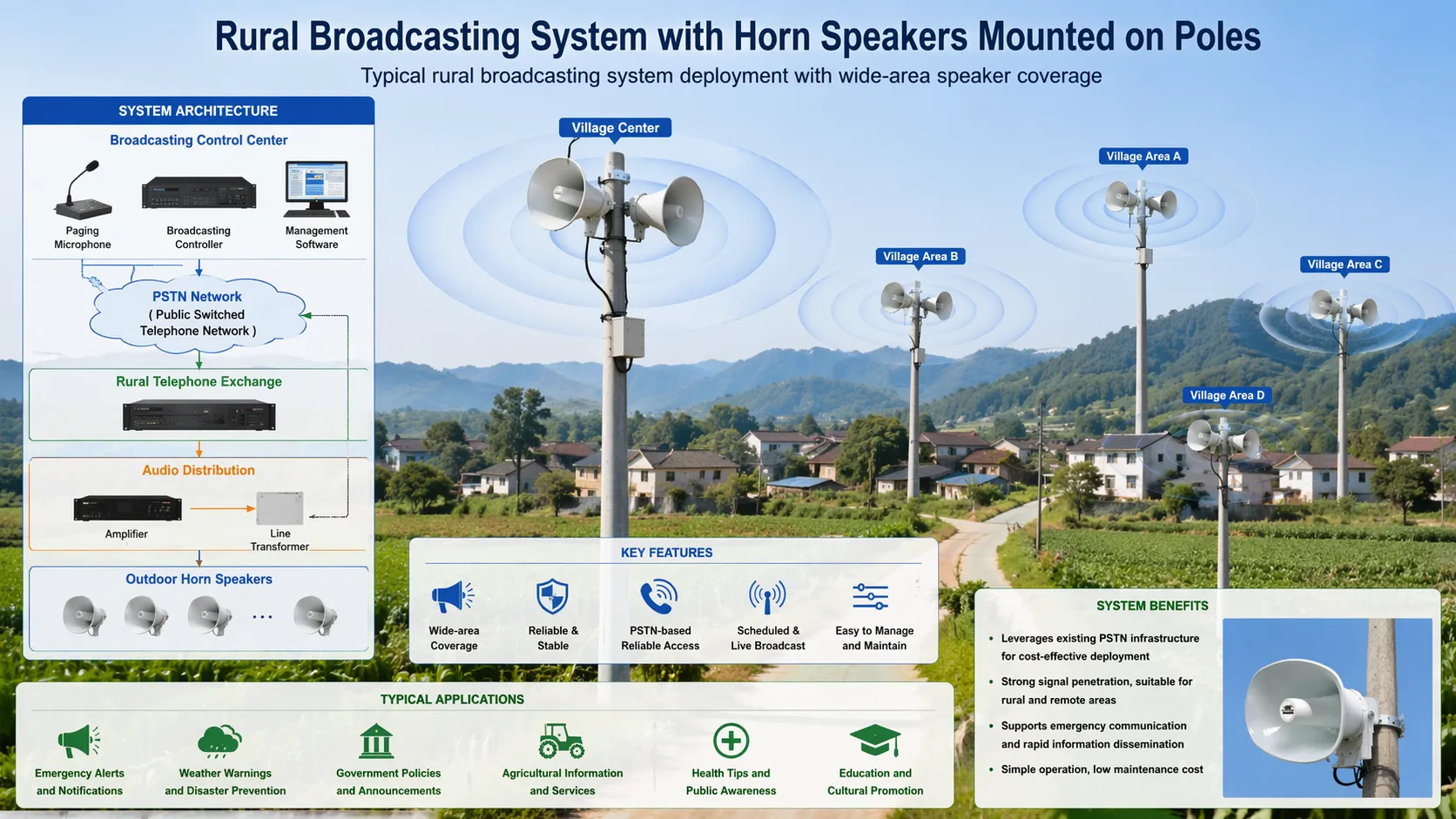
A standard rural broadcasting setup comprises core components including broadcast-grade microphones, power amplifiers, weatherproof loudspeakers (such as horn speakers), and a centralized control unit or IP network gateway. Each component is selected for outdoor adaptability: noise-canceling microphones ensure clear voice input, high-power amplifiers drive long-distance audio transmission, and professional speakers guarantee sound clarity in open areas.
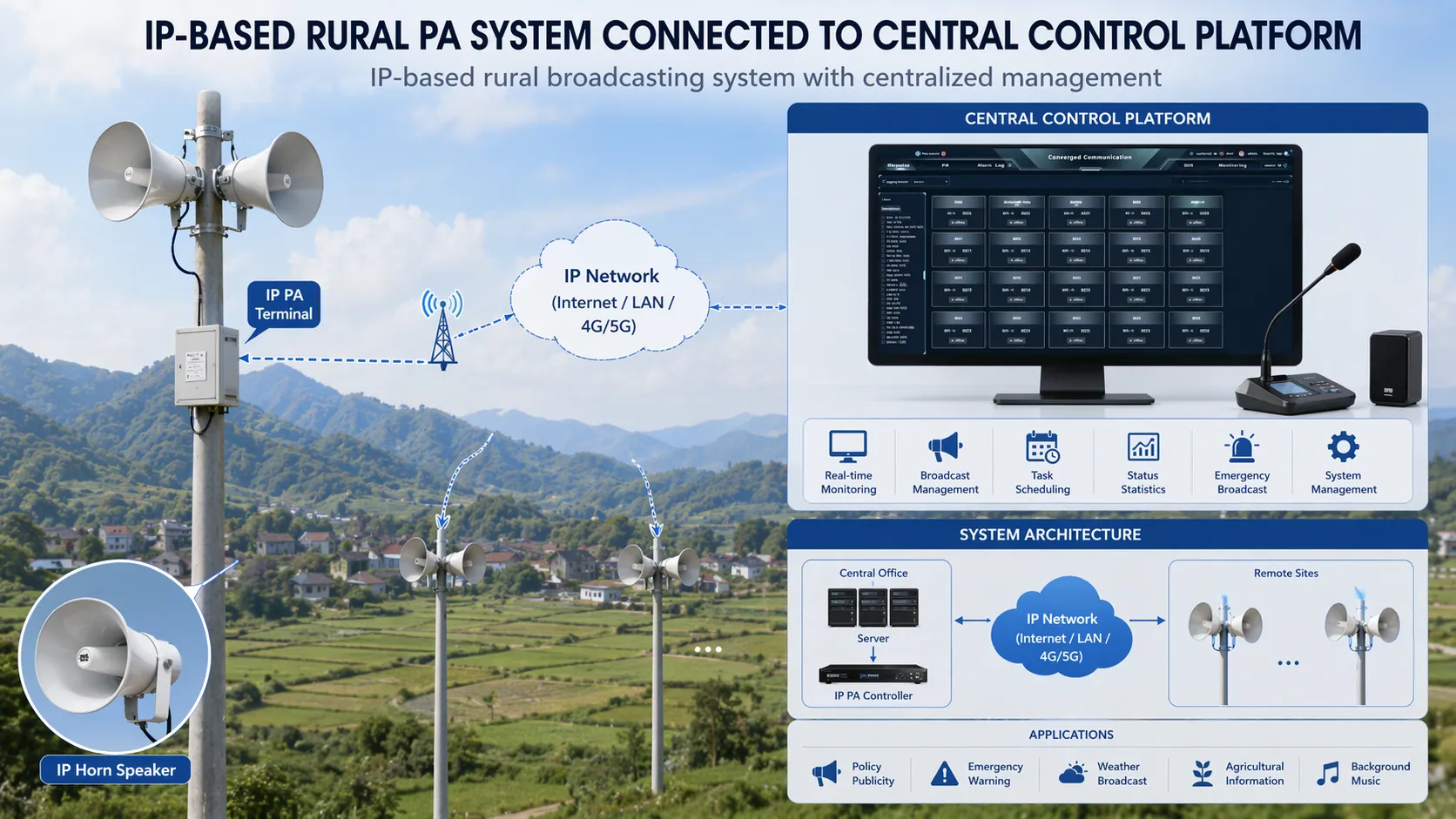
In modern deployments, SIP-compliant IP speakers and industrial VoIP gateways enable full centralized control, remote configuration, and cloud-based monitoring capabilities. These intelligent devices break the limitations of traditional wired broadcasting, support network-based unified management, and allow multi-site linkage, which greatly improves the flexibility and management efficiency of rural broadcasting systems.
Speaker Placement and Coverage
Speakers must be strategically positioned to deliver uniform, intelligible sound distribution across the entire target coverage zone. Professional layout needs to consider terrain undulations, building distribution, and signal interference, avoiding sound dead zones and overlapping areas to ensure that every corner of the village and farmland can receive clear audio signals.
Elevated pole-mounted installations and weatherproof horn speakers are industry-standard choices to achieve far-reaching, wide-area audio coverage. Horn speakers feature high directivity and long transmission distance, while high installation positions avoid obstacles and maximize coverage range, making them the optimal choice for rural outdoor broadcasting.
Power Supply Solutions
Consistent, uninterrupted power is a foundational requirement for rural broadcasting systems. Deployments often utilize solar arrays, high-capacity batteries, or hybrid solar-battery power solutions to maintain 24/7 uptime. Solar-powered solutions are perfectly suited for off-grid rural areas, converting clean solar energy into stable power, eliminating the dependence on municipal power grids.
Redundant backup power systems are strongly recommended to eliminate service disruptions caused by grid outages or adverse weather. Dual backup schemes such as solar + battery + UPS can ensure the system operates normally during continuous rainy days or power failures, maintaining uninterrupted communication services at all times.
Network and Connectivity
Network connectivity is tailored to the local environment, with options including wired Ethernet, long-range wireless links, or 4G/5G mobile networks. For areas with complete wired infrastructure, Ethernet provides stable transmission; for remote areas, wireless and cellular networks become the primary connectivity methods, with strong adaptability and easy deployment.
IP-native systems enable real-time remote monitoring, centralized control, and seamless integration with unified communication platforms. Administrators can manage the entire broadcasting system through a computer or mobile terminal, adjust parameters, release information, and monitor equipment status remotely, greatly reducing the difficulty of daily operation and maintenance.
Key Features of Rural Broadcasting Equipment
Weather Resistance
Broadcasting hardware must be engineered to withstand prolonged exposure to rain, dust, extreme temperatures, and high humidity. All outdoor equipment adopts a fully sealed design, preventing water and dust from entering the interior and protecting electronic components from damage in harsh environments.
Outdoor-rated, IP65+ enclosures and industrial-grade electronic components are non-negotiable for reliable long-term performance. The IP65 protection level means the equipment is completely dust-proof and resistant to low-pressure water jets, while industrial-grade components support a wide operating temperature range, ensuring stable operation in extreme cold and heat.
Wide Coverage Capability
Rural broadcasting systems are purpose-built to deliver audio coverage across vast geographic areas while minimizing the need for complex supporting infrastructure. The system adopts high-efficiency transmission technology, reducing the number of equipment required while covering a larger area, lowering the overall deployment and maintenance costs.
High-efficiency power amplifiers and high-output horn speakers are the industry standard for achieving optimal sound projection over long distances. The combination of high-power amplification and professional horn speakers can transmit clear audio to a range of hundreds of meters, fully meeting the coverage needs of large-scale rural areas.
Remote Management
Modern IP-based rural broadcasting systems support full remote configuration, real-time status monitoring, and firmware updates via standard IP networks. This intelligent management function allows operators to complete all settings and inspections without on-site visits, adapting to the characteristics of scattered rural sites.
This eliminates unnecessary on-site maintenance visits, reducing operational costs and minimizing service downtime. Remote troubleshooting and software updates can quickly resolve faults, ensuring the system is always in optimal working condition and avoiding interruptions to critical information release.
Integration with Communication Systems
Rural broadcasting systems are designed to integrate seamlessly with SIP, VoIP, and mission-critical emergency communication platforms. This cross-system integration realizes the unification of daily broadcasting and emergency communication, forming a comprehensive rural communication guarantee system.
Solutions from trusted providers like Becke Telcom enable unified cross-system communication and centralized control for streamlined operations. Professional integrated solutions optimize system compatibility and stability, providing users with a one-stop, efficient rural communication experience.
Maintenance Tips for Rural Broadcasting Systems
Regular Equipment Inspection
Scheduled routine inspections are essential to verify the proper function of speakers, cabling, power supplies, and network connections. Monthly inspections should focus on equipment appearance, connection firmness, and audio playback effect, while quarterly inspections require in-depth testing of core performance parameters.
Proactive fault detection during these checks prevents unplanned system downtime and costly repairs. Early identification of loose lines, damaged speakers, and power abnormalities can avoid large-scale system failures and ensure the long-term stable operation of the broadcasting system.
Cleaning and Environmental Protection
Accumulated dust, moisture, and environmental contaminants can degrade audio performance and shorten hardware lifespan. Rural areas have large amounts of dust and high humidity, so regular cleaning of equipment surfaces and sound transmission ports is crucial to maintain good audio output.
Equipment should undergo regular cleaning and inspection of weatherproof seals to maintain ingress protection ratings. Damaged seals should be replaced immediately to prevent moisture and dust from invading the equipment interior and causing circuit failures.
Rugged protective enclosures with IP-rated sealing are critical to extending equipment lifespan in harsh conditions. Additional protective covers can be installed for equipment in particularly harsh areas, providing double protection against environmental damage.
Power System Maintenance
Battery banks and solar panel arrays require regular inspection and maintenance to ensure consistent, reliable power delivery. Solar panels need to be cleaned of dust and debris to maintain photoelectric conversion efficiency, while batteries should be checked for voltage and aging status regularly.
Backup power systems, including UPS units and battery backups, should be tested periodically to verify their functionality during outages. Monthly discharge and charge tests can confirm the backup capacity of the power system, ensuring it can take over immediately when the main power fails.
Software and Network Updates
For IP-native rural broadcasting systems, regular firmware updates and network health checks are critical to maintaining system integrity. Official firmware updates optimize system functions, fix potential vulnerabilities, and improve the stability and security of intelligent devices.
These updates address security vulnerabilities, resolve bugs, and ensure the system operates at peak performance. Network stability tests can detect signal interference and connection failures in advance, ensuring smooth data transmission for IP-based broadcasting systems.
A structured, consistent maintenance program is the cornerstone of ensuring long-term reliability and peak performance for rural broadcasting systems. Standardized maintenance not only reduces failure rates but also extends the service life of equipment, maximizing the application value of the entire broadcasting system.
Applications of Rural Broadcasting Systems
Public Announcements
Delivers daily public announcements, community event updates, and general local information to residents across the coverage area. It is widely used for village governance notifications, policy promotion, cultural activity broadcasts, and convenient life information release, building a smooth communication channel between grass-roots management and residents.
Emergency Alerts
Serves as a critical early warning system to alert residents of natural disasters, safety hazards, and other urgent emergencies. In the face of floods, landslides, wildfires, and public health incidents, the system can quickly release full-coverage warning information, guiding residents to take emergency avoidance measures.
Agricultural Communication
Disseminates real-time weather forecasts, agricultural best practices, and market information to support farming operations. It provides farmers with planting guidance, pest control tips, agricultural product market prices, and meteorological early warnings, helping to improve agricultural production efficiency and economic benefits.
Education and Awareness
Supports public education campaigns, health and safety awareness programs, and community outreach initiatives. It is used to promote legal knowledge, medical and health guidelines, fire safety education, and rural revitalization policies, improving the comprehensive quality and safety awareness of rural residents.
FAQ
What equipment is needed for rural broadcasting?
A complete rural broadcasting setup typically includes broadcast-grade microphones, power amplifiers, weatherproof speakers, and a centralized control or IP-based management system. Optional accessories such as solar power kits, backup batteries, and signal amplifiers can be added according to the actual environment and coverage needs of rural areas.
Can rural broadcasting systems work without stable electricity?
Yes. Systems can operate reliably using off-grid power solutions, including solar arrays paired with high-capacity battery backup systems, to maintain continuous operation without access to a stable grid. The hybrid power supply scheme is specially designed for power-deficient areas, ensuring 24-hour uninterrupted operation of the broadcasting system.
Are IP-based systems suitable for rural areas?
Absolutely. IP-native systems are well-suited for rural deployments, particularly when paired with long-range wireless links or 4G/5G mobile network connectivity for reliable data transmission. They support remote management and multi-site linkage, perfectly matching the scattered distribution and low-maintenance characteristics of rural areas.