Understanding the PSTN
Definition of PSTN
PSTN, or the Public Switched Telephone Network, is the traditional telephone network that enables fixed voice communication through circuit-switched infrastructure. It is commonly associated with landline phones and POTS services, and has served as the foundation of public voice communication for more than a century. The network establishes managed voice paths that connect users, carriers, and enterprise systems while maintaining a predictable calling experience.
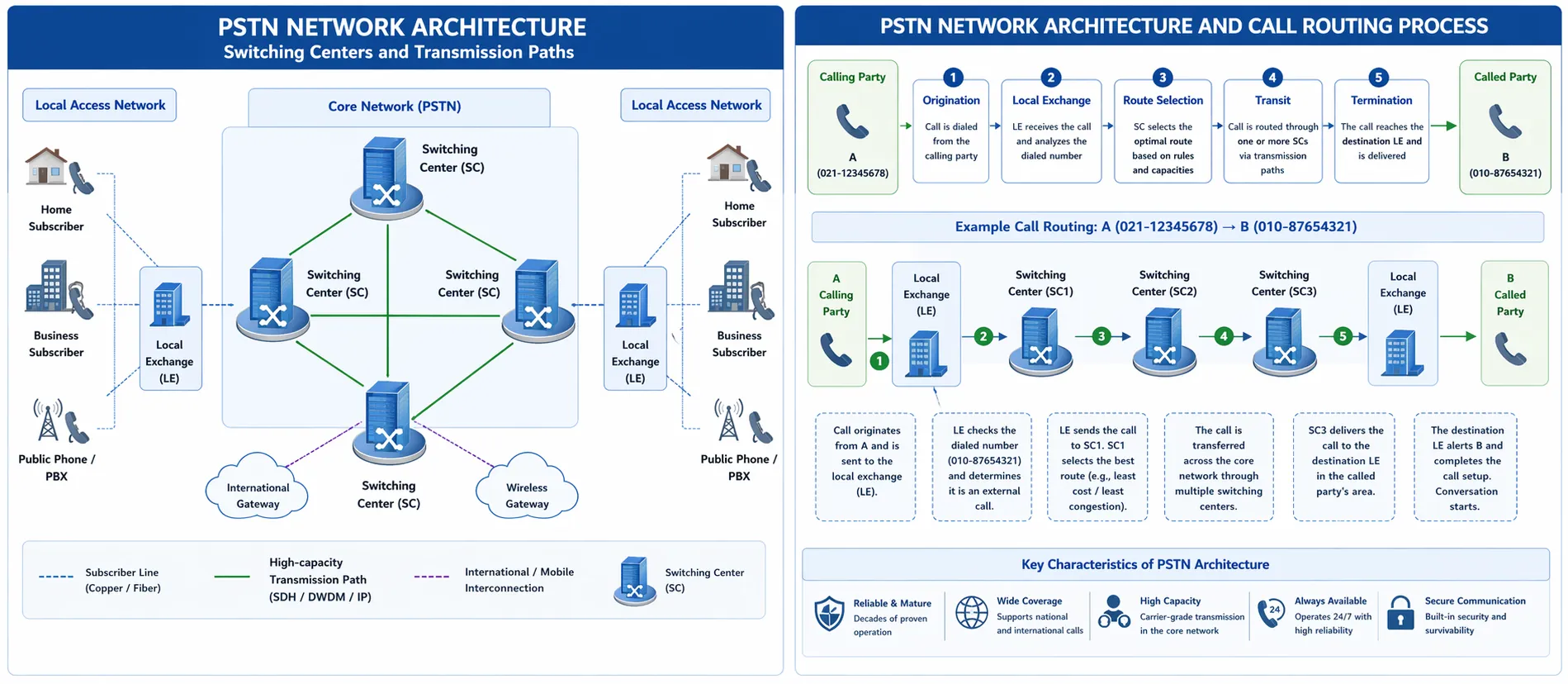
In its classic form, PSTN includes copper local loops, telephone exchanges, switching centers, trunk lines, international gateways, and signaling systems. Local access may still use twisted-pair copper lines, while long-distance and backbone transmission often rely on digital switching, fiber-optic links, and high-capacity carrier infrastructure.
Why PSTN Became the Backbone of Voice Communication
PSTN became central to global communication because it was designed specifically for real-time voice. Unlike general data networks, traditional telephone networks were engineered to deliver predictable voice paths, stable audio quality, global reach, and regulated service availability.
For decades, homes, offices, factories, hospitals, public agencies, banks, transport systems, and emergency services depended on PSTN lines for daily communication. Even today, many hybrid communication systems still retain PSTN access for external calling, backup routing, alarms, elevators, fax machines, and legacy PBX systems.
PSTN is not only an old telephone network. It is also the historical foundation that shaped modern voice communication, numbering plans, carrier interconnection, emergency calling, and enterprise telephony architecture.
How PSTN Developed Over Time
From Manual Switchboards to Automatic Exchanges
The early telephone network depended on manual switchboards, where human operators connected calls by physically plugging cables into switch panels. This model worked for small local networks but became inefficient as telephone usage expanded across cities and regions.
Automatic exchanges later changed the system by allowing users to dial numbers directly. Electromechanical switches, rotary dialing, and step-by-step switching systems gradually replaced manual operation, making telephone communication faster, more scalable, and easier to standardize.
Digital Switching and SS7 Signaling
As telecommunications technology advanced, PSTN moved from purely analog voice transmission toward digital switching and trunking. Pulse-code modulation converted voice into digital signals, and time-division multiplexing allowed many calls to share high-capacity trunk infrastructure.
A major milestone was the introduction of Signaling System No. 7, commonly known as SS7. SS7 separates call-control signaling from the voice path, enabling the network to route calls, check line status, support caller ID, provide call waiting, handle toll-free numbers, and manage many carrier-grade telephony services.
The Shift Toward All-IP Networks
In many countries, operators are gradually retiring traditional copper-based PSTN infrastructure and moving voice services to fiber, broadband, VoIP, LTE, 5G, and cloud-based platforms. This transition is often described as PSTN switch-off or All-IP migration.
However, the transition is complex because many devices still depend on traditional telephone lines. Elevator emergency phones, alarm panels, fax machines, point-of-sale terminals, healthcare systems, and industrial communication devices may require adapters, gateways, cellular modules, or managed IP migration plans to maintain reliable service.
How PSTN Works
Circuit Switching Mechanism
The defining principle of PSTN is circuit switching. When a call is placed, the network reserves a dedicated communication circuit between the caller and the receiver. This circuit remains available to that call until one side hangs up.
This is different from VoIP and Internet-based communication, where voice is divided into data packets and transmitted across shared IP networks. Circuit switching can provide consistent latency and predictable voice quality, but it is less efficient because reserved capacity cannot be used by other traffic during silent moments in the call.
Basic Call Flow
A typical PSTN call begins when the user lifts the handset and receives a dial tone from the local exchange. After the user dials a number, the exchange collects the digits and uses signaling systems to determine where the call should be routed.
The network then reserves transmission capacity across the required local exchange, switching centers, and trunk lines. The destination exchange sends ringing voltage to the called telephone. When the called party answers, the circuit becomes active and voice is carried across the established path until the call ends.
Core Network Components
A PSTN system is usually built from several important components. The local loop connects the subscriber telephone to the nearby telephone exchange. The local exchange provides dial tone, collects dialed digits, and connects local users or routes calls toward other exchanges.
Trunk lines carry aggregated voice traffic between exchanges and switching centers. Switching systems select the appropriate route for each call. International and interconnection gateways allow PSTN traffic to move between countries, carriers, mobile networks, and enterprise systems.
Voice Bandwidth and Numbering
Traditional digital PSTN voice commonly uses a 64 kbps channel based on G.711-style voice encoding. The voice band is optimized for intelligible speech rather than high-fidelity audio, which is why landline calls are clear for conversation but not designed for wideband music-quality sound.
PSTN also depends on standardized telephone numbering. Public telephone numbers follow global numbering principles such as country codes, area codes, and subscriber numbers, allowing users to reach fixed-line, mobile, enterprise, and emergency numbers across different regions and carriers.
Key Technical Characteristics
Reliable Voice Quality
PSTN was engineered for real-time voice, so it provides stable, low-latency communication under normal operating conditions. Because a dedicated circuit is reserved for each call, the user experience is usually predictable and not directly affected by packet congestion in the way IP voice can be.
This reliability explains why many organizations historically used PSTN for business lines, emergency phones, alarm transmission, and public service access. In many cases, PSTN was chosen not because it had the most features, but because it was dependable and widely available.
Independent Power Support
One important advantage of traditional copper-based PSTN service is that a corded telephone can often receive power from the telephone exchange through the line itself. Telephone exchanges typically include backup power systems, which can keep basic voice service available during local commercial power failures.
This lifeline characteristic is one reason why PSTN has been used for elevators, emergency call points, telecare devices, and security systems. When replacing PSTN with IP-based voice, organizations must pay careful attention to local power backup, battery capacity, network resilience, and emergency call compliance.
Compatibility with Legacy Equipment
Many older devices were designed around analog telephone lines. Fax machines, dial-up modems, alarm panels, POS terminals, elevator phones, and analog PBX systems may depend on the electrical and signaling behavior of PSTN lines.
As networks modernize, these devices often require analog telephone adapters, FXO/FXS gateways, SIP gateways, or dedicated migration solutions. A simple network change can create service disruption if legacy device compatibility is not tested before migration.
PSTN and VoIP Integration
Why Gateways Are Needed
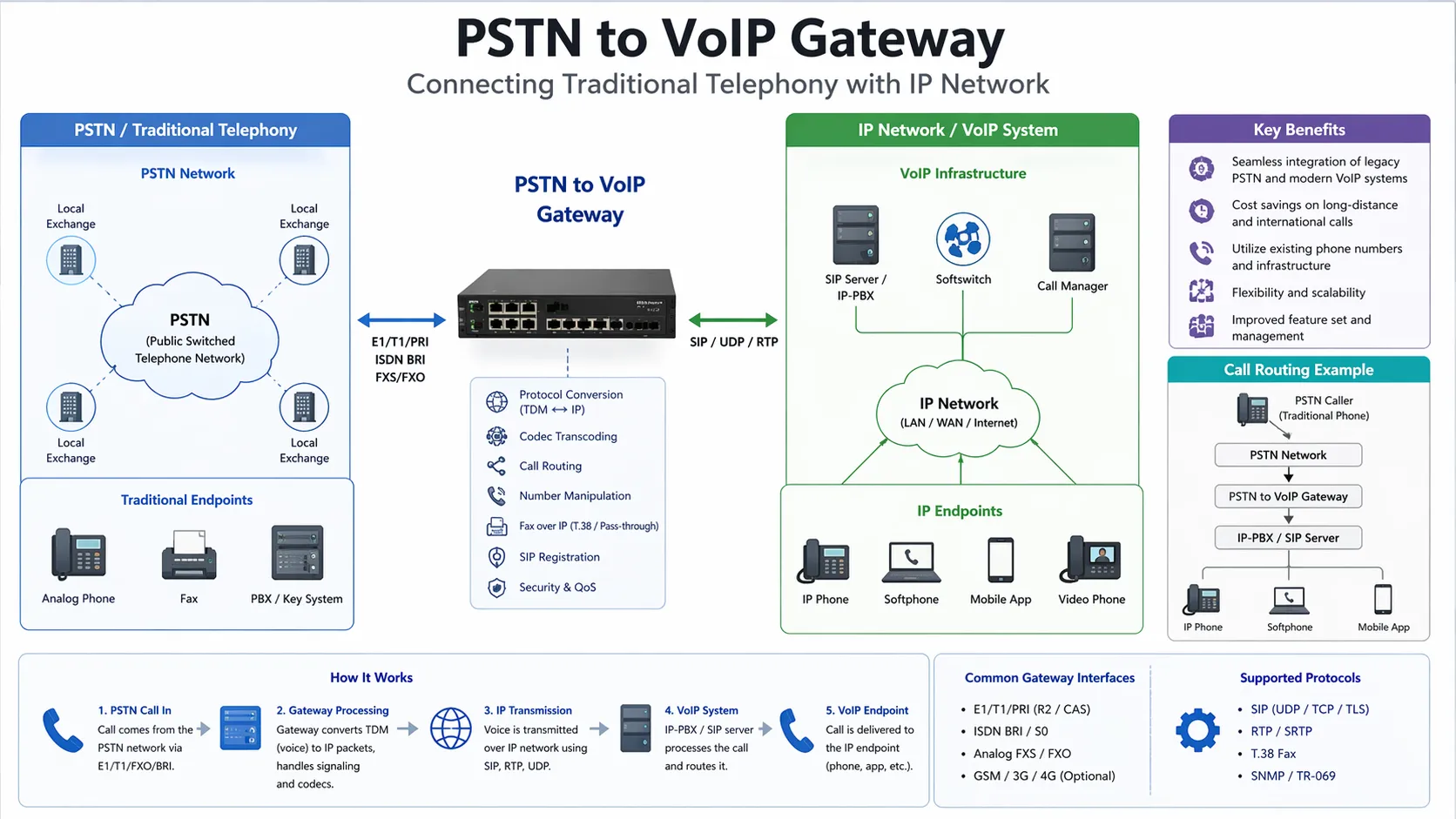
Modern business communication often combines PSTN access with IP-based systems. A gateway is used to translate between traditional telephony signaling and IP communication protocols. It can convert analog or TDM voice into IP packets and convert IP voice traffic back into a format that can reach the public telephone network.
This allows organizations to keep existing telephone numbers, support public-network calling, connect legacy PBX equipment, and gradually migrate toward SIP trunks or cloud telephony without replacing every endpoint at once.
Common Interfaces and Protocols
PSTN integration may involve interfaces such as FXO, FXS, BRI, PRI, E1, T1, or analog trunk ports, depending on the region and system type. Enterprise systems may use these interfaces to connect older telephone lines to modern IP PBX platforms or unified communication systems.
On the IP side, SIP is widely used for signaling, while RTP carries the voice media stream. In hybrid deployments, the gateway handles call routing, number manipulation, codec conversion, echo control, and sometimes fax pass-through or T.38 fax relay.
Hybrid Communication Architecture
A hybrid architecture allows PSTN, VoIP, SIP phones, softphones, dispatch consoles, contact centers, and legacy telephones to operate within one communication environment. This is useful for organizations that cannot complete an immediate full-IP migration because of budget, device compatibility, regulation, or operational continuity needs.
For industrial sites, public facilities, transport systems, and multi-branch enterprises, hybrid design can reduce risk during modernization. It allows old and new systems to coexist while critical voice services remain available.
Common Uses of PSTN
Traditional Landline Calling
PSTN is still used for fixed-line telephone service in homes, offices, public facilities, and business environments. In locations with limited broadband coverage or unstable internet connectivity, a traditional phone line may still provide a practical and reliable voice channel.
Landline numbers are also familiar to customers and public users. Many organizations continue to maintain fixed telephone numbers for credibility, customer service, reception desks, emergency contact, and regulated communication needs.
Backup Communication
Some enterprises, government agencies, healthcare facilities, utilities, and industrial organizations use PSTN as a backup path for voice communication. When IP networks fail because of routing problems, cyberattacks, power issues, broadband outages, or local network faults, PSTN can provide an independent fallback channel.
Backup communication planning is especially important for emergency response centers, production facilities, remote stations, transport operations, and sites where communication failure can affect safety or business continuity.
PBX and Enterprise Trunking
Traditional PBX systems often connect to the public network through PSTN trunks. These trunks allow internal extensions to make and receive external calls while the PBX manages extension dialing, call transfer, hunt groups, voicemail, and other internal features.
Even when enterprises adopt IP PBX systems, they may still use PSTN trunks during transition periods. Some organizations keep one or more PSTN lines as emergency backup or for special equipment that is not ready for SIP trunk migration.
Fax, Alarm, and Special Devices
Fax machines, alarm communicators, building management devices, and elevator emergency phones are among the most common legacy systems still associated with PSTN. These devices often require stable signaling and predictable line behavior.
When replacing PSTN service with VoIP, organizations should test these devices carefully. Voice calls may work well over IP, but fax, alarms, modems, and emergency systems may require specific gateway settings, dedicated service profiles, cellular backup, or certified replacement equipment.
Applications Across Industries
Enterprise Communication
Businesses use PSTN to support external voice communication with customers, partners, suppliers, and service providers. Public telephone numbers remain a basic part of business identity, especially for sales hotlines, support centers, branch offices, and reception desks.
In modern deployments, PSTN may coexist with IP PBX, SIP trunking, cloud calling, CRM systems, call recording, and contact center platforms. This coexistence helps organizations balance reliability, cost control, and functional flexibility.
Emergency and Public Services
PSTN has long been tied to emergency calling because it supports public numbering, fixed-location information, regulated service quality, and broad availability. Emergency numbers such as 911, 112, and local equivalents depend on reliable call routing and location-aware service design.
As emergency communication migrates to IP-based platforms, the same level of reliability must be preserved. Backup power, redundant networks, accurate location information, and carrier-grade routing become critical design requirements.
Industrial and Remote Environments
Remote areas, mines, tunnels, offshore platforms, railway corridors, utility facilities, and industrial zones may continue to use PSTN or PSTN-integrated systems where broadband access is limited or where legacy infrastructure remains operational.
In these environments, voice communication is often linked to safety, maintenance, dispatching, and operational coordination. A hybrid PSTN, VoIP, radio, and emergency communication design can help maintain connectivity across different technologies and site conditions.
Healthcare, Elevators, and Building Safety
Healthcare facilities, elderly care systems, elevator emergency phones, fire alarm panels, and security monitoring systems often require highly dependable communication paths. Historically, PSTN was widely used for these applications because it could remain available even when local power or data networks failed.
During PSTN migration, these systems should not be treated as ordinary office phones. They require risk assessment, compatibility verification, battery backup planning, and sometimes approval from local authorities, safety consultants, or monitoring service providers.
PSTN Compared with VoIP
Transmission Method
PSTN uses circuit switching, which reserves a dedicated path for the call. VoIP uses packet switching, where voice is converted into data packets and transmitted over IP networks. This difference affects network design, bandwidth efficiency, scalability, reliability planning, and troubleshooting methods.
VoIP is generally more flexible and feature-rich. It supports remote extensions, softphones, video calling, unified communications, call analytics, and easier multi-site deployment. PSTN is simpler and traditionally more predictable for basic voice communication, but it lacks the flexibility of modern IP systems.
Cost and Scalability
PSTN can become costly when organizations need many lines, long-distance calling, or multi-site connectivity. Each line or trunk may involve carrier charges, physical infrastructure, and maintenance requirements.
VoIP and SIP trunking can reduce communication costs and improve scalability by using existing IP networks. However, VoIP depends on network quality, power supply, security controls, and proper configuration. A poorly designed IP voice system can experience jitter, latency, packet loss, or registration failures.
Reliability Considerations
PSTN reliability is based on dedicated switching infrastructure and carrier-managed service design. VoIP reliability depends on broadband availability, LAN/WAN performance, router configuration, QoS, firewall traversal, SIP security, and endpoint power.
For critical environments, the best solution is often not a simple choice between PSTN and VoIP. A resilient architecture may combine SIP trunks, PSTN backup, cellular failover, redundant IP links, local survivability, and emergency power.
PSTN and VoIP should not be viewed only as old versus new. In many real projects, they are two parts of a migration path: PSTN provides legacy reach and backup value, while VoIP provides flexibility, integration, and long-term scalability.
The Future of PSTN
PSTN Switch-Off and All-IP Migration
Many telecom operators are reducing or retiring legacy PSTN infrastructure because maintaining separate copper, circuit-switched, and IP networks is expensive. All-IP migration allows operators to deliver voice, data, video, and cloud services over a more unified network foundation.
For users, this does not mean voice calling disappears. Instead, voice service is increasingly delivered through VoIP, SIP, fiber broadband, mobile networks, VoLTE, VoNR, and managed communication platforms. The user may still dial a normal telephone number, but the underlying transport is different.
Migration Challenges
The most important challenge is not replacing ordinary voice calls; it is identifying dependent services. Alarm panels, fax machines, lift phones, payment terminals, remote monitoring devices, and industrial control communication links may fail if they are moved to IP voice without proper testing.
Organizations should create an inventory of all telephone-line-dependent devices before PSTN retirement. Each device should be checked for function, compliance, backup power, monitoring requirements, and replacement options.
Modern Alternatives
VoIP, SIP trunking, cloud PBX, unified communications, VoLTE, and 5G voice services are the main alternatives to legacy PSTN. For fixed locations, fiber-based IP voice and SIP trunks are common. For remote or mobile sites, cellular voice, LTE routers, and private wireless networks may be more practical.
For industrial and mission-critical environments, gateways remain important during migration. They help bridge analog phones, public network access, IP PBX platforms, SIP endpoints, paging systems, dispatch centers, and emergency communication terminals.
Deployment and Migration Considerations
Audit Existing Telephone-Line Devices
Before replacing PSTN service, organizations should identify every device connected to a telephone line. This includes office phones, PBX trunks, fax machines, elevator phones, fire alarm communicators, security systems, POS terminals, remote telemetry devices, and emergency call stations.
The audit should record the device type, line number, location, service provider, business owner, operating status, and risk level. This prevents hidden legacy devices from being disconnected during migration.
Test Gateway Compatibility
When gateways are used to connect PSTN or analog equipment with IP networks, testing is essential. Voice calls, DTMF tones, fax transmission, alarm signaling, caller ID, emergency dialing, and failover behavior should all be verified before the old service is removed.
For enterprise and industrial projects, gateway selection should consider interface type, SIP compatibility, codec support, echo cancellation, power protection, management tools, security features, and long-term maintenance requirements.
Plan Backup Power and Network Resilience
A traditional PSTN line may keep a corded phone alive during local power failure, but IP voice depends on powered devices such as ONTs, routers, switches, gateways, phones, and Wi-Fi access points. Without backup power, an IP phone system may fail during an outage.
Migration planning should include UPS systems, redundant links, cellular backup, local survivability, QoS configuration, network monitoring, and emergency call testing. For safety-related systems, this planning is not optional; it is part of responsible communication design.
Where Becke Telcom Fits in Hybrid Communication Projects
For industrial communication, emergency calling, public address, SIP telephony, and dispatch environments, PSTN migration is often part of a larger communication upgrade. Sites may need to connect legacy telephone lines, SIP phones, industrial telephones, gateways, paging speakers, dispatch consoles, CCTV linkage, and alarm systems into one coordinated architecture.
In this type of migration, a VoIP gateway is often the key bridge between traditional PSTN lines, analog devices, PBX trunks, SIP servers, IP PBX platforms, and modern IP endpoints. It helps organizations keep existing telephone assets while gradually moving toward SIP-based voice, centralized routing, remote management, and unified communication.
Related Product: Becke Telcom VoIP Gateway
Becke Telcom’s VoIP Gateway is designed for stable voice access, intelligent call routing, codec adaptation, PSTN and SIP network interconnection, and centralized network management. It can support hybrid projects where analog phones, fax devices, PBX lines, SIP platforms, dispatch consoles, and industrial terminals need to join the same IP voice network.
For industrial sites, multi-branch enterprises, emergency communication projects, and control room systems, this gateway-based approach can reduce migration risk, protect existing investment, and keep essential voice services available during the transition from PSTN to VoIP.
FAQ
Is PSTN still used today?
Yes. PSTN is still used in many regions and industries, especially for landline service, backup communication, emergency phones, alarm systems, fax machines, PBX trunks, and remote locations where broadband or IP-based service is limited.
What is the main difference between PSTN and VoIP?
PSTN uses circuit switching and reserves a dedicated path for each call. VoIP uses packet switching and transmits voice as digital packets over IP networks. PSTN is traditionally known for predictable basic voice reliability, while VoIP offers greater flexibility, lower scalability cost, and richer communication features.
Can PSTN work with SIP and IP PBX systems?
Yes. PSTN can connect with SIP and IP PBX systems through gateways, adapters, PRI/BRI interfaces, FXO/FXS ports, or SIP trunking services. These devices and services allow organizations to build hybrid systems that combine legacy public-network access with modern IP communication.
Why are many operators shutting down PSTN?
Operators are retiring PSTN because legacy copper and circuit-switched networks are expensive to maintain compared with modern fiber and IP-based infrastructure. All-IP networks can carry voice, data, video, and cloud services more efficiently on a unified platform.
What should businesses check before replacing PSTN lines?
Businesses should check all telephone-line-dependent equipment, including PBX trunks, fax machines, alarm panels, elevator phones, POS terminals, emergency call stations, and remote monitoring systems. They should also test gateway compatibility, backup power, emergency dialing, and failover behavior before removing PSTN service.