


Railway emergency response is very different from ordinary field communication. Trains operate across tunnels, mountains, bridges, valleys, remote sections, and areas where public mobile networks may be weak or completely unavailable. When an accident happens, the first challenge is often not only rescue access, but communication access.
In a tunnel with no mobile signal, a mountain section with blocked roads, or a landslide area where people cannot safely enter, smartphones and normal network services may fail. At that moment, rescue command depends on a field-ready communication system that can be deployed quickly, transmit voice reliably, and send live video back to the command center.
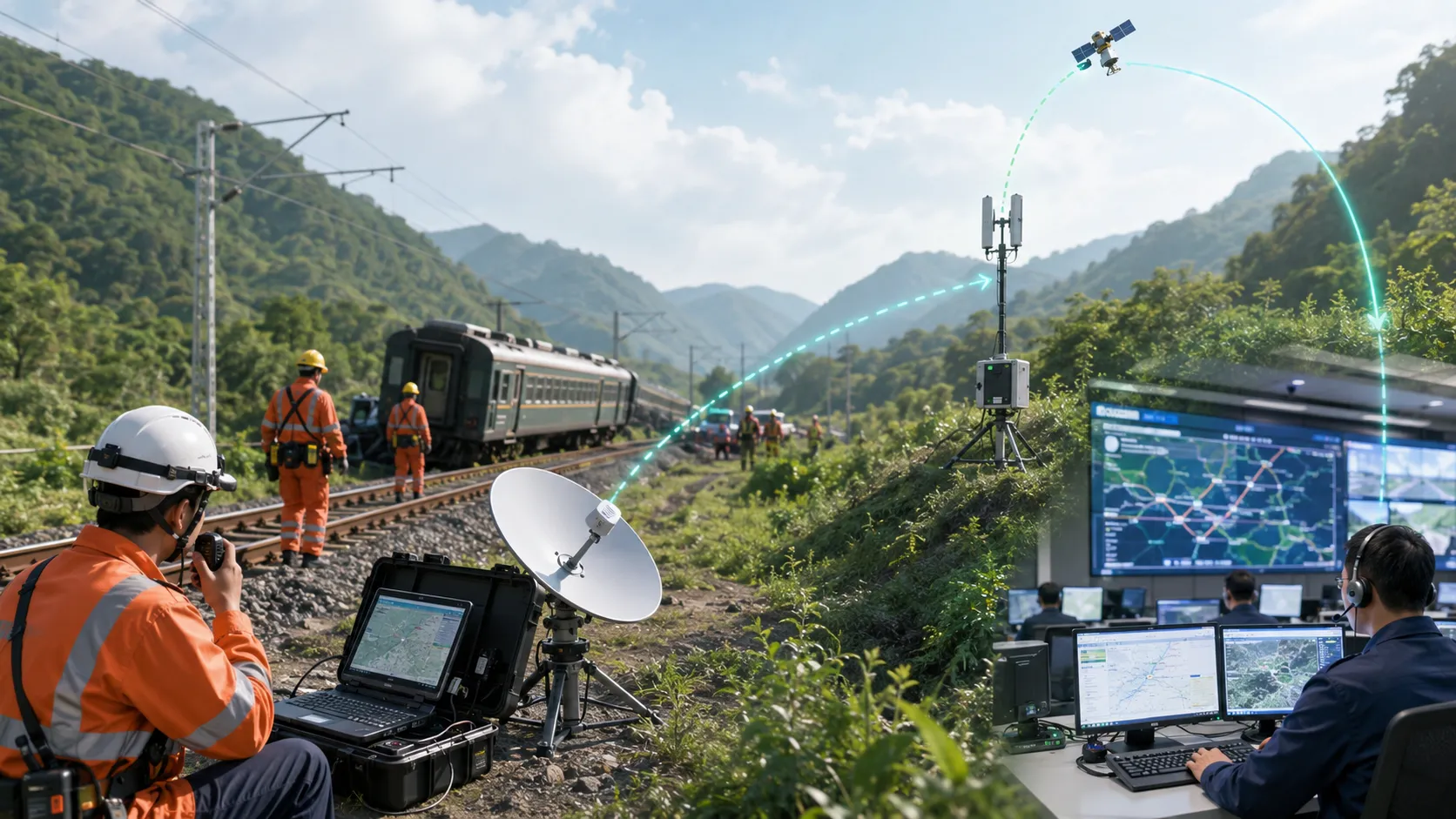
A practical railway emergency communication solution should combine satellite equipment, wireless relay, portable video, two-way radio voice, drones, and dispatch coordination. The goal is not to build a complicated system on paper, but to create a working rescue link within minutes when normal communication infrastructure is unavailable.
Why Railway Emergency Communication Is Difficult
Railway routes often pass through complex environments. A normal city communication plan cannot fully cover railway rescue needs because the risk points are usually located exactly where public networks are weakest: long tunnels, deep mountain valleys, remote bridges, collapsed road sections, and areas affected by extreme weather.
In these scenarios, communication must support more than a phone call. The command center needs to know who is on site, what has happened, whether the track is blocked, whether passengers or workers are trapped, and whether rescue teams can enter safely. Voice is the baseline, while video gives commanders the visual evidence needed for accurate decisions.
Tunnels Become Signal Black Holes
Long tunnels can stretch for several kilometers or even around 10 kilometers. Ordinary mobile signals often cannot penetrate deep into these enclosed structures. Once the rescue team enters the tunnel, external communication may be interrupted unless a relay system is deployed.
Mountain Areas Create Blind Zones
In mountain railway sections, high terrain, dense forests, poor road access, and limited base station coverage can turn a rescue site into a communication blind zone. Rescue vehicles may not be able to reach the scene quickly, and mobile phones may become unusable.
The Command Center Must See the Scene
Railway rescue is not only about hearing reports. Commanders often need live images from cameras, drones, or portable terminals. Video helps confirm the accident type, track condition, structural damage, rescue route, and worker safety.
Golden Time Cannot Be Wasted
In emergency response, equipment that takes too long to deploy is difficult to use in real rescue work. A practical system should be portable, fast to power on, and able to establish a temporary communication link within minutes.
Core Design Principle: Satellite as Backup, Relay as Extension, Drone as the First Eye
A reliable railway emergency communication architecture should not rely on one single network. Public mobile networks are useful during normal operation, but they cannot be the only communication path in extreme situations. Satellite communication, wireless relay, and drone-based reconnaissance provide the backup layers needed when normal infrastructure fails.
The simplest design logic is this: satellite equipment provides the outside link, wireless relay extends coverage into blind areas, and drones provide aerial visual information before people enter dangerous zones. Two-way radio or PTT voice remains the basic communication layer for ground teams.
In railway rescue, video helps commanders understand the situation, but voice must always be protected as the minimum communication guarantee.
Recommended System Architecture
A practical railway emergency communication system can be divided into four layers: field access, relay extension, satellite or IP backhaul, and command-center coordination. Each layer has a clear function and should be prepared before an incident occurs.
Field Access Layer
The field access layer includes handheld radios, portable cameras, mobile terminals, emergency phones, body-worn devices, and drone video equipment. These devices are used by rescue workers, patrol teams, maintenance personnel, and on-site commanders.
Wireless Relay Layer
The wireless relay layer extends communication into tunnels, valleys, blocked sections, and other dead zones. Relay nodes can be placed at tunnel entrances, intermediate points, rescue vehicles, temporary tripods, or safe high-ground positions.
Satellite Backhaul Layer
Satellite terminals create an external communication path when terrestrial networks are unavailable. In a remote railway section, the satellite terminal can act as a temporary signal tower, sending voice, data, and video traffic back to the command center.
Command and Dispatch Layer
The command layer receives field voice, video, alarm information, and location updates. Dispatch operators can coordinate rescue teams, track field communication status, manage emergency calls, and connect with railway operation departments, fire rescue units, medical teams, and maintenance crews.
Scenario 1: Tunnel Rescue Without Mobile Signal
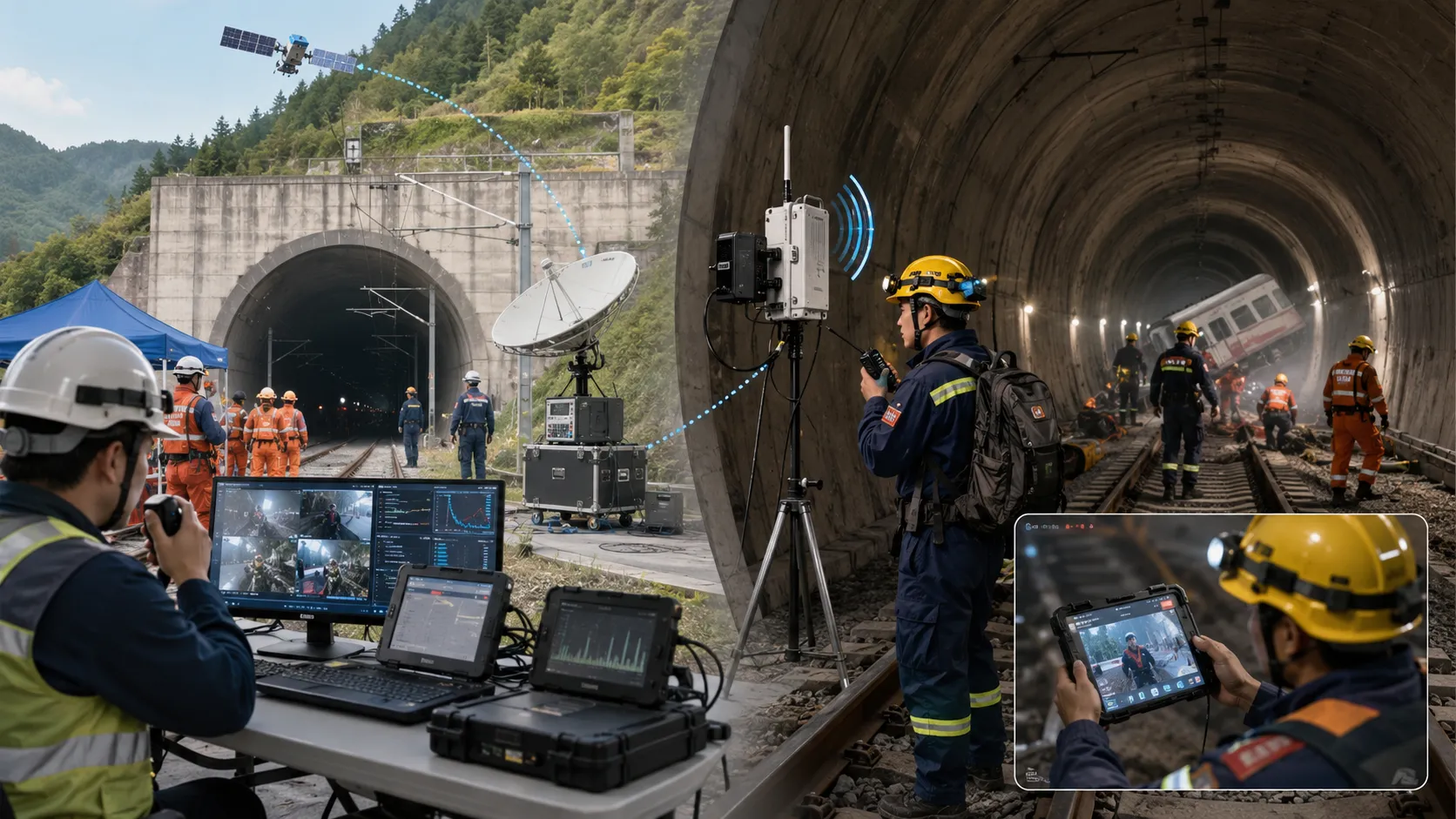
Tunnel rescue is one of the most demanding railway emergency scenarios. A long tunnel can block public mobile signals, weaken wireless transmission, and make it difficult for command staff outside the tunnel to understand what is happening inside.
The recommended method is to place portable satellite equipment near the tunnel entrance and use wireless relay nodes to push the signal into the tunnel. In practical deployment, the relay chain can support communication deep inside a tunnel, including sections in the 3.5–10 km range, depending on terrain, tunnel structure, equipment placement, antenna configuration, and power conditions.
Field cameras, handheld devices, and rescue team radios can connect to the temporary wireless network. Live video can be transmitted back to the command center, while voice communication remains available for rescue coordination. Even if the video link becomes unstable, the system should prioritize voice communication to keep the rescue team connected.
Scenario 2: Mountain Railway Rescue in a Signal Blind Zone
Mountain railway sections are often affected by terrain blocking, weak mobile coverage, difficult vehicle access, and unstable power conditions. When a railway incident happens in this environment, the rescue team may arrive before any reliable communication network is available.
In this scenario, a satellite terminal can be powered on within minutes to create a temporary communication point. Wireless relay equipment can then extend coverage toward the rescue location. Portable cameras can send real-time images to the command center, helping operators identify the accident position, rescue path, and surrounding risks.
This architecture is especially useful when road access is blocked or when the nearest public network signal is too weak. The field team does not need to wait for fixed infrastructure repair before reporting the situation.
Scenario 3: Landslide, Bridge Damage, or Dangerous Zone Reconnaissance
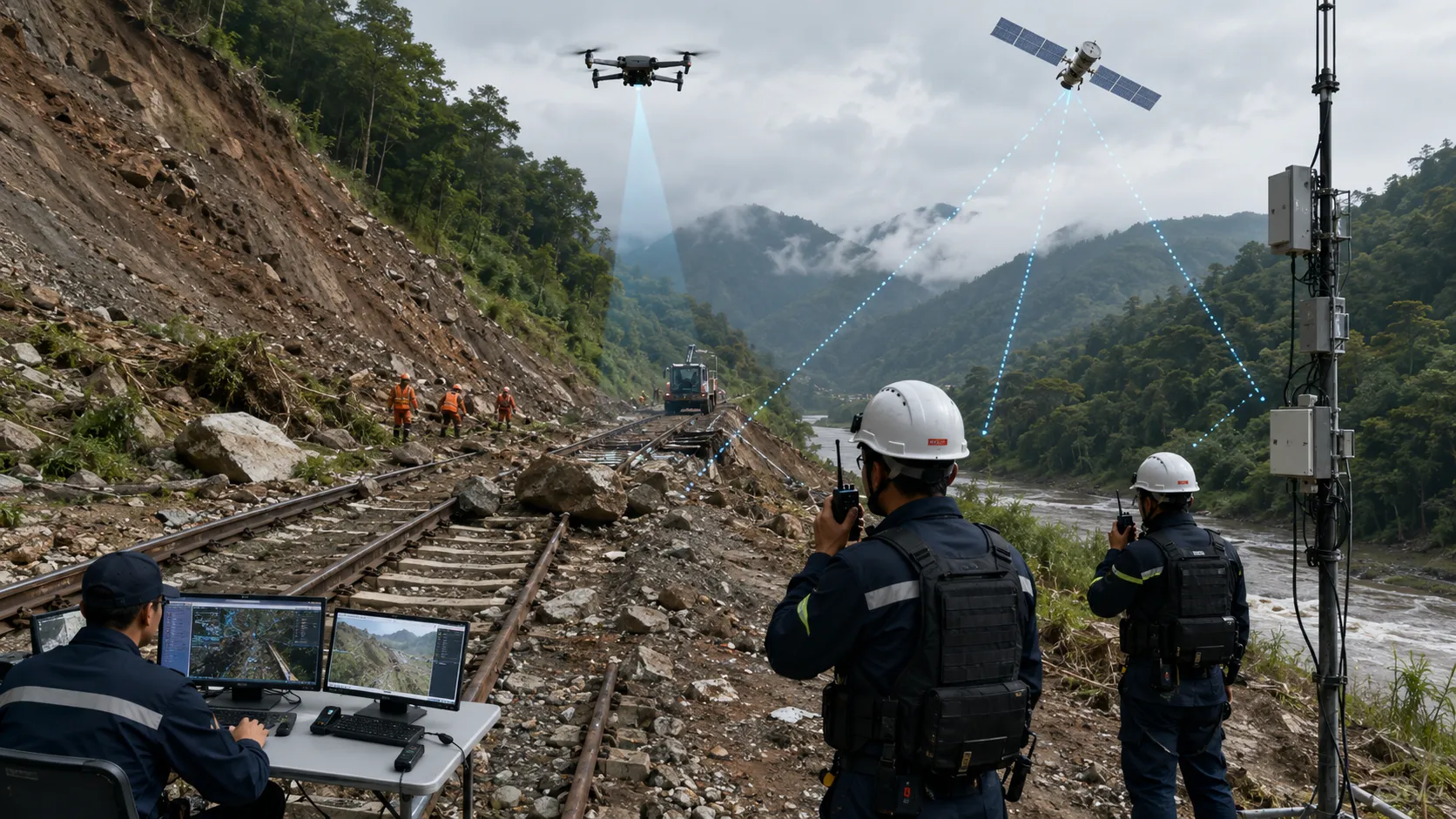
In some railway emergencies, people should not enter the area immediately. Bridge collapse, tunnel entrance damage, falling rocks, landslides, unstable slopes, and flood-affected sections may create secondary risks for rescue workers.
Drones can act as the first visual reconnaissance tool. They can fly over dangerous areas, capture video, inspect track conditions, and send images back through satellite and wireless communication equipment. This allows the command center to assess the site before sending people into the risk zone.
Ground personnel should remain connected through two-way radios or PTT terminals during the whole operation. Voice communication must stay available so that drone operators, rescue workers, and command staff can coordinate movement, warnings, and safety decisions.
Technical Requirements for a Field-Ready Railway Communication System
A railway emergency communication system should be evaluated by real field requirements rather than by product names alone. The system must be portable, fast to deploy, stable under poor conditions, and able to support both voice and visual information.
Fast Deployment
Equipment should be ready for use within minutes. Rescue teams should be able to power on satellite terminals, deploy relay nodes, connect field cameras, and start voice communication without complex configuration.
Voice Priority
Video is valuable, but voice is the communication baseline. The system should ensure that PTT voice, two-way radio calls, or emergency voice channels remain available when bandwidth becomes limited.
Multi-Hop Relay
Railway rescue scenes may require signal extension through multiple relay points. This is especially important in long tunnels, curved structures, valleys, blocked roads, and complex terrain.
Video Backhaul
Field video from cameras or drones should be transmitted to the command center whenever bandwidth allows. Real-time visual information improves decision-making and reduces uncertainty during rescue operations.
Independent Backup Link
Satellite communication provides an independent backhaul path when public mobile networks are unavailable. This is the key difference between an ordinary communication plan and a true emergency communication plan.
Where Becke Telcom Fits into the Architecture
For railway and industrial emergency projects, Becke Telcom can be considered as part of the communication endpoint and system integration layer. Its industrial telephones, SIP intercoms, dispatch communication products, public address terminals, and gateway solutions can connect fixed locations, control rooms, field teams, and emergency response points.
In a railway emergency architecture, Becke Telcom products may work together with satellite terminals, wireless relay equipment, two-way radios, CCTV systems, and dispatch software. The brand role should remain practical: helping build a reliable voice, paging, intercom, and emergency communication path where field operations require stable coordination.
Suggested Deployment Workflow
Before an Emergency
Railway operators should identify high-risk sections, including long tunnels, mountain blind zones, bridges, landslide-prone areas, and remote maintenance sections. Emergency communication kits should be prepared in advance and tested under real field conditions.
When an Incident Occurs
The field team should first establish voice contact, then deploy satellite backhaul, place relay nodes, start video collection, and connect the command center. If the area is unsafe, a drone should be sent before people enter.
During Rescue Coordination
The command center should monitor voice, video, device status, team position, and rescue progress. If video bandwidth drops, voice communication should remain the first priority.
After the Incident
Communication logs, video recordings, dispatch notes, and device performance should be reviewed. This helps improve future emergency plans, relay placement, training procedures, and equipment selection.
Application Scenarios Beyond Railways
Although this solution is built around railway emergencies, the same architecture can also support highway tunnels, power transmission lines, mining areas, petrochemical sites, forest fire response, emergency rescue, water conservancy projects, and remote industrial maintenance.
Any site that may face no signal, blocked roads, long-distance rescue, dangerous access, or real-time command requirements can benefit from a combination of satellite communication, wireless relay, drone reconnaissance, and field voice dispatch.
Conclusion
Railway emergency communication must be designed for the worst moment, not the best network condition. When mobile signals disappear in tunnels, mountains, collapsed sections, or extreme weather, rescue teams still need voice contact, video feedback, and command-center coordination.
The practical solution is a layered emergency communication architecture: satellite equipment as the backup external link, wireless relay as the coverage extension tool, drones as the first visual reconnaissance method, and two-way radio or PTT voice as the communication baseline. In tunnel rescue, relay systems may push signals into 3.5–10 km sections. In mountain rescue, satellite equipment can build a temporary communication point within minutes. In landslide or bridge damage scenarios, drones can send images before people enter.
For professional railway, emergency, power, transportation, and industrial users, the key is not whether one device is powerful enough. The key is whether the whole system can start quickly, stay connected, transmit critical information, and keep voice communication available when normal networks fail.
FAQ
Why do railway emergencies need satellite communication?
Satellite communication provides an independent backhaul path when public mobile networks are unavailable, damaged, congested, or blocked by tunnels and mountains.
How can communication reach deep inside a railway tunnel?
Portable satellite equipment can be deployed at the tunnel entrance, while wireless relay nodes extend the signal into the tunnel. Depending on site conditions, relay chains can support communication across 3.5–10 km tunnel sections.
Why are drones useful in railway rescue?
Drones can inspect landslides, bridge damage, blocked tracks, and dangerous areas before rescue workers enter. This reduces risk and gives the command center real-time visual information.
Should voice or video be prioritized in emergency communication?
Video is important for situational awareness, but voice should always be the baseline. If bandwidth is limited, the system should protect PTT or emergency voice communication first.
What role can Becke Telcom play in this type of solution?
Becke Telcom can provide industrial communication endpoints, SIP intercoms, dispatch integration, public address terminals, and gateway products that support voice, intercom, paging, and emergency communication in railway and industrial scenarios.







