


Outdoor operations place communication devices in environments that are far less predictable than offices, control rooms, or indoor service desks. Rain, dust, sunlight, wind, vibration, low temperature, high temperature, salt mist, equipment impact, background noise, unstable power, and long cable routes can all affect whether a device remains usable when people need it. For field workers, security staff, maintenance teams, drivers, operators, and emergency responders, the device must provide reliable communication even when the surrounding conditions are difficult.
Communication devices used outdoors are therefore designed with stronger physical protection, clearer audio, simpler operation, safer installation, and better environmental adaptability. They may include industrial waterproof telephones, outdoor intercom terminals, emergency call stations, paging points, rugged IP phones, gate communication devices, tunnel help points, public assistance panels, and field dispatch terminals. Their purpose is not only to connect calls, but to make communication reachable, recognizable, and dependable in real operating space.
Environmental resistance comes first
The first characteristic of outdoor communication devices is environmental resistance. A device installed outdoors must face rainwater, wind-blown dust, temperature changes, direct sunlight, condensation, and sometimes cleaning water or industrial particles. If the enclosure, cable entry, buttons, speaker grille, handset, display, and mounting structure are not designed for this exposure, the device may fail long before its internal electronics reach their expected service life.
Water resistance is especially important. Rain does not always fall vertically. Wind can push water toward seams, buttons, cable glands, microphone openings, speaker holes, and wall joints. Outdoor devices must be designed so that water cannot easily enter sensitive areas. This usually involves sealed enclosures, protected cable entry, suitable gaskets, drainage considerations, and materials that do not deform easily after repeated temperature changes.
Dust resistance is equally important in construction sites, mines, ports, warehouses, agricultural facilities, cement plants, road projects, factories, and transport yards. Dust can block microphones, reduce speaker clarity, enter buttons, damage connectors, and accumulate inside poorly sealed enclosures. Outdoor communication equipment should reduce dust entry and remain easy to clean or inspect.
The protection level should match the real environment rather than only look high in a product sheet. A device under a canopy may face different exposure from one installed on an open pole. A coastal site faces salt and moisture. A factory yard may face oil mist and dust. A tunnel entrance may face water spray, exhaust, and vibration. Environmental resistance must be judged by actual placement.
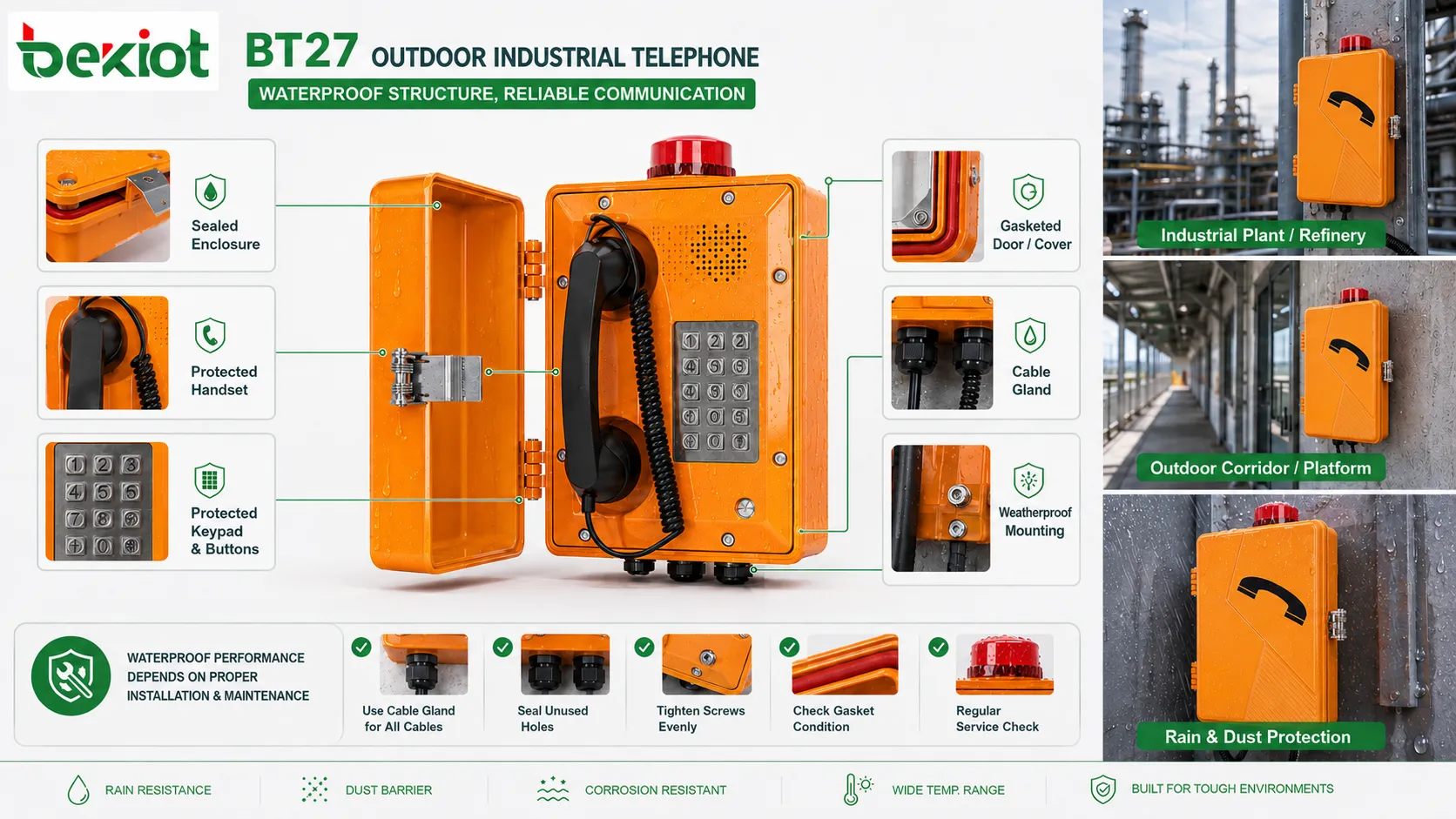
Waterproof structure and sealed access points
Outdoor communication devices usually require a waterproof structure because communication often needs to remain available during rain or wet conditions. The challenge is that communication devices cannot be fully sealed like a solid block. They need microphones, speakers, buttons, cable entry, sometimes handsets, screens, indicator lights, and maintenance access. Each opening must be protected carefully.
For an industrial waterproof telephone such as the Becke Telcom BT27, the practical value lies in providing a fixed voice communication point that can be installed in outdoor or semi-outdoor work areas where ordinary office phones are not suitable. In this type of deployment, the waterproof design, stable housing, clear operation interface, and rugged installation method are more important than decorative appearance.
Waterproof design must include the whole installation. Even if the front housing is protected, water may enter through the rear cable route, conduit connection, wall opening, or improperly tightened gland. Installers should use suitable cable glands, seal unused holes, avoid upward-facing cable entry where possible, and ensure that the mounting surface does not guide water into the device.
Maintenance can also affect waterproof performance. If a cover is opened, a gasket is damaged, or screws are not tightened evenly, the original protection may be reduced. Outdoor devices should be inspected after service work to confirm that sealing has been restored. Waterproof design is not only a factory feature; it depends on correct installation and maintenance.
Rugged housing and impact protection
Outdoor operation sites often involve physical contact. People may carry tools, move carts, operate vehicles, load materials, maintain equipment, or pass through narrow service routes. A communication device may be hit accidentally by a toolbox, ladder, cleaning equipment, forklift mirror, construction material, or public misuse. A rugged housing reduces the risk of damage from these everyday impacts.
Rugged design usually includes stronger enclosure material, reinforced mounting points, protected buttons, robust handset support, metal or high-strength front panels, tamper-resistant screws, and cable protection. If the device is installed in a public or semi-public area, anti-vandal design may also be necessary. A device that works electrically but breaks mechanically is still unreliable.
Impact protection should be matched to the location. A telephone inside a sheltered maintenance room may need less impact resistance than a roadside emergency phone, port terminal, parking gate device, station help point, or warehouse dock communication terminal. The expected user behavior and nearby movement should be considered before selecting the device.
Mounting strength is part of impact protection. A strong device can still fail if fixed to a weak wall, thin panel, loose pole, or unsuitable bracket. Outdoor installations should consider wind load, vibration, pulling force, accidental impact, and long-term loosening. Screws, anchors, brackets, back boxes, and cable supports should be selected as part of the communication device installation, not treated as minor accessories.
Wide temperature adaptability
Outdoor communication equipment may operate under hot sunlight, cold nights, seasonal changes, and sudden temperature shifts. Temperature affects plastics, rubber seals, electronic components, batteries, screens, cable jackets, microphones, speakers, and adhesives. A device that works indoors may become unreliable if exposed to outdoor temperature cycles.
High temperature can accelerate component aging, soften materials, increase internal heat, reduce display readability, and shorten the life of certain electronic parts. If a device is installed inside a sealed outdoor enclosure or under direct sunlight, internal temperature may become higher than ambient air temperature. Thermal design should therefore consider enclosure color, ventilation, component derating, and installation position.
Low temperature can make some materials brittle, reduce battery performance, affect LCD displays, stiffen cables, and change button feel. In cold regions, users may also wear gloves, so buttons and handsets must remain easy to operate. A device that requires delicate finger operation may not be suitable for winter field use.
Condensation is another temperature-related issue. When day and night temperatures change, moisture may condense inside poorly designed enclosures. Even a waterproof device may suffer if moisture becomes trapped inside and cannot escape or be managed. Outdoor communication design should consider both water entry and internal moisture behavior.
Resistance to sunlight, corrosion, and aging
Outdoor devices are exposed to sunlight for long periods. Ultraviolet radiation can fade labels, weaken plastics, harden rubber, and reduce the life of some surface materials. Communication devices installed outdoors should use materials, coatings, and labels that can resist UV aging according to the expected service environment.
Corrosion is a major concern in coastal areas, chemical plants, wastewater facilities, marine terminals, fertilizer plants, tunnels, outdoor industrial yards, and humid environments. Metal parts, screws, connectors, cable glands, hinges, and handset hooks may corrode if material selection is poor. Corrosion can affect appearance, mechanical strength, electrical continuity, and sealing.
Salt mist and chemical exposure should be considered when selecting outdoor communication devices. A normal painted surface may not be enough for marine or chemical environments. Stainless steel, treated aluminum, corrosion-resistant coatings, sealed connectors, and suitable fasteners may be needed depending on site exposure.
Aging also affects labels and visibility. Outdoor devices must remain identifiable after years of use. If the call button label fades, the emergency mark becomes unclear, or the operating instruction disappears, users may hesitate during an incident. Durable marking is part of communication reliability.
Clear audio in noisy surroundings
Outdoor operation sites are often noisy. Vehicles, machines, wind, rain, cranes, pumps, fans, engines, construction tools, alarms, conveyors, and crowds can all interfere with voice communication. A communication device used outdoors must support audio clarity under real noise conditions, not only in a quiet test room.
Speaker output should be strong enough for the environment, but loudness alone is not enough. If the speaker distorts, reflects from hard surfaces, or is directed away from the listener, speech may still be unclear. The device should provide intelligible voice, suitable volume, and stable audio output.
Microphone design is equally important. Wind noise can make speech difficult to hear. Rain, dust, and dirt can block microphone openings. Hands-free terminals may struggle in very noisy outdoor areas. In some environments, a handset telephone provides better voice capture and listening privacy than open hands-free communication.
For outdoor industrial telephones such as BT27-style fixed communication points, the handset can be useful because it places the microphone close to the user’s mouth and the receiver close to the ear. This can improve communication clarity in noisy or semi-noisy locations compared with relying only on a distant speaker and microphone.
Audio testing should be done at the installation site. A device that sounds clear during indoor commissioning may perform differently beside a generator, gate barrier, loading dock, tunnel fan, or busy road. Field testing should include normal operating noise, not only quiet conditions.
Simple operation under work pressure
Outdoor communication devices are often used under pressure. A worker may need to report equipment failure, a driver may need gate assistance, a guard may need to contact the control room, a maintenance technician may need instructions, or a person may need emergency help. The device should be simple to use in these moments.
Simple operation usually means clear call buttons, easy-to-grip handsets, visible labels, large keys, understandable indicators, and minimal steps. Users should not need to search through complex menus or remember long numbers. In some applications, one-button calling or hotline dialing is more suitable than keypad dialing.
Glove operation should be considered. Construction workers, utility technicians, cold-weather staff, and industrial operators may wear gloves. Small touch areas, narrow keys, or delicate controls may be inconvenient. Mechanical buttons or large call keys may be more practical in outdoor work conditions.
Visibility matters too. The device should be easy to find. Outdoor environments may include low light, rain, fog, dust, or visual clutter. High-contrast labels, indicator lamps, protective covers, reflective marks, or clear mounting positions can help users locate the device quickly.
Operation should be predictable. If pressing the button calls the control room, that action should work the same every time. If lifting the handset starts a call, users should not need additional steps. Predictability reduces hesitation and improves response efficiency.
Reliable power and backup planning
Outdoor communication devices need reliable power. Some may use PoE, local DC power, AC adapters, solar-supported systems, battery backup, or dedicated emergency power circuits. The power design should match the importance of the communication point and the difficulty of maintenance.
Power problems are common in outdoor installations. Long cable runs may cause voltage drop. Outdoor conduits may be damaged. Power supplies may be exposed to heat or moisture. Lightning and switching surges may affect circuits. A device may appear unreliable when the real cause is poor power quality.
For critical communication points, backup power should be considered. Emergency phones, tunnel help points, gate communication terminals, security intercoms, and remote site phones may need to remain available during power interruption. Backup can be provided through UPS, protected circuits, centralized power systems, batteries, or redundant power design depending on the project.
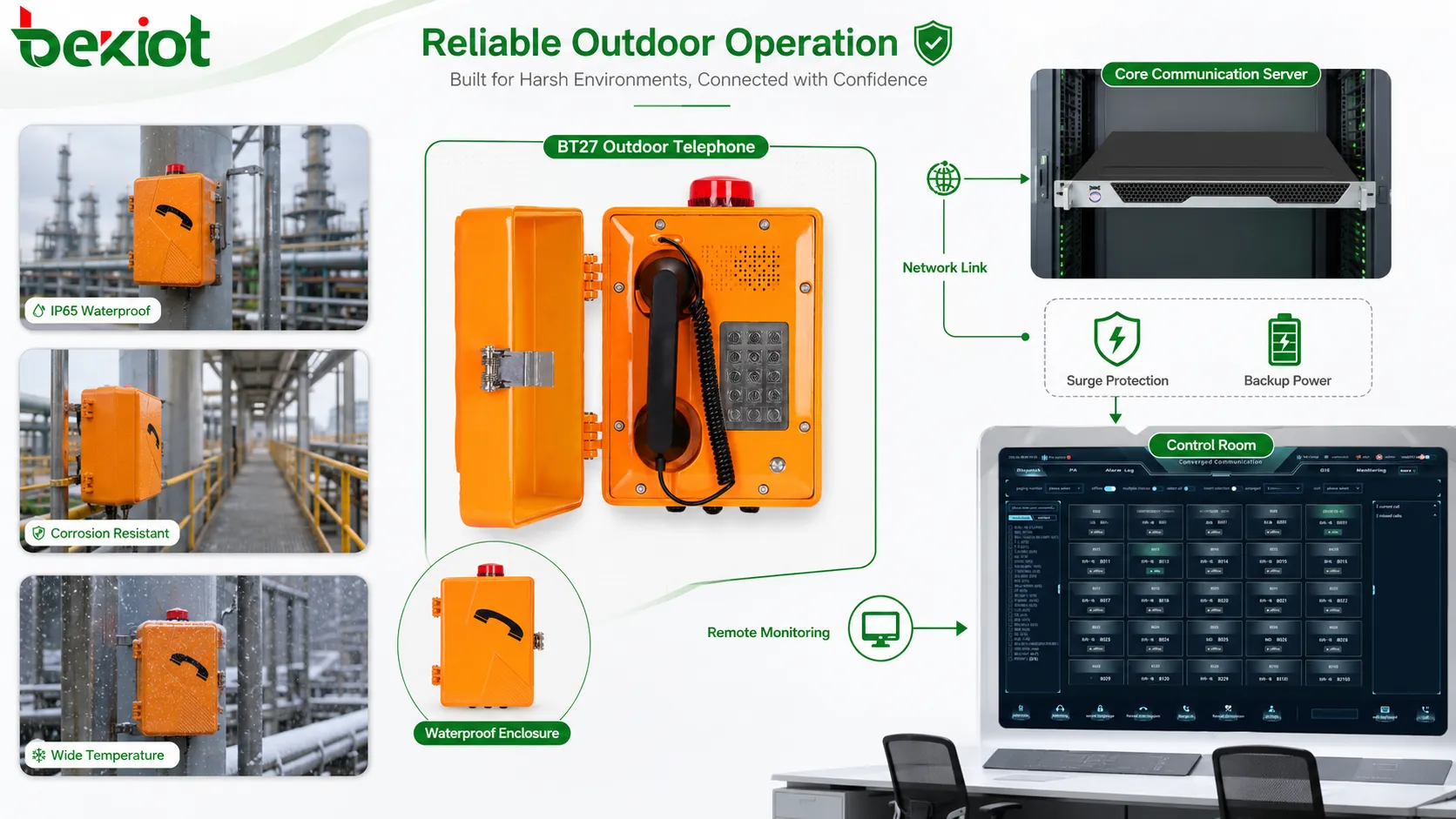
Power protection should include surge protection and grounding where needed. Outdoor cables can act as paths for electrical surges caused by lightning, switching events, or grounding differences. Proper grounding, shielding, surge arresters, and cable routing can improve system reliability.
Power status should also be monitored where possible. If a remote outdoor communication device loses power, maintenance staff should know before someone tries to use it during an incident. Monitoring turns hidden failure into a manageable alarm.
Stable communication path and network adaptability
Outdoor communication devices may connect through analog lines, VoIP networks, fiber, copper Ethernet, wireless links, radio gateways, cellular networks, or private communication systems. The connection method should match distance, environment, bandwidth, reliability, and maintenance capability.
For IP-based outdoor communication devices, network quality affects call stability. Packet loss, delay, jitter, unstable switches, poor cable termination, water-damaged connectors, weak wireless signal, or firewall configuration can all cause call failure or poor audio. A rugged device still needs a stable communication path.
Long outdoor cable runs require protection. Ethernet cables may need outdoor-rated jackets, proper grounding, surge protection, and waterproof connectors. Analog lines may need lightning protection and careful termination. Fiber may be useful for long distances or electrically noisy environments, but it requires proper installation and protection.
Wireless connections can be useful where cabling is difficult, but they should be evaluated carefully. Signal strength, coverage, interference, power availability, weather, antenna position, and network congestion may affect reliability. For emergency or critical communication, wireless-only design should be tested under worst-case conditions.
Network adaptability also includes protocol compatibility. A device may need to register to a PBX, dispatch platform, intercom server, SIP system, or communication management platform. The project should verify registration, call routing, codec support, NAT traversal, failover behavior, and remote management before deployment.
Secure installation and anti-tamper design
Outdoor communication devices may be installed in open or semi-public areas, which means they can be touched by many people. Some users are authorized workers, while others may be visitors, contractors, passengers, drivers, or members of the public. In certain environments, the device may face misuse, vandalism, or unauthorized access.
Anti-tamper design may include protected screws, strong enclosures, hidden cable routes, lockable covers, reinforced mounting, secure cable glands, and limited access to internal settings. The goal is to keep the device available for legitimate communication while reducing the chance of damage or manipulation.
Installation position affects security. A device placed too low may be kicked or hit. A device placed too high may be hard to use. A device mounted in an isolated blind spot may be more vulnerable to vandalism. The site should balance accessibility, visibility, safety, and protection.
For public emergency or assistance points, visibility may be more important than hiding the device. Users must be able to find it quickly. Security should come from rugged design, monitored location, camera coverage where appropriate, and controlled access to internal parts rather than hiding the equipment completely.
Configuration security should also be considered. If the device has a web interface, SIP account, remote management function, or network service, default passwords and open ports should be managed. Outdoor physical exposure should not lead to network exposure.
Clear indication and status feedback
Outdoor communication devices should provide clear status feedback. Users need to know whether the device is powered, calling, connected, busy, failed, or waiting for response. Without feedback, they may press buttons repeatedly, hang up too soon, or assume the system is broken.
Status feedback may include indicator lights, ring tones, call progress tones, display messages, voice prompts, flashing signals, or platform-side confirmation. In noisy outdoor environments, visual feedback may be especially useful. In bright sunlight, indicators should be visible enough. In night environments, the device may need backlighting or high-visibility markings.
For emergency call points, feedback is important because the user may be stressed. A simple indicator such as call initiated, call connected, or help requested can reassure the user. If the device supports hands-free calling, clear audio prompts may guide the user through the process.
Maintenance feedback is also valuable. The system may show device online status, registration status, power status, line fault, button fault, speaker test result, or network availability. This helps maintenance teams find problems before users need the device.
Status design should avoid confusion. Too many lights or unclear colors may reduce usability. The indicators should match the most important user questions: Is the device working? Has the call started? Has someone answered? Is help on the way?
Compatibility with dispatch and emergency systems
Outdoor communication devices are often part of a larger system. They may connect to a PBX, dispatch console, emergency communication platform, intercom server, public address system, security platform, access control system, CCTV system, or maintenance management platform. Compatibility determines how useful the device becomes beyond basic calling.
A fixed outdoor telephone may call a control room directly. An emergency help point may show its location on a dispatch console. A gate intercom may open a video window when a call arrives. A tunnel phone may trigger an event record. A maintenance terminal may route calls to duty staff according to time schedules. These functions depend on system integration.
Outdoor devices should support the communication protocol and call routing method required by the project. In IP systems, SIP compatibility is often important. In analog systems, line interface and signaling behavior matter. In hybrid systems, gateways may be required. Compatibility should be tested with the actual platform, not assumed from general claims.
Emergency integration should also consider priority. Calls from outdoor emergency points may need to override routine calls, ring multiple destinations, trigger recording, display location, or escalate if unanswered. The device is only one part of the emergency workflow; the system must handle the response path.
When a device such as the BT27 is used as an outdoor fixed voice terminal, its value is strongest when it is connected into a planned communication system with clear routing, monitoring, maintenance, and response procedures rather than installed as an isolated phone.
Maintainability in field conditions
Outdoor communication devices must be maintainable. Even strong equipment requires inspection, cleaning, testing, and occasional repair. Dust may collect, labels may fade, cables may loosen, gaskets may age, insects may enter external cavities, and users may damage buttons or handsets. Maintenance planning keeps the device reliable over time.
Good maintainability begins with accessible installation. Technicians should be able to inspect the device without unsafe climbing, road closure, equipment shutdown, or excessive disassembly unless the site requires it. If the device is installed in a difficult location, the maintenance cost increases.
Field-replaceable parts can reduce downtime. Handsets, cords, buttons, labels, gaskets, covers, and cable glands may be easier to replace than the whole device. The availability of spare parts and documentation affects long-term serviceability.
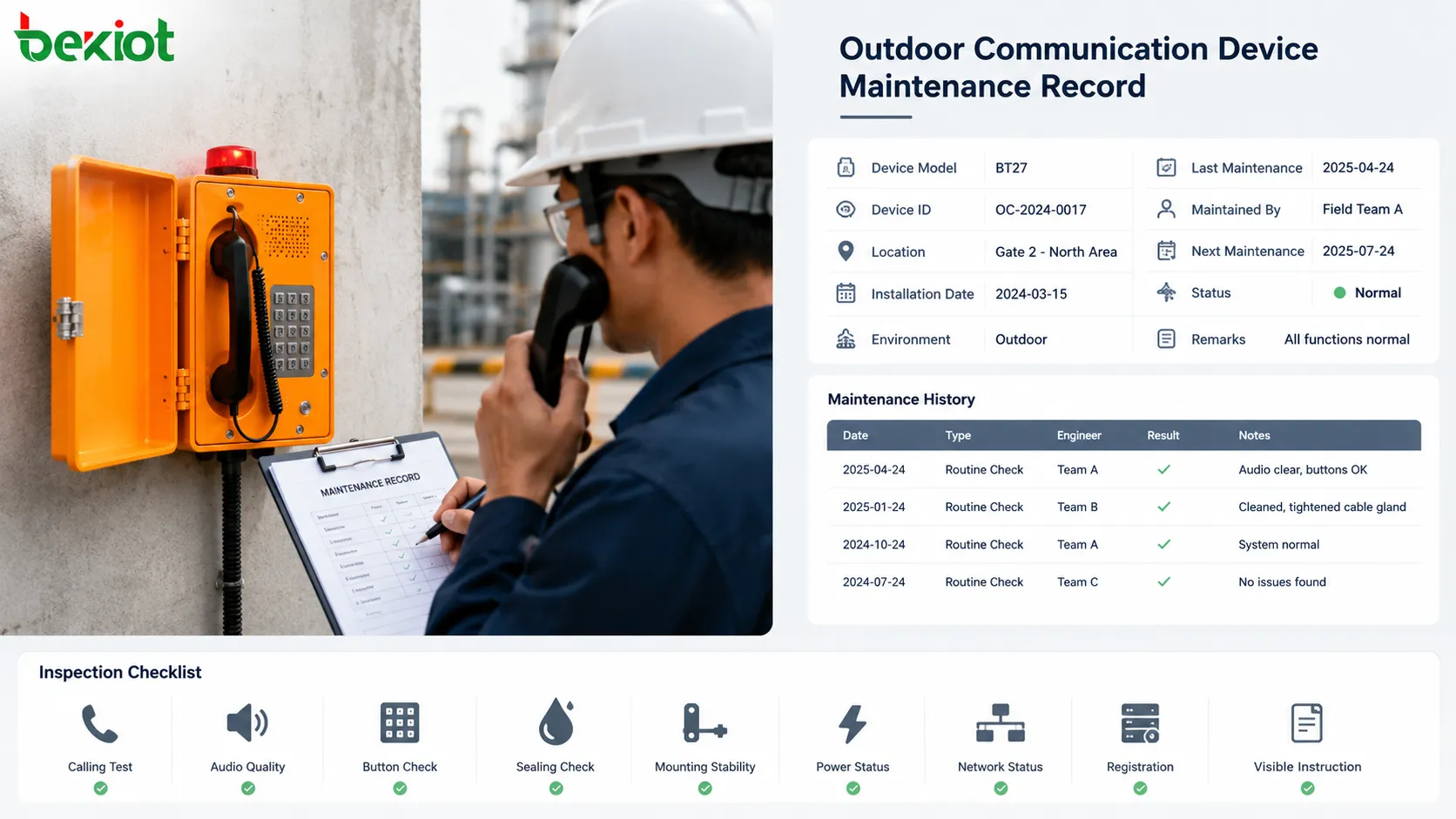
Routine testing should include calling, ringing, audio quality, button operation, handset condition, microphone and speaker clarity, cable sealing, mounting stability, power status, network status, and platform registration. Emergency devices should be tested according to site procedures.
Maintenance records are useful. If several devices fail in one area, the cause may be environmental, such as water exposure, surge, vandalism, or dust. Records help improve future placement, protection, and selection.
Application in industrial plants and production yards
Industrial plants and production yards use outdoor communication devices around workshops, loading areas, storage yards, utility stations, gates, tank areas, power rooms, and maintenance routes. Workers may need to contact control rooms, security desks, supervisors, or maintenance teams without returning indoors.
In these environments, the device should resist dust, water, vibration, impact, and noise. It should be placed where workers naturally pass or where communication is needed during abnormal conditions. A device installed only for convenience of wiring may not be useful during real operation.
Industrial outdoor communication often supports safety procedures. Before entering a restricted area, a worker may call the control room. During equipment fault handling, a technician may report status. At a loading dock, staff may coordinate with the warehouse. At a gate, security staff may communicate with visitors or drivers.
The device should fit the workflow. Some areas need simple hotline calling. Some need keypad dialing. Some need intercom with auto-answer. Some need public address integration. Some need emergency call priority. Outdoor communication design should begin with the communication task, then select the device.
Application in transport and roadside facilities
Transport and roadside facilities use outdoor communication devices in tunnels, railway stations, metro areas, parking lots, bus terminals, toll stations, airport service zones, ports, bridges, and highways. These sites often require fixed help points because users may not know who to call or may not have reliable mobile signal.
Roadside and tunnel communication devices must be highly visible and reliable. A person in difficulty should be able to find the device quickly, understand how to use it, and reach the control center. Weather resistance, impact protection, clear audio, and location identification are essential.
Transport environments may also include high noise. Vehicles, trains, ventilation systems, crowd movement, and public announcements can interfere with voice. Device placement, handset design, speaker level, and platform routing should be tested in real conditions.
For stations and parking facilities, outdoor or semi-outdoor communication points support visitor assistance, gate help, payment machine support, emergency calls, and security coordination. The device should be easy for untrained users to operate.
Application in utilities and remote stations
Utilities and remote stations often include power substations, water treatment sites, pumping stations, pipelines, renewable energy farms, district heating facilities, and unmanned equipment rooms. Communication devices in these sites must remain reliable despite distance, weather, limited staff, and maintenance difficulty.
A fixed outdoor phone or intercom point allows field personnel to contact the control center before switching operations, entering restricted areas, reporting faults, or requesting support. In remote locations, personal mobile coverage may be weak, and dedicated communication points can improve operational reliability.
Power and network planning are especially important for remote sites. The communication device may need backup power, surge protection, fiber connection, cellular backup, or remote status monitoring. If the device fails, repair may require long travel time, so preventive maintenance and monitoring become valuable.
Environmental exposure may include heat, cold, dust, rain, insects, lightning, and corrosion. The device should be selected and installed according to the local risk profile. A remote outdoor communication point must be both physically strong and operationally visible to the central management system.
Application in construction, ports, and logistics areas
Construction sites, ports, and logistics yards are dynamic outdoor environments. Layouts change, vehicles move frequently, materials are loaded and unloaded, and noise levels can be high. Communication devices are used for gate control, crane coordination, loading dock support, safety reporting, visitor access, and emergency contact.
Devices in these areas need rugged structure and simple operation. Users may be drivers, contractors, temporary workers, operators, guards, or maintenance personnel. The interface should be understandable without training. Large buttons, clear labels, and direct calling are useful.
Installation protection is important because the device may be exposed to vehicle contact, dust, vibration, and weather. Mounting should avoid direct vehicle impact zones where possible. Protective posts, barriers, or recessed mounting may be considered in high-risk areas.
Ports and logistics yards may also face salt air, humidity, and outdoor power challenges. Corrosion-resistant materials, sealed cable entry, and regular inspection are important. Communication points should be included in the site’s safety and operation planning rather than treated as accessories.
Application in public safety and emergency assistance
Outdoor emergency assistance points are used in campuses, parks, parking areas, stations, tunnels, industrial roads, public squares, tourist areas, and large facilities. Their role is to give users a direct way to request help. The device must be visible, reliable, and easy to operate under stress.
Emergency devices should support clear routing. A call should reach the correct security desk, control room, emergency center, or duty team. The receiving operator should know the device location. If the system supports video, alarm linkage, or recording, the call can become part of a broader response workflow.
Outdoor emergency communication should remain available during bad weather and low visibility. The device may need lighting, reflective markings, large call buttons, loud ringback, or visual indicators. The user should understand that the call has been placed and that someone is responding.
Routine testing is critical. Emergency devices may not be used often, which means faults can remain hidden. Regular test calls, audio checks, sealing inspections, and platform status monitoring help ensure that the system works when needed.
Selection and deployment considerations
Choosing outdoor communication equipment should begin with the environment and the communication task. The project team should identify whether the device will face rain, dust, salt, chemical exposure, sunlight, impact, vibration, noise, public use, remote installation, unstable power, or emergency requirements. These conditions determine the necessary characteristics.
The second step is defining call behavior. Should the device call one control room, several duty numbers, a dispatch console, or a PBX extension? Should it support keypad dialing, speed dial, hotline dialing, auto-answer, intercom, recording, or emergency priority? Functional configuration should match the response workflow.
The third step is checking installation. Mounting height, user reach, visibility, cable route, protection from vehicle impact, drainage, sunlight exposure, maintenance access, and nearby noise should be reviewed. A strong device can perform poorly if installed in the wrong place.
The fourth step is verifying system integration. Calls should route correctly. Audio should be clear. Status should be monitored where possible. Emergency calls should be logged. Power and network backup should be tested if required. Deployment should include field testing rather than only bench testing.
Finally, the project should define maintenance responsibilities. Outdoor devices need periodic inspection. Someone should be responsible for testing, cleaning, checking seals, updating labels, reviewing logs, and replacing damaged parts. Reliability is maintained over time, not only purchased at the beginning.
Common mistakes to avoid
One common mistake is selecting an indoor device for outdoor use simply because it can make calls. Indoor devices may not resist water, sunlight, dust, impact, or temperature changes. They may work for a short time but fail under real exposure.
Another mistake is ignoring cable entry. Many outdoor failures happen because water enters through cables or conduits rather than the front panel. Cable sealing, route direction, grounding, and surge protection should be planned carefully.
Poor audio planning is also common. A device may be rugged and waterproof but still difficult to hear beside loud equipment or traffic. Audio performance should be tested at the site under normal noise conditions.
Some projects place devices where they are easy to install rather than where users need them. A communication point must be accessible during actual work or emergency conditions. Placement should follow user movement, risk points, and response procedures.
Another mistake is treating installation as final proof of reliability. Outdoor communication devices should be tested periodically. Weather, aging, vibration, corrosion, and human use can change performance over time.
How to judge whether the device is suitable
A suitable outdoor communication device should remain usable under the expected environmental conditions. It should resist water, dust, temperature change, sunlight, impact, and corrosion according to the site requirement. It should also maintain clear audio and stable connection during normal operation.
The device should be easy for the intended user to operate. Field workers, drivers, visitors, guards, maintenance staff, and emergency users may have different levels of training. The interface should be simple enough for the least experienced expected user.
It should also fit the system. A communication device is not useful if calls route to the wrong destination, if the control room cannot identify the location, if audio is unclear, or if faults are not detected. Suitability includes platform compatibility and response workflow.
Maintenance should be practical. If the device cannot be inspected safely, if spare parts are unavailable, or if seals are difficult to restore after service, long-term reliability will suffer. Outdoor suitability includes maintainability.
For projects that require fixed outdoor voice communication, an industrial waterproof telephone such as the BT27 can be used as one example of the type of device considered for exposed or semi-exposed operating environments. The final decision should still depend on site exposure, installation method, system compatibility, and maintenance planning.
Final Review
Communication devices used for outdoor operations must possess characteristics that go beyond ordinary voice connection. They need environmental resistance, waterproof structure, dust protection, rugged housing, impact resistance, wide temperature adaptability, corrosion resistance, clear audio, simple operation, reliable power, stable network connection, secure installation, status feedback, system compatibility, and maintainability.
Their applications cover industrial plants, production yards, transport facilities, tunnels, roadsides, utilities, remote stations, construction sites, ports, logistics areas, public safety points, and emergency assistance locations. In each scenario, the device must match the actual environment and the communication workflow.
The strongest outdoor communication design combines the right device, correct installation, protected power and cabling, clear audio planning, dispatch or PBX integration, routine testing, and maintenance responsibility. When these factors are handled together, outdoor communication equipment becomes a dependable field communication point rather than a vulnerable exposed accessory.
FAQ
Can ordinary office phones be used outdoors?
They are generally not suitable for outdoor operation unless protected by a proper enclosure and installation design. Outdoor devices need resistance to water, dust, temperature change, sunlight, impact, and cable exposure.
Why is waterproof design not enough by itself?
Waterproof housing is important, but outdoor reliability also depends on cable entry, mounting method, gasket condition, power protection, corrosion resistance, audio clarity, surge protection, and maintenance. A device can still fail if installation is poor.
What communication method is best for outdoor devices?
It depends on the site. Some projects use IP networks, some use analog lines, some use fiber, some use wireless links, and some use hybrid systems. The best method depends on distance, reliability, power, network availability, and emergency requirements.
Why is audio testing important outdoors?
Outdoor environments may include wind, traffic, machinery, rain, fans, or public noise. A device that sounds clear indoors may not be clear in the field. Testing should be done at the actual installation location under normal operating noise.
How often should outdoor communication devices be maintained?
The interval depends on site risk, weather exposure, safety importance, and usage frequency. Critical emergency points should be tested more regularly. Maintenance should include call testing, audio checks, sealing inspection, cable review, mounting inspection, and status monitoring.







