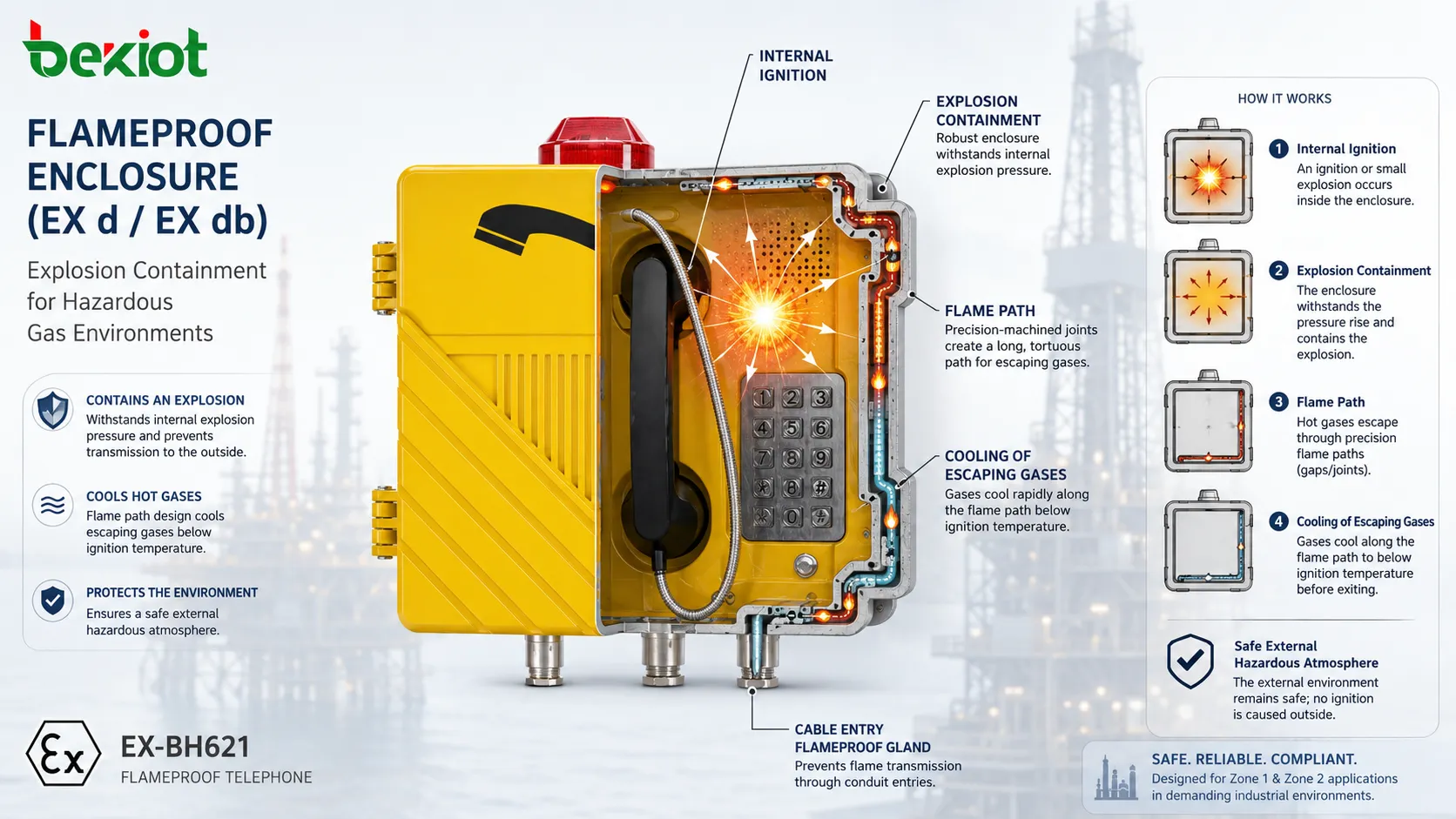
Flameproof enclosure, commonly marked as Ex d or Ex db in modern equipment nameplates, is a protection method used for electrical equipment installed in hazardous gas atmospheres. Instead of trying to remove every possible ignition source from the equipment, the enclosure is designed to withstand an internal explosion and prevent flames, hot gases, or ignition energy from escaping into the surrounding atmosphere.
This makes Ex d one of the most recognized protection concepts in oil and gas facilities, chemical plants, fuel storage areas, offshore platforms, mines, power plants, and other industrial sites where flammable gases or vapors may appear during normal operation. It is widely used for telephones, push buttons, motors, junction boxes, lighting, control stations, cameras, sensors, and field communication devices.
Why This Protection Concept Exists
Hazardous areas need more than ordinary electrical safety
In a normal industrial building, electrical equipment is mainly evaluated for shock protection, overheating, short circuit risk, mechanical strength, and environmental resistance. In a hazardous area, the main concern is different: a spark, arc, hot surface, relay contact, damaged cable entry, or internal fault may ignite a flammable mixture around the equipment.
Ex d protection addresses this risk by accepting that an ignition may occur inside the enclosure under defined fault conditions. The enclosure must then prevent that event from becoming an external explosion. This is why flameproof equipment is not simply a strong metal box. It is a certified assembly with tested joint dimensions, pressure resistance, cable entries, fasteners, surface temperature control, and marking rules.
It is different from weatherproof or dustproof housing
A common misunderstanding is to treat Ex d as a higher version of IP protection. IP66 or IP67 ratings describe resistance to dust and water ingress, while Ex d describes explosion protection for hazardous gas atmospheres. A product can be waterproof but not explosion-protected. A product can also be Ex d certified while still requiring a separate IP rating for outdoor rain, washdown, or dust exposure.
For real projects, both ratings often matter. Outdoor chemical plants, loading stations, tank farms, tunnels, and offshore decks may require explosion protection, corrosion resistance, ingress protection, UV stability, cable sealing, and long-term mechanical durability at the same time.
How an Ex D Enclosure Works
Containment of internal pressure
When a flammable gas mixture enters the enclosure and ignites inside, the enclosure must withstand the resulting pressure without rupture, permanent deformation that affects safety, or flame leakage through weak points. The design normally uses robust metal construction, certified cover joints, threaded entries, tight mechanical tolerances, and fasteners that maintain the integrity of the enclosure under test conditions.
This is why flameproof enclosures are often heavier than ordinary industrial housings. The weight is not only for impact resistance; it is part of the pressure containment and flame path design. Removing bolts, replacing covers, changing cable glands, or machining extra holes can destroy the certified protection concept.
Flame path cooling and controlled gas release
Ex d equipment is not always completely sealed. Instead, it uses flame paths: narrow, controlled gaps at threaded joints, flanged joints, spigot joints, shaft openings, or cover interfaces. If an internal explosion occurs, hot gases may pass through these paths, but the path length and gap dimensions are designed to cool the gases below the ignition capability of the surrounding atmosphere.
For this reason, the condition of flame paths is critical during installation and maintenance. Scratches, corrosion, paint buildup, missing grease, wrong fasteners, mechanical impact, or unauthorized machining can reduce the cooling effect and compromise safety. A visually strong enclosure may no longer be safe if its certified flame path has been damaged.
Standards and Certification Framework
IEC 60079 series and the role of IEC 60079-1
The IEC 60079 series is the central international framework for electrical equipment used in explosive atmospheres. IEC 60079-0 defines general requirements, while IEC 60079-1 covers equipment protection by flameproof enclosures “d”. In practical terms, IEC 60079-1 is where the construction, flame path, pressure test, temperature, entry, and verification principles for Ex d equipment are defined.
Modern equipment markings may show Ex db rather than only Ex d. The additional letter relates to the equipment protection level. Ex db is commonly associated with a high level of protection for gas atmospheres and is typically used in Zone 1 and Zone 2 applications, provided the rest of the marking, certificate, gas group, temperature class, and installation conditions are suitable.
ATEX and IECEx markings in global projects
ATEX is used for equipment placed on the market in the European Union, while IECEx is an international certification system based on IEC standards. Many global industrial projects ask suppliers to provide ATEX, IECEx, or both, especially when equipment will be installed in petrochemical, energy, marine, mining, or process industry environments.
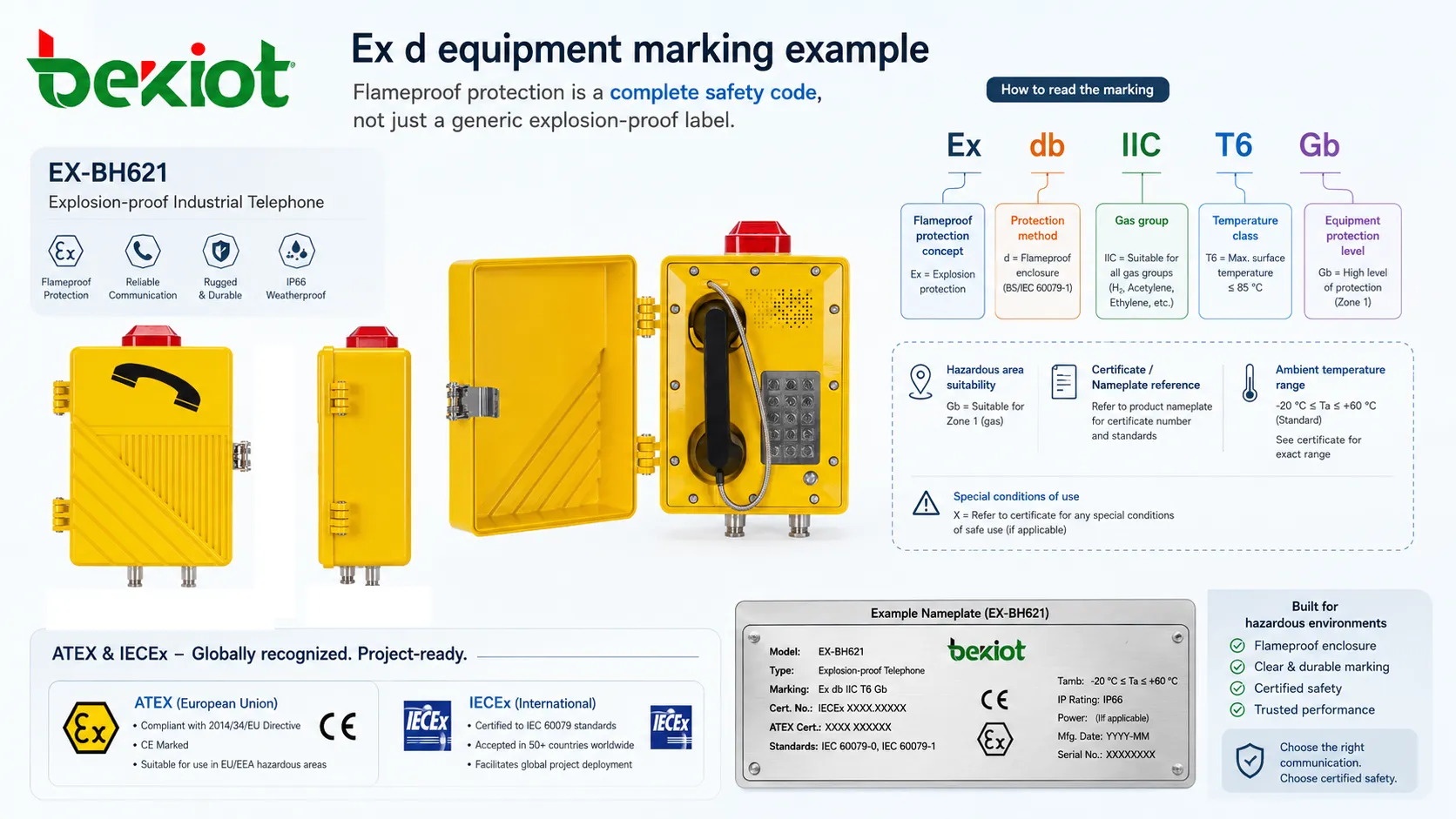
A typical marking may include the protection concept, gas group, temperature class, equipment protection level, equipment category, certificate number, ambient temperature range, and special conditions of use. Buyers should not judge compliance only by the words “explosion-proof” in a product brochure. The certificate and nameplate marking must match the area classification and the installation design.
Protection Ratings That Matter in Selection
Gas group and ignition risk
Gas groups indicate the type of explosive gas atmosphere for which the equipment is suitable. In surface industries, IIA, IIB, and IIC are common gas groups. IIC is generally considered the most demanding group and includes gases such as hydrogen and acetylene. IIB covers gases such as ethylene, while IIA covers less easily ignited gases such as propane.
The gas group must be selected according to the hazardous area classification report. Installing IIB equipment in an IIC atmosphere is not acceptable unless the certificate explicitly covers the required group. Conversely, specifying IIC everywhere may increase cost, weight, and lead time where the actual area classification only requires IIA or IIB.
Temperature class and surface temperature control
Temperature class defines the maximum permitted surface temperature of the equipment under specified conditions. Common gas temperature classes include T1, T2, T3, T4, T5, and T6. A lower maximum surface temperature gives a stricter rating. For example, T6 is more restrictive than T4.
This rating matters because a hot enclosure surface can ignite a surrounding gas mixture even if no flame escapes from inside. Ambient temperature, heat dissipation, solar exposure, internal electronics, power load, and installation position can all affect temperature performance. The certificate should be checked for the approved ambient temperature range and any installation limitations.
IP and mechanical ratings as supporting requirements
Although IP rating is not the same as explosion protection, it remains important for outdoor and harsh industrial applications. IP66, IP67, or similar ratings may be required where equipment faces rain, washdown, dust, salt mist, or heavy industrial contamination. IK impact ratings, corrosion protection, stainless steel hardware, and surface coating also influence long-term reliability.
For communication devices such as field telephones, emergency call boxes, and control stations, environmental resistance affects usability as much as safety. A certified device that suffers from water ingress, corroded keypad contacts, damaged handset cable, blocked speaker holes, or unreadable labels may still fail the operational purpose of the project.
| Rating or Marking Item | What It Means | Why It Matters |
|---|---|---|
| Ex d / Ex db | Flameproof enclosure protection concept | Indicates that internal ignition is contained and flame transmission is prevented by certified construction |
| IIA / IIB / IIC | Gas group suitability | Matches equipment to the flammable gas or vapor risk in the classified area |
| T1–T6 | Maximum surface temperature class | Prevents hot surfaces from becoming ignition sources |
| Gb / Gc | Equipment protection level for gas | Helps determine suitability for Zone 1 or Zone 2 use |
| IP rating | Dust and water ingress protection | Supports outdoor, washdown, dusty, or corrosive applications |
| Ambient range | Approved operating temperature limits | Ensures the certification remains valid in hot, cold, or outdoor environments |
Where Flameproof Equipment Is Commonly Used
Process industries and energy sites
Ex d equipment is commonly installed in refineries, gas compressor stations, LNG facilities, chemical plants, paint production areas, fuel terminals, solvent storage zones, hydrogen systems, offshore platforms, drilling sites, and hazardous utility areas. These environments may contain flammable gases during normal operation, abnormal leakage, maintenance, sampling, loading, or emergency release.
Typical devices include junction boxes, local control stations, emergency stop buttons, lighting fixtures, motors, pressure transmitters, analyzers, telephones, beacons, speakers, CCTV housings, and alarm interfaces. In many systems, Ex d equipment is combined with other protection concepts such as Ex e, Ex i, Ex t, or pressurization depending on circuit type and area classification.
Hazardous-site communication and emergency response
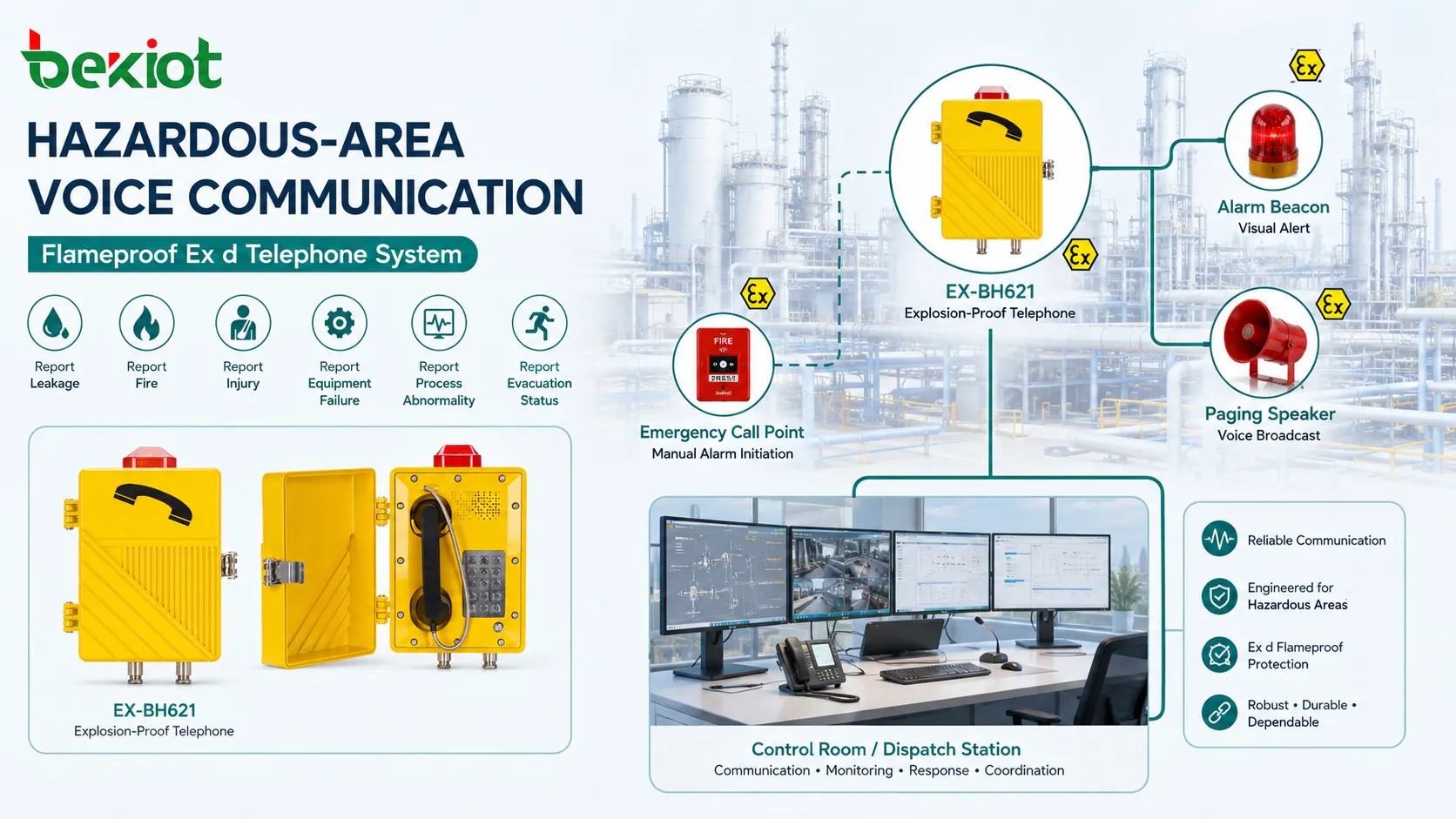
Reliable voice communication is especially important in hazardous areas because workers may need to report leakage, fire, injury, equipment failure, process abnormality, or evacuation status immediately. Mobile phones may be restricted, radios may have coverage limitations, and ordinary intercoms may not be certified for classified zones.
For hazardous-site voice communication projects, Becke Telcom’s EX-BH621 explosion-proof telephone can be considered where certified fixed calling points are required for emergency calling, dispatch connection, or field-to-control-room communication in industrial environments.
Design and Installation Considerations
Area classification comes before product selection
The correct starting point is not the product catalog. It is the hazardous area classification drawing and risk assessment. Engineers need to know whether the location is Zone 0, Zone 1, or Zone 2 for gas, or Zone 20, Zone 21, or Zone 22 for dust. They also need to identify gas group, temperature class, ambient conditions, mounting position, cable route, maintenance access, and operational requirements.
Once the area classification is clear, the equipment marking can be matched to the site. The selected product must meet or exceed the required protection level, gas group, temperature class, ambient range, ingress protection, and installation method. If the same device will be installed in different site zones, each location should be checked separately.
Cable glands, entries, and accessories are part of the safety system
A certified Ex d enclosure can become unsafe if fitted with the wrong cable gland, plug, reducer, breather, adapter, conduit seal, or antenna interface. Cable entries must be certified for the same protection concept and suitable for cable type, gas group, enclosure volume, and installation rules. Unused entries must be closed with certified stopping plugs.
Project failures often happen at interfaces rather than inside the main device. For example, a correct flameproof telephone may be installed with a non-certified gland, a damaged sealing ring, an incorrect thread adapter, or a cable that does not match the gland design. Installation quality must be treated as part of compliance, not as a minor site detail.
Maintenance, Inspection, and Lifecycle Control
Certified condition must be preserved over time
Ex d equipment should be inspected periodically to confirm that the enclosure, cover, fasteners, cable entries, seals, flame paths, labels, earthing, and accessories remain in safe condition. Corrosion, missing bolts, paint over flame paths, cracked windows, loose glands, unauthorized holes, and mechanical damage should be treated seriously.
Maintenance teams should follow the manufacturer’s instructions and relevant hazardous-area inspection standards. Ordinary repair practices may not be acceptable. Replacing a bolt with a similar-looking part, repainting a joint, polishing a flame path incorrectly, or drilling an additional hole for convenience can invalidate the certification and increase ignition risk.
Documentation is part of compliance
A complete project file should include certificates, datasheets, nameplate photos, installation drawings, cable gland records, inspection reports, maintenance logs, repair history, and any special conditions of use. This is especially important for plants with long service life, multiple contractors, and equipment added in phases.
Good documentation also helps future upgrades. When a plant expands, changes process chemicals, adds networked communication, or replaces analog devices with IP-based systems, engineers can review whether existing Ex d equipment remains suitable for the updated hazardous area and operational requirements.
Common Selection Mistakes
Assuming all explosion-proof equipment is equal
The term “explosion-proof” is often used loosely in marketing, but certified Ex equipment must be selected according to marking details. A device suitable for Zone 2 may not be acceptable in Zone 1. A product certified for IIB gases may not be suitable for IIC atmospheres. A device with a T4 rating may not be acceptable where a lower ignition temperature requires T5 or T6.
Another mistake is assuming that a gas-certified device automatically covers combustible dust. Dust hazardous areas require their own classification and protection approach, such as Ex t equipment protection by enclosure. Where both gas and dust risks exist, the complete marking must cover the actual site requirement.
Ignoring usability after certification
Certification confirms the safety concept, but the equipment still needs to work for people in real conditions. For field communication products, the handset must be easy to use with gloves, the call button must be visible, the ringer must be audible, the cable must withstand movement, and the enclosure must resist weather, chemicals, vibration, and impact.
In emergency systems, usability can be as important as technical compliance. A device that is safe but difficult to find, hear, operate, or maintain may not support the intended response workflow. Good projects combine certified hardware with clear signage, logical placement, control room procedures, redundancy planning, and regular testing.
Practical Applications Across Industries
Oil, gas, chemical, and petrochemical sites
In refineries, tank farms, loading racks, blending units, and chemical production areas, Ex d enclosures protect field devices that must remain available near hazardous processes. Communication points, control switches, alarm buttons, and local indicators may be placed at strategic locations so operators can report incidents without leaving the work zone.
These systems often connect to control rooms, distributed control systems, public address networks, CCTV platforms, and emergency shutdown procedures. The goal is not only to protect individual devices, but also to support a traceable incident response chain from field detection to command decision.
Transportation, utilities, and infrastructure
Fuel depots, tunnel pump rooms, power generation sites, wastewater treatment plants, marine terminals, battery energy storage facilities, and utility corridors may include classified areas or localized hazardous zones. Ex d equipment may be used where fixed electrical or communication devices must operate close to flammable gas sources.
In these environments, rugged design, stable network integration, clear emergency workflow, and long maintenance intervals are often decisive. Equipment should be evaluated not only by certification level, but also by how well it fits the site’s communication architecture and service model.
Conclusion
Flameproof enclosure Ex d is a proven explosion protection concept for hazardous gas atmospheres. Its purpose is to contain an internal ignition, control flame transmission, and keep the surrounding explosive atmosphere from being ignited. However, its safety depends on more than a strong enclosure. Standards compliance, correct marking, gas group, temperature class, EPL, cable entries, installation quality, inspection, and lifecycle documentation all matter.
For industrial projects, Ex d selection should always be based on the site classification and system requirements. When used correctly, flameproof equipment can support safer operation in hazardous areas while enabling essential functions such as control, monitoring, emergency calling, alarm notification, and field communication.
FAQ
Can an Ex d enclosure be drilled on site if an extra cable entry is needed?
Normally no. Adding holes or modifying certified flameproof parts can invalidate the certification because the enclosure strength, flame path, and entry arrangement were tested as a defined design. Any modification should be handled only through the manufacturer or an authorized certification route.
Is stainless steel always better than aluminum for flameproof equipment?
Not always. Stainless steel may be preferred for corrosion resistance in marine, chemical, or washdown areas, while aluminum may reduce weight and cost. The right choice depends on certification, gas group, environment, mechanical exposure, coating system, and maintenance expectations.
Can Ex d equipment be connected to an ordinary network switch?
The network architecture must be evaluated by area location. If the switch is outside the hazardous area, certified field equipment can often connect through approved cabling and entries. If active network equipment is inside a classified zone, that equipment and its enclosure must be suitable for the zone and protection concept.
How often should flameproof equipment be inspected?
Inspection intervals depend on site risk, environment, regulation, equipment type, and maintenance history. Harsh outdoor plants, corrosive atmospheres, vibration zones, and equipment with frequent use usually require more attention than clean indoor areas. The inspection plan should follow local rules and hazardous-area maintenance standards.
Does Ex d protection make equipment safe during live opening?
No. Flameproof equipment should not be opened while energized in a hazardous atmosphere unless the certificate and procedure specifically allow it. Many enclosures carry warnings requiring power isolation and a waiting period before opening.
Can wireless antennas be added to a flameproof device?
Only if the antenna arrangement, feedthrough, gland, or radio module is covered by certification and installation instructions. Adding a non-certified antenna or drilling an antenna port can compromise the protection concept and should be avoided.