


Corrective maintenance is a maintenance approach used to repair, restore, adjust, or replace equipment after a fault, failure, abnormal condition, or performance problem has been detected. It is applied when a machine, system, device, component, software service, communication terminal, facility asset, or production line is no longer operating as expected and needs action to return to normal function.
Unlike preventive maintenance, which is planned before failure occurs, corrective maintenance responds to an actual problem. It may be a quick repair after a minor fault, a planned fix after inspection, or an urgent emergency repair after a major breakdown. In real operations, corrective work is often combined with preventive, predictive, and condition-based maintenance to create a balanced asset management strategy.
When Repair Becomes Necessary
Every operational system experiences wear, aging, incorrect settings, component failure, environmental stress, user error, software bugs, or unexpected load changes. When these issues affect performance, the maintenance team must decide how quickly to respond and what repair method is appropriate.
Some faults are minor. A loose connector, worn switch, clogged filter, low battery, failed fan, damaged cable, misconfigured setting, or unstable sensor may be repaired without major service interruption. Other faults may stop production, affect safety, interrupt communication, or damage customer service, requiring immediate response.
The purpose of corrective work is not only to “fix what is broken.” A good process also identifies why the failure happened, whether the same problem may happen again, and whether the repair should include design improvement, user training, spare part change, or maintenance schedule adjustment.
How the Repair Process Usually Works
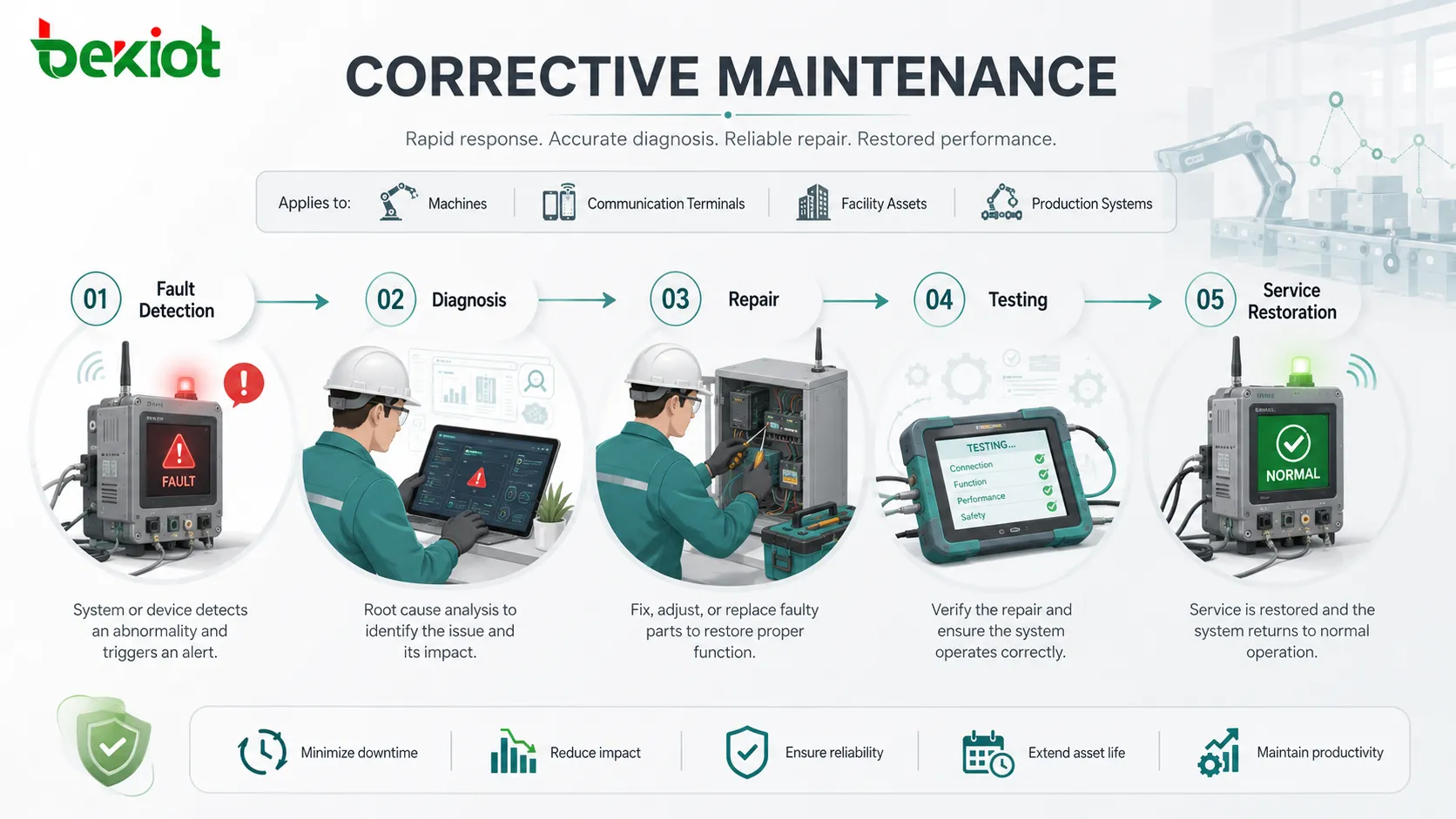
Fault Detection
The process starts when a problem is detected. This may happen through operator reports, alarm notifications, monitoring dashboards, sensor readings, inspection results, failed startup checks, quality defects, abnormal noise, overheating, error codes, customer complaints, or system logs.
Clear detection is important because vague problem reports slow down the response. A report such as “machine not working” is less useful than “motor stops after two minutes and shows overcurrent alarm.” Accurate fault information helps technicians prepare tools, spare parts, and safety procedures.
Initial Assessment
After detection, the maintenance team evaluates severity. They determine whether the asset can continue operating temporarily, whether it must be stopped, whether safety is affected, and whether the issue should be handled immediately or scheduled for a later maintenance window.
This step prevents overreaction and underreaction. Not every fault requires emergency repair, but some problems should not wait. The decision should consider safety, production impact, service importance, environmental risk, and possible secondary damage.
Diagnosis and Root Cause Review
Diagnosis identifies the failed part, incorrect setting, damaged connection, software error, calibration drift, environmental cause, or operating condition behind the issue. Technicians may use visual inspection, test instruments, diagnostic software, logs, wiring diagrams, error codes, thermal checks, vibration readings, or manufacturer guidance.
For repeated or serious failures, a root cause review may be needed. Replacing a failed component may restore operation, but if the real cause is overheating, vibration, contamination, overload, or poor installation, the same failure may return.
Repair or Replacement
The actual repair may involve tightening connections, replacing worn parts, recalibrating sensors, updating firmware, cleaning components, resetting software, repairing wiring, replacing modules, adjusting alignment, restoring configuration, or installing a new unit.
Repair quality matters. A rushed fix may bring the asset back online quickly but create future failure risk. Technicians should follow safe procedures, use approved parts, and document what was changed.
Testing and Return to Service
After repair, the system should be tested before returning to normal operation. Testing may include functional checks, load tests, safety checks, communication tests, calibration verification, alarm confirmation, performance monitoring, or operator approval.
Return-to-service testing confirms that the original fault has been resolved and that the repair did not create a new issue. This step is especially important for safety systems, production equipment, healthcare devices, transport systems, and communication infrastructure.
Different Response Levels
Emergency Repair
Emergency repair is performed when failure creates immediate operational, safety, financial, or service impact. Examples include a stopped production line, failed emergency communication device, broken security gate, critical server outage, major pump failure, or safety alarm malfunction.
This type of response prioritizes speed and risk control. However, temporary fixes should still be followed by proper documentation and permanent repair planning.
Deferred Repair
Deferred repair is used when a fault is known but does not require immediate action. The asset may still operate safely, or the repair may be planned for the next scheduled shutdown, maintenance window, or spare part delivery.
Deferring repair can be reasonable, but it should be controlled. The team should monitor the condition, assess risk, and avoid allowing small problems to become major failures.
Run-to-Failure Repair
Some low-cost or non-critical assets are intentionally allowed to operate until they fail. This may be acceptable for simple items where preventive maintenance costs more than replacement.
This approach should not be used for safety-critical, production-critical, or difficult-to-replace assets. The decision should be based on business impact, replacement cost, failure risk, and availability of spare parts.
Planned Corrective Work
Not all corrective work is chaotic. If inspection finds a worn bearing, weak battery, cracked gasket, or degraded cable, the repair can be planned before total failure occurs. This is still corrective because it responds to a detected defect, but it is controlled through scheduling.
Planned corrective action often provides a better balance between reliability and cost because the team can prepare parts, tools, labor, and downtime in advance.
Corrective maintenance is most effective when the repair restores service and also improves understanding of why the failure happened.
Benefits for Operations
Restores Function Quickly
The most direct benefit is service restoration. When a fault stops a system or reduces performance, corrective action helps bring the asset back to its required operating condition.
For business-critical systems, fast repair reduces production loss, service interruption, customer complaints, safety exposure, and operational uncertainty.
Controls Maintenance Spending
For non-critical assets, repairing only when needed can be cost-effective. Organizations do not always need frequent preventive maintenance for simple, inexpensive, or easily replaceable equipment.
This approach helps maintenance teams focus planned resources on assets where failure would create higher risk or cost.
Supports Better Failure Knowledge
Every repair creates useful information. Maintenance records show which assets fail most often, which components wear quickly, which locations create more problems, and which brands or models require more attention.
This information can support future decisions about spare parts, replacement cycles, vendor selection, operator training, and preventive maintenance planning.
Improves Asset Availability Over Time
When corrective work is documented and analyzed, recurring faults can be reduced. The team may discover that failures are caused by poor ventilation, wrong installation, overload, weak parts, incorrect cleaning, or missing user training.
Solving these causes improves long-term availability rather than only restoring operation after each incident.
Provides Flexibility
Corrective action gives organizations flexibility because not every asset requires the same maintenance strategy. Critical systems may receive predictive monitoring, while less critical assets may be repaired when faults appear.
This flexibility helps organizations balance cost, reliability, labor capacity, and operational priorities.
Where It Fits in a Maintenance Strategy
A mature maintenance program usually does not rely on only one method. Corrective work is one part of the maintenance mix. Preventive maintenance reduces known failure risks through scheduled service. Predictive maintenance uses data to forecast failure. Condition-based maintenance responds to measured asset condition. Corrective action handles faults that still occur.
This combination is practical because no system can prevent every failure. Even well-maintained assets may fail due to unexpected events, environmental damage, hidden defects, user mistakes, or supply quality problems.
The key is to use corrective work intelligently. If the same repair happens repeatedly, it should trigger review. If a failure affects safety or production, the organization may need stronger prevention. If the asset is low-cost and non-critical, corrective response may be enough.
| Maintenance Type | When It Happens | Main Purpose |
|---|---|---|
| Corrective | After a fault or defect is detected. | Restore function and remove the immediate problem. |
| Preventive | On a planned schedule. | Reduce known failure risk before problems appear. |
| Predictive | Based on data trends and failure indicators. | Forecast likely failure and plan action before breakdown. |
| Condition-Based | When measured condition crosses a threshold. | Act when asset condition shows actual need. |
Applications Across Industries
Manufacturing and Production
Manufacturing facilities use corrective maintenance for machines, conveyors, motors, sensors, control panels, robots, pumps, compressed air systems, and production line equipment. When a fault affects output quality or stops production, repair response becomes urgent.
Good repair documentation helps identify weak points in the production process. If the same station fails repeatedly, the solution may require redesign, better spare parts, lubrication changes, or operator training.
Building and Facility Systems
Facility teams use corrective work for HVAC systems, lighting, elevators, access control, pumps, fire doors, plumbing, power distribution, security devices, and communication systems. Some repairs are routine, while others directly affect occupant comfort or safety.
Facilities benefit from clear priority levels. A failed lobby light and a failed emergency exit system should not be treated with the same urgency.
IT and Communication Infrastructure
IT teams apply corrective maintenance when servers, network devices, phones, gateways, software services, storage systems, or endpoint devices fail. Repairs may involve replacing hardware, restoring configuration, patching software, restarting services, or correcting network settings.
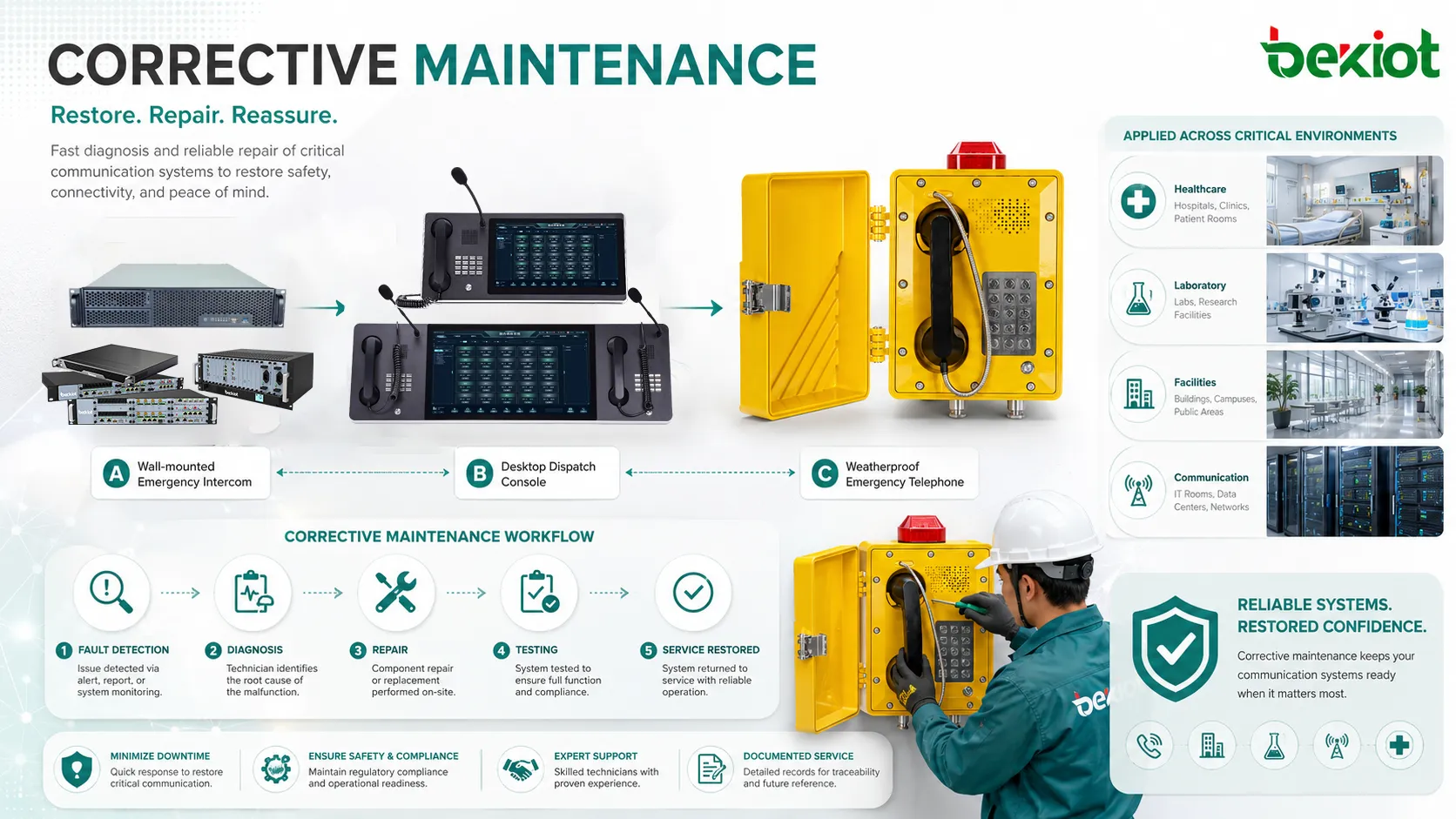
In communication systems, corrective response may be needed for call failures, registration problems, audio issues, device offline alarms, trunk faults, or power interruptions.
Transportation and Utilities
Transportation networks and utilities rely on corrective action for signaling equipment, pumps, substations, control cabinets, communication links, sensors, ticketing machines, vehicle systems, and field devices.
Because these environments often serve the public or support essential services, repair workflows should include safety procedures, escalation rules, and spare part readiness.
Healthcare and Laboratory Equipment
Healthcare and laboratory environments use corrective maintenance for diagnostic devices, monitoring systems, communication terminals, refrigeration, sterilization equipment, power systems, and facility support assets.
Repairs must be documented carefully because equipment availability, calibration, safety, and compliance may affect patient care or test reliability.
Common Triggers and Warning Signs
Corrective work may be triggered by obvious failures or subtle warning signs. Obvious failures include stopped equipment, no power, broken parts, failed startup, leaking fluid, unavailable service, or alarm activation. Subtle signs may include vibration, slow response, unstable performance, unusual heat, repeated resets, poor audio, declining output quality, or intermittent errors.
Intermittent faults deserve special attention because they may disappear during inspection and return later. Technicians should collect logs, operator notes, environmental conditions, and timing patterns to understand these issues.
Warning signs should not be ignored simply because the asset still works. A small issue may indicate a developing failure that can become expensive if left untreated.
Planning Spare Parts and Tools
Corrective response depends heavily on spare part availability. If a critical part is not in stock, downtime may continue even when technicians know the problem. Organizations should classify spare parts based on asset criticality, lead time, failure frequency, and replacement cost.
Tools and test equipment are also important. A technician may need meters, diagnostic software, calibration tools, lifting equipment, replacement modules, safety locks, cleaning materials, or special manufacturer tools.
For remote sites, spare part planning becomes even more important because travel time and logistics delays can increase downtime significantly.
Documentation and Work Orders
Every repair should leave a clear record. A useful work order includes asset name, location, fault description, detection time, priority, technician, diagnosis, parts used, repair steps, test result, downtime, and follow-up recommendation.
Good documentation turns repair work into management data. Over time, the organization can identify assets with high failure rates, high repair cost, long downtime, or repeated root causes.
Without documentation, the same problems may be solved repeatedly without anyone seeing the pattern. This increases cost and reduces reliability.
A repair that is not documented fixes one incident. A repair that is documented and analyzed can improve the whole maintenance strategy.
Risks of Poor Repair Management
Repeated Failures
If technicians only replace failed parts without checking the cause, the same fault may return. Repeated failures waste labor, consume spare parts, and reduce trust in the system.
Recurring faults should trigger root cause analysis or design review.
Longer Downtime
Downtime increases when teams lack spare parts, clear procedures, diagnostic tools, or trained technicians. Poor communication between operators and maintenance staff can also delay response.
Priority rules, spare part planning, and accurate fault reporting reduce this risk.
Safety Exposure
Some repairs involve electrical energy, moving parts, pressure, heat, chemicals, height, confined spaces, or hazardous environments. Rushed work can create safety risk for technicians and operators.
Lockout procedures, permits, personal protective equipment, and safe work instructions should be followed even during urgent repairs.
Hidden Secondary Damage
A visible failure may be only one part of the problem. For example, a blown fuse may indicate short circuit, overload, moisture, or internal component failure. Replacing the fuse alone may not solve the underlying issue.
Technicians should inspect related components before returning the asset to service.
Best Practices for Reliable Results
Classify assets by criticality. High-risk equipment should have faster response rules, better spare part support, and stronger monitoring than low-risk assets.
Standardize fault reporting. Operators should know how to describe the problem, capture error codes, record time of failure, and report operating conditions. Good reports shorten diagnosis time.
Use root cause review for repeated or serious failures. Not every repair needs a formal investigation, but recurring faults and critical incidents should be analyzed.
Test after repair. Functional testing, safety checks, and operator confirmation reduce the chance that equipment is returned to service with unresolved issues.
Update maintenance plans based on repair data. If corrective records show predictable wear, the organization may add preventive tasks or condition monitoring to avoid future breakdowns.
How to Measure Performance
Maintenance teams can track corrective work through several practical indicators. Mean time to repair shows how quickly assets are restored. Mean time between failures shows how often problems return. Downtime records show operational impact. First-time fix rate shows whether repairs are completed successfully without repeat visits.
Cost indicators are also useful. These may include labor hours, spare parts cost, emergency repair cost, contractor cost, and production loss. When repair costs rise, the asset may need redesign, replacement, or stronger preventive maintenance.
Performance measurement should not be used only to judge technicians. It should help the organization improve planning, training, spare part strategy, and asset reliability.
FAQ
Is corrective maintenance always unplanned?
No. Some corrective work is urgent and unplanned, but other work can be scheduled after a defect is discovered during inspection or monitoring.
When is run-to-failure acceptable?
It may be acceptable for low-cost, non-critical assets where failure does not affect safety, production, service quality, or compliance. It is not suitable for critical equipment.
What information should operators report when a fault occurs?
Operators should report the asset name, location, symptoms, error codes, time of failure, operating condition, recent changes, and whether the issue is continuous or intermittent.
How can repeated breakdowns be reduced?
Repeated breakdowns can be reduced by root cause analysis, better spare parts, improved installation, operator training, environmental control, design changes, and updated preventive tasks.
Why is testing after repair important?
Testing confirms that the fault has been resolved and that the asset can safely return to normal operation. It also helps catch wiring mistakes, configuration errors, or hidden secondary problems.







