In many engineering projects, equipment cannot simply be placed on a desk, fixed on the surface, or mounted as an exposed box. Some devices must become part of the wall, panel, cabinet, console, machine body, corridor structure, or public facility surface. This is where embedded installation becomes valuable: it allows the equipment to serve its function while reducing external protrusion, improving protection, organizing cabling, and making the whole installation look more integrated with the site.
Embedded installation is widely used for communication terminals, touch panels, control interfaces, display modules, access devices, emergency call points, medical panels, industrial operator stations, electrical control units, smart building interfaces, and public service equipment. Its value is not only visual. A properly embedded device can reduce collision risk, improve cleaning convenience, protect wiring, save space, support stable operation, and make the user interface easier to manage in long-term operation.
Why the mounting method changes the result
Equipment performance is not determined only by its internal circuit, software, material, or communication protocol. The installation method also influences how the device behaves after it enters the real environment. A strong terminal installed in the wrong position may still be damaged by impact. A reliable control panel placed with exposed wiring may still create maintenance problems. A well-designed user interface mounted at the wrong height may still be difficult to use.
Embedded installation solves part of this problem by reducing the distance between the device and the surrounding structure. Instead of standing outside the wall or panel as an added object, the equipment is partly or fully recessed into a reserved opening. The visible part may be a front panel, screen, keypad, button, handset, speaker grille, indicator lamp, access reader, or service interface, while cables, rear housing, brackets, and connectors are hidden behind the mounting surface.
This creates a more controlled relationship between the equipment and the site. The surface protects the device from accidental side impact. The rear space hides and organizes wiring. The front panel presents only the necessary operation area. The equipment becomes easier to identify as part of a planned system rather than a temporary add-on.
The advantage is especially clear in areas with frequent movement. Corridors, workshops, nursing stations, passenger halls, public entrances, clean rooms, machine rooms, vehicle passages, elevators, control desks, and service counters often have limited usable space. A protruding box may interfere with people, carts, tools, cleaning equipment, or moving materials. Embedded installation reduces this conflict by keeping the device closer to the surface line.
The basic structure behind the surface
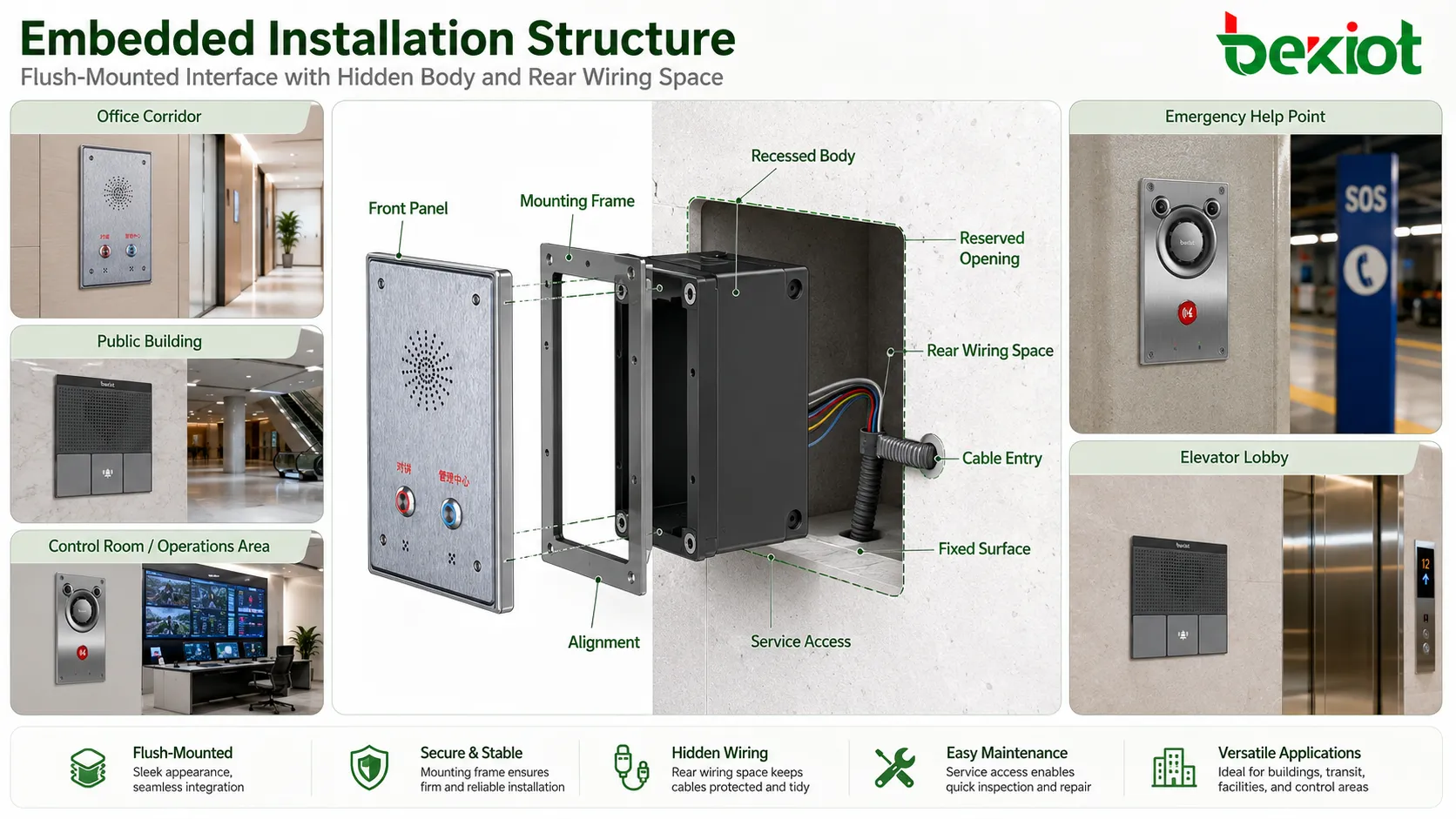
Embedded installation normally includes a front visible interface, a recessed body, a mounting frame or bracket, a reserved opening, rear wiring space, and a fixing method. The front interface is what users see and operate. The recessed body contains the device depth, terminals, circuit boards, connectors, or mechanical parts. The mounting frame helps secure the device to the wall, panel, cabinet, or console.
The reserved opening is a critical part of the installation. It must match the device’s cut-out dimensions, mounting tolerance, depth requirement, and service access needs. If the opening is too small, the equipment may not fit. If it is too large, the front panel may not seal or align correctly. If the rear depth is insufficient, cables may bend sharply or internal components may press against the structure.
Rear wiring space must be planned before construction. Embedded devices often need power cables, network cables, signal lines, grounding wires, speaker lines, control cables, or communication interfaces. These cables should enter in a controlled way, with enough bending radius, strain relief, and labeling. A neat front panel does not guarantee a good installation if the wiring behind it is crowded and difficult to service.
Fixing methods vary by device and site. Some devices are fixed by front screws, rear clamps, side brackets, back boxes, welded supports, DIN rails, or custom panels. The method should match expected vibration, user operation force, maintenance frequency, and environmental conditions. A device that users press frequently needs stronger fixation than a display that is only viewed.
Space integration is the first visible advantage
The most immediate advantage is space integration. By recessing equipment into a wall, panel, machine housing, cabinet door, or control console, the installation reduces the amount of device body exposed to the working area. This can make narrow spaces safer and easier to use.
In corridors, an exposed box may narrow the passage or create a collision point. In workshops, protruding devices may be hit by tools, carts, or moving materials. In hospitals, protrusions may interfere with beds, trolleys, cleaning machines, or staff movement. In passenger facilities, exposed equipment may become a point of impact or misuse. Embedded installation reduces these external risks by keeping the front surface flatter.
Space integration also improves layout discipline. When equipment is embedded into planned surfaces, the site looks more organized. Devices appear in fixed positions and consistent heights. Cables are hidden. The relationship between device and environment becomes clearer. This is valuable not only for appearance, but also for operation and maintenance.
In projects with many repeated installation points, embedded mounting can create a standard visual and functional pattern. A building may use identical recessed access panels on every floor. A factory may use similar operator panels on each production line. A hospital may use standardized wall-mounted medical communication interfaces in different wards. Standardization makes the site easier to understand and maintain.
Better protection from impact and misuse
Embedded installation can improve physical protection because less of the device is exposed outside the surface. When a device protrudes from a wall, side impact may damage its shell, connector, handset, button, or cable entry. When the device is embedded, the surrounding wall or panel can act as partial protection.
This is useful in environments where movement is frequent or uncontrolled. Warehouses may have carts and forklifts. Industrial corridors may have tools and pipes. Schools and public buildings may have many users. Transport stations may have passenger flow and luggage. Hospitals may have beds and mobile equipment. A recessed device is less likely to be struck from the side than a fully exposed one.
Embedded installation can also reduce casual misuse. If only the front operating surface is visible, users are less likely to pull cables, access rear connectors, open boxes, or interfere with internal components. This is helpful in public areas, semi-public corridors, shared facilities, parking areas, service halls, and campuses.
However, embedded installation is not automatically vandal-proof. The front panel, buttons, screen, grille, screws, and visible accessories still need suitable strength. In high-risk public areas, designers may need tamper-resistant screws, metal front plates, reinforced brackets, protected microphones, impact-resistant screens, and controlled access to internal parts. Embedding reduces exposure, but the front interface must still match the risk level.
Cleaner appearance and architectural consistency
Many buildings and facilities require devices to work without disrupting the visual order of the space. Hotels, hospitals, commercial buildings, office parks, campuses, airports, subway stations, exhibition centers, laboratories, and public service halls often care about clean surfaces, consistent design, and reduced visual clutter. Embedded installation helps equipment blend into the environment.
This does not mean hiding the device completely. Emergency devices, service buttons, intercom panels, access readers, control panels, or public terminals must still be visible enough for users. The goal is to make the device look intentional and organized. A flush front panel with clear labeling often looks more professional than a surface-mounted box with exposed cables.
Architectural consistency also helps user confidence. When equipment appears integrated, users are more likely to recognize it as an official service point. A loose box or temporary-looking installation may create doubt, especially in public facilities. Good embedded design communicates that the device is part of the building system.
For high-end interiors, recessed installation can preserve clean wall lines and reduce protrusions. For technical facilities, it can make operator consoles and control panels more compact. For public areas, it can combine accessibility with a more controlled appearance. The visual advantage is strongest when front panel material, color, label design, mounting height, and surrounding surface are planned together.
Cable concealment and wiring safety
One of the most important practical advantages is cable concealment. Exposed cables are vulnerable to pulling, bending, cutting, water entry, accidental disconnection, and unauthorized access. They also make the installation look unfinished. Embedded installation hides cable routes behind walls, panels, cabinets, or consoles, reducing both physical risk and visual disorder.
Hidden wiring does not mean careless wiring. The rear space must still provide proper cable entry, strain relief, bend radius, grounding, labeling, and separation between power and signal lines. If cables are simply squeezed behind the device, maintenance becomes difficult and faults may increase. Concealment should be organized, not improvised.
For communication and control equipment, cable stability is essential. A loose network cable may cause intermittent connection. A strained power wire may create service interruption. A poorly grounded shield may increase noise. A signal cable routed near high-power lines may suffer interference. Embedded installation gives designers an opportunity to manage these details inside a controlled space.
In public areas, concealed wiring also improves safety. Users cannot easily touch or pull cables. Cleaning staff are less likely to snag them. Children, visitors, or unauthorized users cannot easily access connectors. This reduces the chance of accidental damage and helps protect the continuity of the system.
Improved cleaning and hygiene management
Embedded installation can support cleaner surfaces because the visible device area is reduced and the front interface can be made flatter. This is valuable in hospitals, laboratories, clean rooms, food processing areas, pharmaceutical production, kitchens, public toilets, schools, and commercial service spaces where frequent cleaning is required.
Surface-mounted devices often create edges, gaps, brackets, external cable routes, and dust collection points. These areas may be difficult to wipe properly. A recessed device with a smooth front panel can reduce cleaning dead corners if the design includes proper sealing, suitable materials, and flush alignment.
In hygiene-sensitive areas, the front panel material matters. Stainless steel, treated metal, glass, sealed membrane panels, or smooth engineering materials may be selected according to cleaning chemicals, disinfection frequency, moisture exposure, and site standards. The installation should avoid exposed screws, open gaps, and absorbent materials where cleanliness is important.
Cleaning convenience should be balanced with maintenance access. A fully sealed front may be easy to wipe, but technicians still need a way to service the device. The design may require front-opening panels, removable modules, rear service access, or maintenance hatches. Hygiene and maintainability should be planned together.
Safer operation in public and working areas
Embedded installation can improve safety by reducing protruding edges and exposed hardware. In areas where people move quickly or carry objects, protrusions can become collision points. A recessed installation lowers this risk and creates a smoother circulation path.
This is especially important near escape routes, narrow corridors, stairwells, hospital passages, school corridors, platforms, public entrances, and industrial walkways. A device that extends far from the wall may not seem dangerous during design, but it can become a problem when the area is crowded, poorly lit, or used during emergency movement.
Safe operation also includes clear interaction. The device should be installed at a height and angle that users can operate without awkward posture. Emergency call buttons, intercom panels, access readers, medical call points, and control interfaces should be reachable and recognizable. Embedding should not make the device hard to find.
If the device includes a screen, microphone, speaker, handset, camera, or button, the front layout should support real use. A deeply recessed microphone may reduce audio pickup. A poorly placed speaker grille may affect sound clarity. A button hidden in a shadowed recess may be difficult to see. Good embedded installation protects the device without weakening the user interface.
Classification by installation surface
Embedded installation can be applied to many surface types, and each surface has different design concerns. A wall recess is different from a cabinet door cut-out. A control console is different from a machine panel. A clean room partition is different from a concrete tunnel wall. The installation surface determines structural support, cable path, access method, and finishing requirements.
| Installation surface | Typical use | Main advantage | Key planning concern |
|---|---|---|---|
| Wall recess | Intercom panels, emergency buttons, access terminals, public service devices | Clean appearance and reduced protrusion | Opening size, rear depth, cable route, and maintenance access |
| Control cabinet door | HMI screens, switches, indicators, communication modules, control panels | Operator interface integrated with equipment cabinet | Door strength, cable movement, grounding, and internal clearance |
| Machine panel | Operator controls, status displays, safety interfaces, local terminals | Close operation near the process point | Vibration, heat, service space, and protection from accidental operation |
| Console surface | Dispatch panels, control keyboards, touch screens, audio interfaces | Compact and ergonomic workstation layout | Viewing angle, hand reach, cable management, and future replacement |
| Architectural panel | Hotel, hospital, office, campus, and public facility service interfaces | Better visual integration with interior design | Finish matching, cleaning, user visibility, and safe height |
This classification shows why embedded installation should not be treated as one universal method. The same device may require different brackets, front panels, cable entries, sealing methods, or maintenance routes depending on the surface. The design should begin with the actual installation environment rather than only the device drawing.
The surface must also support the device weight and operating force. A thin decorative panel may look suitable but may flex when users press buttons. A cabinet door may sag if too much weight is added. A machine panel may transmit vibration. A wall may need reinforcement before cutting. Structural review prevents later loosening, misalignment, or damage.
Application in industrial control and automation
Industrial control systems often use embedded installation for operator panels, HMI screens, push-button stations, status indicators, local control terminals, communication interfaces, and equipment monitoring modules. These devices need to be close to the process but should not create obstacles around machines or production lines.
Embedding the device into a machine panel or control cabinet gives operators a fixed and protected interface. Workers can see machine status, start or stop processes, acknowledge alarms, change parameters, or communicate with the control system from a defined position. The front panel becomes part of the machine or cabinet rather than an external accessory.
Industrial environments also require protection from vibration, dust, oil mist, temperature change, and accidental impact. Embedded installation can help, but the panel sealing, gasket, material, and cable entry must match the site. If a cabinet is exposed to dust or moisture, a poorly cut opening can weaken the enclosure protection level.
Maintenance access is important. Industrial panels may need module replacement, wiring checks, firmware updates, or terminal inspection. If the embedded device can only be removed by dismantling large machine parts, future maintenance becomes costly. Good design provides either front service access or rear access through a cabinet door.
Application in communication and intercom terminals
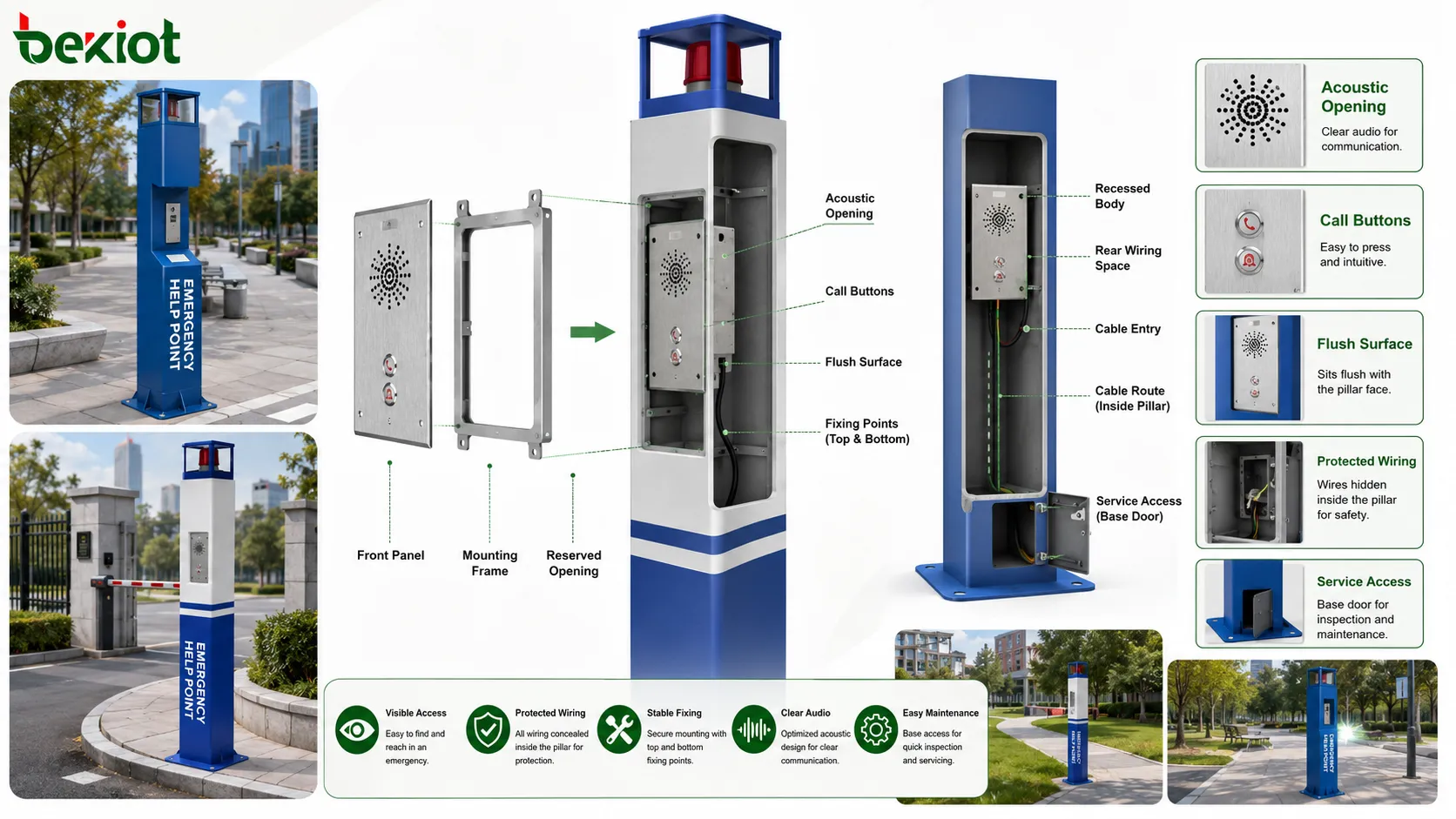
Communication devices are often embedded when they need to be permanently available in a specific location. This includes intercom panels, emergency call stations, hands-free terminals, public help points, visitor communication devices, service phones, and control-room communication interfaces.
Embedding helps keep the device stable and visible while protecting the body and wiring. In a corridor, platform, gate, parking entrance, tunnel, hospital area, or industrial checkpoint, users may need to find the communication point quickly. A flush or semi-flush front panel can reduce accidental damage while keeping the operation surface accessible.
Audio performance should be considered during embedded installation. Microphones, speakers, and acoustic openings must not be blocked by the mounting surface. A recessed design that looks neat but reduces voice pickup or speaker output will fail in real use. The front panel should support clear sound transmission.
For emergency communication, visibility and labeling are just as important as protection. If the device is too hidden, users may not notice it. If the button is not clearly marked, users may hesitate. Embedded installation should integrate the device into the environment without making it disappear from user attention.
Application in healthcare and clean environments
Healthcare and clean environments often require equipment to be easy to wipe, resistant to cleaning processes, and integrated into walls or panels without unnecessary gaps. Embedded installation is useful for nurse call panels, medical communication interfaces, clean room phones, access control panels, monitoring displays, and service terminals.
In hospitals, embedded panels can reduce protrusions in corridors, wards, operating areas, treatment rooms, laboratories, and nursing stations. This helps keep passages clear for beds, carts, and staff movement. It also reduces exposed cable routes that may collect dust or interfere with cleaning.
In clean rooms and laboratories, surface smoothness and sealing are important. A device mounted on top of a wall may create edges where dust or particles collect. A properly embedded front panel can reduce these collection points, provided that the material, gasket, screw design, and installation gap are suitable for the cleanliness requirement.
Healthcare environments also require reliable service access. If a nurse call panel, communication terminal, or medical service interface fails, it may affect workflow quickly. The embedded structure should allow maintenance without damaging the wall finish or disturbing nearby operations more than necessary.
Application in transport and public facilities
Transport and public facilities use embedded installation for passenger help points, ticketing interfaces, emergency call panels, platform communication points, elevator assistance panels, parking payment devices, access gates, information screens, and public service terminals. These sites often combine heavy user traffic with strict appearance and safety requirements.
In a station or terminal, exposed devices may be hit by luggage, cleaning machines, or passenger movement. Embedded installation reduces protrusion and helps maintain a clear public route. It also makes the equipment look like part of the facility rather than a temporary device added later.
Public devices must be both durable and understandable. The front panel should clearly show where to press, speak, scan, or read. If the device is embedded too deeply, users may not notice it or may find it difficult to operate. Good public design balances flush mounting with visual guidance.
Transport facilities often need repeated installation across many locations. A standardized embedded design helps keep passenger experience consistent. When every platform, gate, elevator lobby, or parking entrance uses a similar installation format, users can recognize service points faster and maintenance staff can follow a consistent inspection method.
Application in commercial buildings and interior systems
Commercial buildings, hotels, office towers, residential complexes, shopping centers, campuses, and exhibition halls often use embedded installation to balance function and interior appearance. Devices such as access readers, intercom panels, room control panels, lighting controls, thermostat panels, information displays, and emergency buttons can be integrated into walls or decorative panels.
The advantage is not only aesthetics. Embedded devices are less likely to be bumped, cables are hidden, cleaning is easier, and the building interface becomes more orderly. In customer-facing spaces, this can improve the perceived quality of the facility.
Hotels may use embedded panels for guest room control, service communication, access, and corridor assistance. Office buildings may use them for access control, visitor communication, elevator assistance, and meeting room control. Campuses may use them for help points, classroom control, security calls, and public announcements.
Interior systems require coordination between electrical engineers, low-voltage system designers, architects, decoration contractors, and device suppliers. The wall finish, panel material, cut-out size, mounting depth, and maintenance access must be confirmed before construction. If these teams coordinate too late, the device may not align with the final finish or may require rework.
Application in cabinets, consoles, and equipment rooms
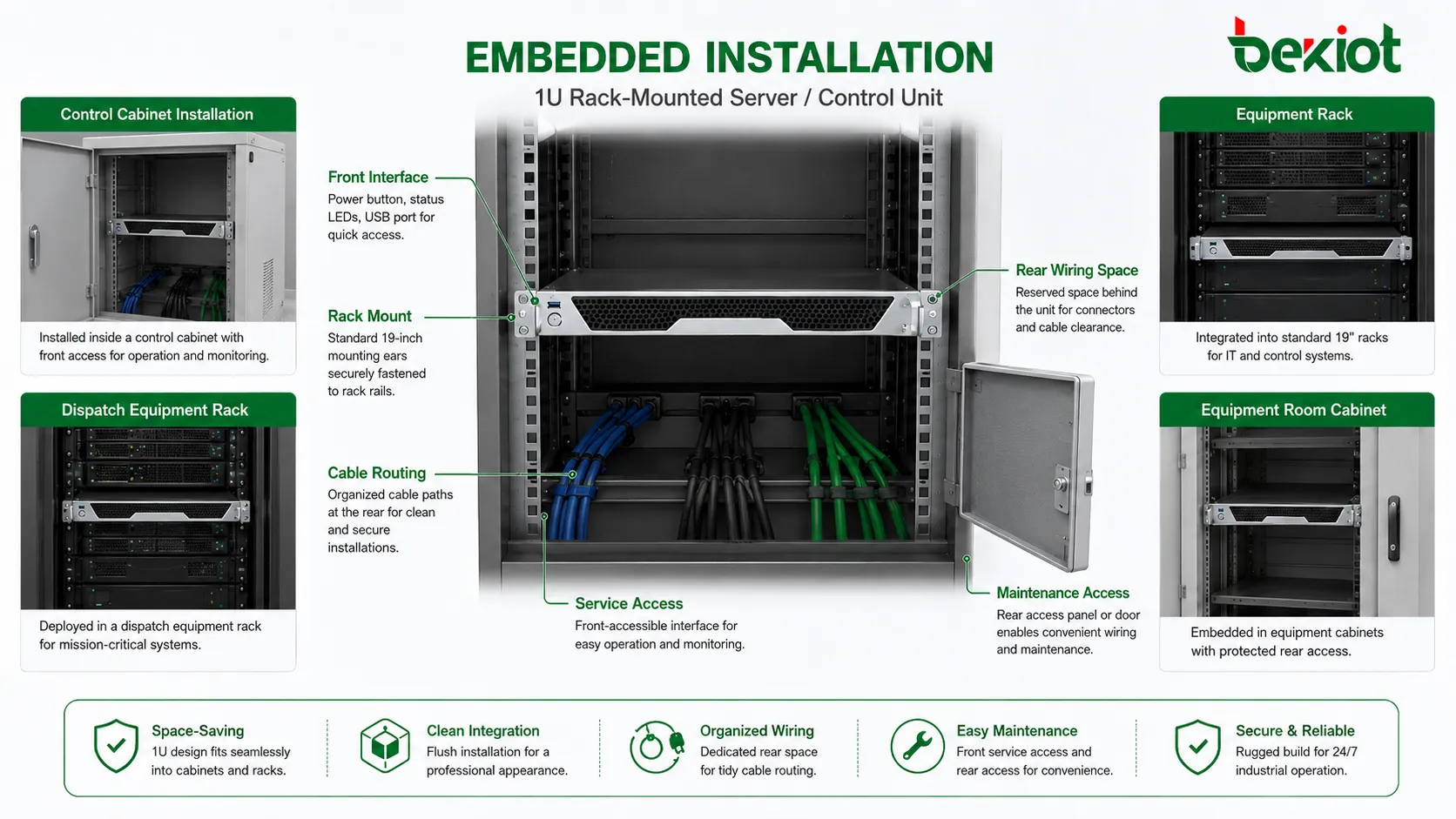
Embedded installation is common in control cabinets, server room panels, dispatch consoles, operator desks, electrical cabinets, and equipment racks. In these environments, the goal is often to provide a compact interface while keeping internal wiring protected.
Control cabinet doors frequently include embedded displays, buttons, meters, selector switches, indicator lamps, and communication ports. Operators can interact with the system without opening the cabinet. This improves safety and convenience, but the door must support the device weight, cable movement, and repeated operation.
Dispatch and control consoles may use embedded microphones, touch screens, keyboards, audio modules, call panels, and control buttons. This reduces desktop clutter and helps operators work more efficiently. A clean console layout matters because operators may need to make decisions quickly while monitoring several systems.
Equipment rooms use embedded panels for local status display, access control, remote management interfaces, alarm indication, and maintenance ports. The embedded design can protect cables and make the interface easy to find. However, maintenance staff should still have enough space to open panels, replace modules, and trace wiring.
Environmental and structural planning
Embedded installation changes the relationship between the device and the environment, so environmental planning must be done carefully. The device may be partly hidden inside a wall cavity, cabinet, machine panel, or architectural structure. This space may have different temperature, humidity, ventilation, dust, or condensation behavior from the visible front area.
Heat dissipation is a common issue. A device that works well when surface mounted may become warmer when recessed into a closed cavity. Displays, processors, power modules, amplifiers, and communication circuits may generate heat. If the rear cavity has poor airflow, internal temperature may rise and shorten device life.
Moisture control is also important. If the wall or panel is exposed to outdoor temperature changes, condensation may form inside the cavity. If water can enter through cable openings, screw holes, panel gaps, or poorly sealed edges, the hidden space may become a moisture trap. Sealing should protect the device without preventing necessary ventilation where heat is present.
Structural planning should consider the mounting surface strength. Cutting an opening can weaken a wall panel, cabinet door, decorative surface, or machine cover. Reinforcement may be required. The installation should remain stable under vibration, user pressure, door movement, and long-term operation.
Installation accuracy and front panel alignment
Embedded installation usually requires more precise construction than surface mounting. The visible front panel must align with the surrounding surface. If the opening is crooked, too large, too small, or poorly finished, the final result may look unprofessional and may affect sealing or fixation.
Cut-out dimensions should follow the device drawing. Tolerances should be respected. The installer should confirm whether dimensions refer to the embedded body, front panel, screw holes, gasket area, or clearance space. Misreading the drawing can cause rework.
Surface flatness matters. If the wall or panel is uneven, the front plate may not sit properly. This can create gaps, stress, water entry, or visual defects. In some cases, a mounting frame or adapter plate is needed to compensate for site irregularity.
Alignment also affects user operation. A tilted screen, off-center button, uneven front plate, or recessed label can make the device look unreliable. In public or customer-facing areas, these details influence user confidence. In industrial areas, poor alignment may affect mechanical durability and sealing.
Maintenance access should be designed early
One of the risks of embedded installation is making equipment too difficult to service. A clean front surface is attractive, but maintenance teams still need access to the rear body, terminals, connectors, fuses, modules, firmware ports, and fixing screws. If the device can only be repaired by destroying wall finishes, the design is poor.
Maintenance access can be provided in different ways. Some devices are front-removable. Some require rear access from a cabinet, service corridor, wall cavity, or maintenance hatch. Some use hinged front panels. Some use modular cartridges. The method should be chosen before installation, not discovered during the first failure.
Spare cable length is also important. If cables are cut too short, the device cannot be pulled forward for service. If cables are too long and unmanaged, they may interfere with mounting or heat dissipation. A suitable service loop should be planned and secured.
Labeling should remain accessible. Hidden wires are harder to trace if they are not labeled. Each cable, terminal, and connector should match documentation. Maintenance teams should not need to guess which cable belongs to power, network, alarm, audio, control, or grounding.
A good embedded design considers the future technician. The person servicing the device may not be the original installer. Clear access, labels, drawings, and modular replacement methods reduce long-term maintenance cost.
Comparison with surface-mounted and desktop installation
Embedded installation is not always better than other mounting methods. It should be selected when its advantages match the site need. Surface-mounted devices are easier to install and replace. Desktop devices are flexible and movable. Embedded devices are more integrated and protected but require more planning.
| Installation method | Main strength | Typical limitation | Best suited for |
|---|---|---|---|
| Embedded installation | Clean integration, reduced protrusion, hidden wiring, stronger site order | Requires precise opening, depth planning, and maintenance access | Permanent interfaces, public areas, panels, consoles, clean spaces, corridors |
| Surface-mounted installation | Fast deployment, easier replacement, simple retrofit | More protrusion, more visible cables, higher collision risk | Retrofit projects, utility areas, temporary systems, rough environments |
| Desktop or movable installation | Flexible position and easy relocation | Less fixed protection and more cable exposure | Office desks, temporary workstations, movable service points |
| Rack or cabinet installation | Centralized equipment management and high capacity | Less direct user access in field areas | Server rooms, network rooms, control centers, equipment clusters |
This comparison shows that embedded installation is most valuable for fixed, long-term, user-facing, or environment-integrated equipment. If the device must move frequently, if the wall cannot be modified, or if future replacement is uncertain, another installation method may be more practical.
The choice should be made by considering user access, safety, aesthetics, wiring, maintenance, environment, cost, and future change. The most professional design is not always the most hidden design. It is the design that best supports the system’s purpose throughout its lifecycle.
Special advantages in long-term operation
The long-term advantage of embedded installation is stability. Once the device is properly installed, it has a fixed location, protected wiring path, cleaner appearance, and reduced risk of accidental movement. This makes the system easier to inspect and manage over time.
Another advantage is reduced visual and physical clutter. In facilities with many devices, clutter can become a real operational problem. Exposed boxes, cables, brackets, and adapters make spaces harder to clean and harder to understand. Embedded installation creates a more disciplined layout.
It can also improve user behavior. When a device is installed neatly at the expected position, people are more likely to use it correctly. A well-placed embedded emergency panel, access reader, or service terminal communicates its purpose clearly. A poorly placed device may be ignored or misused.
For facility managers, embedded installation supports asset standardization. Devices can be installed at consistent heights, with consistent labels, using consistent panel formats. This helps inspections, training, and replacement. In large buildings or campuses, standardization is often more valuable than the performance of any single device.
Common design mistakes
One common mistake is focusing only on the front appearance. A flush panel may look good, but if the rear space is too small, cables are bent sharply, or heat cannot escape, the installation will create long-term problems. Embedded design must consider what happens behind the surface.
Another mistake is cutting openings before confirming the final device model. Similar devices may have different depth, screw positions, gasket size, cable entry, or front plate dimensions. Early construction without confirmed drawings can lead to expensive rework.
Ignoring maintenance access is also frequent. Some installations look clean at handover but become difficult to repair. If the device fails, technicians may need to remove decorative panels, open walls, or disconnect unrelated equipment. This increases downtime and maintenance cost.
Poor sealing is another issue. If the device is installed in a wet, dusty, clean, outdoor, or wash-down environment, the front gap and cable entry must be protected. A small installation gap can allow dust or moisture to enter over time.
Finally, designers sometimes make the device too hidden. For emergency, service, and public interaction points, visibility is part of the function. Embedded installation should reduce clutter, not hide the device from the people who need it.
How to judge whether the design is suitable
A suitable embedded installation should answer several practical questions. Does the device need a permanent and fixed position? Is the site surface suitable for cutting or recessing? Is there enough rear depth? Can cables enter safely? Can the device dissipate heat? Can it be serviced without damaging the surrounding structure?
The design should also consider user behavior. Will users see the device easily? Can they reach it comfortably? Is the front panel readable? Are buttons, screens, speakers, microphones, and labels positioned correctly? Does the installation height match the user group?
Environmental conditions should be reviewed. Is the device exposed to dust, moisture, cleaning chemicals, vibration, impact, heat, cold, or public misuse? Does the embedded structure improve protection or create hidden risks? A recessed cavity can protect against collision, but it may also trap heat or moisture if poorly designed.
Maintenance teams should be included in the evaluation. They can identify access problems, labeling needs, spare cable requirements, and replacement difficulties. A design that satisfies only the architect or installer may fail later in operation.
The final judgment should be based on lifecycle value. Embedded installation is suitable when the benefits in safety, space saving, appearance, wiring protection, hygiene, and operational stability justify the additional planning and construction requirements.
Closing Thoughts
Embedded installation provides special advantages because it integrates equipment into the surrounding structure rather than leaving it exposed as a separate object. It saves space, hides wiring, improves visual order, reduces collision risk, supports cleaning, protects interfaces, and creates stable fixed service points for long-term operation.
Its application scenarios are broad, including industrial control panels, communication terminals, healthcare interfaces, clean rooms, transport facilities, public help points, commercial buildings, access systems, cabinets, consoles, and machine interfaces. In each scenario, the value depends on whether the device needs to be permanent, accessible, protected, and visually or structurally integrated.
The key is careful planning. Opening size, rear depth, cable routing, heat dissipation, sealing, material, structural strength, user height, acoustic performance, maintenance access, and documentation all affect the final result. When these factors are handled properly, embedded installation becomes more than a neat mounting method; it becomes a reliable part of the system design.
FAQ
Is embedded installation suitable for all types of equipment?
No. It is most suitable for fixed, long-term, user-facing, or panel-integrated devices. Equipment that must move frequently, be replaced often, or remain fully accessible from all sides may be better suited to surface-mounted, desktop, rack, or cabinet installation.
What is the biggest advantage compared with surface mounting?
The biggest advantage is integration. Embedded installation reduces protrusion, hides cables, improves appearance, protects the device body, and keeps the installation closer to the surrounding surface. This is useful in corridors, public areas, control panels, clean spaces, and permanent service points.
What should be checked before cutting the installation opening?
The project team should confirm the device model, cut-out size, front panel dimension, rear depth, cable entry direction, mounting method, service access, wall or panel strength, and environmental protection requirements before cutting the opening.
Can embedded installation cause maintenance problems?
Yes, if maintenance access is not planned. A recessed device may be difficult to remove or repair if there is no front-removal method, rear access, service loop, clear labeling, or maintenance hatch. Good embedded design includes service planning from the beginning.
Does embedded installation improve waterproof or dustproof performance?
It can help reduce exposure, but protection depends on the complete design. The front panel, gasket, cable entry, mounting surface, sealing method, material, and installation quality all affect water and dust resistance. Embedding alone does not guarantee environmental protection.