


5G public-network push-to-talk is becoming increasingly common in industry communication, emergency response, transportation, security, utilities, logistics, and field service operations. By using mobile broadband networks and smart terminals, it can simulate the familiar working style of narrowband two-way radios while adding wider coverage, application-based dispatch, video communication, location services, and platform integration.
In simple terms, 5G public-network push-to-talk allows users to press a PTT button and speak to individuals or groups through a mobile data network. Unlike traditional private trunked radio systems, it does not always require dedicated radio base stations or licensed radio infrastructure. However, not all public-network PTT systems are built in the same way. The two major implementation paths are PoC and MCPTT.
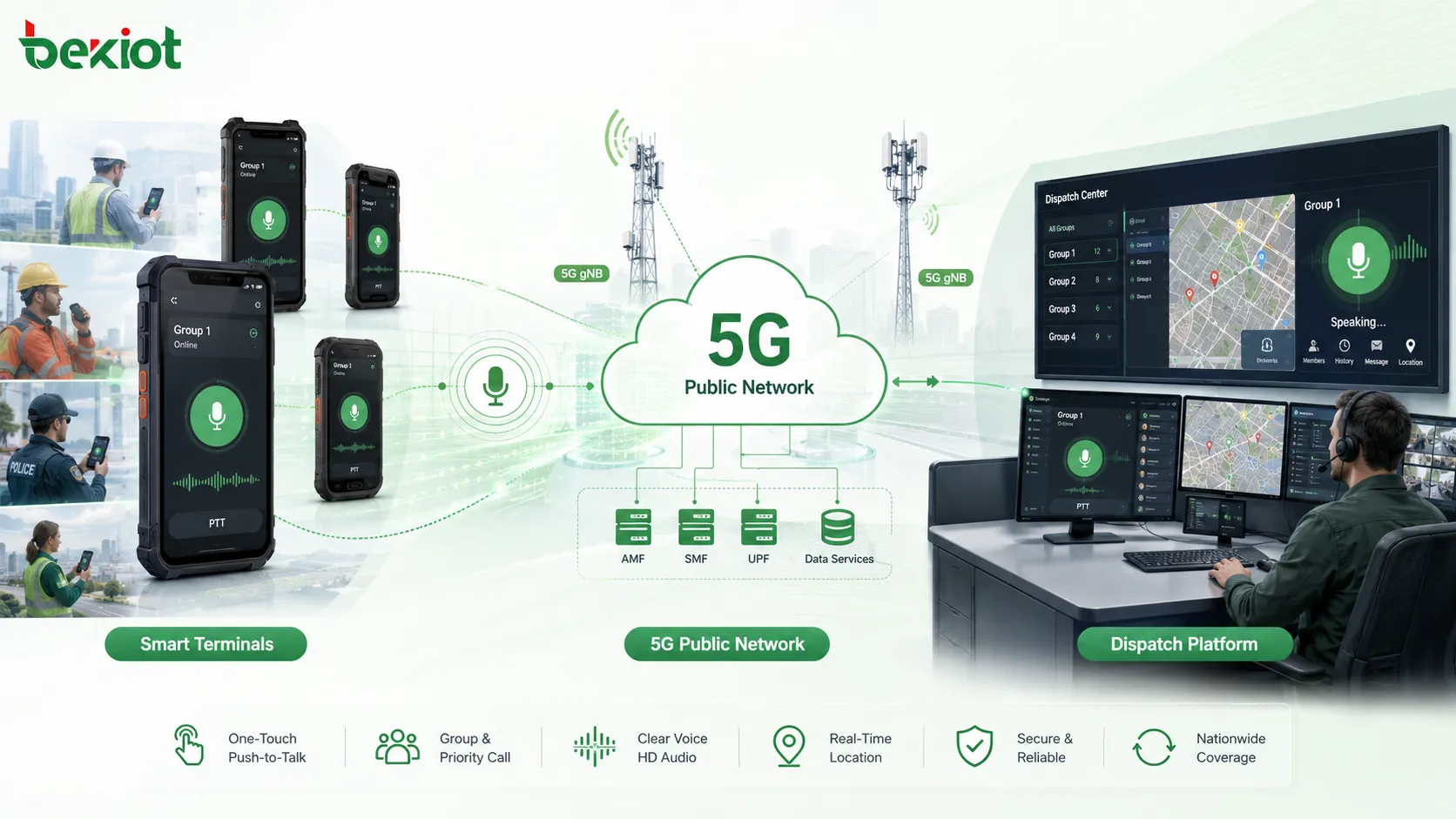
Two Main Technical Paths
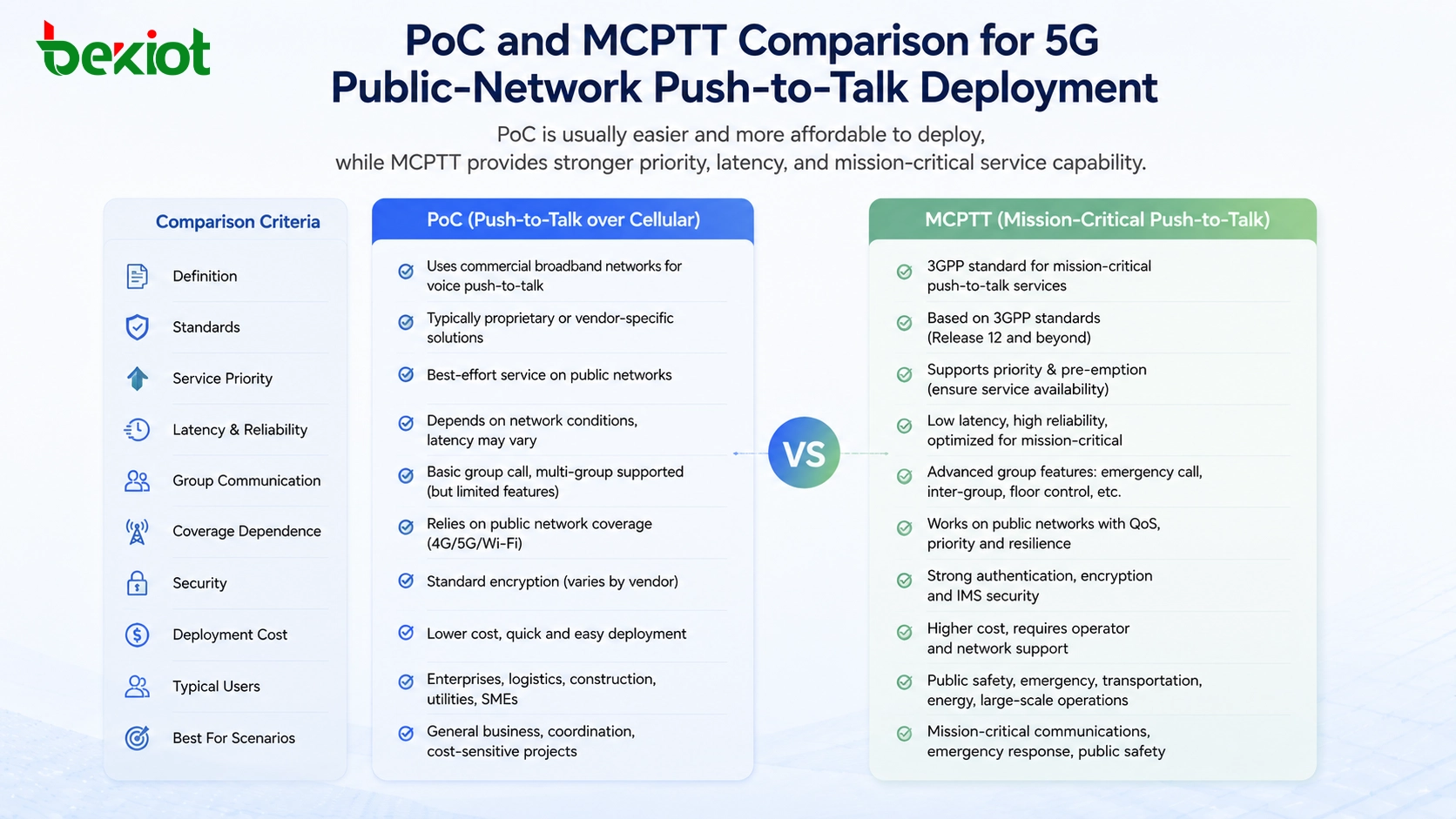
There are two common ways to implement 5G public-network push-to-talk: PoC and MCPTT. PoC stands for Push-to-Talk over Cellular. It is usually delivered through an application, cloud platform, mobile data connection, and smart terminal. MCPTT stands for Mission Critical Push-to-Talk. It is a 3GPP-defined mission-critical communication service designed for higher reliability and service assurance.
In many markets, especially commercial and industrial communication projects, most public-network push-to-talk systems still use the PoC model. This is because PoC is easier to deploy, easier to maintain, and less expensive for organizations that need practical group communication but do not require full mission-critical network integration.
MCPTT, by contrast, is more closely connected with the mobile network itself. It is not only an app-based service. It requires support from the core network, radio access network, terminals, service platform, and operator environment. This gives it stronger technical potential, but also makes deployment more complex.
How PoC Delivers Push-to-Talk over Mobile Networks
PoC uses mobile internet access to provide push-to-talk communication. A user installs a PoC application on a smart terminal or uses a dedicated PoC device. The application connects to the service platform through 4G, 5G, Wi-Fi, or other IP networks. Once online, users can make group calls, private calls, video calls, and dispatch communications.
Most PoC systems are built as application-layer services. Different vendors may use their own private protocols, server architectures, terminal apps, and dispatch platforms. This makes PoC flexible and fast to commercialize, but it also means that interoperability depends heavily on the vendor’s platform design.
PoC is often described as an OTT service, because it runs over existing internet or mobile data networks. The service provider mainly focuses on the application function, user management, group communication, and dispatch experience. It does not usually control the mobile network resource layer directly.
Why PoC Is Widely Adopted
The biggest advantage of PoC is deployment simplicity. It does not require a dedicated core network, customized 5G network configuration, or operator-level mission-critical service integration. In many projects, users only need smart terminals, SIM cards, a PoC platform, and a dispatch client.
This makes PoC attractive for security companies, logistics fleets, property management teams, industrial parks, construction sites, retail chains, field maintenance teams, and commercial operation groups. These users often need wide-area communication and group dispatch, but they may not need the strict service priority and latency guarantees required by public safety agencies.
Cost is another important factor. PoC terminals and applications are usually much easier to purchase and maintain. The system can be deployed quickly, scaled gradually, and managed with relatively simple IT resources. For many organizations, this balance of cost, coverage, and usability is the reason PoC has become the mainstream public-network PTT model.
What Makes MCPTT Different
MCPTT is based on mission-critical communication standards defined by 3GPP. It is designed for public safety, emergency response, critical infrastructure, and other high-reliability communication scenarios. Instead of working only as an application over the public internet, MCPTT is integrated with mobile network architecture.
This means MCPTT can support service-level control, priority handling, and stronger coordination with the network. In congested network conditions, MCPTT services can be designed to receive priority treatment according to the service level. This is a major difference from ordinary PoC systems, which usually do not have the same network-layer priority capability.
A widely cited example of MCPTT-oriented mission-critical broadband development is FirstNet, the public safety broadband network built for emergency response and public safety users in the United States. It shows how public-network broadband communication can be designed for critical users rather than only for consumer data traffic.
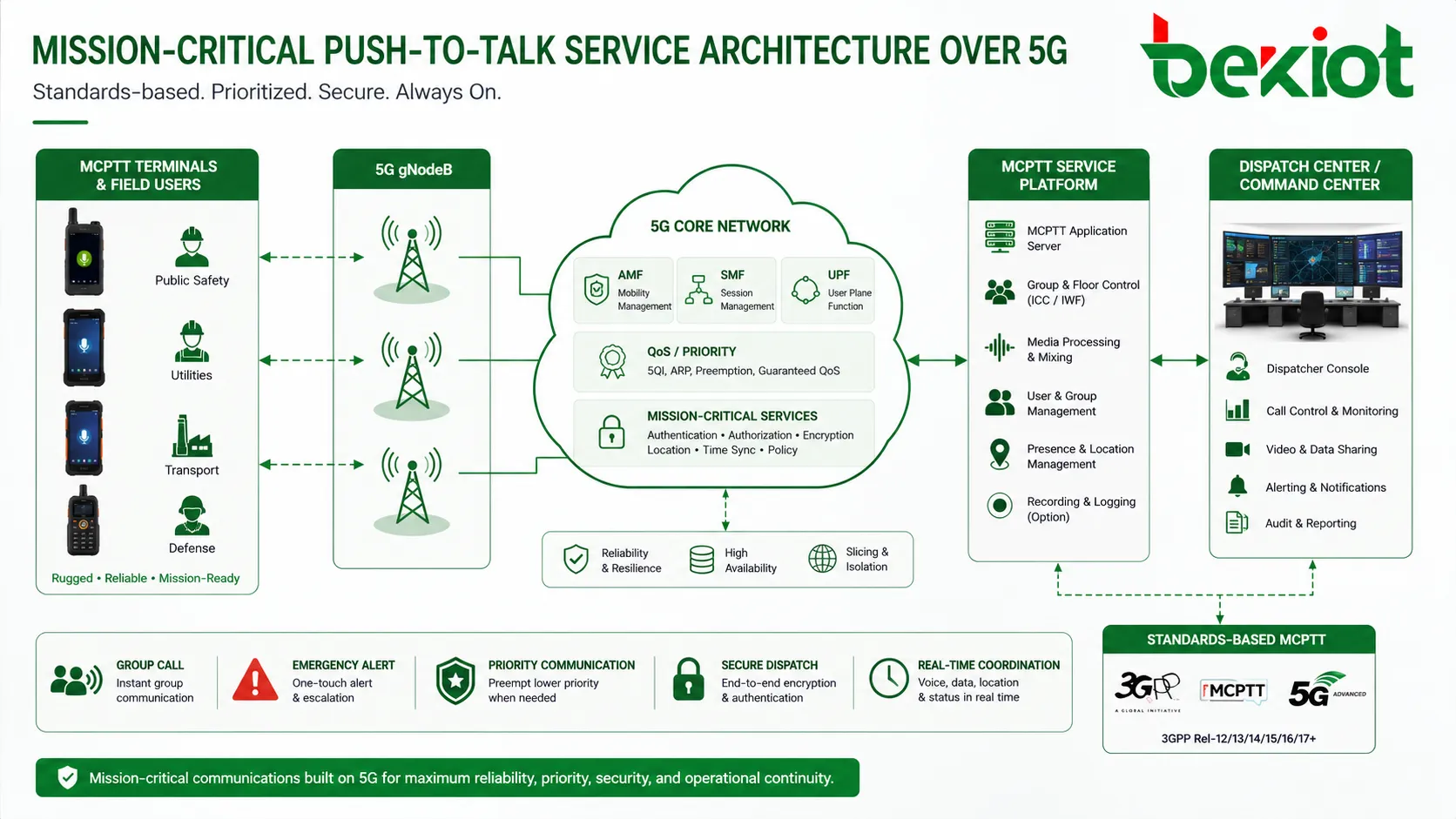
Priority and Latency Are the Key Differences
For mission-critical communication, connection speed and voice delay are not minor details. Emergency teams need fast call setup, predictable voice delivery, and reliable group communication when the network is under pressure. This is where MCPTT has a clear theoretical advantage.
MCPTT targets a call setup time of less than 300 milliseconds and a voice latency of less than 150 milliseconds. This brings the user experience closer to traditional two-way radio communication, where users expect immediate push-to-talk response and very low conversation delay.
PoC systems can work well in normal network conditions, but they usually rely on ordinary mobile data service quality. When the network is congested, overloaded, or unstable, a typical PoC service may not receive priority access. For emergency communication environments, this creates a certain level of risk.
Why MCPTT Is Harder to Deploy
Although MCPTT has strong technical advantages, it is not easy to deploy at scale. It requires much more than an application and a server. The mobile core network, base stations, terminals, SIM profiles, priority policies, service platform, security mechanism, and operation process must all support the mission-critical service model.
This makes MCPTT a large engineering project. It requires operator participation, specialized equipment vendors, advanced mobile network engineers, service configuration, testing, and long-term operation and maintenance. The technical threshold is much higher than ordinary PoC platform deployment.
For many commercial users, this complexity is unnecessary. Their daily communication requirements can be met by PoC. As a result, MCPTT is more suitable for public safety, emergency management, critical infrastructure, and 5G private network scenarios where the value of priority, reliability, and standardization justifies the cost.
Why Most Current Deployments Still Use PoC
In many real-world public-network PTT projects, PoC remains the dominant choice. The reason is not that MCPTT lacks value, but that PoC is easier to commercialize and easier to maintain. It does not require large-scale operator network transformation and does not require every terminal and platform to follow the full mission-critical architecture.
PoC also benefits from a mature device and software ecosystem. There are many terminal manufacturers, platform providers, dispatch software vendors, and system integrators that can deliver PoC solutions quickly. This creates a flexible market where users can choose different terminal styles, platform functions, and service models.
For organizations that need simple PTT, group calling, video communication, GPS location, dispatch management, and affordable wide-area communication, PoC is often the most practical option. It provides enough capability for many industry workflows without the complexity of MCPTT.
Where MCPTT Has Stronger Future Potential
MCPTT is still important because future critical communication will not only be about voice. Emergency response and industry command systems increasingly need mission-critical voice, video, data, location, alarm linkage, and cross-agency coordination. These requirements are closer to the MCX service direction defined in the 3GPP ecosystem.
In 5G private network environments, MCPTT may have more opportunities to develop. A private 5G network can provide better control over coverage, quality of service, user access, and system integration. This creates a stronger foundation for mission-critical communication than ordinary public internet-based application services.
For police, fire rescue, emergency management, transportation, energy, utilities, ports, airports, mining, and large industrial operations, MCPTT may become more attractive as 5G networks mature and mission-critical broadband applications become more common.
Hybrid Systems May Be the Practical Direction
The future may not be a simple choice between PoC and MCPTT. Many organizations may use hybrid systems. PoC can serve general communication users, commercial teams, and low-risk workflows. MCPTT can serve emergency users, priority channels, or high-reliability scenarios.
A hybrid architecture can also connect PoC terminals, SIP systems, IP PBX platforms, dispatch consoles, radio gateways, video systems, and private network resources. This allows project owners to build communication systems according to risk level and budget rather than forcing every user into the same service model.
For example, a transportation authority may use PoC for daily patrol communication, SIP phones for control-room calling, radio gateways for legacy radio interconnection, and MCPTT or private 5G services for emergency response groups. This layered design is more realistic for many professional projects.
Choosing the Right Model for a Project
The choice between PoC and MCPTT should start with workflow requirements. If the project mainly needs wide-area group communication, basic dispatch, location, and video functions at a controlled cost, PoC is usually easier to implement. It is suitable for fast deployment and flexible commercial operation.
If the project requires service priority, low latency, emergency-grade reliability, standardized mission-critical operation, and integration with operator network capabilities, MCPTT is the stronger technical direction. However, the project must be prepared for higher cost, deeper network involvement, and more complex operation and maintenance.
Project teams should evaluate user scale, emergency priority, terminal requirements, network coverage, operator support, budget, data security, and long-term expansion. The correct solution is not always the most advanced one. It is the one that matches the real communication risk and operational value.
Integration with Existing Communication Systems
Public-network PTT is often only one part of a larger communication architecture. Many organizations still need to connect SIP phones, IP PBX platforms, analog or digital radios, emergency broadcast systems, video dispatch platforms, and command-center applications.
This is where system integration becomes important. PoC platforms may need to connect with SIP systems. Radio users may need to communicate with mobile broadband users. Dispatchers may need to call field terminals, watch video, and coordinate multiple groups from one interface.
For projects that need SIP interconnection, radio gateway access, dispatch platform integration, or emergency communication system planning, Becke Telcom can be considered as a practical solution reference. The key is to match products and platforms to the actual command workflow rather than adding isolated devices.
Operational Planning Matters as Much as Technology
Whether a project chooses PoC, MCPTT, or a hybrid model, operation planning is essential. User groups, permissions, emergency calling rules, recording policy, location reporting, terminal management, network monitoring, and maintenance responsibility should be defined before deployment.
For PoC projects, administrators should pay attention to app stability, platform availability, SIM card management, data traffic, terminal battery life, and network coverage. For MCPTT projects, they also need to manage service priority, operator coordination, terminal certification, network configuration, and mission-critical service testing.
A public-network PTT system should not be treated as a simple walkie-talkie replacement. It is part of a wider command and communication system. Good planning makes the difference between a tool that only supports daily talking and a system that can support real emergency coordination.
FAQ
Is PoC the same as MCPTT?
No. PoC is usually an application-layer push-to-talk service running over mobile internet, while MCPTT is a 3GPP mission-critical service that can work more closely with mobile network priority and service control.
Why is PoC more common in current public-network PTT projects?
PoC is easier to deploy, lower in cost, and simpler to maintain. It does not require deep core network integration or fully customized mission-critical network configuration.
When should a project consider MCPTT?
MCPTT should be considered when the project requires emergency-grade reliability, service priority, low latency, standardized mission-critical communication, and strong operator network support.
Can PoC support video and location functions?
Yes. Many PoC platforms support group calling, private calling, GPS location, video communication, dispatch management, and recording. The exact functions depend on the platform and terminal design.
Can PoC and traditional radio systems be interconnected?
Yes. With suitable gateways, dispatch platforms, or SIP integration, PoC users can be connected with analog radios, digital radios, SIP phones, IP PBX systems, and command-center communication platforms.







