


In many converged communication projects, video integration is far more complex than simply connecting a camera to a platform. Different video devices may use different streaming protocols, encoding formats, network environments, and access methods. As a result, project teams often encounter problems such as failed video access, unstable playback, codec mismatch, delayed display, limited device compatibility, and repeated custom development.
Some converged communication platforms already provide GB/T28181-to-SIP functions. However, in real deployment, this method may still face issues when cameras cannot be pulled smoothly, some video streams fail to play, or non-standard field devices need to be connected. For more complex video sources such as drones, body-worn recorders, mobile monitoring devices, encoder systems, or third-party video platforms, a dedicated video access gateway is often a more practical solution.
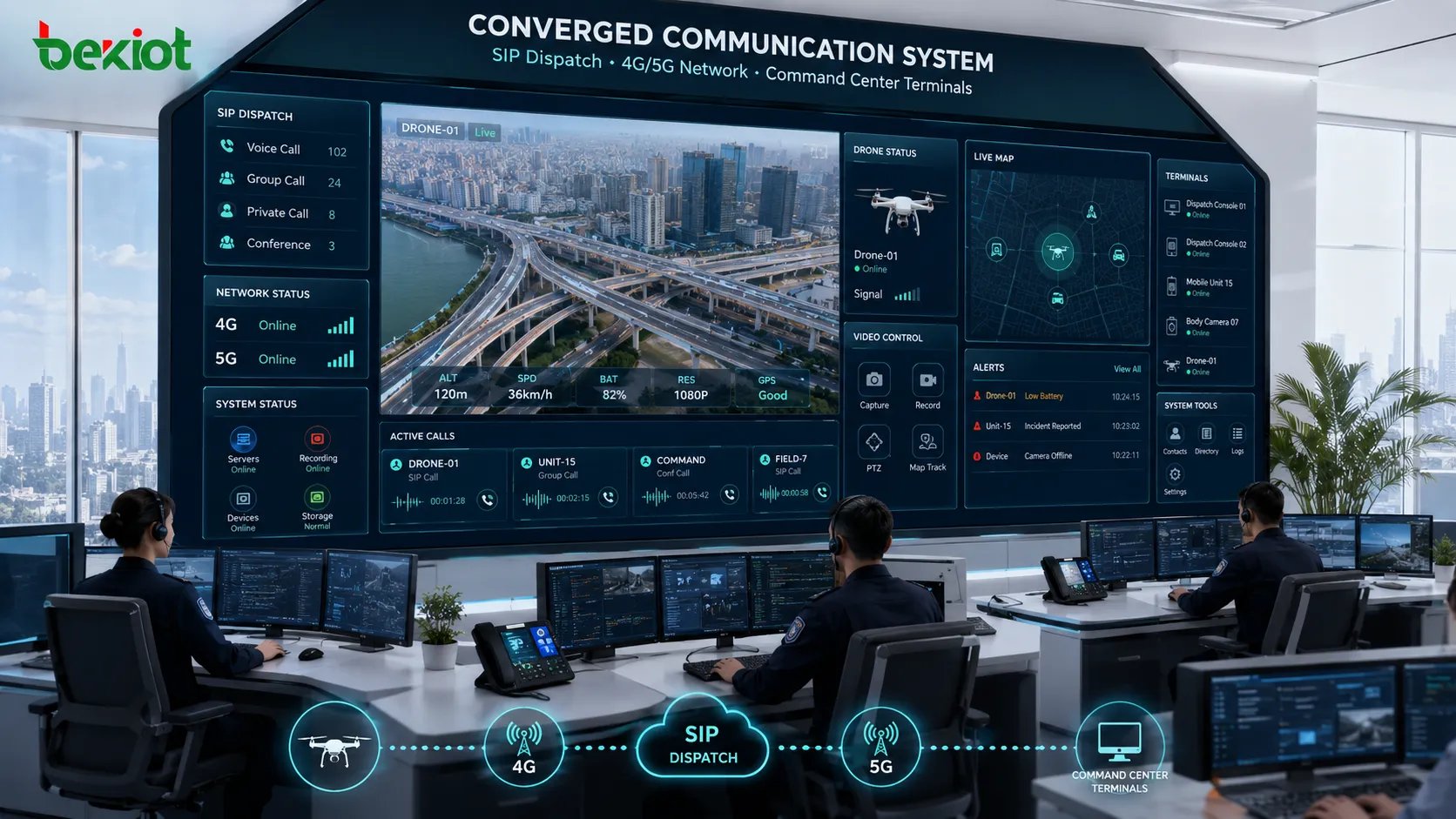
Why Video Integration Is Difficult
Different systems use different video technologies
A converged communication system usually focuses on voice dispatch, SIP calling, intercom, conferencing, paging, alarm linkage, and command coordination. Video systems, however, are often built around surveillance platforms, NVRs, drone controllers, encoders, mobile devices, and browser-based media services. These systems do not always speak the same technical language.
For example, one device may output GB/T28181 video, another may provide RTSP streams, a drone controller may push RTMP, and a web application may require FLV, HLS, or WebRTC. If the communication platform only supports a limited access method, the project team may need multiple converters, software modules, or custom development work to complete the integration.
Codec and playback compatibility often cause problems
Video access is not only about whether a stream address exists. The final terminal must also support the codec, resolution, bitrate, frame rate, and playback method. In many projects, surveillance cameras already output 4K or H.265 streams, while many dispatch terminals, SIP video phones, or embedded communication devices still work better with 1080p or H.264 streams.
This mismatch may cause black screens, slow loading, high latency, unstable playback, or complete playback failure. A video access gateway can be placed between the video source and the converged communication platform to normalize streams before they reach the final terminal.
Standardized Access for GB/T28181 Devices
Connecting more than surveillance cameras
GB/T28181 has become a widely used standard in the video surveillance industry. As the standard has expanded, GB/T28181 devices are no longer limited to ordinary security cameras. A project may include GB/T28181 cameras, portable monitoring balls, NVRs, encoder and decoder devices, drones, body-worn recorders, and even lower-level or upper-level video platforms.
A video access gateway can connect these resources through GB/T28181 and make them available to the converged communication system. Whether the source is an endpoint device or another video platform, the gateway can simplify access through standard configuration instead of requiring a separate integration method for every device type.
Improving adaptation and troubleshooting
In real projects, GB/T28181 compatibility may vary between devices and manufacturers. Some devices follow the standard closely, while others may have differences in registration behavior, catalog reporting, stream negotiation, keepalive handling, or media transmission. This is why a mature protocol adaptation layer is important.
A purpose-built video access gateway can help locate compatibility issues faster, improve device adaptation, and reduce repeated debugging work during project delivery. For integrators, this is especially valuable when the project contains many device brands or when the system must connect both field terminals and platform-level resources.
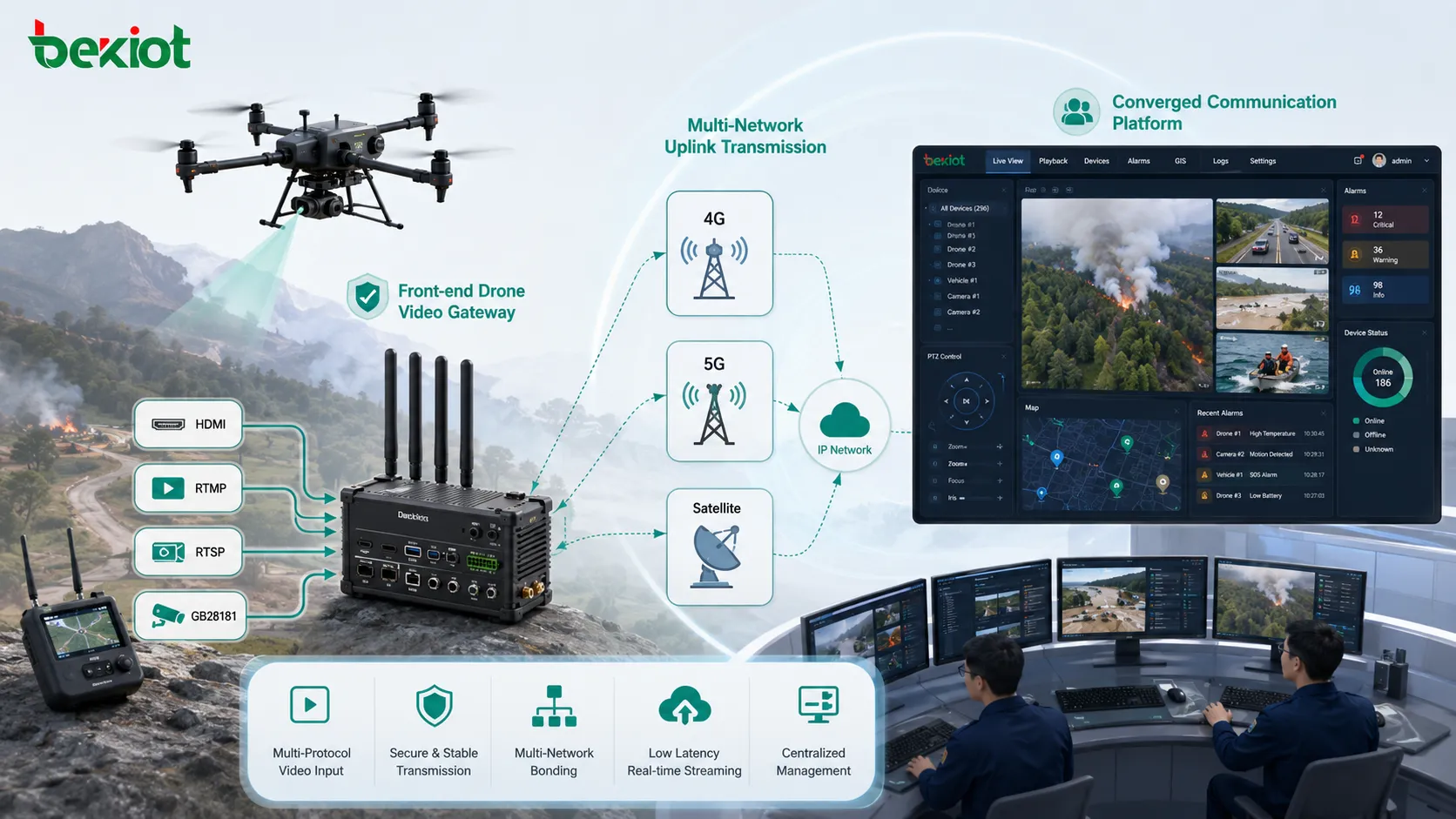
Bringing Drone Video into Communication Workflows
Turning drone footage into usable dispatch resources
Drone video is increasingly used in emergency response, traffic inspection, power patrol, water conservancy monitoring, industrial supervision, fire rescue, and large event security. However, drone footage is often separated from the communication system because it stays inside a drone controller, drone app, drone dock platform, or manufacturer-specific cloud platform.
A video access gateway can provide live media access for drone streams and connect the drone video with SIP-based communication systems. After integration, drone video can be delivered to dispatch consoles, command center screens, video phones, smart terminals, and other communication endpoints. This allows operators to view aerial video while making voice calls, group dispatch decisions, or emergency coordination commands.
Supporting advanced drone scenarios
For more advanced applications, the gateway architecture can also support access from drone platforms, drone docks, airport systems, fixed-wing drones, multi-rotor drones, and hybrid-wing drones. This reduces the need for the converged communication platform to develop separate interfaces for every drone vendor or application platform.
Instead of treating drones as isolated video sources, the system can convert drone footage into reusable communication resources. Operators can assign names, numbers, permissions, and workflows to drone streams, making them easier to call, view, share, record, and distribute during command operations.
One Gateway for Multiple Streaming Protocols
Adapting push and pull video environments
A video access gateway is not limited to a single protocol. In practical projects, it may support GB/T28181, SIP, RTSP, RTMP, FLV, HLS, WebRTC, and other common video transmission or playback methods. This makes it suitable for both push-stream and pull-stream scenarios.
For example, cameras and NVRs may provide RTSP streams, drones may push RTMP streams, video platforms may provide GB/T28181 resources, and browser-based dispatch systems may prefer FLV, HLS, or WebRTC playback. The gateway acts as the media conversion and distribution layer between these systems.
Reducing scattered software deployment
Without a unified gateway, a project may require separate software for GB/T28181 access, RTMP receiving, RTSP pulling, WebRTC playback, SIP video integration, and stream forwarding. This increases deployment complexity and creates more points of failure.
By centralizing media access in one gateway, the system architecture becomes clearer. Video sources enter through a controlled access layer, are converted or forwarded according to project needs, and are then delivered to dispatch terminals, video phones, monitoring workstations, browser clients, or command center platforms.
Solving Codec and Resolution Mismatch
Why H.265 and 4K can become a problem
Many modern surveillance devices support high-definition video, 4K resolution, and H.265 encoding. These technologies are useful for storage efficiency and image quality, but they may not match the playback capability of every converged communication terminal. A SIP video phone, dispatch console, browser client, or embedded smart terminal may require H.264, lower resolution, or a different bitrate.
This is one of the common reasons why some cameras can be viewed while others cannot. The stream exists, but the terminal cannot decode or display it correctly. If the platform only performs simple forwarding, it may not solve the underlying codec compatibility issue.
Transcoding makes streams easier to use
A video access gateway with transcoding capability can adjust important media parameters such as codec, resolution, frame rate, and bitrate. For example, it can convert H.265 to H.264, reduce 4K video to 1080p, lower the bitrate for mobile viewing, or adapt the stream for a specific SIP terminal.
For large-capacity projects, a dedicated video transcoding server may also be used to handle multiple concurrent transcoding tasks. This is useful when many high-definition streams need to be delivered to different terminals at the same time, especially in command centers, transportation systems, industrial parks, and emergency communication platforms.
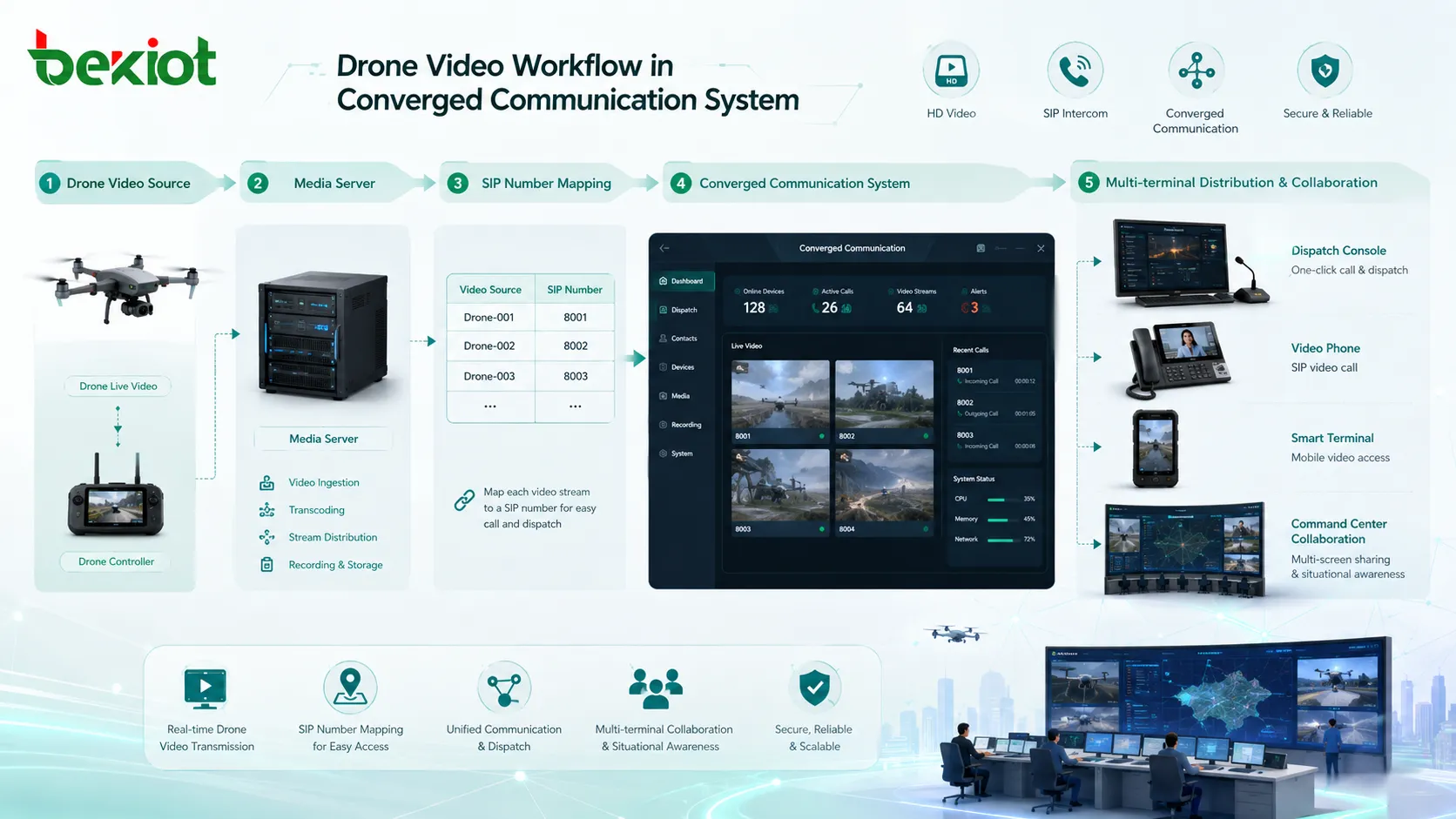
Flexible SIP Networking Options
Peer-to-peer mode for controlled network environments
To deliver video into a converged communication system, the video access gateway often needs to work with the communication platform through SIP networking. In a peer-to-peer mode, the gateway and the converged communication system communicate through direct IP reachability. Both systems need proper routing, firewall rules, and bidirectional network access.
This method is suitable for large projects where the gateway and communication server are deployed in the same data center, equipment room, private network, or controlled enterprise network. It provides a clear and stable path for media negotiation and SIP communication.
Registration mode for private network access
In some projects, the video source is located inside a private network, while the converged communication system is deployed in another network environment. In this case, registration-based SIP networking can be more practical. The video access gateway can be installed inside the video network and register to the communication platform as a SIP device or media node.
This helps solve network traversal problems and reduces the requirement for direct inbound access to the gateway. It is especially useful for distributed projects, remote sites, private LAN video systems, temporary command points, and scenarios where the gateway must sit close to cameras or video platforms.
API Integration for Deeper Applications
When standard SIP video is not enough
In many projects, sending a standard SIP video stream to the communication system is enough. The dispatcher can call a video resource, view a live image, or open a video stream during an event. However, some applications require more detailed video resource control and data exchange.
For example, the dispatch platform may need to read a GB/T28181 device catalog, display camera groups, control PTZ movement, query stream status, obtain recording information, or present video through FLV or WebRTC inside a web-based console. These functions often require API integration in addition to SIP media transmission.
Making the dispatch platform more capable
A video access gateway with API capabilities can provide the communication platform with richer video resource information. Instead of only receiving a video stream, the dispatch system can manage resources, call cameras, control PTZ, display web video, and integrate video actions into command workflows.
For Becke Telcom / 贝克通信 communication solutions, a video access gateway can be used as a practical media access layer when SIP dispatch, emergency calling, video viewing, drone footage, and browser-based command functions need to work together. The gateway does not replace the communication platform; it strengthens the video-side integration capability.
Practical Deployment Architecture
Field access, media processing, and communication delivery
A practical deployment can be divided into three layers. The field access layer includes cameras, NVRs, encoders, drones, portable monitoring devices, body-worn recorders, and existing video platforms. These devices provide video through GB/T28181, RTSP, RTMP, HDMI, or other supported methods.
The media processing layer is the video access gateway or transcoding server. This layer handles protocol adaptation, stream pulling, stream receiving, transcoding, forwarding, SIP mapping, and API service. It makes scattered video resources easier to manage and easier to deliver.
The communication delivery layer includes the converged communication platform, dispatch console, video phone, SIP terminal, command center screen, browser client, mobile device, and recording system. These terminals use the processed streams for live viewing, dispatch collaboration, conference sharing, event handling, and evidence review.
How the workflow operates
When a dispatcher selects a video resource, the communication platform can request the gateway to provide the corresponding stream. The gateway pulls or receives the video source, converts the stream if necessary, and delivers it in a format supported by the terminal. If SIP integration is used, the video resource can also be mapped to a SIP number for calling and routing.
If the user needs richer control, API integration can provide catalog browsing, stream selection, PTZ operation, device status, and web playback functions. This turns the gateway into a bridge between video systems and communication workflows rather than a simple stream converter.
Selection and Project Delivery Notes
Confirm protocols and terminal capability early
Before selecting a video access gateway, the project team should list all video source types, supported protocols, codec formats, resolutions, target terminals, network segments, and security rules. It is important to confirm whether each source uses GB/T28181, RTSP, RTMP, FLV, HLS, WebRTC, SIP, or another access method.
The team should also confirm the decoding capability of dispatch consoles, video phones, browser clients, and mobile terminals. If terminal capability is limited, transcoding should be planned from the beginning rather than added after playback problems appear.
Design for operation and future expansion
A video access gateway should be easy to configure, stable under continuous operation, and suitable for future expansion. For multi-site projects, administrators should plan stream naming, permission control, device grouping, network routes, recording rules, maintenance access, and fault monitoring.
The best result is not only successful video playback. A well-designed gateway layer should reduce integration workload, improve system stability, simplify troubleshooting, and allow the converged communication system to support more video-based command scenarios over time.
Conclusion
A video access gateway can solve many practical problems in converged communication projects. It can connect GB/T28181 devices, integrate drone video, support multiple streaming protocols, adapt push and pull environments, convert H.265 and 4K streams, provide SIP networking, and expose APIs for deeper platform integration.
For projects that involve emergency command, industrial dispatch, transportation control, smart campus operation, public safety coordination, or multi-site video access, the gateway becomes an important media bridge. It helps transform scattered video sources into usable communication resources that can be viewed, called, shared, routed, recorded, and managed through a unified platform.
FAQ
Can a video access gateway replace a video management platform?
Not completely. A gateway focuses on access, protocol conversion, transcoding, SIP mapping, stream distribution, and integration. A full video management platform may also include long-term storage, user permission management, alarm rules, GIS maps, AI analysis, and large-scale camera operations. In many projects, the two systems can work together.
Does the gateway need to be installed near the cameras?
It depends on the network architecture. If cameras are inside a private LAN, installing the gateway near the video source can simplify access. If all sources can be reached from the data center, the gateway can be deployed centrally. Distributed projects may use both local and central gateways.
How should video resources be named in a dispatch system?
A clear naming rule is important. Resource names should include site, building, area, device type, camera direction, or drone team information. This helps dispatchers quickly select the correct video during an emergency instead of searching through unclear device IDs.
What should be tested before project acceptance?
Acceptance testing should include GB/T28181 registration, RTSP pulling, RTMP receiving, SIP video calling, transcoding output, browser playback, PTZ control, multi-terminal viewing, network interruption recovery, concurrent stream load, and long-time stability.
Can the gateway support both live video and recorded video?
Many gateways focus mainly on live video access and real-time media conversion. Recorded video usually depends on the connected NVR, video platform, or storage server. If recording retrieval is required, the API and platform compatibility should be confirmed during the design stage.







