Ringing voltage is one of the most basic but easily overlooked signals in analog telephone communication. Before a user answers a call, the telephone line must provide a ringing signal strong enough to drive the ringer circuit of the connected telephone, bell, analog endpoint, or signaling device. If the ringing voltage is too weak, unstable, incorrectly timed, or overloaded by too many devices, the phone may not ring even though the call route itself is correct.
In modern communication projects, ringing voltage still matters because many systems continue to use analog interfaces. PBX FXS ports, analog telephone adapters, elevator emergency phones, industrial telephones, door intercoms, analog gateways, hotline phones, and legacy telephone extensions may all depend on a correct ringing signal. Understanding its working principle, deployment advantages, and maintenance techniques helps engineers avoid missed calls, false fault judgment, poor endpoint compatibility, and unnecessary equipment replacement.
What ringing voltage means in analog telephony
Electrical signal used to alert the endpoint
Ringing voltage is the electrical signal applied to an analog telephone line to make the connected device ring when an incoming call arrives. In a traditional analog line, the telephone normally stays on-hook while waiting for calls. When the exchange, PBX, gateway, or FXS interface needs to alert the endpoint, it applies a ringing signal to the line. The endpoint detects this signal and activates its bell, ringer, buzzer, speaker, lamp, or electronic ringtone circuit.
This signal is different from the audible ringback tone heard by the caller. Ringback tone is the sound sent to the calling party to indicate that the called side is being alerted. Ringing voltage is the actual electrical signal sent to the called telephone line to make the local device ring. Confusing these two concepts can lead to troubleshooting mistakes. A caller may hear ringback, but the endpoint may still fail to ring if the local ringing voltage or ringer load is abnormal.
Relationship with FXS interfaces
In customer-side systems, ringing voltage is usually generated by an FXS interface. FXS stands for Foreign Exchange Station, which is the port that provides battery feed, dial tone, loop current, and ringing signal to an analog telephone. A PBX analog extension card, VoIP ATA, analog gateway, elevator phone interface, or telephone line simulator may all include an FXS port.
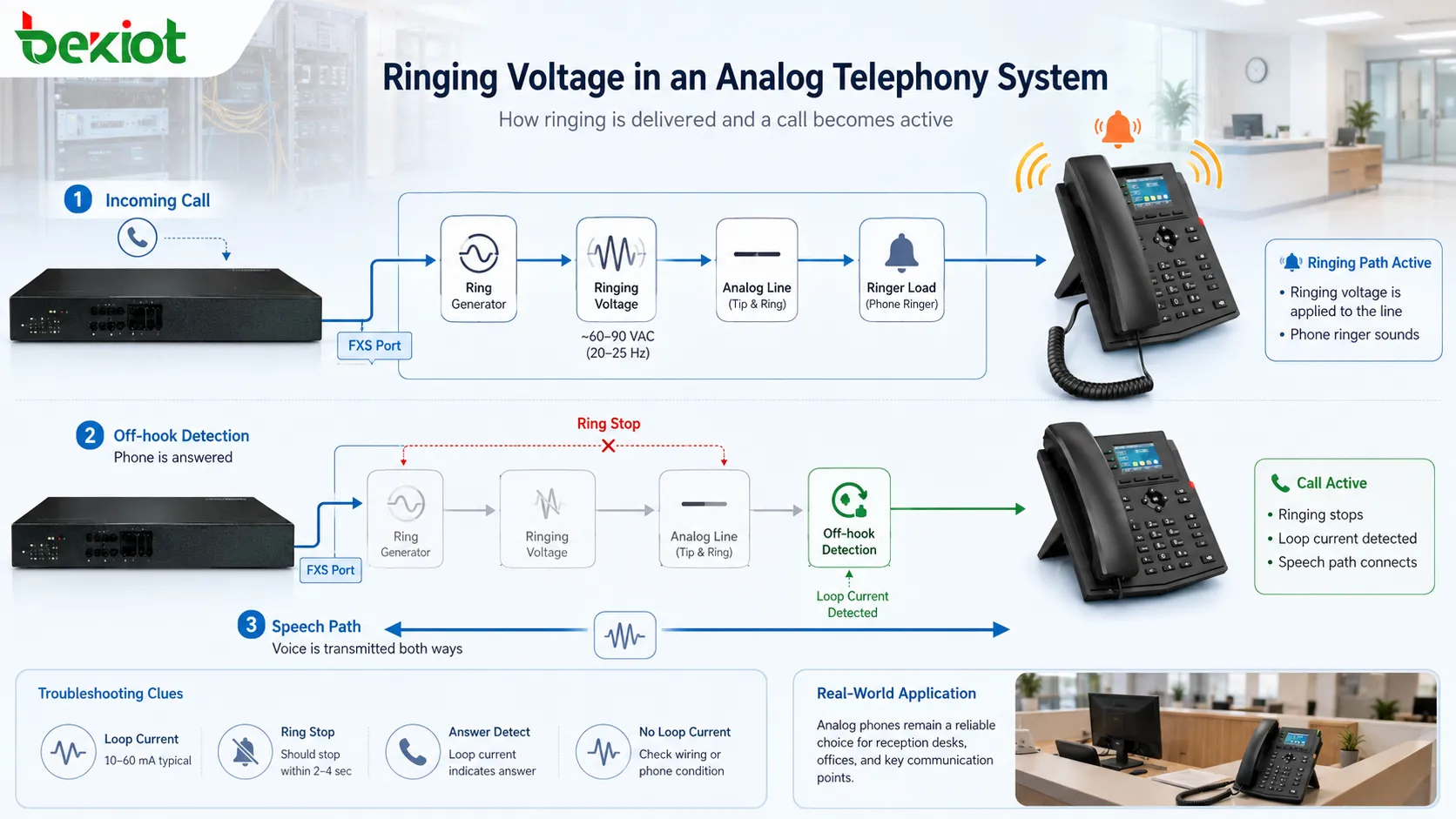
The FXS port behaves like a small local telephone exchange for the connected endpoint. When a call arrives, the FXS circuit generates ringing voltage according to its design and configuration. If the endpoint goes off-hook, the port detects loop current change and stops the ringing signal. This relationship is central to analog telephone operation.
Ringing voltage and ring cadence
Ringing voltage is not applied continuously. It is usually sent in a ring cadence: a repeated pattern of ring-on and ring-off intervals. For example, the phone may ring for a short period, pause, and then ring again. Different countries, PBX systems, gateways, and special service types may use different cadence patterns.
Ring cadence affects user experience and endpoint behavior. Some devices recognize distinctive ringing patterns. Some hotel, office, or PBX systems use different ring cadences to distinguish internal calls, external calls, group calls, or priority calls. During maintenance, engineers should check not only voltage level but also cadence timing.
Working principle and signal path
Call arrival and ringing generation
The process begins when the system determines that an analog extension should be alerted. A call may come from another extension, a SIP trunk, a PSTN line, a door intercom, an emergency call route, or an internal dispatch rule. The switching system selects the target analog port and commands the FXS circuit to generate ringing voltage.
The ringing generator sends an AC ringing signal to the line. The connected endpoint detects the signal through its ringer circuit. If the user answers by lifting the handset or otherwise going off-hook, the loop state changes. The FXS port detects this answer condition, stops the ringing signal, and establishes the talk path.
Line load and ringer response
The ringing signal must supply enough energy to operate the ringer load. Older electromechanical bells may require more ringing current than modern electronic ringers. If several analog devices are connected in parallel on the same line, the total load increases. When the load exceeds the capacity of the FXS port, some or all devices may fail to ring.
This is why REN, or Ringer Equivalence Number, is important in analog deployment. REN represents the approximate ringing load presented by a telephone or ringer. The total REN connected to a line should remain within the capacity of the line or port. If the total load is too high, ringing voltage may drop, ringing current may be insufficient, or the port may enter protection behavior.
Interaction with cable distance
Cable distance affects ringing performance. Long cables add resistance, capacitance, and possible leakage paths. In clean and properly installed wiring, analog ringing can travel a reasonable distance. In aging, wet, damaged, poorly terminated, or high-capacitance wiring, the ringing signal may weaken or become distorted.
Cable problems may not always affect voice and ringing in the same way. A line may support conversation after the user answers but fail to ring reliably. This happens because ringing requires a higher voltage signal and enough current to drive the ringer. Maintenance should therefore test both call audio and ringing performance.
Stop condition after answer
When the called endpoint is answered, the line changes from on-hook to off-hook state. The FXS circuit detects the loop current and stops the ringing signal. This prevents high-voltage ringing from continuing while the user is on the call. If answer detection is abnormal, ringing may continue unexpectedly, stop too early, or fail to transition into speech.
Problems in this transition may come from endpoint impedance, wiring faults, wrong interface type, incompatible terminal equipment, or FXS hardware failure. Troubleshooting should include the full path from ringing generation to answer detection.
Deployment advantages
Supports legacy analog endpoints
The first deployment advantage of ringing voltage is compatibility with analog endpoints. Many facilities still use analog telephones, emergency phones, elevator phones, hotline phones, industrial telephones, wall phones, door phones, and simple service phones. These endpoints may not require IP registration, local power adapters, or complex software configuration.
For projects that need to preserve existing devices, analog ringing support can reduce replacement cost. Instead of changing every endpoint to an IP terminal, the system can use PBX analog cards, FXS gateways, or ATAs to continue driving the analog lines. This is especially useful in buildings with existing copper wiring.
Simple endpoint operation
Analog endpoints are often simple to use. The phone rings, the user answers, and the call begins. This simplicity is valuable in public areas, equipment rooms, elevators, industrial sites, guard posts, visitor points, and emergency locations. Users do not need to understand login status, network registration, or software menus.
Ringing voltage enables this familiar interaction. The device gives a clear local alert when a call arrives. In environments where users may be untrained, stressed, or wearing gloves, simple ringing and handset operation can still be practical.
Useful for emergency and service points
Many emergency and service communication points rely on analog interfaces because they are stable, simple, and easy to monitor. Elevator emergency phones, roadside phones, help points, door communication units, and facility service phones may use ringing voltage to alert local or remote endpoints during incoming calls.
In these cases, ringing must be reliable. A missed ring may mean a missed assistance call. The deployment value is not only technical compatibility, but operational availability. A properly designed ringing circuit ensures that the endpoint produces a clear alert when the system calls it.
Works with PBX and gateway migration
Ringing voltage is important during migration from traditional telephony to VoIP or unified communication. Organizations may deploy IP PBX systems while retaining analog phones through gateways. The gateway must generate suitable ringing voltage for connected analog terminals.
This allows phased migration. Existing analog extensions can continue working while new SIP phones or IP terminals are added. For hotels, hospitals, factories, campuses, offices, warehouses, and public facilities, this reduces disruption and spreads investment over time.
Provides local audible confirmation
A ringing analog phone provides immediate local confirmation that the call is reaching the physical endpoint. In many field environments, this is useful. A guard room, equipment area, elevator machine room, warehouse desk, or maintenance station may need a clearly audible ring rather than only a software notification.
Local audible alert is also useful when users are not watching screens. A ringing telephone can attract attention even if the staff member is away from a console. This makes ringing voltage part of daily operational awareness.
Key technical characteristics
Voltage level
Ringing voltage is typically a relatively high-voltage AC signal compared with normal low-voltage control signals. The exact value depends on the country, exchange, PBX, gateway, line card, load, and design standard. Engineers should not assume that all systems use exactly the same ringing voltage.
From a maintenance perspective, voltage should be measured under realistic conditions. Measuring an unloaded port may show a higher value than measuring the same port with phones connected. If the connected load is high, the voltage may drop during ringing. Both unloaded and loaded behavior can be useful for diagnosis.
Frequency and waveform
Ringing signals are usually low-frequency AC signals. The frequency and waveform may vary between telephone administrations, PBX equipment, gateways, and analog adapters. Older electromechanical bells may be more sensitive to frequency and waveform shape than modern electronic ringers.
A device may fail to ring if the voltage is present but the waveform, frequency, or available current is unsuitable. This is common when connecting old analog telephones or mechanical bells to some VoIP ATAs or low-power analog ports. Maintenance should consider more than voltage reading alone.
Ringer load and REN capacity
Ringer load determines how many devices can be connected to one ringing source. REN is commonly used to estimate this load. If a line has several telephones connected in parallel, their total REN may exceed what the FXS port can support. When this happens, ringing may become weak, intermittent, or completely absent.
REN capacity is especially important in retrofit projects. A legacy wiring loop may have multiple phones, bells, fax devices, modems, alarm dialers, or hidden extensions connected. Before replacing a line provider or PBX, the total ringer load should be checked.
Ring cadence control
Ring cadence controls the pattern of ringing. A system may provide different cadence for internal calls, external calls, priority calls, or special services. Some analog endpoints can respond differently depending on cadence. Some users also rely on cadence to identify call type.
When a new PBX, ATA, or gateway is installed, ring cadence should be checked. If users report that “the phone rings differently” or “the bell does not ring long enough,” the issue may be cadence configuration rather than voltage failure.
Isolation and safety design
Because ringing voltage can be much higher than ordinary low-voltage signal levels, proper isolation and safety design are necessary. FXS equipment, line cards, gateways, and test tools should be designed for telephone ringing conditions. Technicians should use suitable meters and follow safe procedures.
Ringing voltage should not be treated casually just because it is part of a telephone line. Testing should avoid shorting the line, touching exposed conductors during ringing, or using unsuitable instruments. Safety is part of maintenance quality.
Application scenarios
PBX analog extensions
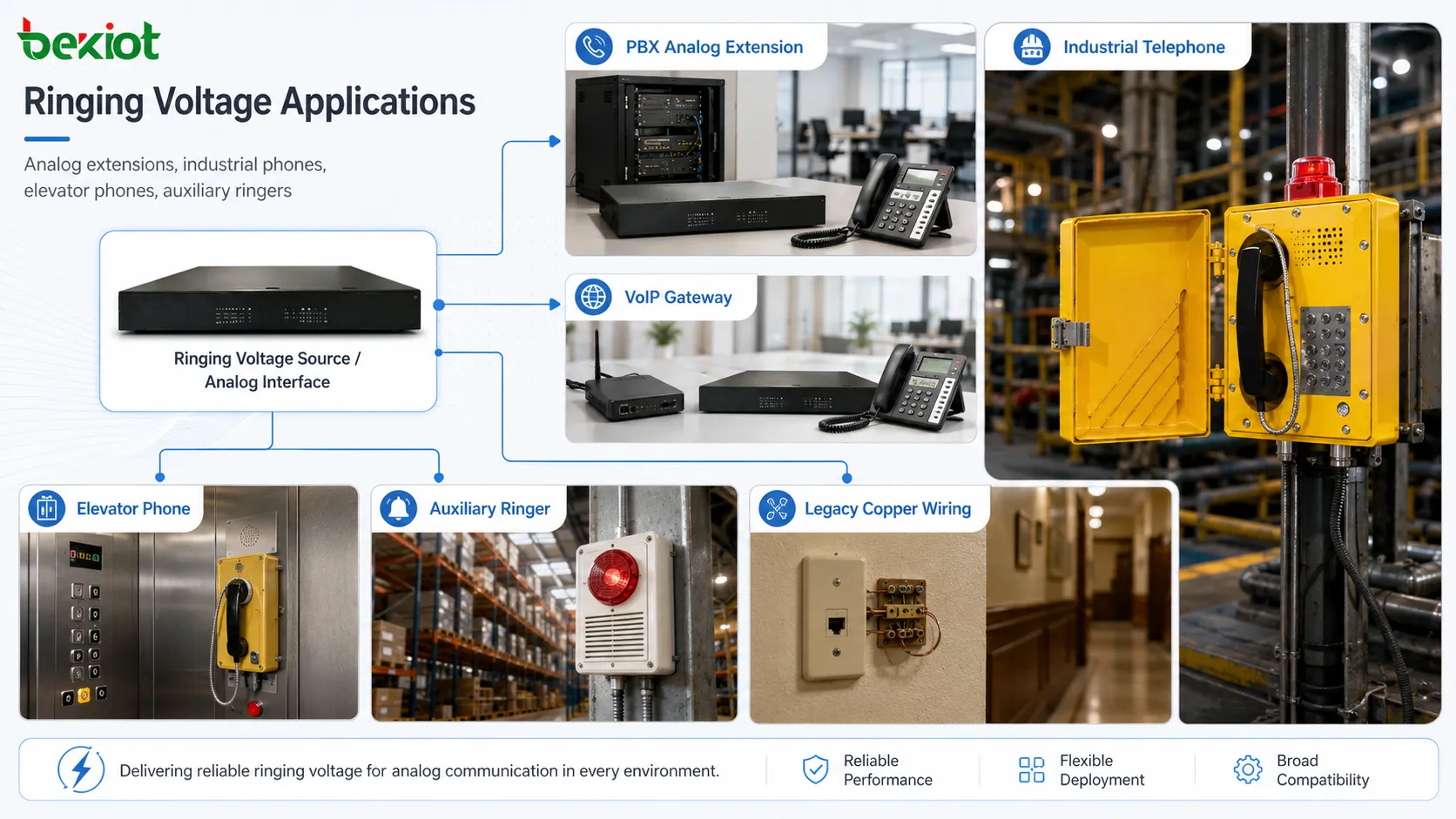
PBX systems often provide analog extension ports for ordinary analog phones, fax machines, elevator phones, hotline devices, or simple service terminals. Ringing voltage allows the PBX to alert these endpoints when calls arrive. In mixed deployments, analog extensions may coexist with SIP phones and digital terminals.
The main requirement is port capacity. Each analog extension port should support the connected ringer load and expected cable length. If several devices are bridged onto one port, engineers should verify whether the port can drive all ringers reliably.
VoIP ATA and analog gateways
Analog telephone adapters and gateways convert VoIP signaling into analog line behavior. They must provide dial tone, loop current, DTMF detection, and ringing voltage for analog endpoints. Ringing performance is often a key difference between a reliable gateway and a weak one.
In VoIP migration projects, users may complain that old phones no longer ring after moving from traditional PSTN lines to an ATA. The cause may be lower REN capacity, different waveform, weaker ringing current, long cable runs, or incompatible ringer circuits. Gateway selection should therefore include ringing capacity review.
Elevator and emergency telephones
Elevator emergency telephones and help phones may use analog interfaces. Although many of these devices initiate calls outward, some systems also need to call back to the device for testing, maintenance, or two-way communication. Ringing voltage must be able to alert the endpoint if inbound ringing is required.
Emergency devices should be tested regularly. It is not enough to confirm that the call button can dial out. Inbound ringing, answer behavior, audio path, line supervision, and backup power may also be important depending on the installation.
Industrial and outdoor analog phones
Industrial facilities may use analog phones in workshops, utility areas, outdoor yards, tunnels, gates, warehouses, and equipment rooms. These phones may be rugged, waterproof, or designed for harsh environments, but they still depend on suitable analog line signaling when connected through FXS ports.
Long cable runs and outdoor conditions can affect ringing. Water ingress, corrosion, insulation leakage, surge damage, poor grounding, and cable aging may reduce ringing performance. Maintenance should include both device and line checks.
Legacy bells and auxiliary ringers
Some sites use external bells, loud ringers, visual ring indicators, or auxiliary signaling devices. These are useful in noisy workshops, warehouses, large rooms, or areas where a normal telephone ring is too weak. These devices add load to the ringing circuit.
Before adding auxiliary ringers, engineers should check the available REN capacity and line voltage under load. If the port cannot support the added load, a ring booster, separate relay-controlled device, or active signaling method may be needed.
Maintenance techniques
Check whether the call reaches the port
Before measuring voltage, confirm whether the call is actually reaching the correct analog port. A phone that does not ring may be caused by wrong extension routing, disabled port, incorrect call group, time schedule, forwarding rule, do-not-disturb setting, or PBX configuration. Electrical testing should not begin until call routing is verified.
Use system logs, call status, port indicators, or a known-good test phone to confirm the call path. If the port never receives a ringing command, the problem is in call control rather than ringing voltage.
Measure ringing voltage safely
Ringing voltage should be measured with a suitable meter and safe procedure. Because the signal is AC and may be applied in bursts, the technician should use the correct measurement mode and understand the ring cadence. A meter that is not suitable for telephone ringing may show unstable or misleading readings.
Measurement should be performed carefully to avoid shorting tip and ring. If possible, test first with a known-good endpoint. For maintenance in active systems, technicians should follow site safety rules and avoid exposing users or equipment to unnecessary risk.
Measure under load
Unloaded voltage measurement can be misleading. A port may show an acceptable voltage with no phone connected but fail when connected to several ringers or long wiring. Loaded testing shows whether the port can provide enough voltage and current under actual conditions.
A practical method is to test with one known-good analog phone first, then add the actual wiring or devices. If one phone rings but the full line does not, the problem may be excessive load, cable leakage, hidden devices, or endpoint incompatibility.
Check total REN load
Add up the REN values of devices connected to the same line where possible. Older phones and bells may have higher ringer load than modern electronic phones. Some hidden devices may not be obvious, such as fax machines, modems, alarm panels, or external ringers connected in parallel.
If the total load is too high, reduce the number of devices, split the line, use a stronger FXS source, add an appropriate ring booster, or replace high-load ringers with lower-load devices. Simply increasing settings without understanding load may stress the port.
Inspect cable and termination
Cable faults are a common cause of ringing problems. Inspect connectors, punch-down blocks, junction boxes, terminal screws, outdoor cable entries, moisture exposure, corrosion, cable splices, and insulation condition. A line may pass basic continuity tests but still leak under high-voltage ringing.
Long or poor-quality cable can reduce ringing performance. If the line passes through several old joints, extension branches, or damp areas, isolate sections and test them separately. Divide-and-test troubleshooting is often faster than guessing.
Compare with a known-good endpoint
Use a known-good analog telephone to separate device problems from line problems. If the test phone rings correctly on the port, the original endpoint may have a faulty ringer, incompatible impedance, disabled ring setting, broken bell, damaged capacitor, or incorrect wiring. If the test phone also fails, focus on the port, cable, or system configuration.
Known-good testing is simple but effective. It prevents unnecessary replacement of PBX cards or gateways when the actual problem is a single phone, and it prevents endpoint replacement when the issue is the line.
Common fault symptoms
Phone does not ring but can make outgoing calls
This symptom usually means the speech path or loop current may be working, but the ringing path has a problem. Possible causes include weak ringing voltage, excessive REN load, wrong cadence, failed ringer circuit, disabled ring volume, cable leakage, or incompatible FXS port.
Troubleshooting should check call routing, ringing voltage, loaded behavior, endpoint ringer setting, REN load, and cable condition. Do not assume the phone is healthy only because it can dial out.
Some phones ring while others do not
If several phones share one analog line and only some ring, the issue may be ringer sensitivity, REN load, wiring branch quality, or device compatibility. A modern electronic phone may ring from a weak signal while an older mechanical bell may not.
Test each phone individually on the same known-good port. Then test them together. This helps identify whether the issue is a single endpoint or total load.
Ringing stops after adding more devices
This usually indicates overload. The FXS port can no longer supply enough ringing current for the total connected load. Some ports may reduce output or shut down ringing protection when overloaded. The result is no ring or weak intermittent ringing.
The solution is to reduce load, split devices across ports, use lower-REN equipment, or add an appropriate external ringing solution. Blindly adding more bells to the same line often makes the problem worse.
Intermittent ringing
Intermittent ringing may be caused by loose connections, moisture, cable movement, failing ring generator, unstable power, software settings, or borderline load. It can also occur when the line works under dry conditions but fails during rain or humidity.
Maintenance should include environmental inspection. Outdoor junction boxes, damp conduits, basement wiring, and corroded terminals are common sources of intermittent ringing faults.
False ringing or abnormal ringing
False ringing may appear when interference, induced voltage, faulty equipment, or incorrect wiring creates a signal that the endpoint interprets as ringing. Abnormal ringing may also be caused by wrong cadence, wrong interface connection, or mixed use of incompatible equipment.
Check grounding, cable routing, nearby power cables, surge protectors, PBX configuration, and endpoint compatibility. False ringing can be difficult to diagnose if the problem occurs only under certain electrical or environmental conditions.
Design considerations for reliable deployment
Match the FXS source to the endpoint load
The ringing source must match the number and type of connected endpoints. A single low-power ATA may be suitable for one modern analog phone but not for several mechanical bells or long extension wiring. Before deployment, check the FXS port’s ringing capacity and the connected REN load.
For larger analog deployments, use equipment designed for the expected scale. Multiple analog ports, proper distribution, active ringers, or dedicated ring boosters may be needed. Reliable design starts with capacity planning.
Avoid unnecessary parallel devices
Bridging many devices onto one analog line may seem convenient, but it increases load and complicates troubleshooting. Each additional device may reduce ringing performance and introduce fault points. If multiple alert points are required, consider whether separate extensions, paging, relay outputs, or active signaling devices are more suitable.
Parallel wiring should be documented. Hidden branches are a common reason for unexpected REN load and intermittent problems. Maintenance becomes easier when wiring structure is known.
Protect outdoor and long cable runs
Outdoor and long analog lines should include proper cable protection. Surge protection, grounding, waterproof junctions, correct cable type, secure termination, and physical protection are important. Ringing voltage may be affected by cable faults caused by moisture, lightning, rodents, mechanical damage, or corrosion.
Long runs should be tested after installation and periodically during maintenance. If a site has repeated ringing failures after storms, power events, or seasonal humidity changes, cable protection and grounding should be reviewed.
Configure cadence and ring duration correctly
PBX, ATA, and gateway systems may allow ring cadence, ring frequency, ring timeout, ring group behavior, and distinctive ringing settings. These should be configured according to the endpoint and user requirement. A very short ring duration may cause users to miss calls even if the voltage is correct.
Ring group settings should also be checked. In some systems, several extensions ring together. If the group timeout is too short, the analog phone may stop ringing before users can reach it. Deployment should consider human response time, not only electrical signaling.
Document test values and wiring records
During commissioning, record ring voltage readings, connected endpoint types, REN estimates, cable routes, port numbers, and configuration settings. These records make future maintenance faster. Without baseline data, technicians cannot easily tell whether a later reading is abnormal.
Documentation is especially useful in hotels, hospitals, industrial facilities, campuses, and old buildings where analog wiring may have been modified many times. Good records reduce repeated troubleshooting work.
Safety and maintenance precautions
Treat ringing voltage as a high-voltage signal
Although telephone circuits are often considered low-power systems, ringing voltage can be high enough to require caution. Technicians should avoid touching exposed conductors during ringing, avoid shorting the line, and use insulated tools and appropriate test instruments.
Training is important. People who are used to low-voltage data cabling may underestimate analog telephone ringing voltage. Safety procedures should be followed during testing, especially in active systems or damp environments.
Disconnect sensitive equipment before testing
Some connected devices may be sensitive to test methods or unexpected voltage. Before applying external ring generators, boosters, or special test signals, verify that all connected equipment can tolerate the test. Disconnect unnecessary devices when isolating faults.
Testing should be controlled. Randomly applying ringing voltage to unknown wiring can damage equipment or create safety risks. The wiring should be identified before any external signal is applied.
Use proper surge protection
Analog lines that run outdoors, between buildings, through industrial areas, or near power equipment should be protected from surges. Lightning, switching events, and grounding differences can damage FXS ports and endpoints. Surge protection must be installed correctly to be effective.
Protection should not introduce excessive leakage or capacitance that affects ringing. Poor-quality or failed protectors can become part of the problem. Surge devices should be inspected when ringing faults appear after electrical events.
Verify after repair
After replacing a phone, cable, port, gateway, or protector, verify the complete behavior. The phone should ring, stop ringing after answer, provide clear audio, release correctly after hang-up, and ring again on the next call. If several devices are on the line, test all of them.
Repair is not complete until the call workflow works under real conditions. A voltage reading alone does not guarantee that users can receive calls reliably.
How to evaluate a ringing voltage design
Endpoint compatibility
The design should support the actual endpoints connected to the system. Modern analog phones, old mechanical bells, emergency phones, fax devices, and auxiliary ringers may have different ringing requirements. Compatibility should be tested before large-scale deployment.
Load capacity
The ringing source should have enough capacity for the total connected load. REN values, cable length, auxiliary ringers, and hidden parallel devices should be considered. A design that only works with one test phone may fail after real devices are connected.
Reliability under real wiring conditions
Testing should use actual site wiring, not only short bench cables. Long routes, old terminals, outdoor sections, and branch wiring can affect ringing. Real wiring tests reveal problems that laboratory tests may miss.
Maintainability
A good design should be easy to troubleshoot. Ports, cables, junctions, and endpoints should be labeled. Wiring diagrams should be available. Test points should be accessible. Maintenance staff should know normal readings and expected behavior.
Safety and protection
The system should include proper isolation, grounding, surge protection, and safe testing procedures. Ringing voltage is part of communication signaling, but it still needs electrical respect. Reliable design includes both performance and safety.
Closing Notes
Ringing voltage is the signal that makes analog telephones and related endpoints ring during incoming calls. It is generated by an FXS interface, PBX card, ATA, gateway, or ring generator, then delivered through the line to the endpoint ringer circuit. When the user answers, the system detects the off-hook condition and stops the ringing signal.
Its deployment advantages include support for legacy analog endpoints, simple user operation, compatibility with emergency and service phones, smoother PBX and VoIP migration, and local audible alerting. These advantages explain why ringing voltage remains relevant even in IP-based communication environments.
Reliable deployment requires attention to voltage level, waveform, cadence, REN load, cable distance, endpoint compatibility, surge protection, and safety. Maintenance should include call routing checks, safe voltage measurement, loaded testing, REN review, cable inspection, known-good endpoint comparison, and full workflow verification after repair.
The best ringing voltage design is not only about producing a high enough voltage. It is about ensuring that the right endpoint rings clearly, at the right time, under the actual wiring and load conditions of the site. When this is achieved, analog extensions remain dependable parts of modern communication systems.
FAQ
What is ringing voltage?
Ringing voltage is the electrical signal applied to an analog telephone line to make the connected telephone, bell, or endpoint ring when an incoming call arrives.
Why can a phone make calls but fail to ring?
Outgoing calls may work because the speech and loop path are functional, while the ringing circuit may still have problems. Causes may include weak ringing voltage, excessive REN load, cable leakage, wrong cadence, or a faulty ringer.
What does REN mean?
REN means Ringer Equivalence Number. It represents the approximate ringing load of a telephone or ringer. If the total REN on a line exceeds the port capacity, ringing may fail.
Should ringing voltage be measured with no phone connected?
Unloaded measurement can be useful, but it is not enough. A port may show voltage with no load but fail under actual connected devices. Loaded testing is important for real troubleshooting.
Is ringing voltage dangerous?
It can be high enough to require caution. Technicians should use suitable test tools, avoid touching exposed conductors during ringing, and follow safe procedures when measuring or repairing analog telephone lines.