


Many video surveillance projects now need to deploy 4G cameras in remote, scattered, or network-limited locations. Unlike traditional IP cameras installed inside a local area network, 4G cameras connect through mobile operator networks. This means camera access, platform control, video preview, and system management usually need to work across the public network.
For a single camera, this may not be difficult. However, in large-scale commercial projects such as smart water management, scenic area monitoring, agriculture, construction sites, reservoirs, oil field inspection, forest fire prevention, and distributed infrastructure monitoring, relying only on the camera vendor’s public cloud platform may create cost, control, integration, and data ownership challenges.
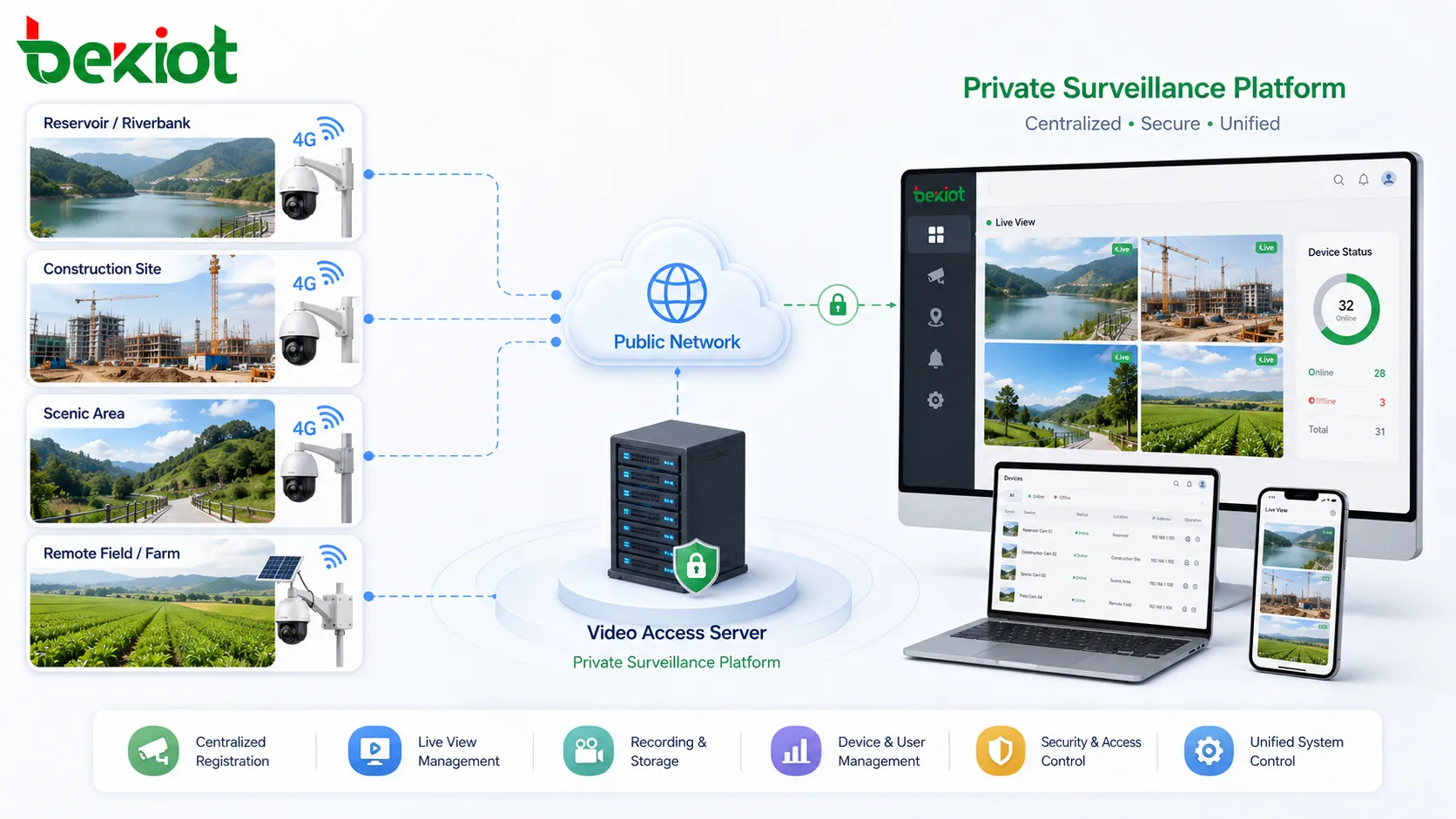
A private video surveillance platform offers another path. By deploying a dedicated video access and management platform, organizations can centrally register, view, manage, integrate, and distribute video streams from 4G cameras while keeping system control closer to their own business environment.
Why 4G Camera Projects Need a Different Architecture
A traditional surveillance system is often built around cameras, switches, recorders, and a management platform inside the same local network. The camera can be discovered, configured, recorded, and viewed through the LAN. This model is simple when the site has wired network access and centralized equipment rooms.
4G camera projects are different. The camera uses a SIM card and mobile data service to access the Internet. It may be installed beside a river, at a reservoir, in a scenic area, on a temporary construction site, near agricultural land, or in a remote inspection point. These locations may not have fixed broadband, fiber access, or a stable private network.
Because the camera is connected through a public mobile network, the management platform needs a reachable public address or a cloud-accessible service. If every camera depends on a third-party cloud account, the project may face platform restrictions, recurring service fees, limited development interfaces, and difficulty integrating video into other business systems.
Core Idea of a Private Monitoring Platform
The core idea is to deploy a private video access platform that acts as the central receiving, management, and distribution point for 4G cameras. Cameras connect to the platform over the public network, and users manage all video resources from one unified interface.
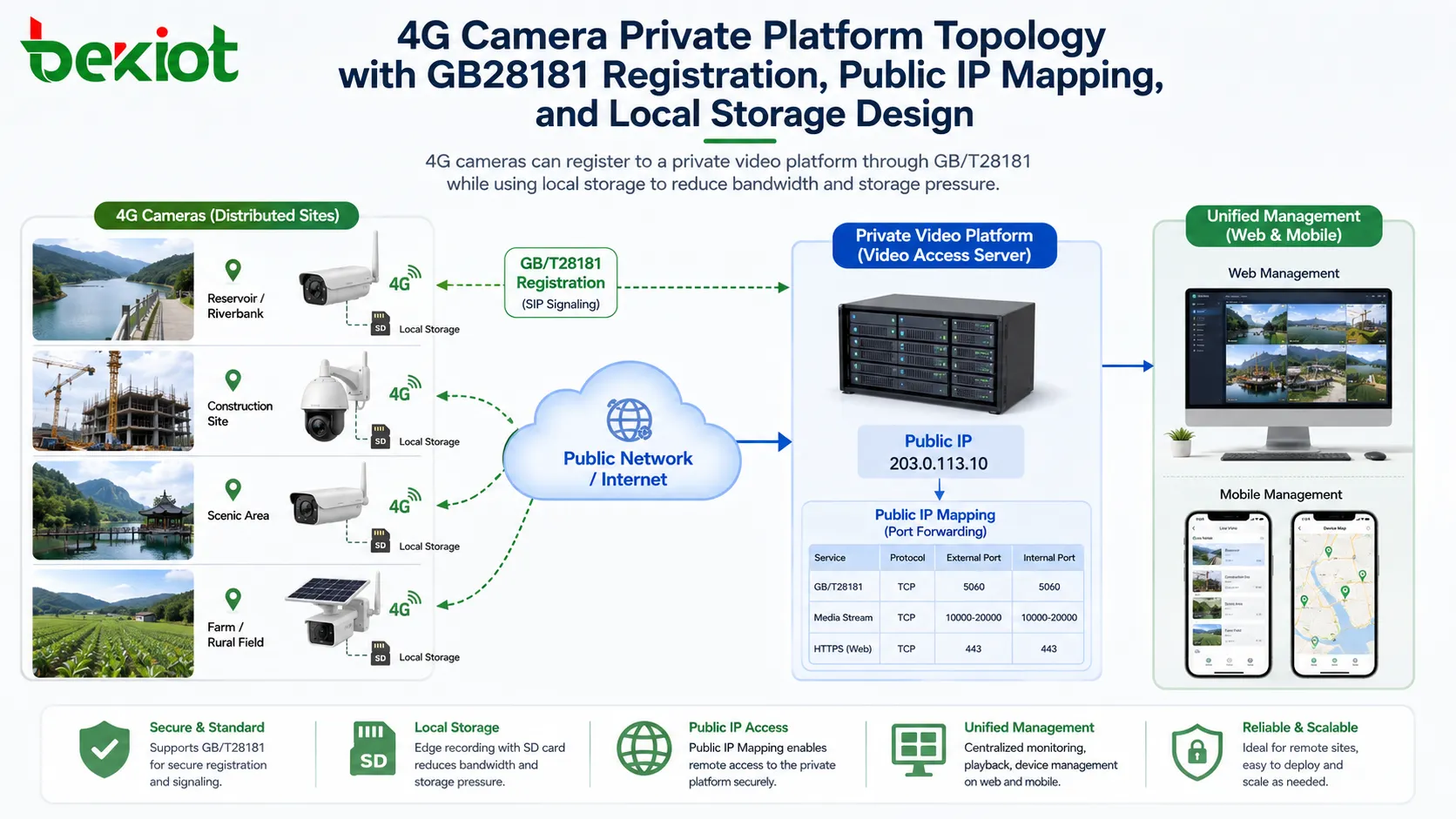
In many projects, 4G cameras can be configured with a GB/T28181 access channel and registered to the private platform. After successful registration, the platform can manage camera status, live preview, PTZ control, alarm information, stream forwarding, and video distribution according to project requirements.
This approach is useful for smart project development because it changes 4G cameras from isolated cloud devices into manageable video resources. The video data can be connected with IoT platforms, command dispatch systems, video conferencing systems, GIS platforms, emergency response systems, and other business applications.
Hardware-Based Deployment in an Enterprise Network
One common deployment method is to install a video access platform or gateway in the enterprise equipment room. The platform is connected to the Internet through a public IP address or port mapping. The 4G cameras then register to this public address through the mobile operator network.
This model is suitable for organizations that already have an equipment room, stable network resources, IT maintenance capability, and a fixed public IP address. It gives the project owner stronger control over system access, device management, video distribution, and integration with the internal surveillance network.
After deployment, all 4G cameras can be centrally managed. Operators can view live video, control PTZ functions, adjust focus where supported, receive alarm events, and organize cameras by region, project, site, or business type. The platform can also help connect mobile video resources with the existing internal video monitoring system.
Traffic and Storage Planning for 4G Cameras
Mobile data cost is one of the most important planning points in a 4G camera project. A common misunderstanding is that the camera will consume a large amount of traffic at all times. In a well-designed access model, traffic is mainly consumed when live video is being viewed, forwarded, or uploaded.
For this reason, project teams should avoid unnecessary continuous cloud streaming unless it is required by the application. Live preview, stream forwarding, and remote access should be designed according to real business demand. This helps reduce mobile data usage and keeps long-term operation costs under control.
Local storage on the camera is also important. Choosing 4G cameras with memory card storage can reduce the need to upload all recordings to the central platform. The camera can store video locally, while the platform focuses on live preview, event access, remote management, and integration. This design can reduce both central storage pressure and mobile data consumption.
Cloud Deployment When No Fixed Public IP Is Available
Some organizations do not have a fixed public IP address or a suitable equipment room. In this case, the private video surveillance platform can be deployed on a cloud server. Public cloud infrastructure provides elastic computing resources, public network access, configurable bandwidth, and easier remote maintenance.
A cloud deployment is often faster to start. The project team can select server resources, storage, bandwidth, and security policies according to the number of cameras and expected viewing demand. 4G cameras register to the cloud platform through the public network, and users access the platform through authorized accounts.
However, cloud deployment also has ongoing service costs. Server rental, public bandwidth, storage, backup, and security protection should be included in the total cost evaluation. For projects with many cameras or heavy video viewing demand, bandwidth planning is especially important.
Video Streams and Development Interfaces
A private video platform is not only used for viewing cameras. Its greater value is integration. When the platform supports standard interfaces and multiple stream output formats, video resources can be reused by different business systems.
Depending on the platform design, video streams may be output as FLV, HLS, WebRTC, SIP, RTMP, RTSP, or other common formats. These stream types can support web preview, mobile applications, command screens, third-party platforms, video meetings, recording systems, and emergency dispatch applications.
API access is also important. Through APIs, a business system can query camera lists, request live streams, receive alarm events, control camera resources, or connect video with maps, IoT sensors, work orders, and command workflows. This makes the 4G camera system part of a larger smart project rather than a standalone monitoring tool.
Connecting with Existing Surveillance Networks
Many organizations already have an internal video monitoring network. A private 4G camera platform can help connect remote mobile cameras with the existing monitoring environment. This is useful when the project needs both fixed cameras inside the LAN and 4G cameras outside the wired network.
For example, a reservoir management center may already have wired cameras at the main station, while remote water level points use 4G cameras. A unified platform can help operators view both types of resources from one system. This improves monitoring efficiency and reduces the need to switch between different platforms.
The same logic applies to construction sites, agriculture, scenic areas, industrial parks, ports, mines, and energy projects. 4G cameras extend video coverage to places where wired networks are difficult, while the private platform keeps management centralized.
Application Scenarios with Distributed Monitoring Points
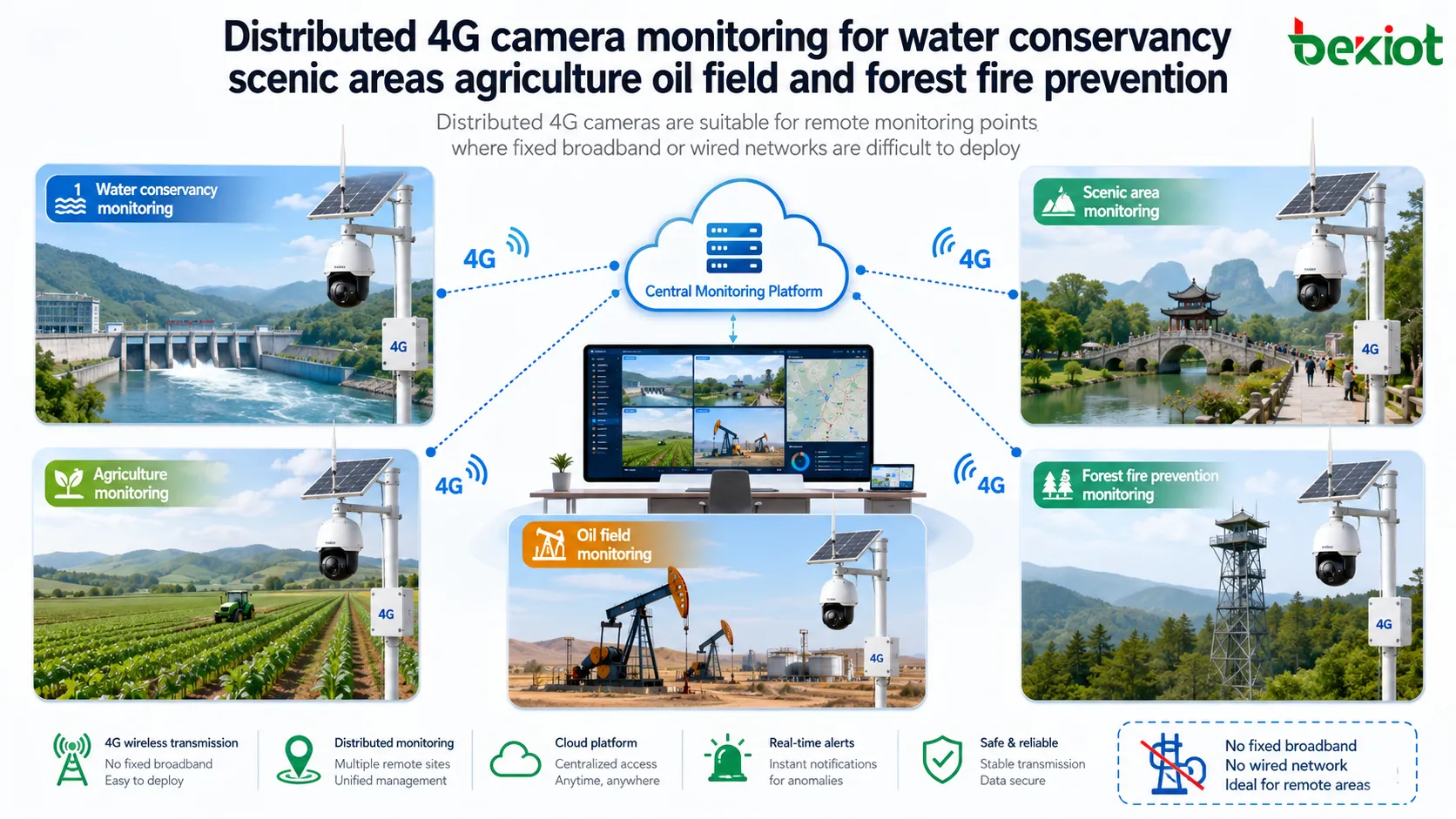
Private 4G camera platforms are most useful in projects where monitoring points are widely distributed and network conditions are limited. Smart water management is a typical example. Rivers, reservoirs, pumping stations, drainage outlets, and water level monitoring points may be far from fixed network infrastructure.
Scenic areas are another common scenario. Cameras may need to be installed at entrances, mountain paths, parking areas, viewing platforms, emergency points, and temporary activity zones. 4G access allows flexible deployment, while the private platform enables unified operation and integration with emergency response workflows.
Other suitable scenarios include agriculture monitoring, oil exploration, forest fire prevention, temporary construction monitoring, environmental protection, power line inspection, transportation facilities, and remote industrial sites. In these projects, private platform deployment can make video access easier to manage and easier to integrate.
Planning Points Before Implementation
Before building a private platform, the project team should first estimate the number of cameras, online concurrency, live viewing frequency, recording strategy, storage location, and expected video quality. These factors directly affect server configuration, public bandwidth, platform capacity, and mobile data cost.
Network planning is also essential. The platform needs stable public access for camera registration and video transmission. Firewall rules, port mapping, security policies, user permissions, and remote maintenance methods should be planned before large-scale deployment.
The camera side should also be checked carefully. The project should confirm whether the 4G camera supports the required access protocol, local storage, remote configuration, alarm reporting, PTZ control, and stable operation under the target environment.
Benefits of a Private 4G Camera Platform
The first benefit is unified management. Instead of managing each camera through different vendor accounts or separated cloud systems, all 4G cameras can be organized and accessed from one platform.
The second benefit is better integration. Video streams and API interfaces can be connected with smart project platforms, IoT systems, command centers, video conferencing, and business applications.
The third benefit is stronger control. The organization can decide how cameras are accessed, how streams are distributed, how permissions are managed, and how video resources are used in the wider system.
The fourth benefit is cost optimization. By combining on-demand viewing, local camera storage, reasonable bandwidth planning, and private platform management, the project can reduce unnecessary traffic and avoid relying completely on restrictive public cloud services.
Conclusion
Building a private video surveillance platform for 4G cameras is a practical solution for projects with scattered monitoring points, limited wired network access, and strong integration requirements. By using public network access, GB/T28181 registration, local storage, API integration, and multi-protocol stream output, 4G cameras can become manageable resources inside a unified video system.
Whether deployed in an enterprise equipment room or on a cloud server, the key is to design the platform around real business needs. For smart water management, scenic areas, agriculture, oil exploration, forest fire prevention, construction sites, and other distributed monitoring scenarios, a private platform can simplify implementation, improve control, and create a better foundation for future system integration.
FAQ
Is a private platform necessary for every 4G camera project?
No. Small projects with only a few cameras may use a standard cloud service. A private platform is more suitable when the project needs centralized management, integration, data control, or large-scale deployment.
Can 4G cameras record video without uploading everything to the platform?
Yes. Many projects use camera-side memory card storage and only transmit live video or event video when needed. This can reduce bandwidth and mobile data usage.
What is the main difference between hardware deployment and cloud deployment?
Hardware deployment is usually placed in the enterprise network and may require a public IP or port mapping. Cloud deployment uses public cloud resources and is easier to access from the Internet, but it creates recurring server and bandwidth costs.
Which video stream formats are useful for integration?
Common formats include FLV, HLS, WebRTC, RTMP, RTSP, and SIP. The best choice depends on whether the video is used for web preview, mobile access, low-latency viewing, recording, or command center integration.
What should be checked before selecting 4G cameras?
The project team should check access protocol support, SIM data plan, local storage, PTZ capability, alarm reporting, power supply, waterproof design, installation environment, and long-term maintenance requirements.







