


Paging systems in wireless communication are built to deliver fast, attention-grabbing messages to specific people, teams, or zones without relying on face-to-face coordination. Even in an era dominated by smartphones and unified communications platforms, paging remains relevant because it is simple, direct, and dependable. In many environments, that combination still matters more than feature richness.
From hospitals and warehouses to campuses, transportation hubs, and industrial plants, wireless paging helps organizations reach the right person at the right moment. It can be used for staff coordination, routine announcements, emergency alerts, escalation workflows, and site-wide operational communication. The exact form varies by industry, but the purpose is consistent: send urgent information quickly and clearly.
What Are Paging Systems in Wireless Communication?
Definition and core concept
A paging system is a communication method that sends short alerts, voice announcements, or notification messages to designated receivers. In a wireless context, the delivery path uses radio frequencies, Wi-Fi, DECT, private wireless infrastructure, cellular connectivity, or hybrid IP-to-wireless links instead of relying only on wired speaker loops or fixed desk endpoints.
The word “paging” can describe several related models. In some systems, it means sending a silent or audible alert to a wearable pager carried by a nurse, technician, security officer, or maintenance worker. In others, it refers to broadcasting a voice message through wireless-connected speakers, handsets, or mobile endpoints. Modern systems often support both targeted alerting and broader zone-based announcements.
What makes paging distinct is its focus on immediacy. A paging workflow is not usually meant for long conversations. It is designed to notify, direct, escalate, and prompt action. That is why paging remains valuable in fast-moving environments where delays can affect safety, service continuity, or response time.
Paging vs. intercom vs. public address
Paging, intercom, and public address are closely related, but they are not identical. A paging system is primarily for sending alerts or announcements to individuals or groups. An intercom system is more focused on two-way communication between points, such as a help point and a control room. A public address system is generally intended to deliver wider audio coverage to a zone, building, or campus.
In practice, these functions often converge. A single platform may support wireless pagers for staff notification, SIP intercom stations for help requests, and IP speakers for mass notification. That is especially common in larger sites that want one operational backbone for routine communication and emergency coordination.
A strong paging design is not just about sending a message. It is about making sure the message reaches the right person, at the right priority level, through a path that remains available when the site is under pressure.
How Wireless Paging Systems Work
The message path from origin to endpoint
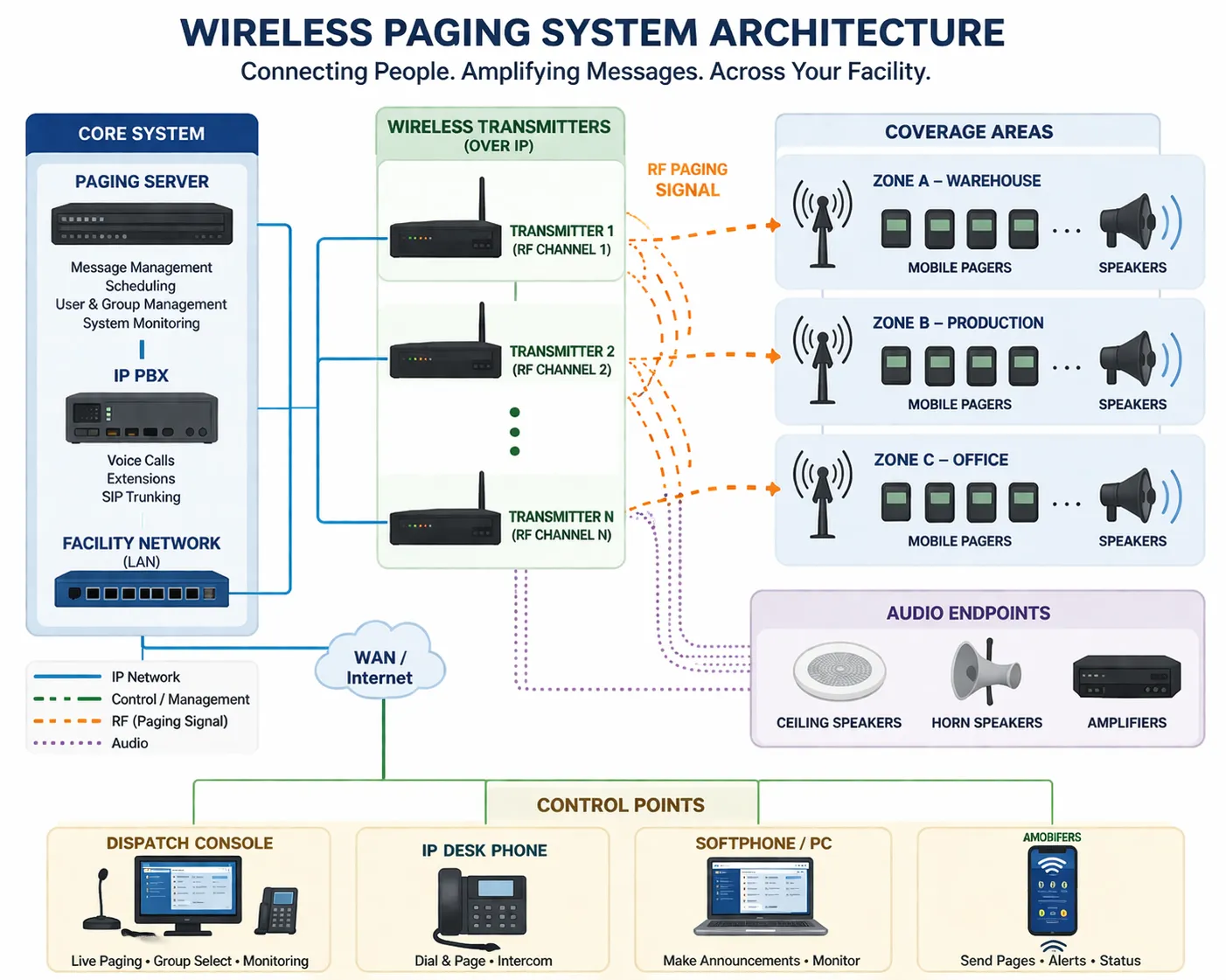
A wireless paging workflow starts with a trigger. That trigger may come from a paging console, a SIP phone, an IP PBX, a nurse call platform, a fire alarm panel, a building management system, or a dispatch application. Once triggered, the system determines who should receive the message, which zone should be alerted, and which delivery method should be used.
The message then moves through the communication core. In a modern deployment, that core may include a paging server, application logic, network switches, wireless access points, radio transmitters, paging gateways, and integration interfaces. The system can translate one event into multiple outcomes, such as sending a text alert to a pager, playing a voice announcement through speakers, and notifying a dispatcher at the same time.
At the endpoint level, the alert appears on a receiver device. That could be a dedicated pager, a wireless handset, a smartphone app, an IP speaker, or a hybrid endpoint connected through a paging adapter. In more advanced systems, the endpoint can also acknowledge receipt, helping supervisors confirm that the message was delivered and seen.
Common system components
Although architectures vary, most wireless paging systems include a familiar set of building blocks. These components shape how far the signal travels, how reliably alerts are delivered, and how easily the system integrates with other communication tools.
Message source: paging console, PBX extension, dispatch software, mobile app, alarm interface, or automation platform
Control layer: paging server, alerting software, SIP platform, or workflow engine
Transport layer: radio network, Wi-Fi, DECT, cellular path, or IP network with wireless edge devices
Endpoint layer: pagers, wireless handsets, mobile clients, IP speakers, strobes, or zone controllers
Integration layer: gateways for alarms, intercoms, PA systems, legacy amplifiers, building systems, or command platforms
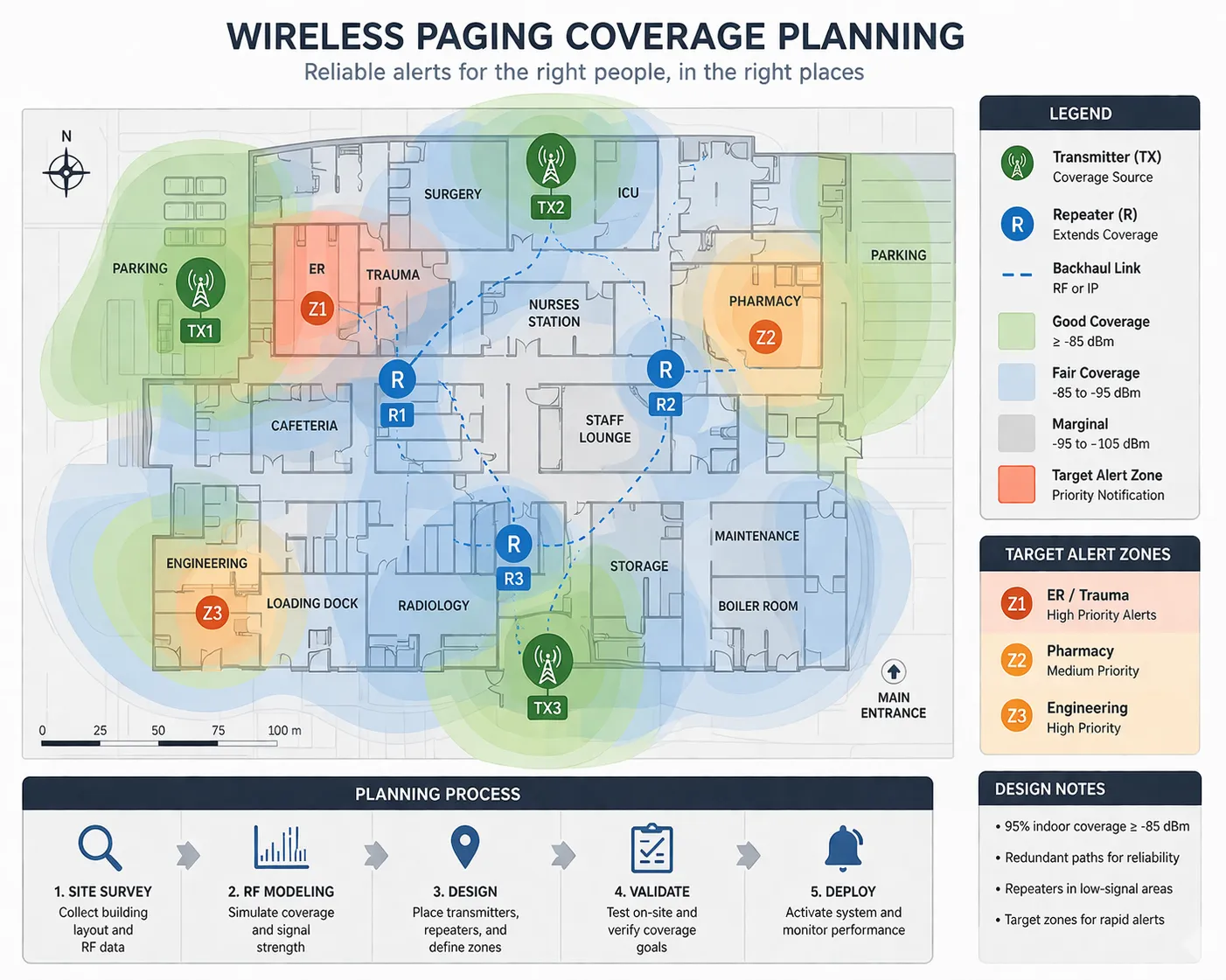
The more critical the environment, the more attention should be paid to redundancy. Backup power, overlapping coverage, dual network paths, failover servers, and local survivability all help prevent a paging system from becoming unavailable when it is needed most.
Coverage, latency, and reliability
Wireless paging performance is shaped by more than raw transmission power. Building materials, metal structures, tunnel sections, moving equipment, electromagnetic interference, and network congestion can all affect coverage and message delivery. That is why site surveys and realistic testing matter before full deployment.
Latency is equally important. In routine communication, a small delay may be acceptable. In an emergency alert workflow, it may not be. Designers need to consider how quickly a message is generated, routed, transmitted, played, and confirmed. A paging system that looks complete on paper can still fail operationally if the end-to-end path is too slow or too fragile.
Types of Paging Systems in Wireless Communication
One-way paging systems
One-way paging is the classic model. A central user sends an alert, and the recipient receives it without sending a reply through the same device. These systems are still used because they are straightforward, low-complexity, and effective for many operational workflows. A warehouse supervisor, for example, may only need to notify a forklift technician to report to a loading area.
One-way paging can be especially useful when the priority is message speed and the operational process does not require confirmation. It is also a practical option in sites that want broad staff notification without the expense or complexity of a fully interactive messaging environment.
Two-way and acknowledgment-based paging
Two-way paging adds more control to the workflow. Instead of only receiving an alert, the user can confirm receipt, send a short response, or trigger a follow-up action. That feature becomes valuable in hospitals, security operations, utilities, and industrial maintenance teams where supervisors need to know not just that an alert was sent, but that it reached an accountable person.
Acknowledgment also improves escalation logic. If the first recipient does not respond within a defined window, the system can notify a backup user, a control room, or a wider response group. This turns paging from a simple broadcast tool into a more structured incident-response mechanism.
IP-based wireless paging across large sites
Many organizations now use IP-based paging platforms that connect wireless devices, SIP endpoints, IP speakers, gateways, and dispatch applications. In this model, the wireless link is one part of a larger communication framework rather than a standalone subsystem. That makes it easier to bridge routine staff paging with intercom calls, scheduled announcements, emergency audio, and operational dispatch.
This architecture is particularly useful in campuses, factories, transportation facilities, and critical sites that need both flexibility and integration. A provider such as Becke Telcom may approach this by combining SIP paging, intercom, voice gateways, IP PBX connectivity, and dispatch functions on one backbone, allowing organizations to link wireless alerting with broader communication workflows instead of treating it as an isolated tool.
Where Wireless Paging Systems Are Used
Healthcare, education, manufacturing, and logistics
Hospitals and care facilities use wireless paging to reach nurses, technicians, support staff, and on-call personnel without forcing them to remain at fixed stations. In these settings, a paging alert can support patient care workflows, critical response escalation, or operational coordination between departments.
Schools and campuses use paging for routine announcements, safety alerts, and staff coordination. Manufacturing and warehouse environments often rely on paging where workers move continuously and may not be watching screens. A fast, audible, or vibration-based alert can be more effective than email or chat in noisy or task-focused environments.
Transportation, utilities, and critical industrial sites
Transportation facilities, tunnels, rail sites, ports, utilities, and industrial plants often need communication systems that work across wide areas, mixed environments, and operationally demanding conditions. Wireless paging helps reach mobile teams, maintenance personnel, security staff, and emergency responders when conditions make fixed-point communication impractical.
In critical industrial settings, paging is often part of a larger emergency communication design. A site may combine paging with emergency telephones, SIP intercoms, alarm triggers, dispatch consoles, and zoned broadcasting. In that context, the value of wireless paging is not just mobility. It is the ability to connect people, alarms, and response actions through a coordinated communication chain.

Benefits and Limitations
Why paging still delivers value
The biggest advantage of paging is focus. Unlike email, chat, or general mobile notifications, a paging alert is usually designed to stand out and trigger action. It can be audible, visual, or vibration-based, and it can be directed to a person, team, role, or zone. That helps reduce the chance that an urgent message is lost in everyday communication noise.
Paging is also adaptable. It can serve routine workflow efficiency, high-noise industrial communication, or emergency escalation. Because the message format is compact and action-oriented, it often works well when conditions are busy, stressful, or time-sensitive.
What paging cannot solve by itself
Paging is not a complete communication strategy on its own. It tells people that something needs attention, but it does not always provide the depth of interaction needed to resolve the situation. In many deployments, the best approach is to use paging as the first alert layer and then link it to voice, intercom, radio, or dispatch tools for follow-through.
There are also practical limits related to spectrum, battery life, endpoint durability, interference, device management, and message security. In regulated or mission-critical environments, organizations should also consider logging, role-based control, priority handling, and integration resilience. A paging system only becomes operationally strong when its surrounding processes are just as well designed.
The real measure of a paging system is not whether it can send an alert. It is whether the alert leads to a dependable response under real operating conditions.
How to Choose the Right Wireless Paging System
Questions to ask before deployment
Before selecting a system, it helps to define the actual communication problem. Is the site trying to notify mobile staff, send zone-based announcements, support emergency escalation, or connect paging with PBX, intercom, and alarm workflows? The answer influences the required architecture, endpoint type, and integration depth.
Key evaluation points usually include site size, indoor or outdoor coverage, expected user density, message priority, environmental conditions, required acknowledgments, and survivability during network or power disruptions. A hospital, warehouse, tunnel, and refinery may all use paging, but they will not need the same design.
Who needs to be reached, and under what conditions?
Does the message require acknowledgment or escalation?
Will the system operate as a standalone tool or as part of a larger communication platform?
What happens if one network path, power source, or controller fails?
How will administrators manage roles, priorities, logs, and future expansion?
Integration matters more than ever
For many organizations, the most effective paging system is the one that fits into a broader communication architecture. That may include IP PBX platforms, SIP phones, intercom devices, paging gateways, control room software, alarm systems, and field communication tools. Integration reduces operator workload and makes response workflows more consistent.
This is where a solution-oriented approach becomes useful. Instead of choosing a paging product in isolation, many sites now evaluate how paging will work alongside dispatch, intercom, emergency telephony, and public address. Becke Telcom, for example, typically frames paging as one part of an integrated communication environment for critical sites, helping organizations combine mobile alerting with voice coordination, emergency response, and zone-based broadcasting.
Conclusion
Paging systems in wireless communication remain relevant because they solve a specific operational problem better than many general-purpose tools: they deliver urgent information quickly, clearly, and directly. That is why paging continues to serve hospitals, factories, campuses, logistics centers, transportation sites, and industrial facilities where mobility and response speed matter.
As communication environments become more integrated, paging works best when it is connected to the larger response chain. A modern design can link paging with PBX platforms, SIP intercoms, speakers, dispatch consoles, and emergency workflows so the site does not just send alerts, but acts on them. For organizations building a more coordinated communication environment, Becke Telcom can support solutions that bring paging, intercom, voice, and dispatch into one operational framework.
FAQ
What is a paging system in wireless communication?
A paging system in wireless communication is a platform that sends alerts, short messages, or announcements to designated users or zones using wireless transmission methods such as radio, Wi-Fi, DECT, cellular links, or hybrid IP-connected wireless infrastructure.
Are paging systems still used today?
Yes. Paging systems are still widely used in healthcare, manufacturing, logistics, education, transportation, and critical infrastructure because they provide fast, direct, and operationally focused notification workflows that are often more dependable than general consumer messaging tools.
What is the difference between one-way and two-way paging?
One-way paging sends a message to the recipient without a reply path on the same device. Two-way paging allows the user to acknowledge, respond, or trigger a follow-up action, which is helpful when accountability and escalation are important.
Can a wireless paging system work with IP PBX and SIP devices?
Yes. Many modern paging systems integrate with IP PBX platforms, SIP phones, IP speakers, paging gateways, intercom stations, and dispatch software. This allows organizations to connect wireless alerting with broader voice and emergency communication workflows.
Where are wireless paging systems most useful?
They are especially useful in environments where staff are mobile and cannot rely on desk phones or screen-based notifications alone. Common examples include hospitals, campuses, warehouses, factories, tunnels, transportation hubs, utilities, and industrial sites.
How do you choose the right paging system?
Start by defining who needs to be reached, how quickly alerts must be delivered, whether acknowledgment is required, and how the system should integrate with existing infrastructure. Coverage design, reliability, redundancy, and long-term manageability should all be part of the decision.







