


A Grandstream IP PBX is more than a business phone system. It is a SIP-based communication platform that helps organizations manage internal extensions, external calling, call routing, voicemail, conferencing, and remote connectivity through a unified IP network. For businesses that want to move away from isolated analog lines or limited legacy PBX infrastructure, it offers a more flexible and scalable way to organize voice communication.
In today’s working environment, communication rarely happens in a single office or through a single device. Staff may work across multiple departments, branch locations, production areas, service desks, or remote sites. An IP PBX creates the logic and control layer that connects these users, devices, and call flows into one manageable system. That is why Grandstream IP PBX solutions are often considered by companies looking to modernize telephony while keeping deployment practical and cost-conscious.
This article explains the core functions of a Grandstream IP PBX, where it fits best, and how businesses can use it as the foundation for broader voice and SIP communication projects.
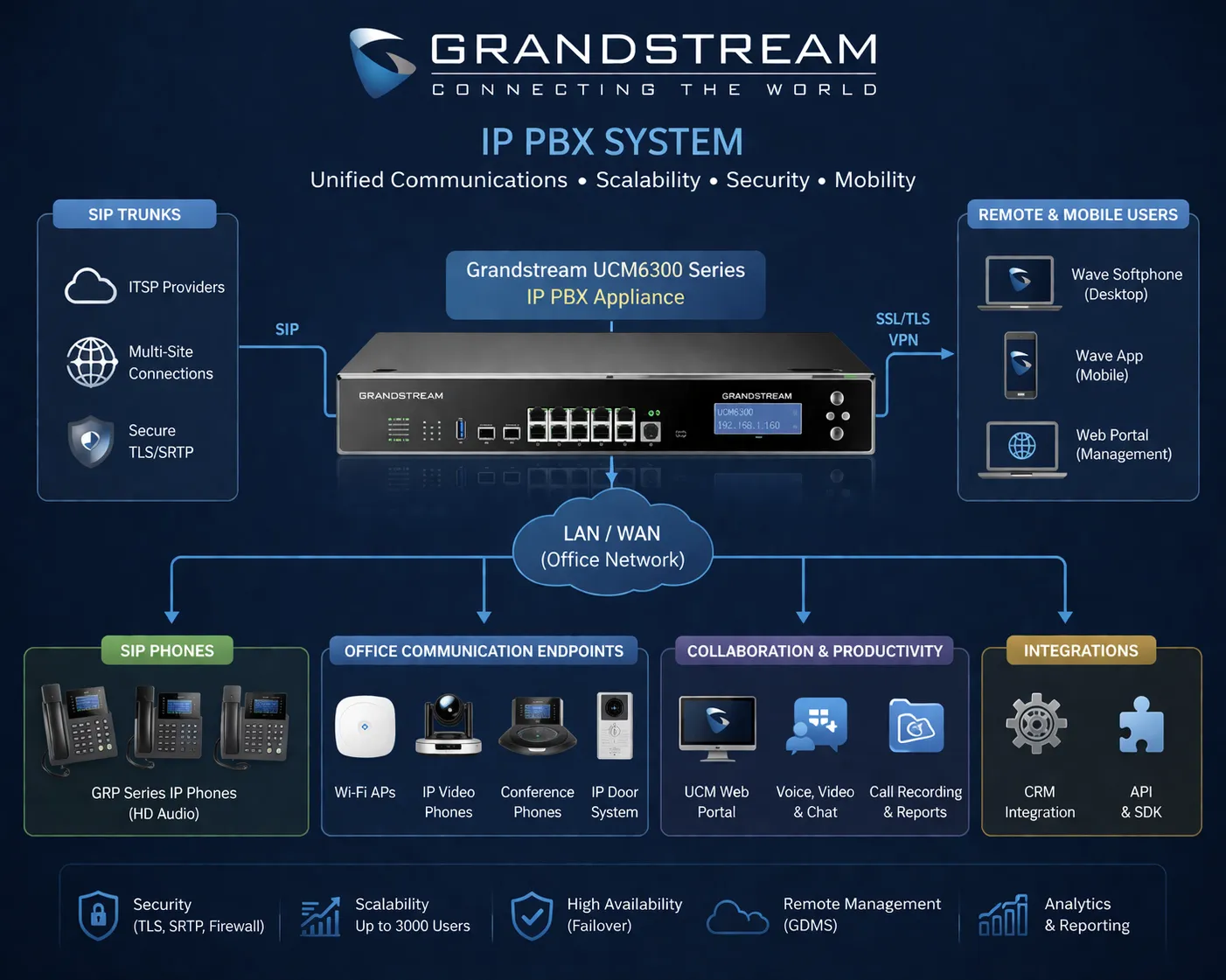
What Is a Grandstream IP PBX?
A Central Platform for SIP-Based Telephony
A Grandstream IP PBX is a business communication system designed to manage calls over an IP network rather than relying primarily on traditional telephone wiring and fixed legacy switching. It typically works with SIP phones, softphones, SIP trunks, gateways, and other compatible devices, allowing businesses to build a more unified communication environment.
At its core, the system handles extension registration, call setup, call routing, voicemail, ring groups, IVR menus, conferencing, and many everyday telephony tasks. Instead of treating each phone line or location as a separate communication island, the IP PBX creates a centralized call control environment that can be adjusted as the organization grows.
Why Businesses Choose an IP PBX
Businesses usually adopt an IP PBX when they want better scalability, easier management, and more efficient use of existing network infrastructure. A company may begin with basic desk phone calling, then later add remote workers, multiple departments, reception workflows, branch users, or SIP-based paging and intercom devices. An IP PBX makes that kind of expansion more realistic than a rigid traditional phone system.
For many organizations, the goal is not only to make calls. It is to build a communication environment that supports collaboration, customer handling, and operational continuity. That is where a Grandstream IP PBX becomes valuable as both a telephony solution and a platform for future communication integration.
A modern IP PBX is not just a switch for phone calls. It is the communication engine that organizes how people, departments, and locations stay connected.
Core Features of a Grandstream IP PBX
Extension Management
One of the most important functions of a Grandstream IP PBX is extension management. Administrators can create users, assign extension numbers, define permissions, and connect phones or soft clients to the system in a structured way. This is essential for businesses that need clear separation between departments while still keeping internal communication simple.
Extension management also improves flexibility. A user can often keep the same business identity even when moving desks, changing departments, or working from another site. That consistency helps maintain smoother internal workflows and reduces administrative complexity.
Call Routing and Call Handling
Call routing is the logic that decides where calls go and how they are handled. A Grandstream IP PBX can direct calls to individual users, departments, reception desks, ring groups, or voicemail depending on time schedules, business rules, and user availability. This is critical for businesses that want incoming calls to be processed professionally rather than manually passed from person to person.
Well-designed routing improves response speed and customer experience. Instead of losing calls or relying on a single receptionist for every decision, the system can automatically guide callers to the right destination. That becomes especially useful in organizations with support teams, sales desks, service counters, or multi-level call priorities.
Voicemail and Unified Message Handling
Voicemail remains an important part of business telephony, especially when staff are in meetings, handling field work, or operating across time zones. A Grandstream IP PBX can provide individual and shared voicemail functions, helping callers leave messages when direct connection is not possible.
In a broader sense, message handling makes communication more resilient. Even when a live answer does not happen immediately, the caller still reaches the business, leaves information, and stays within an organized communication process rather than facing a dead end.
IVR and Auto Attendant
Interactive Voice Response, often called IVR, allows a business to greet callers and guide them through options such as sales, support, accounts, or operator assistance. A Grandstream IP PBX can use IVR to reduce manual call handling and present a more structured first impression to external callers.
For smaller businesses, IVR may be simple. For larger operations, it can support multiple departments, time conditions, holiday behavior, overflow rules, and layered call flows. This makes the phone system more professional and better aligned with how the organization actually operates.
Conference Calling
Conference capability is another important function. Instead of relying on separate tools for every internal discussion, a Grandstream IP PBX can support voice conferencing as part of the business communication environment. This is useful for management coordination, team discussions, branch communication, and everyday collaboration across distributed users.
In practical terms, conferencing reduces communication friction. Teams can bring multiple participants into a discussion without depending on a patchwork of separate systems, especially for fast operational coordination or routine internal calls.
Remote Extensions and Mobility
Modern workforces are no longer tied to a single office floor. A Grandstream IP PBX can help remote staff remain part of the company phone system through SIP-based endpoints, softphones, or mobile-friendly communication setups. This allows employees to make and receive business calls within the same extension framework even when they are not sitting at headquarters.
This feature is particularly valuable for hybrid work, multi-site service teams, and distributed organizations. It supports continuity without forcing the business to create isolated communication processes for each location or user group.
Business Benefits of a Grandstream IP PBX
Better Scalability
One of the strongest advantages of an IP PBX is that it scales more naturally than many legacy systems. When the business adds users, departments, or branch offices, the communication framework can usually expand without forcing a complete redesign. New phones, new extensions, and new call logic can be added within an existing architecture.
This is especially important for growing businesses. Communication systems should not become a barrier to expansion. A Grandstream IP PBX gives organizations a path to increase capacity while keeping administration more centralized and structured.
Lower Operating Complexity
Centralized control helps reduce day-to-day operational complexity. Instead of managing unrelated phone islands, administrators can work from one core platform for users, routing, extensions, trunks, and other settings. This improves consistency and reduces the risk of fragmented communication policies across the business.
When staff move roles or locations, the system can also adapt more easily. Changes can be made at the platform level instead of rebuilding the telephony environment from scratch each time the organization evolves.
Improved Professionalism for Incoming Calls
How a business answers and routes calls shapes how customers, partners, and suppliers experience the organization. A Grandstream IP PBX can improve that experience by making call handling more predictable, more organized, and less dependent on one individual manually transferring everything.
Features such as IVR, time-based routing, ring groups, and department logic help businesses present a more professional image while also ensuring calls reach the right people more efficiently.
Support for Hybrid and Distributed Work
Remote work, branch work, and mobile operations are no longer exceptions. They are now part of normal business communication. A Grandstream IP PBX helps keep these users inside the same business telephony structure, which supports continuity, identity consistency, and operational visibility.
That matters not just for convenience, but for resilience. When teams work across locations, the communication platform should still allow them to function as one business rather than a collection of disconnected users.
The best business phone systems do not only connect calls. They also reduce friction between teams, locations, and daily workflows.
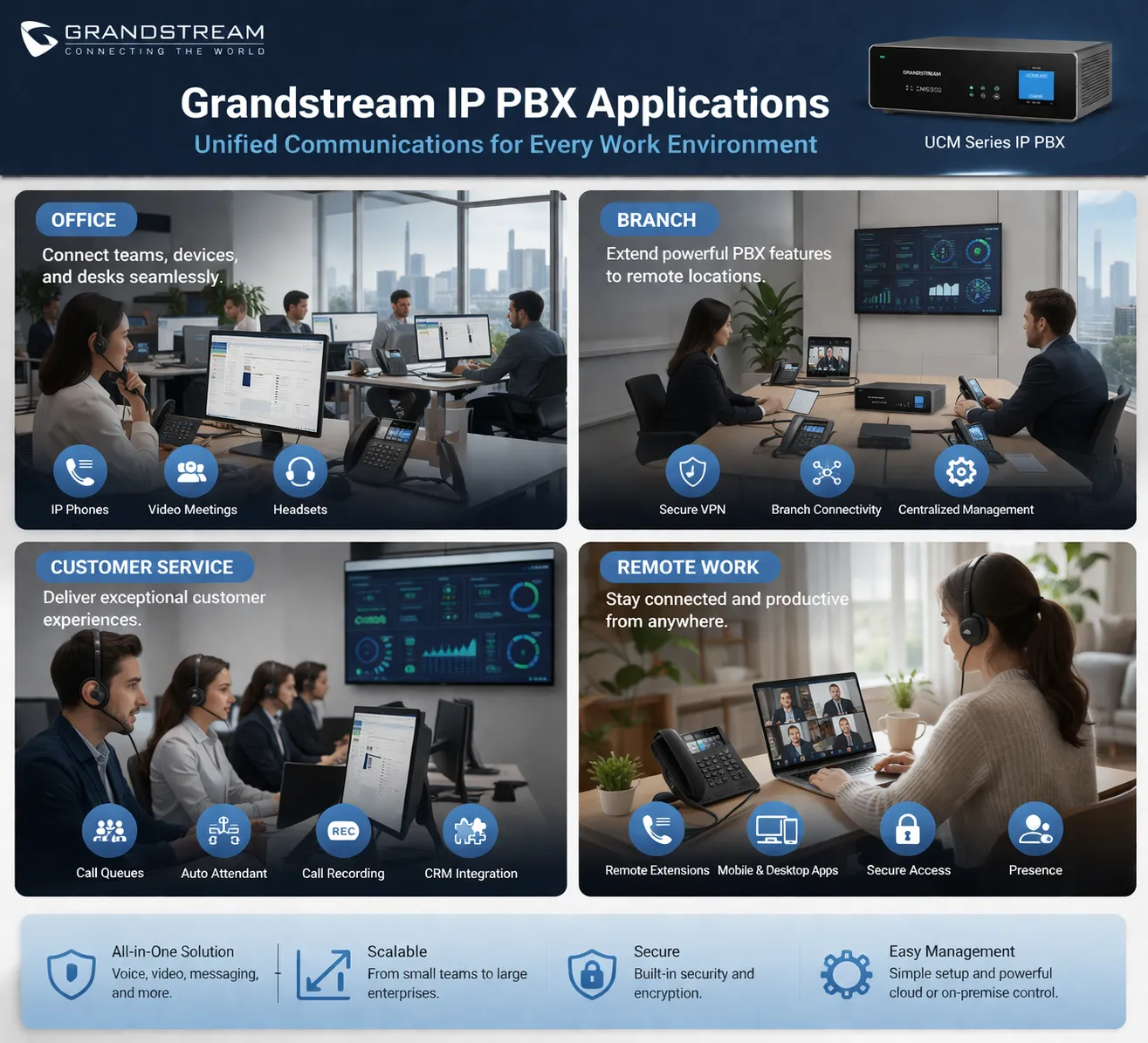
Common Applications of a Grandstream IP PBX
Office Communication
The most common application is standard office telephony. In this environment, a Grandstream IP PBX supports desk phones, reception users, internal extension dialing, voicemail, conference calls, and incoming call distribution. It creates a cleaner communication structure for administration, sales, support, and management teams.
For offices that want a practical business phone system without unnecessary complexity, an IP PBX can deliver the right balance between functionality and manageability.
Multi-Branch Business Communication
Organizations with more than one office often need a shared numbering plan, centralized policy control, and easier communication between branches. A Grandstream IP PBX can help unify those sites under one communication framework, reducing the inefficiency of running each branch as an isolated phone environment.
This is useful for businesses with regional offices, service branches, training centers, or distributed sales teams that still need to operate as one organization from the caller’s perspective.
Retail, Hospitality, and Customer-Facing Environments
Retail locations, hotels, clinics, and service-oriented businesses often need dependable internal calling, front-desk handling, and structured incoming communication. A Grandstream IP PBX can support these needs by organizing extension groups, operator functions, and service-related call routing.
In these environments, the communication system should help staff respond quickly while keeping customer contact smooth and professional. That makes IP PBX deployment a practical fit for many service-based operations.
Remote Team and Hybrid Work Deployment
Businesses with remote employees or mobile service staff can use a Grandstream IP PBX to keep those users connected as part of the same business phone system. Remote extensions and SIP-based access make it easier for distributed workers to stay reachable under the company’s communication identity.
This application has become increasingly relevant because business communication must now support flexibility without losing structure. An IP PBX helps create that balance.
Education, Healthcare, and Administrative Facilities
Educational sites, administrative buildings, and healthcare support environments can also benefit from centralized call control. Even where communication needs are not highly industrial, there is often a need for internal dialing, reception routing, departmental calling, and reliable communication across multiple rooms or offices.
In these cases, the value of an IP PBX lies in making communication simpler to manage while still allowing room for future expansion and SIP device integration.
How a Grandstream IP PBX Fits into a Broader SIP Communication Environment
Beyond Desk Phones
Although many businesses first think of an IP PBX as a system for office phones, its role can go further. In SIP-based environments, the PBX may also interact with gateways, soft clients, intercom devices, paging equipment, and other communication endpoints. That makes it part of a larger communication architecture rather than a stand-alone phone box.
This wider perspective matters because many organizations do not operate only at desks. They may have entrances, corridors, warehouses, service counters, production zones, or response points that also need communication access. In such projects, the PBX becomes one layer within a more complete SIP solution.
Supporting Integrated Communication Projects
For some businesses, especially those with larger facilities or more operationally demanding sites, the communication requirement goes beyond office calling. They may need SIP intercom, emergency call points, paging, broadcast, or dispatch coordination in addition to standard telephony. In these cases, a Grandstream IP PBX can serve as the call control foundation while other communication components expand the system’s reach.
This is where solution design becomes more important than hardware alone. A strong PBX is valuable, but the overall communication result depends on how well the phones, SIP devices, gateways, and field endpoints work together.
An IP PBX is often the center of business telephony, but the real value appears when it fits smoothly into the wider communication ecosystem of the site.
What Businesses Should Consider Before Deployment
User Count and Growth Plans
Before deploying a Grandstream IP PBX, businesses should think beyond current headcount. The better approach is to evaluate future growth, likely department expansion, remote user needs, and possible new locations. A communication system should support where the organization is going, not only where it is today.
Planning for growth early reduces the risk of underbuilding the system and facing avoidable communication bottlenecks later.
Network Readiness
Voice performance depends on network quality. Even a capable IP PBX will struggle if the LAN is unstable, congested, or poorly configured for voice traffic. Businesses should consider network design, switching quality, traffic prioritization, and general reliability before expecting strong telephony performance.
An IP PBX works best when telephony planning and network planning are treated as part of the same project rather than as separate decisions.
Endpoint Compatibility
Businesses should also think about what devices need to connect. That may include SIP phones, softphones, gateways, analog adapters, intercom terminals, paging systems, or other SIP endpoints. A successful deployment depends not only on the PBX itself, but also on how well the surrounding devices fit into the intended communication workflow.
The more clearly these requirements are defined at the start, the easier it is to build a system that remains useful over time.
Conclusion
A Grandstream IP PBX is a practical and capable solution for businesses that want to modernize telephony through SIP-based communication. Its main strengths include extension management, call routing, IVR, voicemail, conferencing, and support for remote or distributed users. These functions make it suitable for offices, branch operations, service businesses, administrative environments, and organizations that need a more scalable communication structure.
Its value becomes even greater when viewed as part of a broader communication strategy. For some businesses, the IP PBX is enough to support everyday office telephony. For others, it can become the core of a more integrated environment that also includes gateways, intercom, paging, and other SIP-based communication tools. The right deployment depends on the real operating needs of the organization and how communication supports those needs in practice.
If your project requires more than standard office telephony, Becke Telcom can help support broader SIP communication solutions that combine PBX capability with intercom, paging, gateways, and communication endpoints for business and critical-site environments.
FAQ
What is a Grandstream IP PBX used for?
A Grandstream IP PBX is used to manage business telephony over an IP network. It supports functions such as extensions, call routing, voicemail, IVR, conferencing, and connectivity between SIP phones, softphones, and other compatible communication devices.
Is a Grandstream IP PBX suitable for small businesses?
Yes. It can be a good fit for small businesses that want a more professional and scalable communication system than basic analog lines or isolated office phones. It can also support future growth more easily.
Can a Grandstream IP PBX support remote workers?
Yes. In many deployments, it can support remote extensions or SIP-based access for users working outside the main office, helping them remain part of the same business communication environment.
What are the main benefits of an IP PBX compared with a traditional PBX?
An IP PBX usually offers better scalability, easier management, more flexible deployment, and improved support for remote or multi-site communication because it uses SIP and IP networking rather than relying mainly on traditional telephony infrastructure.
Can a Grandstream IP PBX be part of a larger communication project?
Yes. In broader SIP environments, it can work alongside compatible phones, gateways, intercom devices, and other communication components as part of a more complete business communication solution.







