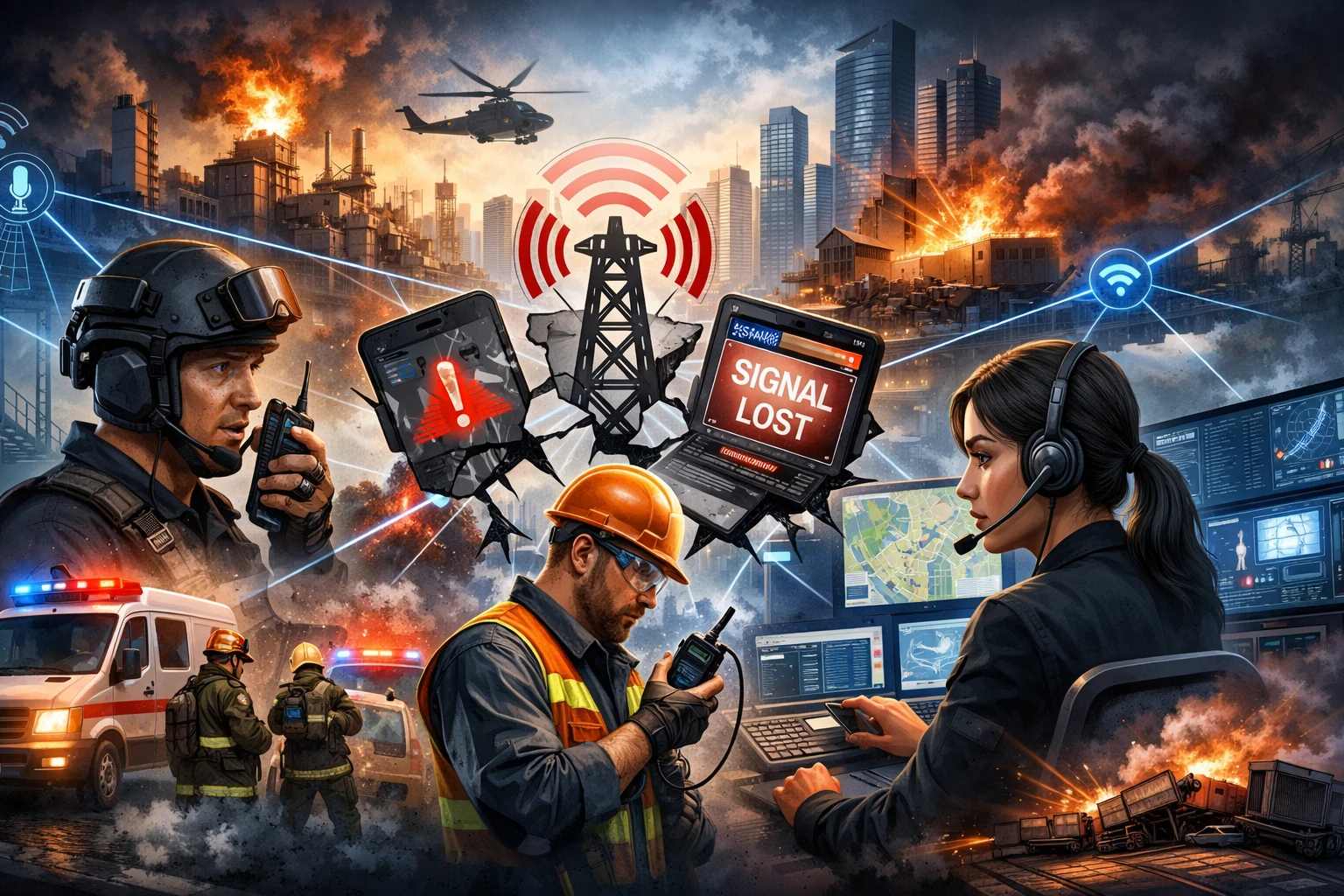
Emergency communication is not only about sending more data. In real incidents, the first requirement is that field teams can communicate effectively under difficult conditions. Whether the event happens in a city, a mountain area, a planned large-scale activity, or a sudden natural disaster, responders must quickly build a reliable communication channel at the scene and keep a stable connection with the back-end command center.
Broadband communication is important for video, images, video conferencing, and high-volume data transmission. Narrowband communication, however, remains irreplaceable for voice, short messages, positioning, and sensor data. In many emergency scenarios, the most valuable system is not the one with the highest bandwidth, but the one that can continue working when power, terrain, backhaul links, and field conditions are uncertain.
Why Bandwidth Alone Cannot Define Emergency Readiness
From a bandwidth perspective, communication systems can be divided into broadband and narrowband. Broadband means that the system can carry a larger amount of information at the same time, so it is commonly used for video backhaul, image transmission, video conferencing, and large data applications. Narrowband is mainly used for voice, text messages, location reporting, and various sensor data.
At first glance, narrowband may seem less advanced because it cannot carry the same volume of video or image data. But in emergency response, available bandwidth is often unstable, and the communication system must work even when infrastructure is damaged or unavailable. This is why narrowband remains a core part of practical emergency communication design.
For field command, the goal is not to choose broadband or narrowband as a single answer. The goal is to design a layered communication system. Broadband should be used where video or high-volume data is necessary. Narrowband should be used for essential voice command, low-power field coordination, positioning, alerts, and basic situation reporting.
The Practical Limits of Video-Heavy Field Communication
Video applications require broadband support. If a field system needs video backhaul or video conferencing, it normally requires a stable link with at least 1M bandwidth, depending on the video quality requirement. In theory, by using ad hoc radio equipment and a portable satellite station, a field team may be able to transmit 1 to 4 video streams back to the command center.
However, the real field environment is rarely ideal. Battery efficiency of ad hoc radio equipment, terrain conditions, signal obstruction, satellite bandwidth limits, and field power availability can all reduce system performance. A solution that looks capable in theory may work for only about two hours before running out of power, or may suffer frequent transmission interruptions during actual deployment.
Another factor that is often underestimated is power supply. Broadband communication equipment usually consumes more power because of its communication mechanism and higher data throughput. Its coverage distance is often shorter, and increasing transmission power to meet emergency coverage requirements can greatly increase field energy consumption. If a power support vehicle is available, this problem can be managed. But in many sudden disaster sites, stable power supply is difficult to guarantee.
Where Narrowband Shows Its Value
Narrowband communication has several natural advantages in emergency scenarios. The equipment usually consumes less power, covers a wider area, is easier to carry, and can be operated by individual responders with minimal setup. These characteristics make narrowband systems suitable for field teams that must move quickly, work in remote areas, or operate under limited energy conditions.
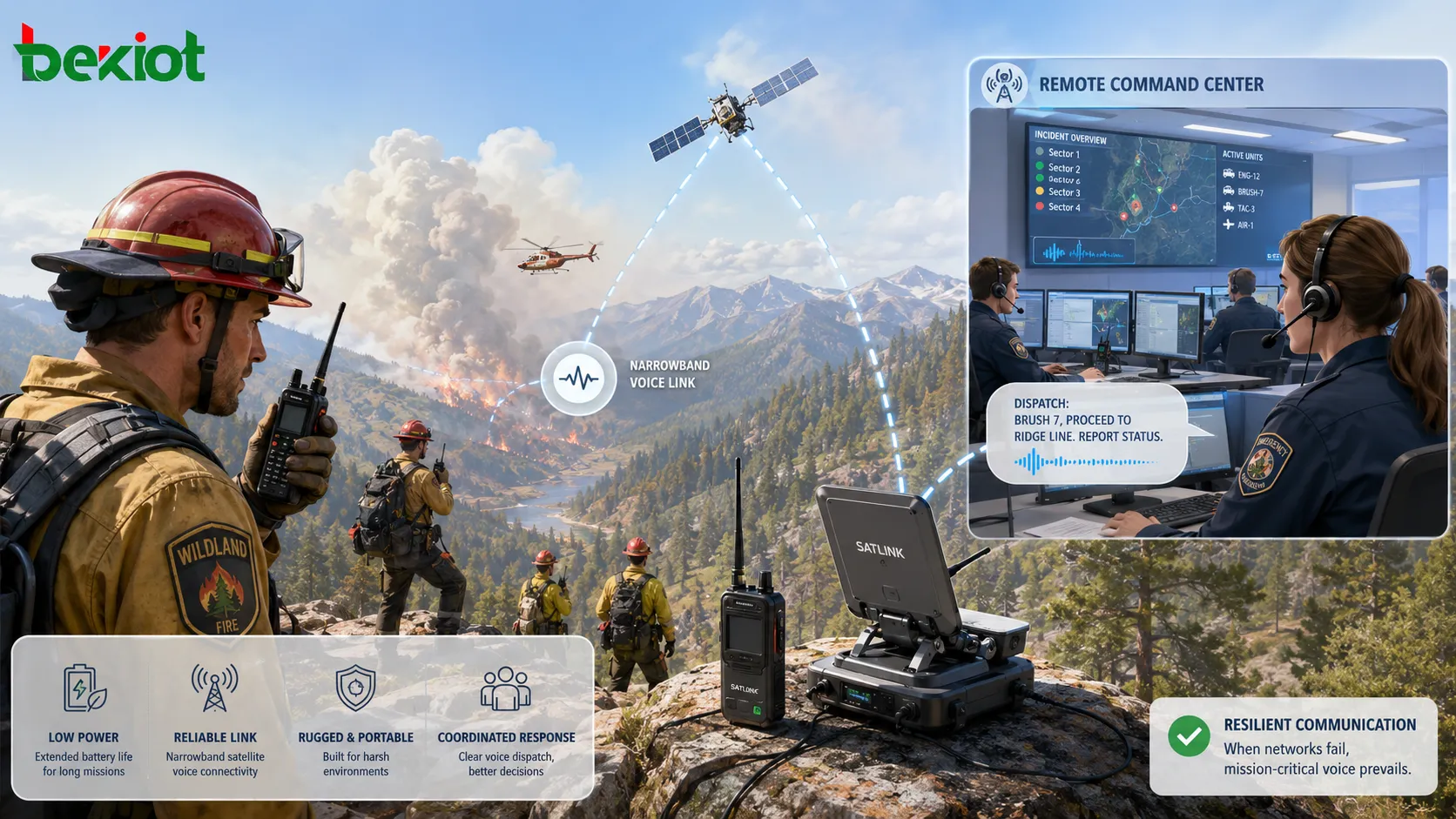
For example, during a forest fire in a mountainous area, rescue personnel may carry a group of handheld radios and satellite phone equipment into the fire zone. By sharing a satellite communication link, the command center can communicate with the on-site radio users, understand the situation, and issue dispatch instructions. This approach solves both local team coordination and field-to-center communication without depending on high-bandwidth infrastructure.
Because narrowband systems combine low power consumption, voice reliability, and long-distance communication support, they are especially useful when network infrastructure is damaged, mobile coverage is weak, or broadband links are not stable enough. In extreme conditions, a system that can carry clear voice and essential status information is often more valuable than a system that tries to transmit video but cannot remain online.
A Resilient Field Communication Architecture
A practical emergency communication solution should combine local field communication, remote command center connectivity, positioning, and optional broadband video access. Narrowband voice should be the foundation because it provides the most stable and energy-efficient communication layer. Broadband video can be added when the link condition, power supply, and operational priority justify it.
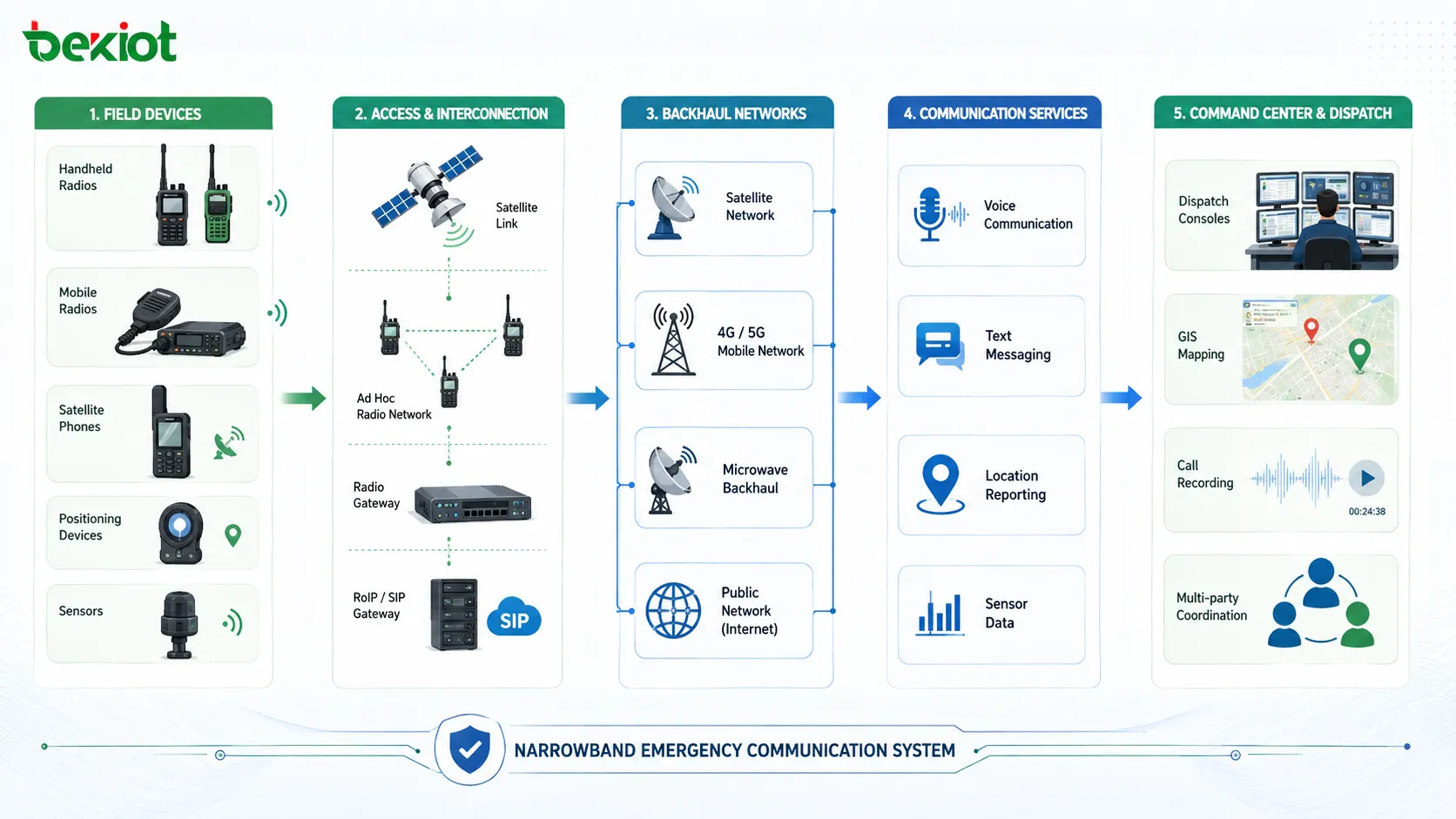
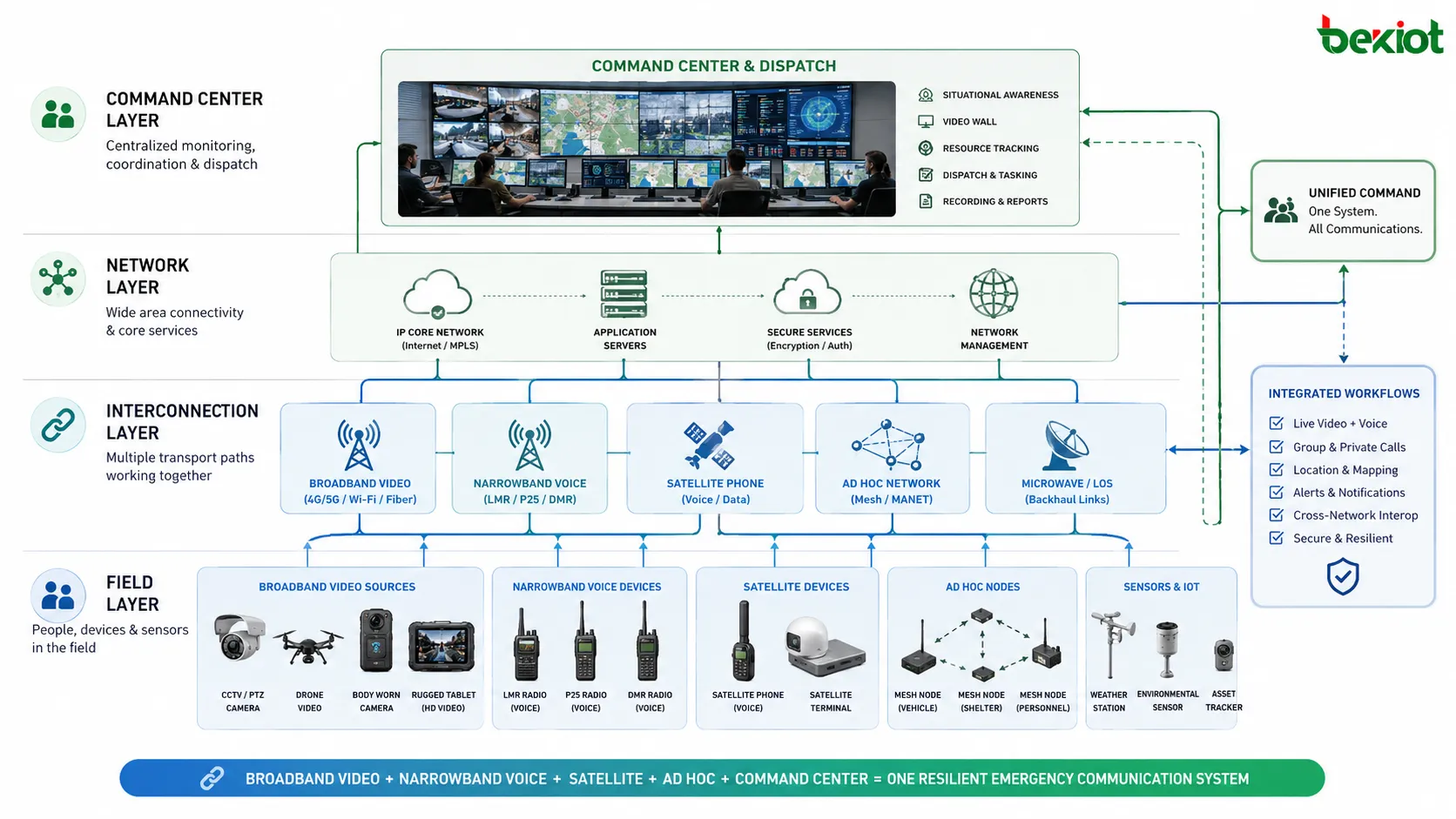
The field layer may include handheld radios, mobile radios, satellite phones, narrowband positioning devices, emergency sensors, and portable dispatch terminals. The interconnection layer may include satellite phone access, radio gateways, RoIP gateways, ad hoc network equipment, and IP communication links. The command center layer may include dispatch consoles, call recording, GIS maps, event management, and multi-party coordination.
For projects that need to integrate radio voice, SIP dispatch, satellite connectivity, and command center communication, Becke Telcom can be considered as a practical solution option for building flexible emergency communication access and field dispatch integration.
Key Functional Modules
Field voice command
Voice is the most essential emergency communication service. Field commanders must be able to speak with rescue teams, patrol teams, vehicle teams, medical support, security personnel, and headquarters. Narrowband radio communication provides a stable voice channel with low power demand and wide-area usability.
Satellite-assisted backhaul
Satellite phones or satellite links are valuable when terrestrial communication infrastructure is unavailable. By connecting radio users to a shared satellite communication path, the command center can communicate with field personnel even when mobile networks, fixed lines, or broadband access are damaged.
Positioning and short messages
Narrowband channels can carry location information, short messages, and basic sensor data. This helps the command center understand where teams are located, whether a responder needs support, and how field conditions are changing.
Optional video access
Video is useful for visual verification, situation awareness, and remote decision-making. However, it should be treated as an optional enhancement rather than the only communication foundation. Video applications should be planned according to available bandwidth, power supply, link stability, and the importance of visual information in the incident.
Balancing Broadband and Narrowband in One System
The most reliable emergency communication architecture is not purely broadband or purely narrowband. It uses each technology where it is strongest. Broadband supports video, image, and large data transmission. Narrowband supports voice command, low-power coordination, positioning, short messages, and basic sensor information.
| Communication Type | Typical Applications | Field Requirement | Emergency Value |
|---|---|---|---|
| Broadband Communication | Video backhaul, video conferencing, images, large data | Stable bandwidth, stronger power supply, higher link quality | Provides visual awareness when network and power conditions allow |
| Narrowband Communication | Voice, short messages, location, sensor data | Low bandwidth, low power, portable devices, wide coverage | Keeps essential command communication online in harsh conditions |
| Satellite Phone Link | Remote voice access and field-to-center communication | Satellite terminal, clear access environment, power backup | Supports communication when ground networks are unavailable |
| Ad Hoc Network | Temporary local coverage and limited video/data transmission | Battery management, terrain planning, relay deployment | Extends field communication when fixed infrastructure is missing |
Scenario-Based Deployment Design
In urban emergency response, the system may use mobile networks and fixed command center links as the primary connection, with narrowband radios supporting local field coordination. In mountain rescue, forest fire response, flood control, and remote inspection, satellite-assisted narrowband voice may become the most reliable communication path.
For large public events, narrowband radios can support security, traffic control, medical teams, and on-site command groups, while broadband systems may support temporary video monitoring or command vehicle access. For industrial emergency response, narrowband communication can connect field operators, safety personnel, and control rooms when wired systems or public mobile networks are not available.
The solution should be designed according to mission type, field terrain, expected response duration, device battery life, available power supply, required video channels, command center interface, and fallback communication path. This prevents the system from depending too heavily on one link or one type of device.
Planning and Commissioning Recommendations
Before deployment, the project team should test communication performance under realistic field conditions. This includes terrain impact, battery endurance, radio coverage, satellite phone availability, backhaul bandwidth, video stream stability, command center access, and power supply duration.
For video requirements, the team should verify whether the available link can provide at least 1M stable bandwidth per required video stream, and whether the total number of planned streams can remain stable during operation. For narrowband requirements, the team should verify radio group configuration, voice clarity, satellite bridging, location reporting, and emergency call procedures.
The commissioning process should include both normal operation and degraded conditions. A system should be tested with limited bandwidth, low battery, partial network failure, and long-distance field operation. Emergency communication must prove that it can still support command decisions when conditions are not ideal.
Operational Benefits
A narrowband-based emergency communication solution improves field reliability, reduces power pressure, extends communication coverage, and keeps essential command channels available during difficult incidents. It also allows organizations to use broadband video more rationally, instead of depending on video transmission in environments where bandwidth and power cannot be guaranteed.
For emergency management departments, public safety teams, fire rescue units, industrial parks, transportation operators, utilities, and large facility managers, this design provides a balanced path. It supports real-time voice command, field positioning, satellite-assisted communication, optional video access, and back-end dispatch integration.
The final value is simple: emergency communication must remain effective under any condition. Narrowband systems carry this responsibility because they require less bandwidth and less power, making them one of the most stable communication safeguards in extreme environments.
FAQ
Can a narrowband system support emergency video transmission?
Not directly in the same way as broadband. Narrowband is better for voice, messages, positioning, and sensor data. Video should normally use broadband, ad hoc networking, satellite broadband, or a dedicated video link.
How should teams decide whether to deploy video at the scene?
They should evaluate whether the video is essential for decision-making, whether stable bandwidth is available, whether power supply can support the equipment, and whether voice command would be more reliable for the task.
Why should satellite phones be included in field plans?
Satellite phones provide an alternative path when terrestrial networks are damaged, overloaded, or unavailable. They are especially useful in mountain areas, remote regions, flood zones, and disaster sites.
What should be prepared before a field emergency kit is used?
Teams should prepare charged batteries, spare power modules, programmed radio channels, satellite access settings, antenna accessories, quick-start guides, and pre-defined command groups before deployment.
How can organizations avoid overbuilding the field system?
They should classify applications into essential voice, useful data, optional video, and backup communication. This helps the project avoid unnecessary complexity while keeping the most important communication functions reliable.