Low-voltage installation refers to the design, wiring, connection, protection, testing, and acceptance of electrical systems used in buildings, industrial sites, commercial facilities, public infrastructure, data rooms, control rooms, and equipment rooms. It covers power distribution, lighting circuits, control wiring, grounding, protection devices, cable routing, terminal connections, panels, cabinets, and related auxiliary systems.
Although the term “low voltage” may sound less risky than high-voltage power systems, poor installation can still cause electric shock, fire, equipment failure, communication interference, nuisance tripping, overheating, and long-term maintenance problems. A reliable low-voltage project depends on correct design review, qualified installation, strict testing, and clear acceptance standards.
Project Scope and Technical Boundaries
Before installation begins, the project team should define the system scope clearly. Low-voltage work may include distribution boards, branch circuits, control panels, cable trays, conduit systems, grounding conductors, protective devices, lighting control, socket circuits, equipment power, weak-current interfaces, and monitoring connections.
Different projects may use the term differently. In some contexts, low-voltage installation means building electrical distribution. In other contexts, it may refer to extra-low-voltage communication, security, control, fire alarm, access control, CCTV, or automation wiring. The first acceptance step is confirming which system is being discussed and which standards apply.
Code and Standard Applicability
Low-voltage installation should always follow the legal and technical requirements of the project location. International standards, national electrical codes, local fire regulations, utility rules, building codes, and manufacturer instructions may all affect the final installation method.
For global projects, IEC-based practices may be used in many regions, while NEC-based practices may apply in the United States and some related markets. However, acceptance should never rely on a generic article alone. The approved drawings, contract documents, authority requirements, and certified inspection procedures should be treated as the project baseline.
Design Documents and Site Conditions
The installation team should review single-line diagrams, load schedules, cable schedules, panel layouts, grounding drawings, equipment manuals, routing plans, and installation details before work starts. Any conflict between drawings, site conditions, and equipment requirements should be clarified before installation.
Site conditions also matter. A clean office building, a wet basement, an outdoor cabinet, a factory workshop, a chemical plant, a tunnel, or a data center may require different cable protection, enclosure rating, corrosion resistance, fire stopping, grounding design, and inspection methods.
Pre-Installation Preparation
Preparation is one of the most important stages of low-voltage installation. Many later defects come from early mistakes such as wrong cable selection, incomplete drawings, poor route planning, insufficient protection level, or unclear responsibility between electrical, mechanical, civil, and communication teams.
Material and Equipment Verification
All cables, conduits, cable trays, circuit breakers, residual current devices, distribution boards, terminal blocks, enclosures, busbars, meters, surge protective devices, labels, and accessories should be checked before installation. The model, rating, certificate, quantity, and appearance should match the approved submittals.
Materials should be stored properly. Cables should be protected from moisture, crushing, sharp bending, and direct sunlight where unsuitable. Distribution boards and control cabinets should be kept clean and dry before energization. Damaged or uncertified materials should not be installed.
Tooling and Personnel Qualification
Low-voltage installation should be performed by qualified personnel using suitable tools. Cable cutters, crimping tools, torque tools, insulation testers, multimeters, continuity testers, earth resistance testers, labeling machines, and personal protective equipment should be available according to the work type.
Incorrect tools can create hidden defects. Loose terminals, damaged conductor strands, poor crimping, scratched insulation, and over-tightened connections may not be visible during a quick inspection, but they can cause overheating or failure after the system is put into service.
Work Sequence Coordination
Electrical installation should be coordinated with civil construction, HVAC, fire protection, plumbing, communication systems, automation, and interior finishing. Cable tray routes, panel positions, wall openings, floor penetrations, and ceiling access should be confirmed in advance.
Good coordination prevents rework. For example, a cable tray installed too close to a hot pipe, a cabinet blocked by ductwork, or a conduit hidden behind finished walls may create long-term operation and maintenance problems.
Cable Routing and Mechanical Protection
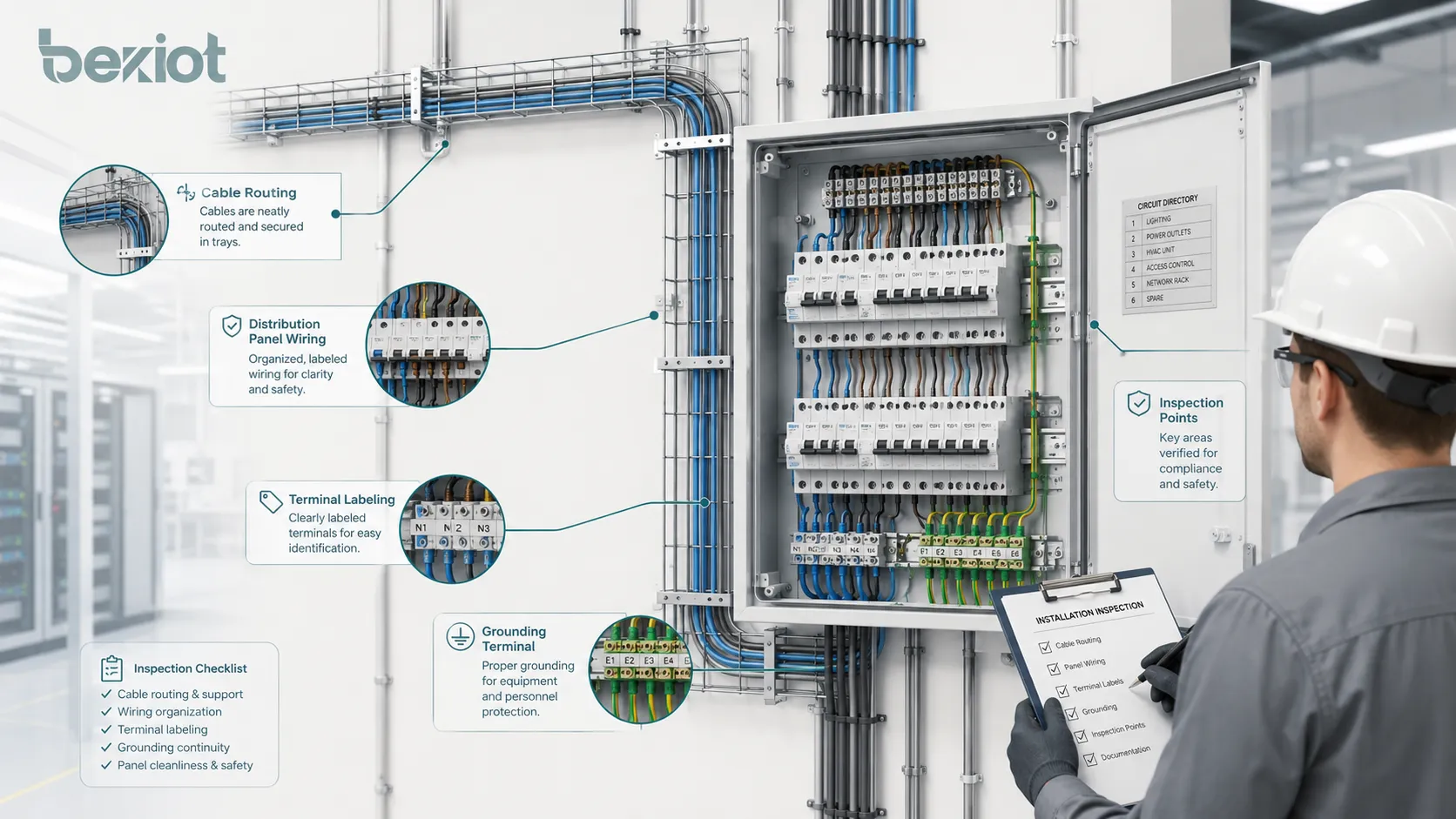
Cable routing affects safety, service life, electromagnetic compatibility, maintenance access, and visual quality. A well-designed route should protect cables from mechanical damage, heat, moisture, corrosion, excessive bending, and interference from other systems.
Tray, Conduit, and Raceway Installation
Cable trays, conduits, and raceways should be installed firmly, aligned neatly, and supported at appropriate intervals. Sharp edges should be removed or protected so that cable insulation is not damaged during pulling or future maintenance.
Routes should maintain safe separation from heat sources, moving machinery, water pipes, steam lines, gas lines, and other hazards. Where cables pass through walls, floors, or fire-rated barriers, proper sleeves, sealing, and fire-stopping measures should be used according to the project requirements.
Bending Radius and Pulling Force
Cables should not be bent beyond the manufacturer’s minimum bending radius. Excessive bending can damage insulation, shielding, conductor structure, or cable geometry. This is especially important for larger power cables, shielded control cables, data cables, and special fire-resistant cables.
During cable pulling, excessive force should be avoided. Pulling lubricant, rollers, guide tools, and staged pulling methods may be needed for long routes. Damaged cable jackets should be inspected carefully and replaced when the damage affects safety or performance.
Separation from Signal and Communication Lines
Power cables can create electromagnetic interference that affects communication, control, audio, video, and data signals. Where power and signal cables are routed in the same area, separation distance, shielding, metal conduit, crossing angle, and grounding design should follow the applicable design requirements.
When cables must cross, crossing at a right angle is usually preferred to reduce coupling. Parallel runs should be planned carefully, especially in control rooms, industrial automation cabinets, data centers, public address systems, security systems, and building management systems.
Wiring, Termination, and Panel Work
Panel wiring is one of the most visible indicators of installation quality. Neat wiring alone is not enough; conductors must be correctly sized, identified, terminated, protected, and tested. Poor panel work may lead to overheating, misoperation, difficult maintenance, and safety hazards.
Conductor Identification
Conductors should be identified according to the project standard. Phase conductors, neutral conductors, protective earth conductors, control conductors, and signal wires should be clearly distinguished by color, label, sleeve, ferrule, or tag.
Accurate identification helps during testing, troubleshooting, maintenance, and future modification. Unlabeled wires increase the risk of wrong connection and make fault diagnosis slower during operation.
Terminal Tightness and Torque Control
Loose terminals are a common cause of overheating and electrical failure. Terminal screws, breaker lugs, busbar connections, earth terminals, and neutral bars should be tightened according to manufacturer torque requirements where specified.
Over-tightening is also a problem because it can damage threads, crush conductors, or weaken terminal hardware. For important connections, torque marking and inspection records can help confirm that the connection has been checked.
Panel Layout and Heat Dissipation
Distribution boards and control panels should allow enough space for wiring, ventilation, operation, inspection, and maintenance. Devices should not be overcrowded. Heat-generating equipment should be arranged with suitable clearance and ventilation.
Panel doors should open properly, equipment labels should be visible, and live parts should be protected against accidental contact. Internal wiring should be routed cleanly so that future maintenance does not require unnecessary disturbance of other circuits.
Grounding and Protective Measures
Grounding and protective bonding are essential for electrical safety. They help reduce electric shock risk, stabilize system reference potential, support protective device operation, and improve equipment reliability.
Protective Earth Continuity
All required exposed conductive parts should be connected to the protective earth system. This may include distribution boards, metal enclosures, cable trays, equipment frames, motor bodies, metal conduits, control cabinets, and other conductive parts specified by the design.
Protective earth continuity should be tested before energization. A visually connected earth wire is not enough; loose terminals, paint layers, corrosion, broken conductors, or missing bonding jumpers can compromise the protective path.
Equipotential Bonding
Equipotential bonding helps keep conductive parts at similar electrical potential, reducing dangerous touch voltage under fault conditions. It is especially important in wet areas, mechanical rooms, industrial sites, medical-related spaces, and locations with large conductive structures.
Bonding should be designed and installed according to the applicable standard and site risk level. Unplanned bonding or random grounding changes can create noise problems or safety issues, so bonding work should follow approved drawings.
Protection Against Electric Shock
Protection against electric shock generally requires a combination of insulation, barriers, enclosures, grounding, automatic disconnection, residual current protection where required, proper equipment selection, and safe working procedures.
Acceptance should confirm that protective measures are not only installed but also functional. For example, a residual current device should be tested, an enclosure should be complete, a protective conductor should have continuity, and a circuit breaker should match the circuit design.
Protection Devices and Circuit Coordination
Low-voltage systems depend on protective devices to respond correctly during overloads, short circuits, leakage faults, surges, and abnormal operating conditions. Incorrect device selection can create nuisance trips, insufficient protection, or dangerous fault conditions.
Circuit Breakers and Overcurrent Protection
Circuit breakers, fuses, and other overcurrent protection devices should match the cable size, load type, fault level, installation method, and coordination design. They should be installed according to approved panel schedules and single-line diagrams.
The rating of a protective device should not be changed casually on site. Replacing a breaker with a higher rating to avoid tripping can create fire risk if the cable or equipment cannot safely carry the current.
Residual Current Protection
Residual current devices may be required in specific circuits or environments to reduce electric shock and fire risk. Their rated residual operating current, type, response characteristics, and coordination with upstream devices should be selected according to the project design.
During acceptance, test buttons and functional trip tests should be performed where applicable. The test result should be recorded, especially for circuits serving wet areas, outdoor equipment, temporary power, sockets, or sensitive locations.
Surge Protection and Lightning-Related Risk
Surge protective devices may be needed where equipment is exposed to lightning-induced surges, utility switching surges, long outdoor cable routes, sensitive electronics, communication interfaces, or automation systems.
SPD installation should consider grounding path, conductor length, coordination level, and panel position. Poorly installed surge protection may not perform as expected, even if the device rating appears suitable on paper.
Testing Before Energization
Testing before energization is a critical safety step. It helps find wiring errors, insulation defects, grounding problems, wrong phase sequence, loose connections, incorrect labeling, and protective device issues before the system is powered.
Visual Inspection
Visual inspection should confirm that the installation matches approved drawings, equipment is installed securely, cable routes are complete, labels are present, enclosures are clean, terminals are tightened, covers are installed, and there is no visible damage.
Inspectors should also check whether temporary construction wiring has been removed, unused openings are sealed, foreign objects are removed from panels, and access space is clear for safe operation and maintenance.
Continuity and Insulation Resistance
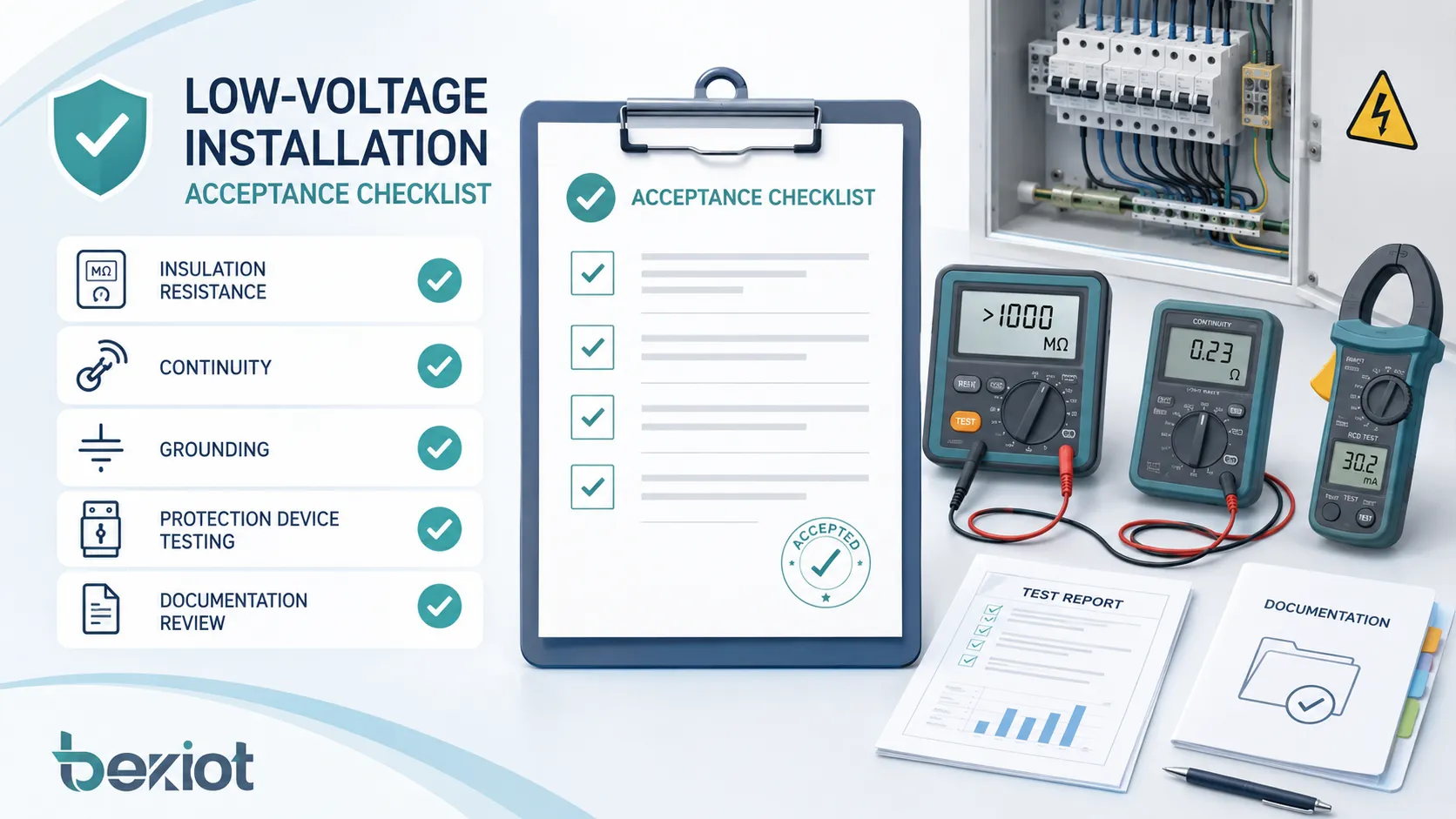
Continuity testing verifies that protective conductors and required bonding paths are properly connected. Insulation resistance testing helps confirm that conductors are not shorted, damaged, wet, or degraded before energization.
Test voltage and acceptance values should follow the applicable standard, equipment type, and project specification. Sensitive electronic devices may need to be disconnected or protected before insulation testing to prevent damage.
Polarity, Phase Sequence, and Functional Checks
Polarity checks help confirm that live, neutral, and protective conductors are correctly connected. Phase sequence checks are important for three-phase motors, pumps, fans, compressors, and equipment that may rotate incorrectly if phases are reversed.
Functional checks should verify switches, indicators, meters, interlocks, alarms, emergency stops, control circuits, automatic transfer functions, and other operational features. Testing should be documented and witnessed when required by the project.
Acceptance Standards and Inspection Criteria
Acceptance standards should be based on the approved design, local code, applicable electrical standard, contract requirements, manufacturer instructions, and authority inspection rules. The following items provide a practical acceptance framework, but they should be adjusted for each project.
| Acceptance Item | Key Inspection Focus | Typical Requirement |
|---|---|---|
| Document review | Drawings, specifications, certificates, test records, as-built documents | Complete, consistent, approved, and traceable |
| Material conformity | Cables, breakers, panels, accessories, enclosures, labels | Match approved submittals and installation environment |
| Cable installation | Routing, support, bending radius, protection, separation, fire sealing | Neat, protected, accessible, and compliant with design |
| Termination quality | Conductor stripping, crimping, ferrules, torque, terminal labels | Secure, clean, correctly identified, and mechanically reliable |
| Grounding and bonding | Protective earth continuity, bonding jumpers, earth bar connection | Continuous, correctly sized, and properly connected |
| Electrical testing | Insulation resistance, continuity, polarity, phase sequence, device operation | Tested, recorded, and within specified acceptance limits |
| Functional verification | Switching, control logic, indication, alarms, interlocks, load operation | Functions operate according to design intent |
| Safety readiness | Covers, barriers, warning labels, access clearance, emergency isolation | Safe for operation and maintenance |
Concealed Work Acceptance
Concealed work should be inspected before it is covered by walls, ceilings, floors, trenches, insulation, or finishes. This includes conduits, embedded boxes, cable routes, sleeves, fire stopping, grounding conductors, and hidden junction points.
Once concealed, defects become difficult and expensive to correct. Photo records, inspection forms, measured routes, and signed acceptance records should be kept for future maintenance and final handover.
Panel and Cabinet Acceptance
Panel acceptance should check enclosure installation, internal cleanliness, wiring neatness, conductor identification, terminal tightness, breaker rating, busbar arrangement, neutral-earth separation where required, grounding connection, and label accuracy.
Each circuit should match the panel schedule. Spare circuits, reserved spaces, and outgoing cable labels should be clearly marked. Panel doors, locks, seals, ventilation openings, and warning signs should be complete before handover.
System Energization Approval
Energization should only occur after required inspections and tests are complete. The team should confirm that all personnel are clear, downstream equipment is ready, temporary grounds are removed, covers are installed, and switching authority is assigned.
For large projects, staged energization is often safer than powering the entire system at once. Each stage should include monitoring for abnormal sound, smell, temperature, voltage, current, tripping, or equipment warning signals.
Documentation and Handover Requirements
Documentation is part of acceptance, not an optional office task. Without complete records, future maintenance teams may not know how the system was installed, tested, modified, or approved.
As-Built Drawings
As-built drawings should reflect the actual installation. They should show final cable routes, panel numbers, circuit numbers, equipment locations, grounding points, junction boxes, spare conduits, and any approved site changes.
Drawings that do not match the site can create safety risks during maintenance and renovation. The handover team should verify as-built documents against the real installation before final acceptance.
Test Reports and Certificates
Test reports should include test date, tested circuit, instrument model, calibration status where required, test method, test value, inspector name, witness name, and final result. Certificates for major materials and equipment should also be included.
Clear records support future troubleshooting and compliance review. If a failure occurs later, the maintenance team can compare new test values with original commissioning values to identify deterioration.
Operation and Maintenance Information
Handover documents should include equipment manuals, panel schedules, breaker settings, maintenance instructions, spare part information, warranty documents, and emergency operation procedures.
For facilities with 24-hour operation, operators should also receive training on normal switching, emergency isolation, alarm recognition, reset procedures, and reporting methods.
Common Defects Found During Acceptance
Many low-voltage installation defects are repetitive. They may appear minor during construction but can cause significant operational problems after the system is energized.
Poor Labeling and Circuit Identification
Missing or inaccurate labels are common. A panel may be neatly wired, but if circuit numbers and destination labels are wrong, maintenance becomes risky. Wrong labels can lead to accidental shutdown, delayed fault repair, or unsafe isolation.
Acceptance should include label verification, not only label presence. Inspectors should randomly check whether the actual circuit destination matches the panel schedule and as-built drawing.
Loose Connections and Damaged Conductors
Loose terminals, poorly crimped lugs, damaged insulation, exposed copper, broken strands, and incorrect conductor stripping length are serious defects. They can cause overheating, arcing, voltage drop, and intermittent faults.
These defects are often preventable through proper tools, qualified labor, torque control, and inspection before enclosure covers are closed.
Incomplete Grounding and Bonding
Missing bonding jumpers, painted contact surfaces, loose earth terminals, undersized conductors, and disconnected cable tray sections can weaken the protective earthing system.
Because grounding problems may not be obvious during normal operation, continuity testing and visual checks are essential during acceptance.
Maintenance-Oriented Acceptance Thinking
A good low-voltage installation should not only pass initial inspection. It should also be easy to operate, maintain, expand, and troubleshoot over many years. Acceptance should therefore consider long-term serviceability.
Access and Maintainability
Panels, junction boxes, cable trays, isolators, and test points should be accessible. Equipment should not be blocked by fixed furniture, piping, ductwork, stored materials, or architectural finishes.
Maintenance space is a safety requirement as well as an operational need. Workers must be able to inspect, test, isolate, and replace components without unsafe body positions or unnecessary removal of unrelated equipment.
Spare Capacity and Future Expansion
Where the design requires future expansion, spare breakers, spare terminals, spare conduits, spare cable tray capacity, and reserved panel space should be checked during acceptance. If spare capacity is lost during construction, future upgrades may become expensive.
For commercial buildings, industrial plants, and technology spaces, future load growth should be considered carefully. A system that works on day one may become overloaded if expansion planning is ignored.
Thermal and Load Review
After energization and load operation, the team may review voltage, current, phase balance, temperature rise, and abnormal heating. Thermal imaging can be useful for detecting hot terminals, overloaded conductors, or poor connections under load.
Load review is especially useful for distribution panels, motor circuits, UPS outputs, server rooms, production equipment, and other circuits with high utilization or critical service requirements.
FAQ
What is low-voltage installation?
Low-voltage installation is the process of installing electrical distribution, wiring, protection devices, grounding, panels, control circuits, and related equipment for building, industrial, commercial, or infrastructure systems. The exact scope depends on the project definition and local standards.
What should be checked before low-voltage installation starts?
The team should check approved drawings, material certificates, cable schedules, panel schedules, site conditions, installation routes, equipment ratings, environmental requirements, safety procedures, and coordination with other construction disciplines.
What are the key precautions during cable installation?
Key precautions include maintaining proper bending radius, avoiding excessive pulling force, protecting insulation, separating power and signal cables where required, supporting trays and conduits correctly, sealing penetrations, and labeling both ends of each cable.
What tests are usually required before energization?
Common tests include visual inspection, protective earth continuity, insulation resistance, polarity check, phase sequence check, residual current device test where applicable, functional control test, and verification of protective device installation.
What documents are needed for acceptance?
Acceptance documents usually include approved drawings, as-built drawings, material certificates, equipment manuals, test reports, inspection records, commissioning records, panel schedules, operation instructions, and maintenance information.
Who should define the final acceptance standard?
The final acceptance standard should be defined by the project contract, approved design, local electrical code, applicable national or international standards, manufacturer requirements, authority inspection rules, and the owner or consultant’s technical specifications.