In mission-critical environments, communication is not simply a support function. It is part of the operational backbone that keeps people connected, decisions coordinated, and incidents under control. Mines, energy sites, transport hubs, logistics networks, emergency command centers, and smart city platforms all depend on fast and dependable voice communication to maintain daily operations and respond effectively when conditions change.
Traditional analog dispatching systems were built for a different era. They often rely on closed architectures, limited integration, fixed hardware structures, and rigid expansion models. While they can still support basic calling and local dispatch tasks, they often become a bottleneck when organizations need wider coverage, higher concurrency, easier interoperability, and better emergency coordination.
Becke Telcom’s IP Phone Dispatching System is designed to address that gap. Built on a SIP-native VoIP architecture, it transforms fragmented voice networks into a unified dispatching platform that supports centralized control, real-time coordination, multi-terminal communication, and future-ready expansion. Instead of forcing organizations to manage separate communication islands, it creates one connected environment for voice, paging, intercom, recording, and command operations.
Why Modern Operations Need IP-Based Dispatching
Organizations working in high-pressure environments require more than point-to-point telephony. They need a communication platform that can handle routine coordination, priority escalation, group paging, emergency response, and post-incident review without switching between disconnected systems. Dispatchers must be able to see what is happening across the network, reach the right people immediately, and maintain communication even under peak-load conditions.
Traditional dispatching platforms often struggle in these scenarios for several reasons. They may be difficult to integrate with IP-PBX systems and legacy PSTN lines. They may have limited support for mobile and remote terminals. They may lack real-time visibility of extension status, and they often make system expansion expensive because every upgrade depends on hardware replacement instead of flexible software scaling.
Closed or proprietary system structures reduce interoperability.
Legacy architectures make multisite coordination more difficult.
Limited terminal diversity restricts field communication flexibility.
Weak visualization slows down dispatcher decision-making.
Inadequate redundancy increases operational risk.
Basic voice systems cannot fully support emergency linkage and review.
A modern dispatching platform should not only connect calls. It should improve situational awareness, accelerate response, and support reliable communication across every critical stage of an operation.
SIP-Native Unified IP Framework
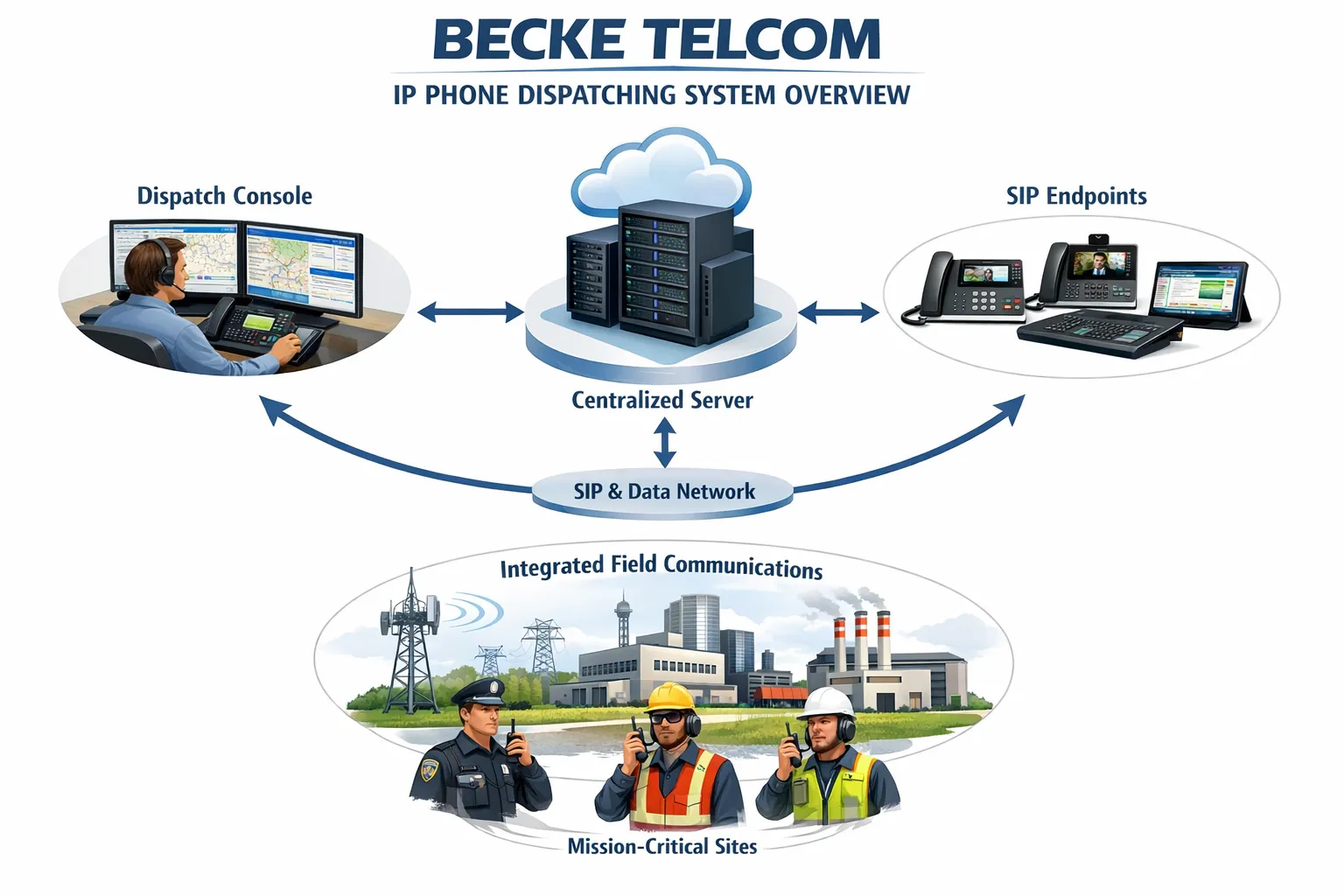
At the core of the Becke Telcom IP Phone Dispatching System is an open SIP-based architecture. This design allows the platform to work smoothly with enterprise IP-PBX environments, public mobile networks, SIP devices, and legacy telecommunication systems. The benefit is practical as well as technical. Organizations can upgrade dispatching capability without discarding all previous communication investments.
Because the platform is IP-based from the ground up, it supports more flexible deployment across headquarters, branch sites, field zones, and mobile teams. It can unify voice calls, dispatch operations, broadcast tasks, group coordination, and emergency intercom into one consistent framework. This gives operators a clearer communication structure and helps organizations simplify long-term infrastructure planning.
Core Components of the System
Centralized Dispatch Server
The dispatch server acts as the control center of the entire platform. It handles SIP signaling, media routing, user management, call control, and database services for dispatching operations. In high-demand scenarios, the server is designed to support high concurrency and stable communication performance so that large volumes of simultaneous activity do not interrupt urgent operations.
Multi-Functional Dispatch Console
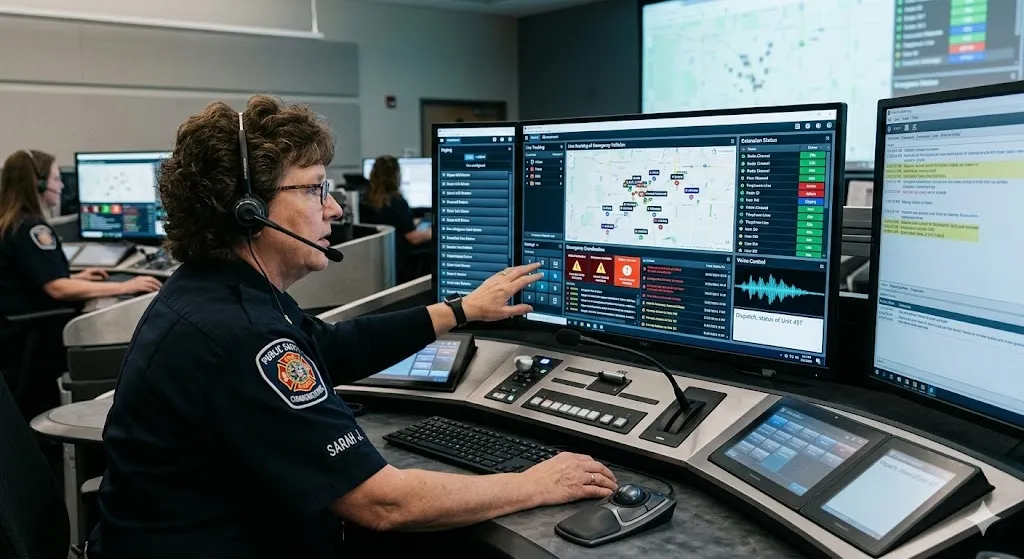
The dispatch console is designed for fast and intuitive operation. It provides real-time visibility of extension status, line conditions, and ongoing communication tasks. Dispatchers can quickly initiate calls, group paging, emergency broadcasts, conferencing, and transfers without navigating multiple disconnected tools. This kind of visual control is especially valuable when time-sensitive coordination is required.
Versatile Endpoint Devices
The solution supports a wide range of communication terminals, including industrial IP phones, SIP desk phones, softphones, Wi-Fi handsets, portable intercom devices, paging gateways, and broadcast speakers. This allows organizations to build one dispatching environment across fixed offices, control rooms, industrial floors, vehicles, and remote field positions.
Recording and Management Modules
Recording and logging modules capture calls, broadcasts, intercom sessions, and system events for later review. These functions are important for post-incident analysis, dispatcher training, operational auditing, and traceability in regulated or safety-sensitive industries.
Integration Interfaces
The platform can connect with CCTV, alarm systems, broadcast devices, paging gateways, and other third-party infrastructure. This enables voice communication to work alongside monitoring, alerts, and response workflows instead of functioning as an isolated telephony layer.
| Component | Main Role | Operational Value |
|---|---|---|
| Centralized Dispatch Server | Call control, signaling, media routing, data management | Provides the stable core for plant-wide or network-wide communication |
| Dispatch Console | Visualized command, fast dispatch actions, live control | Improves decision speed and dispatcher efficiency |
| Endpoint Devices | Voice access for fixed, mobile, and field users | Extends dispatch capability to real working environments |
| Recording and Logging | Call recording, event storage, audit traceability | Supports review, compliance, and training |
| Integration Interfaces | Links to CCTV, alarms, paging, and external systems | Creates a more complete command-and-control workflow |
Core Capabilities Beyond Basic Telephony
Visualized Command and Control
The system provides real-time visualization of user and terminal status, including idle, busy, ringing, and offline conditions. Dispatchers can instantly identify the availability of field users and communication endpoints, reducing the time needed to locate the correct contact during routine work or emergency escalation.
Visual operations also simplify complex actions. Call transfer, conferencing, and dispatch routing can be executed through intuitive interface actions rather than time-consuming manual sequences. This reduces operator stress and lowers the risk of dispatch errors during high-pressure situations.
Advanced Broadcast and Paging
The platform supports several layers of paging and broadcast control. Scheduled broadcasts can automate shift reminders, routine notifications, or recurring operational messages. Zone-based paging allows organizations to send announcements only to selected areas such as a warehouse, tunnel, workshop, or department. Emergency all-call can override ongoing activity when urgent information must be delivered immediately.
Emergency Coordination and Intercom
In real-world emergency scenarios, communication must be immediate, simple, and dependable. The system supports one-key emergency communication workflows that can alert the dispatch center, start call recording, and support linked response actions. This is especially useful in sites where rapid situational confirmation is essential for safety and loss control.
Real-Time Recording and Secure Audit Trails
Dispatch calls, broadcasts, and critical communication sessions can be recorded and stored with associated timestamps and operational data. This creates a full communication record that can be reviewed after incidents, used for training, or analyzed to improve dispatch procedures.
Tailored for Mission-Critical Industry Applications
The Becke Telcom IP Phone Dispatching System is not a generic office phone platform with a dispatch label added to it. Its design is better suited to high-stakes environments where communication continuity, fast response, and field coordination are operational requirements.
Energy and Mining
Energy and mining sites often operate in remote, noisy, and demanding environments. The system helps connect underground areas, open-pit operations, plant control rooms, and remote teams through SIP-based communication, ruggedized terminals, and flexible backhaul options. One-key emergency communication and reliable dispatch control are particularly important in these environments.
Transportation and Logistics
Transport hubs, ports, railway environments, airports, and large logistics operations need fast communication between dispatch centers, mobile teams, loading areas, and service zones. The system helps coordinate vehicle movement, workforce scheduling, incident response, and high-volume daily operations through centralized command and group communication functions.
Public Safety and Smart City Operations
Smart city and public safety environments increasingly depend on the connection between communication, monitoring, and emergency response. By linking dispatch, alarms, broadcast functions, and video-related workflows, the platform supports faster escalation and more structured incident handling for campuses, municipalities, and security-sensitive facilities.
| Industry | Typical Need | Solution Value |
|---|---|---|
| Energy and Mining | Reliable communication in remote and harsh environments | Supports emergency reporting, field coordination, and continuous dispatch |
| Transportation and Logistics | Fast coordination across moving assets and distributed teams | Improves dispatch efficiency and incident response |
| Public Safety and Smart Infrastructure | Unified communication during emergencies and daily operations | Links voice dispatch with alerts, control, and response workflows |
Competitive Advantages of the Becke Telcom Platform
Carrier-Grade Reliability
The system is designed for high availability in mission-critical environments. Redundant architecture can be applied to reduce downtime risk and support continuity during server or network disruption. This is essential for sites where communication outages can directly affect safety and operational control.
Open Interoperability
Because the platform is based on SIP and open IP networking principles, it can integrate more easily with existing enterprise communication systems and third-party devices. This protects previous investment and avoids forcing customers into isolated vendor-specific islands.
Scalable Growth
The platform is designed to grow with operational needs. Organizations can expand users, terminals, and software functions without rebuilding the entire communication environment. This makes the system suitable for both initial deployment and long-term infrastructure planning.
Future-Ready Architecture
As communication environments continue moving toward cloud management, software-defined scaling, and integrated operations, a SIP-native dispatch platform provides a stronger long-term foundation than closed legacy systems. It aligns better with future VoIP, unified communication, and digital command environments.
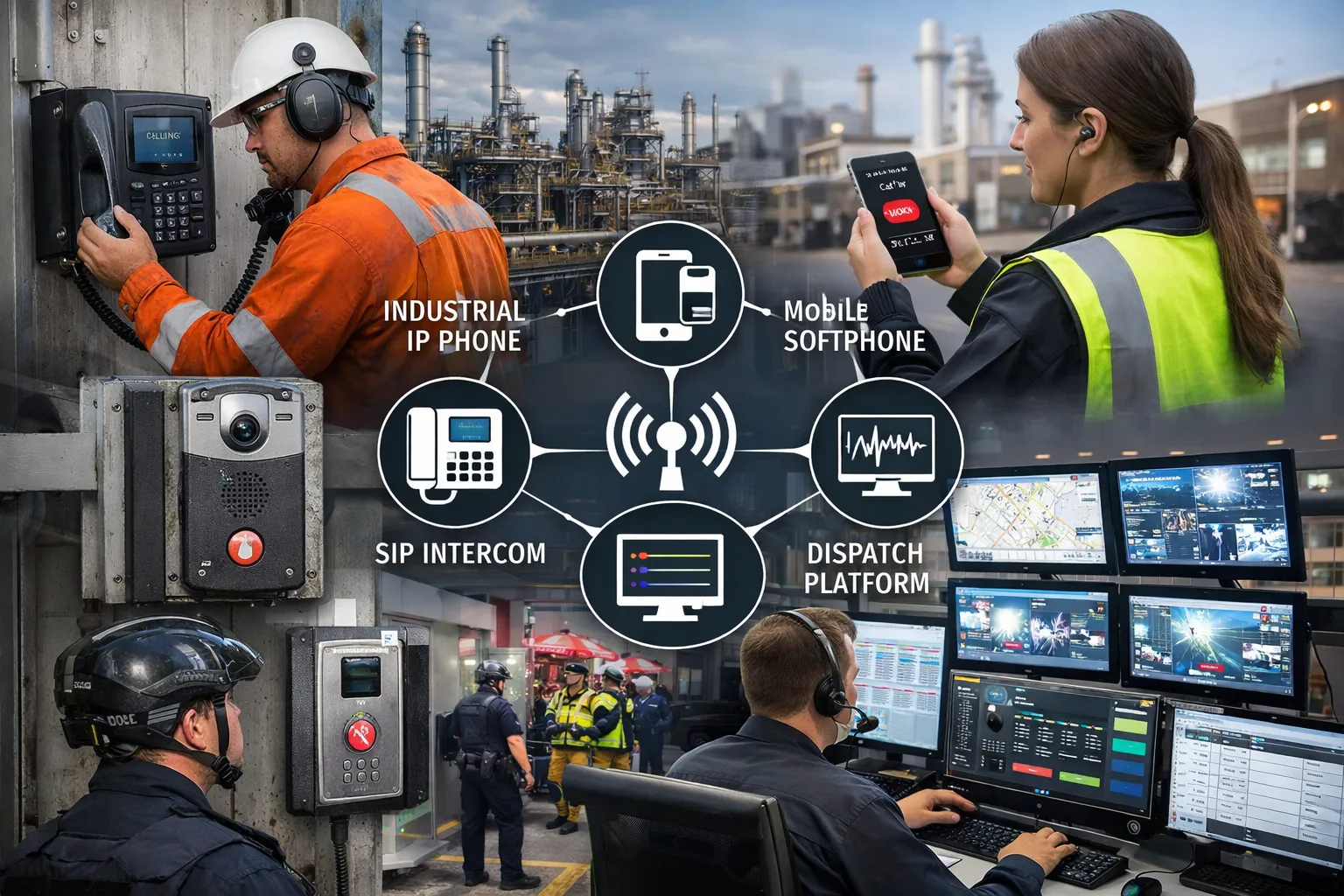
How Becke Telcom Supports Modern Dispatching Projects
Becke Telcom positions this platform as a unified communication and command tool for organizations that cannot afford fragmented voice systems. The focus is not only on telephony, but on reliable coordination across routine work, emergency escalation, field response, and operational review.
With support for SIP-native architecture, centralized management, multi-terminal communication, broadcast integration, real-time recording, and flexible expansion, the system is designed to match the practical needs of customers in energy, transportation, public safety, industrial operations, and other communication-intensive sectors.
Unified IP architecture for dispatch, intercom, and paging
Flexible terminal support for fixed, mobile, and industrial scenarios
Visualized command tools for faster operator decisions
Emergency coordination features for time-sensitive incidents
Scalable design for long-term system growth
Conclusion
Becke Telcom’s IP Phone Dispatching System represents a practical upgrade path for organizations that need more than traditional dispatch telephony. By combining SIP-native openness, centralized control, visualized dispatching, advanced broadcast functions, real-time recording, and scalable deployment, the platform supports both daily coordination and emergency response in a more structured way.
For enterprises and public service institutions operating in mission-critical environments, the value of the platform lies in its ability to unify fragmented communication resources into one dependable command-and-control interface. That makes it not only a modern dispatching tool, but also a stronger foundation for safer, more efficient, and more future-ready operations.
FAQ
What is an IP phone dispatching system?
An IP phone dispatching system is a SIP-based communication platform that combines telephony, dispatch control, paging, intercom, recording, and coordination functions for mission-critical operations.
How is it different from a traditional analog dispatch system?
It offers stronger scalability, better interoperability, easier management, more flexible terminal support, and broader integration with modern IP communication and monitoring environments.
Which industries benefit most from this type of platform?
Industries such as energy, mining, transportation, logistics, public safety, and smart infrastructure benefit most because they require real-time coordination, reliable communication, and structured emergency response.
Can the platform work with existing communication infrastructure?
Yes. A SIP-native architecture makes it easier to integrate with existing IP-PBX systems, legacy telecommunication environments, and other compatible third-party communication resources.