


Introduction
Emergency management involves coordinating response efforts across agencies and jurisdictions during crises, which requires effective communication and dispatch of resources. Integrated communication and dispatch command systems provide a unified platform for emergency personnel to share information, coordinate actions, and dispatch assets. These systems are critical to improving situational awareness, reducing response times, and ensuring that first responders, medical teams, law enforcement, and other agencies can work together seamlessly. This report provides a comprehensive overview of integrated communication and dispatch in emergency management, including its historical development, key components, technologies, protocols, case studies, and future trends.
Historical Development of Communication and Dispatch in Emergency Management
The evolution of communication in emergency management has paralleled technological advancements. In the early 20th century, fire departments and police departments used dedicated radio frequencies for communication, often with separate channels and equipment. This led to inefficiencies and difficulties in cross-agency coordination. The 1960s saw the introduction of emergency number systems like 911 in the United States, which centralized emergency calls to a single point. However, these systems were siloed – each emergency service (police, fire, EMS) had its own dispatch center and limited ability to share information. For example, the U.S. 911 system initially used analog technology and only allowed voice calls, with location accuracy limited by cell tower triangulation . This fragmentation was highlighted in disasters such as Hurricane Katrina (2005), where communication failures between agencies exacerbated the crisis .
By the late 20th century, the need for interoperable communication became clear. The 1990s and 2000s saw the adoption of digital radio systems and the development of standards like the National Incident Management System (NIMS) and the Incident Command System (ICS). NIMS, established by FEMA in 2004, provides a nationwide framework for interagency coordination . ICS, which is a core component of NIMS, standardizes on-scene command and management of incidents to ensure clear roles and efficient resource deployment . These developments laid the groundwork for integrated dispatch centers that can handle multiple emergency service calls and facilitate information sharing.
In recent years, there has been a shift towards digital, networked systems. The Next Generation 9-1-1 (NG9-1-1) initiative in the U.S. is replacing analog 911 infrastructure with IP-based systems that support text, video, and data. This transition, still ongoing, aims to improve reliability and interoperability . Globally, other countries have similarly modernized their emergency communication systems. For instance, Japan and Singapore have invested in advanced systems (often called 119 or 999 systems) that integrate communications for fire, police, and medical services. These systems incorporate new technologies like satellite communications and mobile data to maintain connectivity during disasters. The historical development of integrated communication and dispatch thus reflects a progression from separate radio channels to unified, networked platforms that leverage technology to enhance coordination and situational awareness.
Key Components of Integrated Communication and Dispatch Systems
An integrated communication and dispatch command system typically consists of several interconnected components that enable the flow of information from incident reporting to resource deployment. The following diagram illustrates the core architecture of such a system, showing how different elements work together to support emergency management.
Communication Platforms and Networks
Integrated dispatch systems rely on robust communication networks to connect all participants – from call takers and dispatchers to field units and command centers. This includes public telephone networks (for 911 calls), radio and cellular networks, and satellite networks. Modern systems often use a combination of Voice over IP (VoIP), digital radio, and broadband wireless to ensure redundancy and interoperability. For example, many countries use digital trunked radio systems (such as TETRA or PDTT in Europe and China) to support simultaneous voice and data communications among emergency responders . These networks enable emergency personnel to communicate with each other regardless of their agency or location, breaking down the silos of the past. Additionally, integrated communications emphasize the development of a common communication plan and interoperable systems that integrate voice, data, and video links . This allows, for instance, a dispatcher to receive a text or video message from a citizen at the scene and immediately share it with responding units, enhancing situational awareness.
Dispatch Centers and Command Rooms
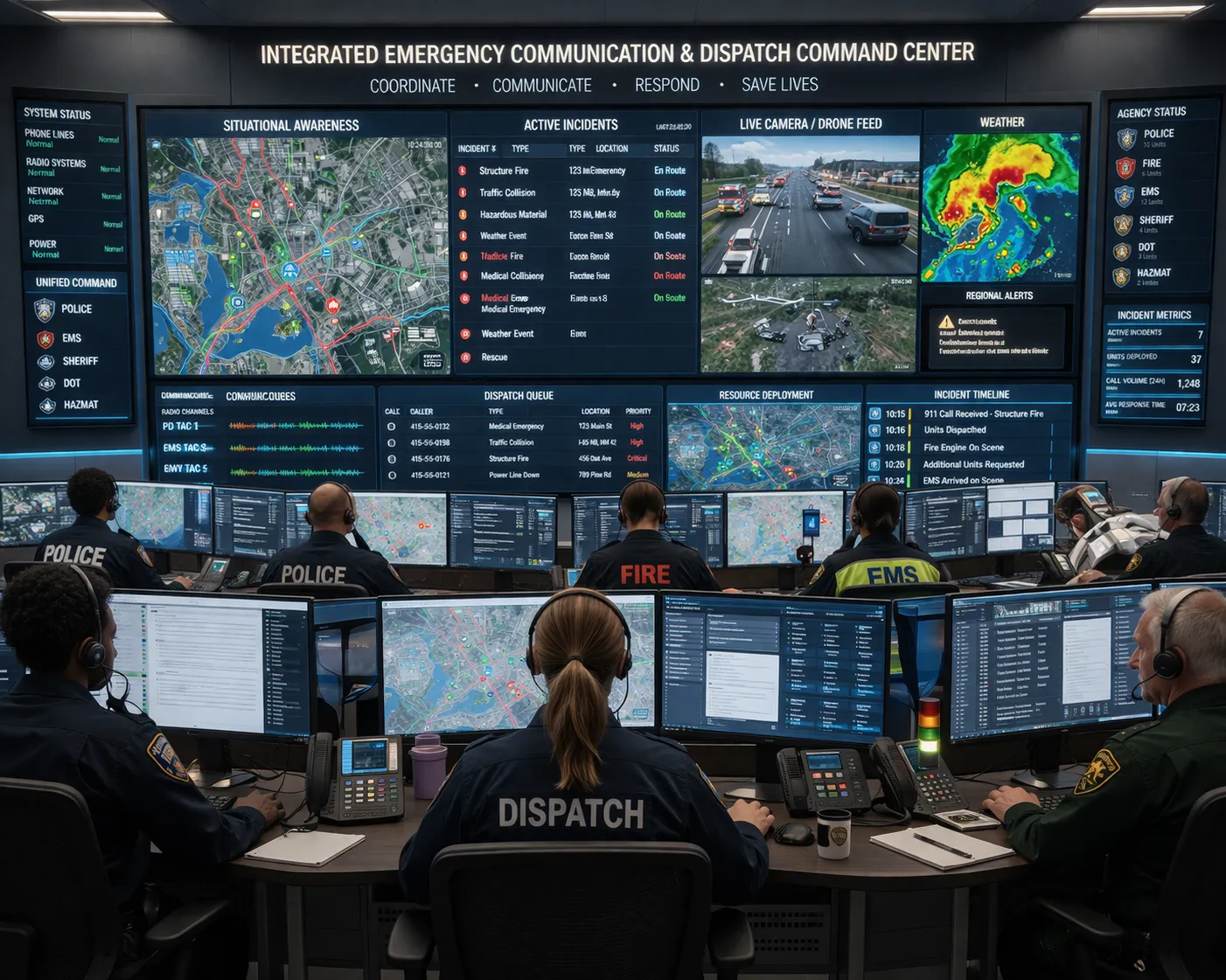
The dispatch center (also known as an Emergency Operations Center or Emergency Communications Center) is the nerve center of the system. It houses the communication consoles, computer-aided dispatch (CAD) systems, and the personnel who manage incoming emergency calls and coordinate responses. Modern dispatch centers are often multi-agency, meaning they handle calls for police, fire, and EMS from one location. This centralization ensures that a single point of contact can handle all emergency services, improving response efficiency. In the U.S., many communities have consolidated 911 call centers, and in Europe, national emergency centers coordinate across jurisdictions. The dispatch center uses technology to integrate data from various sources (calls, sensors, social media, etc.) and displays it on large screens for situational awareness. Dispatchers use CAD software to track incidents and available resources, and they communicate with field units via radio or phone. An effective dispatch center must also manage information flow to and from the Incident Command Post (ICP) at the incident site. During an event, the dispatch center may transition to a more operational role, providing support and information to the ICP commander.
Information Sharing and Integration
Integrated systems prioritize information sharing across agencies and levels of government. This means that data from police, fire, EMS, and other responders (like environmental agencies or utilities) is collected and made accessible to decision-makers. Information integration tools allow disparate data streams – such as incident reports, location data, and status updates – to be combined into a unified picture. For example, when a 911 call comes in, the system automatically alerts the appropriate dispatchers and may retrieve the caller’s location and history from a database. During an ongoing incident, dispatch centers can receive real-time updates from fireground radios or drone feeds, updating the situation map. Information sharing also extends to coordination with other jurisdictions and organizations. In large-scale emergencies, systems support unified command, where representatives from multiple agencies work together under a single command structure . This requires that information is shared transparently so that all participants have the same situational awareness. The ability to share information is often facilitated by a Common Operating Picture (COP) – a shared digital map or dashboard that displays key information for all involved.
Geographic Information Systems (GIS)
GIS is a fundamental component of integrated dispatch systems. GIS technology maps the emergency scene and surrounding areas, overlaying critical information such as incident locations, response units, and infrastructure. Dispatchers use GIS to quickly pinpoint where an incident occurred and visualize which resources are nearby. For instance, a GIS-based system can show the nearest fire trucks or ambulances to an incident, enabling faster deployment. GIS also helps in managing large incidents by providing an overview of the entire area affected, which is crucial for coordinating multi-agency responses. In many systems, the CAD system is integrated with GIS so that an incident location on the map automatically populates the call details. GIS integration is also used in emergency planning and post-incident analysis. During an emergency, GIS can help with routing evacuation traffic or mapping evacuation zones. The integration of GIS with communication systems is so important that it is often a standard requirement – many jurisdictions mandate that emergency response systems incorporate GIS to improve decision-making .
Data Analytics and Decision Support
Modern integrated dispatch systems leverage data analytics and decision support tools to enhance command effectiveness. By collecting and analyzing large volumes of data from past incidents and real-time feeds, these systems can provide insights to dispatchers and commanders. For example, machine learning algorithms can analyze historical call data to predict peak response times or identify high-risk areas. During an incident, analytics tools can crunch data from sensors (e.g., traffic cameras, environmental monitors) to help assess the situation and recommend actions. Some systems use AI to assist in tasks like automatic call classification and dispatcher decision support. For instance, AI can triage emergency calls by urgency and type, or even automatically suggest the most appropriate resources to dispatch based on the incident details. Decision support features might include simulations (e.g., simulating the impact of different response strategies) or predictive modeling for resource allocation. These capabilities move beyond just collecting data – they provide actionable information that can improve situational awareness and optimize responses. In summary, data analytics and decision support components make the dispatch system more proactive and informed, helping commanders make better decisions in complex, time-sensitive situations.
Standardization and Protocols
To ensure that all components of the integrated system work together seamlessly, standardization is crucial. Integrated dispatch systems adhere to a set of protocols and standards for communication, data formats, and procedures. At the operational level, standard operating procedures (SOPs) are in place for call handling, dispatch, and coordination. For example, all emergency services use standardized terminology and protocols for handling 911 calls (such as Emergency Medical Dispatch or Law Enforcement Dispatch protocols) to ensure consistent response. On the technical side, standards like the NENA i3 protocol and E911 standards govern how 911 calls are handled and how location data is transmitted. In the United States, NENA (National Emergency Number Association) has defined standards for Next Generation 911 to ensure interoperability between different jurisdictions . These standards cover aspects like how call routing should work, how location information is sent, and how data should be shared between systems. Internationally, organizations like the ITU (International Telecommunication Union) and ETSI (European Telecommunications Standards Institute) develop standards for emergency communication systems. In China, the PDT (Public Safety Digital Trunking) standard was developed to ensure interoperability among police, fire, and emergency services across the country . By following these standards, different systems can communicate without major technical barriers. Additionally, integration often requires adherence to data standards for information exchange – for example, using a common data format for incident reports or resource status updates. Standardization thus forms the backbone of an integrated communication and dispatch system, ensuring that technology and people can work in harmony to manage emergencies.
Emergency Communication Technologies and Infrastructure
Effective emergency management depends on reliable communication technologies and infrastructure. Over the years, emergency services have deployed a range of technologies to maintain connectivity in critical situations. The following sections outline key technologies and infrastructure components used in integrated communication and dispatch systems.
Public Switched Telephone Network (911) and Analog vs. Digital Systems
The Public Switched Telephone Network (PSTN) has been the backbone of emergency communication in most countries. In the U.S., the 911 system routes calls to the nearest Public Safety Answering Point (PSAP) using telephone number information. Traditionally, 911 calls were analog and limited to voice, with call takers recording the caller’s location from information provided. Modern 911 systems have moved to digital transmission, improving clarity and allowing for additional data. Enhanced 911 (E911) technology, mandated in the 1990s, uses telephone number databases to automatically provide location information for landline calls. For mobile calls, E911 relies on cell tower triangulation or, increasingly, GPS location from the phone. However, these systems have limitations: cell tower triangulation can be inaccurate, especially in urban canyons or rural areas . To address this, the U.S. is transitioning to Next Generation 9-1-1 (NG9-1-1), which uses IP-based networks and can receive location data directly from the caller’s device (PIDF-LO format) . This allows for much more precise location information. Analog systems, once common, are being phased out due to their limited capacity and reliability. Digital systems offer better voice quality and can carry supplementary data like text messages or photos, which is vital for today’s emergency communication needs. In summary, the PSTN-based 911 system has evolved from analog to digital, and is now evolving further to IP-based NG9-1-1 to improve accuracy and functionality.
Wireless and Cellular Communication for 911
Mobile phone networks have become the primary means of emergency communication for the public. In many countries, the majority of 911 calls come from mobile devices . Modern wireless networks, such as 4G LTE and 5G, provide robust voice and data connectivity, but they also face challenges in disaster scenarios. During a large disaster, cellular networks can become congested or even fail if the infrastructure is damaged. To mitigate this, emergency services maintain dedicated wireless networks and mobile base stations. For example, the U.S. Department of Homeland Security’s FirstNet is a nationwide public safety broadband network designed to ensure reliable connectivity for first responders in emergencies. FirstNet uses spectrum set aside for public safety and can operate even when commercial networks are down. Additionally, portable wireless devices (like mobile Wi-Fi routers or satellite phones) are used to extend coverage in remote areas. Cellular networks are also critical for data communication – for instance, sending photos or videos from a smartphone to a dispatch center or updating a GPS position of a responder. Ensuring that wireless networks are resilient and interoperable is a key focus of emergency communication planning. This includes backup power for cell towers, redundant backhaul connections, and coordination with carriers to prioritize emergency traffic. In the long term, technologies like 5G promise even higher bandwidth and lower latency, which could improve emergency video streaming and real-time collaboration among responders.
Satellite Communication
Satellite communication is indispensable for maintaining connectivity in areas where terrestrial networks are out of reach or compromised. In disasters such as earthquakes, hurricanes, or pandemics, satellite phones and terminals can provide a lifeline for communication. Satellite networks operate independently of local infrastructure, so they can continue to function even when landlines and cell towers are down. Emergency response agencies typically stock satellite phones and may deploy satellite dishes or mobile satellite units to establish communication hubs. For example, after a major earthquake, a satellite uplink can be set up to relay calls and data from the affected region to the outside world. Satellite communication is also used for remote monitoring – sensors can transmit data via satellite to early warning systems. The International Telecommunication Union (ITU) and other bodies have allocated emergency communication satellite bands to ensure that these services are prioritized. However, satellite systems have limitations: they often have higher latency and lower bandwidth compared to terrestrial networks, and weather conditions can affect signal quality. Despite these challenges, satellite communication is a cornerstone of emergency infrastructure, especially in rural or remote areas. Modern satellite constellations (like Iridium or OneWeb) provide global coverage and are increasingly used for disaster response, enabling communication even in the most isolated regions. In summary, satellite technology ensures that emergency communication can reach areas beyond the reach of conventional networks, playing a crucial role in integrated dispatch systems.
Drones and Mobile Sensors
In recent years, drones (unmanned aerial vehicles) and mobile sensors have become important tools for emergency communication and data collection. Drones can quickly survey disaster scenes, providing live video feeds to command centers that help assess the situation. This real-time aerial view can be invaluable for incident commanders to understand the extent of damage, locate survivors, or identify hazards. During an urban search and rescue operation, a drone with a thermal camera can detect heat signatures of people trapped under debris. Drones can also deliver small payloads (like first aid kits or emergency supplies) to inaccessible areas. In terms of communication, drones can serve as mobile relays – they can fly to an area with poor connectivity and act as a temporary base station, transmitting data back to the ground. For example, a drone equipped with a 4G modem can set up a hotspot in a disaster zone, allowing responders in the area to connect to the internet or to each other via the drone’s link. Mobile sensors, such as mobile crisis units or sensor-laden vehicles, are also used. These can collect data on air quality, radiation levels, or other conditions in real time and transmit it to the command center. For instance, a mobile chemical sensor truck can drive through a contaminated area and send readings back to the emergency management team, informing their decisions. The integration of drones and sensors into communication systems is part of the broader concept of Internet of Things (IoT) in emergency management. These devices enhance situational awareness by providing new data sources and can even act as communication bridges. However, using them requires careful coordination and often compliance with aviation regulations (for drones). As technology advances, we can expect even more autonomous drones and smarter sensors that feed information directly into integrated dispatch systems, improving response effectiveness.
Network Infrastructure and Backhaul

Behind the scenes, robust network infrastructure supports all these communication technologies. This includes fiber optic cables, microwave links, and wireless backhaul that connect dispatch centers, base stations, and other nodes. In normal operations, these networks are used for routine communication, but in emergencies, they become critical for maintaining connectivity. Ensuring that emergency communication networks have redundancy is a key principle. This means having backup pathways for data and voice – for example, multiple fiber routes to a dispatch center or multiple wireless links between sites. If one route is damaged, traffic can be rerouted through another. Some jurisdictions also maintain emergency networks that can be activated quickly. For instance, during a disaster, an emergency response might set up a temporary Wi-Fi network or a mobile cell tower to cover a specific area. The backhaul for these networks is equally important. Backhaul refers to the connections that carry data from end-user devices (phones, radios) to the core network or to dispatch centers. In a disaster, damage to fiber backhaul can cut off communication, so backup backhaul solutions (like satellite backhaul or wireless mesh networks) are used. Another aspect is the infrastructure at dispatch centers and command posts. These facilities must have uninterruptible power supply (UPS) systems to keep communication equipment running during power outages, and backup generators for longer outages. Communication rooms are often hardened against environmental hazards. The integration of all these infrastructure elements – from physical cabling to mobile units – ensures that the communication network can withstand the rigors of emergencies. In summary, a resilient network infrastructure underpins the entire integrated communication and dispatch system, enabling continuous information flow even in challenging conditions.
Cybersecurity and Data Integrity in Emergency Communications
With the increasing digitization of emergency systems, cybersecurity has become a paramount concern. Emergency communication networks are attractive targets for cyberattacks, and any disruption or tampering can have life-threatening consequences. Integrated dispatch systems must therefore implement strong cybersecurity measures to protect data integrity and availability. Key aspects include network security (firewalls, intrusion detection), encryption of communications, and data protection. All sensitive information – such as emergency call details, location data, and response plans – should be encrypted to prevent interception. For example, voice calls between dispatchers and field units are often encrypted, and data transmitted via IP networks is secured with protocols like TLS. Additionally, systems must be resilient to cyber threats. This includes having backup systems that can take over if a primary system is compromised, and procedures to quickly restore services. During incidents, communication networks may be under heavy load, which can also strain cybersecurity defenses; thus, capacity planning is important. The Federal Communications Commission (FCC) in the U.S. has recognized the importance of NG9-1-1 cybersecurity, as IP-based systems face new threats like DDoS attacks or ransomware . Emergency management agencies regularly conduct cybersecurity drills and vulnerability assessments to ensure their systems are robust. Another element is information integrity – ensuring that data fed into the system is accurate and not maliciously altered. For instance, a dispatcher must be able to trust that a sensor reading or an incident report is genuine. This can involve authentication of data sources and verification procedures. In summary, while communication and dispatch systems must be highly accessible and interoperable, they also need to be secure. By implementing encryption, network security, and disaster recovery plans, integrated communication systems can maintain their integrity even in the face of cyber threats, safeguarding the critical information flow during emergencies.
Standardized Communication and Command Protocols
Standardization is the glue that holds integrated communication and dispatch systems together, enabling different agencies and technologies to work in harmony. In this section, we explore the key protocols and standards that guide emergency communication and command practices.
Incident Command System (ICS) and National Incident Management System (NIMS)
The Incident Command System (ICS) is a standardized management system used by emergency responders to coordinate on-scene operations. It was originally developed for fire management but has since been adopted for all types of incidents. ICS provides a clear chain of command, defined organizational structure, and standardized terminology. Under ICS, an Incident Commander (IC) is appointed at the scene, and supporting positions (Operations, Planning, Logistics, Finance/Administration, etc.) are established to handle different aspects of the incident. This structure ensures that resources are deployed efficiently and that communication flows through established channels. ICS is supported by the National Incident Management System (NIMS), which is a comprehensive framework that includes ICS along with resource management, communications, and training components . NIMS is used nationwide in the U.S. to enable multi-agency coordination. It ensures that regardless of the incident type or location, agencies follow the same basic principles and protocols. For example, all agencies involved in an incident should use the same incident action plan format and communicate using standardized terminology. NIMS also promotes interoperability through its communication and information management component, which emphasizes common communication plans and protocols . In summary, ICS and NIMS provide the operational framework for command and coordination, ensuring that emergency response is organized, efficient, and consistent across jurisdictions.
Federal Emergency Management Agency (FEMA)
In the United States, FEMA plays a central role in setting standards and guidelines for emergency management, including communication and dispatch. FEMA’s National Response Framework (NRF) outlines how the nation responds to disasters, and it builds on NIMS to provide a structure for coordination between federal, state, and local entities. FEMA’s guidelines stress the importance of integrated communications and provide recommendations for best practices. For instance, FEMA has published standards for emergency management centers and for communication interoperability. It also funds and oversees programs like the 911 Program and FirstNet, which contribute to the development of advanced communication systems. FEMA’s influence extends to training as well – many emergency responders undergo NIMS/ICS training developed by FEMA. While FEMA’s standards are U.S.-centric, other countries have analogous agencies that set standards (e.g., the UK’s Home Office or Japan’s Cabinet Secretariat for Disaster Management). These agencies often collaborate through international bodies like the United Nations or the World Meteorological Organization to share knowledge on emergency communication standards. In summary, federal and national agencies provide the overarching guidance that ensures that communication and dispatch protocols are consistent and effective on a national scale.
International Standards and Agreements
Emergency management is a global concern, and international standards and agreements help ensure that communication and dispatch practices are aligned across borders. The ITU (International Telecommunication Union) is a key international organization that develops standards for telecommunications, including emergency communication. ITU has defined standards for emergency numbering (ITU-T E.164 for 911-like services), emergency call routing, and satellite emergency communications. For example, ITU’s recommendations ensure that emergency calls can be routed to the correct service (police, fire, medical) regardless of the country. The ETSI (European Telecommunications Standards Institute) has developed standards for public safety communication systems, such as the TETRA digital trunked radio standard that is widely used in Europe. ETSI also works on standards for interoperability between different systems. ISO (International Organization for Standardization) and IEC (International Electrotechnical Commission) produce standards for various aspects of emergency management, including fire detection, security, and emergency medical services. For instance, ISO 22301 is a business continuity standard that includes provisions for communication during incidents, and ISO 22320 is a standard for incident management systems that aligns with NIMS/ICS. Internationally, agreements like the United Nations Sendai Framework for Disaster Risk Reduction (2015–2030) emphasize the need for resilient communication infrastructure and information sharing. Many countries participate in international exercises and workshops to harmonize their communication protocols. Additionally, regional agreements exist – for example, the Emergency Management Assistance Compact (EMAC) in the U.S. allows states to share resources across borders, which includes coordination of communication during mutual aid operations . In Europe, the European Emergency Number Association (EENA) promotes interoperability among 112 emergency services. In summary, international standards and agreements provide a common language and framework for emergency communication, enabling seamless coordination in cross-border or international disasters.
Standardized Communication Protocols and Interoperability
Beyond organizational frameworks, specific communication protocols ensure that different systems can talk to each other. In the context of integrated dispatch, interoperability is crucial. Interoperability protocols allow, for example, a fire department radio system to communicate with a police department radio system, or for a dispatch center to exchange data with a hospital’s system. A key protocol for interoperability is the Common Alerting Protocol (CAP), which is an XML-based standard for disseminating emergency alerts. CAP allows agencies to send alerts (like severe weather warnings or emergency evacuation orders) in a standardized format that can be read by different systems, ensuring that the same alert can be sent to local radio, television, and mobile apps. Another important protocol is Next Generation 9-1-1 (NG9-1-1) interoperability, which is being developed to allow communication between different PSAPs and even different countries. The NENA i3 standard, adopted in the U.S., is a set of specifications that define how 911 systems should exchange call and location information to ensure interoperability . In China, the PDT standard includes provisions for interoperability among different departments and between different jurisdictions . These protocols often include common data formats and authentication mechanisms. Standardized communication interfaces are also used to connect different pieces of software – for example, using APIs to integrate a CAD system with a GIS or to connect a dispatch center with a hospital emergency department. These APIs follow industry standards (like HL7 for healthcare data or JSON/REST for general data exchange) to ensure compatibility. By adhering to these standards, integrated communication systems can achieve true interoperability, meaning that agencies and systems can work together as if they were a single unit. This is particularly important in large-scale emergencies where multiple agencies and technologies are involved. In conclusion, standardized communication protocols are the bedrock of interoperability, enabling the seamless exchange of information and coordination across the complex landscape of emergency management.
Case Studies: Integrated Communication and Dispatch in Action
To illustrate the impact of integrated communication and dispatch systems, this section presents case studies from different countries. These examples show how these systems have been implemented and the benefits they have brought in real-world emergencies.
The United States: FEMA and 911
In the U.S., the 911 system is a prime example of integrated communication and dispatch. Most communities have consolidated 911 call centers that handle police, fire, and EMS calls from one location. This centralization has led to faster response times and more effective coordination. For instance, when a 911 call comes in, the call taker can immediately notify the appropriate dispatchers and even alert other agencies if needed. This integrated approach was demonstrated during the COVID-19 pandemic, where 911 centers coordinated with hospitals and public health agencies to manage a surge in emergency calls. FEMA’s role in this was to provide guidance and funding for upgrading systems to handle high call volumes and to ensure interoperability between local 911 centers and state emergency management agencies. One notable case is the response to Hurricane Katrina in 2005, which highlighted the need for better integration. In that disaster, communication failures between different agencies hampered the response. Following this, FEMA worked with states to improve 911 infrastructure and to implement NIMS/ICS across all agencies. Another case is the implementation of FirstNet – the nationwide public safety broadband network. FirstNet was established to ensure that first responders have reliable communication in emergencies. It has been used in events like wildfires and hurricanes to maintain connectivity when commercial networks fail. The U.S. also has examples of multi-agency command centers, such as the Joint Field Offices (JFOs) set up during disasters, where federal, state, and local agencies collaborate under a unified command. These JFOs rely on integrated communication systems to coordinate operations. Overall, the U.S. experience shows that a well-integrated 911 and dispatch system can greatly enhance emergency response, but continuous improvement (like moving to NG9-1-1 and strengthening interoperability) is needed to keep up with new challenges.
Japan: Cabinet Secretariat for Disaster Management
Japan’s emergency communication system is often cited as a model for integrated services. Japan’s 119 emergency service is a unified number for fire, police, and ambulance services. The system is highly centralized and technologically advanced. For example, when a 119 call is made, the call is routed to a central dispatch center in the local fire department, which then dispatches the appropriate emergency responders (firefighters, police, or ambulance crews) based on the nature of the call. Japan’s dispatch centers are equipped with advanced GIS and communication systems that can instantly identify the caller’s location and any history of previous calls. One of Japan’s strengths is its robust emergency communication infrastructure. The country has invested in high-quality 119 systems, including dedicated emergency lines and mobile units. During natural disasters like earthquakes, Japan’s communication networks have proven resilient. Japan’s early warning system for earthquakes, combined with its emergency communication system, allows warnings to be broadcast via multiple channels (TV, radio, cell phones) within seconds of an earthquake, giving people time to seek shelter. Japan’s dispatch centers also integrate with the Cabinet Secretariat for Disaster Management, which coordinates national-level response. In the aftermath of the 2011 Tōhoku earthquake and tsunami, Japan’s integrated communication system was tested on a massive scale. Communication networks were damaged, but satellite phones and other backup systems kept some communication lines open. The government set up command centers in disaster zones and used technology to coordinate the response. The disaster highlighted the importance of interoperability and led to improvements in cross-agency communication. Today, Japan continues to refine its 119 system, incorporating new technologies like drones and AI. For example, drones are used to assess damage and locate survivors, and AI is being explored to help triage emergency calls. Japan’s case demonstrates that a highly integrated and technologically advanced emergency communication system, combined with strong standards and training, can significantly improve disaster response and save lives.
Singapore: Civil Defence Force and 999
Singapore’s emergency communication system, known as 999, is a single number for fire, police, and ambulance services, similar to Japan’s 119. The system is managed by the Civil Defence Force (CDF) in partnership with the police and ambulance services. Singapore’s dispatch centers are modern and fully integrated. When a 999 call is received, the call taker enters the location and details into a computer system that immediately displays the nearest emergency units and dispatches them. The system uses GIS to pinpoint the caller’s location, and it can even automatically identify the caller’s location if they are using a mobile phone. Singapore’s approach emphasizes interoperability between different services. For instance, if a fire and an ambulance call come in at the same time, the system can coordinate both responses without manual intervention. The CDF also has an Emergency Command Center (ECC) that can be activated during major incidents, where multiple agencies collaborate under a unified command. During the COVID-19 pandemic, Singapore’s 999 system was used to handle a surge in calls related to the virus. The government deployed additional call takers and upgraded the system to handle video calls and remote consultations, showing the adaptability of integrated communication systems. Singapore’s communication infrastructure is also notable for its resilience. The country has a robust fiber optic network and multiple data centers, ensuring that emergency communication systems remain operational even during power outages or network failures. In terms of standards, Singapore follows international best practices and has participated in initiatives like the ITU’s emergency communication standards. The government also conducts regular drills to test the integrated system. One challenge Singapore faced was the 2013 haze crisis, where thick smoke from forest fires affected air quality across the country. The 999 system was used to coordinate emergency services and to disseminate information to the public via multiple channels. Overall, Singapore’s 999 system demonstrates how a small, technologically advanced nation can implement a highly integrated emergency communication model, achieving rapid and effective responses to a variety of emergencies.
China: Ministry of Emergency Management and the Beijing City Operation Center
China’s emergency management system has been evolving in recent years to be more integrated and technology-driven. The country established the Ministry of Emergency Management (MEM) in 2018 to unify disaster management under one agency, reflecting a push for integrated communication and coordination. One example is the Beijing City Operation Center (BCOC), which serves as a central hub for emergency management in Beijing. The BCOC integrates information from various sources – including public security, fire, medical, transportation, and environmental agencies – into a single command platform. During a major event or emergency, the BCOC can display real-time data on everything from traffic conditions to pollution levels and emergency calls. This allows decision-makers to get a comprehensive view of the situation and to coordinate responses across departments. The BCOC also uses advanced technologies like GIS mapping and AI analytics. For instance, it can analyze real-time data from social media and surveillance cameras to detect potential incidents early. It also employs drones for aerial inspections and can issue alerts through multiple channels (sms, apps) to the public. China’s communication infrastructure for emergencies is also significant. The country has invested in digital trunked radio systems (like the PDT system for public safety) to ensure that police, fire, and other emergency services can communicate with each other. The government has also developed national and provincial emergency communication networks. During the COVID-19 pandemic, China’s emergency management system was tested on a massive scale. The BCOC, for example, was used to coordinate the lockdown of Wuhan and the deployment of medical resources. The system’s ability to share information between health authorities, transportation, and logistics helped in managing the crisis. Another case is the response to the 2022 Henan floods, where the integrated emergency system allowed coordination between flood control agencies, emergency rescue teams, and local governments. China’s approach emphasizes standardization – it has published standards for emergency information exchange and interoperability. For example, the GB/T 37228-2025 standard for emergency management provides guidelines for incident management, and GB/Z 42476-2023 defines a framework for information exchange in emergency management . These standards help ensure that different systems can talk to each other. In summary, China’s case shows how a country with a large population and complex emergencies is leveraging technology and integration to improve its emergency communication and dispatch capabilities, with the ultimate goal of saving lives and minimizing damage in disasters.
Challenges and Future Trends
Despite the advancements, integrated communication and dispatch in emergency management face several challenges and is continually evolving. The following chart highlights some of the key challenges that need to be addressed to ensure effective emergency response.
Looking ahead, several trends are shaping the future of integrated communication and dispatch:
Artificial Intelligence (AI) and Machine Learning: AI is set to play a bigger role in automating and enhancing emergency communications. AI can analyze incoming emergency calls to determine the appropriate response (e.g., classifying a call as a medical emergency or a traffic accident) and even suggest the best resources to dispatch. Natural language processing can help call takers by providing information from databases (like finding the caller’s address or medical history from a single question). Machine learning can also predict demand – for example, forecasting where and when emergencies might occur based on historical data and current conditions. In the future, we may see AI-driven virtual assistants handling routine calls, freeing human operators to focus on complex cases. AI can also improve coordination by simulating different scenarios and advising commanders on optimal strategies. However, the use of AI raises questions about bias and trust, so careful development and oversight are needed.
5G and Beyond: The rollout of 5G networks is expected to revolutionize emergency communication. 5G offers much higher bandwidth, lower latency, and the ability to connect many more devices simultaneously than previous generations. This means that emergency responders can stream high-definition video in real time, share large data files instantly, and connect a multitude of IoT sensors. For instance, first responders could use 5G-enabled drones or augmented reality (AR) devices to share live video of a building collapse with experts at a remote command center. 5G’s low latency could also improve the reliability of remote commands and feedback. Additionally, the development of 6G is already being discussed, with the goal of even more advanced communication features for emergency use. Beyond 5G, technologies like edge computing and distributed networks will ensure that communication remains stable during disasters by processing data closer to the source and using decentralized networks. The integration of 5G and 6G will create a more resilient and capable communication infrastructure for emergency management.
Cybersecurity and Resilience: As emergency systems become more digital, cybersecurity will continue to be a major focus. The trend is towards more robust cybersecurity measures to protect against cyber threats. This includes better encryption, intrusion detection, and incident response plans. There is also a move towards cyber resilience – designing systems so that they can withstand cyber attacks and recover quickly. In the future, we may see more collaboration between emergency services and cybersecurity experts to anticipate and mitigate threats. Another aspect is data privacy in emergency communication – ensuring that personal information is protected even as it is shared. The use of standards and regulations (like those in the EU’s GDPR) will influence how data is handled in emergencies. Overall, maintaining the security and integrity of communication systems will be crucial to the effectiveness of integrated dispatch, and this will likely be an ongoing challenge that evolves with new technologies.
Internet of Things (IoT) and Smart Devices: The proliferation of IoT devices in our infrastructure (from smart thermostats to traffic lights and environmental sensors) is creating new opportunities and challenges for emergency communication. In the future, more devices will be connected and capable of sending data automatically during emergencies. For example, a smoke detector in a building could send an alert to the fire department before anyone even calls. Traffic sensors could feed data to dispatch centers during a road closure. The challenge will be integrating this flood of data into the existing systems and making sense of it. IoT also introduces new vulnerabilities – if a device is hacked, it could send false alarms or disrupt systems. Thus, there is a trend towards securing IoT devices and ensuring that only relevant data is acted upon. On the positive side, IoT can enhance situational awareness by providing real-time data on everything from weather conditions to building integrity. The future of integrated dispatch may involve AI algorithms that continuously analyze IoT data to predict and prevent incidents (for example, detecting an early sign of a structural failure in a building and alerting authorities). Additionally, the concept of “smart cities” is increasingly intertwined with emergency management, meaning that cities will have unified platforms that integrate emergency communication with other city services.
Interoperability and Cross-Border Coordination: As emergencies can span borders (e.g., a transnational environmental disaster or a cyber attack affecting multiple countries), future systems will need to improve interoperability on an international scale. There is a trend towards developing international standards and agreements that allow seamless communication between different countries’ emergency systems. This might involve standardized data formats and protocols, as well as joint training exercises. Another aspect is cross-border cooperation – countries sharing resources and information during a crisis. For instance, during a major wildfire on a border, two countries might coordinate dispatch of firefighting resources and share real-time incident data. The use of multi-national emergency communication centers or joint response teams is becoming more common. The future will likely see more collaboration between agencies like Interpol, the Red Cross, and regional bodies to harmonize communication strategies. Ensuring that languages and cultural differences do not hinder communication is also a trend – translation services and language support will be integrated into systems to facilitate communication with diverse communities. In summary, interoperability will expand beyond domestic agencies to international cooperation, requiring continuous improvement in standards and technology.
Public Engagement and Social Media: The role of the public in emergency communication is growing. People now use social media and messaging apps to report emergencies or share information during disasters. This trend will continue, and emergency management systems are adapting to incorporate public-generated data. In the future, we may see more crowdsourcing of information – for example, a system that aggregates posts on Twitter or WhatsApp to identify areas of concern. Emergency services can then prioritize those areas. However, managing this information requires filtering out false or irrelevant reports. Another aspect is public warning systems – the future may involve more targeted and interactive warning methods, such as sending alerts directly to smartphones with location-specific instructions. This will require integration with mobile communication networks. Additionally, public engagement will include training citizens on how to use emergency apps and digital tools. The trend is towards a more two-way communication model, where the public is not just recipients of information but also active participants in sharing information and receiving updates. This will be facilitated by improved communication technology and more user-friendly interfaces.
Integration of Emergency and Public Services: The lines between emergency services and other public services are blurring. For example, city utilities (water, electricity, gas) have emergency response plans, and in the future, their systems may be integrated with emergency communication centers. If a power outage occurs, the utility can send a notification to the emergency center, which can then alert the public and dispatch repair crews. Similarly, healthcare systems may share data with emergency dispatch to help in triage (e.g., if a hospital is overwhelmed, the emergency center can know to redirect patients). The concept of a “whole-of-government” and even “whole-of-society” approach to emergency management means that communication systems will need to connect with various municipal services. This integration can lead to more holistic solutions – for instance, an integrated system that handles both emergency response and routine public service requests. The challenge is ensuring that all these different systems and data sources can coexist and share information securely. We may see the emergence of unified platforms that manage everything from routine service calls to emergency alerts. This integration will be driven by the need for efficiency and the desire to treat emergencies as part of a larger public service delivery framework.
In conclusion, the future of integrated communication and dispatch in emergency management is bright but requires continued innovation and adaptation. By embracing AI, 5G, and IoT, and by addressing challenges like interoperability and cybersecurity, these systems will become even more powerful tools in saving lives and protecting communities. The trends discussed – from smarter AI to global cooperation – indicate a direction towards more proactive, connected, and effective emergency response.
Conclusion
Integrated communication and dispatch command systems are the backbone of modern emergency management. They enable the seamless coordination of resources and information across agencies, ensuring that when disasters or emergencies strike, responders can act in concert. From the early days of separate radio channels to today’s highly integrated digital networks, the journey has been one of overcoming silos and leveraging technology. Key components like multi-agency dispatch centers, GIS, data analytics, and standardized protocols have come together to create systems that significantly enhance situational awareness and response efficiency. Technologies such as 911, wireless networks, satellite communication, and IoT devices have expanded the reach and capabilities of these systems, while standards and frameworks like ICS, NIMS, and international protocols have provided the glue to hold everything together.
Case studies from around the world demonstrate the real-world impact of these integrated systems. Whether it’s the unified 119 service in Japan, the consolidated 911 in the U.S., or the integrated command centers in China, these systems have proven their value in improving response times, reducing confusion, and saving lives. They have also shown resilience in the face of major challenges, adapting to new threats like pandemics and cyberattacks.
However, challenges remain. Ensuring interoperability across all agencies and jurisdictions, maintaining communication in extreme conditions, and protecting systems from cyber threats are ongoing concerns. The future will require continued investment in technology and collaboration to meet these challenges. Trends like AI, 5G, and IoT promise to further revolutionize emergency communication, making systems faster, smarter, and more connected. The integration of emergency management with other public services and the involvement of the public through social media will also shape the future, moving towards a more inclusive and holistic approach to emergency response.
In conclusion, integrated communication and dispatch command is not just a set of technologies; it’s a strategic approach to emergency management that brings together people, processes, and technology. As the world becomes more complex and interconnected, the importance of these systems will only grow. By learning from past experiences, adhering to best practices, and embracing innovation, societies can build emergency management systems that are robust, agile, and truly capable of protecting their citizens in times of crisis. The goal remains the same: to ensure that when emergencies occur, the right information reaches the right people at the right time, and that responders can coordinate their efforts seamlessly – ultimately leading to better outcomes for communities facing disaster.







