


Airports operate like small cities. Ground handling, security, fire rescue, logistics, maintenance, airside operations, passenger service, and command teams all need fast and reliable communication. However, these departments often use different radio and intercom systems, which makes unified dispatch difficult during daily operations and emergency response.
A modern airport communication solution should not force every department to replace its existing radio equipment. Instead, it should connect TETRA radios, narrowband trunking systems, PoC platforms, broadband trunking systems, aviation radios, internal intercom systems, SIP communication platforms, and emergency dispatch software through a flexible gateway architecture.
For airport operators and system integrators, the goal is not simply to add another communication device. The real goal is to build a controlled interconnection layer that allows different teams to communicate when needed, while still keeping channel permissions, operational rules, and safety boundaries clear. This is why radio gateway access has become an important technical path for airport emergency communication integration.
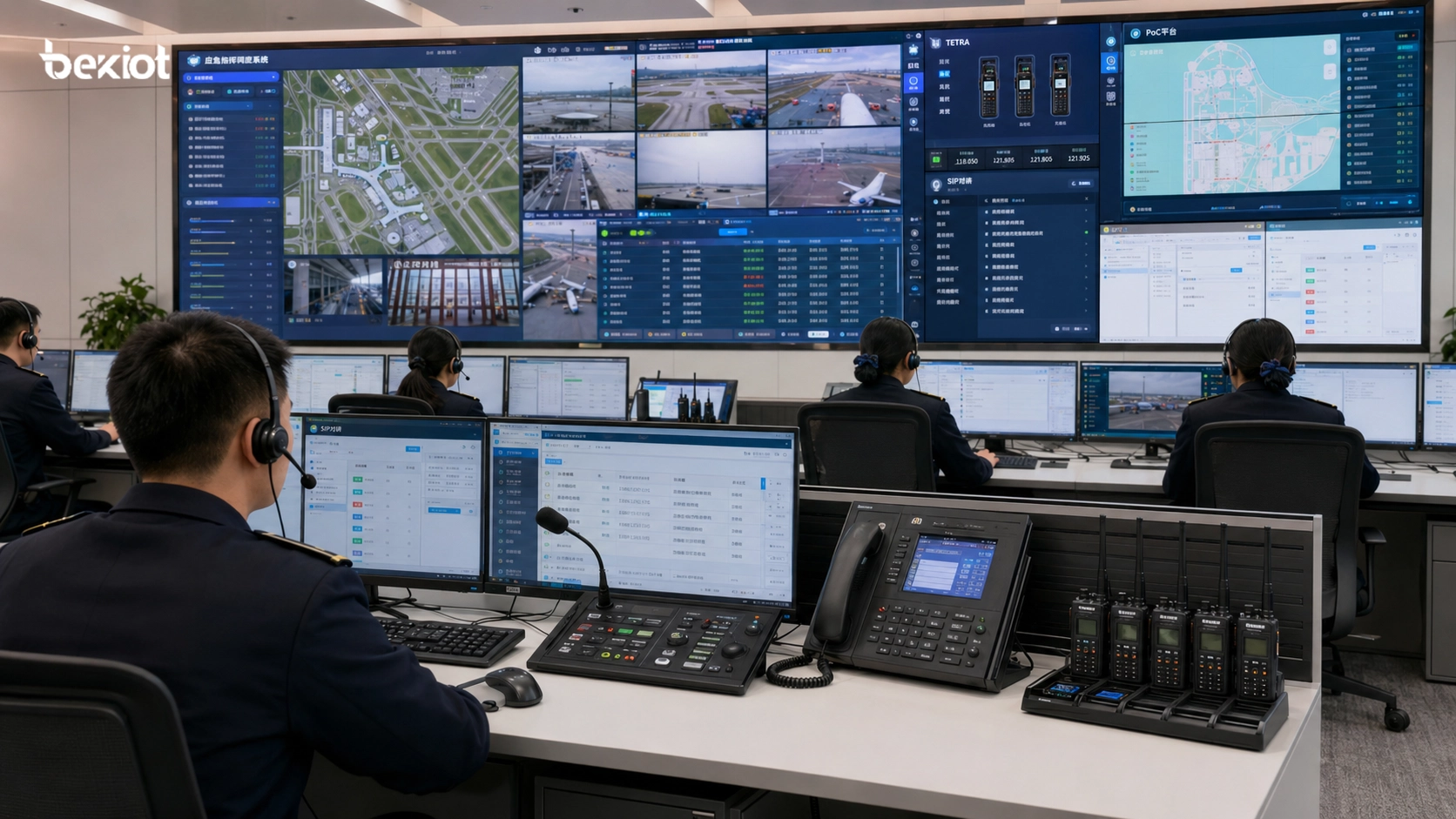
Airport Communication Is More Complex Than a Single Radio Network
In many airports, communication systems are built gradually over time. One team may use a narrowband private trunking system, another may use a public network push-to-talk platform, while security, ground service, logistics, and emergency response teams may use different radio groups or frequency resources.
TETRA digital trunking radios are still widely used in many airport operation scenarios because they provide fast push-to-talk communication, group calling, and reliable field coordination. At the same time, PoC systems are increasingly used where wide-area mobile coverage and flexible user management are needed. Broadband trunking systems may also be introduced for richer voice, data, and multimedia communication.
Besides these staff communication systems, airports also need aviation radios for communication related to air traffic operations, internal intercom systems for staff coordination, and passenger help intercoms for public service areas. These systems are necessary, but they often use different technologies and cannot communicate with each other directly.
The Real Challenge Is Interconnection
The key question in an airport emergency command or converged communication project is not whether each individual system can work. Most of them already work well within their own areas. The real challenge is how to connect them into one dispatch and command platform without disrupting existing operations.
If radio systems remain isolated, command staff must switch between multiple devices, platforms, and channels. Information may need to be repeated manually from one system to another, which can slow down decision-making during fire response, medical rescue, airside incidents, severe weather, security events, or equipment failures.
A gateway-based integration model solves this problem by creating a bridge between traditional radio systems and IP-based communication platforms. With the right gateway equipment, airport radios and intercom systems can be connected to SIP dispatch, VoIP softswitches, internal communication systems, recording servers, and unified command platforms.
This interconnection should be designed with operational control in mind. Not every radio channel needs to be opened to every user. The platform should support channel grouping, user authorization, dispatch priority, emergency override, call recording, and controlled cross-system bridging. In this way, airport teams can gain interoperability without losing communication order.
Gateway Access for Existing Airport Radios
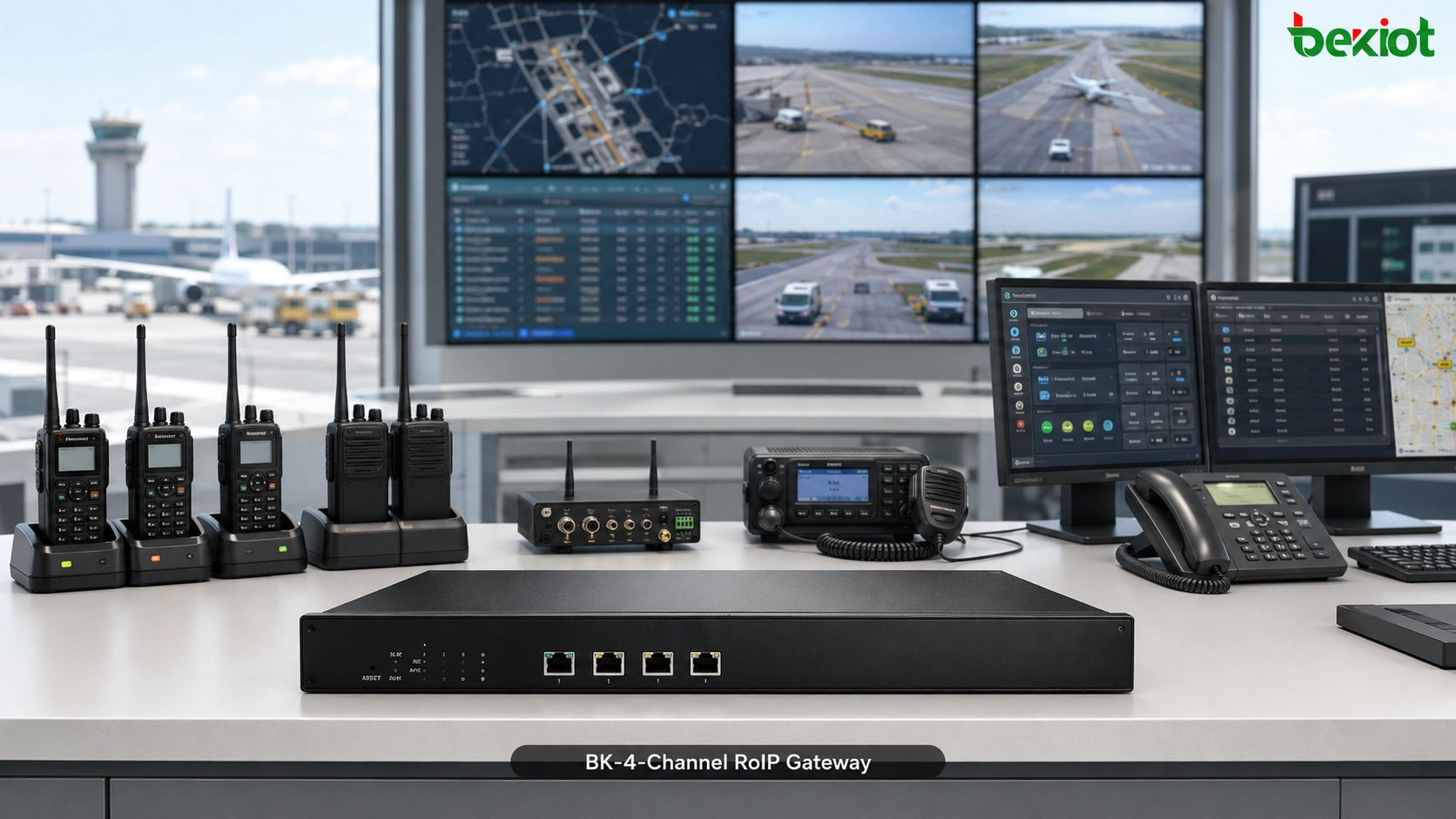
For most airport radio and intercom devices, a cluster intercom gateway can provide a practical access method. It can connect different brands of handheld radios, vehicle radios, aviation radios, and radio base stations through physical radio interfaces and IP communication protocols.
A typical radio gateway uses interfaces such as multi-pin aviation connectors to support audio input, audio output, push-to-talk control, carrier detection, signaling, and extended radio control requirements. This is important because different radios may have different wiring definitions, audio levels, and control methods.
By connecting airport narrowband radios or radio stations through multiple gateway ports, several radio channels can be brought into a SIP-based intercom system or converged communication platform at the same time. Each channel can be assigned to a specific department, operating area, task group, or emergency response function.
In practical deployment, this means existing airport radio assets can continue to serve field users, while the command center gains a digital access point for monitoring, dispatching, recording, and linking radio communication with other IP-based systems. This approach reduces replacement pressure and makes phased airport communication upgrades easier to implement.
Connecting PoC and Narrowband Systems Together
Public network push-to-talk systems are useful for mobile teams because they can provide wider-area communication through cellular networks. However, traditional narrowband trunking systems remain important for local airport operations because they are familiar, fast, and purpose-built for mission-critical voice.
In many airport projects, both systems need to coexist. A gateway integration approach can connect a PoC dispatch platform with narrowband trunking radio channels, allowing users on different systems to communicate through a controlled dispatch workflow.
This means a dispatcher can coordinate PoC users, TETRA users, narrowband radio users, SIP phone users, and command center operators from one platform. Instead of replacing the entire radio system, the airport can improve interoperability while preserving existing communication habits and equipment investment.
Aviation Radio Integration for Command Platforms
Aviation radios are another important part of the airport communication environment. These radios may be used in airside operation, ground coordination, aviation support, or specialized operational scenarios where aviation-band communication is required.
Through the extended interface of aviation radio equipment, a gateway can connect aviation radio audio and control signals into an internal intercom system or dispatch platform. This allows dispatch systems and telephone systems to communicate with aviation radio channels under controlled conditions.
In practical airport deployment, this type of integration should be carefully designed according to operational rules, radio management requirements, safety boundaries, and permission control. The goal is not to merge all communication without control, but to provide authorized interconnection where command coordination requires it.
For example, an emergency command seat may need to monitor a specific airside support channel during a special operation, while routine passenger service teams should not access that channel. A well-designed gateway and dispatch platform can help define these boundaries, ensuring that aviation-related communication remains controlled, auditable, and aligned with airport safety procedures.
SIP Makes Platform Integration Easier
SIP is one of the most important protocols for airport communication integration. A gateway that supports open SIP protocol can connect radio channels to VoIP softswitch platforms, SIP dispatch systems, IP PBX systems, recording platforms, and converged communication systems.
In this type of architecture, SIP-based access can support voice transmission and dispatch integration. For push-to-talk control and call control, signaling methods such as DTMF, SIP INFO, and RTCP can be used depending on platform requirements. These methods help transmit floor control, PTT status, and related dispatch actions between the radio side and the IP communication side.
For airports with private PoC systems or customized dispatch platforms, this open integration capability is valuable. It reduces the difficulty of deep system integration and allows project teams to build more flexible communication workflows according to actual airport operation needs.
No Need to Rebuild the Existing System
One of the major advantages of gateway-based access is that airports do not need to change the structure of every existing communication system. In many cases, radios, aviation stations, or vehicle-mounted radios can be connected through their existing expansion interfaces.
For some radio devices, only a customized cable may be required to complete the connection between the radio equipment and the gateway. This reduces engineering complexity, shortens deployment time, and avoids unnecessary protocol development when physical audio and control interfaces are already available.
This is especially important for airports because communication systems usually support live operations. Large-scale replacement may introduce risk, increase downtime, and require long user training cycles. A gateway approach allows gradual integration while keeping field teams familiar with their current devices.
During phased construction, the airport can start with key departments such as security, fire rescue, ground service, and emergency command, then gradually expand access to more channels and more locations. This makes the project easier to manage, easier to test, and less disruptive to daily airport operations.
Flexible Placement for Better Radio Signal Quality
Airport environments are large and complex. Terminals, aprons, maintenance areas, cargo zones, parking areas, underground spaces, control rooms, and outdoor service roads may all affect signal coverage. If the radio access device is installed in the wrong place, the overall communication quality may suffer.
Because the gateway uses VoIP transmission on the IP side, it can be placed in a suitable location close to the radio equipment or radio coverage area. The IP network can then carry the communication back to the dispatch center, command vehicle, equipment room, or emergency command platform.
This flexible deployment method helps ensure that radio devices access the system with better signal quality while still allowing centralized dispatch and management. For large airport sites, this can improve both communication reliability and system scalability.
Recording, Traceability, and Incident Review
Airport communication is closely related to safety, service quality, and operational accountability. When an incident occurs, managers may need to review who issued an instruction, which channel received the message, how quickly the response team acted, and whether any communication delay affected the outcome.
After radio channels are connected through a gateway and dispatch platform, voice communication can be routed to a recording server or command management system. This provides a clearer event timeline for emergency review, operation analysis, staff training, and compliance reporting.
Recording is not only useful after major incidents. It can also support routine management, shift handover, dispute verification, emergency drill evaluation, and service improvement. For airport operators, this turns fragmented radio communication into manageable communication data.
Network Reliability and Redundancy Planning
Airport intercom integration should not depend on a single fragile link. The IP side of the gateway can be designed with private network access, VLAN isolation, VPN transmission, redundant switches, backup power, and dual-path network planning according to the project requirement.
For emergency command scenarios, the system can also be connected with mobile command vehicles, temporary command posts, satellite links, or dedicated emergency communication networks. When one communication path is interrupted, another path can support continued dispatch communication.
This redundancy design is especially important for severe weather, power failure, large public events, security incidents, and airport emergency drills. A stable integration architecture should consider both normal operation and abnormal conditions from the beginning of the project.
Practical Architecture for Airport Projects
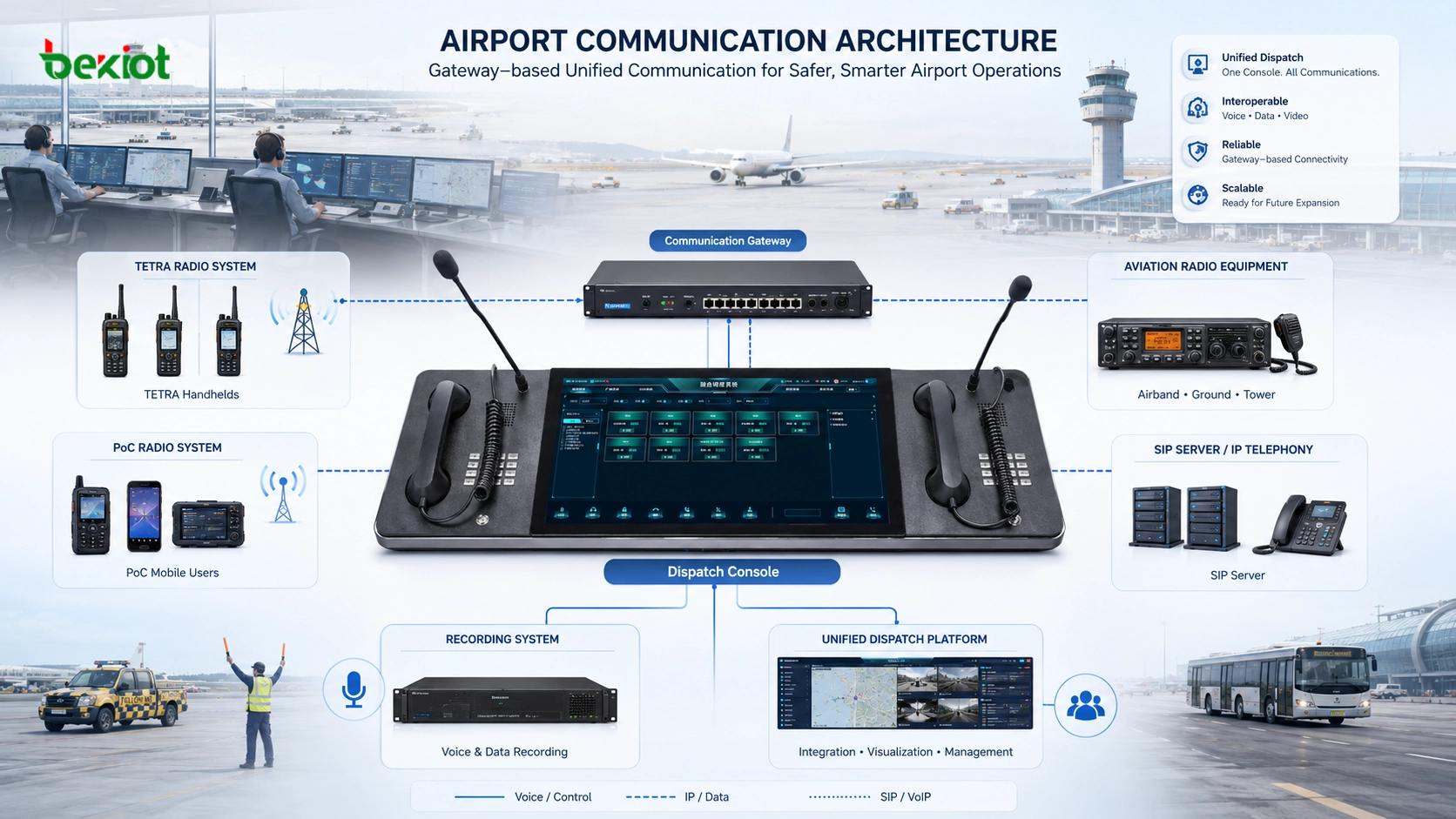
A typical airport integration architecture includes existing handheld radios, vehicle radios, aviation radios, radio base stations, PoC platforms, cluster intercom gateway equipment, SIP server, dispatch console, recording system, and unified command platform.
On the radio side, the gateway connects to radio devices through audio and control interfaces. On the IP side, it registers or connects to the SIP communication platform. The dispatch platform can then monitor, call, group, bridge, record, and manage different radio channels according to operational needs.
This architecture can be used for daily airport operation, emergency command, security coordination, fire rescue response, ground service dispatch, maintenance coordination, passenger assistance, and multi-department incident handling.
In system design, each radio channel should be mapped clearly to its department, location, user group, and dispatch permission. The project team should also define whether a channel is for monitoring only, two-way calling, emergency override, group bridging, or recording. Clear mapping reduces future maintenance difficulty and avoids confusion during real incidents.
Value for Airport Emergency Command
For airport emergency command systems, the greatest value is interoperability. Different departments can keep using their existing communication tools while the command center gains a unified access layer for listening, calling, dispatching, and recording.
The second value is operational efficiency. Dispatchers do not need to manually transfer every message between systems. Radio traffic, SIP calls, and platform communication can be coordinated through one command interface, reducing delays and improving response speed.
The third value is project feasibility. Compared with replacing every radio network, gateway-based integration is more practical for airports with existing infrastructure. It supports phased deployment, flexible access, and better compatibility with multiple system types.
The fourth value is long-term scalability. As airports add new terminals, cargo zones, parking facilities, emergency stations, or smart operation systems, the communication platform can continue expanding through additional gateway channels, SIP endpoints, dispatch seats, and network nodes.
Deployment Checks Before Going Live
Before the system is officially used, airport project teams should complete compatibility testing between each radio model and the gateway. This includes microphone input, speaker output, PTT control, carrier detection, audio gain, grounding, cable stability, and long-duration operation.
Network tests should verify SIP registration, packet delay, jitter, packet loss, recording quality, dispatch permission, channel switching, and failover performance. Field tests should cover actual airport environments such as terminal interiors, airside roads, underground spaces, maintenance zones, cargo areas, and command rooms.
User training is also important. Dispatchers should know how to select channels, bridge groups, record calls, handle emergency priority, and avoid accidental transmission to the wrong radio group. Field users should understand that their existing radios are now connected to a wider command system, which may affect communication discipline and operational procedures.
Conclusion
Airports need more than separate radio networks. They need a communication architecture that can connect narrowband trunking, TETRA radios, PoC platforms, broadband trunking, aviation radios, internal intercom systems, passenger help terminals, SIP platforms, and emergency dispatch systems.
For projects that need to connect radio channels with SIP dispatch and unified command platforms, Becke Telcom cluster intercom gateway solutions can be considered as part of the overall access layer. This type of architecture improves interoperability, protects existing investment, supports flexible deployment, and makes airport emergency communication projects easier to implement.
FAQ
Can airport radio channels be separated after integration?
Yes. Integrated radio channels can still be managed separately by department, task group, area, or emergency level. The dispatch platform can define who can monitor, call, bridge, or record each channel.
Is audio level adjustment important during radio gateway deployment?
Yes. Different radios may have different microphone levels, speaker output levels, impedance, and control wiring. Proper audio matching helps avoid low volume, distortion, echo, or unstable PTT behavior.
Can the gateway support both fixed command centers and mobile command vehicles?
Yes. The IP side of the gateway can be connected to a fixed dispatch room, mobile command vehicle, temporary command post, or remote control center, as long as the network path and SIP platform are properly configured.
What should be tested before airport-wide deployment?
Recommended tests include radio compatibility, PTT control, channel isolation, SIP registration, dispatch permission, recording quality, failover behavior, network delay, power reliability, and communication performance in real airport operating areas.







