


Emergencies rarely leave time for confusion. Whether the situation involves a fire in a manufacturing plant, a medical incident in a hospital, a roadside breakdown on a highway, or a security event in a public building, people need a fast and reliable way to report what is happening, receive instructions, and coordinate the next step. That is where emergency communication becomes essential.
The importance of emergency communication lies in its ability to connect people, devices, and decision-makers when every second matters. It supports early reporting, faster situational awareness, clearer command, and more organized response. In modern environments, it is not only a safety tool but also a core part of operational resilience, public protection, and incident management.
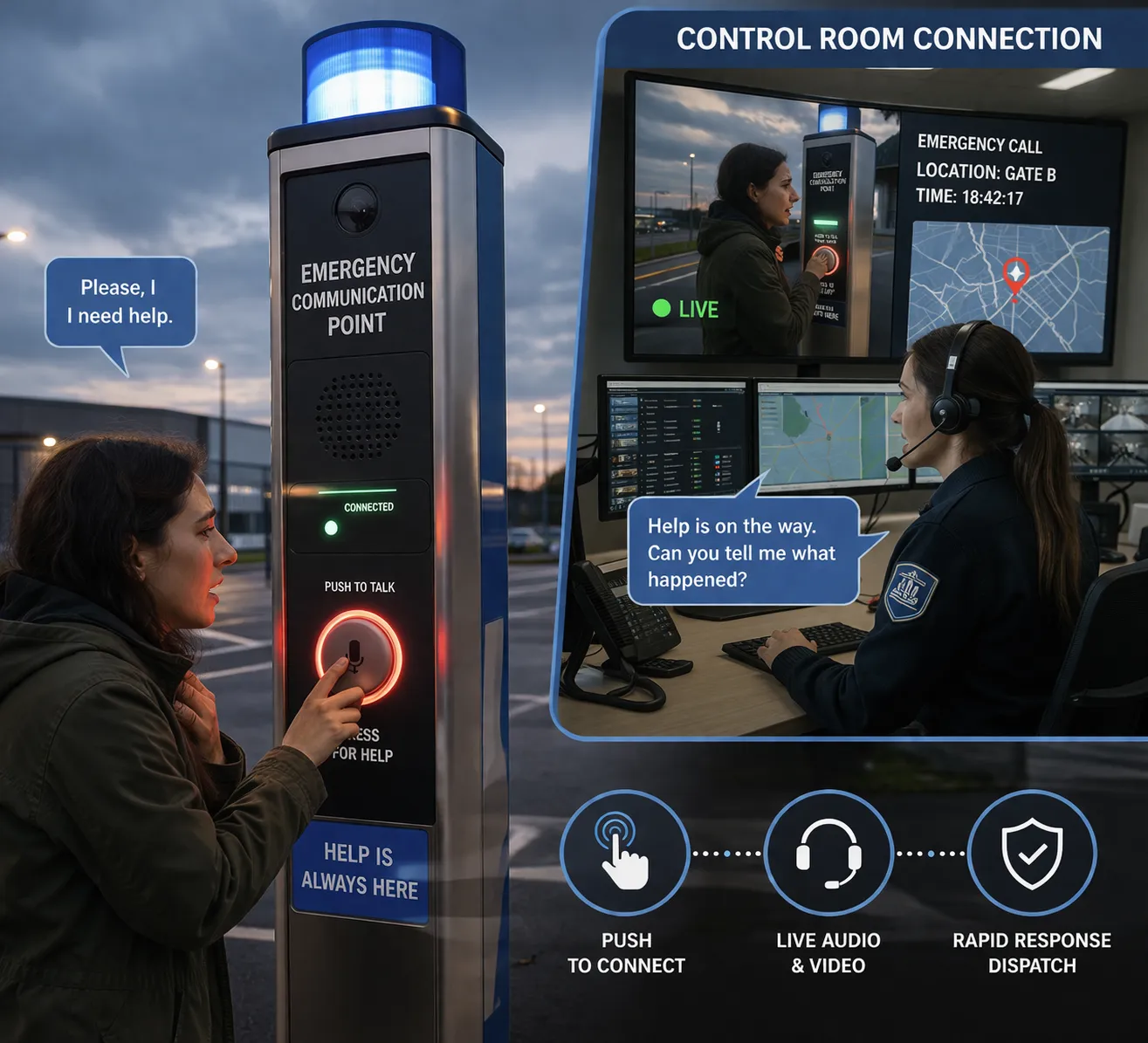
What Is Emergency Communication?
Emergency communication refers to the methods, systems, and procedures used to exchange urgent information during incidents, hazards, or disruptions. It includes the tools people use to call for help, the platforms operators use to dispatch resources, and the channels organizations use to issue warnings, evacuation notices, or response instructions.
Solution Overview:Emergency Communication System
In practical terms, emergency communication may involve emergency telephones, call boxes, SIP intercoms, IP phones, paging systems, dispatch consoles, radios, alert platforms, and integrated monitoring systems. Together, these elements help organizations move from detection to action in a structured and timely way, even when normal communication channels are under pressure.
Emergency communication is not only about making contact. It is about making the right information reach the right people at the right time.
Why Emergency Communication Is Important
Faster Incident Reporting
One of the most immediate benefits of an emergency communication system is speed. In many emergencies, the first few minutes influence the severity of the outcome. A worker who can press a one-touch help button, a driver who can use a roadside call box, or a passenger who can contact a station control room directly gives responders a valuable time advantage.
Fast incident reporting reduces the delay between event discovery and action. Instead of relying on informal message chains or searching for the correct contact point, users can connect directly to a predetermined response path. This makes reporting more consistent, reduces confusion, and increases the chance that the first message contains actionable information.
Better Coordination Across Teams
Emergencies often involve multiple departments and multiple layers of response. Security teams, facility managers, maintenance staff, medical personnel, fire units, transport controllers, and outside agencies may all need to work from the same operational picture. Without dependable communication, these groups can act in parallel but not in coordination.
Emergency communication improves coordination by creating a common link between field devices, operators, and command personnel. Integrated systems can connect calls, broadcast messages, alarm events, and dispatch workflows into one response structure. That helps decision-makers issue clear instructions, assign resources more efficiently, and avoid duplicated or conflicting actions.
Improved Public and Worker Safety
At its core, emergency communication is about protecting people. In industrial facilities, high-noise production areas, hazardous process zones, tunnels, mines, campuses, and public buildings, communication tools provide a direct path to assistance when conditions become unsafe. They also allow control centers to send guidance back to people who may need to shelter, evacuate, or avoid a dangerous area.
Safety improves when communication is immediate, understandable, and accessible. A system that combines direct calling, group notification, and zone-based paging can help staff and visitors make faster decisions under stress. That is especially important in environments where delays, uncertainty, or lack of situational awareness can increase injuries and extend exposure to risk.
Reduced Response Time
Emergency response depends not only on how quickly an event is reported, but also on how quickly the report reaches the right responder with the right context. Effective emergency communication reduces handoff delays between the person reporting the incident, the operator receiving the alert, and the team tasked with intervention.
When a system links communication devices with dispatch consoles, location information, alarms, video, or mapped assets, responders can move faster and with better preparation. Even small reductions in response time can be meaningful in events involving fire spread, medical treatment, equipment failure, violence, or traffic hazards.
Business Continuity and Operational Resilience
The importance of emergency communication extends beyond immediate life safety. It also affects how well an organization maintains control during disruption. In factories, logistics hubs, transport networks, campuses, utilities, and critical sites, an incident that is poorly communicated can escalate into downtime, service interruption, reputational damage, and higher recovery costs.
By supporting organized communication during abnormal conditions, emergency systems help contain the impact of an event. Teams can isolate affected areas, inform stakeholders, redirect operations, and restore service more efficiently. In this way, emergency communication supports resilience as much as response.
Regulatory and Risk Management Support
Many industries operate under safety, duty-of-care, and emergency preparedness requirements. While the exact obligations vary by sector and region, organizations are commonly expected to provide reliable alerting, reporting, evacuation support, and documented response procedures. Emergency communication systems help translate those obligations into practical capability.
From a risk management perspective, communication is one of the foundations of preparedness. A site may have cameras, sensors, protective equipment, and emergency plans, but without an effective way to report incidents and coordinate action, those protections are harder to use well. Communication turns isolated safety measures into a functioning response framework.
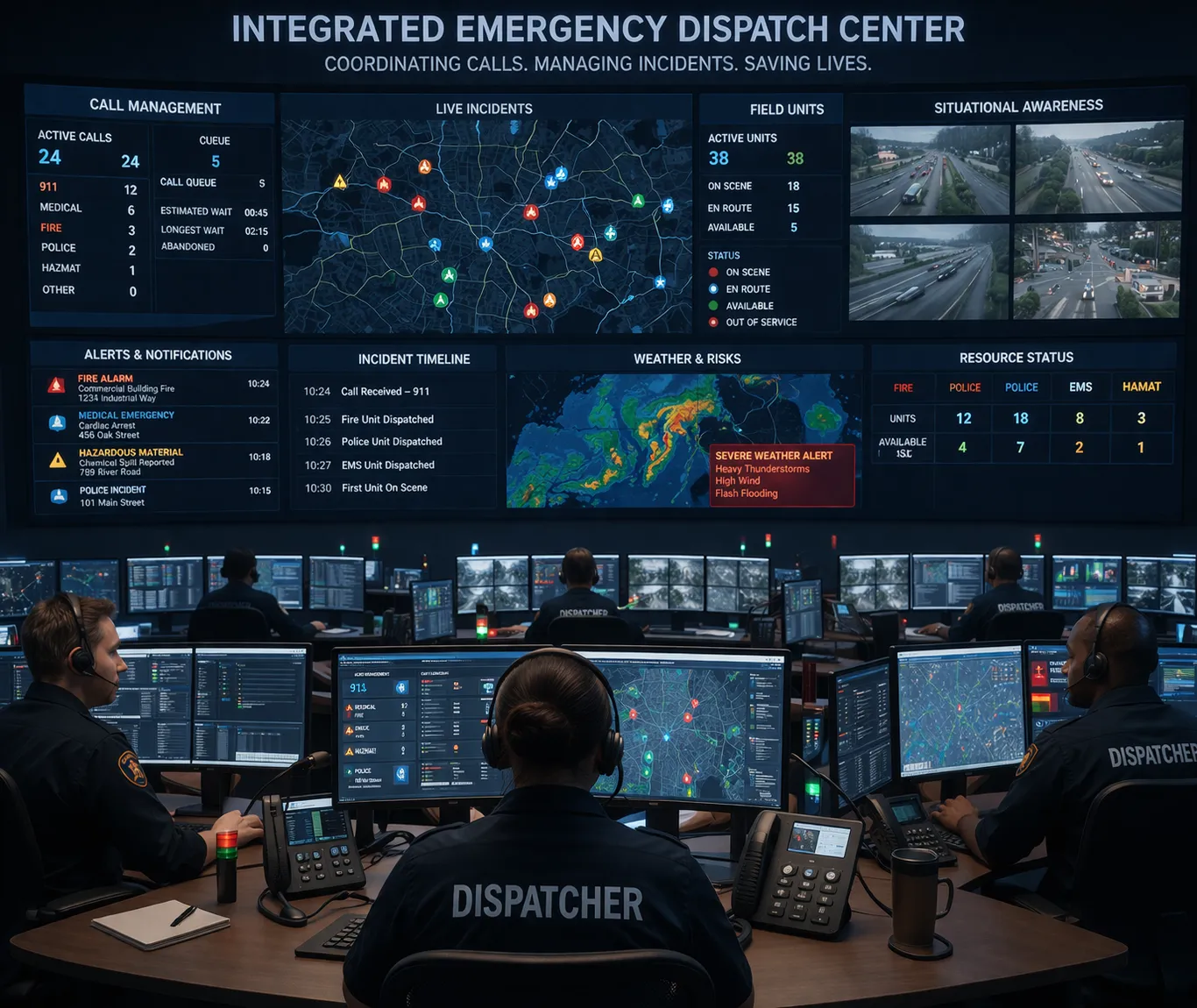
Common Applications of Emergency Communication
Industrial and Hazardous Environments
Industrial sites often present a combination of noise, distance, machinery, environmental exposure, and process risk. In sectors such as petrochemicals, mining, power generation, metallurgy, ports, and heavy manufacturing, emergency communication systems help workers report incidents quickly and enable control rooms to coordinate instructions across large or segmented sites.
These environments often require more than a basic phone line. They may need rugged devices, weather-resistant or hazardous-area-rated endpoints, loud and clear audio, and integration with paging, alarms, process systems, or dispatch platforms. Communication infrastructure in these sites must support reliability under demanding conditions.
Transportation and Public Infrastructure
Roads, tunnels, rail stations, airports, parking structures, and public transit facilities depend on clear and immediate communication during service disruptions and emergencies. A passenger help point, highway emergency call box, or tunnel intercom can provide a direct path between the public and the control center when assistance is needed.
In transportation settings, emergency communication also supports crowd management, incident verification, public announcements, and coordination with field responders. Because these environments involve high movement, distributed assets, and public-facing risk, communication systems play a central role in maintaining order and reducing response complexity.
Campuses, Hospitals, and Public Buildings
Educational campuses, healthcare facilities, government sites, and commercial buildings require communication systems that can serve both staff and the public. The risks may range from medical emergencies and fire alarms to security incidents, access problems, and severe weather events. In these settings, the quality of communication affects both response speed and confidence.
Hospitals may need to connect wards, nurse stations, security teams, and facility managers. Campuses may need mass notification, help points, and building-level coordination. Public buildings may need a combination of telephony, intercom, paging, and operator response. In each case, communication supports safer decision-making at scale.
A strong emergency communication system does more than transmit messages. It creates structure during uncertainty.
Key Components of an Effective Emergency Communication System
Field Communication Endpoints
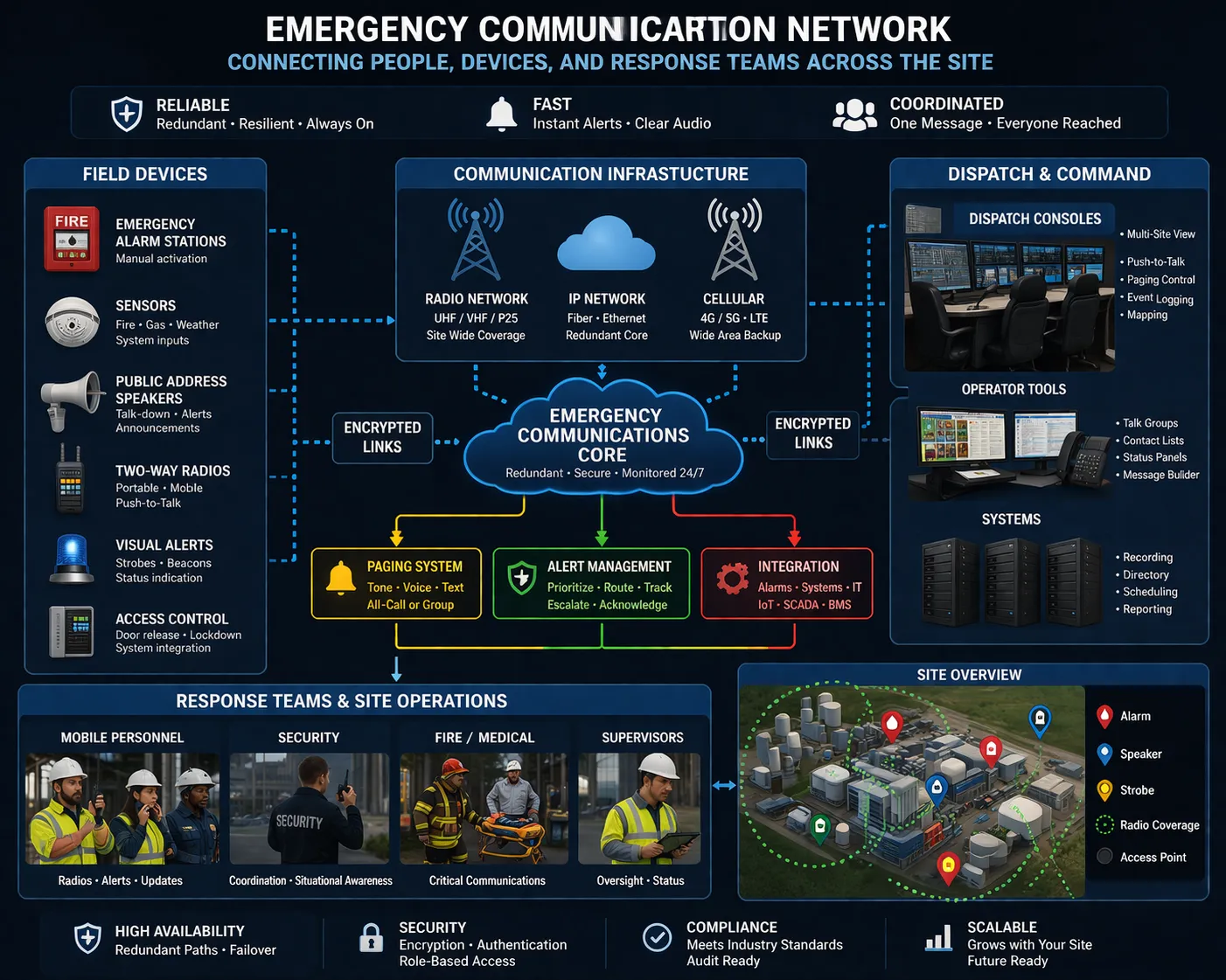
The field layer includes the devices people use to initiate or receive communication. These may include emergency telephones, SIP intercom terminals, call stations, IP phones, help points, paging speakers, visual indicators, and mobile communication tools. The purpose of this layer is accessibility: people must be able to reach help quickly and understand the response clearly.
Field devices should be selected according to the environment. A noisy plant area may require high-output hands-free communication. A roadside installation may require weather protection and high visibility. A hospital corridor may require discreet but reliable intercom access. The endpoint is often the first link in the entire emergency chain.
Control, Dispatch, and Notification
The control layer is where communication turns into organized action. Dispatch consoles, operator software, alarm handling platforms, and paging controllers allow teams to receive calls, assess priority, talk to the scene, trigger announcements, and coordinate responders. This layer is critical because it converts raw reports into managed response.
Well-designed control platforms also help with escalation logic, call routing, event logging, and multi-party coordination. In complex sites, they may unify telephony, intercom, broadcast, video, and external agency links into one interface. That reduces fragmentation and helps operators work faster during high-pressure events.
Network, Integration, and Redundancy
Behind the visible devices is the communication backbone that keeps the system available. This includes IP networks, SIP platforms, gateways, radio interworking, recording tools, and integrations with alarms, CCTV, access control, GIS, or building systems. A modern emergency communication design usually works best when it is not isolated from the rest of the operational environment.
Redundancy matters just as much as functionality. Power backup, network failover, alternate routing, and distributed architecture can all improve survivability during incidents. The value of an emergency communication system depends on whether it still works when normal conditions do not.
What Happens Without Effective Emergency Communication?
When emergency communication is weak, even capable organizations can struggle. Incident reports may be delayed, messages may pass through too many intermediaries, and people on site may not know whether help is coming or what they should do next. That uncertainty can slow evacuation, complicate dispatch, and increase the overall impact of the event.
Poor communication also reduces confidence in the response process. Operators may receive incomplete information, responders may arrive without context, and managers may lack visibility across the site. In public and industrial environments alike, communication failure often becomes a force multiplier for every other operational weakness.
Best Practices for Building an Emergency Communication Strategy
Prioritize Coverage and Accessibility
An emergency communication strategy should begin with real site conditions. High-risk areas, remote points, public access zones, transportation corridors, plant entrances, control rooms, and shelter locations all have different communication needs. Coverage should be planned so that no critical area depends on improvisation during an event.
Accessibility matters as much as coverage. Devices should be easy to locate, easy to use, and suitable for the people who rely on them. In stressful situations, communication must feel immediate, not complicated. Visibility, hands-free operation, multilingual prompts, and clear audio can all improve usability.
Design for Redundancy and Interoperability
Emergency communication should not depend on a single channel or a single platform. Combining intercom, telephony, paging, radio, and software-based dispatch creates more options when one path is unavailable or overloaded. Redundancy in power and network connectivity adds another layer of reliability.
Interoperability is also essential. Many incidents involve outside agencies or different internal departments using different systems. A communication strategy is stronger when it can bridge these differences and maintain a coordinated flow of information instead of forcing responders into disconnected silos.
Train, Test, and Update Regularly
Even the best equipment cannot replace preparation. Staff should know how to report an incident, how escalation works, and how instructions will be delivered during different scenarios. Operators should be trained not only on device use but also on workflow, prioritization, and communication clarity.
Regular drills, maintenance checks, and post-incident reviews help organizations keep the system effective over time. Communication strategies should evolve with facility changes, new risks, and operational lessons. Emergency communication is strongest when it is treated as a living capability rather than a one-time installation.
Conclusion
The importance of emergency communication is clear in any environment where safety, speed, and coordination matter. It enables rapid incident reporting, supports better decisions, improves team alignment, and helps protect people during stressful and fast-moving events. It also strengthens resilience by helping organizations maintain control when normal operations are disrupted.
From industrial plants and transportation networks to hospitals, campuses, and public facilities, emergency communication systems form a practical bridge between risk detection and organized response. When designed well, they do more than transmit urgent messages. They help turn uncertainty into action.
FAQ
What is emergency communication?
Emergency communication is the process of sending, receiving, and managing urgent information during incidents such as fires, medical emergencies, security threats, equipment failures, or public safety events.
Why is emergency communication important?
It is important because it reduces reporting delays, improves coordination, supports faster response, and helps protect workers, visitors, passengers, patients, and the public during critical situations.
Where is emergency communication commonly used?
It is widely used in industrial facilities, highways, tunnels, rail systems, airports, campuses, hospitals, public buildings, utilities, and other environments where rapid assistance and coordinated response are required.
What devices are used in an emergency communication system?
Common devices include emergency telephones, call boxes, SIP intercoms, IP phones, paging speakers, dispatch consoles, radios, alarm platforms, and integrated monitoring or notification systems.
How does emergency communication improve safety?
It improves safety by making it easier to report incidents, issue instructions, coordinate teams, guide evacuations, and connect people to help without unnecessary delay.
Need Support for Emergency Communication Planning?
If you are evaluating how to improve emergency reporting, site-wide coordination, paging coverage, or dispatch response, Becke Telcom can help you explore a more practical communication architecture for your environment. From industrial facilities and transport infrastructure to campuses and public sites, the goal is to build clearer, faster, and more reliable emergency communication workflows.
Contact Becke Telcom to discuss suitable emergency communication devices, intercom systems, paging solutions, and integrated dispatch approaches for your project.







