


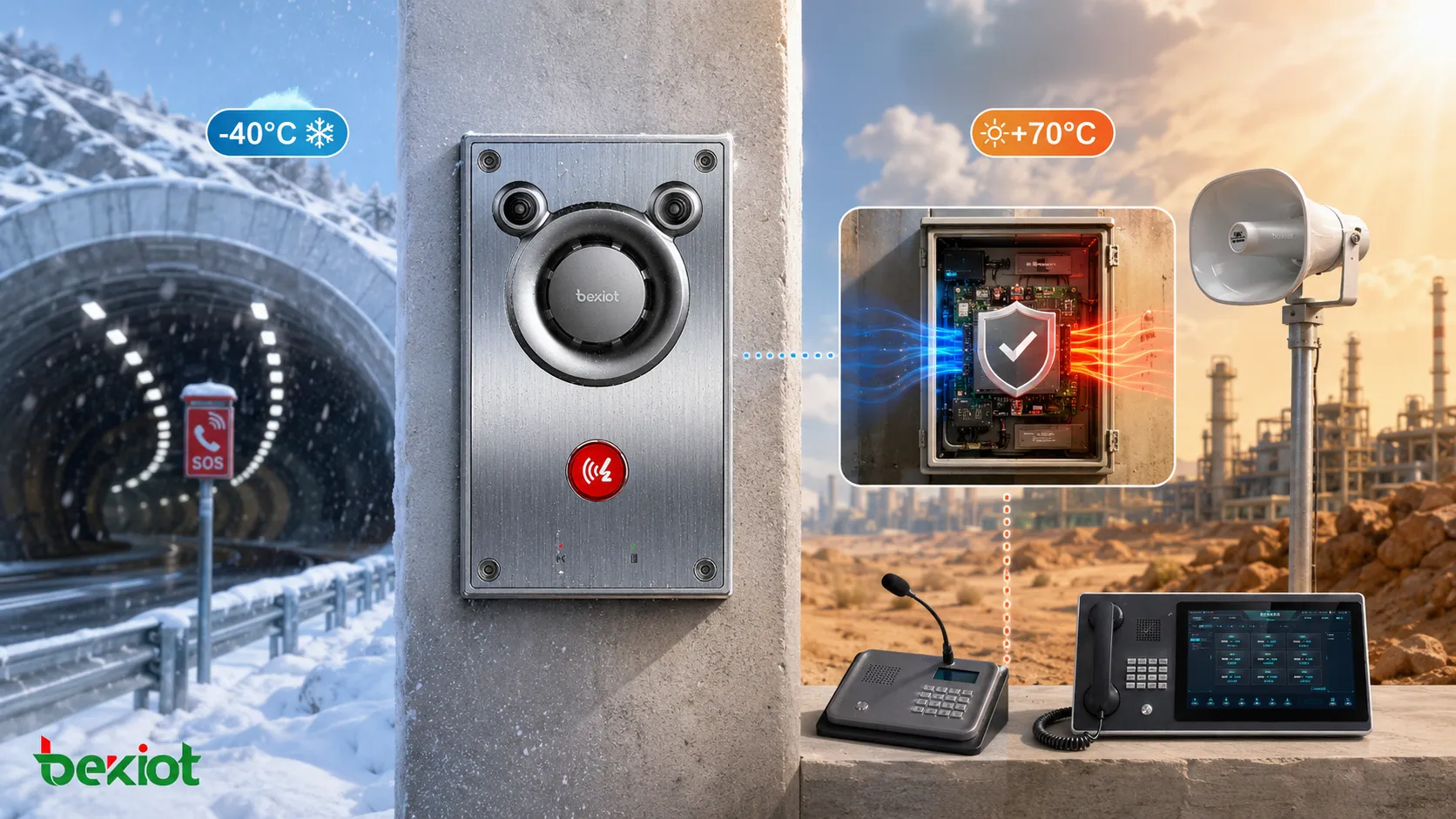
A communication terminal installed beside a tunnel entrance may face winter freezing, summer heat, direct sunlight, condensation, dust, and long operating hours. A control device inside an outdoor cabinet may start cold in the morning, heat up under load at noon, and then cool rapidly at night. In these conditions, ordinary electronics may still power on, but their clocks, capacitors, batteries, displays, sensors, connectors, and power circuits may drift, slow down, fail, or age faster.
Wide temperature operation describes the ability of a device or system to maintain stable function across a specified temperature range that is broader than ordinary indoor use. The working principle is not a single technology. It is a complete design method that combines suitable components, circuit derating, thermal paths, enclosure structure, firmware protection, material selection, power stability, environmental sealing, and validation testing.
From Temperature Rating to Real Reliability
A temperature range printed on a product specification may look simple, such as -20°C to 60°C, -30°C to 70°C, or -40°C to 85°C. However, the real engineering question is more complex: can the device start, communicate, display, process, store data, charge, transmit audio, and recover from faults throughout that range?
Low temperature and high temperature create different risks. Low temperature can increase material brittleness, reduce battery performance, slow LCD response, change oscillator behavior, and increase startup difficulty. High temperature can accelerate component aging, increase leakage current, reduce power efficiency, soften materials, deform seals, and cause processor throttling or shutdown.
Reliable design therefore requires more than selecting one “industrial-grade” part. Every temperature-sensitive path must be considered, including electrical, mechanical, chemical, acoustic, optical, and software behavior.
How Heat and Cold Affect Electronics
Electrical Drift
Electronic components do not behave exactly the same at all temperatures. Resistors, capacitors, oscillators, sensors, voltage references, amplifiers, and semiconductor devices may shift in value or performance. Small shifts may be acceptable in non-critical circuits, but they can affect timing, measurement accuracy, audio quality, communication stability, and power regulation.
For example, an oscillator may drift enough to affect timing-sensitive communication. A capacitor may lose effective capacity at low temperature or age faster at high temperature. A sensor may require compensation because its output changes with ambient conditions.
Mechanical Stress
Materials expand when heated and contract when cooled. Different materials expand at different rates. A circuit board, solder joint, metal enclosure, plastic component, seal, connector, and cable may all respond differently to the same temperature change.
Repeated thermal cycling can create stress. Solder joints may fatigue, seals may loosen, connectors may shift, and enclosures may deform slightly. A device that survives one hot day may still fail after many cycles if the design does not account for expansion and contraction.
Chemical Aging
High temperature accelerates many aging processes. Electrolytic capacitors dry out faster, battery chemistry degrades, adhesives lose strength, plastics become brittle, and sealing materials may harden or crack. Moisture combined with temperature changes can also create condensation and corrosion.
This is why long-term reliability depends on both operating temperature and exposure duration. A short high-temperature test does not always represent years of outdoor service.
Component Selection
The first technical layer is choosing components that are rated for the intended range. Industrial and extended-temperature components are designed and tested for wider conditions than ordinary commercial components. This may include processors, memory, capacitors, crystals, relays, displays, connectors, regulators, sensors, power modules, and communication chips.
Component rating should be checked carefully. A single part with a narrow range can become the weak point of the entire product. For example, a processor may support high temperature, but an LCD module, battery, relay, or capacitor may not. The system rating must be based on the most temperature-sensitive functional path.
Selection should also consider derating. A component operating close to its maximum limit for long periods may age faster. Good design leaves margin so the device can tolerate unexpected heat, load changes, and enclosure temperature rise.
Thermal Path Design
Heat generated inside the device must move away from critical components. This movement can happen through conduction, convection, radiation, heat sinks, thermal pads, metal chassis, ventilation paths, or enclosure surfaces.
In sealed industrial equipment, natural airflow may be limited. The enclosure may need to act as part of the heat dissipation structure. Metal housings, internal thermal bridges, and component placement become important. Hot components should not be clustered in a way that creates local thermal concentration.
Thermal path design must also consider the external environment. A device in direct sunlight can become much hotter than the surrounding air. A dark enclosure may absorb more heat. A cabinet with no ventilation may trap hot air. A device mounted near an engine, transformer, or furnace may experience higher local temperature than the site average.
Cold Start Behavior
Starting a device at low temperature can be harder than keeping it running after it has warmed up. Power supplies, oscillators, displays, batteries, storage devices, and mechanical parts may behave differently during cold start.
A power circuit may need higher startup margin because component characteristics shift in cold conditions. A display may respond slowly. A battery may deliver less current. A crystal oscillator may take longer to stabilize. Firmware may need to wait for key subsystems before starting communication or control functions.
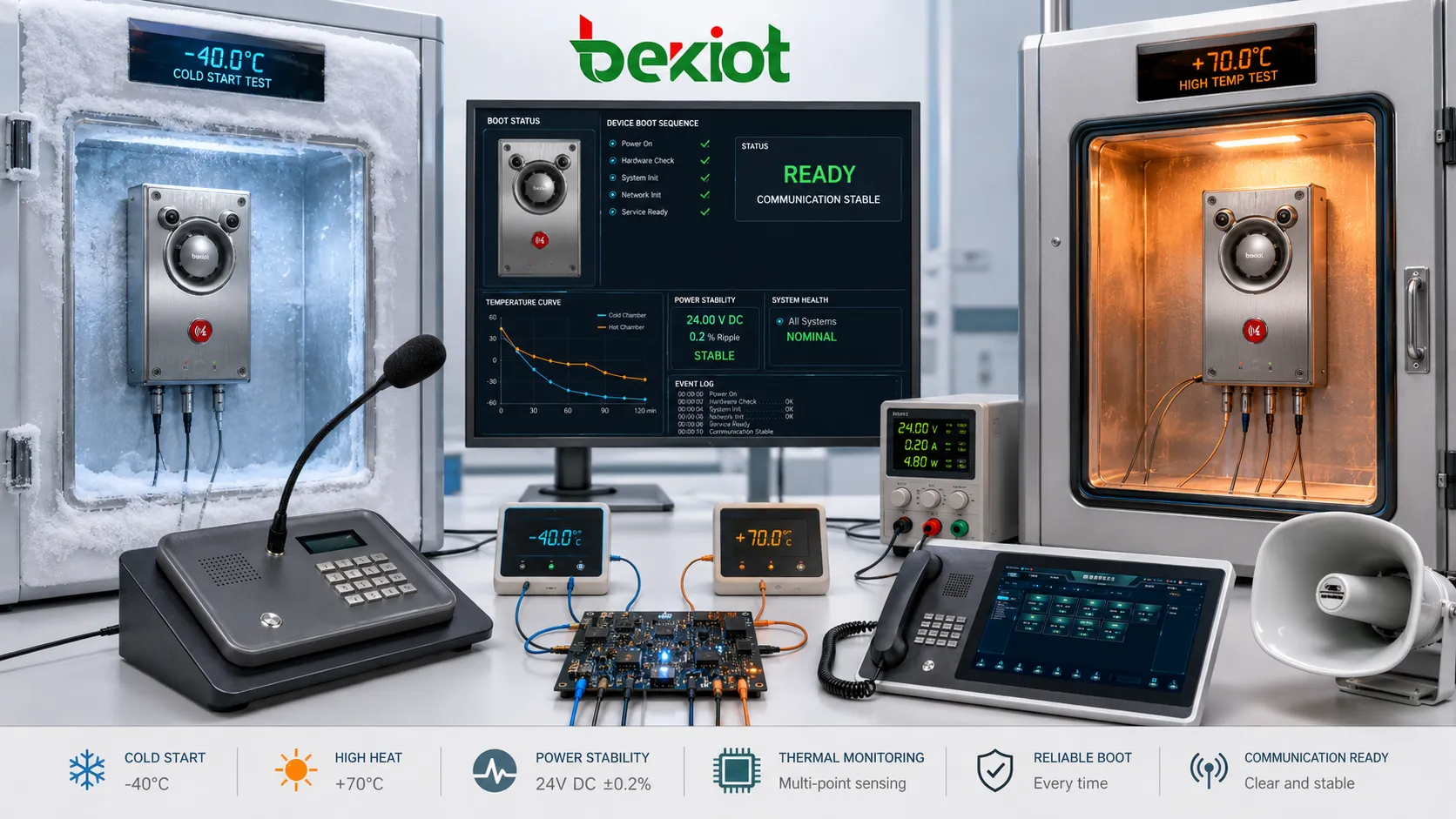
For this reason, test procedures should include cold start, not only continuous operation after the device is already warm. A device that works in a cold chamber after warm startup may still fail when powered on from a frozen state.
High-Temperature Protection
At high temperature, internal heat generation becomes more dangerous because the difference between component temperature and ambient temperature becomes smaller. Heat cannot escape as easily, and components may approach their maximum rating.
Protection methods may include heat spreading, lower-power design, processor throttling, over-temperature shutdown, fanless thermal architecture, warning logs, and load reduction. In communication devices, the system may reduce non-critical functions while preserving essential voice, alarm, or monitoring functions.
High-temperature protection should not be treated as a normal operating state. If a device frequently enters thermal shutdown, the installation environment, enclosure ventilation, power load, and thermal design should be reviewed.
Power Supply Stability
Power circuits are highly affected by temperature. Regulators, capacitors, inductors, batteries, protection devices, and connectors may all change behavior. Voltage ripple, startup time, output stability, and conversion efficiency can vary across temperature.
A wide-range device should maintain stable voltage rails during cold start, hot operation, load changes, and input fluctuation. Protection circuits should handle surge, brownout, reverse polarity, overcurrent, and overheating where relevant.
In field communication systems, power reliability is especially important because unstable power can cause repeated rebooting, registration loss, audio interruption, or device offline alarms.
Display, Battery, and Storage Challenges
Displays are often sensitive to temperature. LCD response can slow at low temperature, while high temperature may affect contrast, backlight life, or panel reliability. Touch panels may also behave differently when gloves, condensation, or surface temperature changes are present.
Batteries have strong temperature limitations. Low temperature reduces available capacity and discharge performance. High temperature accelerates aging and can create safety risks. Charging is especially sensitive and may need strict temperature control.
Storage devices can also be affected. Flash memory endurance, retention, and controller behavior may vary with heat. In systems that record logs, audio, video, or operational data, storage selection and thermal management should be planned carefully.
Material and Enclosure Behavior
Mechanical materials must survive expansion, contraction, impact, UV exposure, moisture, dust, chemical exposure, and long-term aging. Plastics, rubber seals, gaskets, adhesives, coatings, metal parts, screws, and labels must all remain functional across the specified range.
Sealing design is especially important. Temperature cycling can create pressure differences inside an enclosure. If the device is sealed too tightly without pressure compensation, stress may build. If sealing is weak, moisture and dust may enter. Condensation may form when warm humid air cools inside the enclosure.
For outdoor equipment, wide temperature performance is closely related to weather resistance. Temperature, water, dust, sunlight, and mechanical exposure often occur together rather than separately.
Thermal Cycling and Fatigue
Thermal cycling means repeated movement between hot and cold conditions. This is often more damaging than a constant temperature because it creates repeated expansion and contraction stress.
Solder joints, connectors, seals, circuit boards, coatings, and cable interfaces can fatigue over time. This may cause intermittent faults that are difficult to diagnose. A device may work normally in the workshop but fail after months of outdoor temperature swings.
Testing should therefore include cycling, not only fixed high and low temperature points. Cycling reveals weaknesses in mechanical assembly, solder reliability, material compatibility, and enclosure sealing.
Firmware and Software Compensation
Software can improve wide temperature performance by monitoring sensors, adjusting behavior, logging abnormal states, controlling startup sequence, and applying compensation algorithms.
For example, the firmware may delay certain operations until voltage becomes stable, reduce processor load when temperature rises, adjust sensor calibration, trigger alarms, control heaters or fans, or store temperature history for maintenance review.
Software cannot replace poor hardware design, but it can make the system more adaptive and safer. A good design combines hardware margin with intelligent control.
Communication Performance Under Temperature Stress
Communication devices must maintain stable network registration, audio quality, protocol timing, RF behavior, Ethernet performance, serial communication, and signaling under temperature variation. Temperature-related clock drift, power instability, or connector problems can affect communication reliability.
For IP devices, high temperature may affect Ethernet PHY stability, processor load, memory behavior, and packet processing. For wireless systems, temperature may influence RF components, antenna matching, battery behavior, and transmit performance.
For voice and intercom equipment, acoustic components such as microphones, speakers, seals, and membranes may also change behavior. Audio quality should therefore be tested in temperature extremes, not only at room temperature.
Testing and Verification
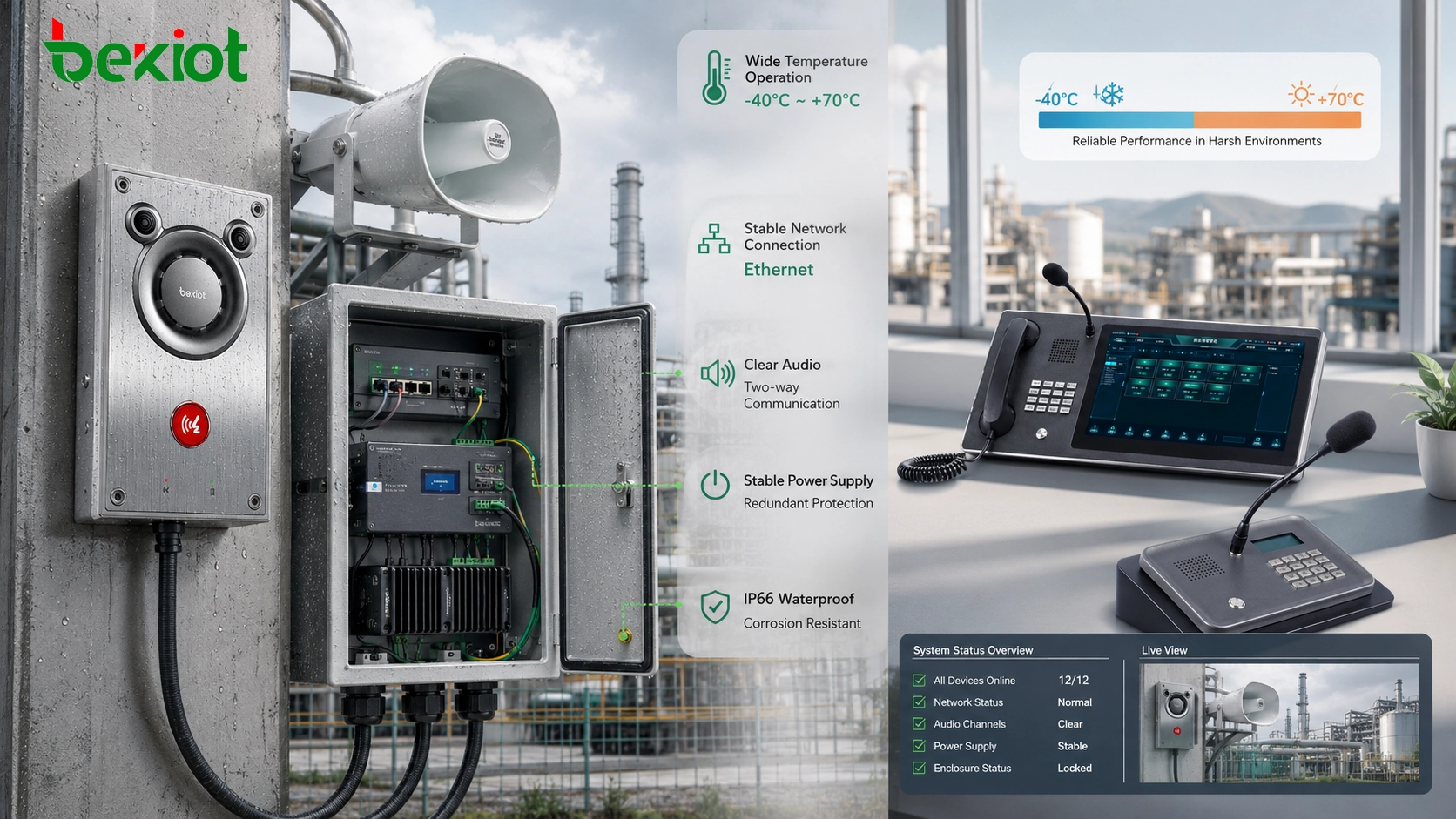
Validation should cover more than simple power-on operation. Tests may include low-temperature storage, low-temperature startup, high-temperature operation, temperature cycling, humidity interaction, thermal shock, load testing, communication stability, audio testing, display response, battery behavior, and long-duration aging.
Test conditions should represent the real product configuration. A bare circuit board in a chamber is not the same as a complete device inside its final enclosure. Internal heat buildup, cable entries, mounting orientation, and sealing can change the result.
Pass criteria should be functional, not only electrical. The device should boot correctly, communicate normally, process data, display information, maintain audio quality, record logs, and recover safely from abnormal conditions.
Installation Factors
Installation can improve or weaken temperature performance. A device installed under direct sun, near a heat source, inside a poorly ventilated cabinet, or against a hot surface may exceed its expected internal temperature. A device installed in a shaded, ventilated, and correctly mounted location may perform much better.
Cable routing also matters. Cables can transfer heat, create strain during contraction, or allow moisture entry if glands are not sealed correctly. Mounting hardware should tolerate thermal expansion and vibration.
Installers should follow orientation, clearance, ventilation, and sealing requirements. A well-designed product can still fail if installed in a way that traps heat or exposes it to condensation.
Maintenance and Lifecycle Management
Wide temperature operation should be managed throughout the device lifecycle. Enclosure seals age, coatings wear, fans fail, thermal pads dry out, vents become blocked, and connectors corrode. A product that passed initial testing may degrade after years of service.
Maintenance should include inspection of seals, cable entries, corrosion, enclosure damage, heat sinks, ventilation paths, internal temperature logs, power stability, and communication records. Repeated temperature alarms should not be ignored because they may indicate installation or aging problems.
Replacement parts should match the original temperature rating. Using an ordinary capacitor, battery, gasket, or display module during repair can reduce the real operating range.
Common Application Fields
Outdoor communication terminals, emergency phones, industrial gateways, surveillance devices, traffic systems, railway equipment, power substation devices, mining communication points, port equipment, oil and gas terminals, and environmental monitoring systems often require wide temperature operation.
It is also important in edge computing, remote telemetry, smart utility equipment, outdoor wireless access, cabinet-mounted network devices, and industrial automation. These applications may run unattended for long periods, so failure recovery is more difficult than in office environments.
The higher the cost of site access and service interruption, the more valuable wide temperature design becomes.
Typical Misunderstandings
One misunderstanding is that a wide temperature label means every function performs identically at every temperature. In reality, some functions may slow down, derate, or require protection behavior while still staying within acceptable operation.
Another misunderstanding is that the ambient rating equals the internal component temperature. Internal parts can become much hotter than ambient air because of self-heating and enclosure heat buildup.
A third misunderstanding is that low temperature is only a battery problem. Low temperature can also affect displays, clocks, seals, plastics, connectors, and startup circuits.
A fourth misunderstanding is that high temperature only causes immediate shutdown. Often the bigger risk is accelerated aging, which may shorten service life even if the device keeps running.
Design Checklist
Start with the real environment. Identify minimum and maximum ambient temperature, sunlight exposure, cabinet temperature, humidity, condensation risk, wind, dust, water, vibration, and heat sources nearby.
Select components with proper ratings and margin. Check the weakest parts, including display, battery, capacitor, oscillator, connector, cable, seal, and power module. Design thermal paths before the product layout is finalized.
Test cold startup, hot operation, cycling, and real functional performance. Validate the final enclosure, not only the circuit board. Document installation requirements so field conditions do not invalidate the design.
Industry Trend Outlook
As more systems move outdoors and to the edge, wide temperature design is becoming more important. Industrial IoT, smart transportation, remote energy sites, emergency communication, outdoor security, and distributed edge computing all require devices that can operate without constant human attention.
At the same time, equipment is becoming more compact and powerful. Higher processing density creates more internal heat. This makes thermal design, low-power architecture, and software-based temperature management more important.
The future direction is not only a wider rating range. It is smarter environmental adaptation, better remote monitoring, predictive maintenance, and design methods that link temperature behavior with real service reliability.
Wide temperature operation works by combining rated components, thermal management, stable power design, material control, firmware protection, environmental sealing, and real-condition testing so the device can keep functioning across cold, heat, and repeated temperature cycling.
FAQ
Does a wide temperature range mean the device can be installed anywhere outdoors?
No. Outdoor installation also depends on sunlight, rain, dust, humidity, enclosure rating, mounting method, ventilation, corrosion exposure, and power conditions.
Why does equipment fail only after months of temperature changes?
Repeated thermal cycling can fatigue solder joints, seals, connectors, and materials. Some failures appear only after long-term expansion and contraction stress.
Can firmware solve temperature problems by itself?
No. Firmware can monitor, compensate, and protect, but it cannot fully correct unsuitable components, poor thermal design, weak materials, or bad installation.
Why is cold start testing important?
A device may run after warming up but fail to boot from a frozen state. Cold start tests reveal startup margin, power stability, display response, and oscillator behavior.
What should be checked during maintenance?
Check seals, cable entries, corrosion, ventilation, heat paths, power stability, temperature logs, display behavior, battery condition, and communication reliability.







