In voice communication, the cost of a missed call is often higher than it first appears.A customer may call during a busy hour, a maintenance worker may leave the desk, a manager may move between offices, or a service line may need coverage after working hours. If the original phone number cannot be answered, communication does not simply stop at the ringing tone. It may affect service response, internal coordination, emergency handling, sales opportunity, user satisfaction, and operational continuity.
Call forwarding became important because it solves this practical problem directly: when one answering point is unavailable, the call can be redirected to another destination that still has a chance to answer.
A missed connection can affect the whole workflow
Many communication problems begin with a simple situation: the person or terminal assigned to receive a call is not available at that moment. The user may be away from the desk, already on another call, outside the office, in a meeting, working remotely, or temporarily unreachable because of a device or line fault. Without a forwarding rule, the caller may hear endless ringing, a busy tone, or voicemail. In some contexts, that is acceptable. In others, it creates delay and uncertainty.
Modern organizations rely on voice communication for more than conversation. Voice calls are still used for appointment confirmation, customer service, maintenance dispatch, emergency escalation, internal approval, front desk handling, hotel service, healthcare coordination, security response, transport operation, and field support. In these workflows, reaching the right person quickly can be more important than the exact number dialed.
Call forwarding changes the logic of reachability. Instead of treating a telephone number as a fixed physical point, it treats the number as an entry point into a communication route. The original number remains familiar to callers, while the system can decide where the call should go when the first destination cannot answer or should not receive the call directly.
This is why the technology has become indispensable. It does not only solve personal convenience. It supports the continuity of service, the flexibility of work, and the reliability of communication workflows. A business can maintain one public number while routing calls to different staff. A department can avoid losing calls when one extension is busy. A system can redirect traffic during maintenance or failure. A mobile worker can remain reachable without giving every caller a new number.
How redirection works behind the ringing tone
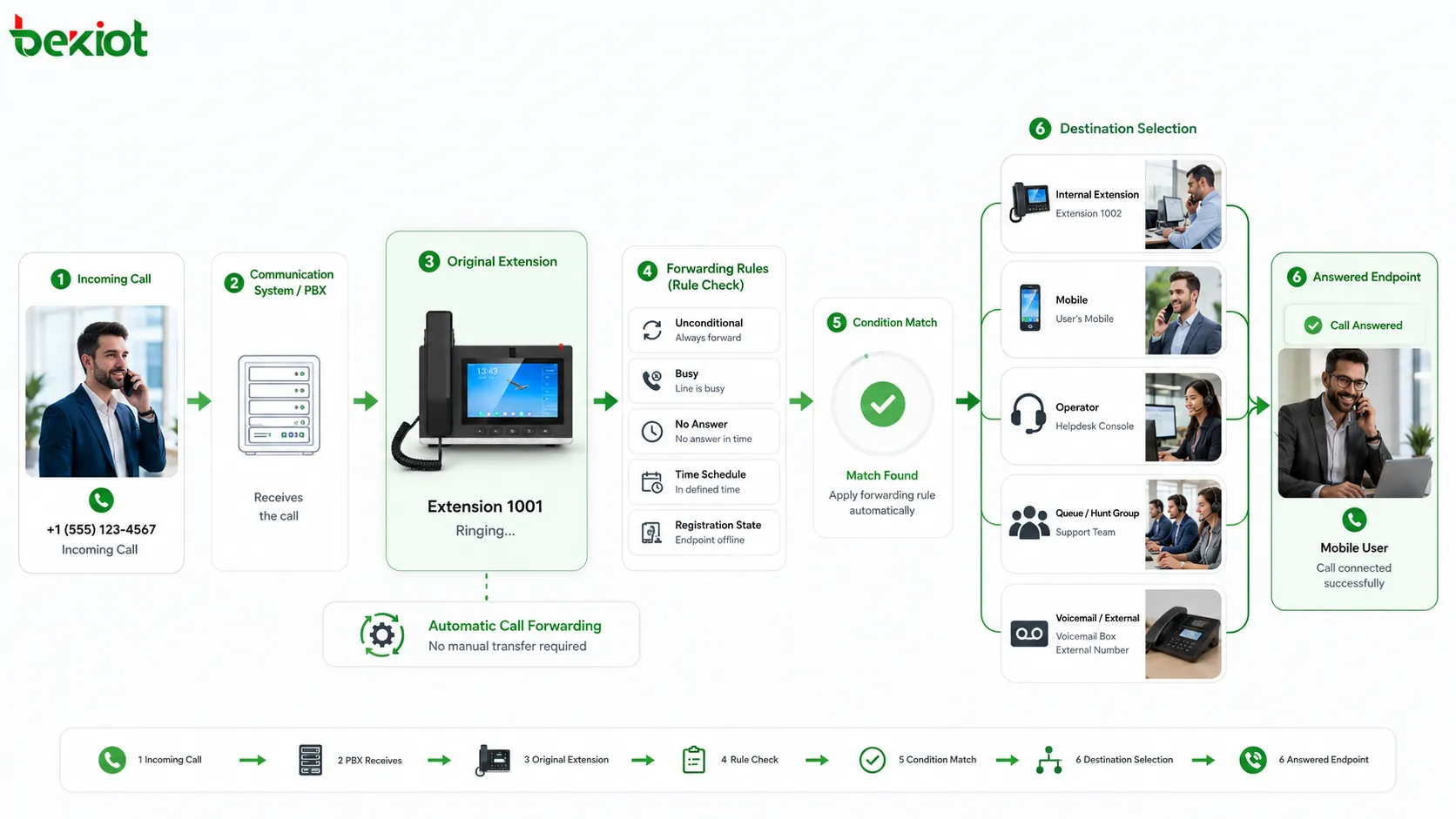
The basic working logic is straightforward. A caller dials a number. The communication system receives the call request and checks whether forwarding rules are configured for that number, extension, user, group, trunk, or service line. If a matching rule exists, the system redirects the call to another destination according to the condition that has been met.
The destination may be another internal extension, a mobile phone, a landline, a department number, a voicemail box, an operator console, a call queue, a hunt group, a contact center, or an external service number. In IP-based systems, the forwarding decision may involve SIP signaling, routing policies, user status, registration state, time schedules, or application-level call control. In traditional telephony environments, forwarding may be handled by the exchange, PBX, carrier network, or endpoint feature code.
Forwarding is not the same as transferring a call manually. A call transfer usually happens after someone answers the call and then sends it to another person. Call forwarding happens automatically according to predefined rules before or instead of normal answering. This automatic nature is what makes it useful for availability planning.
Good forwarding behavior depends on rule order. A system may need to decide whether unconditional forwarding takes priority over busy forwarding, whether no-answer forwarding should wait for a specific ring time, whether external forwarding is allowed, whether a forwarded call can be forwarded again, and whether caller identity should be preserved. These details affect both user experience and system reliability.
The main conditions that make it useful
Call forwarding is valuable because it can be triggered by different real-life conditions. The most direct mode is unconditional forwarding. In this mode, every incoming call to the original number is immediately sent to another destination. This is useful when a user is working from another location, a department number must be temporarily handled by another team, or a service line should be redirected during a planned change.
Busy forwarding is used when the original destination is already engaged. Instead of letting the caller hear only a busy tone, the system can send the call to another extension, assistant, queue, or voicemail. This is especially useful for customer-facing numbers, support lines, reception desks, and departments where one busy person should not block all incoming communication.
No-answer forwarding is triggered when a call rings for a defined period without being answered. It solves a different problem from busy forwarding. The extension may be available in theory, but no one answers in time. The rule can then send the call to another person, a team line, voicemail, or an operator. This supports better caller experience because the call is not left ringing indefinitely.
Unavailable forwarding is used when the system cannot reach the original destination. This may happen when a device is offline, an IP phone is unregistered, a mobile client has no network, a remote extension is disconnected, or a user endpoint is powered off. In systems where voice service depends on registration or network status, this condition is important for resilience.
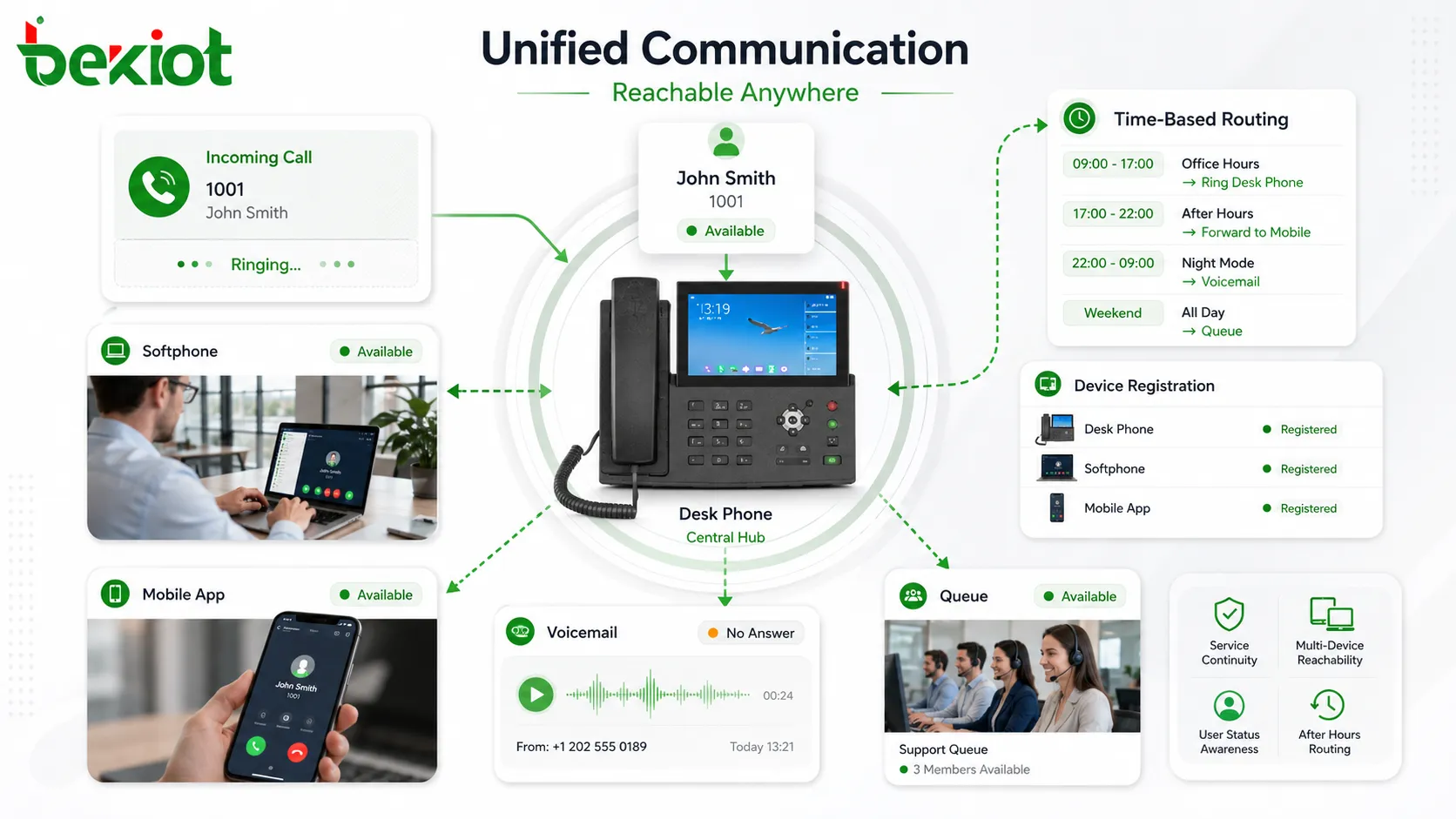
Time-based forwarding adds another layer. Calls can be routed differently during working hours, lunch breaks, weekends, holidays, night shifts, or emergency periods. A front desk number may ring locally during the day and forward to a duty phone at night. A support hotline may go to a queue during business hours and voicemail after closing. A facility service line may forward to an on-call technician outside normal office hours.
Why reachability became a business requirement
In older office environments, a missed call was often accepted as normal. People worked at assigned desks, customers had fewer contact channels, and business processes moved more slowly. That environment has changed. Employees move between meeting rooms, branch offices, remote work locations, customer sites, warehouses, production areas, and mobile devices. Customers also expect faster response and clearer service availability.
Call forwarding supports this new communication pattern by separating the caller’s entry number from the answering location. A customer can still call the published number. A colleague can still dial the internal extension. A service process can still use the same contact point. The system handles the change behind the scenes.
This is especially important for roles that are not tied to one desk. Managers, sales staff, engineers, maintenance teams, doctors, nurses, security supervisors, hotel service staff, logistics coordinators, and field technicians may all need to receive calls while moving. Forwarding allows the organization to keep the numbering plan stable while allowing people to work flexibly.
Reachability also affects trust. When a caller reaches someone quickly, the organization appears responsive and organized. When calls repeatedly fail, callers may doubt service quality even if the underlying business is competent. Voice communication remains a human-facing channel, so the experience of being answered still matters.
Service continuity during absence, overload, and failure
One of the strongest advantages of call forwarding is that it keeps communication alive when the normal answering point cannot serve the call. The reason may be personal absence, high call volume, device failure, line interruption, network instability, office relocation, system maintenance, or temporary staffing change. In each case, the caller still needs a path to reach help.
For absence management, forwarding gives users a controlled way to hand calls to another destination. A staff member leaving the office can forward calls to a mobile phone. A department head can forward calls to an assistant during a meeting. A duty desk can forward calls to another shift. This is more reliable than expecting callers to know who is available.
For overload handling, forwarding reduces the damage caused by one busy endpoint. If a reception line is constantly busy, calls may be sent to a secondary operator, a queue, or a department group. If a technical support extension cannot answer within a defined time, the call can move to a backup agent. This helps distribute pressure and reduce caller abandonment.
For failure handling, forwarding becomes part of communication resilience. If a phone is offline or a site is under maintenance, calls can be redirected to another device or location. This does not replace full disaster recovery, but it provides a practical layer of continuity for daily incidents. Many service interruptions become less serious when calls can still be answered somewhere else.
| Condition | Typical forwarding action | Main operational value |
|---|---|---|
| User away from desk | Redirect to mobile phone or another extension | Keeps the user reachable without changing the published number |
| Extension busy | Send the call to assistant, queue, or team member | Reduces busy-tone failures and improves caller response |
| No answer after timeout | Forward to backup destination or voicemail | Prevents endless ringing and gives the caller a next step |
| Device offline | Route to alternate device, site, or duty phone | Maintains communication during local endpoint failure |
| After-hours service | Forward to on-call staff or night service line | Supports continuous service beyond office hours |
Mobility without changing the caller experience
One reason call forwarding remains important is that it supports mobility without forcing callers to learn new contact information. A person may work from a desk phone in the morning, a mobile phone in the afternoon, and a remote office the next day. The caller still dials the same number. The system handles the routing.
This is different from simply publishing multiple numbers. When every user has several numbers, callers must decide which one to try. They may call the wrong number, leave messages in different places, or abandon the attempt. Forwarding keeps the contact point consistent while allowing the answering point to change.
For internal communication, this improves numbering discipline. Employees can continue using extension numbers even when colleagues are not at their desks. For external communication, it protects the value of public numbers printed on websites, business cards, brochures, service contracts, signs, and customer records. The public number stays stable even when staffing arrangements change.
Mobility also supports hybrid work and distributed organizations. A headquarters employee may support branch users from home. A technical expert may assist multiple sites. A regional manager may move between offices. A service team may rotate duty phones. Forwarding allows these arrangements to work without redesigning the entire communication system each time.
Support for teams instead of single individuals
Many calls are not truly intended for one person. They are intended for a function: sales, support, reception, maintenance, nursing station, security desk, logistics, reservations, finance, or after-sales service. Call forwarding helps transform a personal-number model into a service-function model.
For example, a customer may call a known account manager, but the account manager is unavailable. If the call can forward to an assistant or team line, the customer still receives support. A hotel guest may call the front desk, but if the front desk line is busy, the call can move to a service center. A facility worker may call maintenance, but if the responsible technician is unreachable, the call can go to the duty supervisor.
This team-based approach reduces communication bottlenecks. It prevents one person’s availability from determining whether a service request is handled. It also helps organizations design responsibility coverage. The question changes from “Who owns this number?” to “Who should receive this type of call when the first answer point cannot handle it?”
Team support also improves continuity during vacations, shift changes, staff turnover, training, and workload peaks. Numbers can remain unchanged while forwarding destinations are adjusted. This is useful because changing public numbers or internal contact habits is often more disruptive than changing routing rules.
Role in customer service and caller satisfaction
Customer service depends heavily on first contact experience. A caller who reaches a responsible person quickly is more likely to feel that the organization is reliable. A caller who hears a busy tone, waits through repeated ringing, or has to call multiple numbers may become frustrated before the actual service conversation begins.
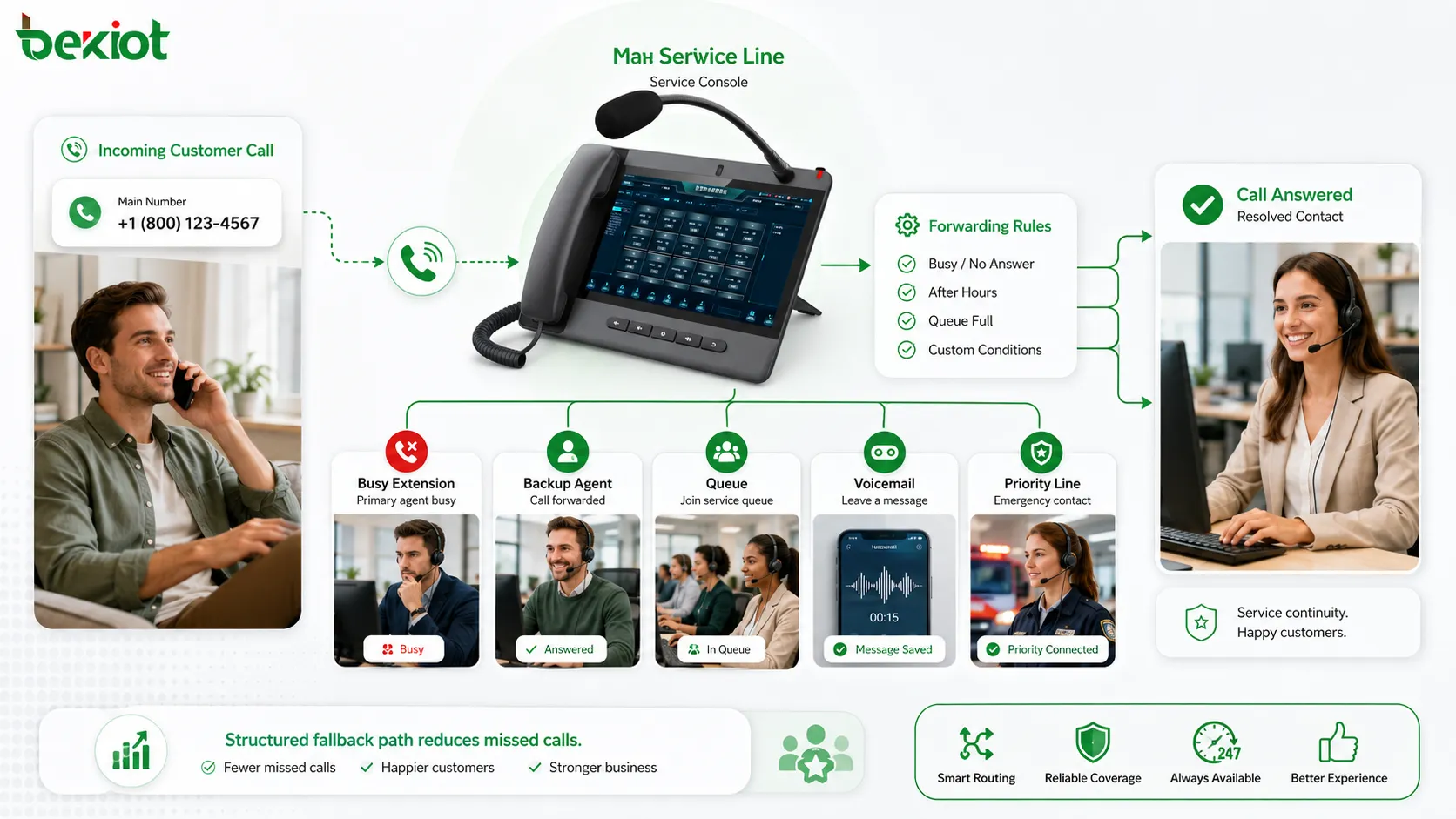
Call forwarding improves this experience by providing a structured fallback path. If the first agent is busy, the call can move to another agent. If the main number is not answered, it can forward to a queue. If the office is closed, it can redirect to voicemail or an emergency contact line. Each of these options is better than leaving the caller without guidance.
It also supports service-level discipline. Organizations can define how long a call should ring before it moves to the next destination. They can decide which calls need backup coverage and which can go to voicemail. They can route VIP, emergency, or high-priority calls differently from ordinary inquiries where the system supports such logic.
The value is not only emotional. Missed calls may become missed sales, delayed support tickets, lost appointment confirmations, unresolved complaints, or repeated inbound traffic. By reducing missed calls, forwarding can lower operating friction and improve the efficiency of service teams.
Operational value in different environments
Office environments use forwarding to support managers, departments, reception desks, conference schedules, remote work, and cross-branch communication. A call to a desk extension can follow the user to another extension or mobile device. A department number can forward to backup staff during meetings. Reception calls can overflow to another assistant during peak hours.
Healthcare environments use forwarding carefully because response time and responsibility are important. A call may need to move from one nursing station to another, from a doctor’s office to a duty phone, or from a department desk to an on-call line. The forwarding design should match clinical workflow, role responsibility, and patient service rules.
Hotels and property services rely on call coverage because guests, tenants, and visitors expect timely response. Front desk, housekeeping, engineering, security, and service center numbers may need forwarding during busy periods, night shifts, or staff movement. The caller should not need to know who is on duty.
Industrial and maintenance teams use forwarding to connect control rooms, workshops, duty engineers, field technicians, and supervisors. When a machine fault, site issue, or maintenance request appears, the call should reach someone responsible even if the first extension is unattended. In these settings, forwarding supports both productivity and safety coordination.
Public service, transport, education, logistics, and security organizations also use forwarding to maintain contact continuity across teams and locations. The specific destinations may differ, but the operating logic remains the same: calls should follow responsibility, not only physical desk location.
Relationship with voicemail, queues, and hunt groups
Call forwarding often works together with other call handling features. Voicemail provides a place for messages when no live person can answer. A call queue holds callers while agents become available. A hunt group tries several members according to a defined order or ringing strategy. These features are related, but they solve different parts of the communication problem.
Forwarding is strongest when the goal is to redirect a call from one destination to another. Voicemail is strongest when no live destination is available. Queues are strongest when many callers must wait for a group of agents. Hunt groups are strongest when several people share responsibility for a call type. In practice, systems often combine them.
For example, a call may first ring a main extension. If there is no answer, it forwards to a hunt group. If no member answers, it moves to voicemail. During working hours, it may go to a queue; after working hours, it may forward to an on-call phone. This layered approach gives callers a clearer path than a single fixed endpoint.
The design should avoid confusion. Too many forwarding steps can create long waits, repeated ringing, or loops. A caller should not be passed from one destination to another without progress. Good call handling design defines a reasonable sequence, clear timeout values, and a final destination when live answering is not possible.
Importance in IP telephony and unified communication
IP telephony and unified communication platforms make call forwarding more flexible because routing decisions can be connected with user status, device registration, application settings, location, time, and integration logic. A user may have a desk phone, softphone, mobile app, web client, and voicemail box under one identity. Forwarding helps manage where calls should land.
In IP-based environments, a user may not always be registered on the same device. A desk phone may be offline, a softphone may be logged out, or a mobile client may be temporarily unreachable. Forwarding and related routing features help maintain service continuity even as endpoint availability changes.
Unified communication also increases expectations. Users may want calls to ring multiple devices, forward after no answer, route differently outside working hours, or move to voicemail with email notification. These behaviors are often treated as normal user experience. The more flexible the working environment becomes, the more necessary forwarding becomes.
However, IP-based forwarding requires good configuration. Number formats, SIP routing, caller ID presentation, NAT traversal, external trunk permission, emergency call policy, and security restrictions must be planned. A forwarding rule that looks simple at the user level may involve several technical checks behind the scenes.
Why it matters during outages and maintenance
Planned maintenance and unexpected faults are unavoidable. A line may be tested, a PBX may be upgraded, a branch network may fail, a device may reboot, or a service desk may temporarily relocate. Without a forwarding plan, these events can interrupt communication for callers who know only the original number.
Call forwarding gives administrators a practical way to reroute calls during these periods. A main number can be redirected to another site. A department line can be sent to a temporary service phone. A branch number can forward to headquarters while local systems are repaired. Users may continue calling the familiar number while the receiving location changes.
This is especially useful for staged migration. When organizations change phone systems, move offices, merge departments, or introduce new service centers, call forwarding can bridge old and new arrangements. It allows old numbers to remain reachable while users adapt to new routing plans.
For emergency handling, forwarding should be treated carefully. Critical lines need tested destinations, clear responsibility, and reliable fallback. A rule that redirects an important call to an unattended mobile phone may create more risk than benefit. The destination must match the operational responsibility of the call.
Configuration rules that affect real performance
The effectiveness of call forwarding depends heavily on configuration quality. The first configuration rule is to define the forwarding condition precisely. Unconditional forwarding, busy forwarding, no-answer forwarding, unavailable forwarding, and time-based forwarding should not be mixed casually. Each one solves a different operational problem.
The second rule is to choose the right destination. A forwarded call should go to a person, group, queue, voicemail, or service point that can actually handle it. Sending calls to someone who is not responsible only moves the problem. The destination should match the caller’s likely need.
The third rule is to set reasonable timeout values. If no-answer forwarding happens too quickly, the original user may not have enough time to answer. If it happens too late, the caller waits too long. Timeout settings should reflect the work environment. A reception desk may need shorter fallback timing than a private office extension.
The fourth rule is to control external forwarding. Forwarding to mobile or external numbers is useful, but it can create cost, privacy, caller ID, security, and compliance concerns. Some systems should restrict external forwarding by user role, destination type, time period, or approval policy.
The fifth rule is to prevent loops. A call forwarded from extension A to extension B should not be forwarded back to A repeatedly. Loops can waste trunk capacity, confuse callers, and create troubleshooting problems. The system should have loop prevention, maximum forwarding depth, or clear rule design.
Security and policy considerations
Because call forwarding can redirect communication outside the original destination, it should be managed with security awareness. Unauthorized forwarding may expose calls to the wrong person, send business calls to personal numbers, bypass recording rules, increase toll fraud risk, or violate internal communication policy.
Administrators should define who can enable forwarding, which destinations are allowed, whether external numbers require permission, whether forwarding can be applied to shared lines, and whether certain numbers are protected from user-level changes. High-risk destinations such as international numbers may need stricter control.
Caller ID handling is another policy issue. Some systems preserve the original caller number when forwarding. Others show the forwarding user’s number or the organization’s trunk number. The chosen behavior affects callback, billing, privacy, and caller recognition. It should be tested before deployment, especially when calls leave the internal network.
Recording and compliance rules may also be affected. If a customer service call is forwarded to a mobile phone, will it still be recorded? If a regulated department forwards calls outside the official platform, does it create a compliance gap? These questions should be answered before enabling broad forwarding rights.
Security does not mean disabling forwarding entirely. It means using it with clear boundaries. The feature is most valuable when users can stay reachable while administrators still control risk.
Caller experience depends on the route design
From the caller’s perspective, forwarding should feel natural. The caller should not hear long silence, repeated ringing, strange tones, unclear announcements, or multiple unnecessary transfers. Even when the call is being redirected, the experience should remain controlled.
Announcements may be useful in some cases. A system may tell the caller that the call is being transferred, that the office is closed, or that the call will be answered by the next available agent. In other cases, silent forwarding may be smoother. The decision depends on service style and caller expectation.
Ringback behavior also matters. If the system forwards calls through multiple routes, the caller should still receive understandable progress tones. Poor routing can make the caller believe the call has failed even when it is still being processed. This can lead to early hang-up.
The final destination should be meaningful. If a caller waits through forwarding only to reach a voicemail box with no useful greeting, the system has not created a good experience. Voicemail greetings, queue messages, and after-hours prompts should match the forwarding logic.
A good route design respects the caller’s time. It uses forwarding to increase answer probability, not to hide poor staffing or create endless redirection. The best forwarding rules are usually simple, predictable, and tied to real responsibility.
Management value for organizations
Call forwarding provides management value because it makes communication coverage easier to organize. Managers can define backup paths for departments, shift teams, service desks, and individual roles. This supports more consistent handling of incoming calls without requiring every caller to understand internal staffing changes.
It also helps standardize communication procedures. For example, sales calls can forward to a group when the responsible person is unavailable. Maintenance calls can forward to duty staff outside business hours. Administrative calls can forward to a shared assistant line. These rules make communication less dependent on informal habits.
Reporting can improve the value further. If the system records forwarded calls, missed forwarded calls, answer rates, busy events, and after-hours traffic, managers can see whether coverage rules are working. High forwarding frequency may reveal staffing gaps, overloaded lines, or poor number planning.
Forwarding data can also support process improvement. If most calls to a department are forwarded because the main extension is rarely answered, the issue may not be technical. It may indicate that the number should be assigned to a team queue, that reception coverage is insufficient, or that business hours are not aligned with caller behavior.
Typical mistakes that reduce its value
One common mistake is using forwarding as a substitute for proper call design. If every call is forwarded several times because no one owns the number, the system becomes confusing. Forwarding should support a clear responsibility structure, not cover up the absence of one.
Another mistake is forwarding to destinations that are not monitored. A call may be redirected to a mobile phone that is switched off, a voicemail box that no one checks, or an extension that belongs to a staff member on leave. The route may exist technically but fail operationally.
Overuse of unconditional forwarding is also risky. It can make the original number meaningless if all calls are always redirected without review. In some cases this is useful, such as temporary relocation. In others, it may hide staffing problems, bypass team coverage, or confuse internal communication.
External forwarding without policy control can create cost and security issues. Calls may be sent to personal numbers, international destinations, or unrecorded channels. Administrators should balance flexibility with governance.
Failure to test is another common issue. Users may set forwarding rules and assume they work, but number format, trunk permission, caller ID behavior, or time conditions may prevent successful completion. Important forwarding routes should be tested before they are relied on.
How to judge whether it is configured well
A well-configured forwarding design should make calls more likely to be answered without making the route confusing. The caller should have a clear path, the receiving party should be responsible for the call, and the administrator should be able to understand the route from system records.
One useful judgment question is whether each forwarding rule has a reason. If the rule exists because a user is mobile, a department needs backup, a line is busy, a site is under maintenance, or after-hours service is required, the rule is likely meaningful. If no one can explain why a rule exists, it may need review.
Another question is whether the destination is reliable. A backup destination must be reachable, staffed, authorized, and appropriate for the call type. A rule that sends service calls to an unavailable or untrained person may create worse results than no rule at all.
The third question is whether the route is visible. Administrators should be able to see active forwarding settings, call logs, failed attempts, and destination behavior. Users should also know when their own calls are being forwarded. Hidden rules can create troubleshooting difficulty.
The fourth question is whether the design has a clean end point. Every route should eventually reach an answer point, a queue, voicemail, announcement, or failure message. Endless redirection is a sign of poor design.
Conclusion
Call forwarding has become indispensable because communication no longer depends on one fixed desk, one device, or one working schedule. People move, teams share responsibility, customers expect faster response, and systems must remain reachable during absence, overload, maintenance, and failure. Forwarding provides the routing flexibility needed to keep calls connected.
Its value is strongest when it is used as part of a planned communication workflow. The feature should match real conditions such as busy lines, no answer, unavailable devices, after-hours service, mobile work, and team coverage. Good forwarding improves answer rates, protects caller experience, supports business continuity, and gives organizations more control over communication availability.
The feature should still be governed carefully. Poorly planned routes, excessive redirection, unmonitored destinations, external forwarding risks, and missing tests can weaken its value. When rules are clear, destinations are appropriate, and policies are controlled, call forwarding becomes one of the most practical technologies for keeping voice communication reliable.
FAQ
Is call forwarding only useful for office phones?
No. It is useful for office phones, mobile workers, service desks, contact centers, healthcare teams, hotels, industrial maintenance teams, security staff, and any environment where calls must reach the right person or backup destination.
What is the difference between call forwarding and call transfer?
Call forwarding is usually automatic and happens according to predefined rules before the call is answered. Call transfer usually happens after someone answers and manually sends the call to another destination.
Can forwarding affect caller ID?
Yes. Depending on system configuration and carrier behavior, the receiving party may see the original caller number, the forwarding number, or an organization number. This should be tested, especially for external forwarding.
Why should external forwarding be controlled?
External forwarding can create cost, privacy, security, recording, and compliance concerns. Organizations should define which users can forward to external numbers and which destinations are allowed.
How can forwarding loops be avoided?
Loops can be avoided by clear routing design, system limits on forwarding depth, loop detection, careful rule review, and testing. A call should not be allowed to move repeatedly between the same destinations without reaching an answer point.