


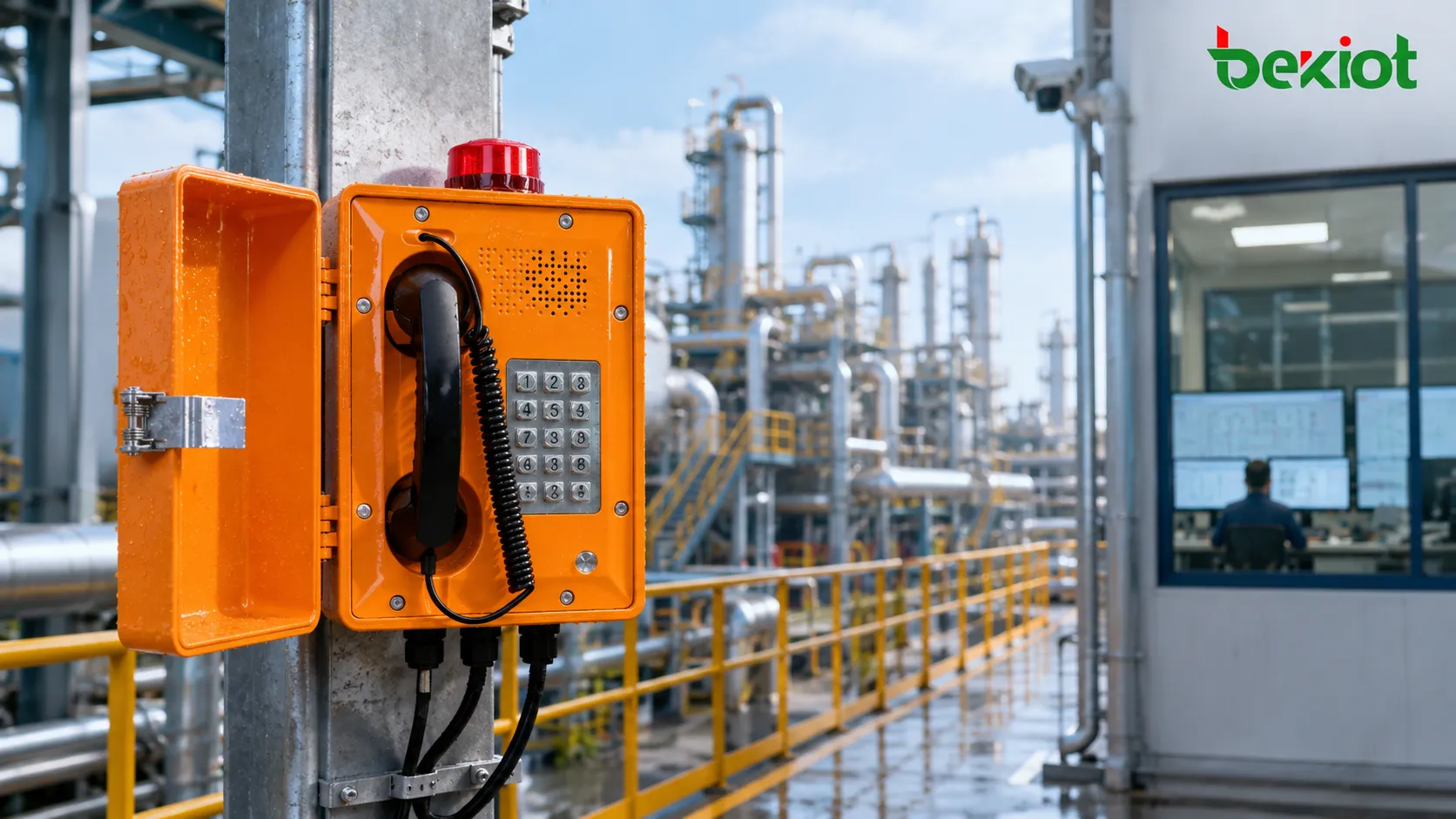
A weatherproof telephone is a fixed communication device designed to keep working in outdoor or harsh environments where rain, dust, humidity, temperature changes, sunlight, wind, and physical exposure may damage ordinary telephones. It is commonly installed in industrial plants, tunnels, ports, parking areas, railway stations, highways, campuses, mines, utility sites, and public service locations where people need a reliable way to call a control room, security center, help desk, or emergency response team.
Unlike a standard desk phone, a weatherproof telephone is built around environmental protection. Its enclosure, keypad, handset, cable entry, speaker, microphone, hook switch, gasket, mounting hardware, and internal electronics must work together to resist water ingress, corrosion, dust accumulation, UV exposure, and repeated field use. The goal is not only to survive bad weather, but also to keep voice communication clear and dependable when the surrounding environment is difficult.
What a Weatherproof Telephone Really Means
It is built for environmental exposure
The word “weatherproof” usually means that the telephone is designed to resist environmental conditions such as rain, splashing water, dust, moisture, wind, sunlight, and temperature variation. In professional projects, this claim should be supported by specific ratings, material descriptions, and installation instructions rather than treated as a vague marketing label.
Weatherproof performance depends on the whole device. A sealed front cover does not help much if the cable entry leaks. A strong enclosure does not prevent failure if the handset cord cracks under UV exposure. A high IP rating may not remain valid if the device is installed with the wrong gland or if the cover is not closed correctly after maintenance.
It is different from indoor rugged telephones
Some telephones are rugged enough for factories, warehouses, or control rooms but are not suitable for direct outdoor exposure. Indoor ruggedness may focus on impact resistance, chemical cleaning, or heavy use. Weatherproof design adds protection against rain, dust, humidity, condensation, temperature cycling, and sometimes salt mist or corrosive atmosphere.
This difference matters when selecting phones for outdoor gates, tunnel portals, loading docks, substations, coastal facilities, tank farms, and roadside call points. A phone that works well indoors can fail quickly outdoors if its enclosure, cable entry, acoustic openings, and materials are not designed for weather exposure.
How It Works
The enclosure creates the first protection layer
The enclosure is the main barrier between the environment and the internal electronics. Weatherproof telephones often use aluminum alloy, stainless steel, engineering plastic, powder-coated steel, or reinforced composite materials. The housing may include a door, hood, gasket, drainage structure, sealed keypad, protected hook switch, and shielded handset area.
The enclosure must protect the device while still allowing normal use. Users need to lift the handset, press buttons, hear ringing, speak into the microphone, and read labels or indicators. Good design protects vulnerable openings without making the telephone difficult to operate.
Sealing details protect the weak points
Most weather-related failures happen at weak points: cable glands, screw holes, cover joints, handset cords, speaker grilles, microphone openings, keypad surfaces, and wall-mount interfaces. A weatherproof telephone uses seals, gaskets, glands, membranes, protected acoustic paths, and corrosion-resistant fasteners to reduce these risks.
Installation quality is part of the protection. Even a well-designed device can leak if the gland is loose, the wall is uneven, the back box is not sealed, the cable enters from the wrong direction, or the cover gasket is pinched during service.
The communication interface depends on the site
Weatherproof telephones may use analog lines, SIP/IP networks, GSM/LTE modules, fiber-connected gateways, or dedicated emergency communication systems. Analog models are often used where legacy telephone lines are already available. SIP weatherproof phones are common in modern IP PBX, dispatch, security, and campus communication systems.
In outdoor and industrial projects, the communication interface should be selected together with power, cabling, network protection, surge protection, and monitoring requirements. Long outdoor cable runs may require grounding, lightning protection, waterproof junction boxes, and careful routing away from high-power equipment.
Protection Ratings and Standards
IP rating explains dust and water resistance
The most common environmental rating for weatherproof telephones is the IP code, defined by IEC 60529. The first digit describes protection against solid objects and dust, while the second digit describes protection against water ingress. For outdoor telephones, ratings such as IP54, IP55, IP65, IP66, or IP67 may appear depending on the product design and test level.
A higher number is not always automatically better for every site. IP66 is often associated with strong protection against water jets, while IP67 relates to temporary immersion under defined conditions. A site exposed to hose washdown, driving rain, dust, or occasional flooding should be evaluated according to the actual risk rather than only choosing the largest number.
NEMA ratings may appear in North American projects
In North America, NEMA enclosure types may also be used. For example, NEMA Type 3, 3R, 4, and 4X are commonly associated with different levels of outdoor protection against rain, sleet, windblown dust, hose-directed water, and corrosion. These ratings are not identical to IP ratings, so project specifications should avoid treating them as direct one-to-one equivalents unless a verified comparison is provided.
For coastal, chemical, or washdown environments, corrosion resistance is often as important as water protection. A weatherproof telephone installed near salt air, fertilizer, chemicals, wastewater, or industrial exhaust may need stainless steel hardware, special coating, sealed components, and regular inspection.
Weatherproof does not mean explosion-proof
Weatherproof and explosion-proof are different protection concepts. Weatherproof design focuses on environmental exposure such as rain and dust. Explosion-proof or hazardous-area certification focuses on preventing ignition in areas with flammable gas, vapor, or dust risk.
If a phone will be installed in a classified hazardous area, project teams must check explosion protection requirements separately. A weatherproof telephone may be suitable for outdoor rain but still not permitted in a hazardous gas zone unless it carries the correct certification and marking.
A weatherproof telephone should be specified by its real installation environment, not by the word “outdoor” alone.
Key Features to Consider
Rugged housing and durable materials
Outdoor telephones may face rain, wind, dust, sunlight, vandalism, accidental impact, insects, corrosion, and temperature changes. Housing material should match the expected exposure. Aluminum alloy may provide a strong and practical enclosure. Stainless steel can be useful in corrosive or public environments. Engineering plastic may reduce weight and support insulation, but it must be suitable for UV and impact requirements.
The finish also matters. Powder coating, anti-corrosion treatment, UV-resistant surfaces, and smooth drainage design can extend service life. In public areas, the enclosure may also need anti-vandal design, tamper-resistant screws, and protected mounting.
Clear audio in outdoor conditions
A weatherproof phone must protect its acoustic components without blocking voice quality. The microphone should reduce wind and water impact while still picking up speech clearly. The speaker or receiver should remain audible in noisy locations such as roads, railways, loading bays, factories, and pump stations.
Some models include noise reduction, amplified ringer output, horn speaker connection, hearing-aid compatibility, or adjustable volume. For industrial or emergency sites, voice clarity should be tested in the real environment rather than judged only by datasheet values.
Reliable buttons, handset, and hook switch
The components touched by users are often the first to fail if they are not designed for outdoor use. Keypads should resist water, dust, gloves, dirt, and repeated pressing. The handset should be durable and comfortable. The hook switch should work reliably even after long exposure to moisture and dust.
For emergency or security phones, simplified dialing may be better than a full keypad. A single call button, auto-dial function, or speed-dial layout can reduce user confusion and shorten response time.
Power and network protection
Outdoor communication equipment is more exposed to power instability, lightning, surge events, moisture-related leakage, and cable damage. SIP phones may need PoE switches, surge protectors, waterproof network connectors, and stable grounding. Analog phones may need protected line circuits and proper junction boxes.
For critical sites, designers may also consider backup power, redundant call routes, central monitoring, and alarm reporting. A weatherproof telephone should be part of a reliable communication path, not just a sealed endpoint.
Deployment Benefits
Reliable access to voice communication
Weatherproof telephones provide a known and fixed communication point where mobile coverage may be weak, devices may be prohibited, or workers may not carry radios. This is useful for visitors, contractors, drivers, maintenance staff, and emergency users who need a simple way to reach the right person.
In outdoor and industrial sites, fixed phones also support predictable response workflows. A call from a named location helps the control room identify where the caller is and what kind of assistance may be needed.
Lower failure risk in exposed locations
Using ordinary telephones outdoors often leads to water ingress, corroded contacts, unreadable labels, cracked plastics, weak audio, and repeated repair work. Weatherproof models reduce these risks by using materials and sealing methods designed for exposure.
This can reduce downtime and maintenance pressure across multi-site facilities. For organizations with many gates, parking areas, platforms, tunnel points, utility rooms, and outdoor service areas, standardizing on suitable weatherproof devices can simplify spare parts and maintenance planning.
Better support for safety and service operations
Weatherproof telephones are often used where fast communication matters. At a gate, a driver may need access assistance. In a tunnel, a user may need emergency help. At a pump station, a technician may need to report a fault. At a campus, a visitor may need security support.
A reliable outdoor phone helps connect these field situations with operators, guards, dispatchers, maintenance teams, or emergency responders. For industrial waterproof phone applications, Becke Telcom’s BT27 can be considered where a fixed rugged telephone is needed for outdoor, wet, or exposed communication points.
Application Scenarios
Industrial plants and utilities
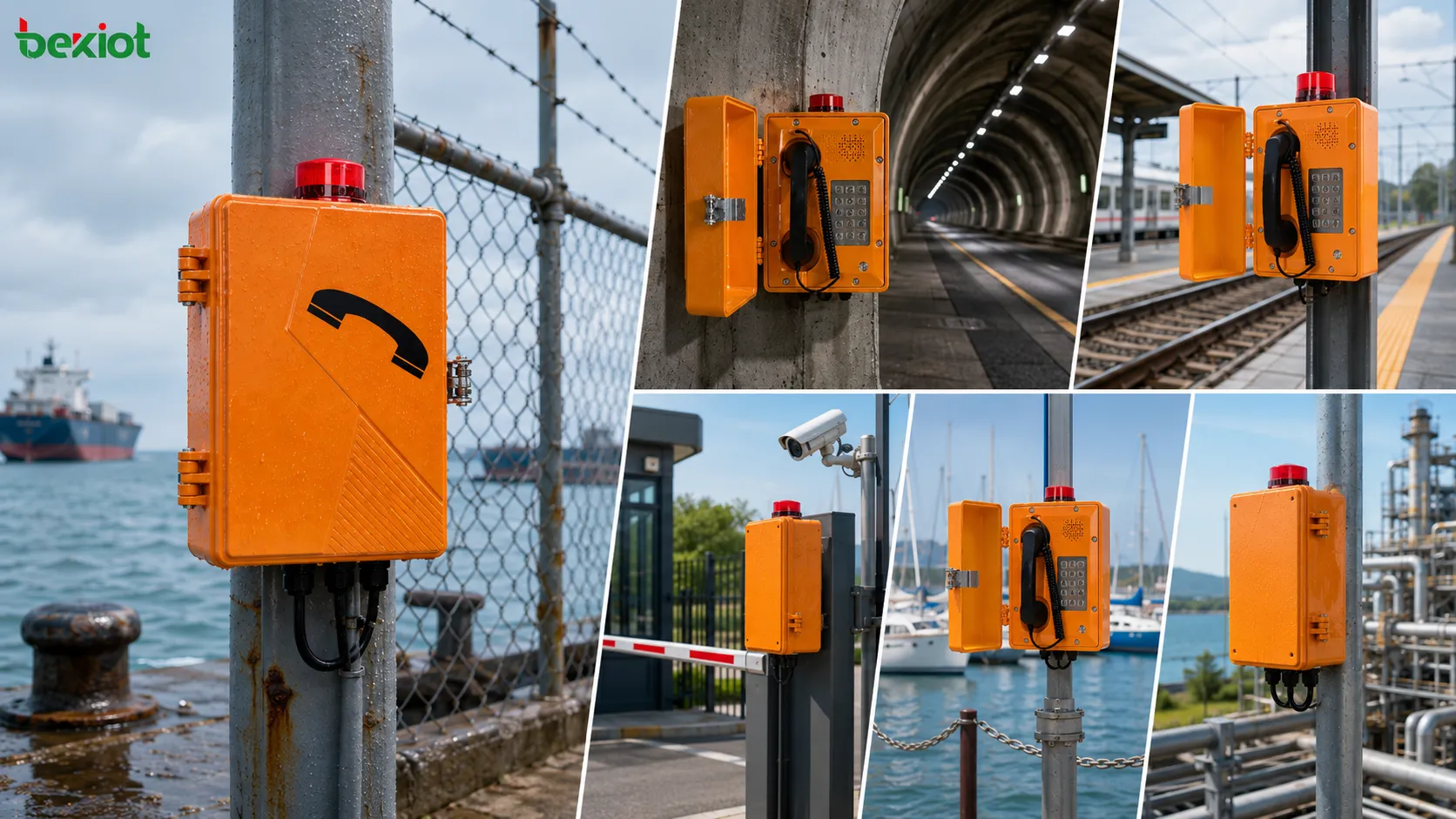
Factories, power plants, water treatment facilities, substations, chemical storage areas, warehouses, and logistics yards use weatherproof telephones to support outdoor operations and maintenance communication. Phones may be installed near gates, equipment platforms, pump rooms, loading docks, weighbridges, and remote utility areas.
In these sites, telephones should be selected according to weather exposure, noise level, cable distance, power availability, and integration with PBX or dispatch systems. Rugged mounting and protected cabling are especially important where vehicles, tools, and vibration are present.
Transportation and public infrastructure
Roadside emergency phones, tunnel phones, railway platform phones, airport service phones, bus station help points, parking garage phones, and bridge communication points all need reliable outdoor performance. Users may be under stress, unfamiliar with the site, or exposed to weather while making a call.
A clear and simple interface is important in these environments. The phone should be visible, easy to operate, and connected to a response center that can identify the location quickly.
Marine, coastal, and outdoor security sites
Ports, marinas, shipyards, coastal plants, perimeter fences, remote gates, and security posts face additional challenges from salt air, humidity, wind, and corrosion. Weatherproof telephones in these locations may require stronger corrosion resistance and more frequent inspection.
Security teams may use outdoor phones for visitor access, guard communication, emergency reporting, and coordination with control rooms. In remote sites, reliable fixed communication can remain important even when mobile devices are widely used.
Installation and Maintenance Tips
Mount the phone where people can reach and notice it
A weatherproof telephone should be installed where users can find it quickly and operate it safely. Good placement considers visibility, lighting, mounting height, signage, surrounding noise, access path, weather direction, and whether the user can stand safely while calling.
Avoid placing the phone where water flows directly into the enclosure, where cables are easy to pull, where vehicles can hit it, or where the handset is exposed to constant spray without protection. A hood, pole, back box, or protective frame may be useful depending on the location.
Protect cable entries and connection points
Cable entry is one of the most important installation details. Use suitable glands, sealed conduit, drip loops, waterproof junction boxes, and strain relief. The cable should enter in a way that reduces water tracking into the enclosure.
For networked phones, outdoor Ethernet runs may need surge protection and proper grounding. For analog lines, junction boxes and terminal blocks should be protected from corrosion and moisture. Cable labels should remain readable for future maintenance.
Inspect seals, buttons, and audio quality regularly
Maintenance should include checking the enclosure, door, gasket, screws, cable glands, handset cord, keypad, hook switch, speaker, microphone, labels, and mounting hardware. After storms, flooding, construction work, or vandalism, inspection should be performed sooner.
A functional test is just as important as a visual check. The phone should be used to place a real test call. Technicians should confirm ringing, dialing, two-way voice, location identification, and response center routing. A phone that looks intact but has weak audio or failed dialing is not ready for emergency use.
Selection Mistakes to Avoid
Choosing only by IP rating
IP rating is important, but it does not describe every requirement. A weatherproof telephone also needs suitable materials, acoustic design, cable protection, corrosion resistance, mounting strength, temperature range, and communication compatibility. A high IP number alone does not guarantee long-term reliability.
For exposed projects, the specification should describe the actual environment: rain, washdown, dust, salt air, wind, sunlight, temperature range, public access, noise level, and required call workflow.
Forgetting user behavior
Outdoor phones are often used by people who are not trained operators. A driver, visitor, worker, or emergency caller may need to use the phone quickly. If the interface is confusing, the label is unreadable, or the call route is unclear, the device may not deliver its intended value.
Simple operation, clear instructions, reliable auto-dial, visible status indication, and correct control room naming can make a large difference in real use.
Ignoring lifecycle conditions
Weatherproof performance can degrade over time. Gaskets age, coatings get scratched, cable glands loosen, UV exposure weakens materials, and repeated opening affects sealing. Maintenance planning should be part of the original project, not an afterthought.
For large deployments, keeping records of model numbers, locations, IP addresses, line numbers, inspection dates, spare parts, and fault history helps reduce downtime and simplify future upgrades.
Conclusion
A weatherproof telephone is a fixed communication device designed to provide reliable voice service in outdoor, wet, dusty, humid, corrosive, or exposed environments. It combines environmental protection with practical communication features such as durable housing, protected cable entry, clear audio, rugged buttons, stable power, and integration with analog or IP-based systems.
The best selection starts with the real site conditions rather than the product name alone. By considering IP or NEMA protection, material durability, acoustic performance, installation quality, cable protection, user workflow, and maintenance requirements, project teams can deploy weatherproof telephones that remain useful and dependable throughout their service life.
FAQ
Can a weatherproof telephone be washed directly with high-pressure water?
Only if its rating and manufacturer instructions allow that type of water exposure. Some outdoor phones resist rain and splashing but are not designed for high-pressure washdown or continuous water jets.
Does IP67 mean the phone is better than IP66?
Not necessarily. IP67 relates to temporary immersion under defined conditions, while IP66 relates to powerful water jets. The better choice depends on whether the site faces flooding, washdown, driving rain, or spray.
Can a weatherproof SIP phone use ordinary indoor network cable?
Outdoor network cabling should be selected for the environment. UV exposure, moisture, conduit conditions, grounding, surge protection, and connector sealing should be considered. Ordinary indoor cable may fail early outdoors.
Why does condensation appear inside some outdoor devices?
Condensation can occur when temperature changes cause moisture in the air to collect on internal surfaces. Poor sealing, blocked drainage, damaged gaskets, or frequent opening in humid weather can increase the risk.
Should outdoor telephones have full keypads or auto-dial buttons?
It depends on the use case. Full keypads offer flexibility, while auto-dial buttons are faster and simpler for help points, gates, emergency stations, and public access locations.
How often should weatherproof telephones be tested?
Testing frequency depends on site risk, weather exposure, usage, and safety requirements. Critical emergency phones should be tested regularly with real call routing, audio checks, and visual inspection of seals and cables.







