Total Harmonic Distortion, commonly abbreviated as THD, is a measurement used to describe how much unwanted harmonic content is added to an audio signal as it passes through equipment such as amplifiers, speakers, microphones, mixers, audio interfaces, processors, receivers, and communication systems. In simple terms, THD shows how much the output signal differs from the original signal because of nonlinear distortion.
In audio engineering, lower distortion usually means the reproduced sound stays closer to the original signal. THD is one of the key measurements used to describe that accuracy.
Basic Meaning of Harmonic Distortion
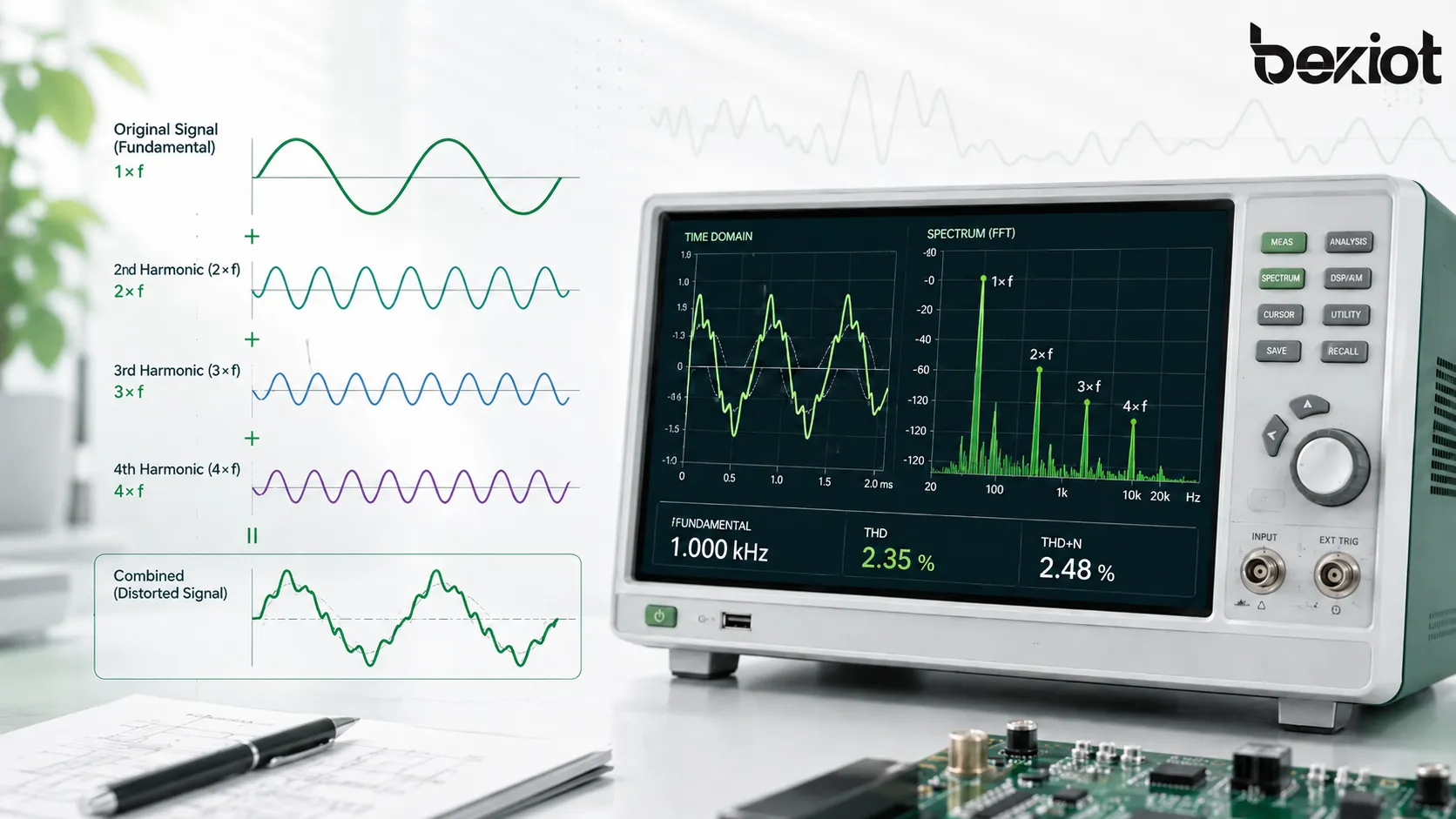
When an audio device receives a pure tone, the ideal output should contain only that same tone. In real equipment, however, small additional frequencies may appear. These extra frequencies are called harmonics because they occur at integer multiples of the original frequency.
For example, if the original signal is 1 kHz, harmonic distortion may create additional components at 2 kHz, 3 kHz, 4 kHz, and higher multiples. These extra frequencies were not part of the original signal, so they represent distortion introduced by the equipment or system.
Fundamental Frequency and Harmonics
The fundamental frequency is the original signal being tested or reproduced. Harmonics are additional tones generated at multiples of that fundamental frequency. The second harmonic is twice the original frequency, the third harmonic is three times the original frequency, and so on.
Some harmonic distortion may be extremely small and inaudible, while higher levels can change the tonal character of the sound. Depending on the equipment and the amount of distortion, the result may be perceived as warmth, coloration, harshness, fuzziness, or loss of clarity.
Why THD Is Expressed as a Percentage
THD is usually expressed as a percentage. A lower percentage means the harmonic distortion level is smaller compared with the original signal. For example, 0.01% THD indicates very low distortion, while 10% THD indicates that the distortion is much more significant.
However, THD should not be judged by the number alone. The test frequency, output power, load impedance, measurement bandwidth, equipment type, and listening environment all affect how meaningful the value is in real use.
How the Measurement Works
THD is measured by applying a known test signal to a device and analyzing the output. The measurement equipment compares the level of harmonic components with the level of the original fundamental frequency. The combined harmonic energy is then calculated as a percentage of the fundamental signal.
In audio testing, the input signal is often a sine wave because a pure sine wave contains only one frequency. If the device were perfectly linear, the output would also contain only that frequency. Any additional harmonic content indicates distortion.
Signal Input and Output Analysis
The test process starts with a clean signal source. This source sends a pure tone into the device under test, such as an amplifier, preamp, speaker, or audio interface. The output is then captured by an audio analyzer, measurement microphone, or digital analysis system.
The analyzer separates the fundamental frequency from the harmonic frequencies. It measures the level of each harmonic component and calculates the total harmonic distortion value. This gives engineers a repeatable way to compare equipment performance.
THD and THD+N
THD and THD+N are related but not identical. THD measures harmonic distortion only. THD+N measures harmonic distortion plus noise. Because noise is included, THD+N values are usually higher than pure THD values.
THD+N is common in audio product specifications because real audio systems contain both distortion and noise. It can provide a broader view of signal cleanliness, especially for amplifiers, DACs, audio interfaces, and communication equipment.
Measurement Conditions Matter
A THD value is only meaningful when the test conditions are clear. An amplifier may show very low THD at 1 watt but higher THD near maximum output. A speaker may produce different distortion levels at different frequencies and sound pressure levels.
Good specifications should state the test frequency, output power, load impedance, bandwidth, and measurement method. Without these details, comparing THD values across different products can be misleading.
Why It Matters for Audio Quality
THD matters because distortion changes the relationship between the original sound and the reproduced sound. In high-fidelity audio, broadcast, conference systems, public address, recording, and professional sound reinforcement, signal accuracy directly affects listening quality and intelligibility.
A low THD value often indicates that equipment can reproduce audio more cleanly. This is especially important when the system must deliver natural speech, accurate music, low listening fatigue, or reliable monitoring.
Cleaner Reproduction
Low harmonic distortion helps preserve the original tone, dynamics, and detail of the source material. In music playback, this can make instruments and vocals sound more natural. In voice systems, it can help maintain speech clarity.
Clean reproduction is not only useful for audiophile listening. It is also important in meeting rooms, studios, classrooms, control rooms, transportation announcements, emergency communication, and any environment where listeners must understand sound accurately.
Less Harshness and Listening Fatigue
Higher distortion can add unwanted sharpness, roughness, or muddiness to the sound. Even when the distortion is not obvious as a separate sound, it may make long listening sessions more tiring.
This is why THD is often considered during amplifier selection, loudspeaker evaluation, headset design, microphone preamp testing, and system commissioning. A cleaner signal path can improve comfort and perceived quality over time.
Better Headroom and System Stability
THD often increases when equipment is pushed close to its limits. An amplifier driven near clipping, a speaker operated beyond its linear range, or an overloaded input stage may produce significantly more distortion.
Monitoring THD helps engineers understand how much usable headroom a system has before audible distortion becomes a problem. This supports safer gain structure, better amplifier sizing, and more reliable audio performance.
Technical Features Behind THD
Total Harmonic Distortion is connected to nonlinear behavior. Any audio component that does not respond perfectly proportionally to the input signal can generate harmonic content. This may happen in electronic circuits, magnetic components, mechanical speaker movement, overloaded converters, or poorly matched system stages.
Nonlinear Amplification
Amplifiers are one of the most common places where THD is measured. A linear amplifier increases signal level without changing the waveform shape. A nonlinear amplifier changes the waveform shape slightly, creating harmonics.
Distortion may increase when the amplifier is overloaded, when power supply capacity is insufficient, when the load impedance is difficult, or when the circuit design is not optimized. This is why amplifier THD is often specified at a given power output and load.
Speaker Driver Behavior
Speakers can create harmonic distortion because they convert electrical energy into mechanical movement. The cone, voice coil, suspension, magnetic structure, enclosure, and crossover all affect how accurately the speaker follows the input signal.
Low frequencies often create more mechanical stress because the speaker cone must move farther. This can increase distortion, especially in small drivers or systems without enough low-frequency headroom.
Digital and Analog Signal Chains
THD can appear in both analog and digital audio systems. Analog circuits may introduce distortion through amplifiers, transformers, capacitors, tubes, transistors, or overloaded inputs. Digital systems may introduce distortion through clipping, poor conversion, processing errors, or insufficient level management.
Digital audio does not automatically eliminate distortion. If a signal clips before conversion, overloads a plugin, exceeds internal processing limits, or drives an output stage too hard, distortion can still occur.
Benefits of Low THD in Audio Systems
Low THD is beneficial because it helps audio systems reproduce sound more faithfully. It does not guarantee perfect sound by itself, but it is an important part of technical audio quality, especially when combined with good frequency response, low noise, proper gain structure, and suitable acoustic design.
More Accurate Sound
Lower THD means fewer unwanted harmonic components are added to the signal. This helps the output remain closer to the input, which is especially important in studio monitoring, broadcast production, measurement systems, and high-fidelity playback.
Accurate sound reproduction allows engineers, performers, listeners, and operators to make better decisions. If the monitoring system adds too much distortion, it becomes harder to judge the true quality of the original source.
Improved Speech Intelligibility
In voice communication and public address systems, distortion can reduce intelligibility. Excess harmonic content may mask consonants, make speech sound rough, or reduce clarity in noisy environments.
Low THD helps maintain clearer speech transmission. This is valuable in conference rooms, classrooms, control rooms, railway stations, airports, industrial sites, emergency paging systems, and commercial sound systems.
Professional System Reliability
Audio systems with low distortion at normal operating levels are usually less likely to be operating near their limits. This can support better reliability, more consistent output, and reduced risk of clipping during dynamic peaks.
For installed systems, selecting equipment with suitable THD performance and enough headroom can reduce complaints, maintenance issues, and the need for frequent level adjustments.
Common Applications
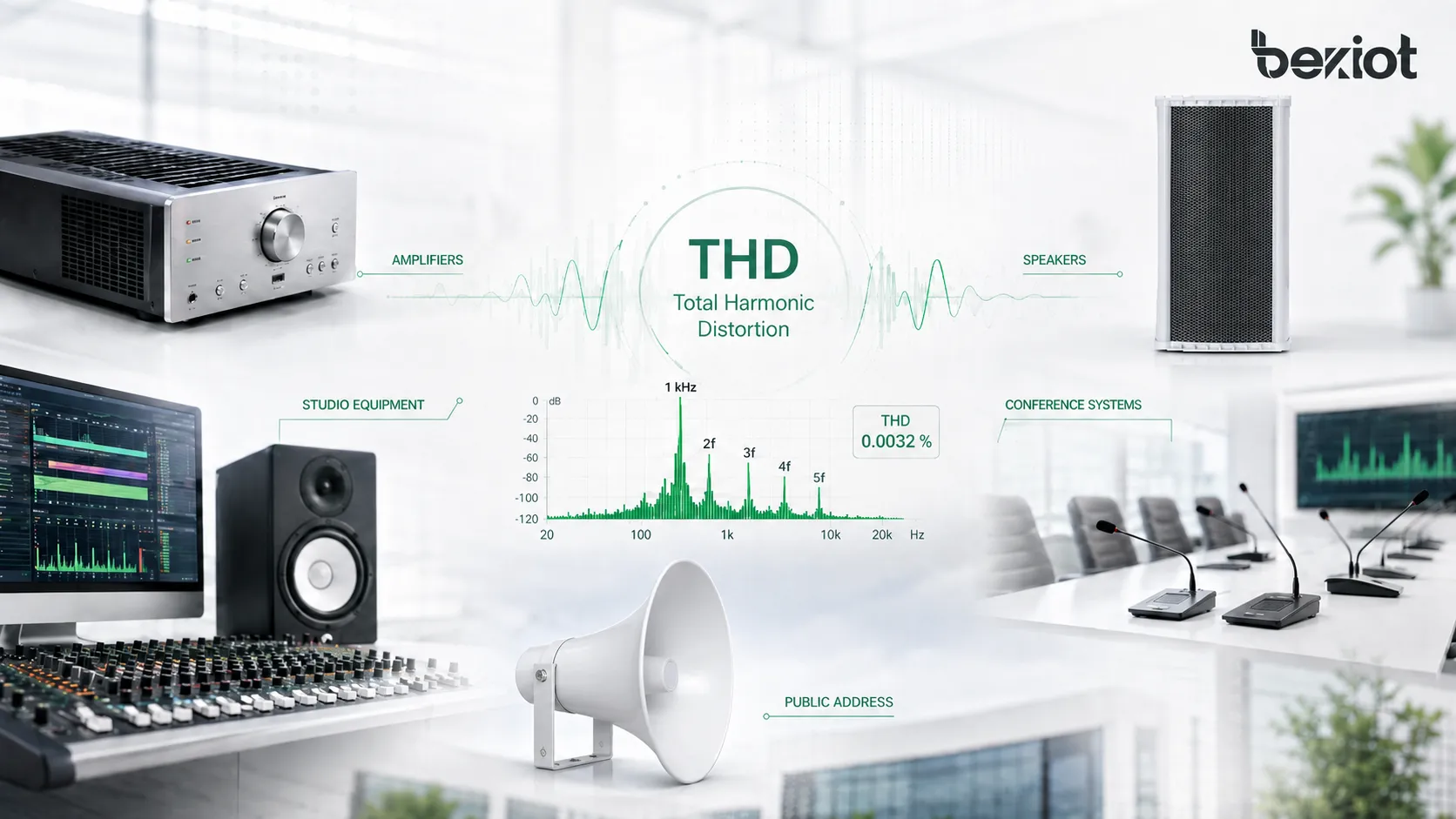
THD appears in specifications and testing for many audio products. It is used by manufacturers, engineers, installers, reviewers, and buyers to evaluate signal quality and compare equipment under defined conditions.
Amplifiers and Receivers
Power amplifiers, integrated amplifiers, headphone amplifiers, AV receivers, and professional amplifiers often include THD or THD+N values in their specifications. These values help users understand how clean the output remains at certain power levels.
For amplifier comparison, the measurement should be checked carefully. THD at low power may be very different from THD at rated power. The load impedance and frequency range should also be considered.
Speakers and Subwoofers
Speaker THD is important because loudspeakers are mechanical devices and often create more distortion than electronic components. Distortion varies with frequency, volume level, enclosure design, driver size, crossover behavior, and room conditions.
Subwoofers and small speakers are especially affected because low-frequency reproduction requires larger cone movement. Measuring THD helps evaluate whether the speaker can reproduce sound cleanly at the desired output level.
Recording and Studio Equipment
Audio interfaces, microphone preamps, mixers, compressors, equalizers, converters, and studio monitors may all be evaluated with THD or THD+N. In recording environments, low distortion helps preserve the quality of the source signal.
However, some studio equipment intentionally adds harmonic character. Tube preamps, tape machines, transformers, and analog saturation processors may create distortion that is considered musically pleasing. In these cases, the goal is controlled coloration rather than the lowest possible THD.
Broadcast, Conference, and Public Address
Broadcast and conference systems need clean speech and stable audio quality. Excessive distortion can reduce clarity and make listeners uncomfortable. THD is one of several technical indicators used when selecting microphones, processors, amplifiers, and speakers.
Public address systems also benefit from low distortion, especially in large spaces where acoustics are already challenging. A distorted signal sent into a reverberant environment can become even harder to understand.
Headphones and Consumer Audio
Headphones, earbuds, soundbars, Bluetooth speakers, DACs, and portable players may all have THD specifications. For consumer products, THD can help describe technical cleanliness, but it should be considered together with tuning, comfort, noise level, codec quality, and user listening preferences.
A product with very low THD may not automatically sound better if its frequency response is poorly tuned. Likewise, a product with slightly higher THD may still sound pleasant if the distortion is low enough and the overall design is strong.
Reading THD Specifications Correctly
THD specifications are useful, but they must be read carefully. A single number cannot describe the full sound quality of an audio device. It only describes harmonic distortion under specific test conditions.
Check the Test Power Level
Amplifier THD often changes as output power increases. A specification may show very low distortion at 1 watt but much higher distortion near maximum output. If the product is used in a demanding system, the rated-power THD value is more meaningful than a low-power test result.
For speakers, the sound pressure level used during measurement matters. A speaker may have low THD at moderate volume but much higher distortion at high output.
Check the Frequency and Bandwidth
Some specifications only measure THD at 1 kHz. This is useful, but it does not show performance across the full audio band. Distortion may be different at low frequencies, midrange, and high frequencies.
For a more complete view, frequency-dependent distortion graphs are more informative than a single number. They show how distortion changes across the listening range.
Do Not Ignore Noise
A device may have low THD but still have audible noise. This is why THD+N, signal-to-noise ratio, dynamic range, and noise floor should also be considered. In quiet listening environments, noise may be more noticeable than harmonic distortion.
For microphones, preamps, headphone amplifiers, and studio interfaces, low noise is especially important because weak signals may require high gain.
THD Compared with Related Audio Metrics
THD is only one part of audio performance. It should be evaluated together with frequency response, noise, dynamic range, intermodulation distortion, damping factor, sensitivity, maximum SPL, and acoustic performance.
| Metric | Main Meaning | Why It Matters |
|---|---|---|
| THD | Total Harmonic Distortion | Shows unwanted harmonic content added to the original signal |
| THD+N | Total Harmonic Distortion plus Noise | Shows combined distortion and noise level |
| Frequency Response | Output level across different frequencies | Shows tonal balance and bandwidth accuracy |
| Signal-to-Noise Ratio | Useful signal level compared with background noise | Shows how clean the signal is from noise contamination |
| Intermodulation Distortion | Distortion created when multiple frequencies interact | Can be more revealing for complex music and real program material |
THD and Intermodulation Distortion
THD uses harmonics of a test frequency, while intermodulation distortion measures new frequencies created when two or more tones interact. Real music and speech contain many frequencies at the same time, so intermodulation distortion can be important in practical listening.
A device may perform well in a simple THD test but still show weaknesses with complex signals. For serious evaluation, engineers often review multiple measurements rather than relying on one number.
THD and Frequency Response
Frequency response describes tonal balance, while THD describes distortion. A speaker may have low THD but poor tonal balance, or a pleasing frequency response but higher distortion at certain volumes.
Good audio performance requires both low distortion and suitable frequency response. In rooms and installed systems, acoustic treatment, speaker placement, and calibration also affect the final listening result.
Practical Selection Guidelines
When selecting audio equipment, THD should be considered in context. The best choice depends on the application, required output level, listening distance, background noise, program material, installation environment, and user expectations.
For Hi-Fi and Studio Use
For hi-fi playback and studio monitoring, low THD is usually desirable because the goal is accurate reproduction. Amplifiers, DACs, audio interfaces, and monitors should have low distortion at normal listening levels.
Studio users should also consider noise floor, latency, dynamic range, converter quality, monitor accuracy, and room acoustics. A low THD number alone does not guarantee a reliable monitoring environment.
For Public Address and Voice Systems
For public address, paging, and voice reinforcement, intelligibility is the priority. Low distortion helps, but speaker coverage, acoustic design, microphone placement, equalization, feedback control, and background noise are equally important.
In large spaces, a clean signal can still become unclear if the room is too reverberant or the speaker layout is poor. THD should be part of a broader system design approach.
For High-Power Sound Reinforcement
In live sound and high-power systems, distortion can increase quickly when amplifiers or speakers are pushed too hard. Equipment should be selected with enough headroom for peak levels.
Limiters, proper gain staging, amplifier matching, speaker protection, and system tuning can help keep distortion under control during real events.
Common Misunderstandings
THD is useful, but it is often misunderstood. Some users assume that the lowest THD value always means the best sound. Others assume that any distortion is bad. In reality, audibility, distortion type, harmonic order, level, and listening context all matter.
Extremely Low THD Is Not Always Audibly Better
Once distortion is below a certain level, further reduction may not be audible in normal listening conditions. The difference between 0.001% and 0.0001% THD may be technically measurable but not necessarily meaningful to most listeners.
Other factors, such as speaker quality, room acoustics, noise floor, and frequency response, may have a much larger impact on perceived sound quality.
Some Distortion Can Be Intentional
In music production, some distortion is intentionally added for creative effect. Guitar amplifiers, tube preamps, analog tape, saturation plugins, and certain vintage-style processors may produce harmonic distortion that listeners find musically pleasing.
This does not contradict the value of low THD. It simply means that technical accuracy and creative coloration are different goals. In measurement, distortion is an error; in music production, controlled distortion can be an artistic tool.
THD Does Not Describe Everything
THD does not fully describe transient response, stereo imaging, noise, compression behavior, frequency balance, distortion order, room acoustics, or subjective listening preference. It is one useful measurement among many.
Good audio evaluation combines specifications, measurements, listening tests, installation design, and real application requirements.
FAQ
What is Total Harmonic Distortion in audio?
Total Harmonic Distortion is a measurement of unwanted harmonic frequencies added to an audio signal by equipment or a system. It shows how much the output signal differs from the original signal because of nonlinear distortion.
Is lower THD always better?
Lower THD usually means cleaner signal reproduction, but it is not the only factor that determines sound quality. Frequency response, noise, dynamic range, speaker design, room acoustics, and listening level also matter.
What is a good THD value?
A good THD value depends on the equipment type and application. Electronic devices such as amplifiers and DACs often have very low THD, while speakers usually have higher distortion. The value should be judged under the stated test conditions.
What is the difference between THD and THD+N?
THD measures harmonic distortion only. THD+N measures harmonic distortion plus noise. THD+N is often higher because it includes both unwanted harmonic content and background noise.
Why does THD increase at high volume?
THD often increases at high volume because amplifiers, speakers, and other components may operate closer to their physical or electrical limits. Clipping, cone movement limits, power supply stress, and thermal effects can all increase distortion.
Does THD matter for speech systems?
Yes. Excessive distortion can reduce speech clarity and increase listening fatigue. For conference rooms, public address, paging, broadcast, and communication systems, low distortion helps maintain intelligibility and professional sound quality.