


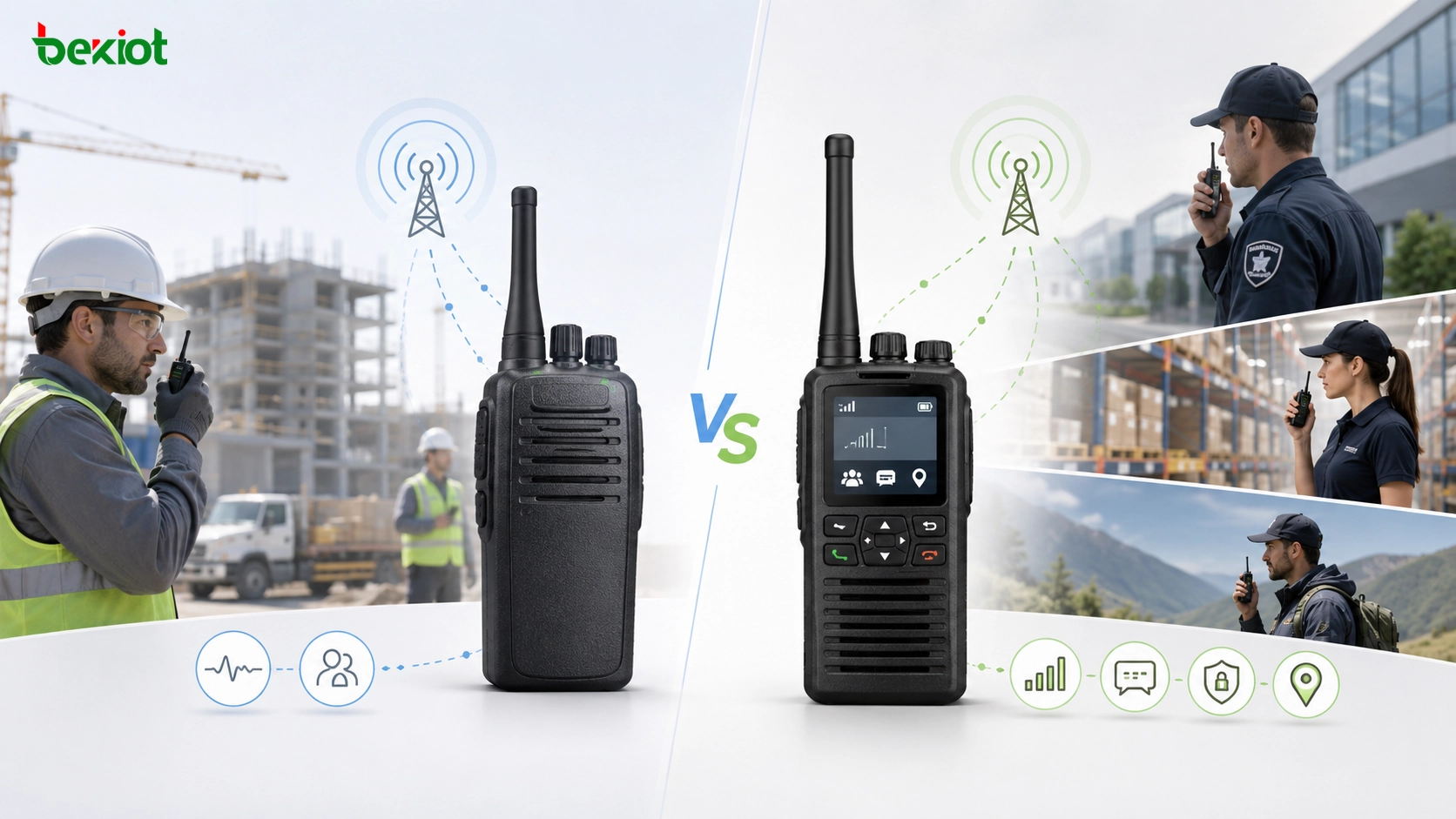
Walkie-talkies remain one of the most practical tools for field communication because they can work independently of public mobile networks. Today, radio communication devices can generally be divided into analog radios, digital radios, and public-network push-to-talk terminals. Public-network radios are becoming more popular, but they depend on carrier networks in the same way mobile phones do. When there is no cellular coverage, no data network, or no operator service, the real independent options are still analog and digital walkie-talkies.
Digital radio technology has become more advanced in many ways. It can support features such as group calls, private calls, short messages, GPS positioning, remote control, better spectrum efficiency, and lower power consumption in some operating modes. However, many users still feel that analog walkie-talkies are easier to use, especially in temporary field work, emergency response, construction sites, outdoor teams, small businesses, and non-professional radio scenarios. This preference is not only a matter of habit. It is closely related to interoperability, configuration complexity, latency, voice quality, maintenance cost, and real-world deployment pressure.
The Radio Choices Behind Field Communication
In practical communication projects, the first question is not whether a radio is analog or digital. The first question is whether the team needs independent communication. If the site depends on public mobile networks, public-network push-to-talk devices may provide wide-area coverage and platform-based management. But if the environment has no reliable cellular coverage, or if the communication system must continue working during network failure, then traditional radio remains important.
Analog and digital walkie-talkies both use radio frequencies to communicate directly or through repeaters. They do not require a cellular base station or internet connection for local communication. This is why they remain valuable for construction teams, factories, warehouses, mines, ports, security patrols, outdoor rescue, temporary events, transportation sites, and emergency response.
The difference is how they process and transmit voice. Analog radios transmit voice as a continuous radio signal after audio processing and frequency modulation. Digital radios first convert voice into digital data, compress it through a vocoder, and then transmit it using a digital modulation method. This difference creates many advantages for digital systems, but it also explains why analog radios can still feel more direct and easier to operate.
How a Simple RF Voice Path Works
The working principle of an analog walkie-talkie is relatively simple. A microphone captures the user’s voice and converts it into an analog electrical signal. The radio then processes the audio, amplifies it, filters unwanted components, modulates the signal onto a specific frequency, amplifies the RF output, and transmits it through the antenna.
At the receiving side, another radio receives the signal on the same frequency, demodulates it, restores the audio waveform, amplifies the sound, and plays it through the speaker. This process is mature, direct, and easy to understand. The technology has been used for many decades and has become one of the most stable forms of short-range and medium-range voice communication.
Because the signal chain is straightforward, analog radios usually have very low voice delay. When the user presses the PTT button and starts speaking, the voice is transmitted almost immediately. This is one of the key reasons many field users feel analog radios are more natural, especially in fast conversations, security coordination, loading operations, traffic guidance, and emergency communication.
What Changes When Voice Becomes Digital
Digital walkie-talkies use a more complex process. The microphone still captures the voice, but the radio converts the analog audio into digital data. A vocoder compresses the voice, and the system may apply encryption, error correction, framing, and digital modulation before transmission. The receiving radio must use compatible standards and a compatible vocoder to decode the signal correctly.
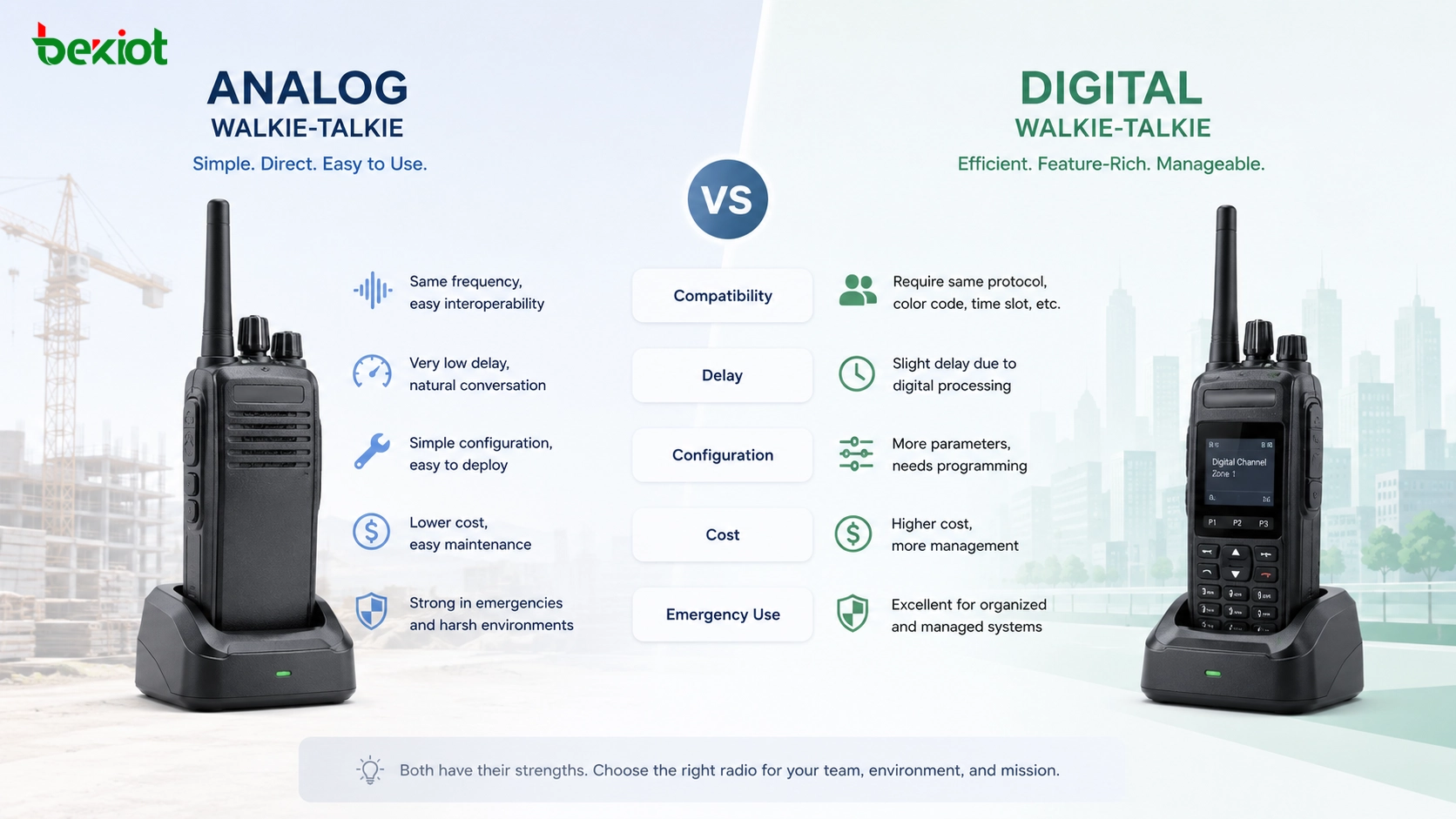
This design brings clear advantages. For example, many digital radio systems use TDMA technology, allowing one frequency channel to support two time slots. This means two voice paths may share the same channel structure under the right system design. Digital systems can also support user IDs, group calls, private calls, short data messages, GPS reporting, remote stun or kill functions, and better platform management.
However, these advantages also introduce more setup requirements. A digital radio is not only matched by frequency. It may also require the correct color code, time slot, talk group ID, contact list, encryption setting, channel profile, and system mode. If one parameter is wrong, the radios may not talk to each other even though they appear to be on the same channel.
Why Same-Frequency Operation Still Matters
The biggest advantage of analog radios is often interoperability. In many cases, if different analog walkie-talkies are set to the same frequency and compatible bandwidth settings, they can communicate regardless of brand. Some scenarios may also use CTCSS or DCS tones to reduce unwanted reception, but the basic operating logic remains simple: match the frequency, press PTT, and talk.
This simplicity is extremely valuable for non-professional users. A temporary team can distribute radios quickly. A site manager can add another radio to the same channel. A rescue team can coordinate with another group by agreeing on a frequency. A warehouse can replace a damaged unit without rebuilding a complicated configuration file.
Digital radios are different. Even if the frequency is the same, incompatible digital standards, different modulation modes, different vocoders, different vendor settings, or mismatched talk group parameters can prevent communication. In a controlled enterprise system, this is not a problem because all radios are planned and programmed by professionals. In mixed, temporary, or emergency environments, it can become a major barrier.
Configuration Complexity in Real Projects
Analog radio configuration is usually easier. For many users, the key task is setting the correct frequency. In some cases, a sub-audio tone must be configured, but the overall process is still relatively simple. This makes analog radios suitable for users who need practical communication without deep technical training.
Digital radio configuration requires more planning. The system may need channel definitions, color codes, time slots, talk groups, contact IDs, encryption keys, repeater settings, roaming parameters, and permission rules. These settings are powerful, but they also create more opportunities for errors. A non-professional user may think two radios are on the same channel while the actual time slot or group ID is different.
For a large organization with a trained communication team, the additional configuration is acceptable because it enables better control. For small teams, outdoor workers, short-term contractors, and emergency groups with mixed equipment, the same complexity can become a usability problem. This is why analog radios often win in environments where “quickly working” matters more than advanced functions.
Delay and Audio Experience in Daily Use
Analog radios are often described as having almost no voice delay. This makes the conversation feel natural. In fast field coordination, even a small delay can be noticeable. When a person presses the PTT button and speaks immediately, analog transmission usually starts with very little waiting time.
Digital radios need more processing time. The voice must be sampled, encoded, framed, modulated, transmitted, received, decoded, and played back. This process is usually fast enough for normal communication, but users may still feel a small delay. In some cases, if a user presses PTT and starts speaking too quickly, the first word or first syllable may be clipped. This is one reason new digital radio users sometimes feel that digital devices are less responsive.
Audio quality also depends on signal conditions and codec performance. When the signal is strong, analog radios can sound natural because they preserve the voice waveform more directly. Digital radios can sound clean, but if the vocoder or audio processing is not optimized, the voice may feel mechanical or compressed. When signal quality becomes weak, analog audio may become noisy but still understandable, while digital audio may remain clear up to a point and then suddenly break, freeze, or disappear.
Cost and Maintenance Are Still Major Factors
Price is another reason analog radios remain popular. In many markets, entry-level analog walkie-talkies can be very inexpensive. Some low-cost analog units may cost less than one hundred yuan, while digital radios can be much closer to the thousand-yuan range depending on brand, features, and system requirements.
For small teams, this price difference matters. If a site needs dozens or hundreds of radios, the total investment can increase quickly. Accessories, batteries, chargers, programming cables, repeaters, repair costs, and replacement units also affect the full lifecycle cost. Analog radios are often cheaper to buy, simpler to repair, and easier to replace.
Digital radios provide more functions, but not every user needs those functions. A team that only needs push-to-talk voice on one or two channels may not benefit enough from group messaging, GPS, or remote management to justify the higher cost. In these cases, analog radios remain attractive because they solve the core communication problem with less financial pressure.
Emergency Use Requires Fast Interoperability
Emergency scenarios reveal the practical strength of analog radio. Different teams may arrive with different brands and models. Some may use older devices. Some may bring temporary radios. In a time-sensitive situation, the fastest way to establish basic communication is often to agree on a frequency and start talking.
Digital systems can be very effective in organized emergency networks, especially when all teams use the same standard, same system planning, and same configuration. But if different teams use different digital modes, different frequencies, different encryption settings, or different talk group structures, temporary interoperability can be difficult. Field technicians may need programming tools, software, cables, permission files, or system access before the radios can communicate.
This does not mean digital radios are unsuitable for emergency work. It means emergency communication planning must be realistic. A good plan should consider how different teams will interconnect, how backup channels are assigned, how analog compatibility is maintained, and how command centers can bridge radio networks with IP dispatch systems.
Where Digital Systems Provide Clear Advantages
Although many users feel analog radios are easier to use, digital systems are not inferior. They are simply designed for different priorities. Digital radios are valuable when an organization needs better channel efficiency, structured group management, identity control, data services, location reporting, encryption, call logs, and centralized system planning.
For industries such as utilities, transportation, public safety, industrial security, logistics, and large campuses, digital radio can provide more organized communication. Dispatchers can identify users, manage groups, record calls, trigger alerts, and integrate radio traffic with wider command systems. TDMA-based systems can also improve spectrum utilization by supporting more structured channel use.
The key is to match the technology to the scenario. If the project requires simple, low-cost, brand-flexible, fast-start communication, analog may still be the most practical option. If the project requires permission control, data services, radio management, encryption, and dispatch platform integration, digital radio may be more suitable.
A Hybrid Architecture for Practical Deployment
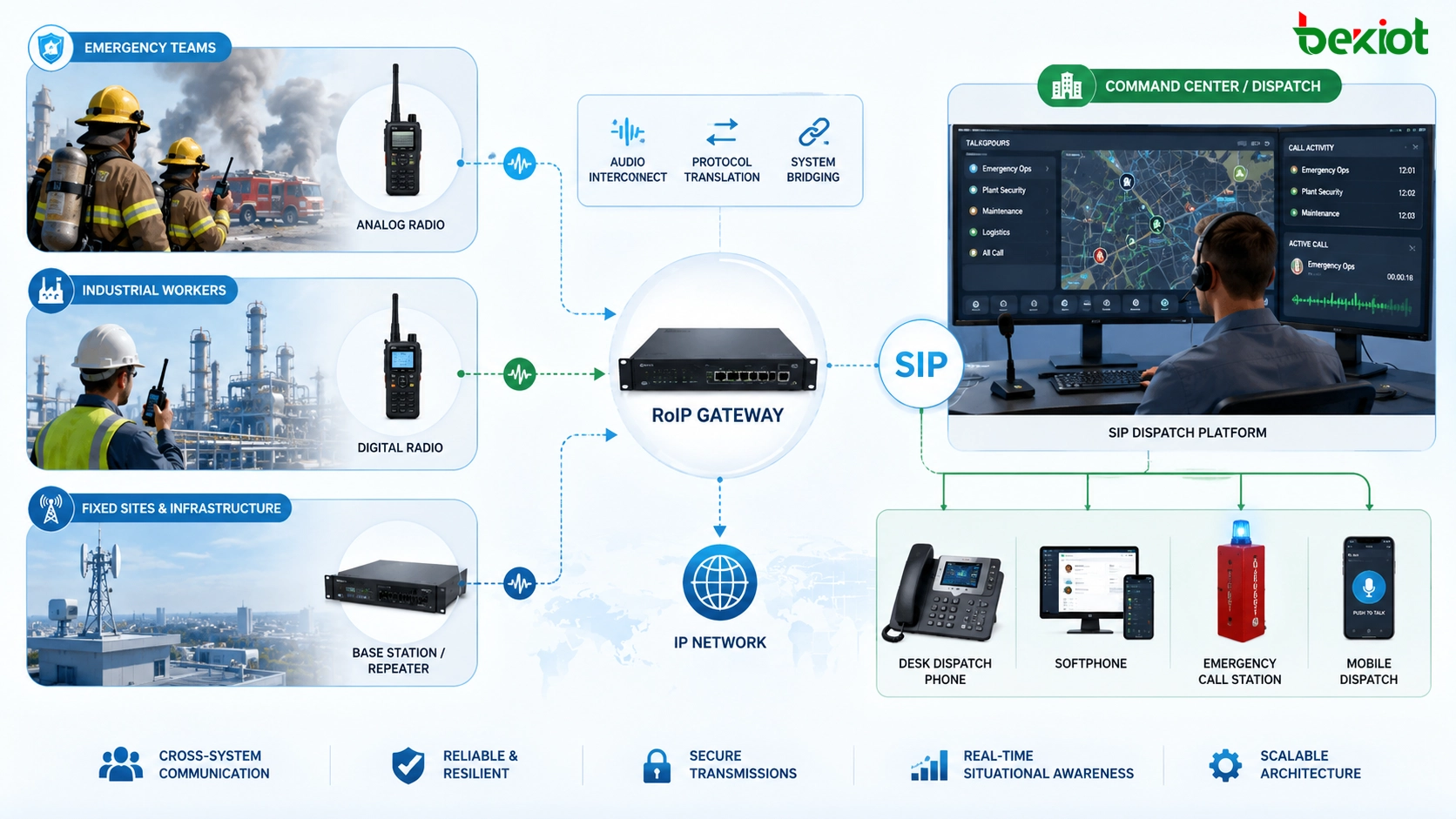
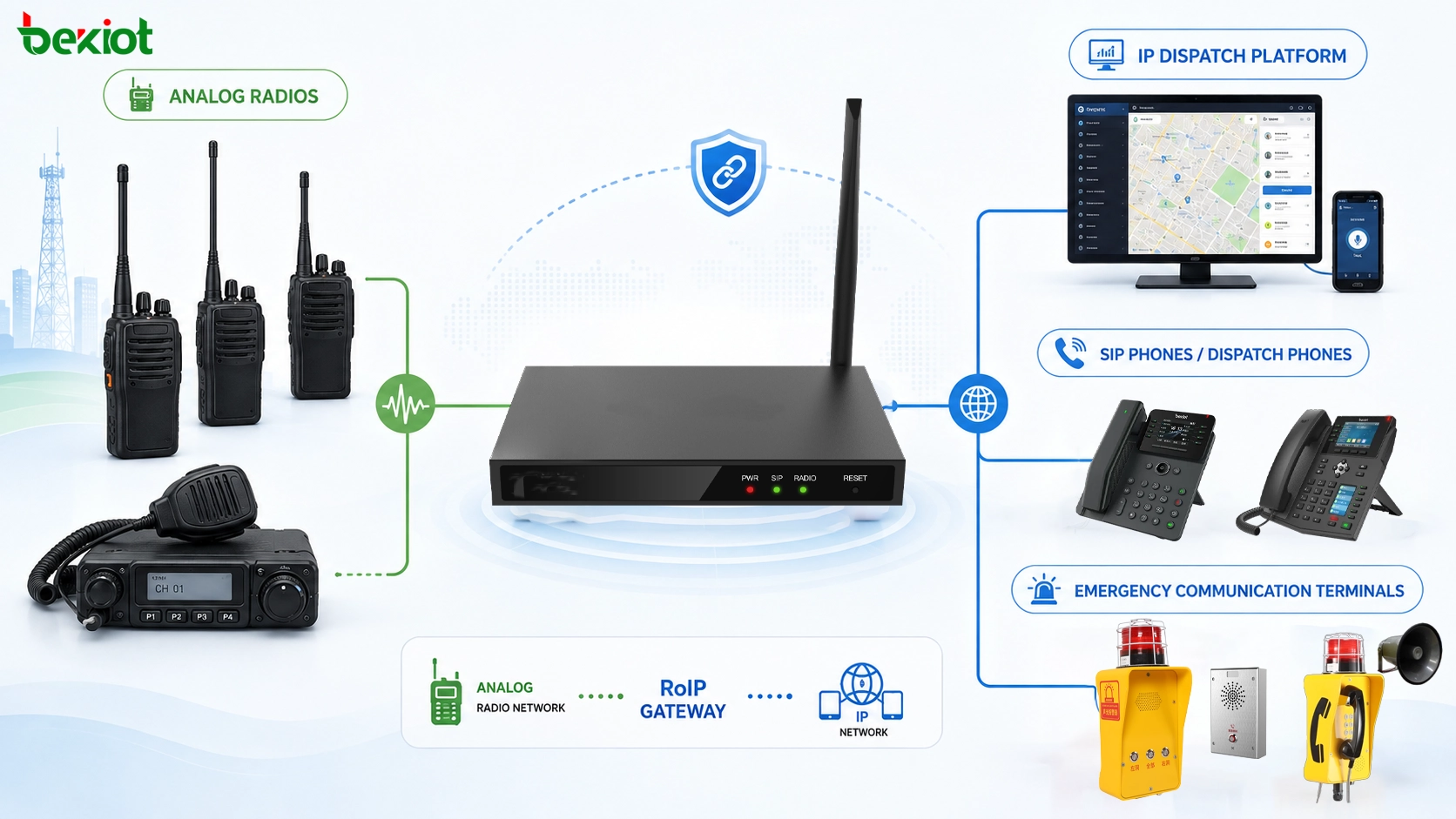
Many organizations do not need to choose only one side. A practical solution is to build a hybrid communication architecture. Analog radios can remain in use for field teams that need simple and fast communication. Digital radios can be deployed for departments that need structured management. RoIP gateways can connect radio channels into IP networks. SIP dispatch platforms can bridge radio voice, phones, intercoms, emergency terminals, and public address systems.
This approach is especially useful in industrial parks, construction sites, ports, mines, campuses, transportation hubs, and emergency command systems. Field workers can continue using familiar radios, while command centers gain centralized dispatch, recording, monitoring, and cross-system communication. Becke Telcom can be considered in projects that need RoIP gateway access, SIP dispatch, industrial telephony, and emergency communication integration without forcing field teams to abandon existing radio habits.
A hybrid solution also reduces migration pressure. Instead of replacing all analog radios immediately, organizations can connect existing radio channels to a dispatch system and upgrade gradually. This protects previous investment while creating a path toward modern unified communication.
Planning a Radio System for Real Operations
Before choosing analog, digital, or hybrid radio communication, project teams should define the real operating requirements. The first factor is coverage. A small site may only need direct radio-to-radio communication, while a larger facility may require repeaters, distributed antennas, or IP-linked radio gateways.
The second factor is user skill. If users are non-technical and the team changes frequently, simplicity becomes important. Analog radios or simplified digital profiles may reduce training time and operating mistakes. If the organization has trained administrators and strict communication procedures, digital systems may provide better long-term control.
The third factor is interoperability. If the site often cooperates with contractors, emergency teams, third-party service providers, or temporary staff, analog compatibility may remain valuable. If all users belong to one managed organization, digital systems can be standardized more easily.
The fourth factor is dispatch integration. A modern command center may need to connect radio channels with SIP phones, industrial phones, intercoms, alarm inputs, video systems, and broadcasting terminals. In this case, radio technology should not be evaluated alone. The full architecture should consider gateways, recording, group dispatch, emergency call handling, and platform integration.
Common Mistakes to Avoid
One common mistake is assuming that newer technology is always easier to use. Digital radio is newer and more powerful, but it is not always simpler for field users. If a team only needs immediate voice communication, too many configuration options may create unnecessary complexity.
Another mistake is ignoring emergency interoperability. A digital system may work perfectly inside one organization, but problems can appear when different teams need to communicate quickly. Backup analog channels, shared emergency frequencies, or gateway-based interconnection should be considered during planning.
A third mistake is focusing only on device price. The real cost includes programming, training, accessories, maintenance, repeaters, gateways, software, and future expansion. Analog radios may reduce entry cost, while digital systems may reduce management cost in larger organizations. The best choice depends on scale and workflow.
Recommended Solution Framework
A practical radio communication solution should begin with a site survey and user analysis. Project teams should identify where people work, how far they need to communicate, whether repeaters are required, how many groups are needed, what emergency procedures exist, and whether the system must connect to a dispatch center.
For simple field coordination, analog radios may be enough. They are easy to configure, quick to replace, and suitable for mixed-brand communication when frequency planning is clear. For managed enterprise communication, digital radios may provide better structure, security, user identity, and data capability.
For complex industrial or emergency environments, a hybrid approach is often the most balanced. Analog channels can provide fast and familiar field communication. Digital radio groups can support managed teams. RoIP gateways can connect radio traffic to IP dispatch. SIP systems can link radios with phones, intercoms, emergency call stations, and broadcast systems. This framework keeps field operation simple while giving the command center better control.
Conclusion
Analog walkie-talkies are still considered easier to use because they are simple, direct, low-latency, affordable, and highly practical in mixed field environments. If radios are set to the same frequency, communication can often begin quickly. Configuration is easier, maintenance cost is lower, and emergency interoperability is more straightforward.
Digital walkie-talkies provide advanced capabilities such as TDMA channel efficiency, group calls, private calls, messaging, GPS, remote management, encryption, and better system control. These functions are valuable for professional networks, but they also introduce more configuration requirements and compatibility risks when different devices or teams need to interoperate.
The best solution is not always to choose one technology and reject the other. For many organizations, the future is hybrid. Keep analog radios where simplicity and fast interoperability matter. Use digital systems where structured management and advanced features are needed. Connect both through gateways and dispatch platforms when command centers require centralized control, recording, and cross-system communication.
FAQ
Why do many users feel analog walkie-talkies are easier to use?
Analog walkie-talkies are easier for many users because the operating logic is simple. In many cases, radios only need to be set to the same frequency to communicate. They usually require fewer parameters than digital radios, making them more practical for non-professional users, temporary teams, and fast field deployment.
Are digital walkie-talkies better than analog radios?
Digital walkie-talkies are better for structured communication systems that need group management, user IDs, messaging, GPS, encryption, remote control, and better spectrum efficiency. Analog radios are often better for simple, low-cost, low-latency, mixed-brand, and temporary communication. The better choice depends on the application.
Why can digital radios fail to communicate even on the same frequency?
Digital radios may require matching parameters such as modulation standard, vocoder, color code, time slot, talk group ID, encryption setting, and system profile. If any key parameter is different, two radios may not communicate even when the frequency appears to be the same.
Do analog radios have lower latency?
Analog radios usually have very low voice delay because they transmit the processed voice signal directly through RF modulation. Digital radios need encoding, framing, modulation, decoding, and playback processing, so a small delay may occur. In some cases, speaking too quickly after pressing PTT may cause the first word to be clipped.
When should a hybrid radio solution be used?
A hybrid solution is suitable when a site wants to keep simple field radio communication while adding dispatch control, recording, SIP intercom, emergency phones, or public address linkage. It is useful for industrial parks, ports, mines, campuses, transportation hubs, construction sites, and emergency command centers.







