Miniaturized laser communication is becoming a practical option for high-capacity network deployment between buildings, towers, base stations, remote sites, and temporary communication nodes. For many years, laser communication was mainly discussed in satellite networks, aerospace systems, and advanced research projects. Today, the same optical transmission concept is moving toward terrestrial infrastructure, using compact terminals and highly focused light beams to move data through the air without relying on buried fiber or conventional radio spectrum.
The value of this technology is clear. When two locations can maintain a stable line of sight, laser communication can work like an invisible fiber link. Instead of digging roads, waiting for construction approval, or competing for limited RF spectrum, operators can install optical wireless terminals and quickly create a high-speed connection. This makes the technology useful for 5G backhaul, enterprise campus interconnection, emergency response, temporary event networks, industrial parks, disaster recovery, and resilient backup links.
Recent solutions, including the development direction represented by Taara, show that compact optical wireless communication is moving from technical demonstration to commercial deployment. With claimed capabilities such as 25Gbps full-duplex throughput, up to 10 kilometers of link distance under suitable conditions, mesh networking, and telecom-grade reliability targets such as 99.999% availability, miniaturized laser communication is becoming a serious tool for modern network planning.
Why Optical Wireless Links Are Becoming More Relevant
Modern digital infrastructure requires more bandwidth, lower latency, faster deployment, and stronger redundancy. Mobile operators are expanding 5G networks. Enterprises are connecting offices, warehouses, data rooms, security centers, and production facilities. Cities are deploying surveillance cameras, sensors, public safety systems, edge computing nodes, and smart transportation platforms. Industrial sites need stable connectivity for control rooms, substations, inspection points, access control, video monitoring, and emergency systems.
Fiber optic cable remains the preferred medium for many permanent high-capacity routes. However, fiber deployment can be slow and costly. A project may require trenching, road closure approval, right-of-way negotiation, building access coordination, and long installation cycles. In dense cities, mountains, islands, ports, mines, temporary sites, and disaster areas, these challenges can become even more difficult.
Radio-based wireless links can solve some deployment problems, but they may face spectrum congestion, licensing limits, interference, and security concerns. Optical wireless communication offers another path. It uses narrow beams of light instead of traditional RF channels, allowing high-capacity transmission without adding pressure to radio spectrum resources.
The strongest value of miniaturized laser communication is not that it replaces fiber or radio everywhere. Its value is that it adds another practical layer when fiber is unavailable, RF spectrum is limited, or rapid deployment is required.
How the Technology Works in Practical Networks
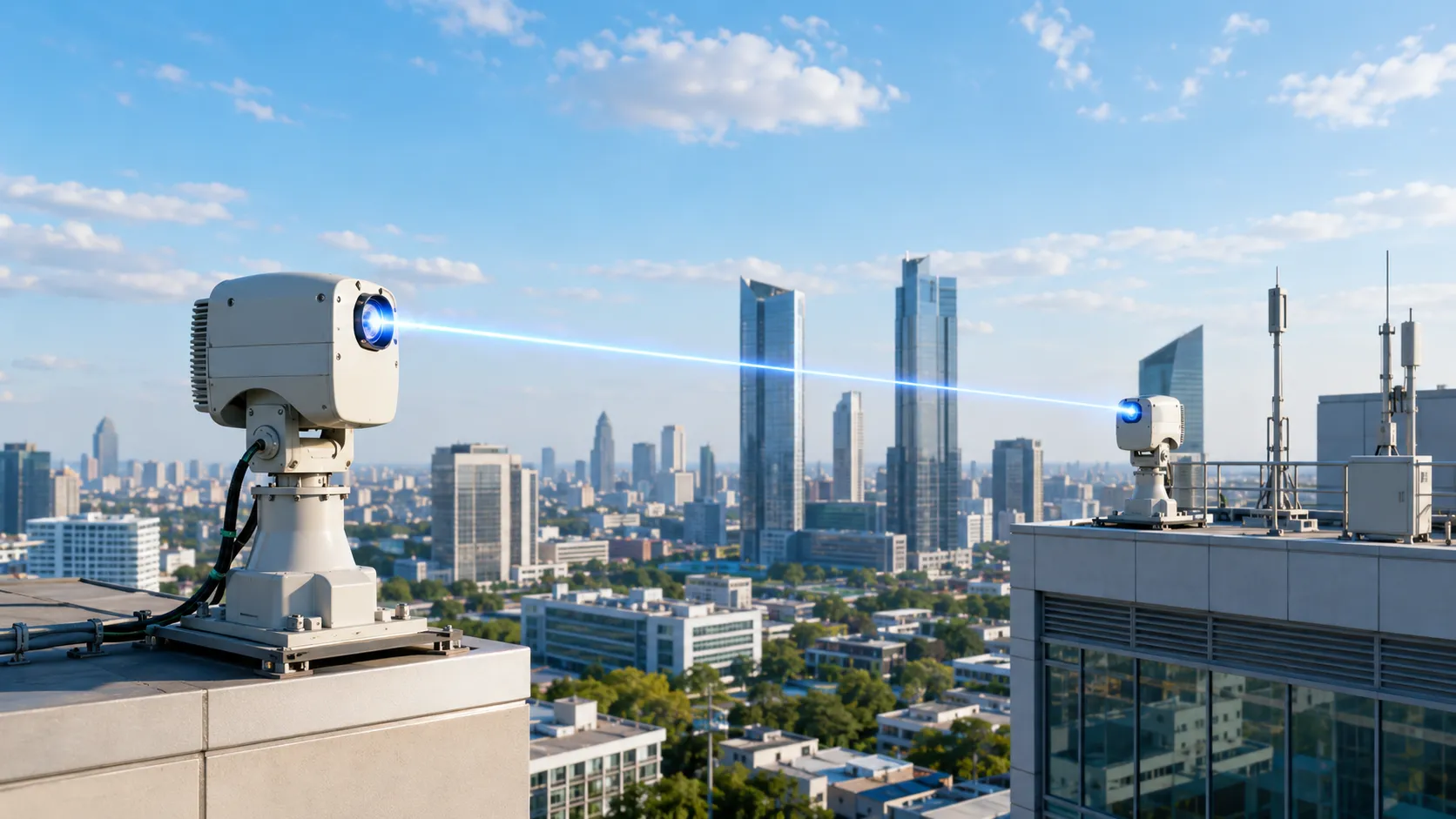
A laser communication system transmits data through a narrow optical beam. In many terrestrial systems, the beam uses near-infrared light, which is invisible to the human eye. Two optical terminals are installed at separate locations and precisely aligned with each other. Once the optical path is stable, the system can transmit data between the two points at very high speed.
Because the beam is narrow and directional, signal energy is concentrated along a specific path rather than broadcast widely in all directions. This helps improve transmission efficiency and reduces interference with nearby communication systems. It also means installation quality is critical. Stable mounting, accurate alignment, automatic tracking, environmental monitoring, and link management all affect long-term reliability.
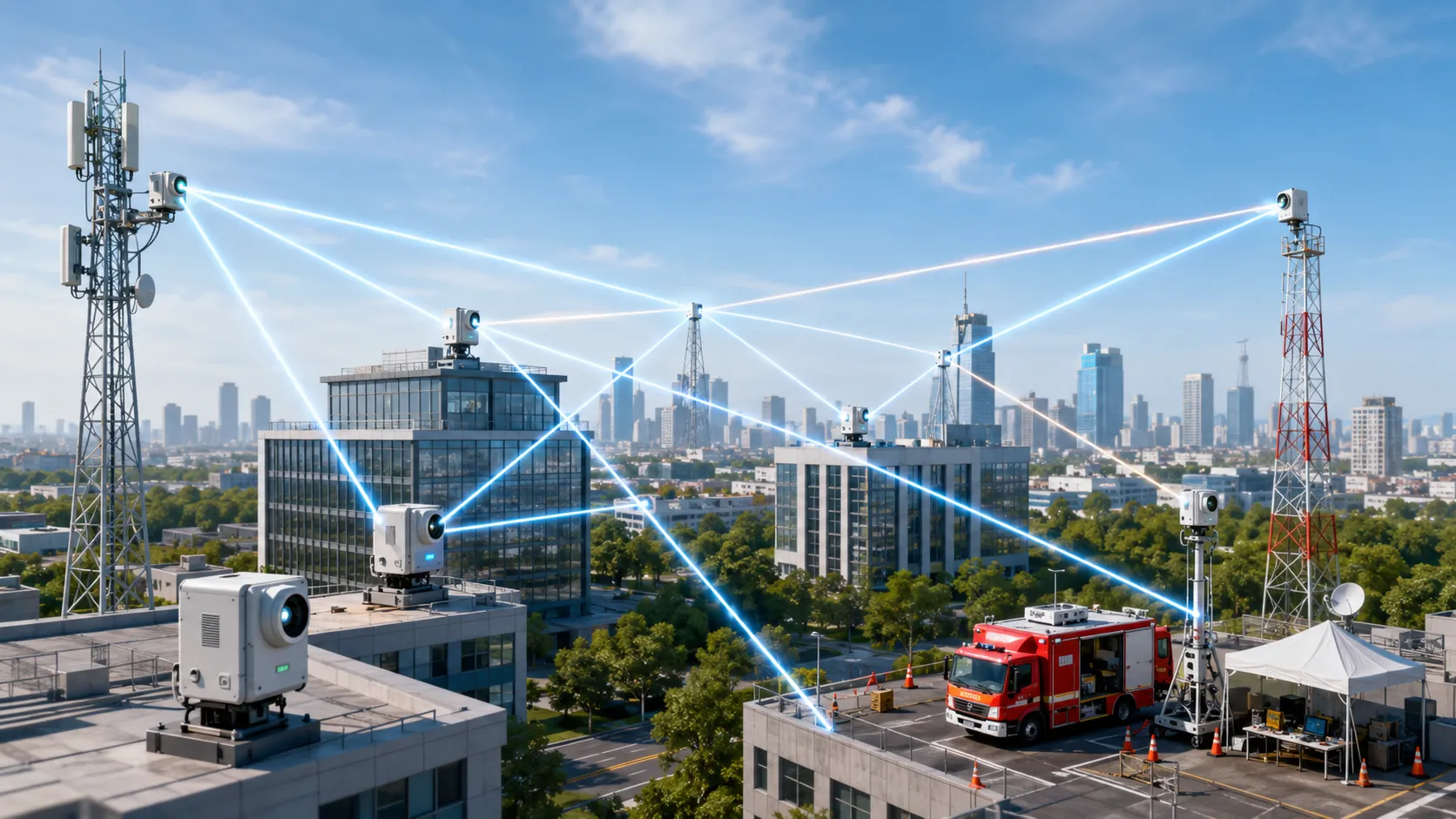
Compared with general wireless access technologies, optical wireless links behave more like fixed point-to-point infrastructure. They are suitable for known and stable routes such as rooftop-to-rooftop links, tower-to-base-station links, command-center-to-field-site links, and building-to-data-room connections. When multiple terminals are deployed together, the system can form a mesh network and route traffic through different paths.
From Satellite Links to Ground-Based Infrastructure
Laser communication has already proven its value in space-related applications. In satellite constellations, optical links can connect spacecraft and support high-speed data relay across long distances. Space is naturally suitable for laser links because there are fewer physical obstacles, no buildings, no trees, and less atmospheric disturbance compared with ground-level environments.
Terrestrial deployment is more complex. Buildings can block the optical path. Fog can scatter light. Heavy rain and snow can weaken the signal. Dust, smoke, vibration, tower movement, heat shimmer, and alignment drift can also affect performance. These factors explain why ground-based laser communication has taken longer to mature.
The progress now comes from miniaturization and smarter system design. New optical wireless terminals are becoming smaller, easier to install, and more suitable for telecom and enterprise environments. Better optical design, automatic alignment, real-time link monitoring, adaptive transmission control, and failover mechanisms make the technology more practical for commercial use.
Performance Factors Network Planners Should Review
For real projects, laser communication should not be evaluated only by headline speed. Network planners need to consider bandwidth, latency, distance, alignment tolerance, weather resistance, routing flexibility, power supply, installation complexity, monitoring capability, maintenance requirements, and integration with existing systems. A high-speed link is only valuable when it can operate reliably in its actual environment.
High Throughput for Backhaul Traffic
One of the most important performance claims associated with Taara Beam is up to 25Gbps full-duplex throughput. Full-duplex means high-speed transmission can occur in both directions at the same time. This is important for telecom backhaul, enterprise aggregation, cloud access, surveillance transmission, and data-intensive industrial applications.
A 25Gbps-class optical wireless link can support 5G base station backhaul, HD and 4K video traffic, edge computing data exchange, campus network interconnection, emergency command applications, and high-volume enterprise services. It can also serve as a temporary bridge while fiber construction is delayed or as an independent backup path when fiber routes are damaged.
Useful Distance for City and Regional Links
Another important figure is the potential link distance of up to 10 kilometers between two devices under suitable line-of-sight and environmental conditions. This range is long enough for many urban, suburban, campus, industrial, and infrastructure scenarios.
A city may use optical wireless links to connect buildings across a district. A carrier may connect a 5G site to an aggregation point. A port may connect control centers, warehouses, and security towers. A utility company may connect substations, monitoring points, and control facilities. The actual distance still depends on mounting height, visibility, weather, optical power, receiver sensitivity, link budget, and structural stability.
Mesh Networking for Flexible Routing
A single point-to-point optical link is useful, but a multi-node network can provide greater resilience. Mesh networking allows multiple optical terminals to connect with each other and route traffic through the most suitable path. If one path is blocked, weakened, or temporarily unavailable, traffic can move through another route.
This capability is valuable for smart cities, public safety networks, industrial parks, enterprise campuses, and emergency response scenarios. It allows organizations to build optical wireless infrastructure step by step instead of relying on one single route. It also reduces the risk that one link failure will interrupt the entire service.
Application Scenarios with Strong Commercial Value
5G Base Station Backhaul
5G networks require dense site deployment and high-capacity backhaul. In many cities, radio access sites can be installed faster than fiber routes can be completed. This creates a gap between bandwidth demand and transmission availability. Miniaturized laser communication can help close that gap by providing optical wireless backhaul between base stations, rooftops, towers, and aggregation nodes.
For mobile operators, the value is not only speed. Deployment flexibility is equally important. A laser link can support rapid activation when fiber trenching is difficult, when a site must go online quickly, or when temporary capacity is required. It can also support network densification by connecting small cells, temporary cells, and edge nodes where permanent fiber planning would slow down rollout.
Emergency Communication and Disaster Recovery
Emergency networks must be deployed quickly and remain operational under pressure. Natural disasters, construction accidents, cable cuts, power outages, and network congestion can damage or overload existing infrastructure. A high-capacity optical wireless link can help connect command centers, field headquarters, temporary base stations, emergency shelters, medical points, and surveillance locations.
The ability to deploy without excavation is valuable after disasters. Roads may be blocked, fiber routes may be damaged, and public networks may be overloaded. A compact laser communication system mounted on a vehicle, temporary mast, rooftop, or tower can provide a rapid transmission path for voice, video, GIS data, command platforms, and public safety coordination.
Enterprise Campus and Industrial Park Connectivity
Large enterprises often operate multiple buildings, warehouses, laboratories, control rooms, data rooms, and production facilities across one campus. Installing fiber between every building can be expensive or disruptive, especially when roads, production zones, leased property, or existing infrastructure are involved. Laser communication can provide a high-speed building-to-building connection with much less civil work.
Industrial parks, logistics centers, oil and gas facilities, mines, ports, and power plants can also benefit from this approach. These environments often need stable connectivity for video monitoring, access control, production management, dispatch platforms, sensors, and emergency communication. Optical wireless links can become part of a layered network architecture together with fiber, microwave, LTE/5G, Wi-Fi, private radio, and satellite communication.
Temporary Events and Rapid Network Expansion
Temporary events such as exhibitions, sports competitions, concerts, emergency drills, government activities, and large public gatherings often require short-term network capacity. Installing permanent fiber for a temporary requirement may not be practical. A compact optical wireless link can provide high-speed backhaul for temporary command centers, media zones, surveillance systems, ticketing platforms, Wi-Fi access, and on-site operations.
The same logic applies to construction sites, temporary offices, seasonal operations, exploration projects, and remote field activities. When a site needs high-speed connectivity for weeks or months rather than years, laser communication may be more efficient than waiting for permanent fiber construction.
Advantages Compared with Fiber and RF Systems
Miniaturized laser communication should be positioned as a complementary technology rather than a universal replacement. Fiber provides excellent long-term stability and capacity but requires physical cable deployment. RF wireless is flexible but may face spectrum, interference, and licensing limits. Laser communication provides high-capacity wireless optical transmission, but it requires clear line of sight and weather-aware design.
The first advantage is fast deployment. In suitable locations, optical terminals can be installed and aligned much faster than underground fiber. This can shorten project timelines and help operators activate services sooner.
The second advantage is spectrum independence. Because optical wireless communication uses light beams rather than traditional radio frequency channels, it can avoid some spectrum congestion and licensing pressure. This is especially useful in dense urban areas, telecom backhaul projects, and high-demand enterprise networks.
The third advantage is physical directionality. A narrow optical beam is harder to intercept casually than a wide-area radio signal. This does not remove the need for encryption and cybersecurity, but it provides an additional physical layer of control.
The fourth advantage is flexible redundancy. A laser link can back up a fiber route, and a fiber or radio link can back up a laser route. In advanced designs, optical wireless, microwave, fiber, and carrier networks can work together as a resilient multi-path system.
Deployment Conditions That Must Be Checked
Line-of-Sight Availability
The first requirement is line of sight. The optical path between two terminals must be clear. Buildings, trees, mountains, cranes, temporary structures, vehicles, and moving equipment can interrupt the beam. Before installation, engineers should perform a site survey, check mounting height, evaluate future obstruction risks, and confirm that both ends can maintain a stable optical path.
Weather and Atmospheric Conditions
Weather is one of the most important limitations. Fog can scatter optical signals. Heavy rain and snow can reduce signal strength. Dust, smoke, pollution, and atmospheric turbulence can also affect performance. This does not mean laser communication cannot be used, but it means the system must be designed with environmental margin and redundancy.
For regions with frequent fog, sandstorms, heavy snow, or long rainy seasons, laser communication should be evaluated carefully. It may still be useful as part of a hybrid architecture, but depending on the required availability, backup links may be necessary.
Mounting Stability and Alignment
Laser communication requires precise pointing. If a terminal is installed on an unstable pole, a vibrating tower, or a weak bracket, the link may become less reliable. Professional mounting, stable structures, automatic alignment, and regular inspection are important for long-term performance.
Network Integration
A laser link is only one part of the network. It must connect to routers, switches, firewalls, power systems, monitoring platforms, and management tools. Network engineers should plan VLANs, routing policies, QoS, redundancy protocols, security controls, monitoring alarms, and failover behavior before deployment.
Reliability and Failover Strategy
For telecom and enterprise networks, speed alone is not enough. Reliability is equally important. Taara’s Lightbridge Pro has been promoted with a 99.999% reliability target. To approach this level in the real world, the system must handle environmental changes, temporary blockage, equipment faults, routing problems, and network congestion.
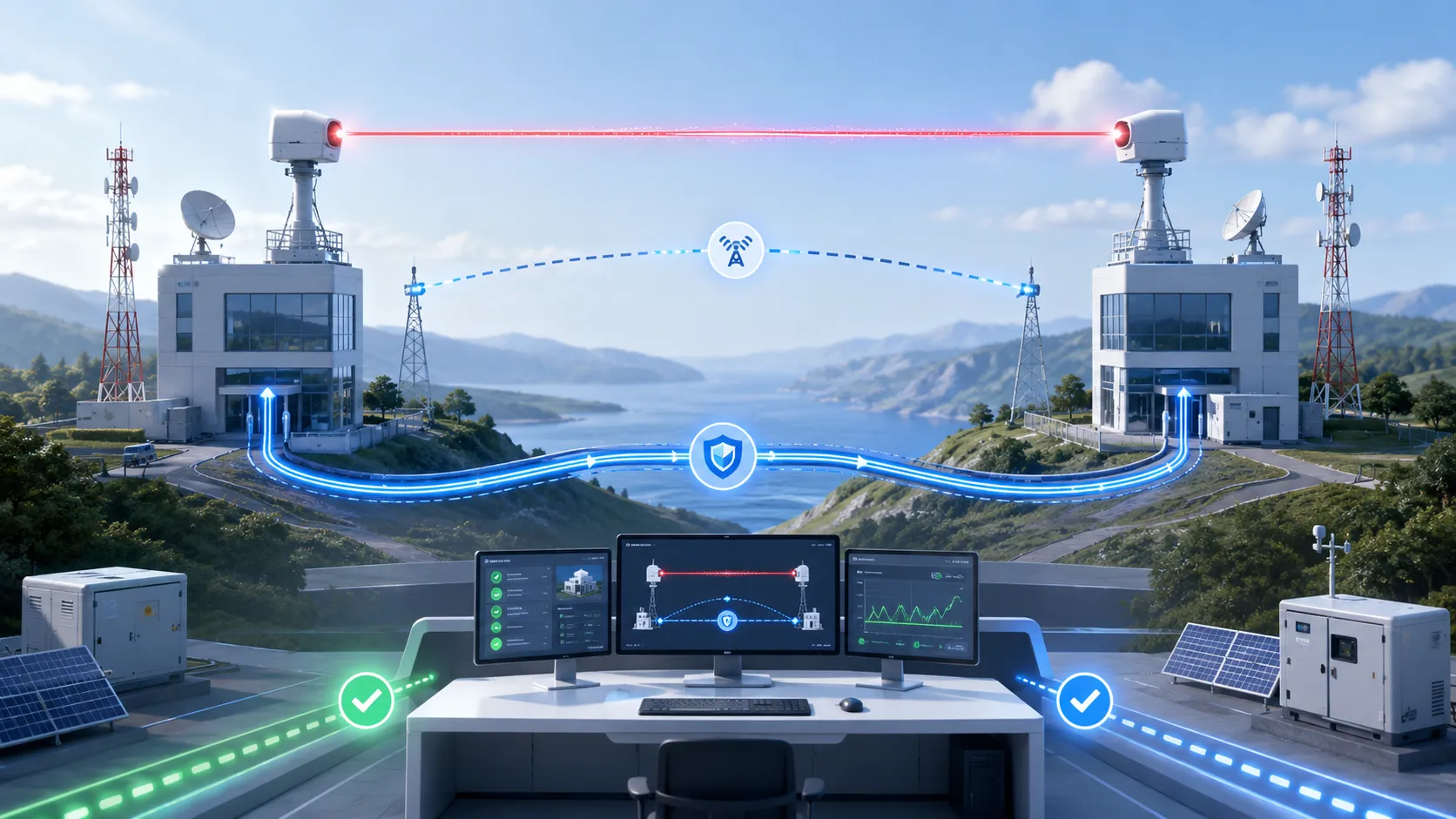
One important method is lossless or near-lossless switching. When the optical link becomes weak due to weather or obstruction, traffic can move to another path, such as microwave, fiber, or an alternate optical route. This avoids a single point of failure and helps keep critical services online.
A strong failover strategy should include real-time link quality monitoring, automatic route selection, alarm reporting, bandwidth management, and traffic priority control. Emergency voice, command video, public safety traffic, and industrial control data may need higher priority than general internet traffic. The network should be designed so that important services remain available even when the primary path becomes unstable.
Security Considerations for Optical Wireless Links
Laser communication has a natural physical security advantage because the beam is narrow and directional. It is not broadcast across a wide area like many RF systems. However, this advantage should not be confused with complete security. Any link carrying IP traffic still needs proper cybersecurity protection.
Recommended security practices include encryption, access control, secure management interfaces, network segmentation, strong authentication, firmware management, device hardening, and continuous monitoring. For telecom, government, finance, healthcare, public safety, and industrial environments, security should be designed from the beginning of the project rather than added after deployment.
Operation and Maintenance Requirements
A miniaturized laser communication system may be easier to install than traditional large optical transmission equipment, but it still requires professional operation. Maintenance teams should periodically inspect mounting brackets, optical windows, power supply, grounding, weatherproofing, cable connections, device logs, and management alarms.
Because optical links depend on a clear transmission path, cleaning and environmental inspection can be important in dusty, coastal, industrial, or polluted environments. If the optical window is covered by dust, salt, ice, oil mist, or other material, link performance may decline. Preventive maintenance helps maintain stability.
Network teams should also monitor throughput, packet loss, latency, link margin, failover events, and environmental alerts. These indicators can help identify early problems before users experience service interruption. For critical networks, maintenance procedures should be documented and included in the overall network operation plan.
Commercial Outlook for Optical Wireless Infrastructure
The future of miniaturized laser communication depends on cost, field reliability, installation simplicity, and proven performance across different environments. The technology has strong potential, but wide adoption requires confidence from telecom operators, enterprises, public safety agencies, and industrial users.
Taara is not yet as widely known as the largest telecom equipment brands, but its connection with Alphabet gives the project strong technical and commercial backing. The broader idea is attractive: use the air as a high-speed optical medium and make network deployment faster, more flexible, and less dependent on civil construction.
If equipment becomes smaller, more affordable, and easier to align, laser communication may become a common part of carrier and enterprise networks. It may not replace underground fiber, but it can become a powerful tool for middle-mile and last-mile connectivity, temporary deployment, redundant links, smart city networking, and emergency infrastructure.
Conclusion
Miniaturized laser communication is moving from a futuristic idea toward a practical network solution. With 25Gbps-class full-duplex throughput, link distances up to 10 kilometers, mesh routing, and resilient failover design, optical wireless links can solve many real-world connectivity challenges.
The strongest value of the technology is not that it replaces every existing medium. Its value is that it gives network planners another powerful option. When fiber is too slow to deploy, RF spectrum is limited, temporary capacity is needed, or a backup path is required, laser communication can provide a fast, high-capacity, and flexible connection.
As commercial deployment experience grows, miniaturized laser communication may become an important part of 5G backhaul, emergency communication, enterprise networking, smart city infrastructure, industrial communication, and critical network redundancy. For organizations planning future-ready connectivity, it is a technology worth serious attention.
FAQ
What is miniaturized laser communication?
Miniaturized laser communication is a compact optical wireless transmission technology that uses focused laser or near-infrared light beams to send data between two fixed points. It works through the air instead of underground fiber, making it useful for rapid deployment between buildings, towers, base stations, temporary sites, and remote network nodes.
Can laser communication replace fiber optic networks?
Laser communication is better understood as a complement to fiber rather than a full replacement. Fiber remains the best choice for many permanent high-capacity routes. However, laser communication can be very useful where fiber is too expensive, too slow to deploy, physically difficult to install, or needed as a redundant backup path.
What are the main limitations of laser communication?
The main limitations are line-of-sight requirements, weather sensitivity, mounting stability, and alignment accuracy. Buildings, trees, terrain, cranes, or temporary structures can block the optical path. Fog, heavy rain, snow, dust, and atmospheric turbulence may also reduce signal quality, so professional site planning and backup links are important.
Where is this technology most useful?
It is most useful for 5G backhaul, building-to-building links, enterprise campus networks, emergency communication, temporary event networks, industrial parks, smart city infrastructure, disaster recovery, and network redundancy. It is especially valuable when high bandwidth is needed quickly and fiber construction is difficult or delayed.