A telephony gateway is a communication device or system that connects different voice networks and converts calls between different signaling methods, media formats, line interfaces, or transport technologies. It allows traditional telephone systems, analog phones, PBX platforms, PSTN lines, ISDN trunks, SIP servers, VoIP networks, mobile gateways, and enterprise communication platforms to work together.
In many organizations, voice communication does not exist in one single format. A company may still use analog lines, digital trunks, legacy PBX equipment, SIP phones, cloud calling services, fax devices, paging systems, and emergency phones at the same time. A gateway helps these systems exchange calls without requiring every device to be replaced immediately.
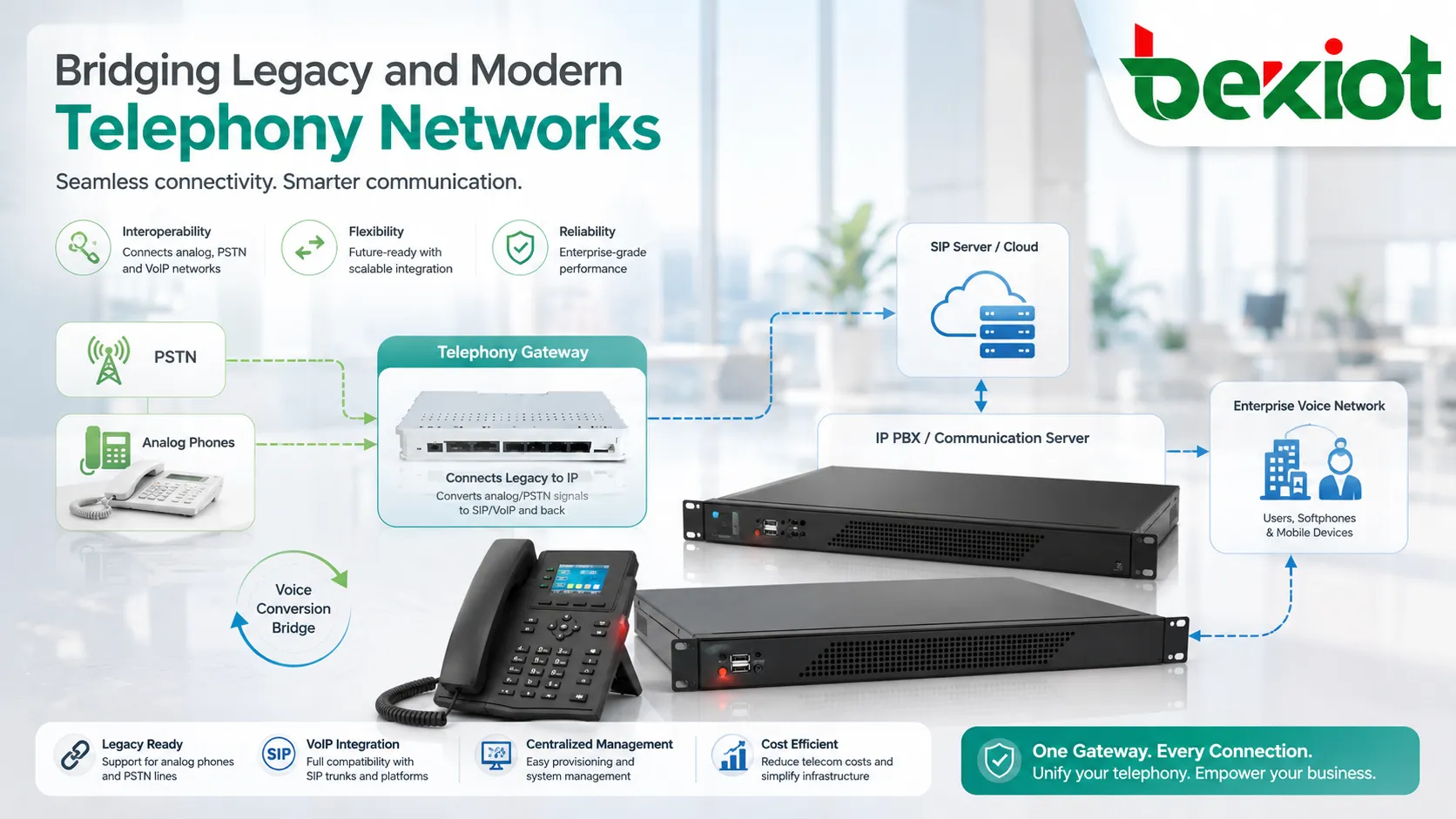
The Bridge Between Old and New Voice Networks
Traditional telephone systems were built around circuit-switched voice. Calls were carried through analog copper lines, E1/T1 digital trunks, ISDN PRI, or carrier exchange networks. Modern enterprise communication increasingly uses SIP, VoIP, IP PBX, cloud telephony, unified communications, and IP-based dispatch systems.
The challenge is that many organizations cannot move everything to IP at once. They may have existing phone numbers, analog emergency devices, fax machines, elevator phones, hotel room phones, alarm dialers, paging interfaces, or PBX investments that still need to operate. A gateway provides a controlled migration path between these environments.
Instead of forcing a full replacement, the gateway translates between the legacy side and the IP side. It can help preserve existing lines, protect older equipment, connect remote branches, support SIP trunking, and extend voice services across different network types.
How the Conversion Process Works
Signaling Translation
Every call needs signaling. Signaling tells the system who is calling, which number was dialed, whether the destination is ringing, when the call is answered, and when the call ends. Different networks use different signaling methods.
A gateway may translate analog loop start, FXO, FXS, ISDN PRI, E1/T1, SS7-related interfaces, GSM signaling, or other telephony signaling into SIP signaling for an IP PBX or VoIP platform. This allows calls to be set up correctly across dissimilar systems.
Media Conversion
After the call is established, the voice audio must be carried between endpoints. Traditional systems may use analog electrical signals or digital circuit channels, while IP systems usually use RTP voice packets over the network.
The gateway converts the media path so that the voice can pass between these formats. It may also handle codec negotiation, echo cancellation, gain adjustment, packetization, DTMF conversion, and jitter buffering depending on the application.
Number Processing
Phone numbers may need formatting before they can be routed correctly. A user may dial a short extension, a local number, an international number, or a trunk access prefix. The gateway can modify digits, add prefixes, remove access codes, normalize numbers, or route calls according to dial plans.
This is especially important when connecting legacy PBX systems with SIP trunks or when routing calls between multiple sites that use different numbering plans.
Route Selection
A gateway may decide which path a call should take. Local calls may go to PSTN lines, long-distance calls may go through SIP trunks, emergency calls may use a dedicated route, and backup calls may move to another trunk if the main connection fails.
Routing rules help organizations control cost, improve reliability, and keep important calls available during network or carrier issues.
Common Interface Types
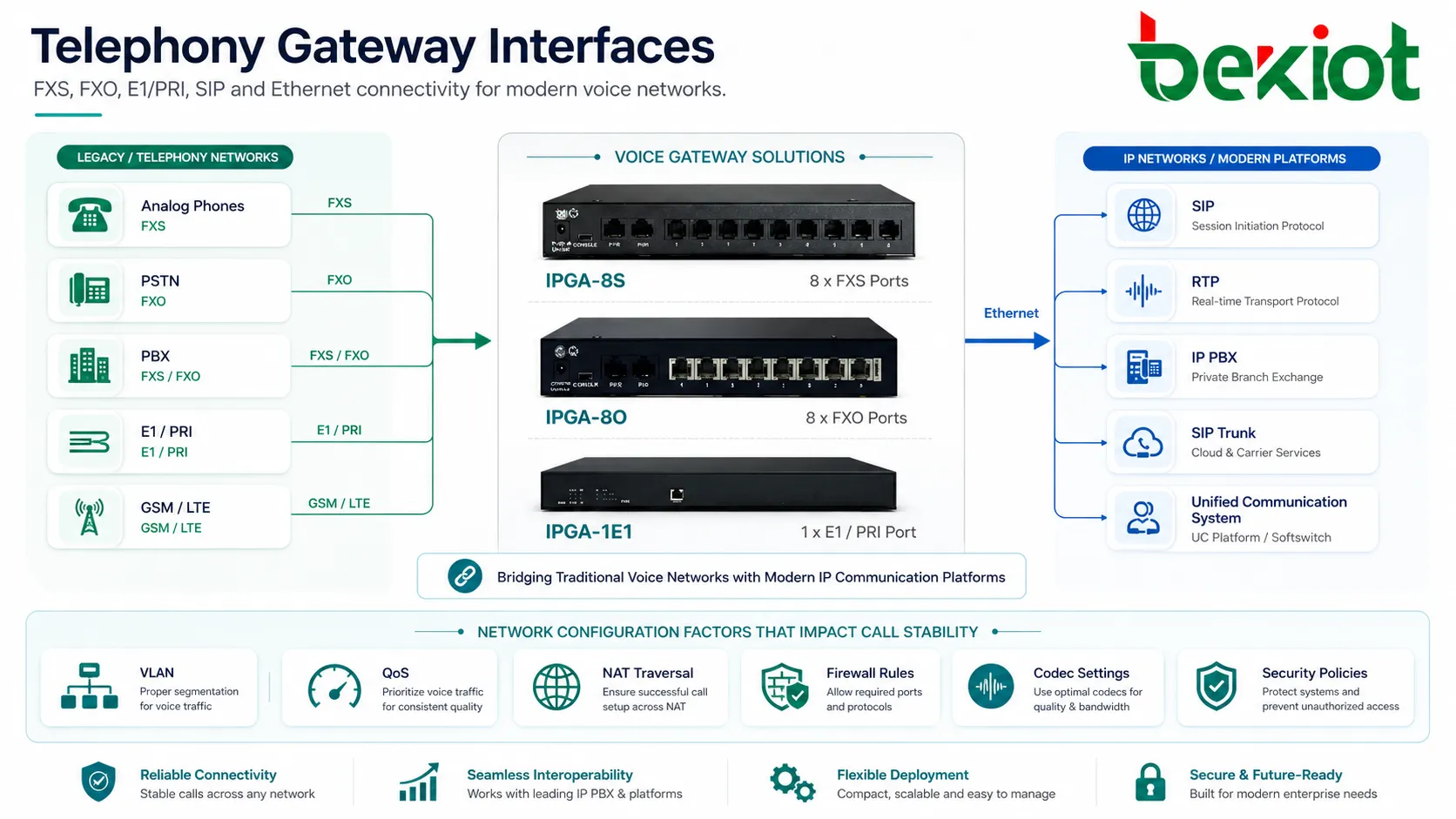
FXS Ports
FXS ports provide analog telephone service to endpoint devices such as analog phones, fax machines, elevator phones, emergency phones, or modems. The port supplies dial tone, ringing voltage, and line power to the connected device.
FXS gateways are useful when older analog endpoints need to connect to an IP PBX or SIP platform. They allow organizations to keep certain analog devices while modernizing the core phone system.
FXO Ports
FXO ports connect to analog telephone lines from the public telephone network or a legacy PBX. They behave like analog phone devices from the line’s point of view and allow calls to enter or leave through PSTN lines.
FXO gateways are often used when organizations want to connect existing analog trunks to a VoIP platform or keep PSTN lines as backup routes.
E1/T1 and PRI Interfaces
Digital trunk gateways connect PBX systems, carrier circuits, and IP telephony platforms through E1, T1, or PRI interfaces. These gateways are common in enterprise migration projects where a legacy PBX or carrier digital trunk must be connected to SIP infrastructure.
PRI gateways can carry many simultaneous calls and support caller ID, direct inward dialing, outbound number presentation, and structured call control depending on the carrier and PBX configuration.
GSM and LTE Interfaces
Mobile gateways connect enterprise phone systems with cellular networks. They may be used for mobile route backup, remote sites, temporary deployments, or locations where wired telephony access is limited.
Mobile gateways require careful SIM management, carrier policy review, signal quality testing, and call cost planning.
SIP and IP Network Ports
On the IP side, gateways usually connect through Ethernet and communicate using SIP, RTP, and related protocols. They register to an IP PBX, connect to a SIP trunk provider, or operate as part of a unified communication system.
Network configuration matters. VLANs, QoS, NAT traversal, firewall rules, codec settings, and security policies can all affect call stability.
Important Features to Evaluate
Protocol Compatibility
A gateway must support the protocols and interfaces required by the existing and target systems. For VoIP projects, SIP compatibility is especially important. The gateway should work correctly with the IP PBX, SIP server, SBC, SIP trunk provider, or unified communication platform.
Compatibility should be tested with real call scenarios, including inbound calls, outbound calls, transfer, hold, DTMF, fax, caller ID, emergency calls, and failover routes.
Voice Quality Control
Voice quality depends on codec selection, echo cancellation, gain control, packet timing, jitter buffer, network stability, and line condition. A gateway should provide stable audio conversion between legacy and IP networks.
For analog lines, impedance matching and echo control are important. For SIP calls, packet loss, jitter, latency, and codec mismatch must be controlled.
Dial Plan Management
Dial plan rules define how numbers are processed and routed. A gateway may add digits, remove prefixes, block certain numbers, route emergency calls, select trunks, or normalize numbers into a standard format.
A clear dial plan reduces call routing errors and makes future maintenance easier. Poor number processing is one of the most common causes of gateway deployment problems.
Failover and Backup Routing
Some gateways support backup routes when a trunk, carrier, network, or server becomes unavailable. Calls can be routed through another SIP trunk, analog line, mobile network, or local PBX path.
This is valuable for businesses that need voice continuity during network outages, carrier failures, or PBX maintenance windows.
Management and Monitoring
Modern gateways often include web management, remote configuration, status dashboards, call logs, alarm reporting, SNMP, syslog, firmware upgrade tools, and provisioning options.
Monitoring helps administrators detect trunk faults, registration failures, line problems, high call failure rates, packet loss, or abnormal traffic before users report major issues.
| Feature Area | What It Controls | Why It Matters |
|---|---|---|
| Signaling | Call setup, routing, caller ID, status, and disconnect behavior. | Ensures calls are established and released correctly. |
| Media | Voice codec, RTP stream, echo cancellation, gain, and packet timing. | Determines call clarity and audio stability. |
| Dial Plan | Number formatting, prefix rules, route selection, and restrictions. | Prevents misdialing and supports organized call routing. |
| Security | Authentication, firewall policy, access control, TLS, SRTP, and SIP protection. | Reduces toll fraud, unauthorized access, and signaling attacks. |
| Monitoring | Line state, trunk status, call logs, alarms, and performance indicators. | Supports maintenance, troubleshooting, and service continuity. |
Business Value in Migration Projects
One of the biggest values of a gateway is gradual migration. Many organizations want the flexibility of IP telephony but still need to keep existing PSTN lines, analog devices, digital trunks, or older PBX equipment. A gateway allows both worlds to operate during the transition.
This reduces risk because users can be migrated in stages. Critical services such as emergency phones, fax lines, alarm dialers, elevator phones, and reception lines can be tested carefully before being moved fully to IP.
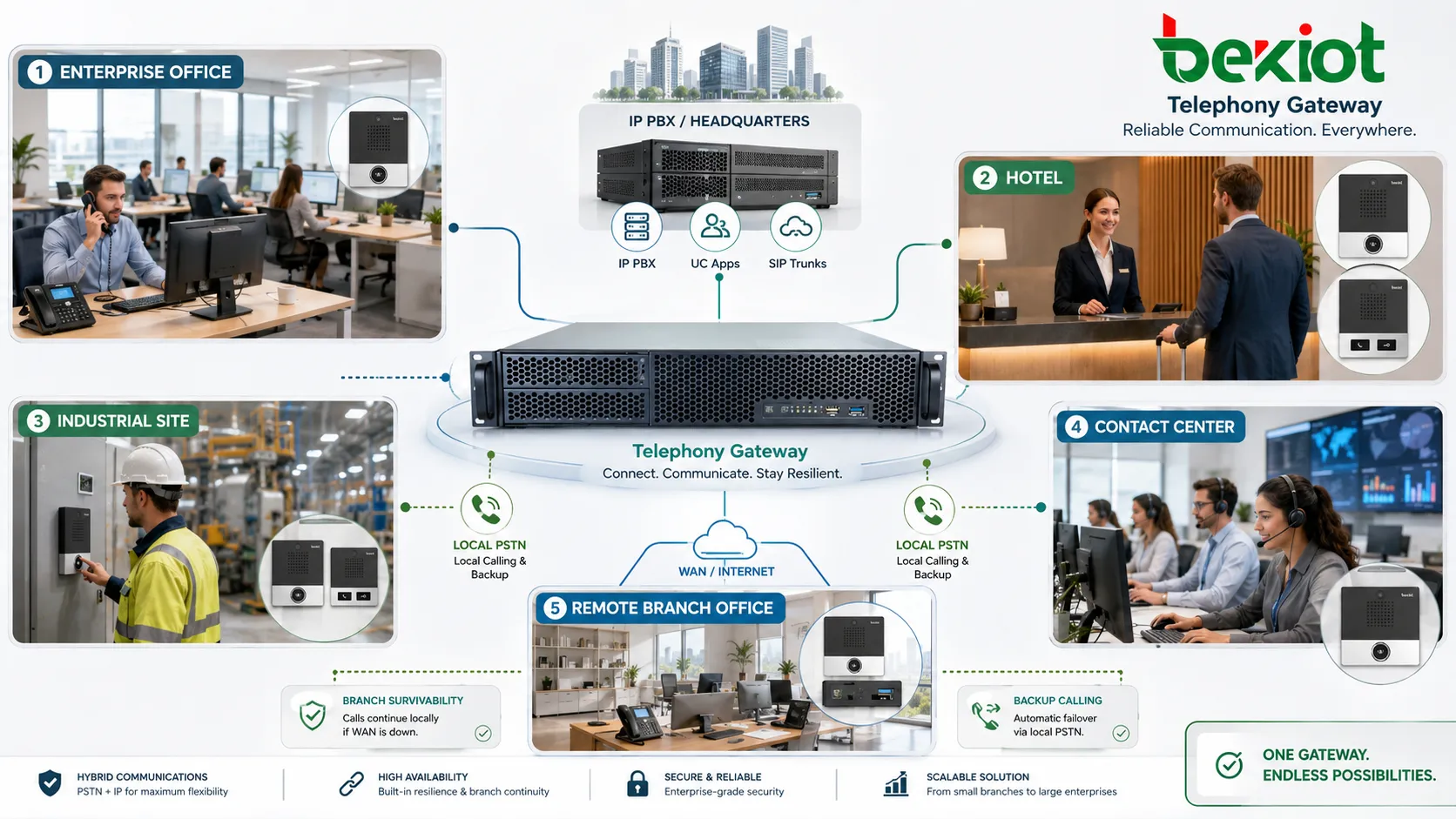
In enterprise and industrial deployments, Becke Telcom IPGA series gateways can be considered for projects that need to connect analog phones, PSTN lines, SIP platforms, IP PBX systems, and multi-site voice networks. The IPGA gateway layer helps bridge existing telephony resources with modern IP communication architecture while keeping routing, conversion, and management more centralized.
Applications in Different Environments
Enterprise Office Communication
Businesses use gateways to connect IP PBX systems with PSTN lines, legacy PBX equipment, analog extensions, fax devices, and SIP trunks. This helps companies modernize voice communication without replacing every device at once.
Office deployments often focus on cost control, number preservation, call routing, caller ID handling, and stable daily calling.
Hotels and Hospitality Systems
Hotels may still use analog room phones, front desk systems, back-office phones, emergency phones, and PMS-integrated PBX platforms. A gateway can connect these services to IP-based voice infrastructure.
This allows hotels to modernize core telephony while continuing to support guest room phones and legacy service workflows.
Industrial and Utility Sites
Factories, power plants, refineries, mines, ports, and transportation facilities may use gateways to connect emergency phones, analog field devices, paging systems, control room phones, and SIP dispatch platforms.
These environments often require rugged operation, stable routing, backup paths, and integration with safety communication systems.
Contact Centers and Service Teams
Contact centers may use gateways to connect SIP platforms with traditional trunks, PSTN backup lines, fax services, or legacy PBX systems. This supports inbound and outbound call handling during migration or hybrid operation.
Gateway routing can also help separate campaigns, carriers, backup routes, and regional number plans.
Remote Branch and Multi-Site Networks
Branches may need local PSTN access while still connecting to a central IP PBX or headquarters communication platform. A gateway can provide local breakout, backup calling, and branch survivability.
This is useful when wide-area network links are unstable or when local emergency calling requirements must be preserved.
Design Factors Before Deployment
Call Capacity
The gateway must support the expected number of simultaneous calls. A small analog gateway may only support a few channels, while a digital trunk gateway may support many concurrent calls.
Capacity should be planned according to peak call volume, branch size, trunk type, emergency call requirements, and future growth.
Numbering Plan
Before installation, administrators should define how internal extensions, public numbers, emergency numbers, fax numbers, DID numbers, and outbound caller IDs will be handled.
A poorly planned numbering structure can create routing conflicts, wrong caller ID display, failed inbound calls, or difficult troubleshooting later.
Network Readiness
For SIP and VoIP connections, the IP network must support real-time voice. Switches, routers, firewalls, VLANs, QoS, NAT rules, and WAN bandwidth should be reviewed before deployment.
Voice may use less bandwidth than video, but it is sensitive to delay, jitter, and packet loss. A weak network can make a good gateway perform poorly.
Security Policy
Gateways connect different networks, so security should be taken seriously. Administrators should protect management access, disable unused services, use strong passwords, restrict source IP addresses, update firmware, and monitor abnormal call attempts.
SIP-facing gateways should also be protected against scanning, registration attacks, toll fraud, and unauthorized routing attempts.
Legacy Device Behavior
Analog and legacy devices may have special requirements. Fax machines, alarm panels, elevator phones, modems, and old PBX cards may depend on specific tones, voltage, impedance, timing, or DTMF behavior.
These devices should be tested individually. Passing a normal voice call does not automatically prove that fax or alarm dialing will work reliably.
A gateway project succeeds when legacy behavior, IP routing, voice quality, security, and operational maintenance are planned as one complete call path.
Common Problems and Troubleshooting
No Dial Tone on Analog Ports
If an analog endpoint has no dial tone, check the port type, cable connection, FXS configuration, phone compatibility, power status, and whether the port is enabled. FXS and FXO ports are different and should not be confused.
Also confirm that the analog phone or device works on another known-good port.
Inbound Calls Fail
Inbound failure may be caused by wrong trunk settings, number format mismatch, SIP registration failure, PRI signaling issue, FXO line fault, firewall blocking, or incorrect inbound route rules.
Check call logs and signaling traces to see whether the call reaches the gateway and how it is routed afterward.
One-Way Audio
One-way audio often points to RTP path problems, NAT configuration, firewall rules, codec negotiation, or incorrect network routing. SIP signaling may succeed while media packets fail in one direction.
Packet capture and RTP port review are useful for diagnosing this issue.
Echo or Low Audio Volume
Echo and volume problems may occur on analog lines due to impedance mismatch, gain settings, line quality, hybrid conversion, or acoustic feedback. Adjusting echo cancellation and gain levels may help.
For IP calls, also check codec settings, endpoint volume, and network packet quality.
DTMF Does Not Work
DTMF issues can affect IVR menus, voicemail access, door release, conferencing, and automated systems. The problem may be caused by mismatched DTMF mode, codec compression, SIP INFO settings, RFC 2833 behavior, or in-band tone distortion.
Test DTMF across every expected call route, especially between analog devices and SIP trunks.
Best Practices for Implementation
Start with a call flow map. Identify every trunk, extension, analog device, SIP server, PBX route, emergency number, fax line, and backup path that the gateway must support.
Use clear port labeling. Physical ports, cables, lines, and route names should be documented so maintenance teams can troubleshoot quickly.
Test in stages. Verify analog ports, SIP registration, inbound calls, outbound calls, caller ID, DTMF, fax, transfer, emergency routing, and failover before going live.
Secure the system early. Change default credentials, limit management access, restrict SIP sources, disable unused ports, and review logs during pilot operation.
Keep configuration backups. A gateway may hold critical dial plans and routing rules. Backups make replacement and disaster recovery easier.
Maintenance and Lifecycle Management
Gateways should be monitored like other critical communication infrastructure. Administrators should review line status, registration state, call failure rates, abnormal traffic, firmware versions, CPU load, channel usage, and alarm logs.
Firmware updates should be planned and tested. Updates may improve security and compatibility, but they should not be applied blindly during business hours without backup and rollback planning.
As the organization migrates more services to IP, some gateway ports or routes may become unnecessary. Old rules should be removed to reduce complexity and security exposure.
FAQ
Can one gateway connect both analog phones and SIP trunks?
Some models support multiple interface types, while others are designed for a specific role such as FXS, FXO, PRI, or SIP trunk conversion. The required interfaces should be confirmed before selection.
Why does fax sometimes fail through a voice gateway?
Fax is sensitive to packet loss, codec compression, timing, and tone handling. T.38 support, G.711 passthrough, network quality, and provider compatibility should be tested before relying on fax over IP.
Is a gateway still needed after moving to cloud telephony?
It may still be needed if the organization must keep analog devices, local PSTN lines, elevator phones, fax machines, alarm dialers, or legacy PBX connections during or after migration.
What is the difference between a gateway and an SBC?
A gateway mainly converts between different telephony interfaces or networks. An SBC focuses on securing, controlling, and managing SIP sessions at network borders. Some systems may include overlapping functions.
What should be checked before replacing an old gateway?
Check port types, call capacity, dial plans, caller ID rules, emergency routing, fax requirements, alarm lines, analog device behavior, SIP trunk settings, configuration backups, and current firmware compatibility.