


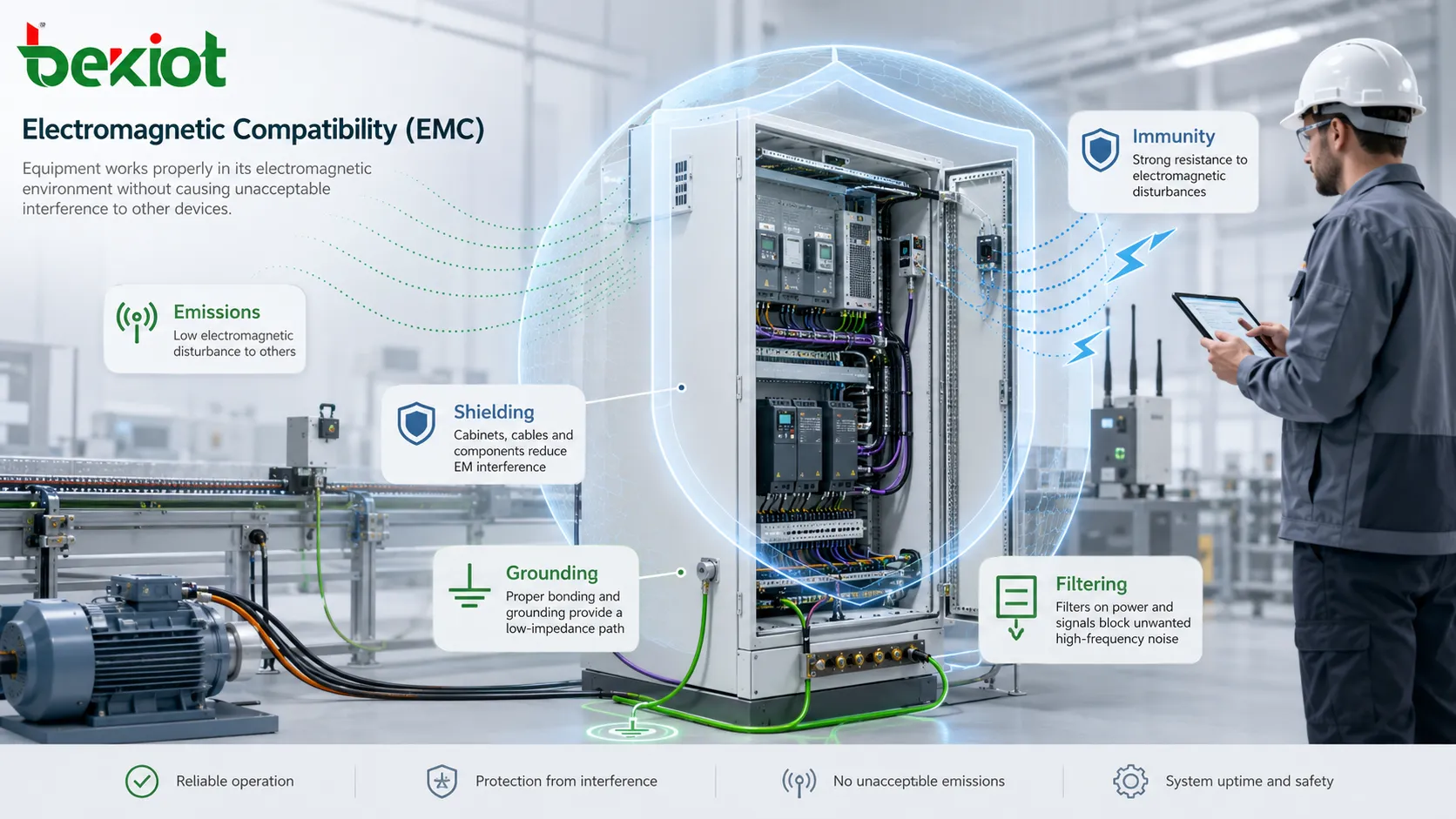
Electromagnetic Compatibility, commonly abbreviated as EMC, is the ability of electrical and electronic equipment to operate properly in its electromagnetic environment without causing unacceptable interference to other equipment. It is a key requirement for products, systems, installations, and facilities that contain circuits, cables, processors, power supplies, sensors, motors, radios, communication interfaces, or control electronics.
In practical terms, EMC has two sides. A device should not emit too much electromagnetic disturbance, and it should also withstand reasonable electromagnetic disturbances from its surroundings. This balance helps equipment work safely and reliably in homes, offices, factories, vehicles, hospitals, transportation systems, telecom rooms, energy facilities, laboratories, and public infrastructure.
Compatibility Is a Two-Way Requirement
Many people think electromagnetic problems only happen when one device interferes with another. That is only half of the story. A product can fail EMC expectations in two ways: it can generate excessive electromagnetic noise, or it can be too sensitive to noise produced by nearby equipment.
For example, a switching power supply may inject noise into the power line. A motor drive may disturb sensor signals. A radio transmitter may affect poorly protected electronics. A poorly designed digital circuit may radiate energy through attached cables. At the same time, a weakly protected device may reset, freeze, lose communication, or show false readings when exposed to normal field disturbances.
EMC therefore requires system thinking. Engineers must control the source of interference, the path it travels through, and the equipment that receives it. A good design does not rely on one single measure. It combines circuit layout, filtering, shielding, grounding, bonding, cable routing, enclosure design, surge protection, software recovery, and compliance testing.
How Disturbance Moves Through a System
Conducted Paths
Conducted disturbance travels through physical conductors. Power lines, signal wires, grounding conductors, data cables, control wiring, shield connections, and chassis connections can all carry unwanted noise from one part of a system to another.
This is common in industrial cabinets, building systems, telecom racks, machinery lines, and power distribution networks. A noisy power supply or motor drive may affect a controller through shared wiring even if the devices are not physically close.
Radiated Paths
Radiated disturbance travels through space as electromagnetic fields. Cables, circuit board traces, enclosure openings, antennas, and high-speed switching nodes can unintentionally radiate energy. Nearby devices or cables may then receive that energy.
Radiated effects are especially important in products with fast digital circuits, wireless modules, switching converters, long cables, unshielded enclosures, or operation near radio transmitters.
Coupling Through Ground and Return Paths
Grounding is not automatically noise-free. When high-current circuits and sensitive circuits share return paths, unwanted voltage differences can appear. This can create hum in audio systems, communication errors in data systems, and unstable readings in sensors.
Proper bonding, low-impedance return paths, separated noisy and sensitive circuits, and correct shield termination help reduce these problems. Poor grounding can make interference worse rather than better.
What Engineers Usually Test
Emissions
Emission testing checks whether a product sends out too much electromagnetic disturbance. This may include conducted emissions on power lines and radiated emissions from enclosures, cables, ports, and internal circuits.
The goal is to prevent one product from disturbing radio services, nearby electronics, communication links, measurement equipment, or other devices in the same environment. Emission control is especially important for devices with clocks, processors, switching power supplies, wireless modules, inverters, and high-speed interfaces.
Immunity
Immunity testing checks whether a product continues to operate acceptably when exposed to defined electromagnetic disturbances. These disturbances may include electrostatic discharge, surge, electrical fast transients, voltage dips, radiated RF fields, conducted RF, magnetic fields, and power frequency disturbances.
During immunity testing, the expected behavior depends on the product function and performance criteria. Some products must continue operating without visible change. Others may show temporary degradation but recover automatically. Safety-critical systems usually require stricter expectations.
Power Quality Effects
Power supply disturbances can affect EMC performance. Voltage dips, interruptions, harmonics, flicker, transients, and surges can disturb equipment or cause equipment to disturb the power network.
Products connected to public or industrial power systems may need to consider both their tolerance to power disturbances and their effect on the power supply environment.
Standards and Regulatory Frameworks
IEC 61000 Series
The IEC 61000 family is one of the most important EMC standard frameworks. It includes basic standards, generic standards, test methods, environment descriptions, emission limits, immunity test procedures, and guidance for applying EMC requirements to electrical and electronic equipment.
Different parts of this series are used for different purposes. Some define how to perform a specific test, while others define requirements for equipment used in residential, commercial, light industrial, or industrial environments.
CISPR Publications
CISPR standards are widely used for radio disturbance and emission requirements. They help define how interference should be measured and what limits may apply to different types of equipment.
These standards are commonly relevant for multimedia equipment, information technology products, lighting devices, household appliances, industrial/scientific/medical equipment, vehicles, and many electronic devices that may generate radio-frequency disturbance.
FCC Part 15
For the United States, FCC Part 15 is a major regulatory framework for radio-frequency devices. It includes requirements for intentional, unintentional, and incidental radiators and is highly relevant to many electronic products before they are marketed in the U.S.
Products containing digital circuits, radio modules, processors, switching electronics, or high-speed interfaces may fall under specific authorization and technical requirements. The exact path depends on the device type and intended use.
European EMC Directive
For the European market, the EMC Directive 2014/30/EU applies to many types of electrical and electronic equipment. It aims to ensure equipment does not generate excessive electromagnetic disturbance and has an adequate level of immunity for its intended use.
Manufacturers typically use applicable harmonized EN standards to demonstrate conformity. The chosen standards should match the product category, environment, and function.
Industry-Specific Requirements
Some industries require additional EMC rules beyond general commercial requirements. Automotive, railway, aerospace, medical, military, marine, power utility, and industrial automation systems may use specialized standards because their operating environments are more demanding or safety-critical.
For these products, ordinary office-level EMC testing may not be enough. The system may need to withstand stronger fields, higher surge levels, traction power disturbances, radio transmitters, or harsh industrial noise.
| Standard Area | Main Focus | Common Application |
|---|---|---|
| IEC 61000 | Basic EMC methods, generic requirements, emissions, immunity, and test guidance. | Electrical equipment, industrial systems, control devices, commercial electronics. |
| CISPR | Radio disturbance measurement and emission limits for product categories. | Multimedia equipment, appliances, lighting, ISM devices, digital electronics. |
| FCC Part 15 | U.S. requirements for radio-frequency devices and unintentional radiators. | Digital devices, wireless products, consumer electronics, business equipment. |
| EN Harmonized Standards | European conformity support under applicable directives. | CE-marked electrical and electronic equipment. |
| Sector Standards | Special EMC conditions for high-risk or harsh environments. | Automotive, railway, medical, military, power, marine, and aerospace systems. |
Design Methods That Improve Compatibility
PCB Layout Control
Good EMC performance often begins on the printed circuit board. High-speed traces, switching loops, clock lines, DC-DC converters, grounding planes, decoupling capacitors, and return current paths all influence emissions and immunity.
Short current loops, solid reference planes, proper decoupling, controlled impedance, careful partitioning of noisy and sensitive circuits, and correct connector placement can reduce many problems before enclosure-level fixes are needed.
Filtering at Power and Signal Ports
Filters reduce unwanted conducted noise entering or leaving the product. Power entry filters, common-mode chokes, ferrite beads, LC filters, RC snubbers, feedthrough capacitors, and transient suppression components are common tools.
Filter placement matters. A well-selected filter may perform poorly if placed too far from the entry point or if its grounding path is long and noisy.
Shielding and Enclosure Bonding
Shielding limits radiated coupling. Metal enclosures, conductive coatings, cable shields, shielded connectors, gaskets, and bonded panels can reduce electromagnetic leakage.
Effective shielding requires continuity. Gaps, seams, plastic windows, unbonded doors, poorly connected cable screens, and painted contact surfaces can reduce shielding effectiveness.
Grounding and Equipotential Bonding
Grounding provides a reference and safety connection, while bonding reduces voltage differences between conductive parts. Together, they help control unwanted current paths and support shield performance.
The correct grounding strategy depends on product type, installation environment, frequency range, safety requirements, and cable structure. A grounding method that works for low-frequency safety may not solve high-frequency interference unless bonding impedance is also controlled.
Cable Routing and Separation
Cables can act as both transmitters and receivers of interference. Sensitive signal cables should be routed away from high-current power cables, motor cables, relay wiring, inverter outputs, and switching power paths.
Twisted pairs, shielded cables, proper connector grounding, cable trays, physical separation, and avoiding long parallel runs can all improve system compatibility.
EMC design is most successful when it is built into the circuit, enclosure, cabling, grounding, and installation plan instead of being treated as a last-minute test problem.
Where Compatibility Matters Most
Industrial Automation
Factories often contain motors, drives, PLCs, sensors, robots, power supplies, relays, and communication networks in the same cabinet or production line. Without EMC planning, noise from one system can affect another.
Industrial compatibility measures include shielded motor cables, separated wiring ducts, cabinet bonding, filtered power supplies, surge protection, and immunity testing for control devices.
Telecommunications and Data Networks
Telecom and networking equipment must maintain stable data, voice, timing, and signaling performance. Disturbances can cause packet loss, port errors, audio noise, timing problems, or equipment resets.
EMC planning in telecom environments may involve rack bonding, clean power distribution, shielded cabling where appropriate, surge protection, grounding design, and equipment compliance verification.
Medical and Laboratory Equipment
Medical and laboratory devices often handle low-level signals, measurements, alarms, or patient-related information. Interference can affect accuracy, safety, and confidence in results.
These environments require careful product selection, cable routing, separation from strong RF sources, and compliance with applicable medical or laboratory EMC requirements.
Transportation and Railway Systems
Transportation systems may include traction power, signaling, communication, surveillance, passenger information, ticketing, lighting, and control electronics. High-power equipment and long cable runs can create complex electromagnetic environments.
EMC design helps prevent control faults, communication errors, false alarms, and equipment malfunction in railways, metros, airports, ports, tunnels, and vehicle systems.
Building Safety and Security Systems
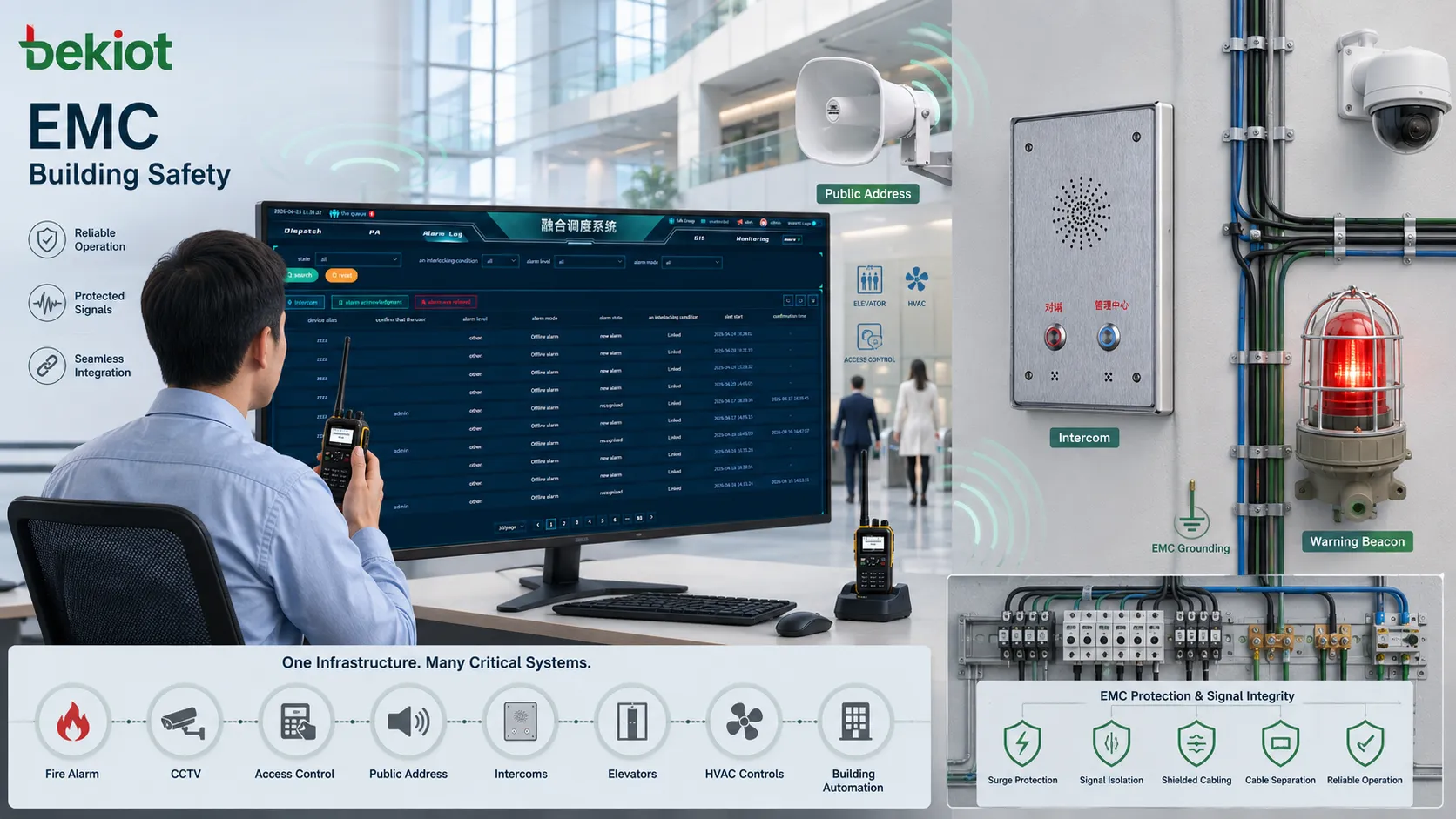
Fire alarms, access control, CCTV, public address, intercoms, elevators, HVAC controls, and building automation systems often share infrastructure. Poor compatibility may cause false triggers, audio hum, video noise, communication failure, or control instability.
Proper grounding, cable separation, surge protection, and tested equipment selection help maintain reliability in large buildings and public facilities.
Product Development and Test Planning
Risk Review
EMC planning should begin early with a review of likely noise sources, sensitive circuits, cable exits, operating modes, enclosure materials, grounding strategy, and target markets. This helps identify which tests and design measures may be needed.
A product with a wireless module, motor driver, switching power supply, metal enclosure, long cables, and external ports will have a different risk profile from a simple battery-powered device.
Pre-Compliance Checks
Pre-compliance testing helps engineers find issues before formal laboratory testing. Near-field probes, spectrum analyzers, LISNs, ESD generators, surge testers, and temporary shielding methods may be used during development.
This stage can save time because PCB layout, cable placement, grounding, and filter changes are easier before the product design is frozen.
Formal Laboratory Testing
Formal EMC testing follows the applicable standard and defined setup. The product is tested in specified operating modes with controlled cable arrangements, loads, ports, and test levels.
The test report should identify the standards used, operating conditions, sample configuration, test limits, performance criteria, and results. Without these details, a simple “EMC passed” claim is incomplete.
Installation Verification
Some EMC risks appear only after installation. A product may pass laboratory tests but still experience problems because of poor grounding, nearby high-power equipment, long cable routes, or unsuitable installation practices.
For complex systems, site verification should check wiring separation, bonding, shield termination, cabinet layout, surge protection, power quality, and equipment operating behavior under real conditions.
Common Symptoms of Poor Compatibility
Unstable Communication
Communication errors may appear as dropped packets, failed calls, network port errors, lost control signals, serial communication faults, or intermittent device disconnection. These problems may become worse when motors start, radios transmit, or equipment switches loads.
Time correlation is a useful clue. If failures occur at the same moment as switching events, EMC investigation is needed.
False Alarms or False Inputs
Control systems may register false button presses, sensor alarms, door events, safety inputs, or relay signals when noise couples into wiring. Long unshielded cables and high-impedance inputs are common weak points.
Filtering, shielded cable, debounce logic, correct grounding, and route separation can reduce false triggering.
Audio, Video, and Display Disturbance
Audio systems may produce hum, buzz, or clicking. Video systems may show lines, flicker, or dropouts. Displays may flicker or reset. These symptoms often point to grounding, shielding, filtering, or power quality issues.
Changing the cable path, grounding method, power source, or nearby equipment state can help isolate the cause.
Unexpected Resets
Devices may restart when exposed to electrostatic discharge, surge, voltage dips, relay switching, or nearby high-current events. This may indicate weak power design, poor transient protection, insufficient decoupling, or firmware recovery gaps.
Resets in safety or communication systems should be treated seriously because they may affect system availability.
Procurement and Specification Tips
When purchasing equipment, buyers should ask for the relevant EMC standards, test reports, target market compliance, operating environment, supported installation requirements, and any limitations. A generic compliance label may not be enough for harsh or safety-related environments.
Specifications should define where the equipment will be used. Residential, commercial, light industrial, heavy industrial, railway, marine, medical, and power environments may require different EMC expectations.
For system projects, compatibility should be specified not only at the product level but also at the installation level. Cable routing, grounding, surge protection, cabinet layout, and bonding should be included in project design and acceptance checks.
Maintenance and Long-Term Reliability
EMC performance can change over time. A shield may be disconnected during repair. A cabinet door gasket may become damaged. A grounding screw may loosen. A power supply may be replaced with a lower-quality unit. A new motor drive may be installed near sensitive wiring.
Maintenance teams should inspect bonding points, cable shields, ferrites, filters, surge protection devices, enclosure panels, connector grounding, and cable routes during periodic service. After major system changes, compatibility risk should be reviewed again.
Long-term reliability depends on keeping the original EMC design intact. Many field problems happen after small changes gradually weaken shielding, grounding, filtering, or cable separation.
FAQ
Is EMC testing required for every electronic product?
Requirements depend on the product type, target market, and applicable regulations. Many electronic products need some form of EMC evaluation before they can be legally marketed, but the exact standard and process vary.
Can one EMC certificate cover every country?
Not always. Some standards are internationally aligned, but regulatory acceptance, labeling, documentation, and test requirements may differ by market. Manufacturers should check each target region.
Why can a device pass testing but fail in a factory?
The factory environment may include stronger disturbances, poor grounding, long cables, nearby drives, welding equipment, or installation practices that were not present in the laboratory test setup.
Does a metal enclosure guarantee good EMC performance?
No. The enclosure must be properly bonded, continuous, and integrated with cable shield termination, connector design, grounding, and filter placement. Gaps and poor bonding can reduce effectiveness.
What should be checked after modifying a control cabinet?
Review cable routing, shield termination, grounding, bonding, filter placement, surge protection, power supply quality, enclosure continuity, and whether noisy and sensitive wiring were accidentally placed together.







